Effects of C/O Ratio and Temperature on Sooting Limits of Spherical Diffusion Flames V.R. Lecoustre, 1  P.B. Sunderland, 1  B.H. Chao, 2   D.L. Urban, 3  D.P. Stocker, 3  R.L. Axelbaum 4 1  University of Maryland, College Park, MD, USA 2  University of Hawaii, Honolulu, HI, USA 3  NASA Glenn Research Center, Cleveland, OH, USA 4  Washington University, St. Louis, MO, USA Supported by NASA AIAA 2008-0827 January 9, 2008
Inverse Normal  C2H4  air C2H4/N2  O2 d=29.3 mm d=18.8 mm air  C2H4 O2  C2H4/N2 d=24.7 mm d=31.3 mm Z st  = 0.064 Z st  = 0.78
Sooting limits. All images from end of 2 s drop test. 18% C 2 H 4     27% O 2 18% C 2 H 4     28% O 2 Flame 5 O 2     12% C 2 H 4 O 2     13% C 2 H 4 Flame 17
Correlation of measured sooting limits. T ad  >>  T peak  owing to radiation. Model needed to evaluate local  T , local C/O, local  χ  .
Background C/O ratio is about 0.6 for C 2 H 4  premixed flames at sooting limits (Glassman, 1988).  The minimum soot formation  T  in diffusion flames is 1250 – 1650 K (Glassman, 1998). Short  t res  can prevent soot formation. 17 sooting limit spherical C 2 H 4  microgravity flames were identified by Sunderland et al. (2004). These flames have a local critical C/O of about 0.6. Microgravity allows control over convection direction and residence time.
Objectives Investigate sooting limits of microgravity C 2 H 4  diffusion flames, emphasizing: local C/O atom ratio, local  T , and local scalar dissipation rate,  χ  . This numerical investigation uses detailed chemistry and transport to elucidate past experiments.
Sooting limit flames blue=min yellow=max For all flames  HRR  is 71 W and sooting limit occurs at 2 s. 1814 2670 0.249 0.692 1 0.13 Fuel 17 1729 2578 0.279 0.666 0.8 0.12 Fuel 16 1802 2539 0.148 0.509 0.5 0.15 Fuel 15 1736 2370 0.122 0.336 0.3 0.19 Fuel 14 1689 2274 0.119 0.277 0.25 0.21 Fuel 13 1515 1814 0.086 0.066 0.13 0.6 Fuel 12 1549 1835 0.072 0.051 0.13 0.8 Fuel 11 1581 1847 0.059 0.041 0.13 1 Fuel 10 2262 2740 0.024 0.661 1 0.15 Oxidizer 9 2057 2528 0.044 0.685 0.8 0.11 Oxidizer 8 1795 2381 0.11 0.586 0.5 0.11 Oxidizer 7 1593 2308 0.33 0.353 0.29 0.17 Oxidizer 6 1592 2306 0.351 0.333 0.28 0.18 Oxidizer 5 1498 2238 0.665 0.225 0.23 0.25 Oxidizer 4 1479 2226 0.91 0.18 0.21 0.31 Oxidizer 3 1492 2326 1.63 0.102 0.21 0.6 Oxidizer 2 1545 2390 2.72 0.065 0.22 1 Oxidizer 1 T f   2s K T ad ,  K t res , s Z st X O2,0 X C2H4,0 Ambient Flame
Numerical methods Sandia PREMIX code, modified for steady and transient spherical diffusion flames. GRI Mech. 3.0 (53 species, 325 reactions), detailed transport properties. Species and heat diffusivities incremented 30% to match experiments. Discrete ordinates radiation model (HITRAN, 25  cm -1 ). Ignition via steady solution for small domain (1.2 cm) with adiabatic boundaries (Tse et al., 2001). Transient computation over extended domain (100 cm) with radiation.
Temporal evolution Flame 10 (O 2 /N 2     C 2 H 4 ). Radiative loss fraction is 0.28. All flames were unsteady at 2 s.
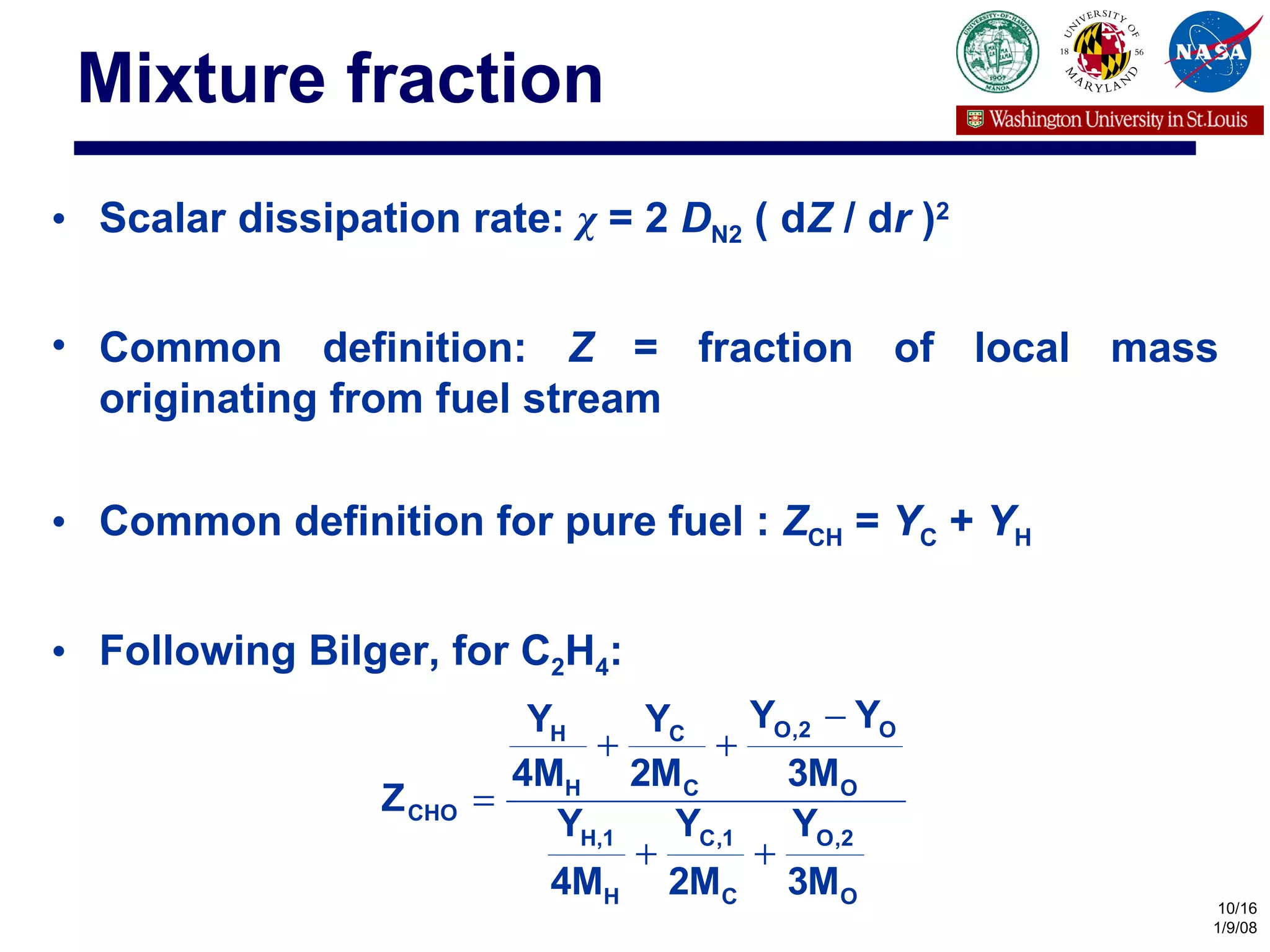
Mixture fraction Scalar dissipation rate:  χ  = 2  D N2  ( d Z  / d r  ) 2   Common definition:  Z  = fraction of local mass originating from fuel stream Common definition for pure fuel :  Z CH  =  Y C  +  Y H Following Bilger, for C 2 H 4 :
Mixture fraction (Flame 10)
Flame structure (Flame 10) Results shown at 2 s at sooting limit. Peak  χ  = 0.2 s -1 . Highest gradients are inside flame. A large radiating region is outside flame. C/O > 0.51 only where T < 1400 K.
Critical local C/O ratio For various C/O ratios, local  T  was found for each flame. Flames 7-9 had the highest  χ  and were excluded here. Local  T  standard deviation is minimum at C/O = 0.51. Agrees with C/O = 0.6 in premixed flames and gas jet flames.
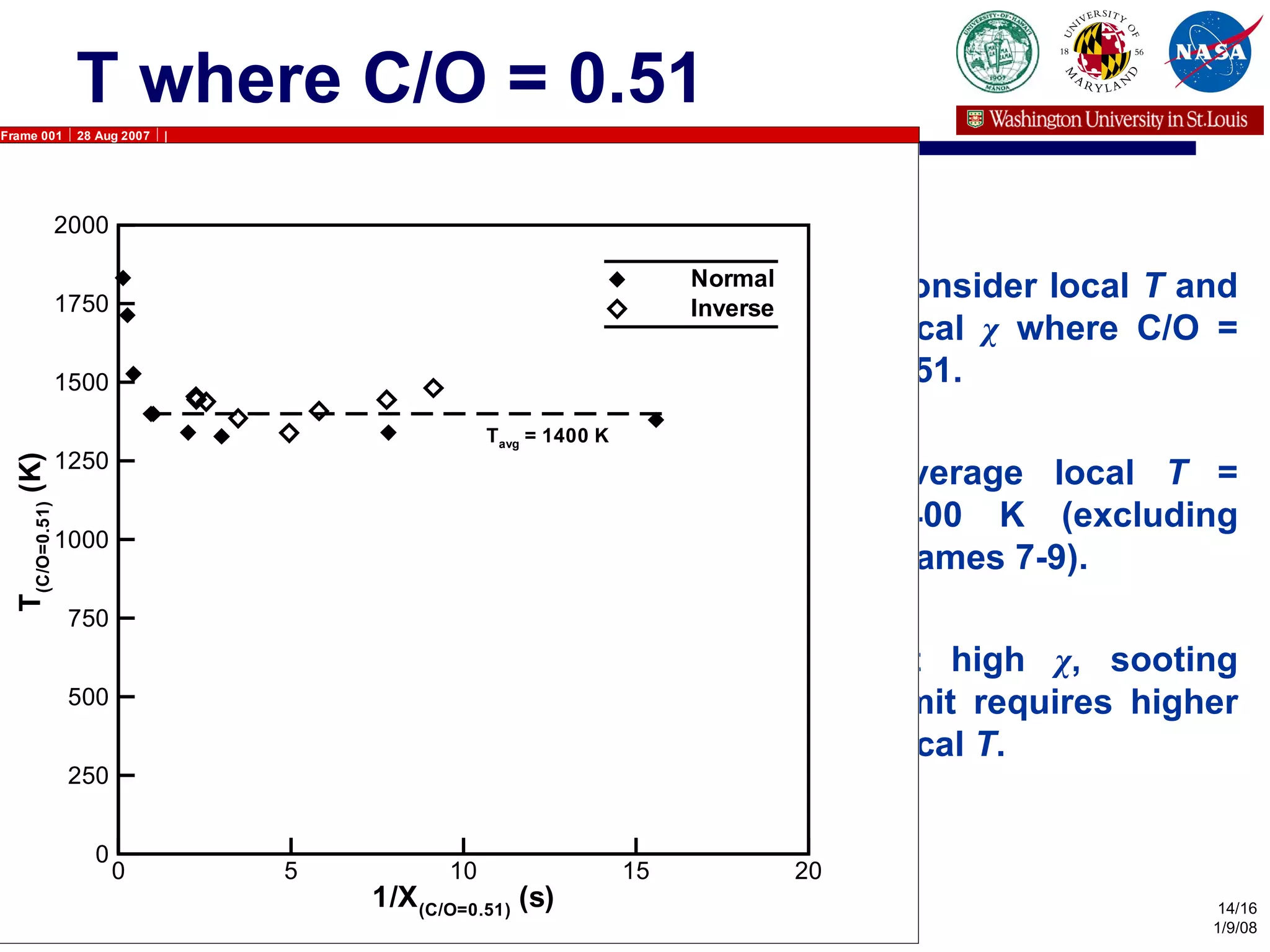
T where C/O = 0.51 Consider local  T  and local  χ  where C/O = 0.51.  Average local  T  = 1400 K (excluding Flames 7-9). At high  χ , sooting limit requires higher local  T .
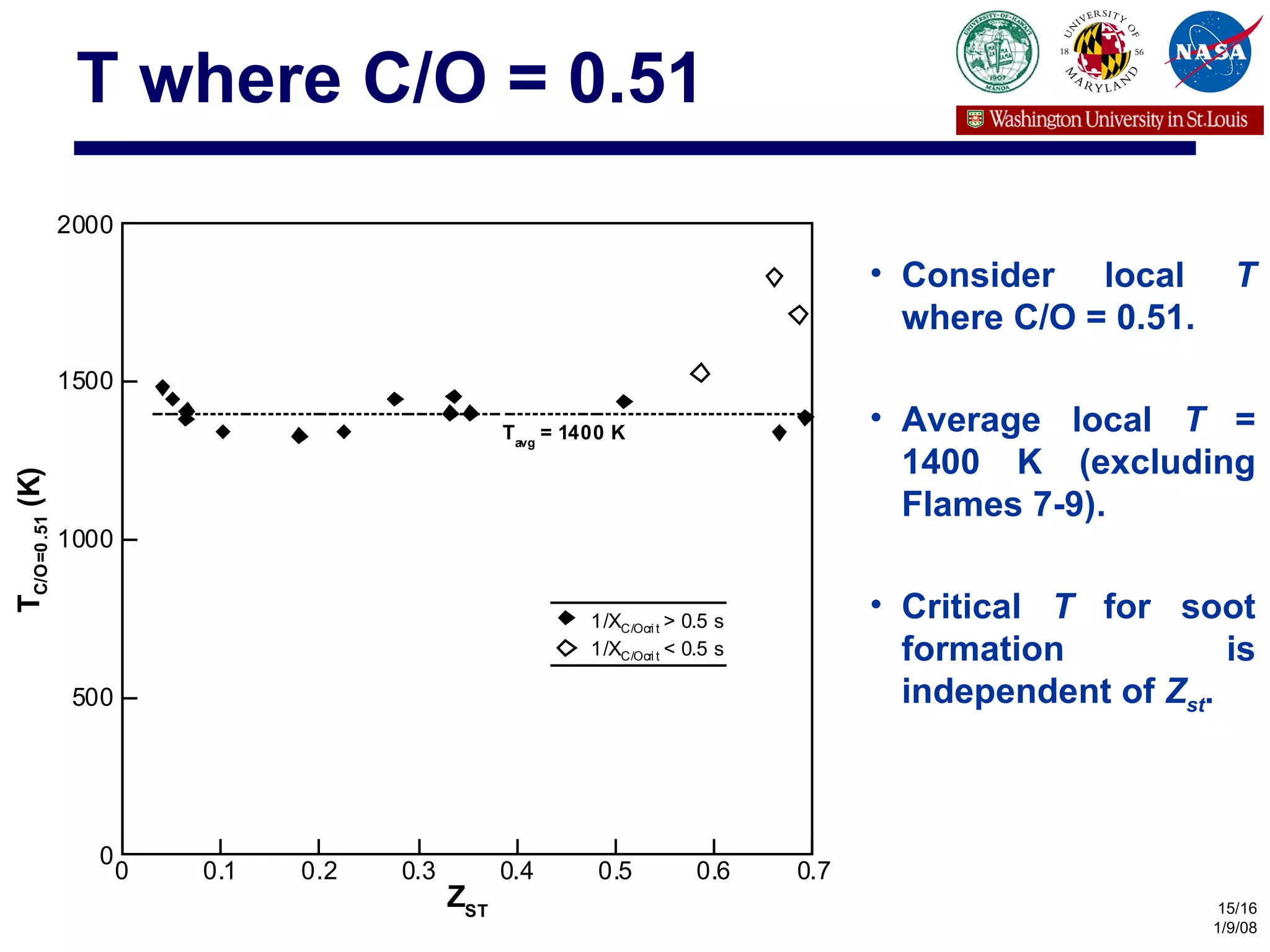
T where C/O = 0.51 Consider local  T  where C/O = 0.51.  Average local  T  = 1400 K (excluding Flames 7-9). Critical  T  for soot formation is independent of  Z st .
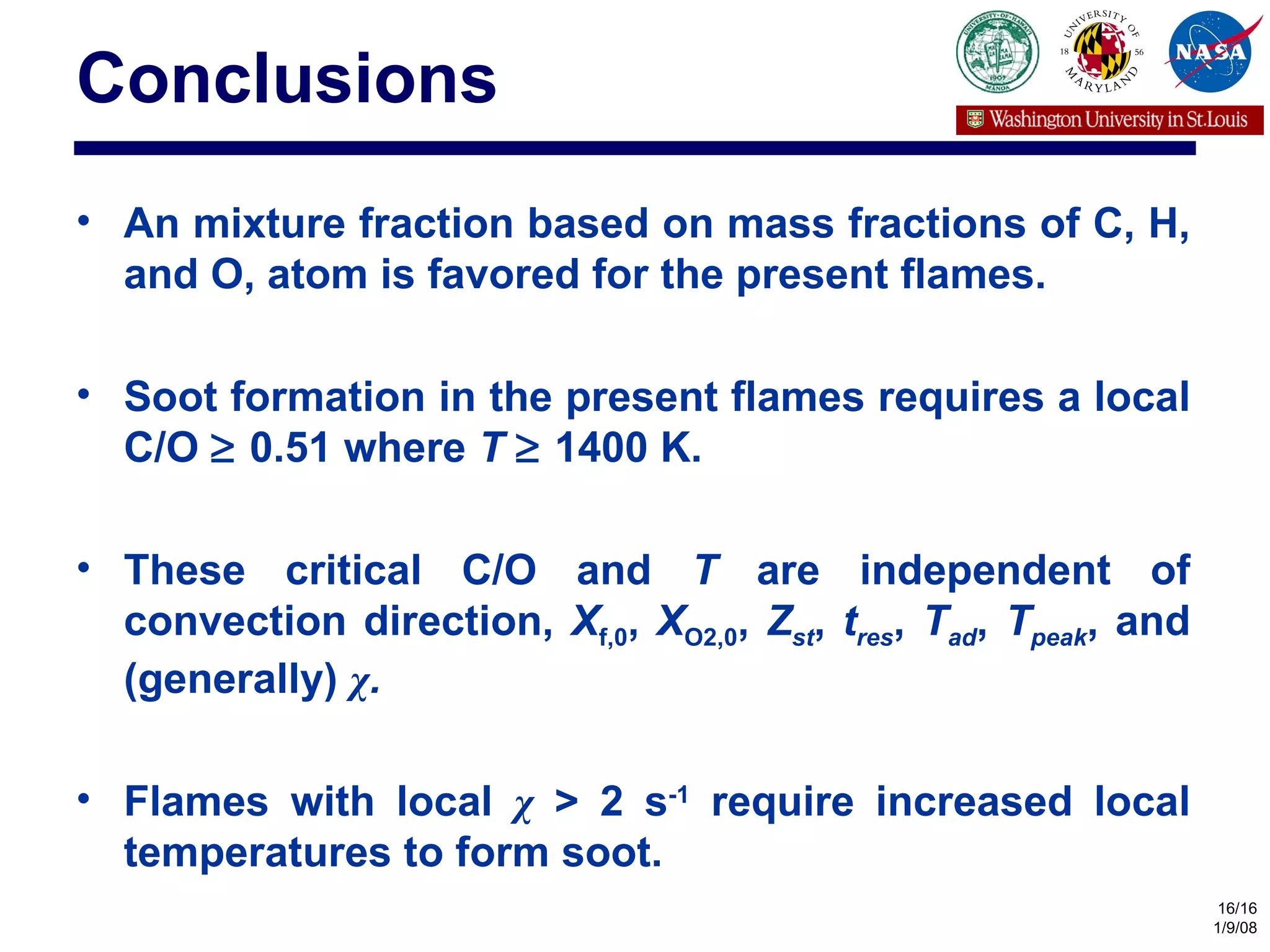
Conclusions An mixture fraction based on mass fractions of C, H, and O, atom is favored for the present flames. Soot formation in the present flames requires a local C/O    0.51 where  T     1400 K. These critical C/O and  T  are independent of convection direction,  X f,0 ,  X O2,0 ,  Z st ,  t res ,  T ad ,  T peak , and (generally)  χ .   Flames with local  χ  > 2 s -1  require increased local temperatures to form soot.

Reno Lecoustre Et Al

  • 1.
    Effects of C/ORatio and Temperature on Sooting Limits of Spherical Diffusion Flames V.R. Lecoustre, 1 P.B. Sunderland, 1 B.H. Chao, 2 D.L. Urban, 3 D.P. Stocker, 3 R.L. Axelbaum 4 1 University of Maryland, College Park, MD, USA 2 University of Hawaii, Honolulu, HI, USA 3 NASA Glenn Research Center, Cleveland, OH, USA 4 Washington University, St. Louis, MO, USA Supported by NASA AIAA 2008-0827 January 9, 2008
  • 2.
    Inverse Normal C2H4  air C2H4/N2  O2 d=29.3 mm d=18.8 mm air  C2H4 O2  C2H4/N2 d=24.7 mm d=31.3 mm Z st = 0.064 Z st = 0.78
  • 3.
    Sooting limits. Allimages from end of 2 s drop test. 18% C 2 H 4  27% O 2 18% C 2 H 4  28% O 2 Flame 5 O 2  12% C 2 H 4 O 2  13% C 2 H 4 Flame 17
  • 4.
    Correlation of measuredsooting limits. T ad >> T peak owing to radiation. Model needed to evaluate local T , local C/O, local χ .
  • 5.
    Background C/O ratiois about 0.6 for C 2 H 4 premixed flames at sooting limits (Glassman, 1988). The minimum soot formation T in diffusion flames is 1250 – 1650 K (Glassman, 1998). Short t res can prevent soot formation. 17 sooting limit spherical C 2 H 4 microgravity flames were identified by Sunderland et al. (2004). These flames have a local critical C/O of about 0.6. Microgravity allows control over convection direction and residence time.
  • 6.
    Objectives Investigate sootinglimits of microgravity C 2 H 4 diffusion flames, emphasizing: local C/O atom ratio, local T , and local scalar dissipation rate, χ . This numerical investigation uses detailed chemistry and transport to elucidate past experiments.
  • 7.
    Sooting limit flamesblue=min yellow=max For all flames HRR is 71 W and sooting limit occurs at 2 s. 1814 2670 0.249 0.692 1 0.13 Fuel 17 1729 2578 0.279 0.666 0.8 0.12 Fuel 16 1802 2539 0.148 0.509 0.5 0.15 Fuel 15 1736 2370 0.122 0.336 0.3 0.19 Fuel 14 1689 2274 0.119 0.277 0.25 0.21 Fuel 13 1515 1814 0.086 0.066 0.13 0.6 Fuel 12 1549 1835 0.072 0.051 0.13 0.8 Fuel 11 1581 1847 0.059 0.041 0.13 1 Fuel 10 2262 2740 0.024 0.661 1 0.15 Oxidizer 9 2057 2528 0.044 0.685 0.8 0.11 Oxidizer 8 1795 2381 0.11 0.586 0.5 0.11 Oxidizer 7 1593 2308 0.33 0.353 0.29 0.17 Oxidizer 6 1592 2306 0.351 0.333 0.28 0.18 Oxidizer 5 1498 2238 0.665 0.225 0.23 0.25 Oxidizer 4 1479 2226 0.91 0.18 0.21 0.31 Oxidizer 3 1492 2326 1.63 0.102 0.21 0.6 Oxidizer 2 1545 2390 2.72 0.065 0.22 1 Oxidizer 1 T f 2s K T ad , K t res , s Z st X O2,0 X C2H4,0 Ambient Flame
  • 8.
    Numerical methods SandiaPREMIX code, modified for steady and transient spherical diffusion flames. GRI Mech. 3.0 (53 species, 325 reactions), detailed transport properties. Species and heat diffusivities incremented 30% to match experiments. Discrete ordinates radiation model (HITRAN, 25 cm -1 ). Ignition via steady solution for small domain (1.2 cm) with adiabatic boundaries (Tse et al., 2001). Transient computation over extended domain (100 cm) with radiation.
  • 9.
    Temporal evolution Flame10 (O 2 /N 2  C 2 H 4 ). Radiative loss fraction is 0.28. All flames were unsteady at 2 s.
  • 10.
    Mixture fraction Scalardissipation rate: χ = 2 D N2 ( d Z / d r ) 2 Common definition: Z = fraction of local mass originating from fuel stream Common definition for pure fuel : Z CH = Y C + Y H Following Bilger, for C 2 H 4 :
  • 11.
  • 12.
    Flame structure (Flame10) Results shown at 2 s at sooting limit. Peak χ = 0.2 s -1 . Highest gradients are inside flame. A large radiating region is outside flame. C/O > 0.51 only where T < 1400 K.
  • 13.
    Critical local C/Oratio For various C/O ratios, local T was found for each flame. Flames 7-9 had the highest χ and were excluded here. Local T standard deviation is minimum at C/O = 0.51. Agrees with C/O = 0.6 in premixed flames and gas jet flames.
  • 14.
    T where C/O= 0.51 Consider local T and local χ where C/O = 0.51. Average local T = 1400 K (excluding Flames 7-9). At high χ , sooting limit requires higher local T .
  • 15.
    T where C/O= 0.51 Consider local T where C/O = 0.51. Average local T = 1400 K (excluding Flames 7-9). Critical T for soot formation is independent of Z st .
  • 16.
    Conclusions An mixturefraction based on mass fractions of C, H, and O, atom is favored for the present flames. Soot formation in the present flames requires a local C/O  0.51 where T  1400 K. These critical C/O and T are independent of convection direction, X f,0 , X O2,0 , Z st , t res , T ad , T peak , and (generally) χ . Flames with local χ > 2 s -1 require increased local temperatures to form soot.

Editor's Notes

  • #2 Thank you for attending my presentation. My name is Vivien Lecoustre, mechanical engineer PhD student at UMD. My topic presentation is Effects of C/O ratio and scalar dissipation rate on sooting limits of spherical non-premixed flames /I would like to present my co-authors who are professor Beei Huan Chao, from university of Hawaii, Professor Peter Sunderland (who is my advisor) from UMD, David Urban and Denis Stocker, from the NASA Glenn Research center and Professor Richard Axelbaum, from Washington University/. This project is supported by NASA. This work is about modeling results. We revisit an experimental paper which characterized 17 sooting limits spherical diffusion flames. Those flame were characterized in microgravity. You may be familiar with the temperature and scalar dissipation rate effects on soot formation. But maybe not on the C/O ratio. Sooting limits arise from a competition between the reaction of fuel pyrolysis and the reaction of soot oxidation. The former will be likely to occur when we have a large number of carbon. The latter, on the contrary, will be likely to occur when great number oxygen atoms are present, greater than the carbon atoms. C/O ratio is a useful parameter to asses the importance of one or the other reactions. The past work carried on soot formation was first established for premixed flame due to nearly constant temperature and Carbon to Oxygen atom ratio, C/O ratio, in the soot-forming regions of premixed flame, and to the decoupling effect of those two parameters. Experiments, carried out by Haynes and Wagner and Glassman using a ethylene premixed flame, show that there is a critical C/O ratio value for soot inception. Soot did not form into ethylene flames with a global C/O ratio less than 0.6