Calculation and Application Of Continuous NTG Pore to Bed Scale and Impact on Oil In Place Calculations Simon Stromberg Study Centre, Petroleum Development Oman
Acknowledgements PDO Study Centre Robbert  Nieuwenhuijs Herve Farran Caroline Hern Andy Griffin Marcel Braas PDO Kathy Heller Conrad Blumhagen Shell E. C. Thomas S. J. Stieber Others Bengt Pedersen Kjetil Nordahl Schlumberger (MRX Data Logging) SPWLA 16 th  Annual Logging Symposium, 1975, Paper T. Norwegian University of Science and Technology.  Semester Report. 1999.
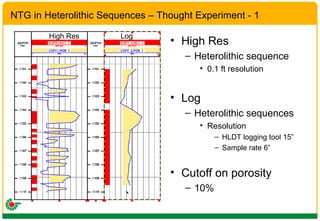
High Res Heterolithic sequence  0.1 ft resolution Log Heterolithic sequences Resolution HLDT logging tool 15” Sample rate 6” Cutoff on porosity 10% NTG in Heterolithic Sequences – Thought Experiment - 1 High Res Log
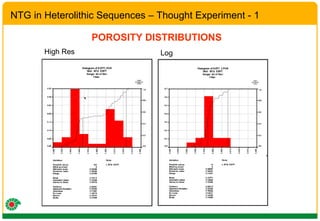
NTG in Heterolithic Sequences – Thought Experiment - 1 High Res Log POROSITY DISTRIBUTIONS
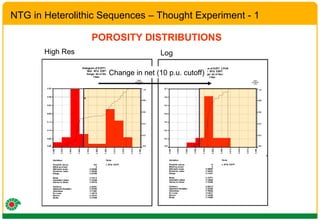
NTG in Heterolithic Sequences – Thought Experiment - 1 High Res Log POROSITY DISTRIBUTIONS Change in net (10 p.u. cutoff)
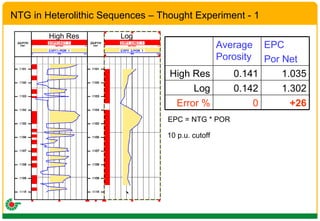
NTG in Heterolithic Sequences – Thought Experiment - 1 High Res Log EPC = NTG * POR 10 p.u. cutoff 1.302 0.142 Log +26 0 Error % 1.035 0.141 High Res EPC Por Net Average Porosity
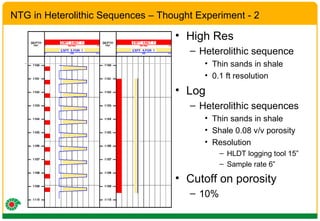
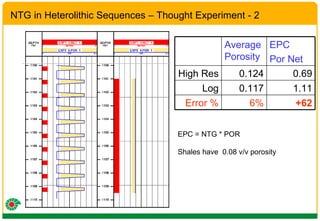
NTG in Heterolithic Sequences – Thought Experiment - 2 High Res Heterolithic sequence Thin sands in shale  0.1 ft resolution Log Heterolithic sequences Thin sands in shale Shale 0.08 v/v porosity Resolution HLDT logging tool 15” Sample rate 6” Cutoff on porosity 10%
NTG in Heterolithic Sequences – Thought Experiment - 2 EPC = NTG * POR Shales have  0.08 v/v porosity 1.11 0.117 Log +62 6% Error % 0.69 0.124 High Res EPC Por Net Average Porosity
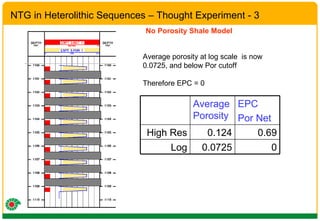
NTG in Heterolithic Sequences – Thought Experiment - 3 No Porosity Shale Model Average porosity at log scale  is now  0.0725, and below Por cutoff Therefore EPC = 0 0 0.0725 Log 0.69 0.124 High Res EPC Por Net Average Porosity
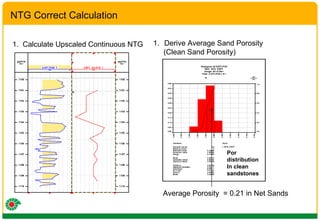
NTG Correct Calculation 1.  Calculate Upscaled Continuous NTG Derive Average Sand Porosity (Clean Sand Porosity) Average Porosity  = 0.21 in Net Sands Por distribution In clean sandstones
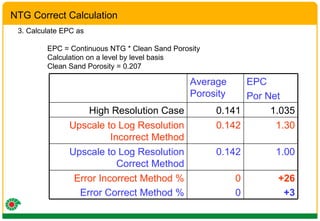
NTG Correct Calculation 3. Calculate EPC as EPC = Continuous NTG * Clean Sand Porosity Calculation on a level by level basis  Clean Sand Porosity = 0.207 1.30 0.142 Upscale to Log Resolution Incorrect Method 1.00 0.142 Upscale to Log Resolution Correct Method +26 +3 0 0 Error Incorrect Method % Error Correct Method % 1.035 0.141 High Resolution Case EPC Por Net Average Porosity
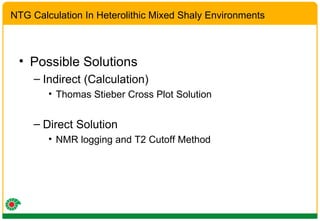
Possible Solutions Indirect (Calculation) Thomas Stieber Cross Plot Solution Direct Solution NMR logging and T2 Cutoff Method NTG Calculation In Heterolithic Mixed Shaly Environments
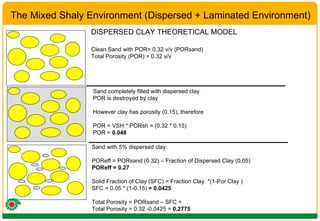
The Mixed Shaly Environment (Dispersed + Laminated Environment) Clean Sand with POR= 0.32 v/v (PORsand) Total Porosity (POR) = 0.32 v/v Sand completely filled with dispersed clay POR is destroyed by clay However clay has porosity (0.15), therefore POR = VSH * PORsh = (0.32 * 0.15)  POR =  0.048 Sand with 5% dispersed clay: POReff = PORsand (0.32) – Fraction of Dispersed Clay (0.05)  POReff = 0.27 Solid Fraction of Clay (SFC) = Fraction Clay  *(1-Por Clay )  SFC = 0.05 * (1-0.15)  = 0.0425 Total Porosity = PORsand – SFC =  Total Porosity = 0.32 -0.0425 =  0.2775  DISPERSED CLAY THEORETICAL MODEL
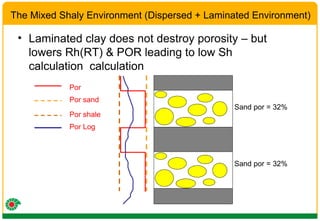
The Mixed Shaly Environment (Dispersed + Laminated Environment) Laminated clay does not destroy porosity – but lowers Rh(RT) & POR leading to low Sh calculation  calculation Sand por = 32% Sand por = 32% Por Por sand Por shale Por Log
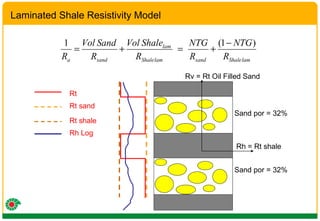
Laminated Shale Resistivity Model Sand por = 32% Sand por = 32% Rt Rt sand Rt shale Rh Log Rh = Rt shale Rv = Rt Oil Filled Sand
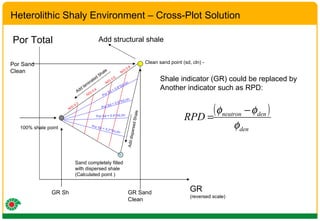
Heterolithic Shaly Environment – Cross-Plot Solution Por Total GR  (reversed scale) Clean sand point (sd, cln) -  100% shale point Sand completely filled with dispersed shale (Calculated point ) GR Sh Por Sand Clean GR Sand Clean Add dispersed Shale Add laminated Shale N/G 0.2 N/G 0.4 N/G 0.6 N/G 0.8 Por Sd = 0.8*Sd,cln Por Sd = 0.6*Sd,cln Por Sd = 0.4*Sd,cln Por Sd = 0.2*Sd,cln Add structural shale Shale indicator (GR) could be replaced by Another indicator such as RPD:
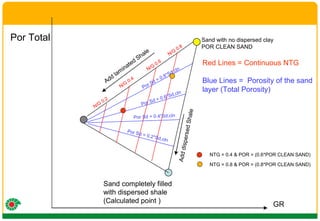
Red Lines = Continuous NTG Blue Lines =  Porosity of the sand layer (Total Porosity) Por Total GR NTG = 0.4 & POR = (0.6*POR CLEAN SAND) NTG = 0.8 & POR = (0.8*POR CLEAN SAND) Sand with no dispersed clay POR CLEAN SAND
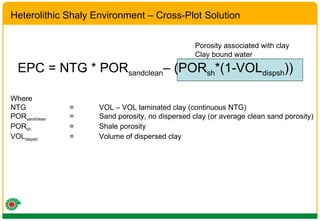
Heterolithic Shaly Environment – Cross-Plot Solution EPC = NTG * POR sandclean – (POR sh *(1-VOL dispsh )) Where NTG =  VOL – VOL laminated clay (continuous NTG) POR sandclean =  Sand porosity, no dispersed clay (or average clean sand porosity) POR sh   =  Shale porosity VOL dispsh   =  Volume of dispersed clay Porosity associated with clay Clay bound water
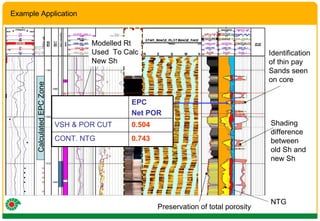
Example Application Preservation of total porosity Identification of thin pay Sands seen on core Shading difference  between old Sh and  new Sh Modelled Rt Used  To Calc New Sh Calculated EPC Zone NTG 0.743 CONT. NTG 0.504 VSH & POR CUT EPC Net POR
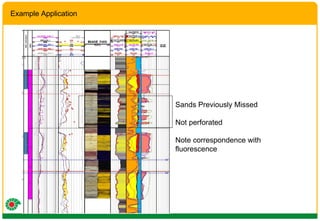
Example Application Sands Previously Missed Not perforated Note correspondence with fluorescence
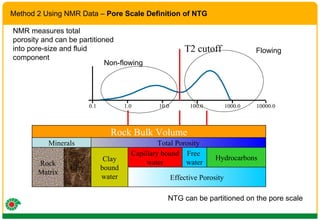
Method 2 Using NMR Data –  Pore Scale Definition of NTG 0.1 1.0 10.0 100.0 1000.0 10000.0 Rock Bulk Volume Rock Matrix Clay Clay bound water Total Porosity Effective Porosity Capillary bound water Free  water Hydrocarbons Minerals T2 cutoff NMR measures total porosity and can be partitioned into pore-size and fluid component NTG can be partitioned on the pore scale Flowing Non-flowing
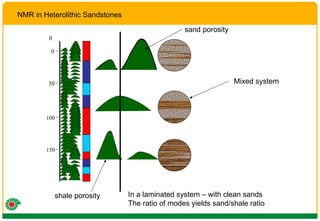
NMR in Heterolithic Sandstones ft 0 50 100 150 In a laminated system – with clean sands The ratio of modes yields sand/shale ratio sand porosity shale porosity Mixed system
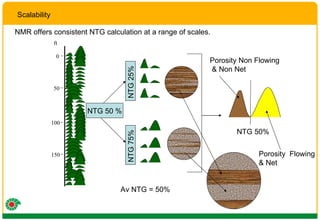
Scalability ft 0 50 100 150 NTG 50 % NTG 50% Porosity Non Flowing & Non Net Porosity  Flowing  & Net NMR offers consistent NTG calculation at a range of scales. NTG 25%  NTG 75%  Av NTG = 50%
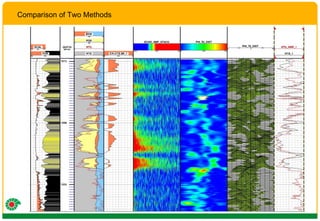
Comparison of Two Methods
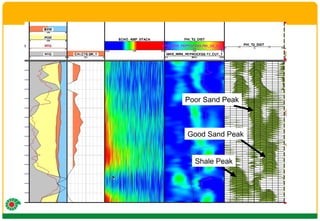
Shale Peak Poor Sand Peak Good Sand Peak
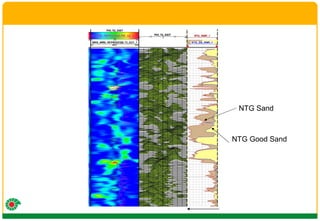
NTG Sand NTG Good Sand
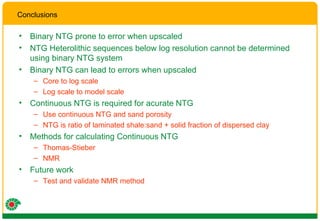
Binary NTG prone to error when upscaled NTG Heterolithic sequences below log resolution cannot be determined using binary NTG system Binary NTG can lead to errors when upscaled Core to log scale Log scale to model scale Continuous NTG is required for acurate NTG Use continuous NTG and sand porosity NTG is ratio of laminated shale:sand + solid fraction of dispersed clay Methods for calculating Continuous NTG Thomas-Stieber NMR Future work Test and validate NMR method Conclusions

Ntg Full

  • 1.
    Calculation and ApplicationOf Continuous NTG Pore to Bed Scale and Impact on Oil In Place Calculations Simon Stromberg Study Centre, Petroleum Development Oman
  • 2.
    Acknowledgements PDO StudyCentre Robbert Nieuwenhuijs Herve Farran Caroline Hern Andy Griffin Marcel Braas PDO Kathy Heller Conrad Blumhagen Shell E. C. Thomas S. J. Stieber Others Bengt Pedersen Kjetil Nordahl Schlumberger (MRX Data Logging) SPWLA 16 th Annual Logging Symposium, 1975, Paper T. Norwegian University of Science and Technology. Semester Report. 1999.
  • 3.
    High Res Heterolithicsequence 0.1 ft resolution Log Heterolithic sequences Resolution HLDT logging tool 15” Sample rate 6” Cutoff on porosity 10% NTG in Heterolithic Sequences – Thought Experiment - 1 High Res Log
  • 4.
    NTG in HeterolithicSequences – Thought Experiment - 1 High Res Log POROSITY DISTRIBUTIONS
  • 5.
    NTG in HeterolithicSequences – Thought Experiment - 1 High Res Log POROSITY DISTRIBUTIONS Change in net (10 p.u. cutoff)
  • 6.
    NTG in HeterolithicSequences – Thought Experiment - 1 High Res Log EPC = NTG * POR 10 p.u. cutoff 1.302 0.142 Log +26 0 Error % 1.035 0.141 High Res EPC Por Net Average Porosity
  • 7.
    NTG in HeterolithicSequences – Thought Experiment - 2 High Res Heterolithic sequence Thin sands in shale 0.1 ft resolution Log Heterolithic sequences Thin sands in shale Shale 0.08 v/v porosity Resolution HLDT logging tool 15” Sample rate 6” Cutoff on porosity 10%
  • 8.
    NTG in HeterolithicSequences – Thought Experiment - 2 EPC = NTG * POR Shales have 0.08 v/v porosity 1.11 0.117 Log +62 6% Error % 0.69 0.124 High Res EPC Por Net Average Porosity
  • 9.
    NTG in HeterolithicSequences – Thought Experiment - 3 No Porosity Shale Model Average porosity at log scale is now 0.0725, and below Por cutoff Therefore EPC = 0 0 0.0725 Log 0.69 0.124 High Res EPC Por Net Average Porosity
  • 10.
    NTG Correct Calculation1. Calculate Upscaled Continuous NTG Derive Average Sand Porosity (Clean Sand Porosity) Average Porosity = 0.21 in Net Sands Por distribution In clean sandstones
  • 11.
    NTG Correct Calculation3. Calculate EPC as EPC = Continuous NTG * Clean Sand Porosity Calculation on a level by level basis Clean Sand Porosity = 0.207 1.30 0.142 Upscale to Log Resolution Incorrect Method 1.00 0.142 Upscale to Log Resolution Correct Method +26 +3 0 0 Error Incorrect Method % Error Correct Method % 1.035 0.141 High Resolution Case EPC Por Net Average Porosity
  • 12.
    Possible Solutions Indirect(Calculation) Thomas Stieber Cross Plot Solution Direct Solution NMR logging and T2 Cutoff Method NTG Calculation In Heterolithic Mixed Shaly Environments
  • 13.
    The Mixed ShalyEnvironment (Dispersed + Laminated Environment) Clean Sand with POR= 0.32 v/v (PORsand) Total Porosity (POR) = 0.32 v/v Sand completely filled with dispersed clay POR is destroyed by clay However clay has porosity (0.15), therefore POR = VSH * PORsh = (0.32 * 0.15) POR = 0.048 Sand with 5% dispersed clay: POReff = PORsand (0.32) – Fraction of Dispersed Clay (0.05) POReff = 0.27 Solid Fraction of Clay (SFC) = Fraction Clay *(1-Por Clay ) SFC = 0.05 * (1-0.15) = 0.0425 Total Porosity = PORsand – SFC = Total Porosity = 0.32 -0.0425 = 0.2775 DISPERSED CLAY THEORETICAL MODEL
  • 14.
    The Mixed ShalyEnvironment (Dispersed + Laminated Environment) Laminated clay does not destroy porosity – but lowers Rh(RT) & POR leading to low Sh calculation calculation Sand por = 32% Sand por = 32% Por Por sand Por shale Por Log
  • 15.
    Laminated Shale ResistivityModel Sand por = 32% Sand por = 32% Rt Rt sand Rt shale Rh Log Rh = Rt shale Rv = Rt Oil Filled Sand
  • 16.
    Heterolithic Shaly Environment– Cross-Plot Solution Por Total GR (reversed scale) Clean sand point (sd, cln) - 100% shale point Sand completely filled with dispersed shale (Calculated point ) GR Sh Por Sand Clean GR Sand Clean Add dispersed Shale Add laminated Shale N/G 0.2 N/G 0.4 N/G 0.6 N/G 0.8 Por Sd = 0.8*Sd,cln Por Sd = 0.6*Sd,cln Por Sd = 0.4*Sd,cln Por Sd = 0.2*Sd,cln Add structural shale Shale indicator (GR) could be replaced by Another indicator such as RPD:
  • 17.
    Red Lines =Continuous NTG Blue Lines = Porosity of the sand layer (Total Porosity) Por Total GR NTG = 0.4 & POR = (0.6*POR CLEAN SAND) NTG = 0.8 & POR = (0.8*POR CLEAN SAND) Sand with no dispersed clay POR CLEAN SAND
  • 18.
    Heterolithic Shaly Environment– Cross-Plot Solution EPC = NTG * POR sandclean – (POR sh *(1-VOL dispsh )) Where NTG = VOL – VOL laminated clay (continuous NTG) POR sandclean = Sand porosity, no dispersed clay (or average clean sand porosity) POR sh = Shale porosity VOL dispsh = Volume of dispersed clay Porosity associated with clay Clay bound water
  • 19.
    Example Application Preservationof total porosity Identification of thin pay Sands seen on core Shading difference between old Sh and new Sh Modelled Rt Used To Calc New Sh Calculated EPC Zone NTG 0.743 CONT. NTG 0.504 VSH & POR CUT EPC Net POR
  • 20.
    Example Application SandsPreviously Missed Not perforated Note correspondence with fluorescence
  • 21.
    Method 2 UsingNMR Data – Pore Scale Definition of NTG 0.1 1.0 10.0 100.0 1000.0 10000.0 Rock Bulk Volume Rock Matrix Clay Clay bound water Total Porosity Effective Porosity Capillary bound water Free water Hydrocarbons Minerals T2 cutoff NMR measures total porosity and can be partitioned into pore-size and fluid component NTG can be partitioned on the pore scale Flowing Non-flowing
  • 22.
    NMR in HeterolithicSandstones ft 0 50 100 150 In a laminated system – with clean sands The ratio of modes yields sand/shale ratio sand porosity shale porosity Mixed system
  • 23.
    Scalability ft 050 100 150 NTG 50 % NTG 50% Porosity Non Flowing & Non Net Porosity Flowing & Net NMR offers consistent NTG calculation at a range of scales. NTG 25% NTG 75% Av NTG = 50%
  • 24.
  • 25.
    Shale Peak PoorSand Peak Good Sand Peak
  • 26.
    NTG Sand NTGGood Sand
  • 27.
    Binary NTG proneto error when upscaled NTG Heterolithic sequences below log resolution cannot be determined using binary NTG system Binary NTG can lead to errors when upscaled Core to log scale Log scale to model scale Continuous NTG is required for acurate NTG Use continuous NTG and sand porosity NTG is ratio of laminated shale:sand + solid fraction of dispersed clay Methods for calculating Continuous NTG Thomas-Stieber NMR Future work Test and validate NMR method Conclusions