The 2nd Party System
1834-1856
Whig vs. Democrats
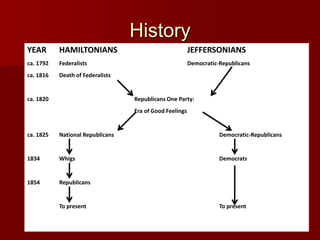
History
YEAR HAMILTONIANS JEFFERSONIANS
ca. 1792 Federalists Democratic-Republicans
ca. 1816 Death of Federalists
ca. 1820 Republicans One Party:
Era of Good Feelings
ca. 1825 National Republicans Democratic-Republicans
1834 Whigs Democrats
1854 Republicans
To present To present
WHIGS DEMOCRATSVs.
Whigs
 Modernization
 Active from 1833-1856
 Industry
 The party broke off into the Free Soil
Party, the Know-Nothing Party, and the
modern Republican Party
Democrats
 Tradition
 Emphasis on farming
 State rights

The 2nd party system 7

Editor's Notes

  • #3 The first political party system of the U.S. was the Federalist party and the Democratic-Republican party. The Republican party would soon turn into the Democratic Party and Federalist Party would turn into the Whig Party. The federalists, like the Whigs were nationalists who believed in business and commerce, and were elitist. The early Republicans, like the later Democrats, were more for state power and favored the average man.
  • #6 INTRO: Both the Whigs and the Democrats wanted what was best for America, but they each had different ways of going about doing so. As a party it did not exist before 1834, but its nucleus was formed in 1824 when the adherents of John Quincy Adams and Henry Clay joined forces against Andrew Jackson. A political party of the United States during the era of Jacksonian democracy the Whig Party was a reaction to the authoritarian policies of Andrew Jackson . “King Andrew,” as his critics labeled him, had enraged his political opponents by his actions regarding the Bank of the United States , Native Americans, the Supreme Court and his use of presidential war powers. The term Whig was taken from English politics, the name of a faction that opposed royal tyranny. 3. Jackson critics, states’ rights advocates, and supporters of the American System made up the Whig Party
  • #10 In the election of 1852, the party was torn wide open by sectional interests. Both Clay and Webster died during the campaign, and Winfield Scott, the Whig presidential candidate, won only 42 electoral votes. This brought about a quick end to the party, and its remnants gravitated toward other parties. The newly formed (1854) Republican party and the sharply divided Democratic party absorbed the largest segments. Other Whigs, led by Fillmore, drifted into the Know-Nothing movement.