


What is TOC?
• Systems theory for goal oriented organisations
• Developed by the Israeli Phycisist Eli Goldratt (1947 –
2011)
• Author of the most read managementbook of all times
Every complex system
is based on
Inherent simplicity
What do we mean by Inherent Simplicity?
The Starting point
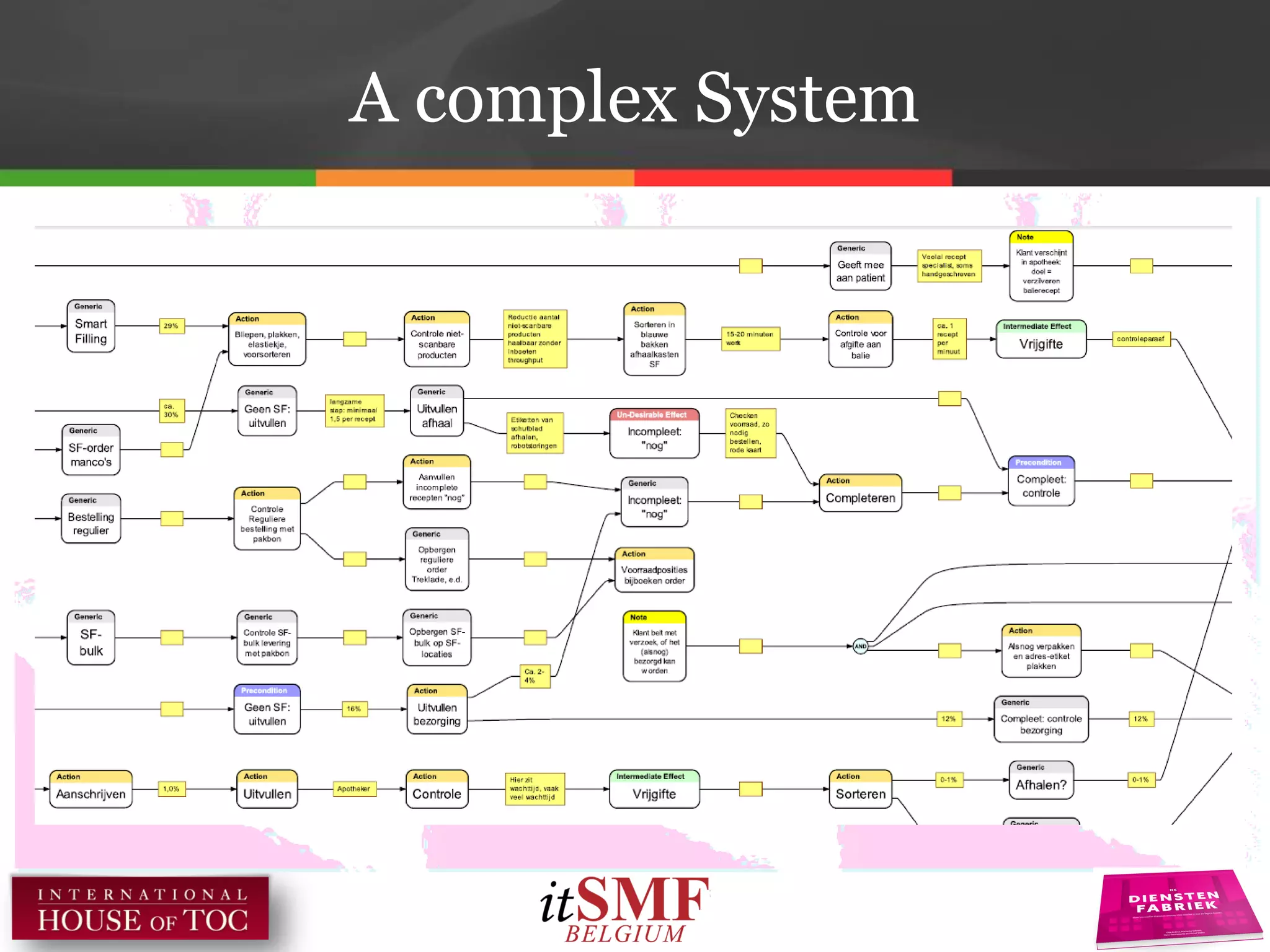
A complex System
SYSTEM A SYSTEM B
Which system is more complex?
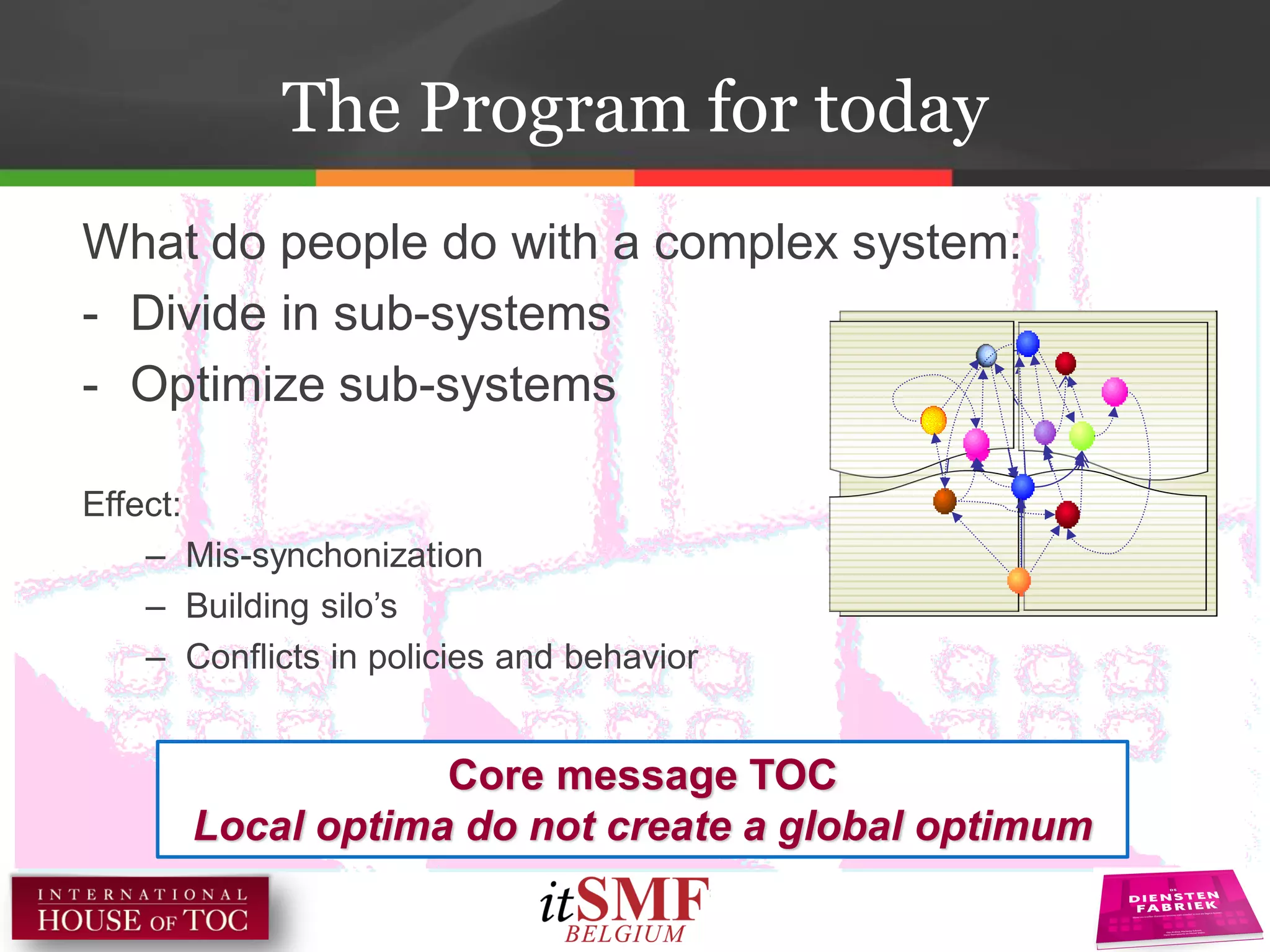
What do people do with a complex system:
- Divide in sub-systems
- Optimize sub-systems
Effect:
– Mis-synchonization
– Building silo’s
– Conflicts in policies and behavior
Core message TOC
Local optima do not create a global optimum
The Program for today
The Theory Of Constraints defines this as
the Inherent Simplicity of the system
Only very few factors govern
the performance of the system as a whole
Inherent Simplicity
What is your Goal?
Emp. #1 Emp. #3 Emp. #5 Emp. #4 Emp. #6
Emp. #4 Emp. #5
Emp. #2 Emp. #2 Emp. #2Emp. #2
Emp. #1 Emp. #3
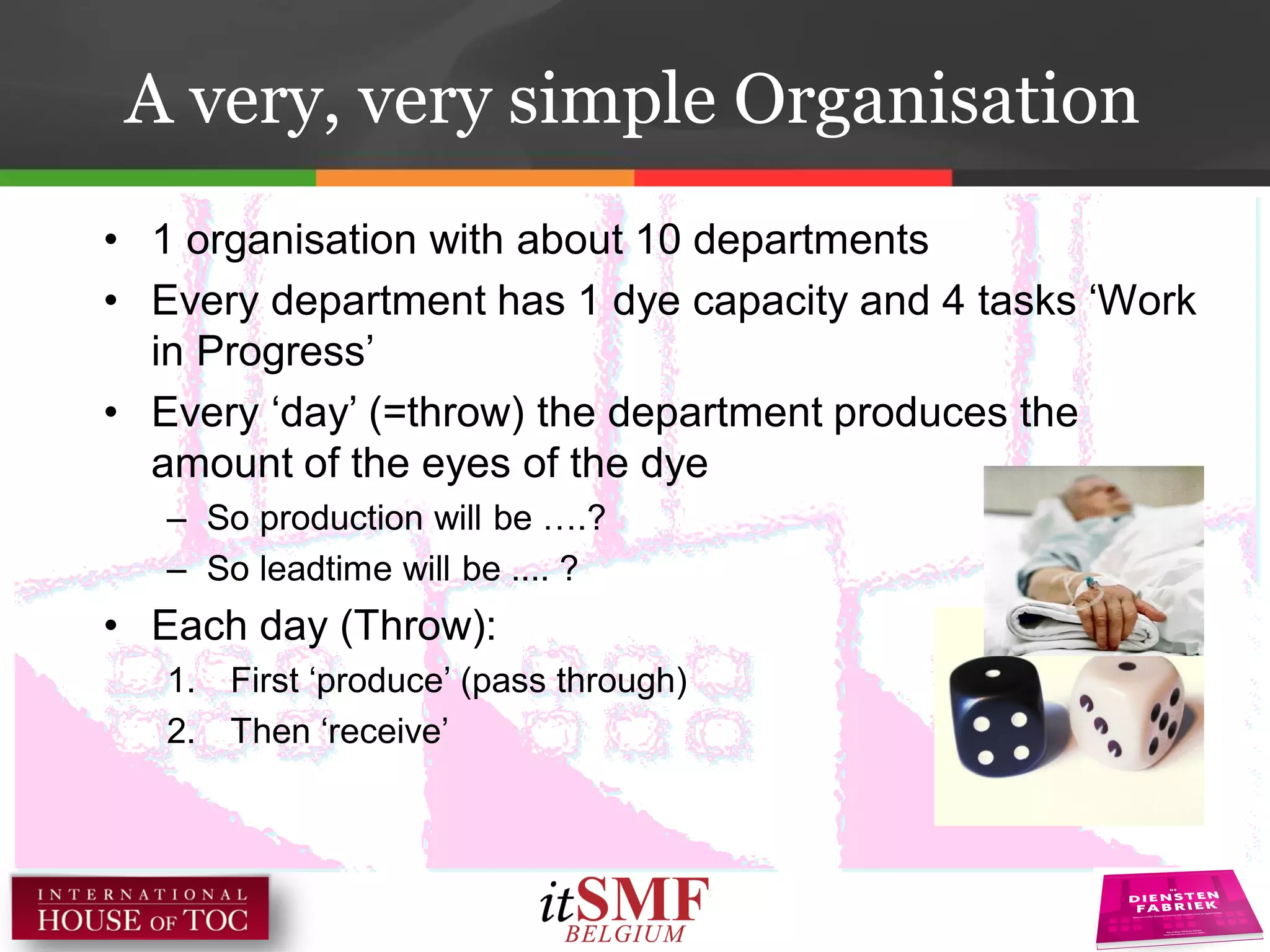
A very, very simple Organisation
• 1 organisation with about 10 departments
• Every department has 1 dye capacity and 4 tasks ‘Work
in Progress’
• Every ‘day’ (=throw) the department produces the
amount of the eyes of the dye
– So production will be ….?
– So leadtime will be .... ?
• Each day (Throw):
1. First ‘produce’ (pass through)
2. Then ‘receive’
Findings Round 1
• Running and Stopping
• Frequently missing work
• Increasing Work in Progress
• Increasing Leadtime
• Stress
......... Sounds familiar?
As from Operations Management perspective:
• Systems produce significantly less than their capacity (efficiency <
100%). In this case ca. 75%
• Leadtime ≠ touchtime
• Variability + interdependancy causes
– Missing parts en increasing WIP
How can we improve?
Improve the elements of the system
 Increase efficiency per department
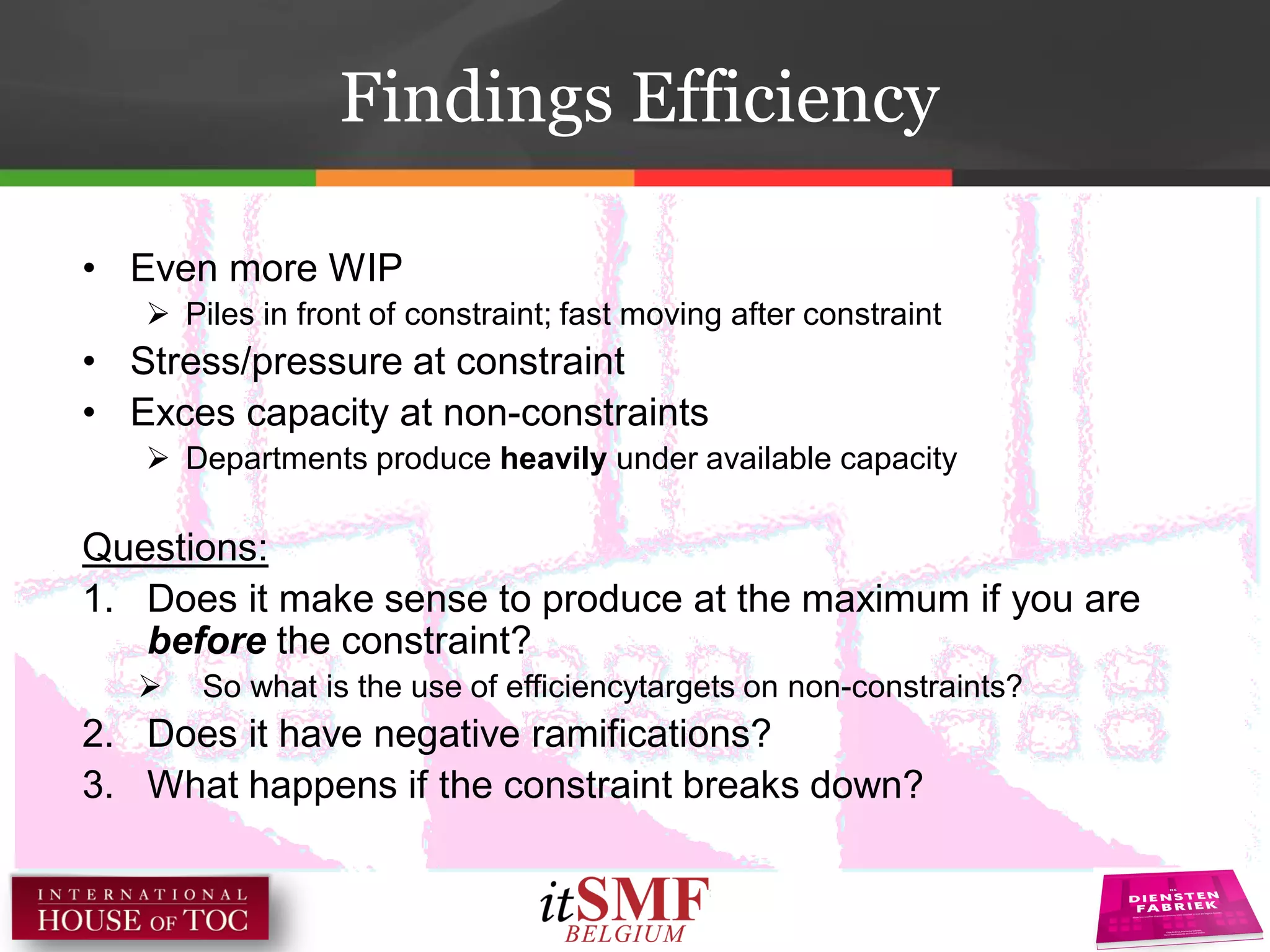
Findings Efficiency
• Even more WIP
 Piles in front of constraint; fast moving after constraint
• Stress/pressure at constraint
• Exces capacity at non-constraints
 Departments produce heavily under available capacity
Questions:
1. Does it make sense to produce at the maximum if you are
before the constraint?
 So what is the use of efficiencytargets on non-constraints?
2. Does it have negative ramifications?
3. What happens if the constraint breaks down?
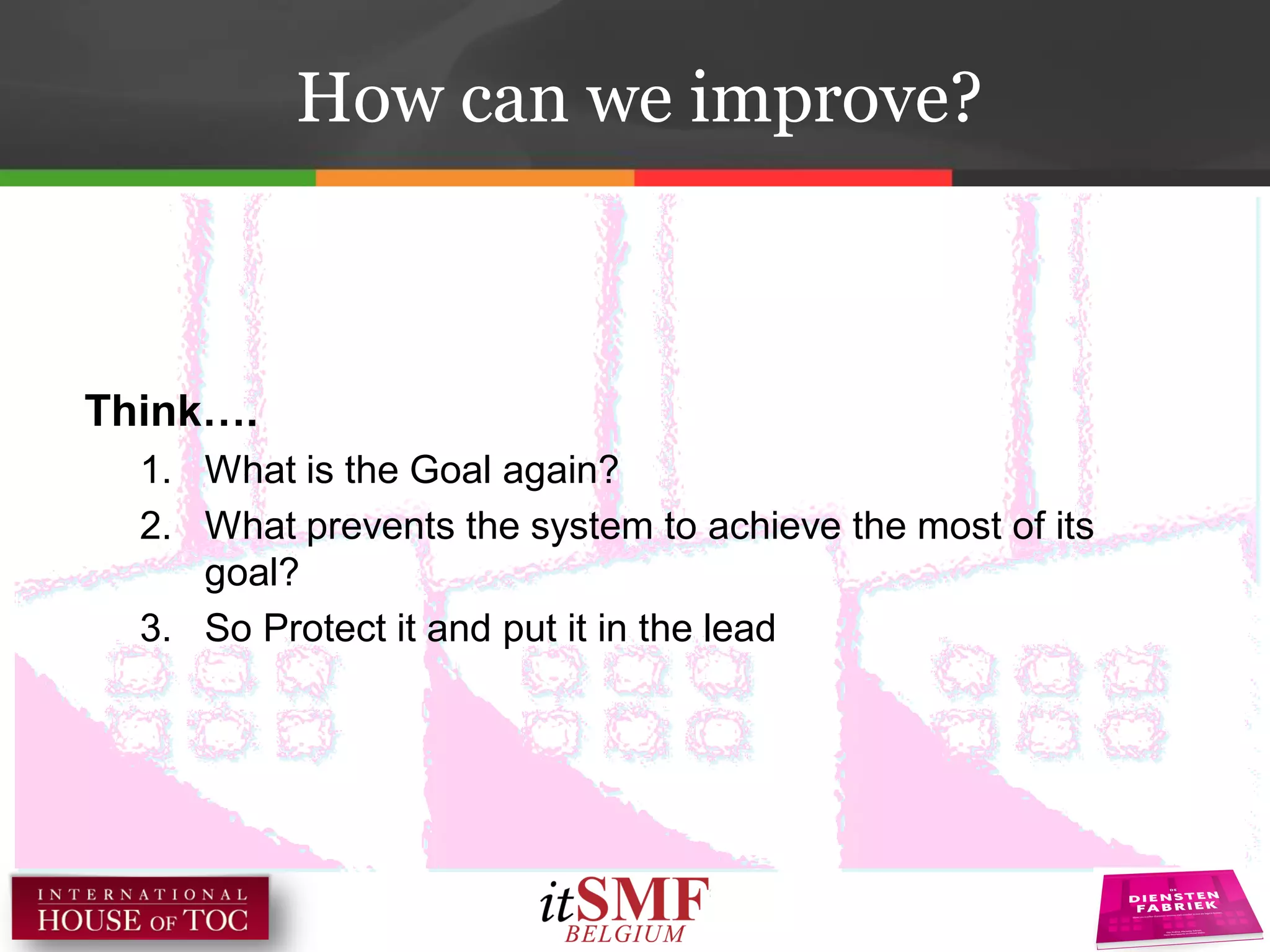
How can we improve?
Think….
1. What is the Goal again?
2. What prevents the system to achieve the most of its
goal?
3. So Protect it and put it in the lead
Findings TOC
• Proces is stable
• Production is almost equal to theoretical capacity
 Constraint is effectively protected against starvation with
relatively low WIP
• WIP remains low
 Leadtime remains low
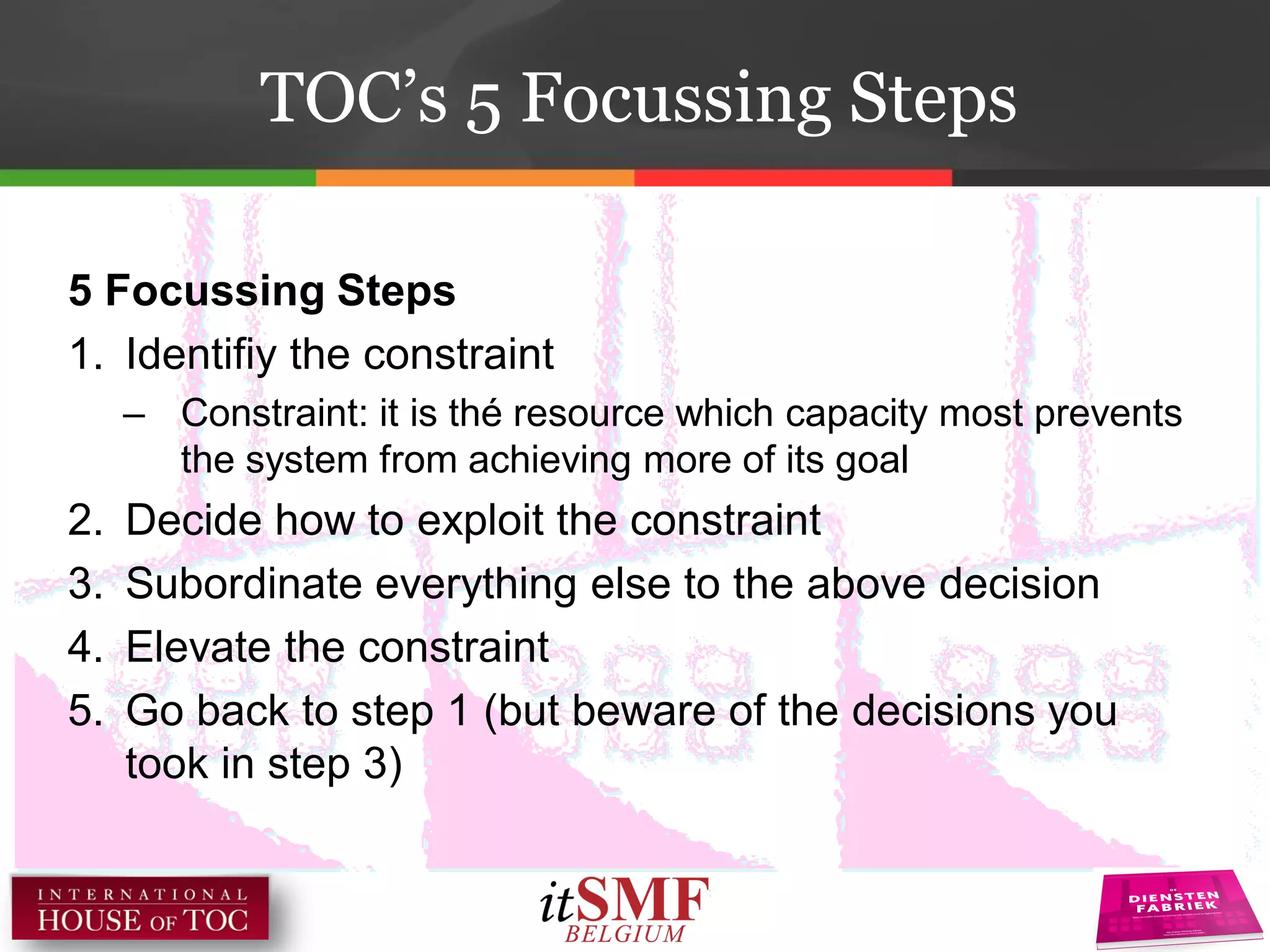
TOC’s 5 Focussing Steps
5 Focussing Steps
1. Identifiy the constraint
– Constraint: it is thé resource which capacity most prevents
the system from achieving more of its goal
2. Decide how to exploit the constraint
3. Subordinate everything else to the above decision
4. Elevate the constraint
5. Go back to step 1 (but beware of the decisions you
took in step 3)
Findings Simulation
• Dependencies + Variability determine the flow through
a system
• WIP determines leadtime, not the output
• ‘Output rules Input’ makes a system stable, fast and
easy to improve
• 5 Focussing steps cause an Ongoing Improvement
Problems in most service organisations
Many things are working fine. But some problems tend to be persistent:
• Completion of tasks takes (too) long (long leadtimes)
• Too many escalations on (potential) late delivery
• Unclear and continuously changing priorities
• Continuous disruptions in (resource)planning
• Too many complaints
• Poor and overdue completion of project(task)s
• Projectresources are not available when needed
• Incorrect identification for causes of quality issues/problems
• Poor solutions for quality issues/problems
From effects to causes
Speculated causes of poor performance
Management and staff do not have the same goal
There is not enough capacity
The process is inefficient
Priorities keep changing (Emergencies)
There are a lot of highs and lows in demand
and/or production
Performance is not measured and improved in a
stuctured way
Good news!
(Almost) every service provider encounters the same
problems!
You are not alone
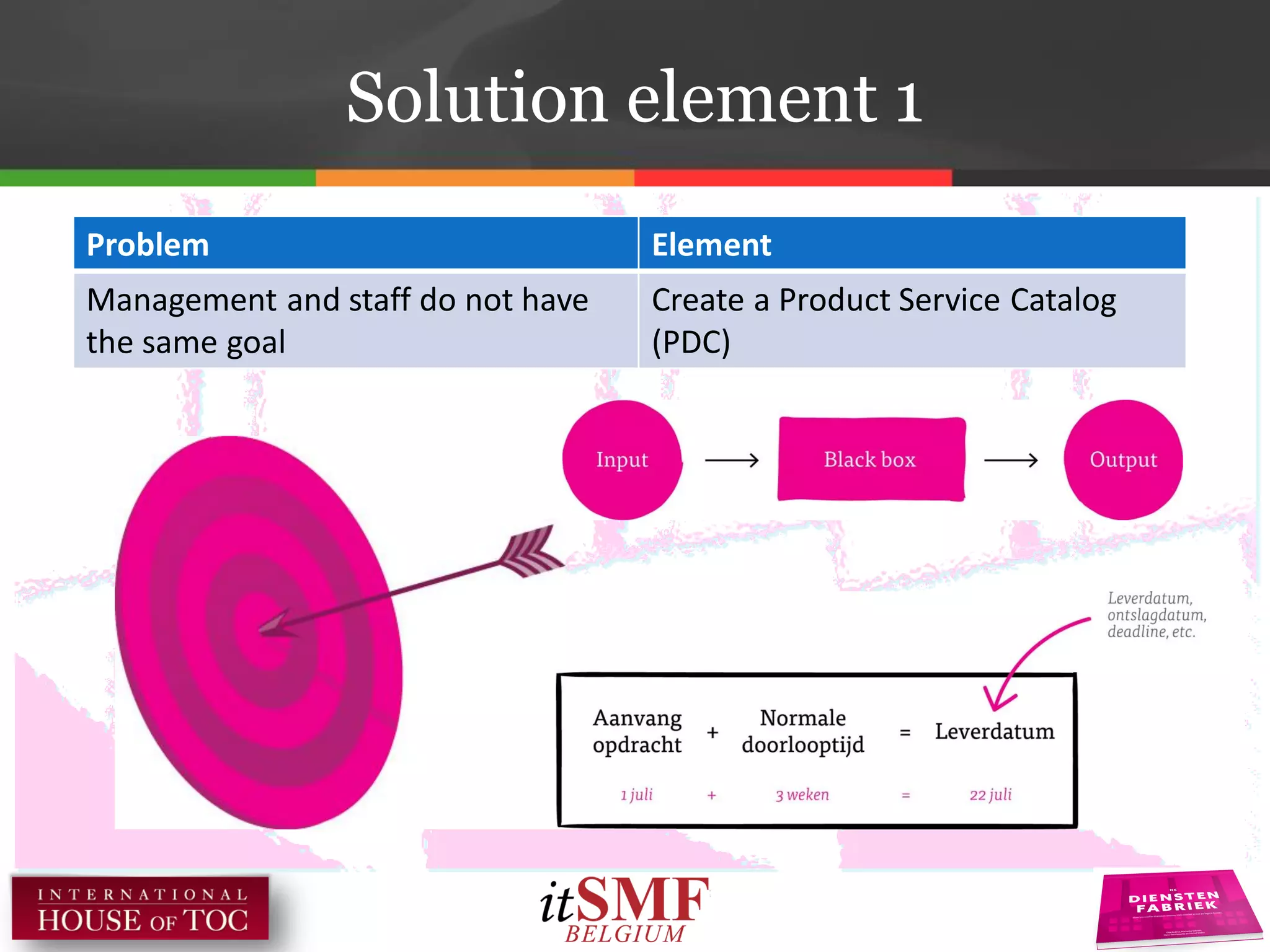
Solution element 1
Problem Element
Management and staff do not have
the same goal
Create a Product Service Catalog
(PDC)
Solution element 2
Problem Element
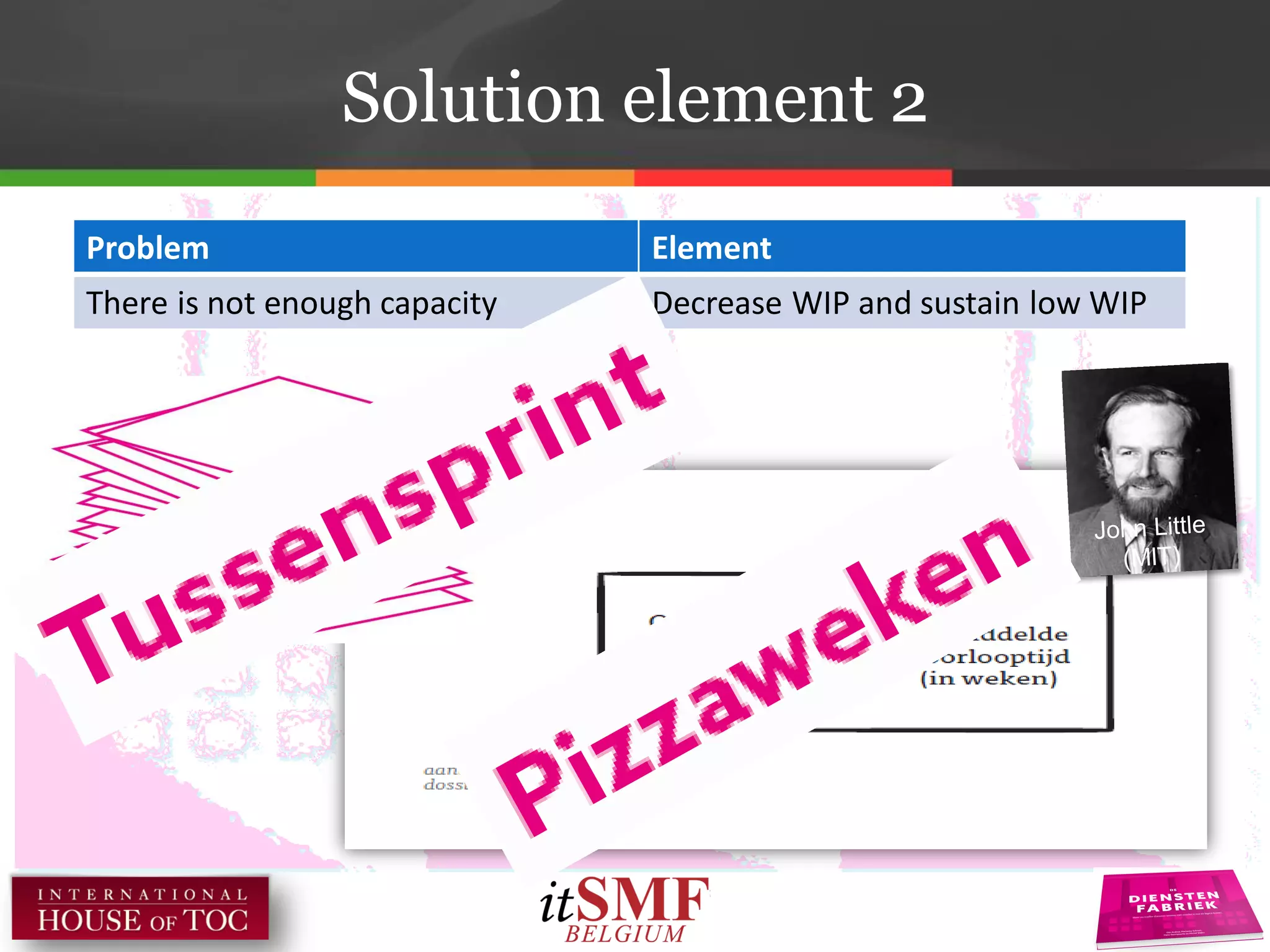
There is not enough capacity Decrease WIP and sustain low WIP
Effect of too much WIP: Multitasking
Prioritizing? Simple!
Assignment: perform 3 ‘projects’ (complex jobs)
• Every project consists of 26 tasks
=> In total: 78 tasks!
• Problem: everything has HIGH priority!!
• Solution: work on all projects simultaneously (simple!)
Let ‘s do a simulation……
3 projects
Project 1 Project 2 Project 3
1 a I
2 b II
Round 1: horizontally!!
Register:
• Time of completion project 1?
• And project 2 and 3?
• # errors?
Round 2: vertically!!
• First finish project 1, then 2 and
then 3
• Register completion time &
errors
• Results?
Solution element 2
Problem Element
There is not enough capacity Decrease WIP and sustain low WIP
Solution element 3
Problem Element
The process is inefficient Optimize processes
Solution element 4
Problem Element
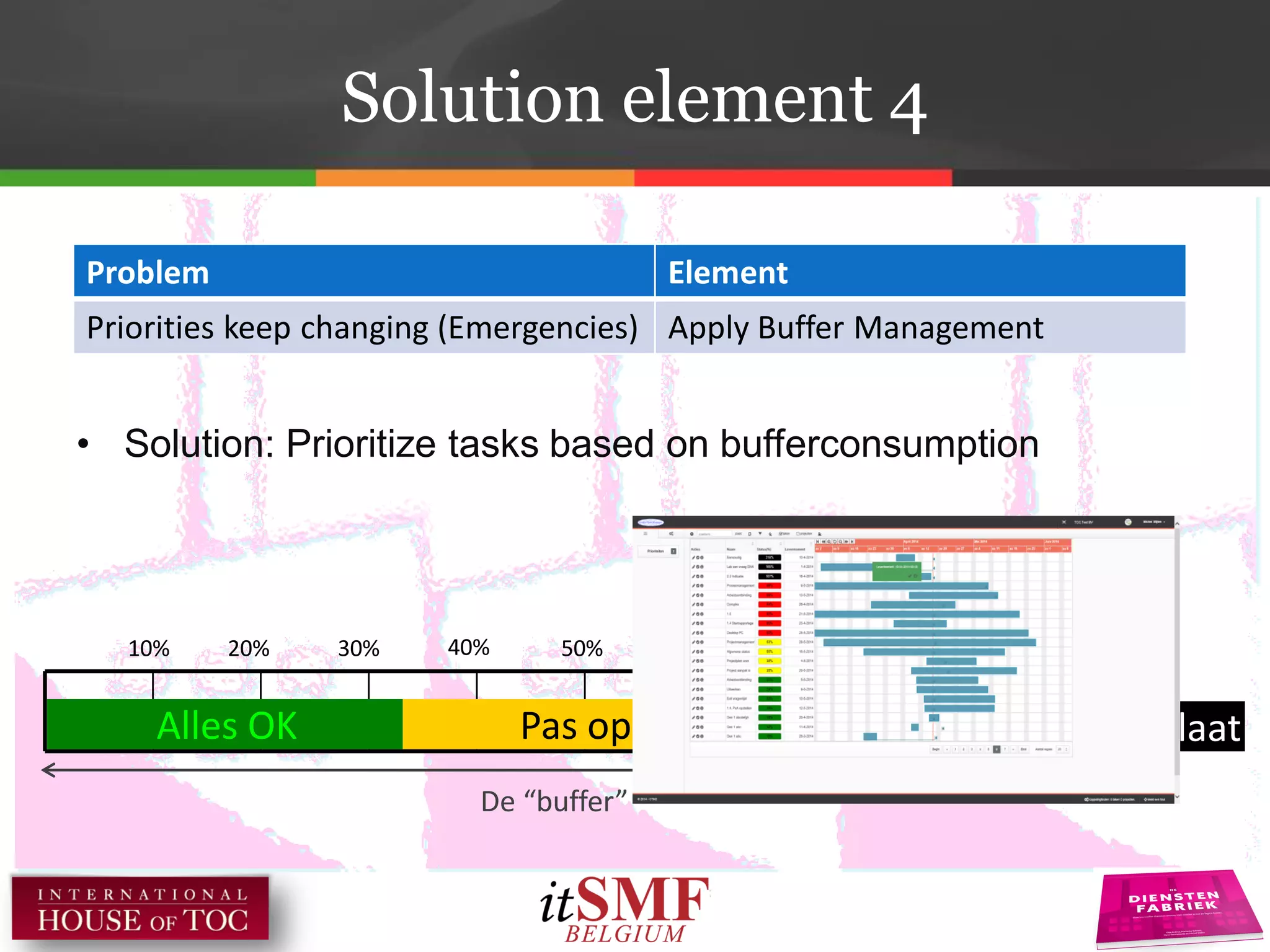
Priorities keep changing (Emergencies) Apply Buffer Management
Alles OK Pas op! Spoed!
10% 20% 30% 40% 50% 60% 70% 80% 90% 100%
Te laat
De “buffer”
• Solution: Prioritize tasks based on bufferconsumption
Solution element 5
Problem Element
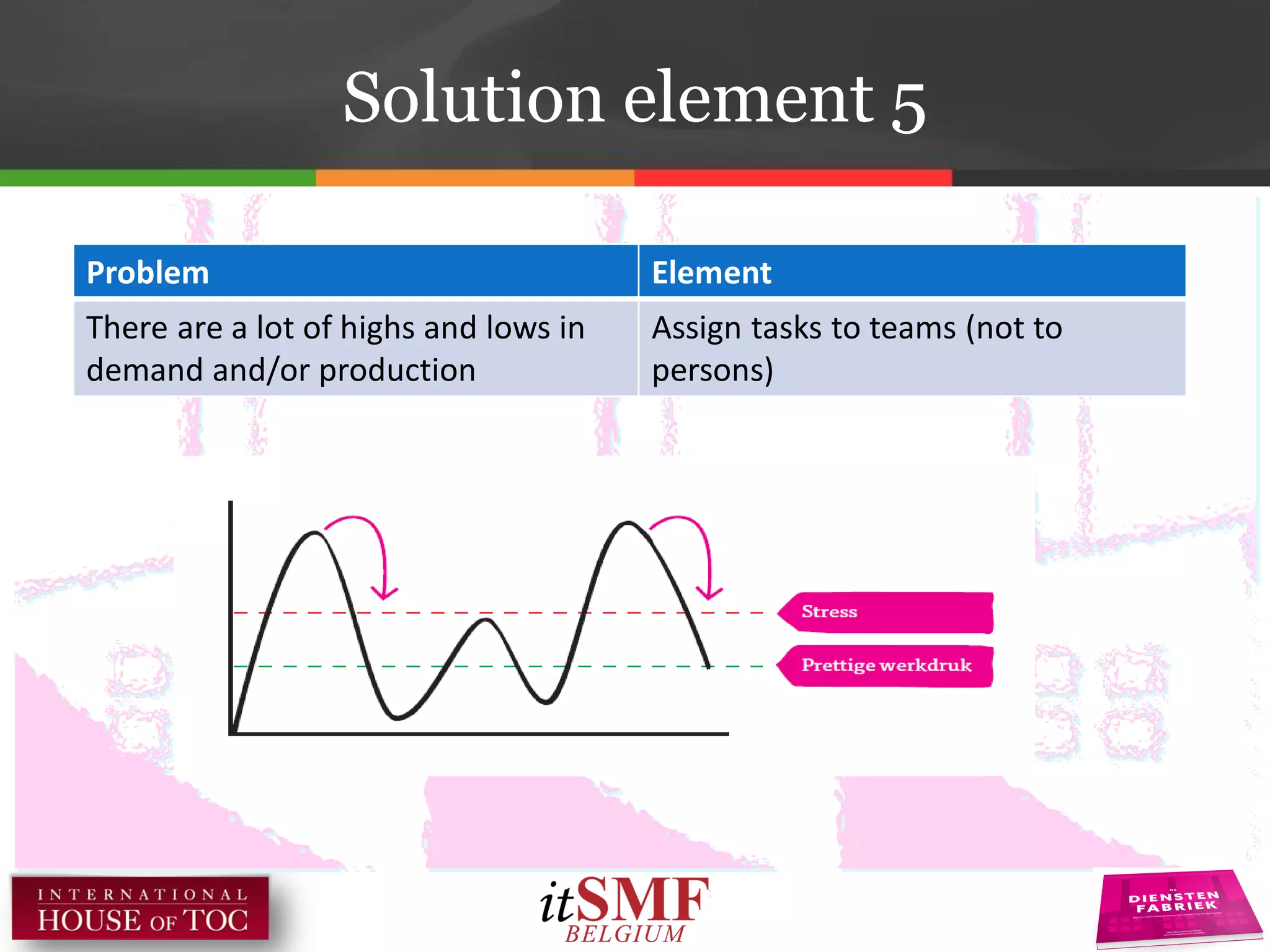
There are a lot of highs and lows in
demand and/or production
Assign tasks to teams (not to
persons)
Solution element 6
Problem Element
Performance is not measured and
improved in a stuctured way
Establish Management processes
Elements of the Solution
Nr Problem Element
1 Management and staff do not have
the same goal
Create a Product Service Catalog
(PDC)
2 There is not enough capacity Decrease WIP and sustain low
WIP
3 The process is inefficient Optimize processes
4 Priorities keep changing
(Emergencies)
Apply Buffer Management
5 There are a lot of highs and lows in
demand and/or production
Assign tasks to teams (not to
persons)
6 Performance is not measured and
improved in a stuctured way
Establish Management processes
Questions?
There was no doubt in my mind that the
lessons being imparted in The Goal were
relevant to the work we do in IT
(Gene Kim – DevOps)
itSMF Belgium kickoff 2015

itSMF Belgium kickoff 2015

  • 18.
    What is TOC? •Systems theory for goal oriented organisations • Developed by the Israeli Phycisist Eli Goldratt (1947 – 2011) • Author of the most read managementbook of all times
  • 19.
    Every complex system isbased on Inherent simplicity What do we mean by Inherent Simplicity? The Starting point
  • 20.
  • 21.
    SYSTEM A SYSTEMB Which system is more complex?
  • 22.
    What do peopledo with a complex system: - Divide in sub-systems - Optimize sub-systems Effect: – Mis-synchonization – Building silo’s – Conflicts in policies and behavior Core message TOC Local optima do not create a global optimum The Program for today
  • 23.
    The Theory OfConstraints defines this as the Inherent Simplicity of the system Only very few factors govern the performance of the system as a whole Inherent Simplicity
  • 24.
    What is yourGoal? Emp. #1 Emp. #3 Emp. #5 Emp. #4 Emp. #6 Emp. #4 Emp. #5 Emp. #2 Emp. #2 Emp. #2Emp. #2 Emp. #1 Emp. #3
  • 25.
    A very, verysimple Organisation • 1 organisation with about 10 departments • Every department has 1 dye capacity and 4 tasks ‘Work in Progress’ • Every ‘day’ (=throw) the department produces the amount of the eyes of the dye – So production will be ….? – So leadtime will be .... ? • Each day (Throw): 1. First ‘produce’ (pass through) 2. Then ‘receive’
  • 26.
    Findings Round 1 •Running and Stopping • Frequently missing work • Increasing Work in Progress • Increasing Leadtime • Stress ......... Sounds familiar? As from Operations Management perspective: • Systems produce significantly less than their capacity (efficiency < 100%). In this case ca. 75% • Leadtime ≠ touchtime • Variability + interdependancy causes – Missing parts en increasing WIP
  • 27.
    How can weimprove? Improve the elements of the system  Increase efficiency per department
  • 28.
    Findings Efficiency • Evenmore WIP  Piles in front of constraint; fast moving after constraint • Stress/pressure at constraint • Exces capacity at non-constraints  Departments produce heavily under available capacity Questions: 1. Does it make sense to produce at the maximum if you are before the constraint?  So what is the use of efficiencytargets on non-constraints? 2. Does it have negative ramifications? 3. What happens if the constraint breaks down?
  • 29.
    How can weimprove? Think…. 1. What is the Goal again? 2. What prevents the system to achieve the most of its goal? 3. So Protect it and put it in the lead
  • 30.
    Findings TOC • Procesis stable • Production is almost equal to theoretical capacity  Constraint is effectively protected against starvation with relatively low WIP • WIP remains low  Leadtime remains low
  • 31.
    TOC’s 5 FocussingSteps 5 Focussing Steps 1. Identifiy the constraint – Constraint: it is thé resource which capacity most prevents the system from achieving more of its goal 2. Decide how to exploit the constraint 3. Subordinate everything else to the above decision 4. Elevate the constraint 5. Go back to step 1 (but beware of the decisions you took in step 3)
  • 32.
    Findings Simulation • Dependencies+ Variability determine the flow through a system • WIP determines leadtime, not the output • ‘Output rules Input’ makes a system stable, fast and easy to improve • 5 Focussing steps cause an Ongoing Improvement
  • 33.
    Problems in mostservice organisations Many things are working fine. But some problems tend to be persistent: • Completion of tasks takes (too) long (long leadtimes) • Too many escalations on (potential) late delivery • Unclear and continuously changing priorities • Continuous disruptions in (resource)planning • Too many complaints • Poor and overdue completion of project(task)s • Projectresources are not available when needed • Incorrect identification for causes of quality issues/problems • Poor solutions for quality issues/problems
  • 34.
    From effects tocauses Speculated causes of poor performance Management and staff do not have the same goal There is not enough capacity The process is inefficient Priorities keep changing (Emergencies) There are a lot of highs and lows in demand and/or production Performance is not measured and improved in a stuctured way
  • 35.
    Good news! (Almost) everyservice provider encounters the same problems! You are not alone
  • 36.
    Solution element 1 ProblemElement Management and staff do not have the same goal Create a Product Service Catalog (PDC)
  • 37.
    Solution element 2 ProblemElement There is not enough capacity Decrease WIP and sustain low WIP
  • 38.
    Effect of toomuch WIP: Multitasking
  • 39.
    Prioritizing? Simple! Assignment: perform3 ‘projects’ (complex jobs) • Every project consists of 26 tasks => In total: 78 tasks! • Problem: everything has HIGH priority!! • Solution: work on all projects simultaneously (simple!) Let ‘s do a simulation……
  • 40.
    3 projects Project 1Project 2 Project 3 1 a I 2 b II Round 1: horizontally!! Register: • Time of completion project 1? • And project 2 and 3? • # errors? Round 2: vertically!! • First finish project 1, then 2 and then 3 • Register completion time & errors • Results?
  • 41.
    Solution element 2 ProblemElement There is not enough capacity Decrease WIP and sustain low WIP
  • 42.
    Solution element 3 ProblemElement The process is inefficient Optimize processes
  • 43.
    Solution element 4 ProblemElement Priorities keep changing (Emergencies) Apply Buffer Management Alles OK Pas op! Spoed! 10% 20% 30% 40% 50% 60% 70% 80% 90% 100% Te laat De “buffer” • Solution: Prioritize tasks based on bufferconsumption
  • 44.
    Solution element 5 ProblemElement There are a lot of highs and lows in demand and/or production Assign tasks to teams (not to persons)
  • 45.
    Solution element 6 ProblemElement Performance is not measured and improved in a stuctured way Establish Management processes
  • 46.
    Elements of theSolution Nr Problem Element 1 Management and staff do not have the same goal Create a Product Service Catalog (PDC) 2 There is not enough capacity Decrease WIP and sustain low WIP 3 The process is inefficient Optimize processes 4 Priorities keep changing (Emergencies) Apply Buffer Management 5 There are a lot of highs and lows in demand and/or production Assign tasks to teams (not to persons) 6 Performance is not measured and improved in a stuctured way Establish Management processes
  • 47.
  • 48.
    There was nodoubt in my mind that the lessons being imparted in The Goal were relevant to the work we do in IT (Gene Kim – DevOps)