Theory of Constraints and  Project Management: Challenging the Dominant Paradigm Bob Donaldson, VP Strategy, McElroy Translation Company
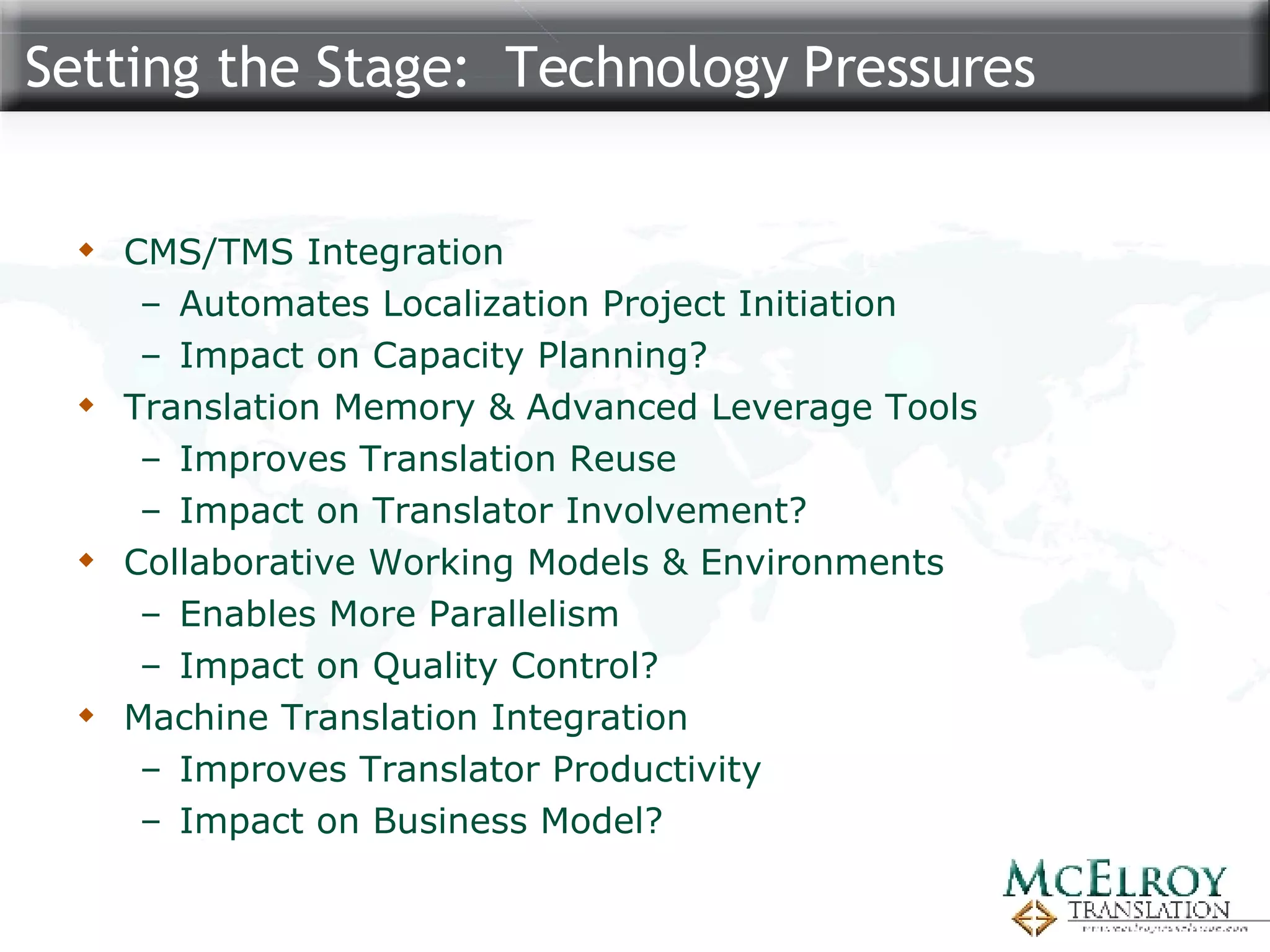
Setting the Stage:  Technology Pressures CMS/TMS Integration Automates Localization Project Initiation Impact on Capacity Planning? Translation Memory & Advanced Leverage Tools Improves Translation Reuse Impact on Translator Involvement? Collaborative Working Models & Environments Enables More Parallelism Impact on Quality Control? Machine Translation Integration Improves Translator Productivity Impact on Business Model?
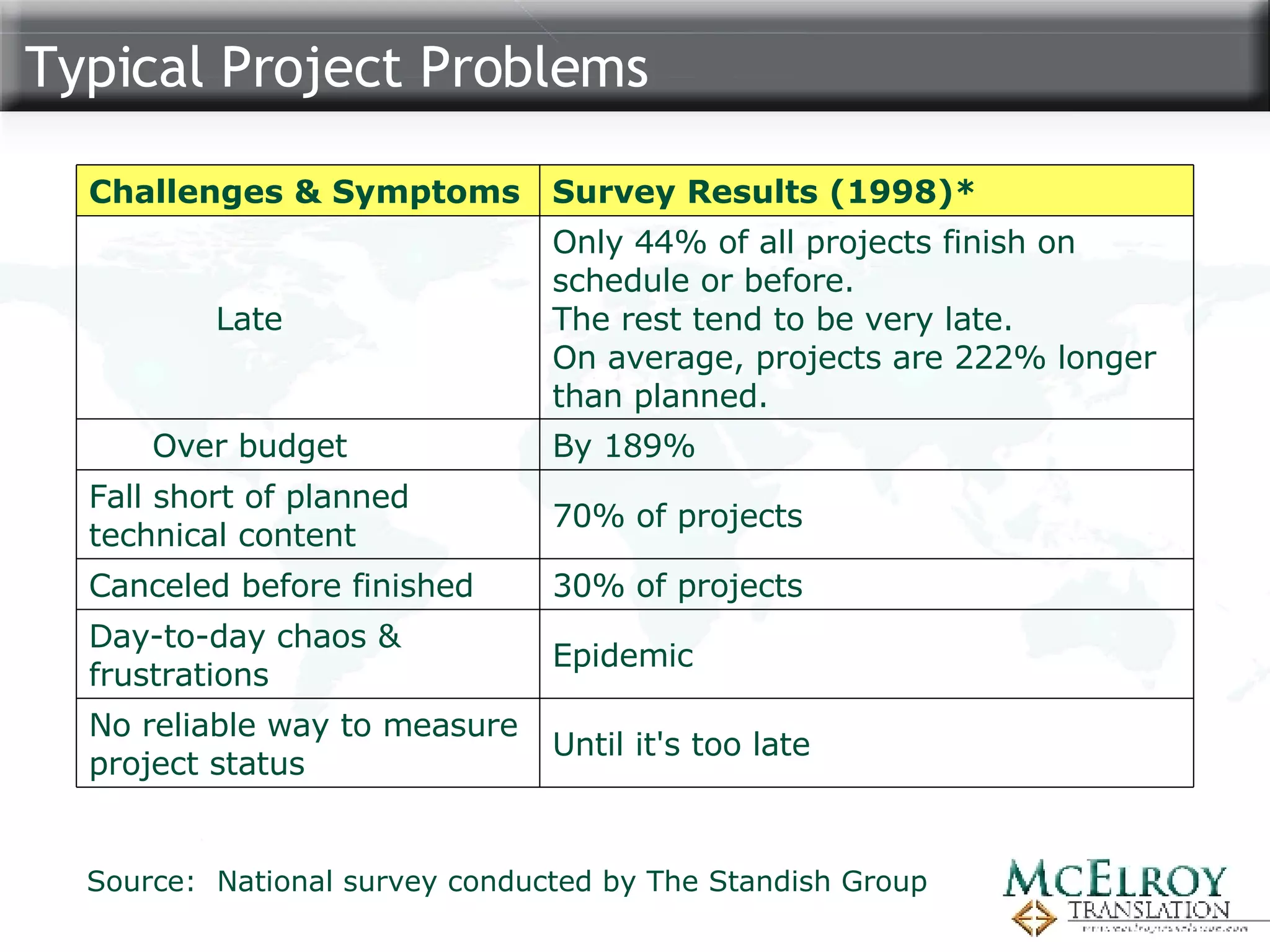
Typical Project Problems Source:  National survey conducted by The Standish Group Until it's too late No reliable way to measure project status Epidemic Day-to-day chaos & frustrations 30% of projects Canceled before finished 70% of projects Fall short of planned technical content By 189% Over budget Only 44% of all projects finish on schedule or before.   The rest tend to be very late.   On average, projects are 222% longer than planned. Late Survey Results (1998)* Challenges & Symptoms
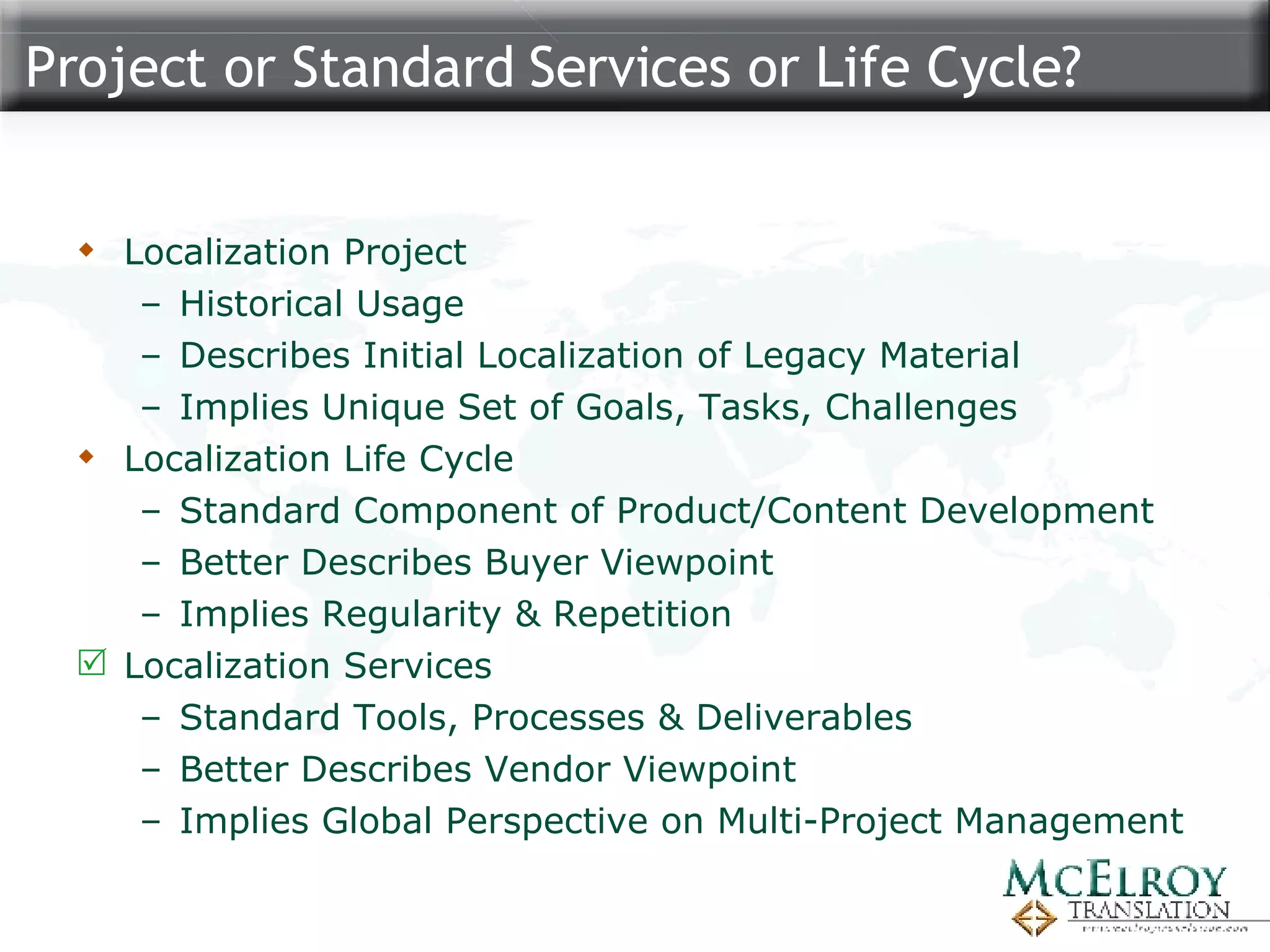
Project or Standard Services or Life Cycle? Localization Project Historical Usage Describes Initial Localization of Legacy Material Implies Unique Set of Goals, Tasks, Challenges Localization Life Cycle Standard Component of Product/Content Development Better Describes Buyer Viewpoint Implies Regularity & Repetition Localization Services Standard Tools, Processes & Deliverables Better Describes Vendor Viewpoint Implies Global Perspective on Multi-Project Management
Service Delivery Challenges Service delivery depends upon people who … Do not always work at the same rate Do not always communicate effectively Constitute a capacity constraint Customer satisfaction depends upon … Service Quality    standard processes Service Responsiveness    flexible processes Management intervention to adjust priorities Suboptimal processes & metrics often create  Interdepartmental friction An environment of chaos
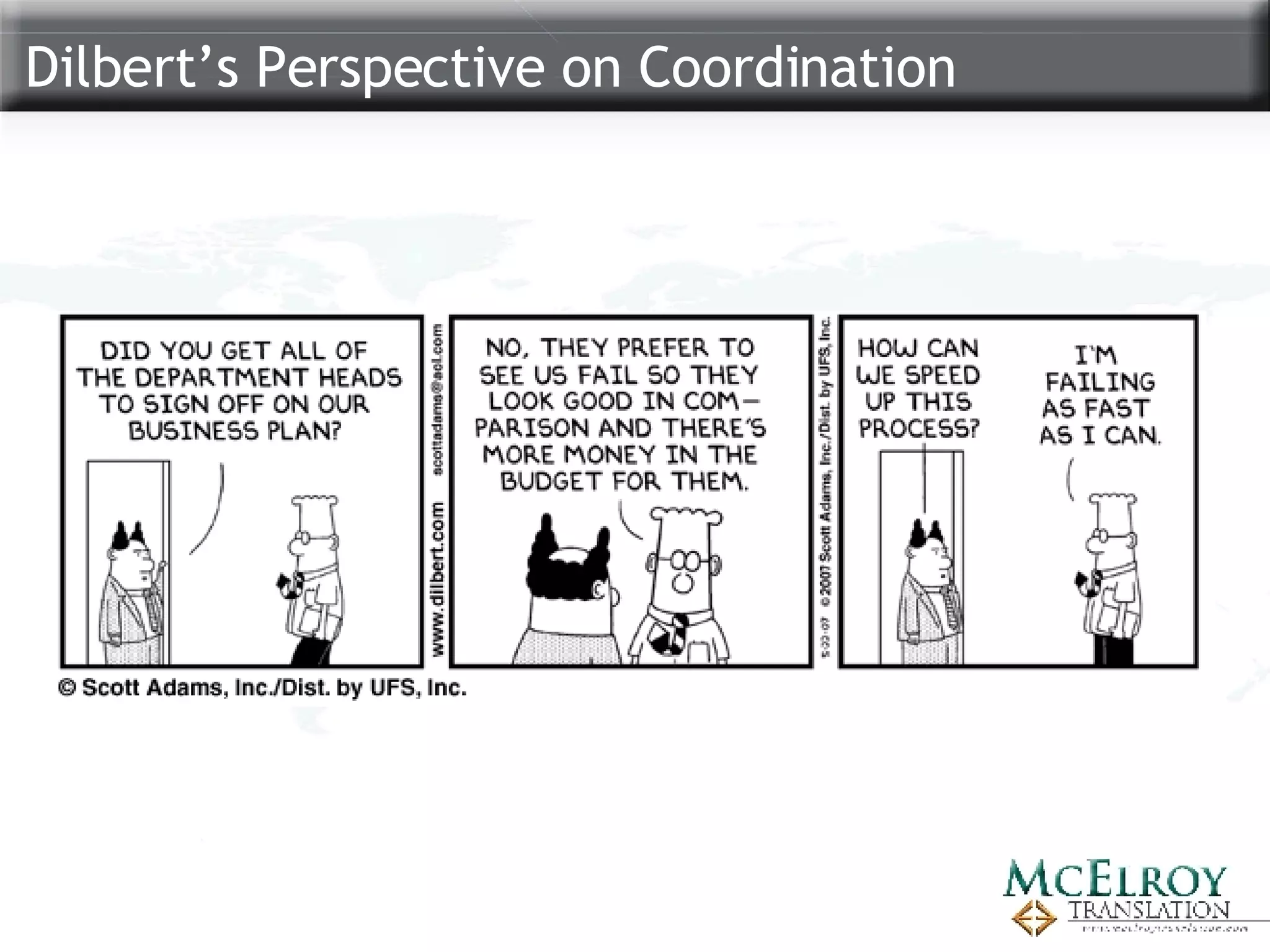
Dilbert’s Perspective on Coordination
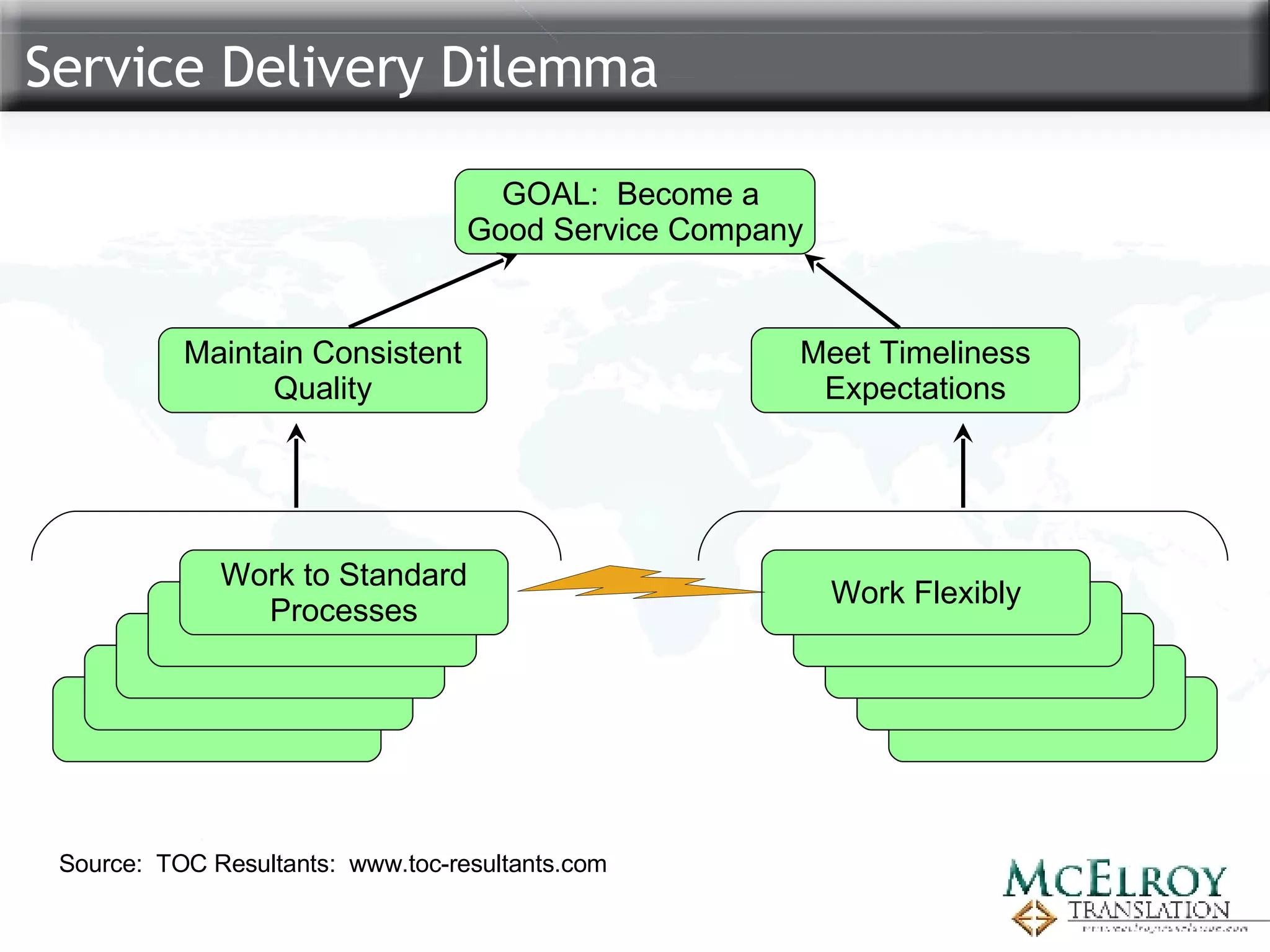
Service Delivery Dilemma GOAL:  Become a  Good Service Company Source:  TOC Resultants:  www.toc-resultants.com Maintain Consistent Quality Meet Timeliness Expectations Work to Standard Processes Work Flexibly
PMBOK – The Current Standard Initiating Sponsorship, Project Goals, etc. Planning Schedule, Budget, Resource Allocation, etc. Executing Monitoring, Problem Resolution, QA, etc. Controlling Performance/Risk Reporting, Forecasting, etc. Closing Delivery, Lessons Learned, etc.
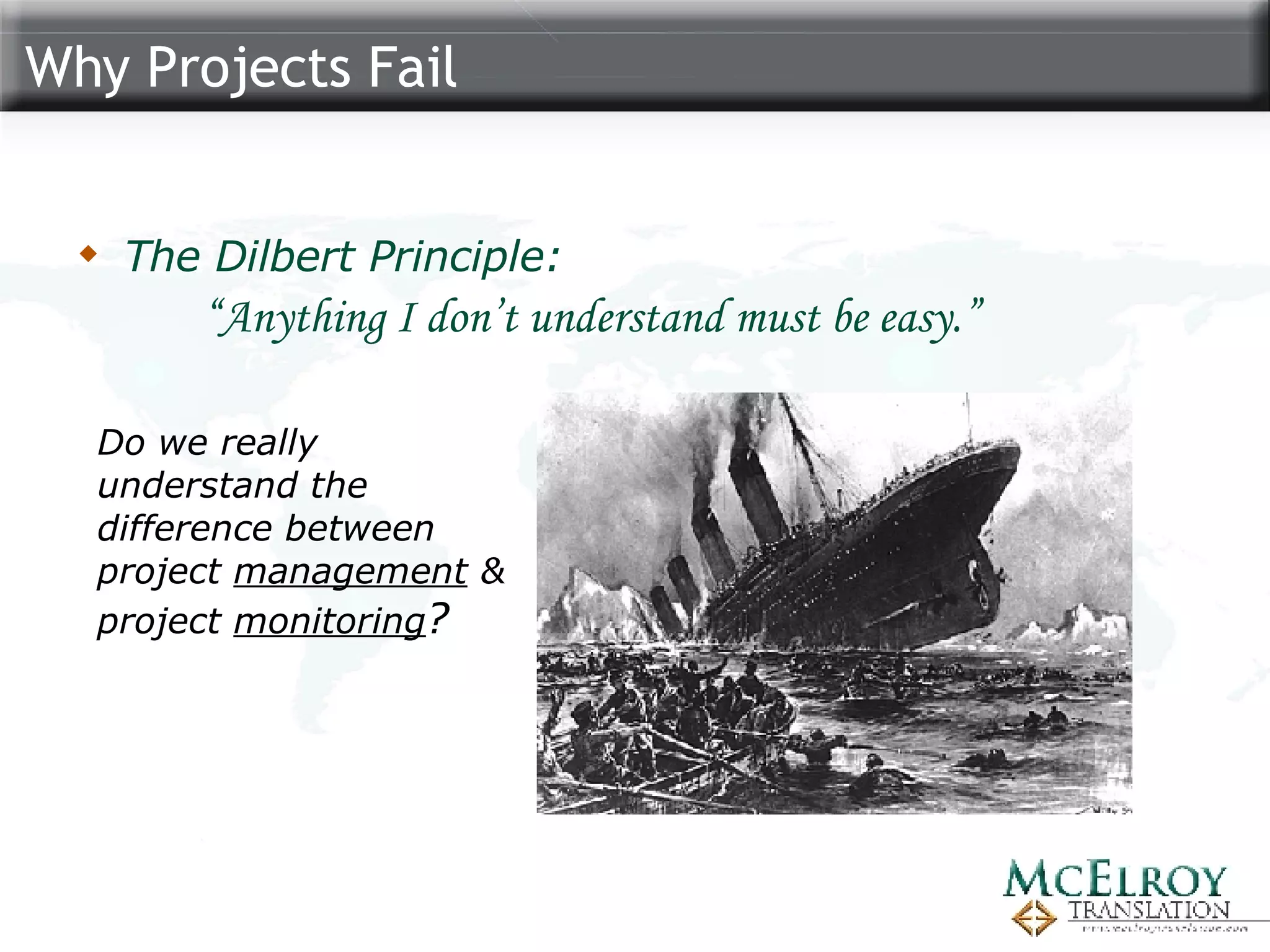
Why Projects Fail The   Dilbert Principle: “ Anything I don’t understand must be easy.” Do we really understand the difference between project  management  & project  monitoring ?
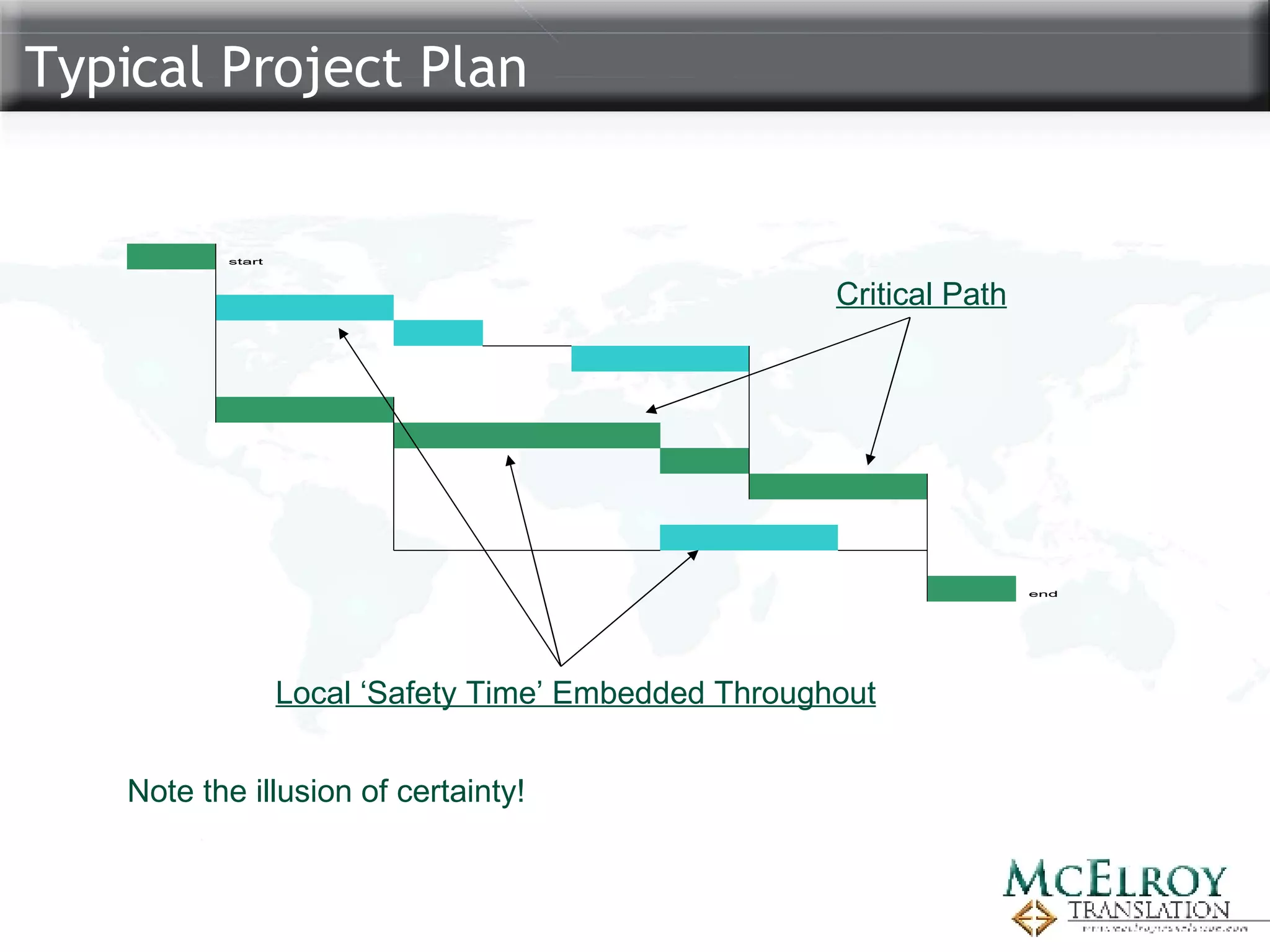
Typical Project Plan Note the illusion of certainty! Critical Path Local ‘Safety Time’ Embedded Throughout
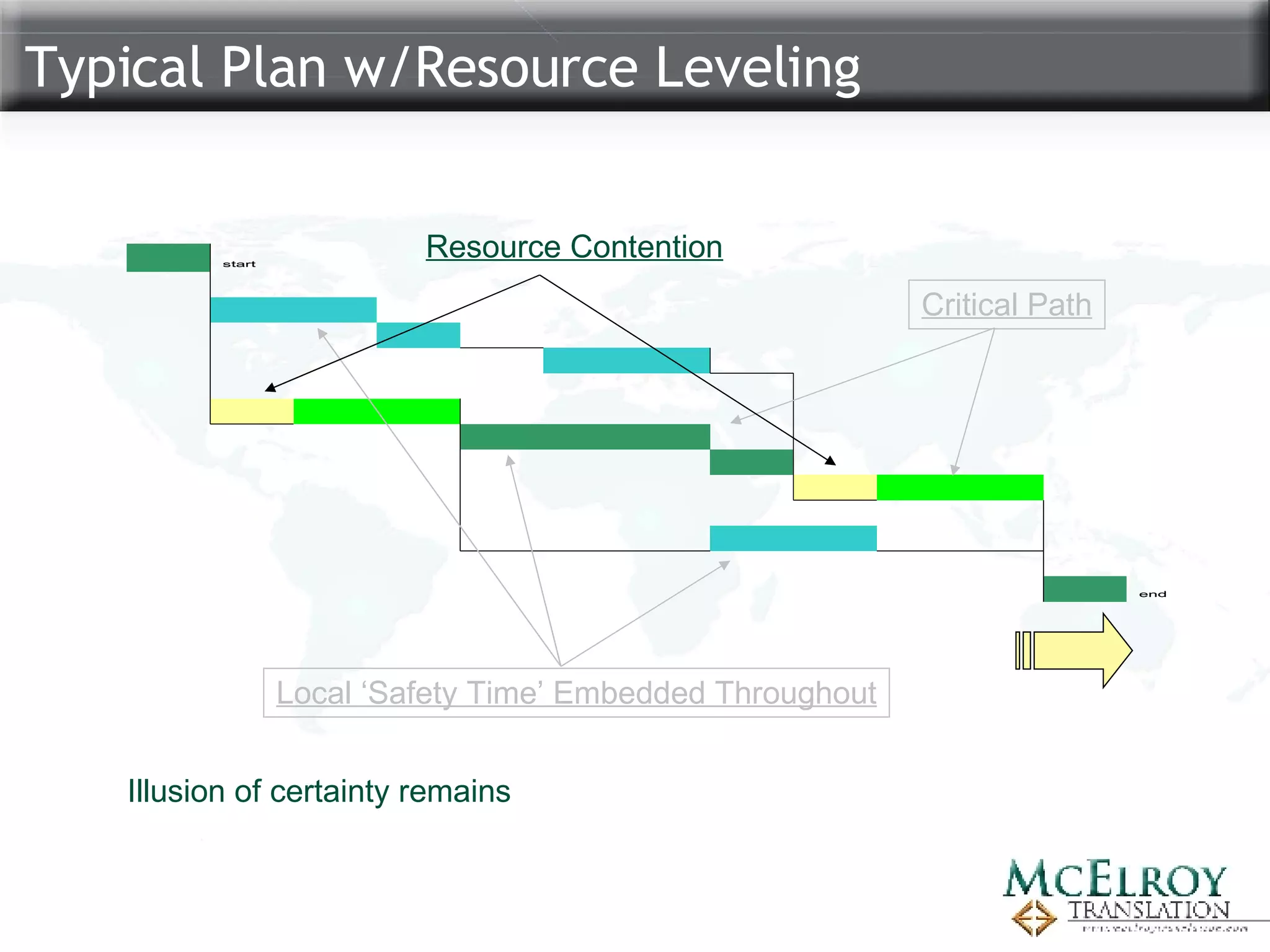
Typical Plan w/Resource Leveling Illusion of certainty remains Critical Path Local ‘Safety Time’ Embedded Throughout Resource Contention
Multi-Project [Standard Services] Issues Actual Performance? Early Late Expected Performance Early Late ……
Parkinson’s Law 1  C. Northcote Parkinson; The Economist, Nov. 1955 Work expands to fill the time  available for its completion 1 The root problem is “Safety” time!
Implications for Project Execution Resources scheduled to maximize utilization Late completion is penalized (obviously) So local safety time expands  Early completion is  also  penalized “ Excess” capacity invites more work Utilization is often part of performance reviews Credibility of estimates may be in question On-time delivery is placed at risk Current ‘on time’ status not indicative of risk Time ‘saved’ by early completion is typically wasted Time ‘lost’ by late completion cascades to subsequent tasks (and projects!)
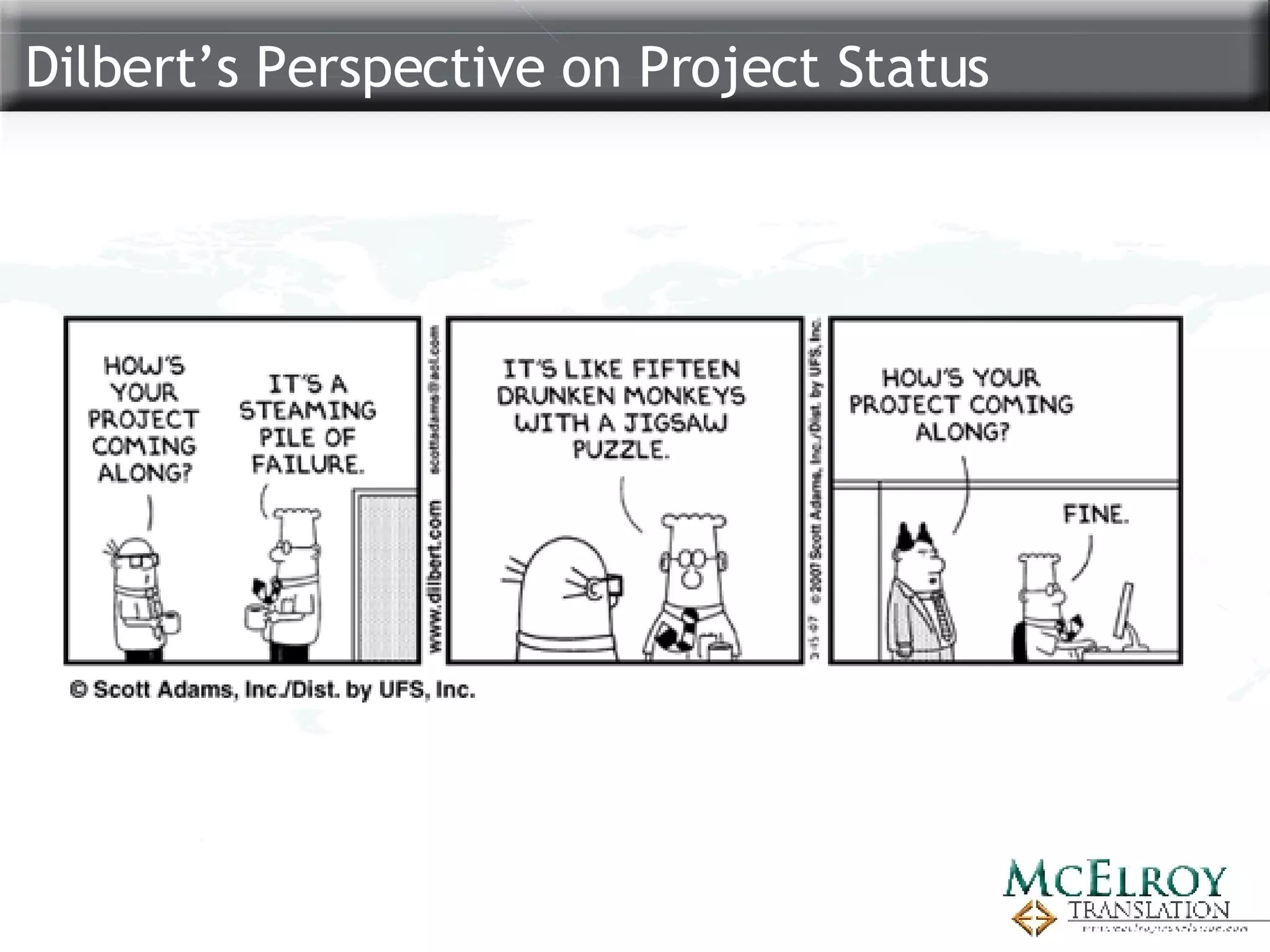
Dilbert’s Perspective on Project Status
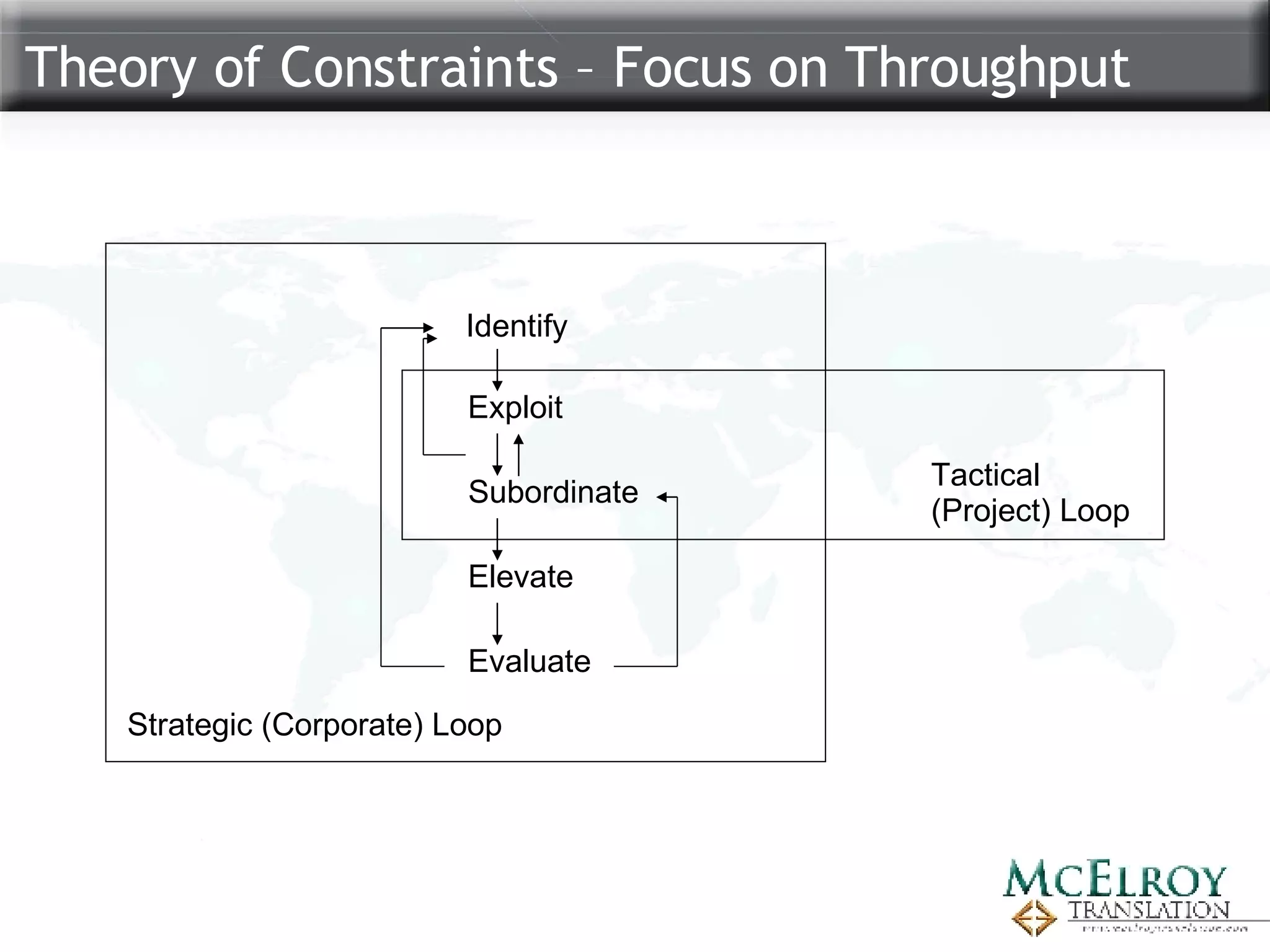
Theory of Constraints – Focus on Throughput Identify Exploit Subordinate Elevate Evaluate Strategic (Corporate) Loop Tactical  (Project) Loop
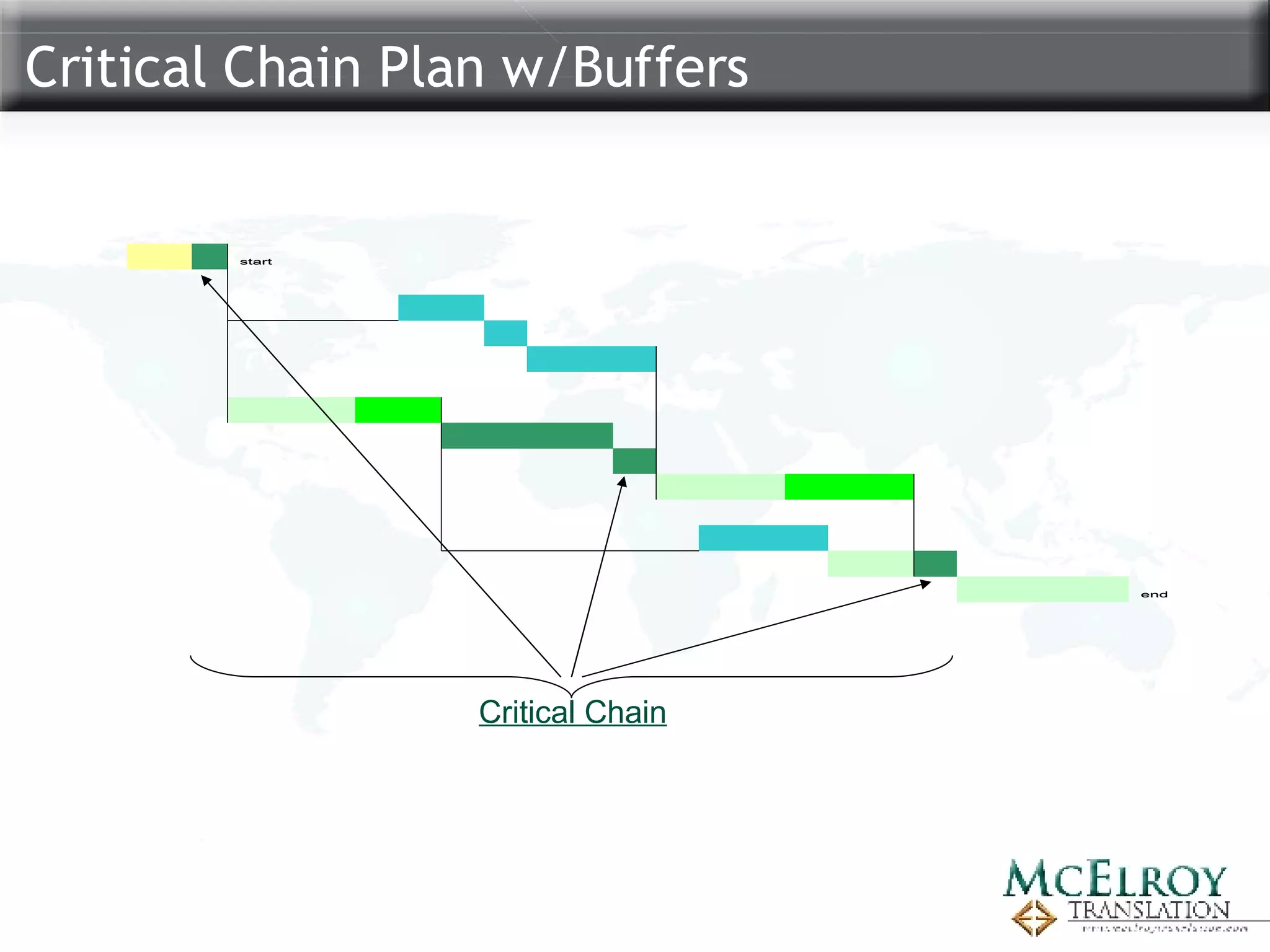
Tactical Constraints – Single Project Goal is to deliver project benefit as quickly as possible Effective project management involves  Identifying  the  critical chain of tasks  that are constraining the project’s completion Exploiting  potential capacity constraints through effective scheduling Subordinating  non-critical tasks &  Controlling  uncertainty through buffer management Focus on  throughput  not utilization
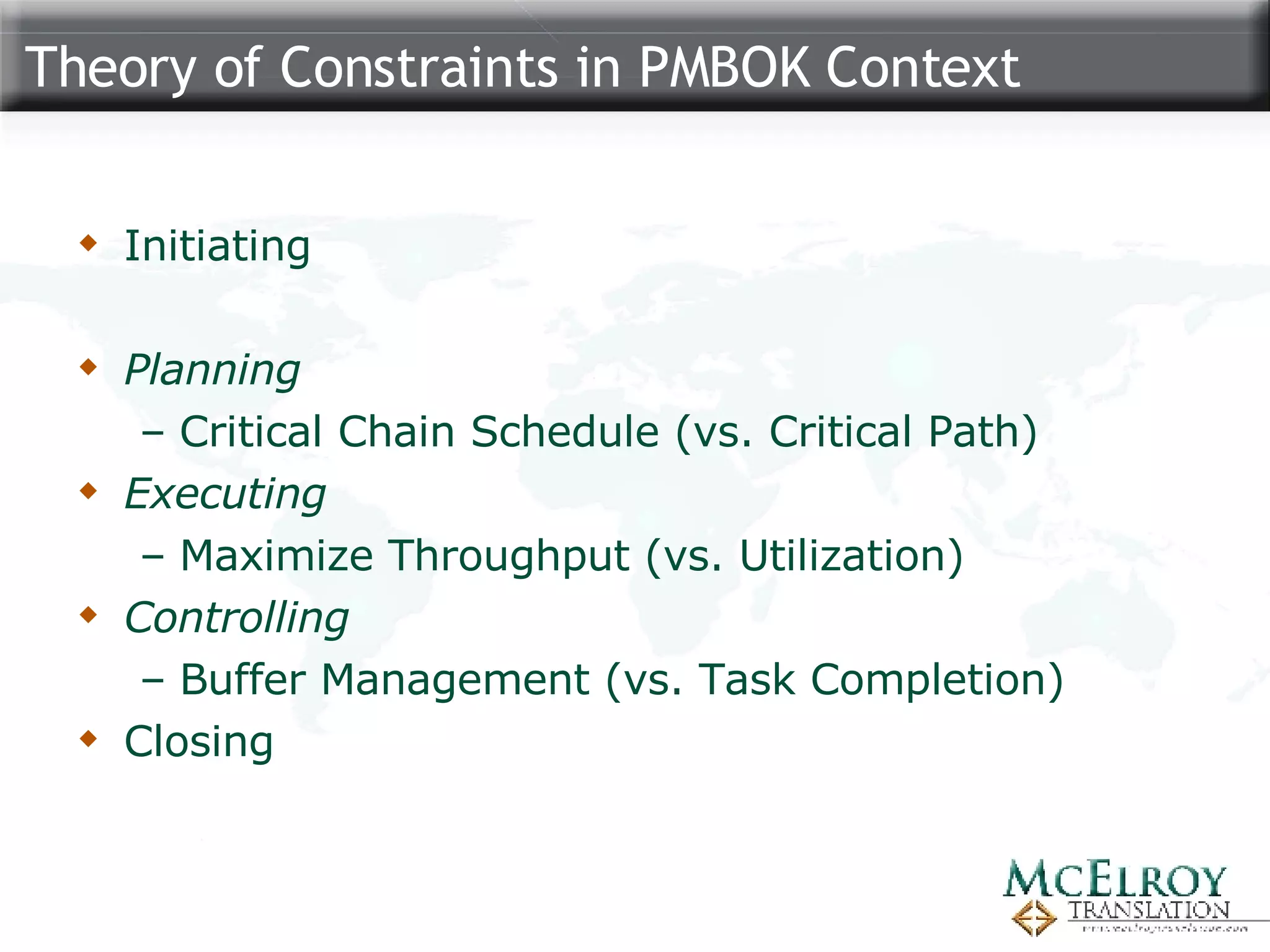
Theory of Constraints in PMBOK Context Initiating Planning Critical Chain Schedule (vs. Critical Path) Executing Maximize Throughput (vs. Utilization) Controlling Buffer Management (vs. Task Completion) Closing
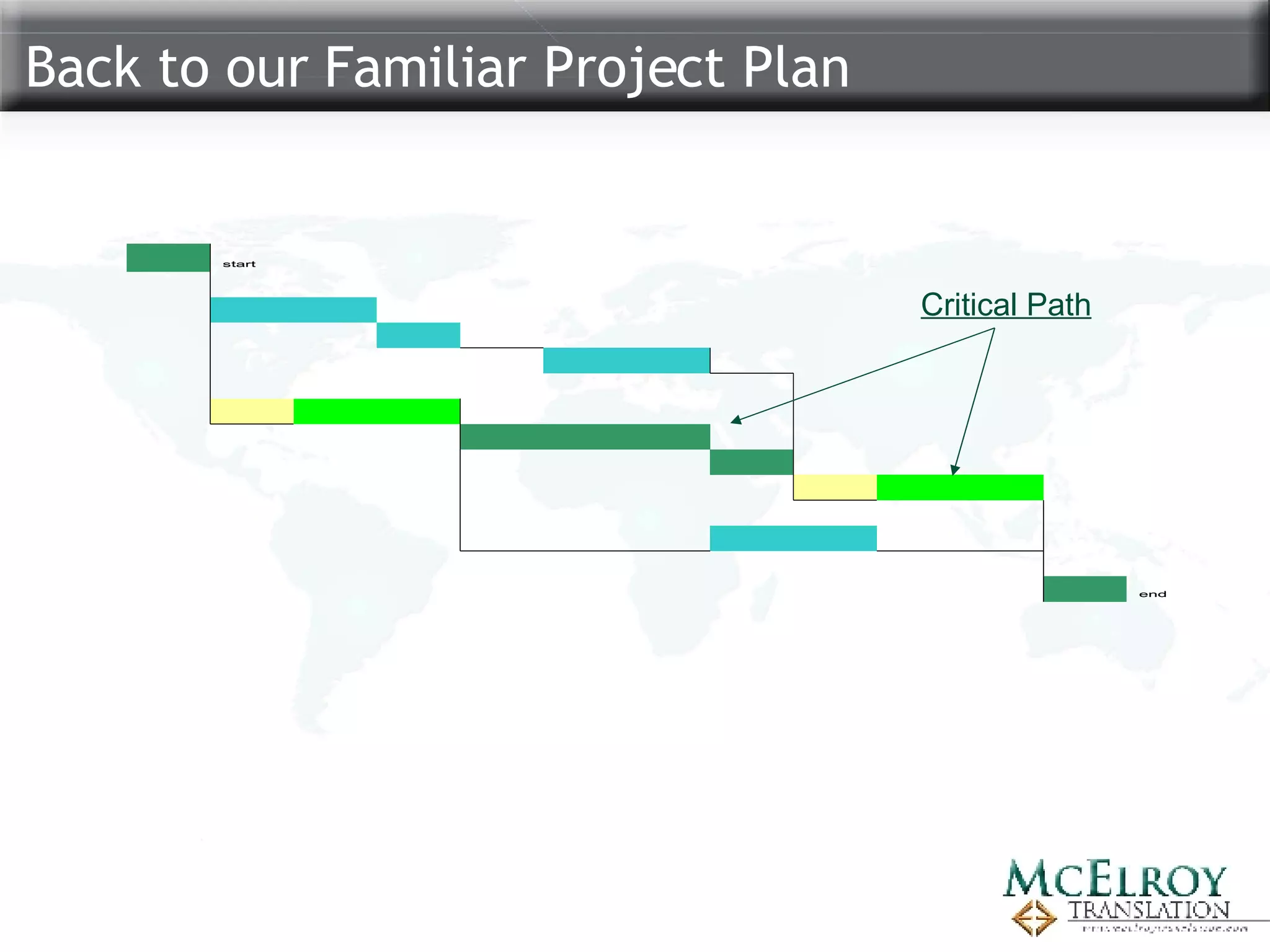
Back to our Familiar Project Plan Critical Path
Critical Chain Plan w/Buffers Critical Chain
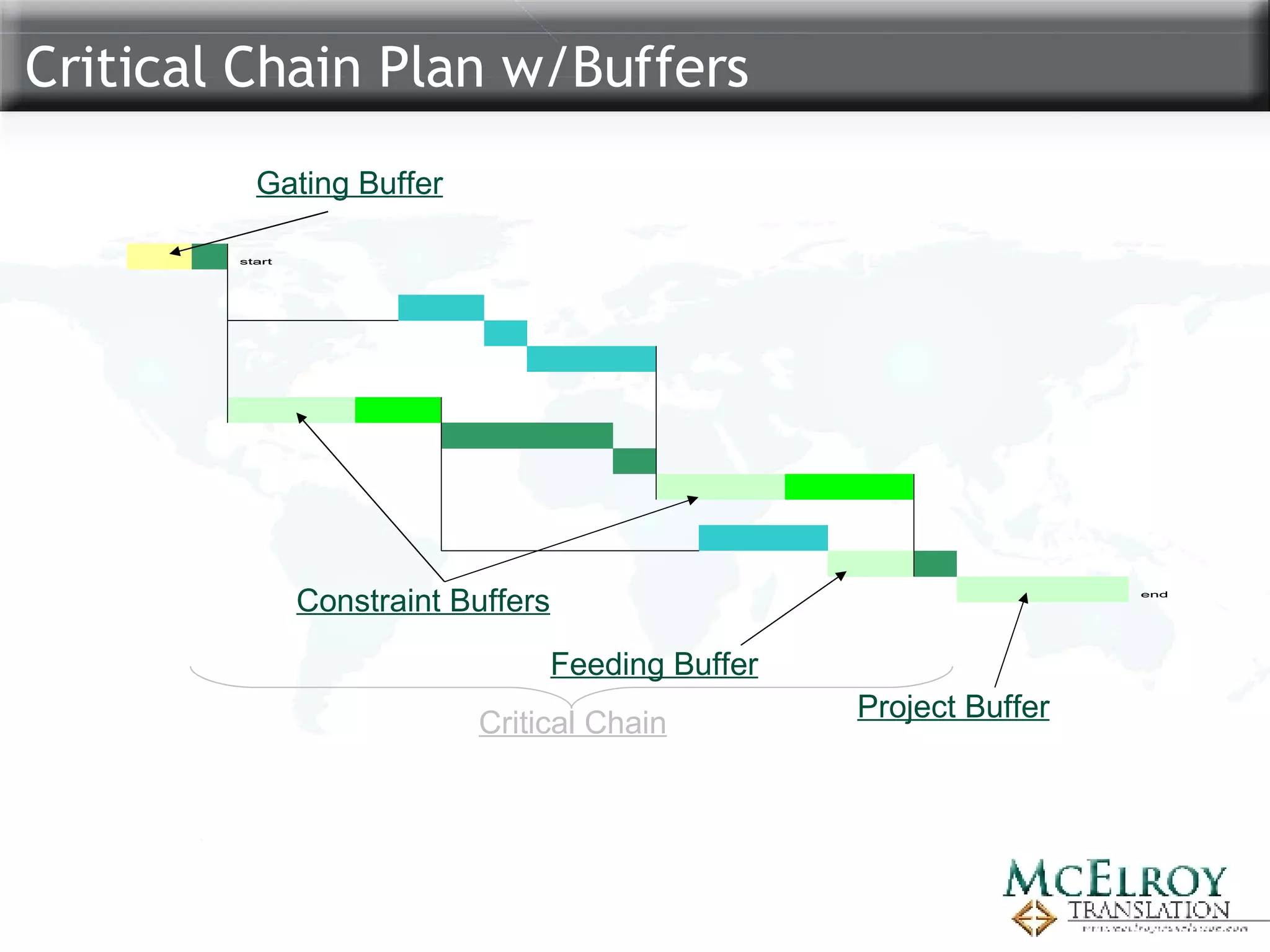
Critical Chain Plan w/Buffers Gating Buffer Constraint Buffers Feeding Buffer Project Buffer Critical Chain
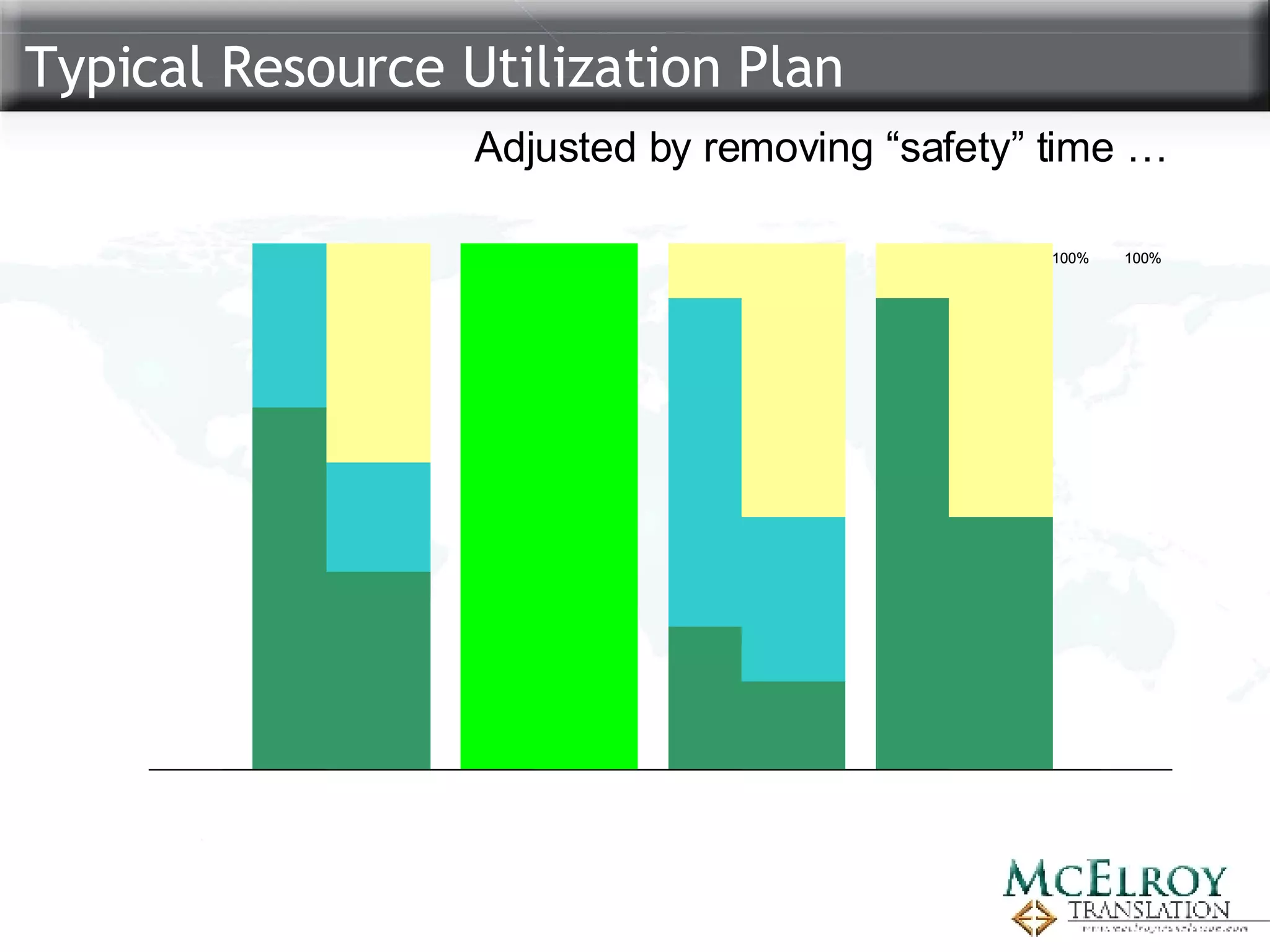
Typical Resource Utilization Plan Adjusted by removing “safety” time …
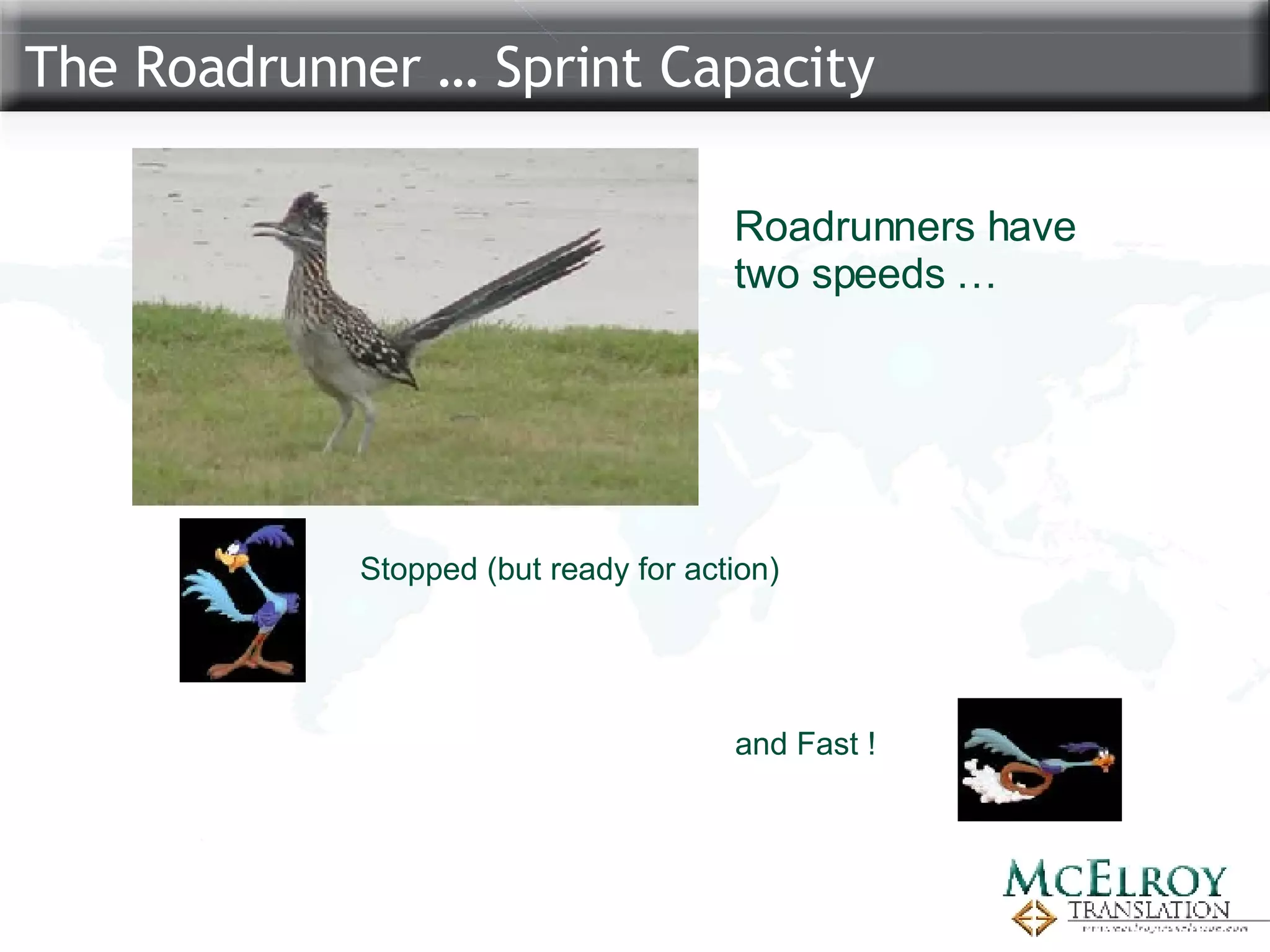
The Roadrunner … Sprint Capacity Roadrunners have  two speeds … Stopped (but ready for action) and Fast !
Roadrunner Advantages Working to capacity per schedule  generates  throughput Not  working ahead  protects  throughput by Preserving “sprint capacity” Avoiding unnecessary work Reducing work in progress It’s all about  throughput !
Strategic Constraints Goal is to maximize organizational throughput “Hard” Constraints Resource Capacity Infrastructure Capacity “Soft” Constraints Existing Policies Existing Performance Metrics
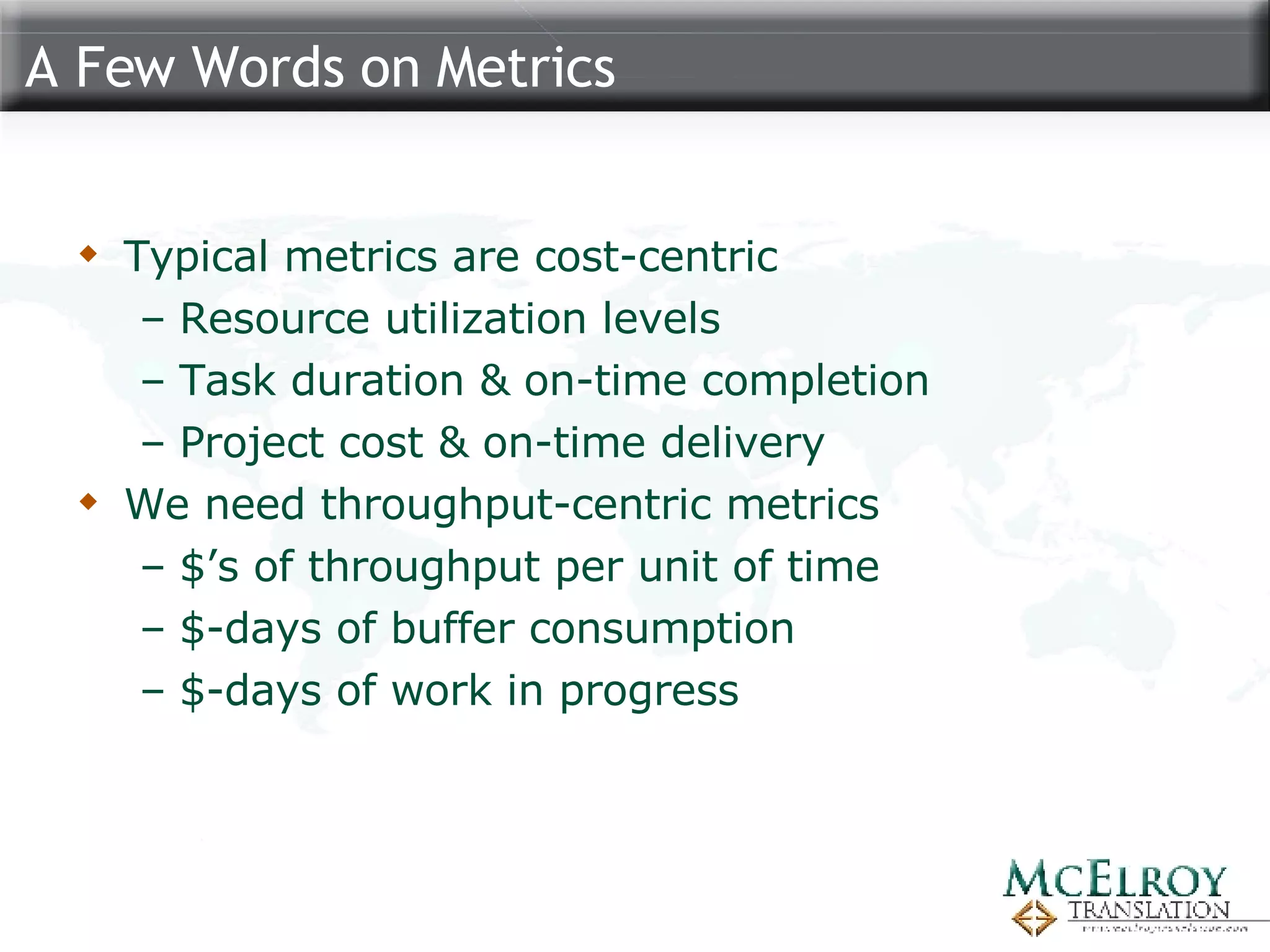
A Few Words on Metrics Typical metrics are cost-centric Resource utilization levels Task duration & on-time completion Project cost & on-time delivery We need throughput-centric metrics $’s of throughput per unit of time $-days of buffer consumption $-days of work in progress
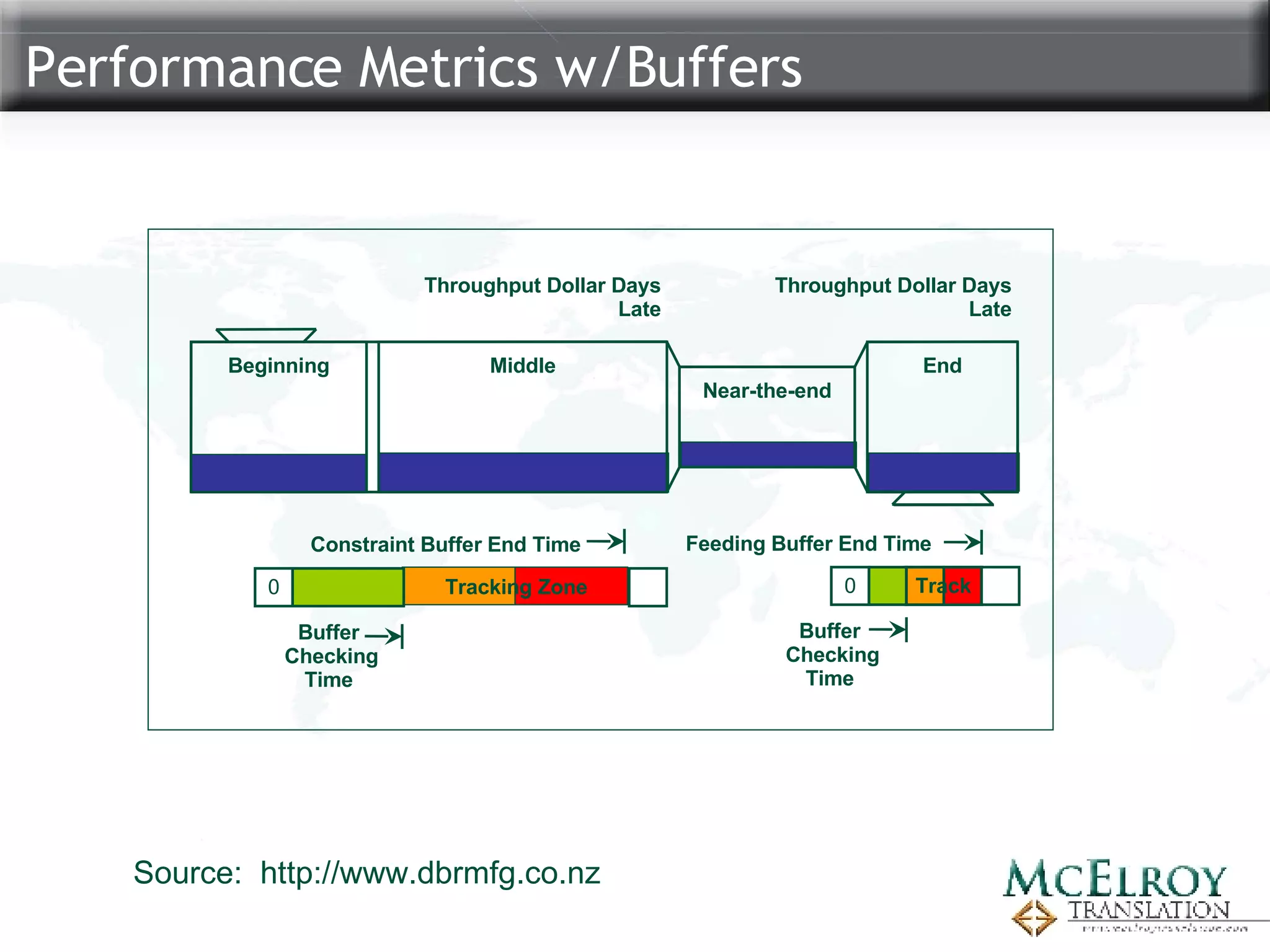
Performance Metrics w/Buffers Source:  http://www.dbrmfg.co.nz Throughput Dollar Days Late Throughput Dollar Days Late Near-the-end Middle Beginning End Track Feeding Buffer End Time 0  Buffer  Checking Time Constraint Buffer End Time 0  Buffer  Checking Time Tracking Zone
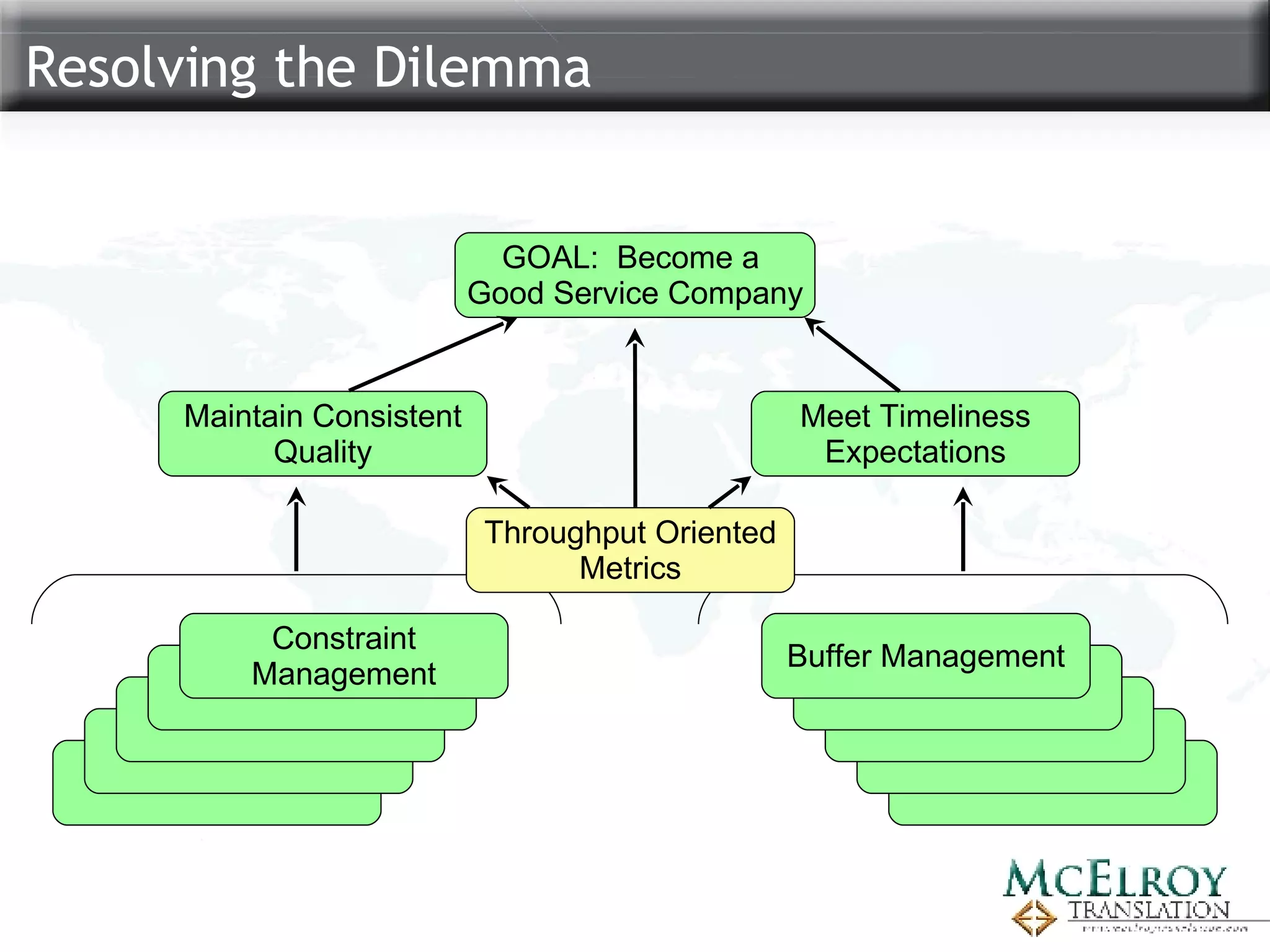
Resolving the Dilemma GOAL:  Become a  Good Service Company Maintain Consistent Quality Meet Timeliness Expectations Constraint Management Buffer Management Throughput Oriented Metrics
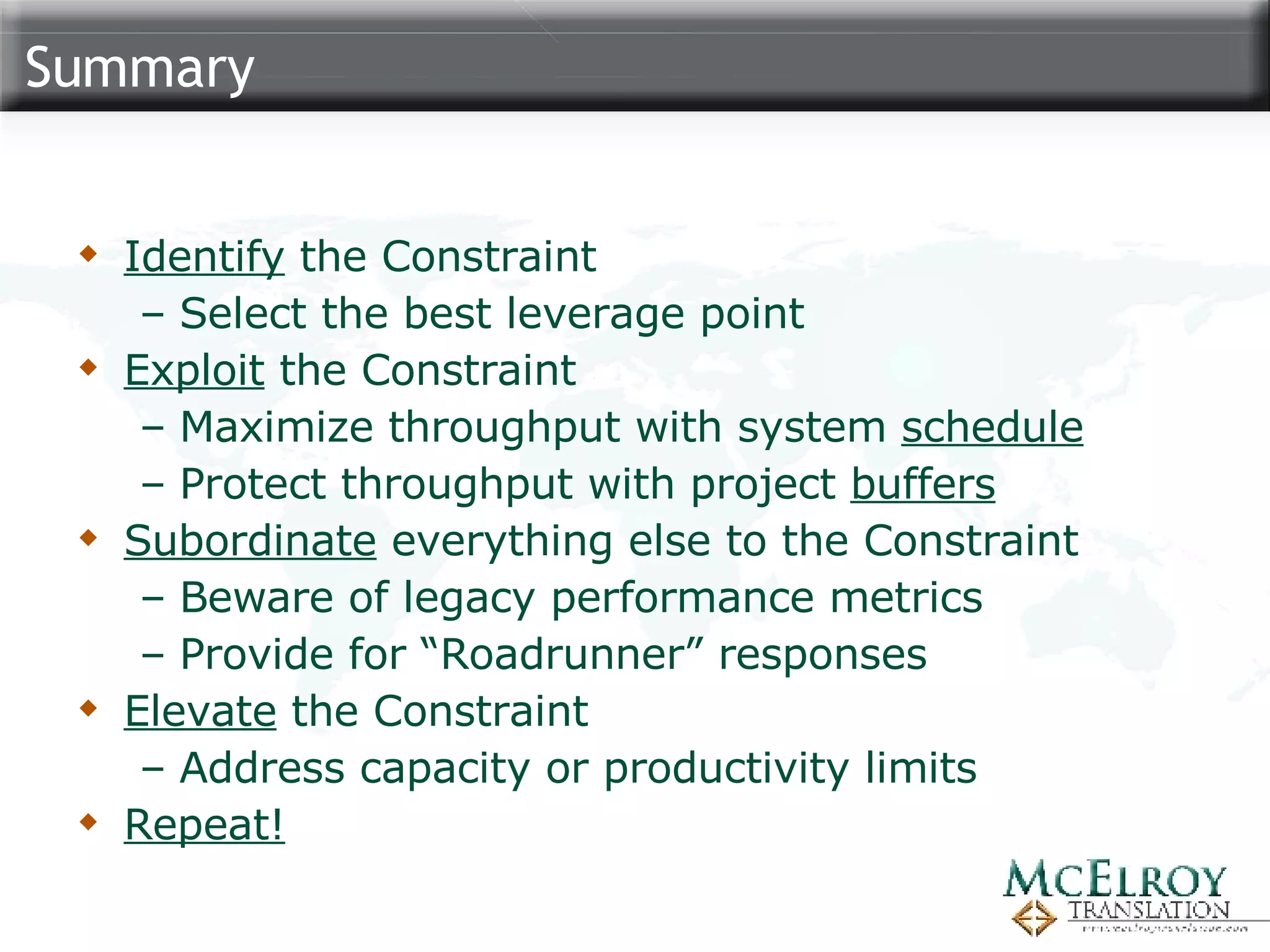
Summary Identify  the Constraint  Select the best leverage point Exploit  the Constraint Maximize throughput with system  schedule Protect throughput with project  buffers Subordinate  everything else to the Constraint Beware of legacy performance metrics Provide for “Roadrunner” responses Elevate  the Constraint Address capacity or productivity limits Repeat!
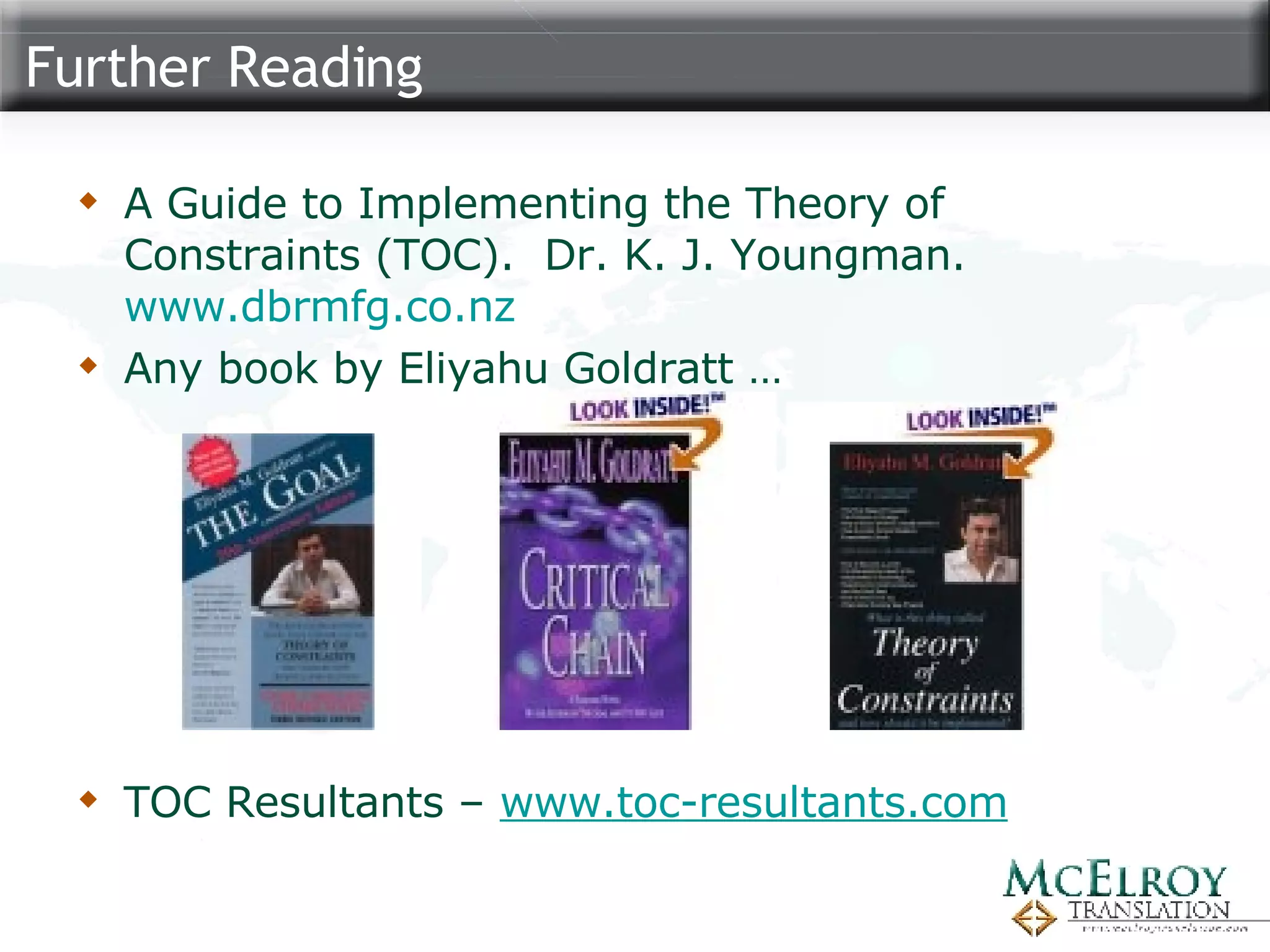
Further Reading A Guide to Implementing the Theory of Constraints (TOC).  Dr. K. J. Youngman.  www.dbrmfg.co.nz Any book by Eliyahu Goldratt … TOC Resultants –  www.toc-resultants.com
Contact Details Bob Donaldson VP Strategy McElroy Translation Company 910 West Avenue Austin, TX  78701 +1 (512) 472-6753 [email_address] www.mcelroytranslation.com

Theory of Constraints and Project Management: Challenging the Dominant Paradigm

  • 1.
    Theory of Constraintsand Project Management: Challenging the Dominant Paradigm Bob Donaldson, VP Strategy, McElroy Translation Company
  • 2.
    Setting the Stage: Technology Pressures CMS/TMS Integration Automates Localization Project Initiation Impact on Capacity Planning? Translation Memory & Advanced Leverage Tools Improves Translation Reuse Impact on Translator Involvement? Collaborative Working Models & Environments Enables More Parallelism Impact on Quality Control? Machine Translation Integration Improves Translator Productivity Impact on Business Model?
  • 3.
    Typical Project ProblemsSource: National survey conducted by The Standish Group Until it's too late No reliable way to measure project status Epidemic Day-to-day chaos & frustrations 30% of projects Canceled before finished 70% of projects Fall short of planned technical content By 189% Over budget Only 44% of all projects finish on schedule or before.  The rest tend to be very late.  On average, projects are 222% longer than planned. Late Survey Results (1998)* Challenges & Symptoms
  • 4.
    Project or StandardServices or Life Cycle? Localization Project Historical Usage Describes Initial Localization of Legacy Material Implies Unique Set of Goals, Tasks, Challenges Localization Life Cycle Standard Component of Product/Content Development Better Describes Buyer Viewpoint Implies Regularity & Repetition Localization Services Standard Tools, Processes & Deliverables Better Describes Vendor Viewpoint Implies Global Perspective on Multi-Project Management
  • 5.
    Service Delivery ChallengesService delivery depends upon people who … Do not always work at the same rate Do not always communicate effectively Constitute a capacity constraint Customer satisfaction depends upon … Service Quality  standard processes Service Responsiveness  flexible processes Management intervention to adjust priorities Suboptimal processes & metrics often create Interdepartmental friction An environment of chaos
  • 6.
  • 7.
    Service Delivery DilemmaGOAL: Become a Good Service Company Source: TOC Resultants: www.toc-resultants.com Maintain Consistent Quality Meet Timeliness Expectations Work to Standard Processes Work Flexibly
  • 8.
    PMBOK – TheCurrent Standard Initiating Sponsorship, Project Goals, etc. Planning Schedule, Budget, Resource Allocation, etc. Executing Monitoring, Problem Resolution, QA, etc. Controlling Performance/Risk Reporting, Forecasting, etc. Closing Delivery, Lessons Learned, etc.
  • 9.
    Why Projects FailThe Dilbert Principle: “ Anything I don’t understand must be easy.” Do we really understand the difference between project management & project monitoring ?
  • 10.
    Typical Project PlanNote the illusion of certainty! Critical Path Local ‘Safety Time’ Embedded Throughout
  • 11.
    Typical Plan w/ResourceLeveling Illusion of certainty remains Critical Path Local ‘Safety Time’ Embedded Throughout Resource Contention
  • 12.
    Multi-Project [Standard Services]Issues Actual Performance? Early Late Expected Performance Early Late ……
  • 13.
    Parkinson’s Law 1 C. Northcote Parkinson; The Economist, Nov. 1955 Work expands to fill the time available for its completion 1 The root problem is “Safety” time!
  • 14.
    Implications for ProjectExecution Resources scheduled to maximize utilization Late completion is penalized (obviously) So local safety time expands Early completion is also penalized “ Excess” capacity invites more work Utilization is often part of performance reviews Credibility of estimates may be in question On-time delivery is placed at risk Current ‘on time’ status not indicative of risk Time ‘saved’ by early completion is typically wasted Time ‘lost’ by late completion cascades to subsequent tasks (and projects!)
  • 15.
  • 16.
    Theory of Constraints– Focus on Throughput Identify Exploit Subordinate Elevate Evaluate Strategic (Corporate) Loop Tactical (Project) Loop
  • 17.
    Tactical Constraints –Single Project Goal is to deliver project benefit as quickly as possible Effective project management involves Identifying the critical chain of tasks that are constraining the project’s completion Exploiting potential capacity constraints through effective scheduling Subordinating non-critical tasks & Controlling uncertainty through buffer management Focus on throughput not utilization
  • 18.
    Theory of Constraintsin PMBOK Context Initiating Planning Critical Chain Schedule (vs. Critical Path) Executing Maximize Throughput (vs. Utilization) Controlling Buffer Management (vs. Task Completion) Closing
  • 19.
    Back to ourFamiliar Project Plan Critical Path
  • 20.
    Critical Chain Planw/Buffers Critical Chain
  • 21.
    Critical Chain Planw/Buffers Gating Buffer Constraint Buffers Feeding Buffer Project Buffer Critical Chain
  • 22.
    Typical Resource UtilizationPlan Adjusted by removing “safety” time …
  • 23.
    The Roadrunner …Sprint Capacity Roadrunners have two speeds … Stopped (but ready for action) and Fast !
  • 24.
    Roadrunner Advantages Workingto capacity per schedule generates throughput Not working ahead protects throughput by Preserving “sprint capacity” Avoiding unnecessary work Reducing work in progress It’s all about throughput !
  • 25.
    Strategic Constraints Goalis to maximize organizational throughput “Hard” Constraints Resource Capacity Infrastructure Capacity “Soft” Constraints Existing Policies Existing Performance Metrics
  • 26.
    A Few Wordson Metrics Typical metrics are cost-centric Resource utilization levels Task duration & on-time completion Project cost & on-time delivery We need throughput-centric metrics $’s of throughput per unit of time $-days of buffer consumption $-days of work in progress
  • 27.
    Performance Metrics w/BuffersSource: http://www.dbrmfg.co.nz Throughput Dollar Days Late Throughput Dollar Days Late Near-the-end Middle Beginning End Track Feeding Buffer End Time 0  Buffer Checking Time Constraint Buffer End Time 0  Buffer Checking Time Tracking Zone
  • 28.
    Resolving the DilemmaGOAL: Become a Good Service Company Maintain Consistent Quality Meet Timeliness Expectations Constraint Management Buffer Management Throughput Oriented Metrics
  • 29.
    Summary Identify the Constraint Select the best leverage point Exploit the Constraint Maximize throughput with system schedule Protect throughput with project buffers Subordinate everything else to the Constraint Beware of legacy performance metrics Provide for “Roadrunner” responses Elevate the Constraint Address capacity or productivity limits Repeat!
  • 30.
    Further Reading AGuide to Implementing the Theory of Constraints (TOC). Dr. K. J. Youngman. www.dbrmfg.co.nz Any book by Eliyahu Goldratt … TOC Resultants – www.toc-resultants.com
  • 31.
    Contact Details BobDonaldson VP Strategy McElroy Translation Company 910 West Avenue Austin, TX 78701 +1 (512) 472-6753 [email_address] www.mcelroytranslation.com