UNIT2:STRUCTURES
OF GLOBALIZATION
The Globalization Of World Economics
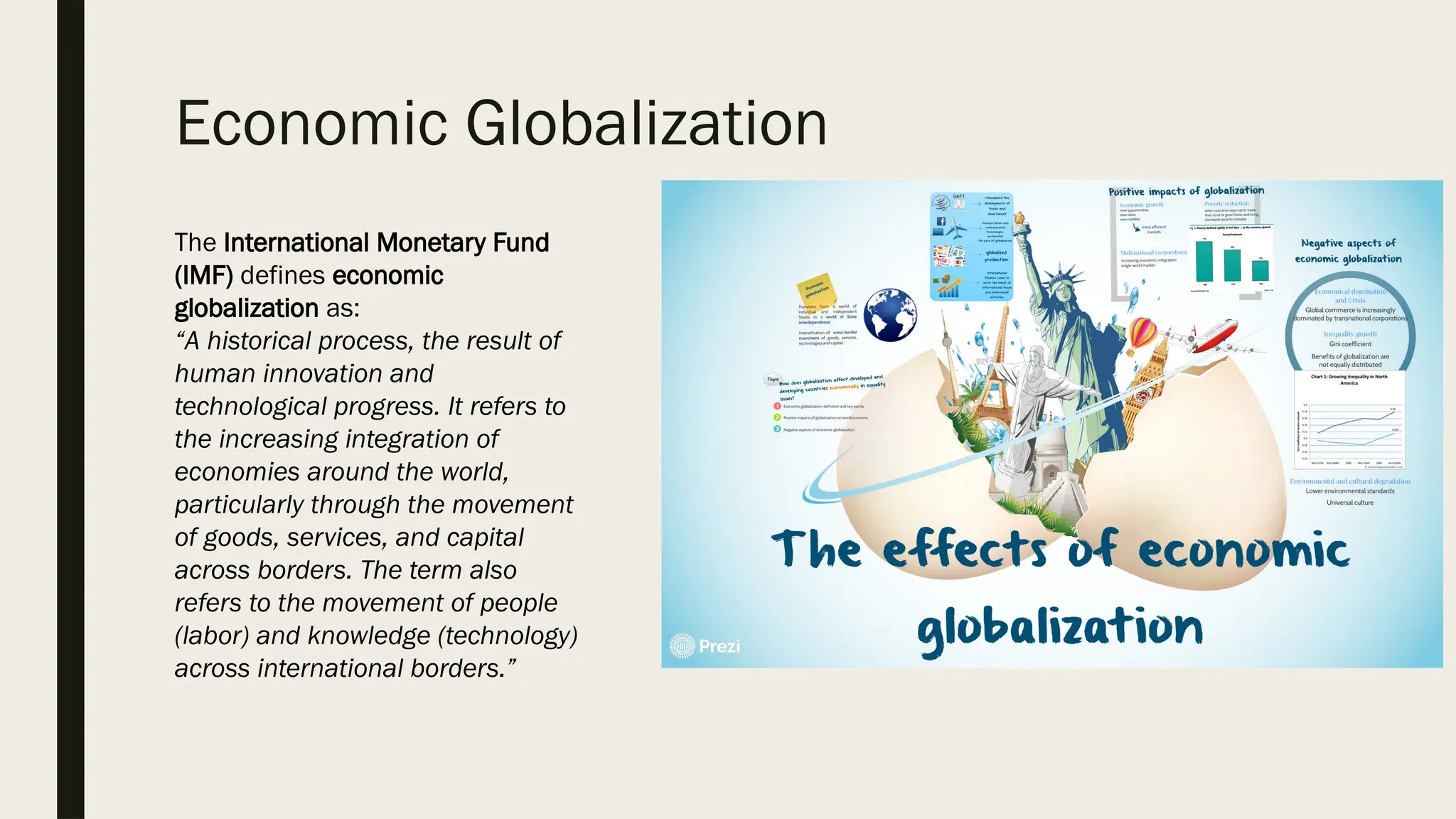
Economic Globalization
The International Monetary Fund
(IMF) defines economic
globalization as:
“A historical process, the result of
human innovation and
technological progress. It refers to
the increasing integration of
economies around the world,
particularly through the movement
of goods, services, and capital
across borders. The term also
refers to the movement of people
(labor) and knowledge (technology)
across international borders.”
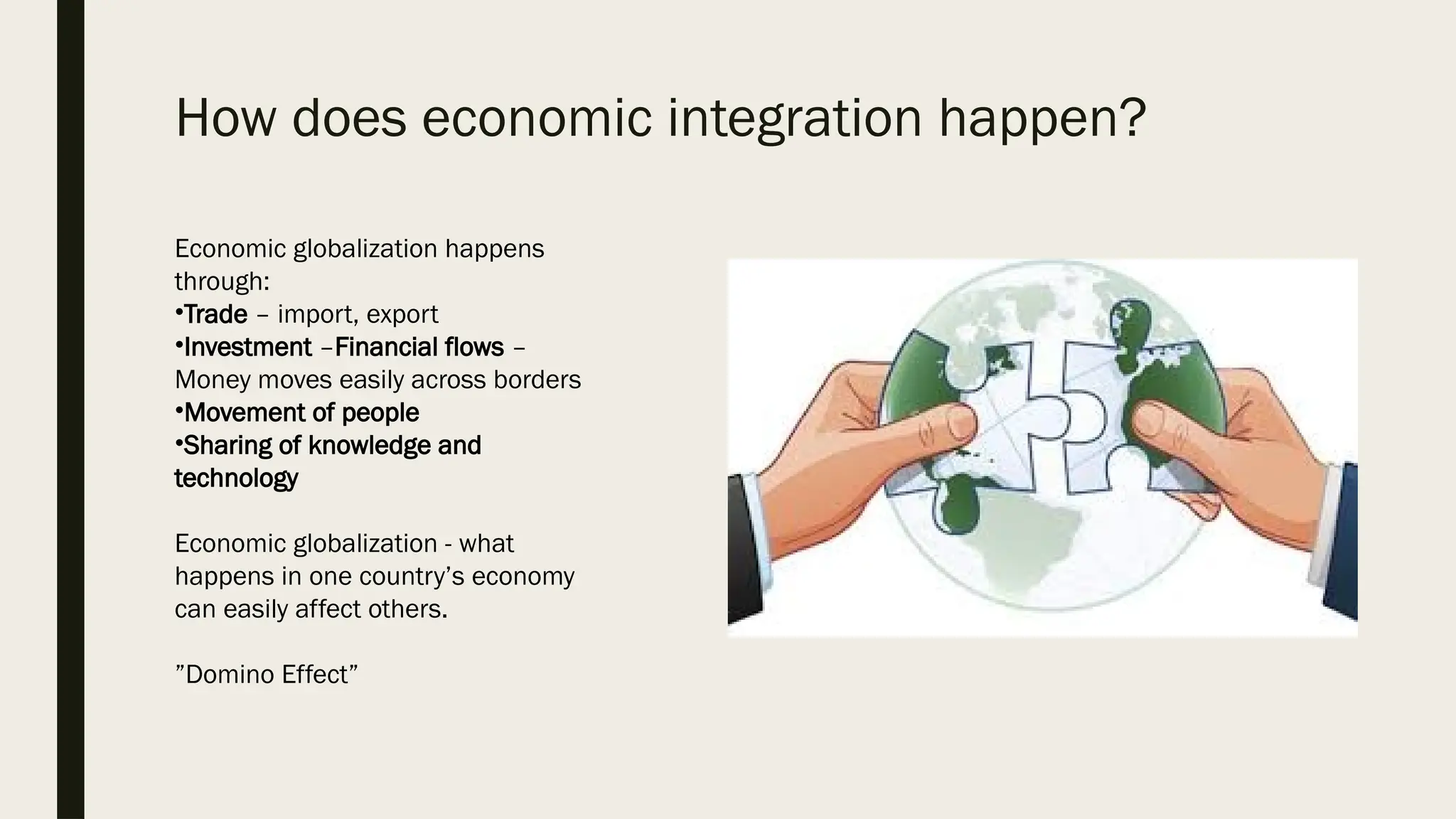
How does economic integration happen?
Economic globalization happens
through:
•Trade – import, export
•Investment –Financial flows –
Money moves easily across borders
•Movement of people
•Sharing of knowledge and
technology
Economic globalization - what
happens in one country’s economy
can easily affect others.
”Domino Effect”
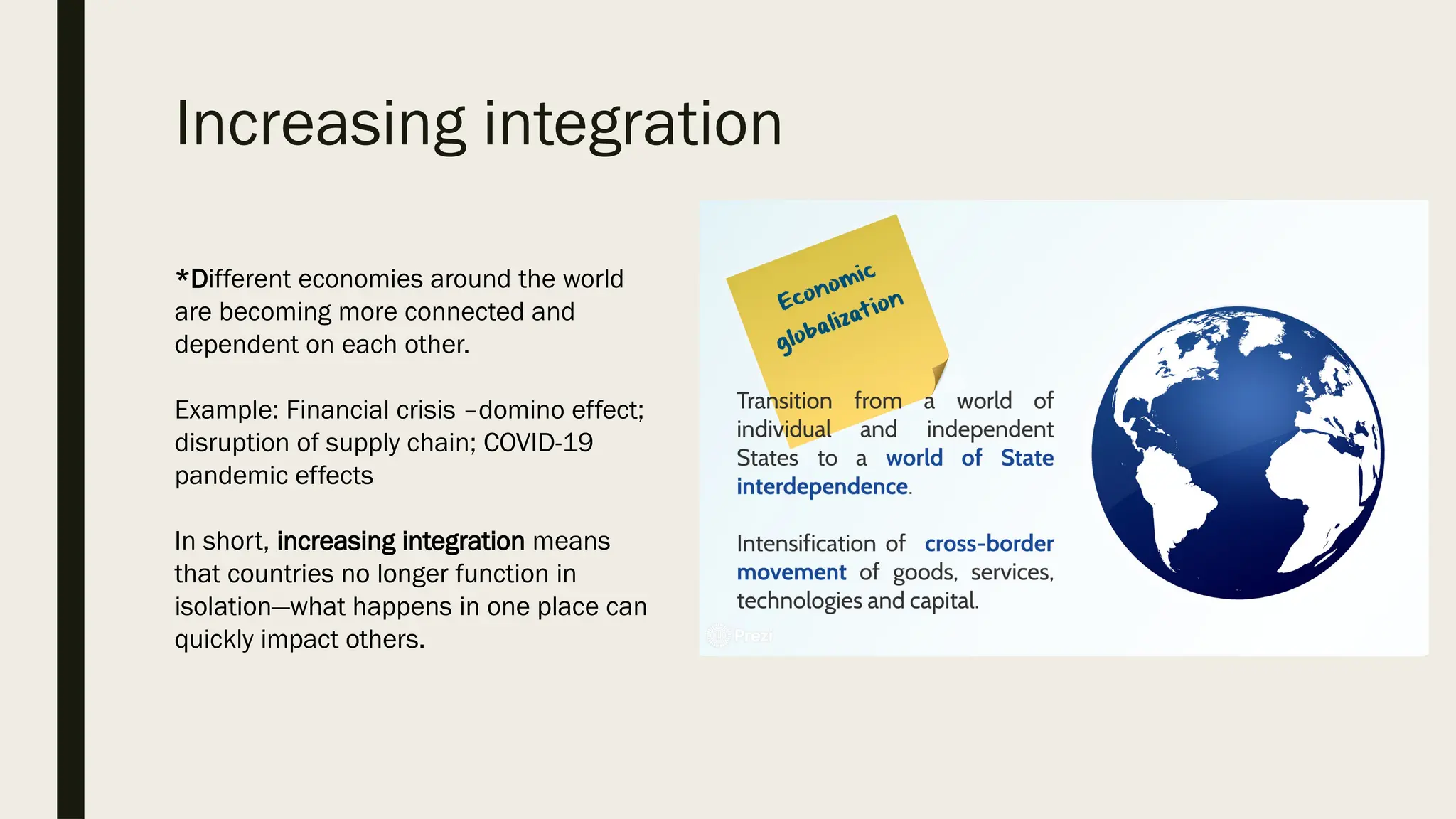
Increasing integration
*Different economies around the world
are becoming more connected and
dependent on each other.
Example: Financial crisis –domino effect;
disruption of supply chain; COVID-19
pandemic effects
In short, increasing integration means
that countries no longer function in
isolation—what happens in one place can
quickly impact others.
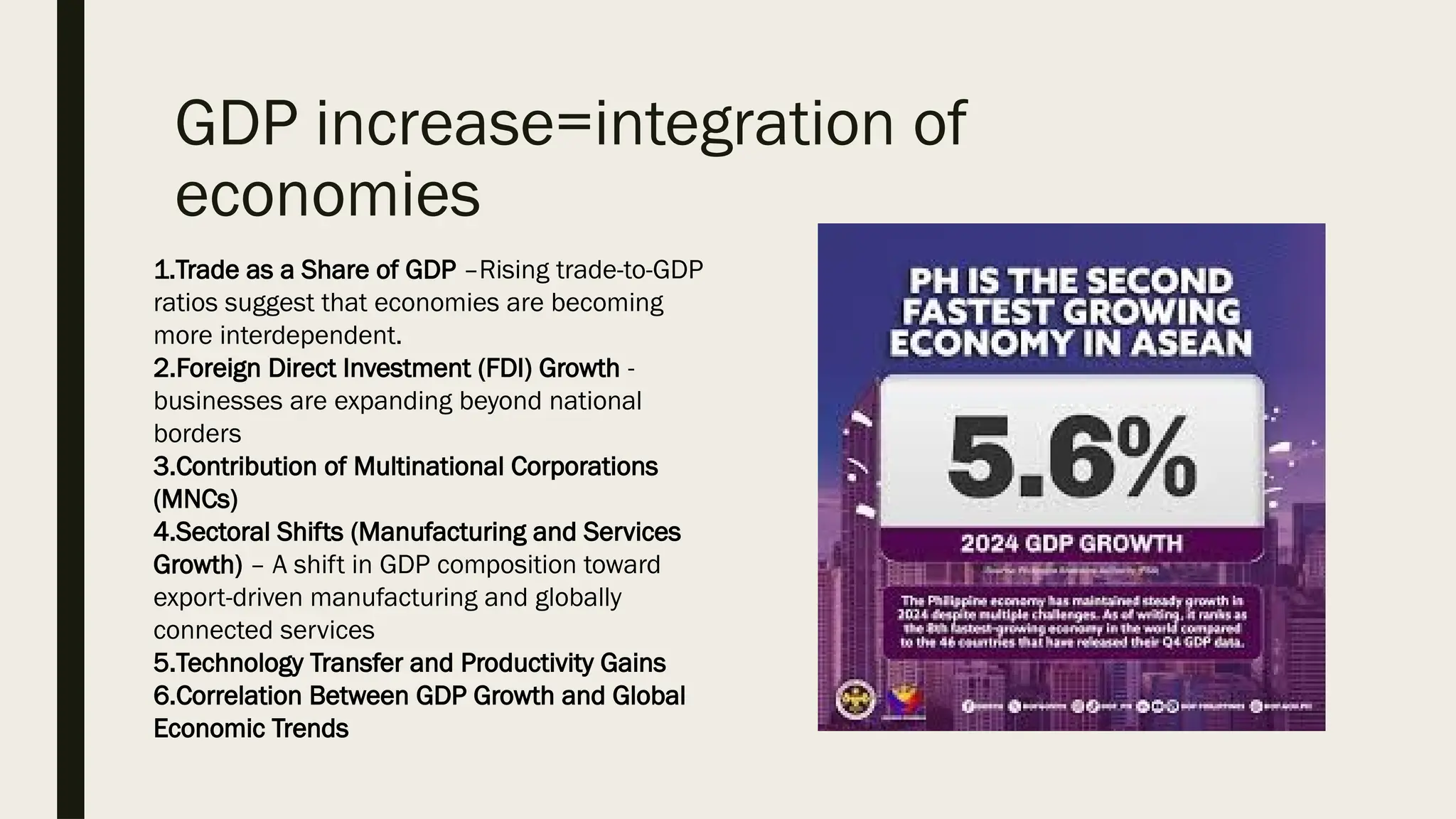
GDP increase=integration of
economies
1.Trade as a Share of GDP –Rising trade-to-GDP
ratios suggest that economies are becoming
more interdependent.
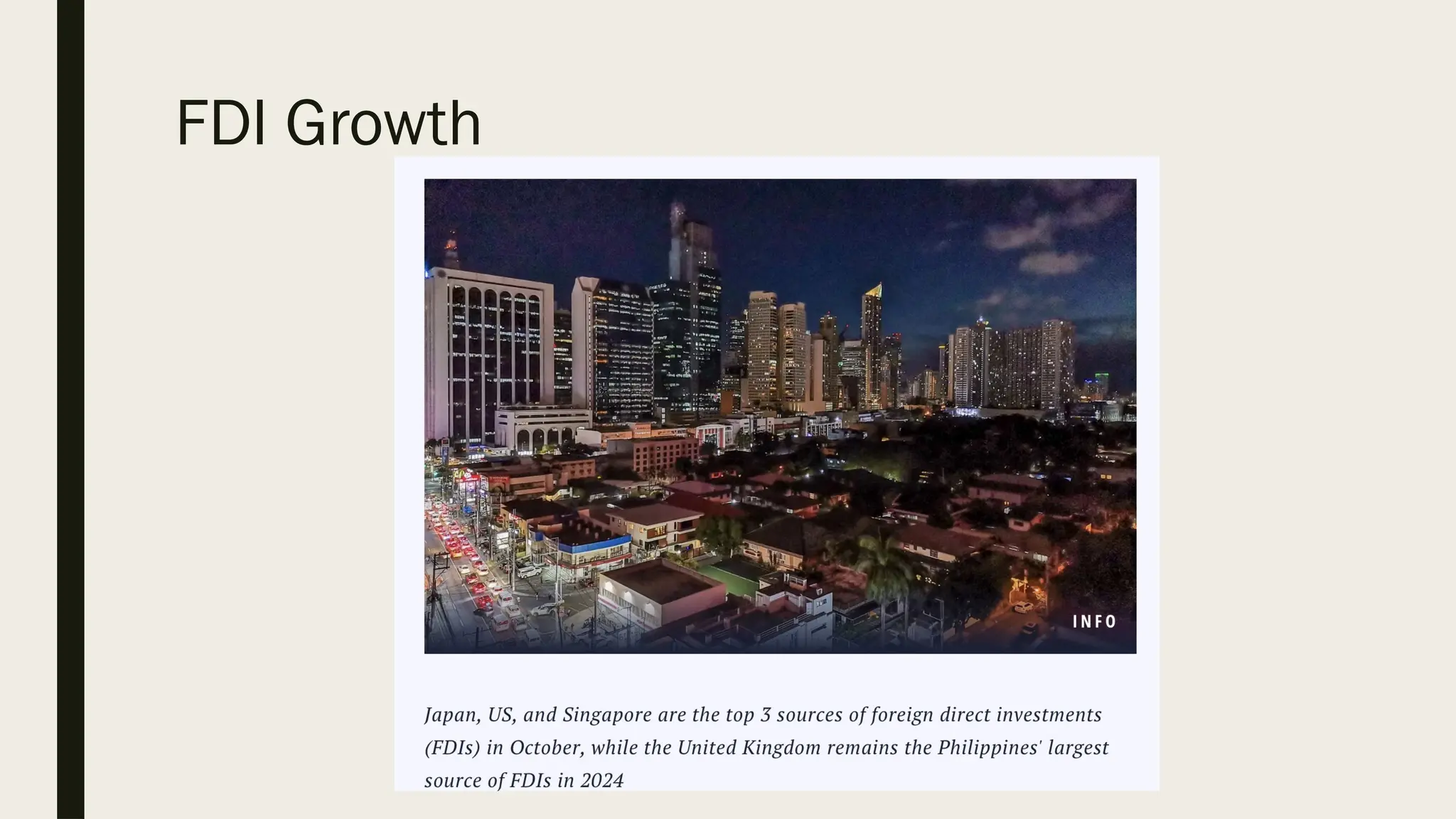
2.Foreign Direct Investment (FDI) Growth -
businesses are expanding beyond national
borders
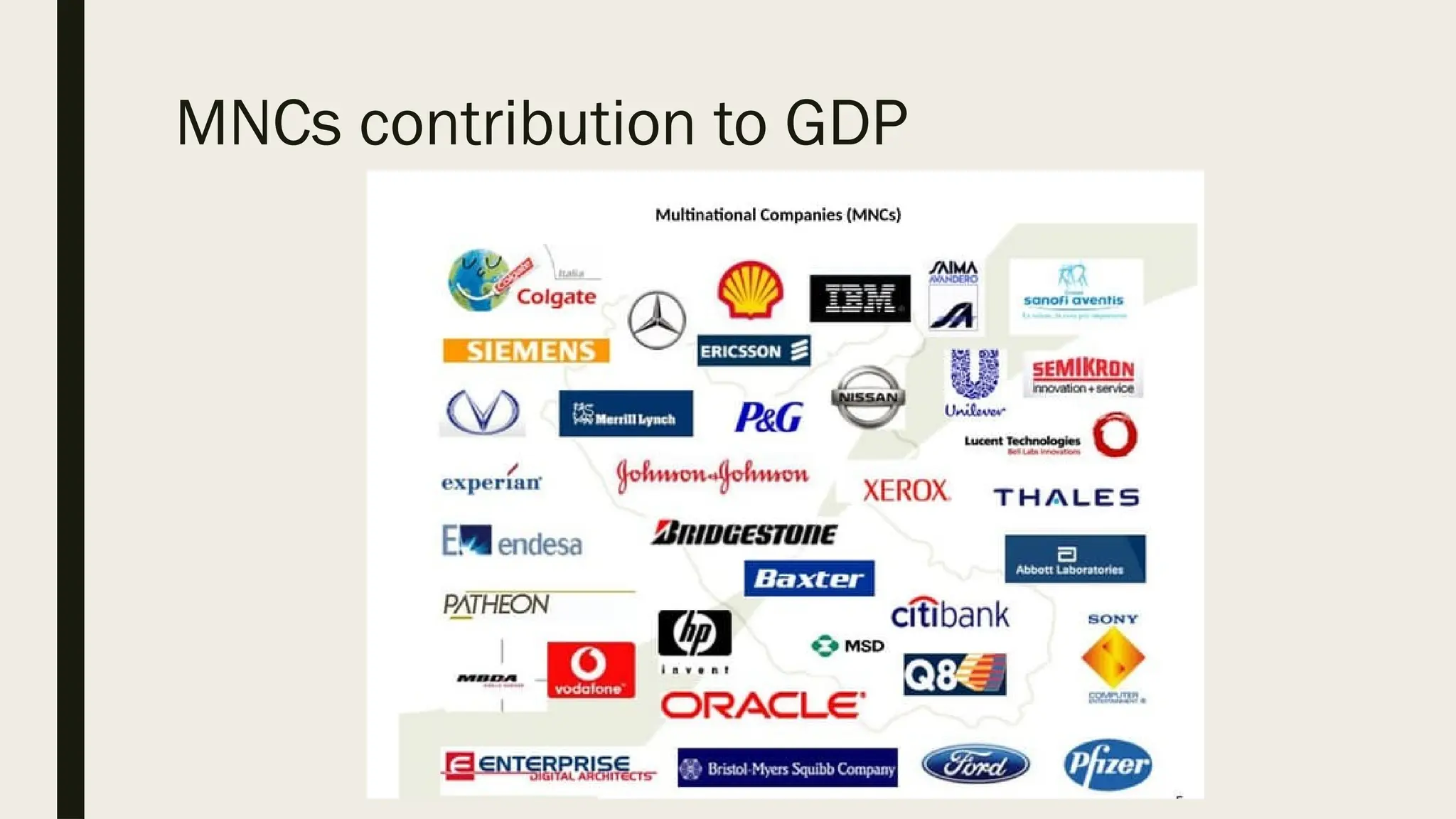
3.Contribution of Multinational Corporations
(MNCs)
4.Sectoral Shifts (Manufacturing and Services
Growth) – A shift in GDP composition toward
export-driven manufacturing and globally
connected services
5.Technology Transfer and Productivity Gains
6.Correlation Between GDP Growth and Global
Economic Trends
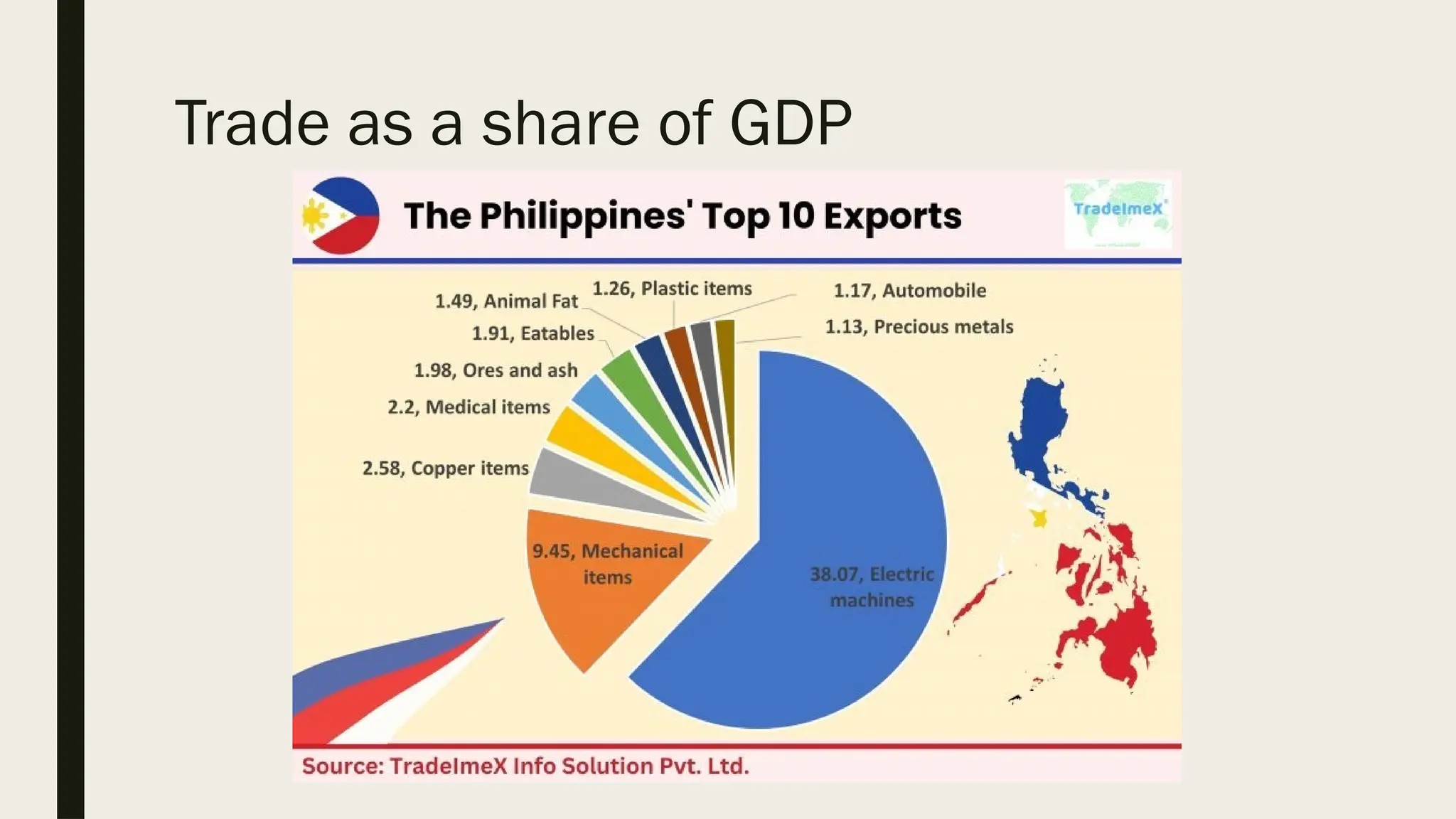
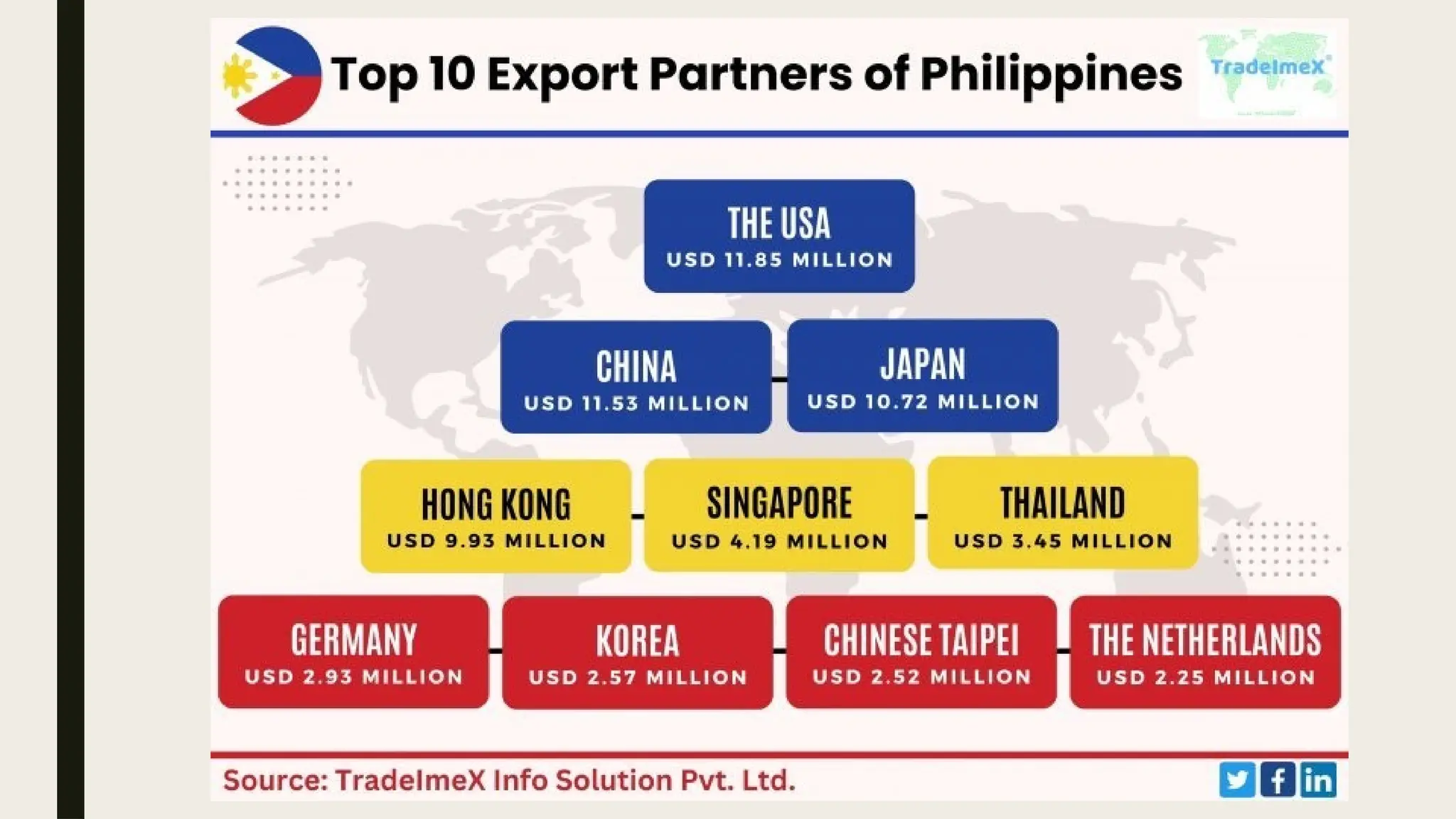
Trade as a share of GDP
FDI Growth
MNCs contribution to GDP
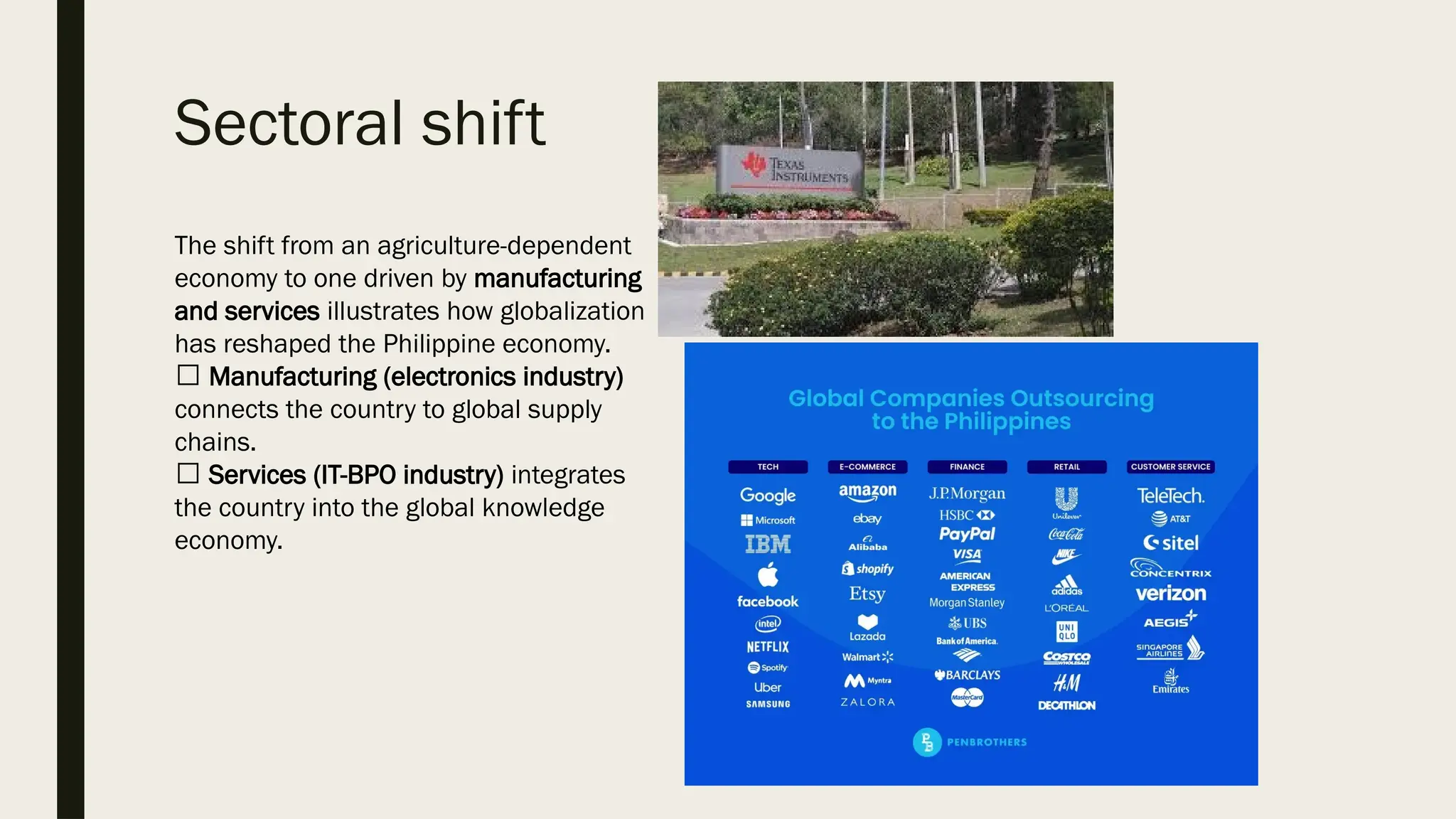
Sectoral shift
The shift from an agriculture-dependent
economy to one driven by manufacturing
and services illustrates how globalization
has reshaped the Philippine economy.
✅ Manufacturing (electronics industry)
connects the country to global supply
chains.
✅ Services (IT-BPO industry) integrates
the country into the global knowledge
economy.
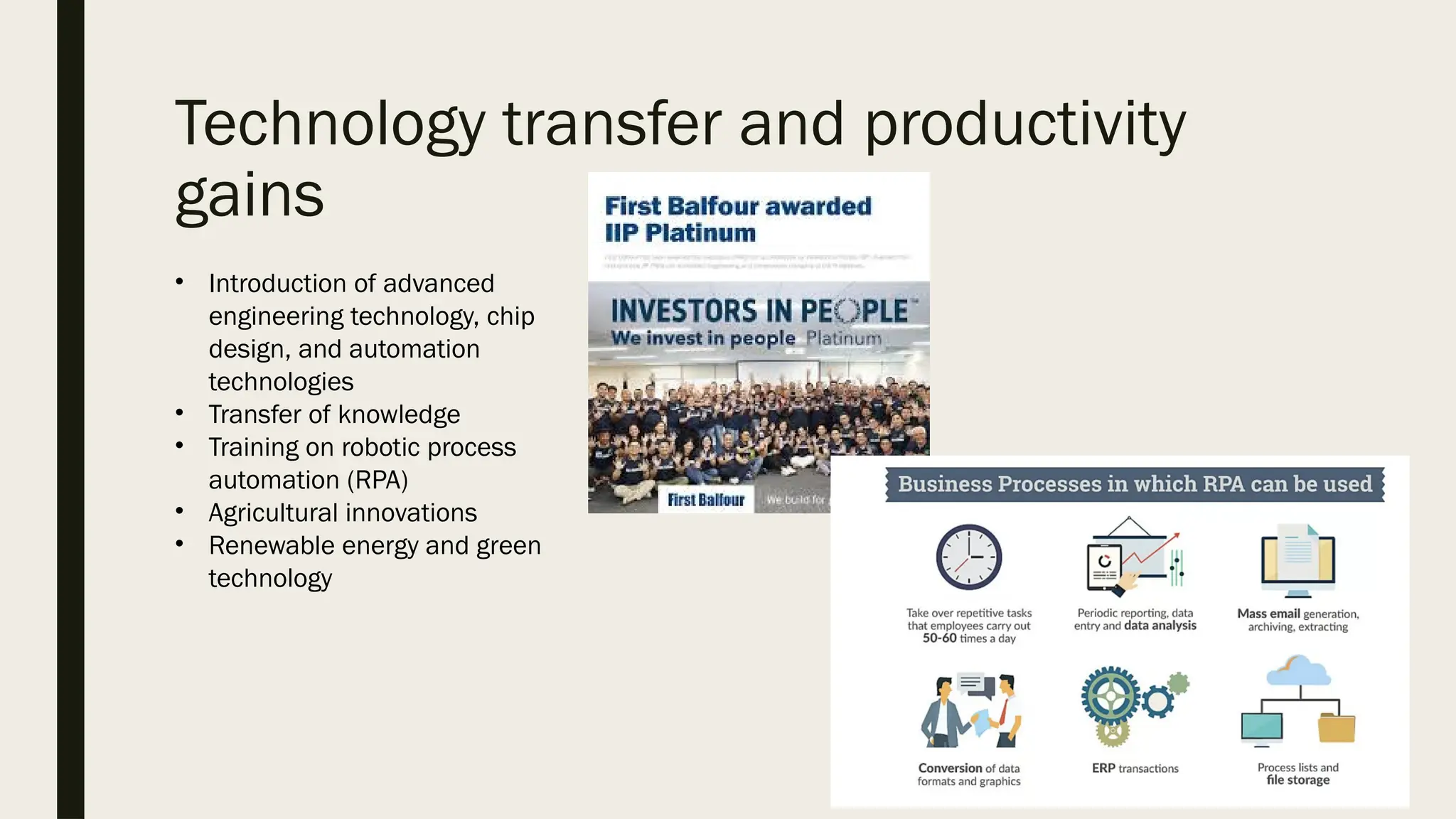
Technology transfer and productivity
gains
• Introduction of advanced
engineering technology, chip
design, and automation
technologies
• Transfer of knowledge
• Training on robotic process
automation (RPA)
• Agricultural innovations
• Renewable energy and green
technology
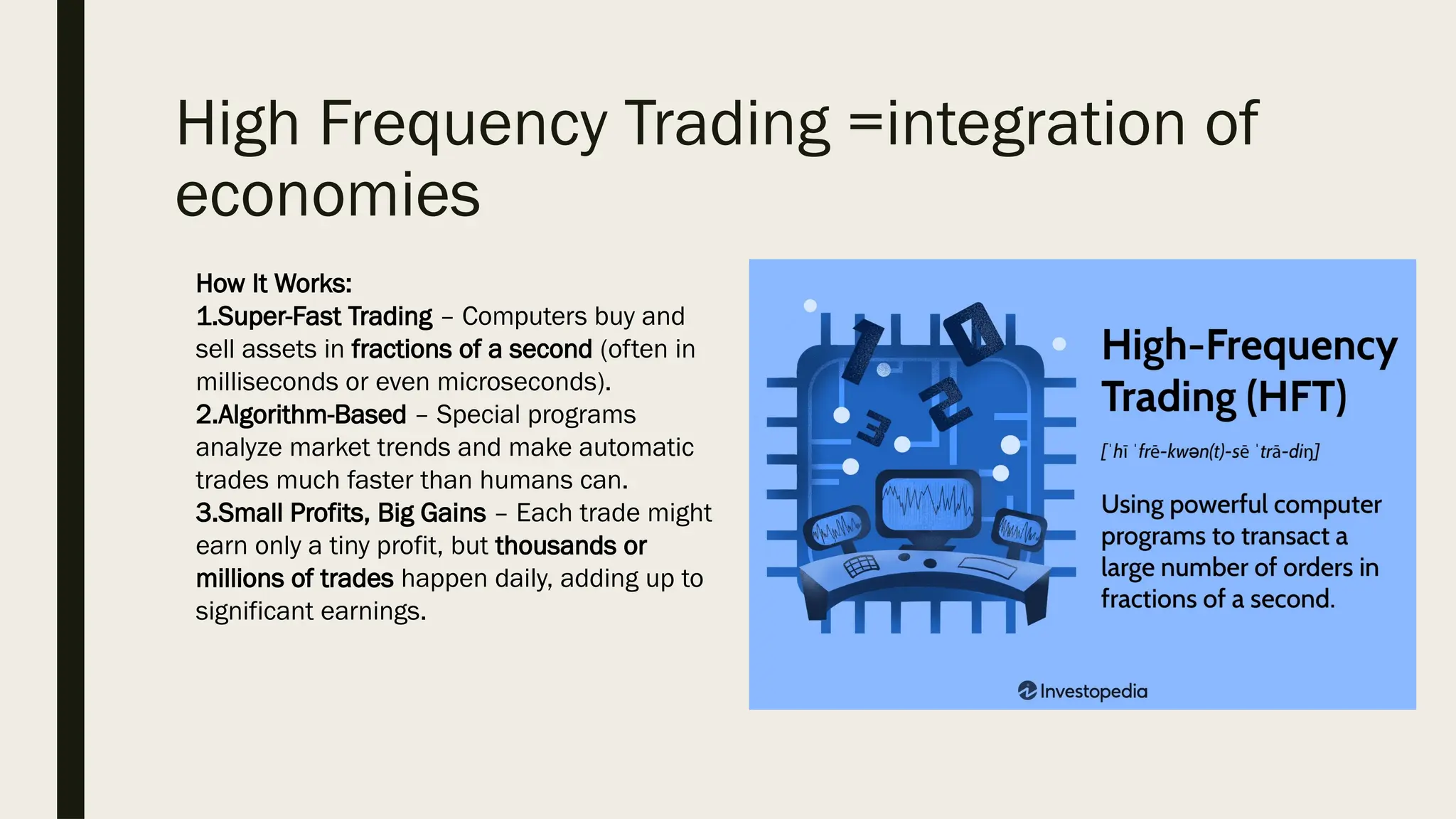
High Frequency Trading =integration of
economies
How It Works:
1.Super-Fast Trading – Computers buy and
sell assets in fractions of a second (often in
milliseconds or even microseconds).
2.Algorithm-Based – Special programs
analyze market trends and make automatic
trades much faster than humans can.
3.Small Profits, Big Gains – Each trade might
earn only a tiny profit, but thousands or
millions of trades happen daily, adding up to
significant earnings.
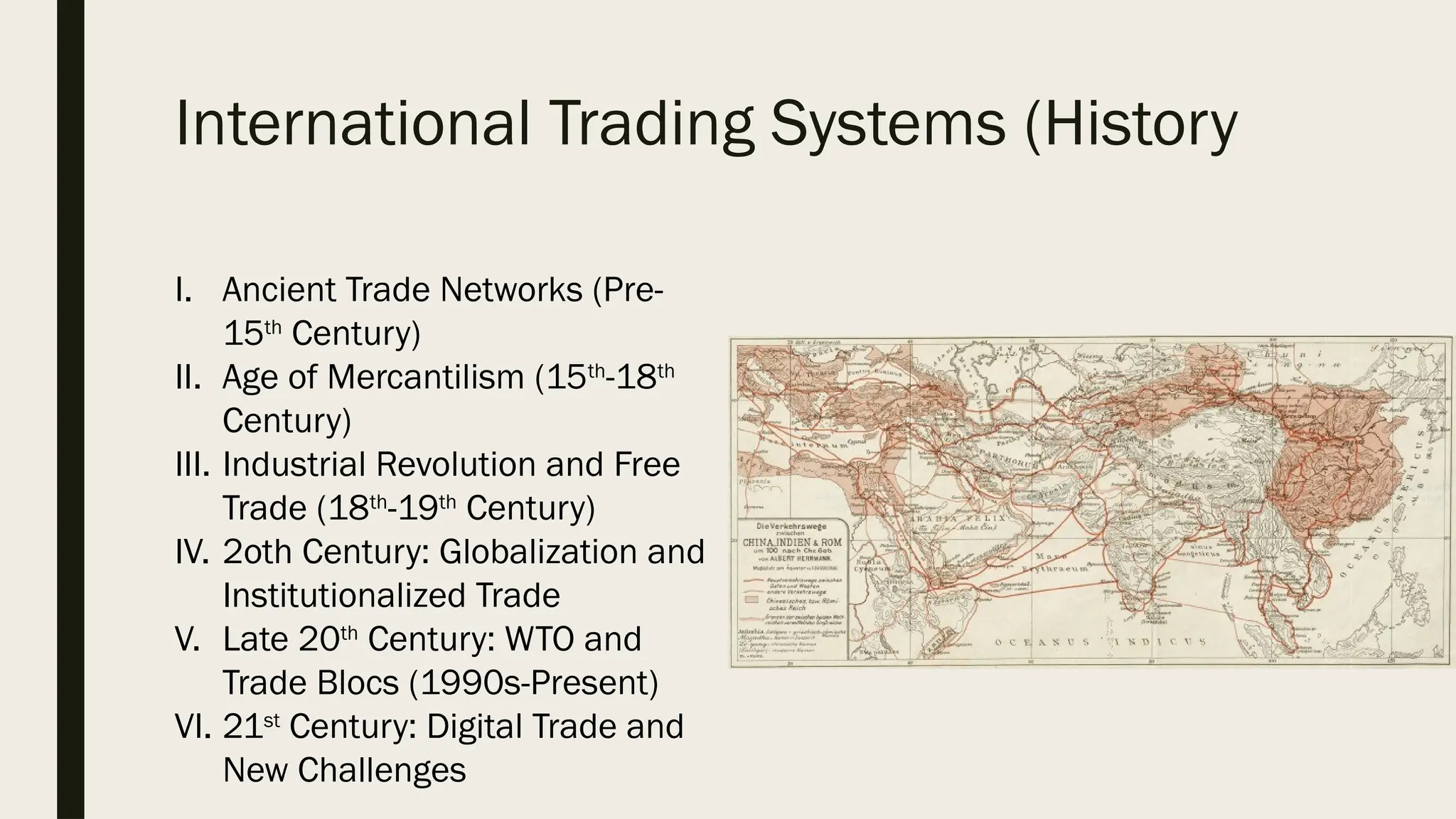
International Trading Systems (History
I. Ancient Trade Networks (Pre-
15th
Century)
II. Age of Mercantilism (15th
-18th
Century)
III. Industrial Revolution and Free
Trade (18th
-19th
Century)
IV. 2oth Century: Globalization and
Institutionalized Trade
V. Late 20th
Century: WTO and
Trade Blocs (1990s-Present)
VI. 21st
Century: Digital Trade and
New Challenges
I. Ancient Trade Networks (Pre-15th
Century)
Before formal trade agreements, international trade was based on barter and
regional exchange networks.
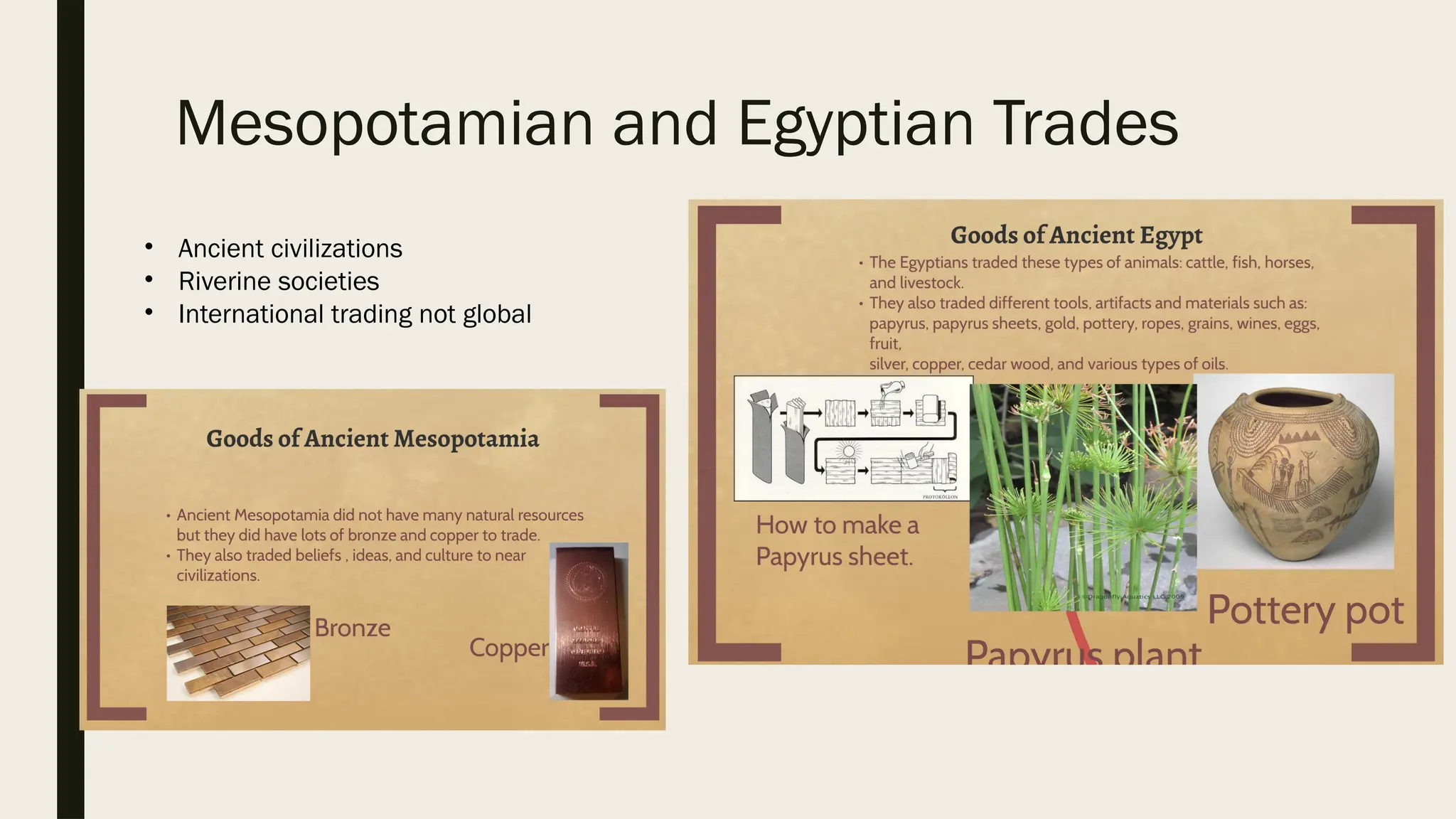
a) Mesopotamian and Egyptian Trade (~3000 BCE)
•Early civilizations in Mesopotamia and Egypt traded goods like grain, textiles, and
precious metals.
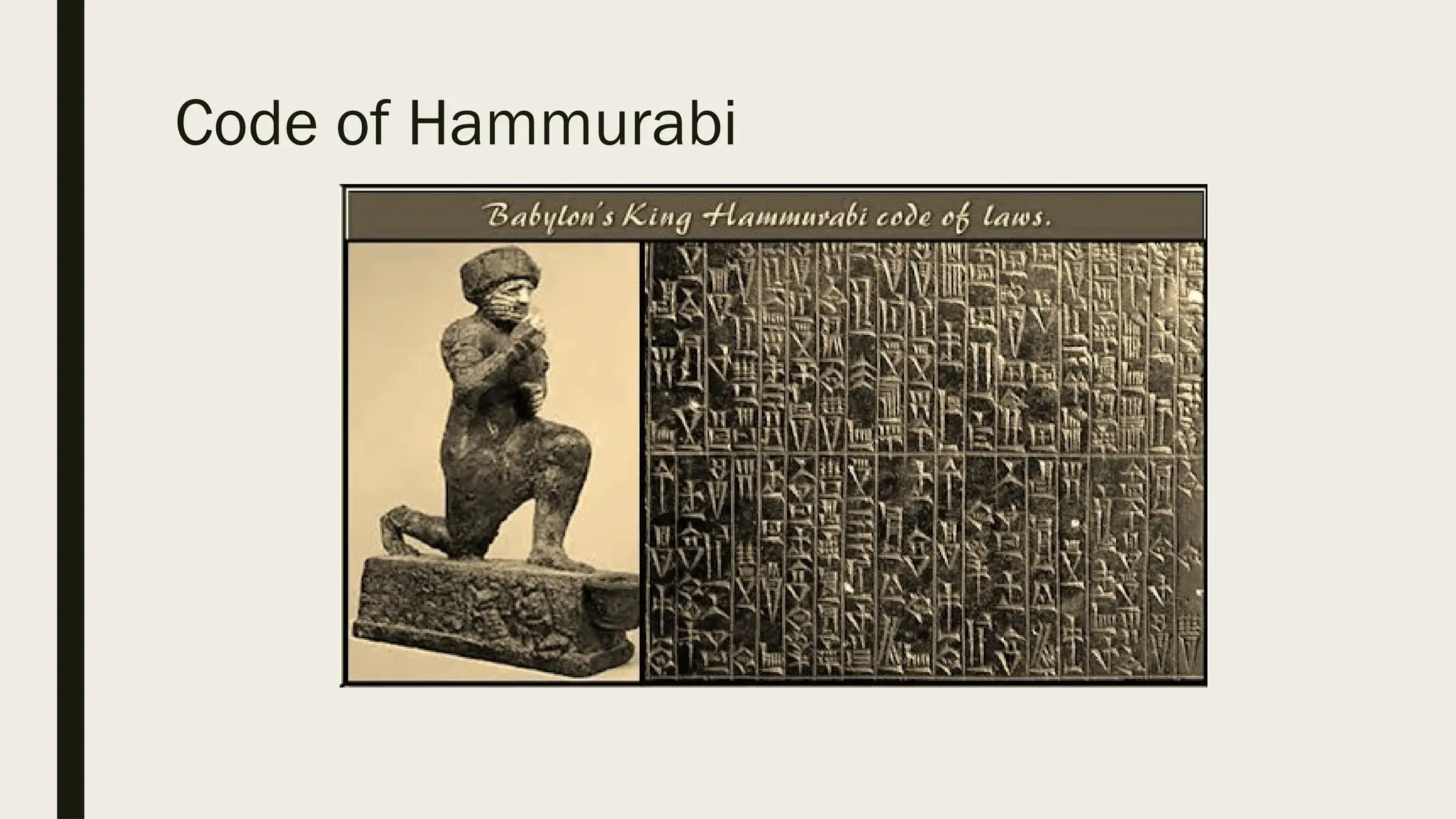
•The Code of Hammurabi (1754 BCE) regulated contracts and trade practices.
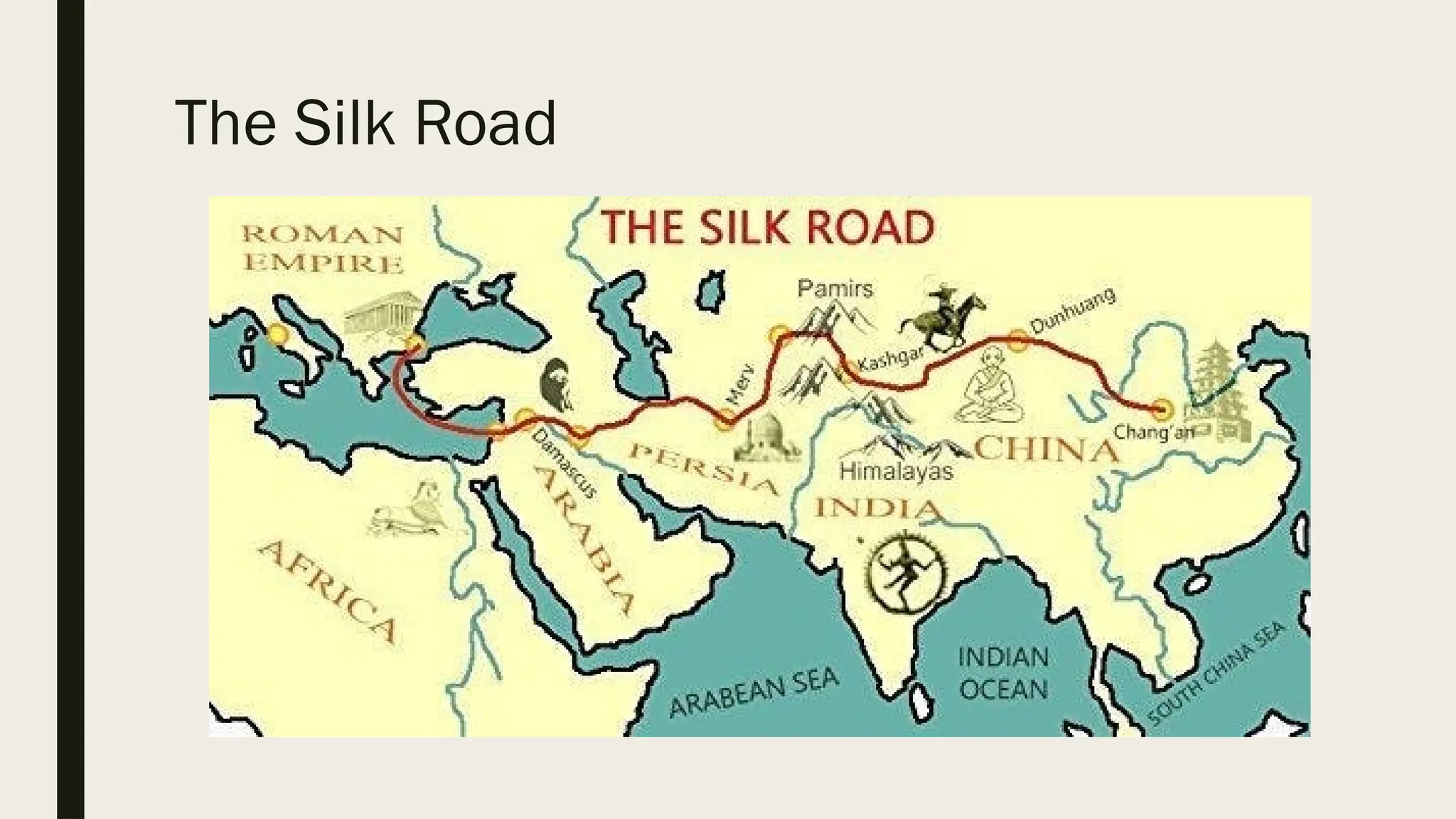
b) Silk Road (130 BCE – 1453 CE)
•Connected China, Central Asia, the Middle East, and Europe.
•Traded silk, spices, and luxury goods, enabling cultural and economic exchange.
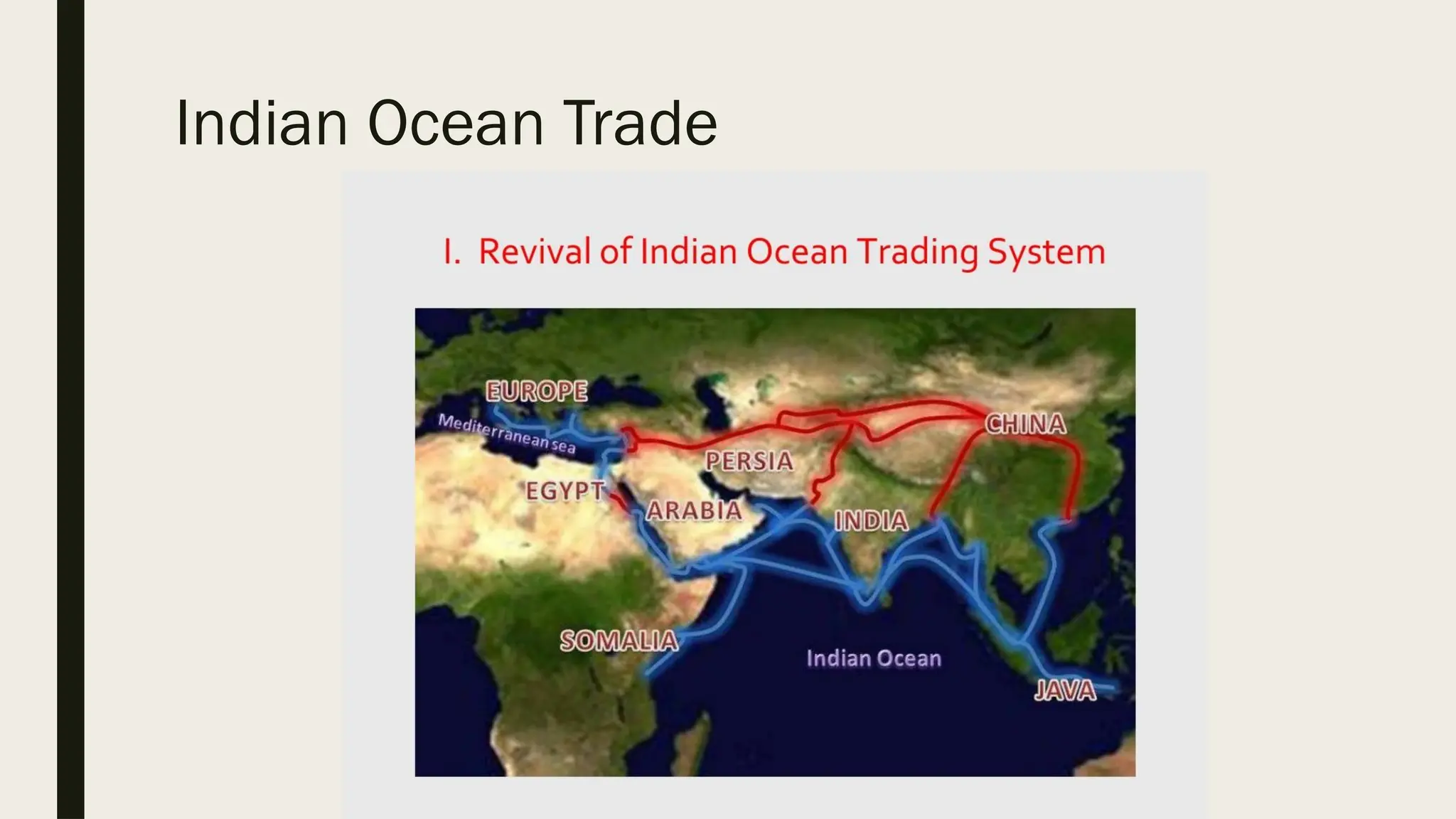
c) Indian Ocean Trade (200 BCE – 1500 CE)
•A vast network connecting India, Southeast Asia, the Middle East, and Africa.
•Dominated by Arab, Chinese, and Indian traders using monsoon winds for
navigation.
d) Hanseatic League (12th – 17th Century)
•A trade alliance in Northern Europe, regulating Baltic and North Sea trade.
•Established early forms of trade agreements and commercial law.
Mesopotamian and Egyptian Trades
• Ancient civilizations
• Riverine societies
• International trading not global
Code of Hammurabi
The Silk Road
Indian Ocean Trade
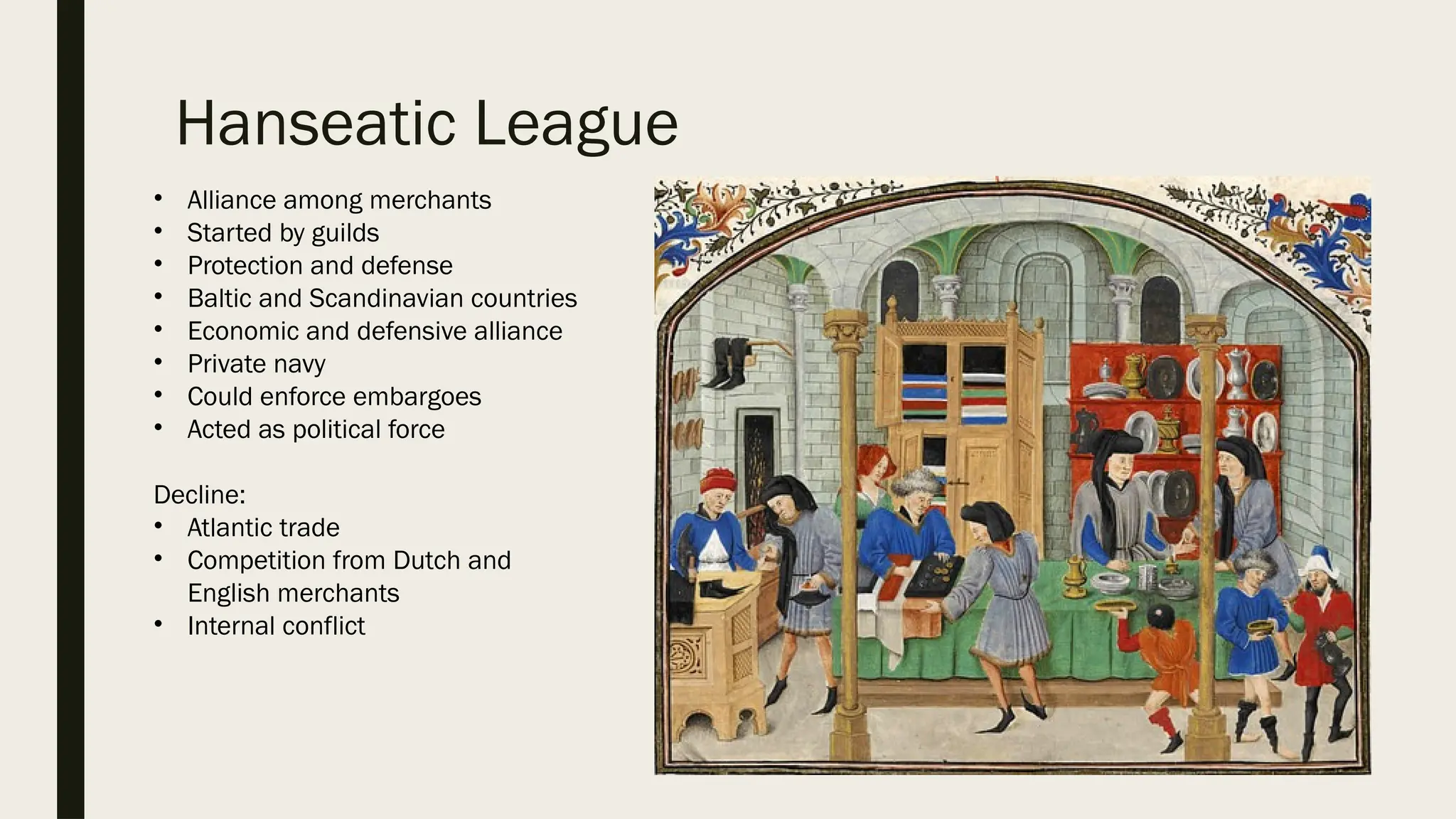
Hanseatic League
• Alliance among merchants
• Started by guilds
• Protection and defense
• Baltic and Scandinavian countries
• Economic and defensive alliance
• Private navy
• Could enforce embargoes
• Acted as political force
Decline:
• Atlantic trade
• Competition from Dutch and
English merchants
• Internal conflict
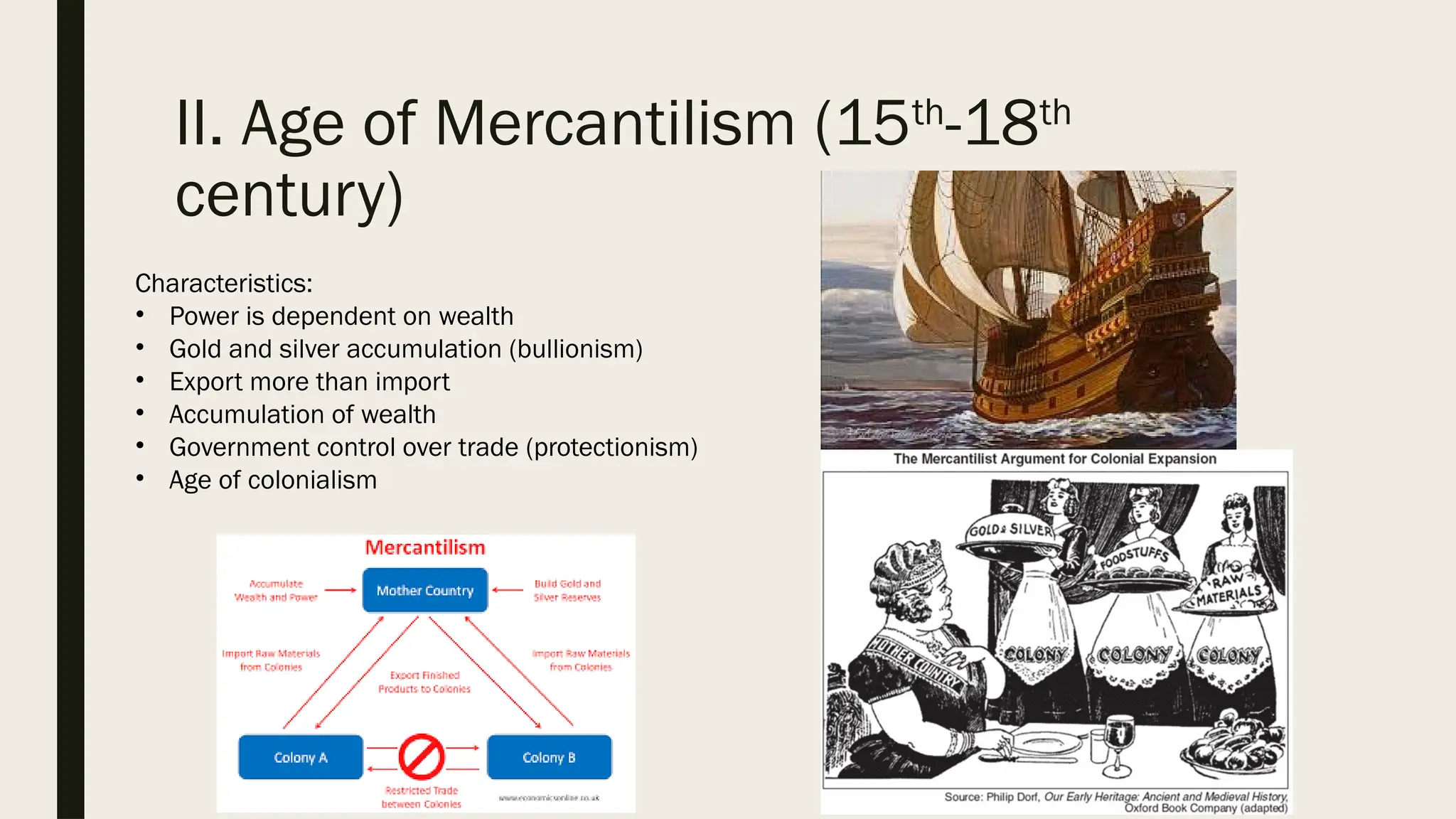
II. Age of Mercantilism (15th
-18th
century)
Characteristics:
• Power is dependent on wealth
• Gold and silver accumulation (bullionism)
• Export more than import
• Accumulation of wealth
• Government control over trade (protectionism)
• Age of colonialism
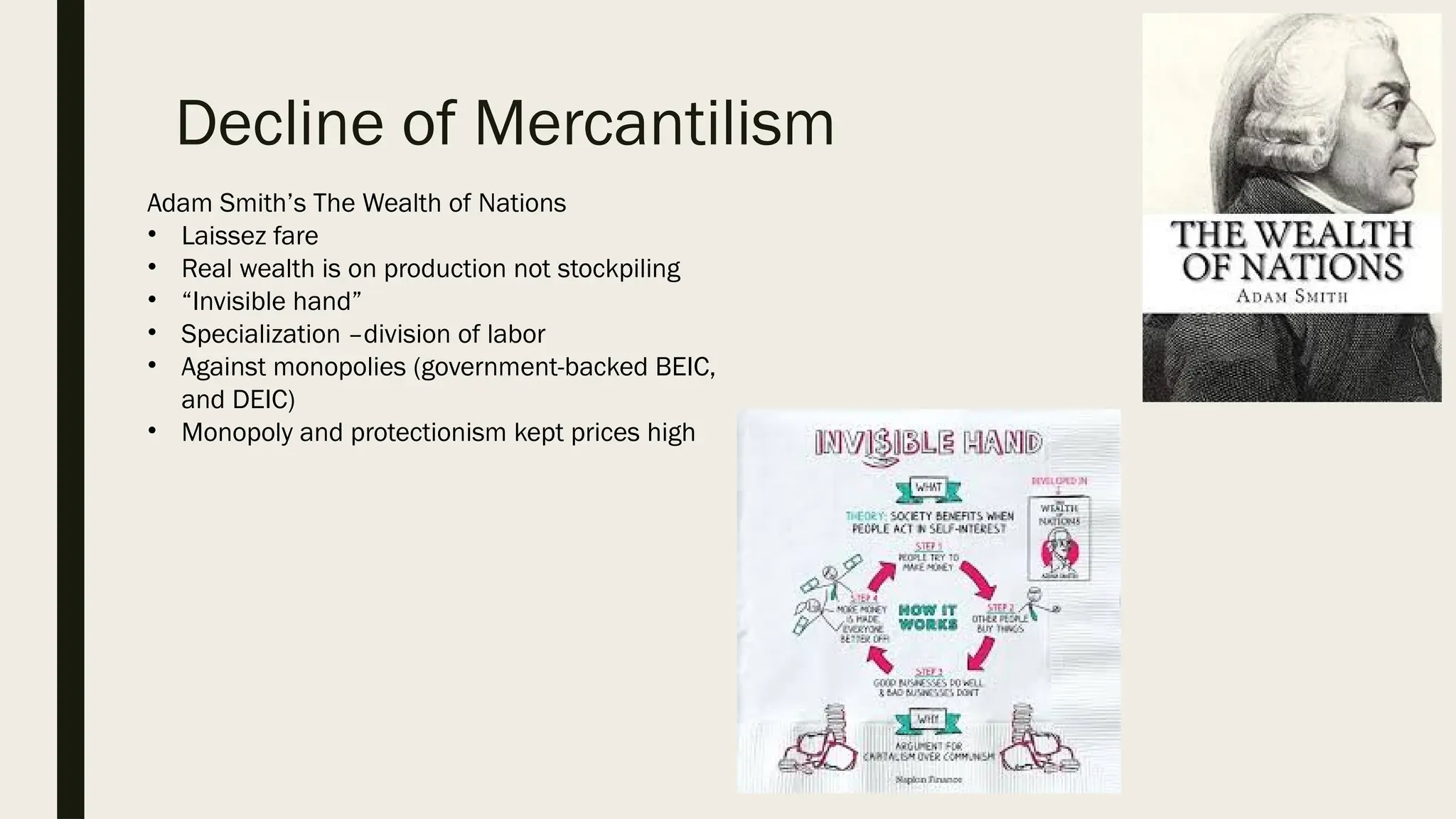
Decline of Mercantilism
Adam Smith’s The Wealth of Nations
• Laissez fare
• Real wealth is on production not stockpiling
• “Invisible hand”
• Specialization –division of labor
• Against monopolies (government-backed BEIC,
and DEIC)
• Monopoly and protectionism kept prices high
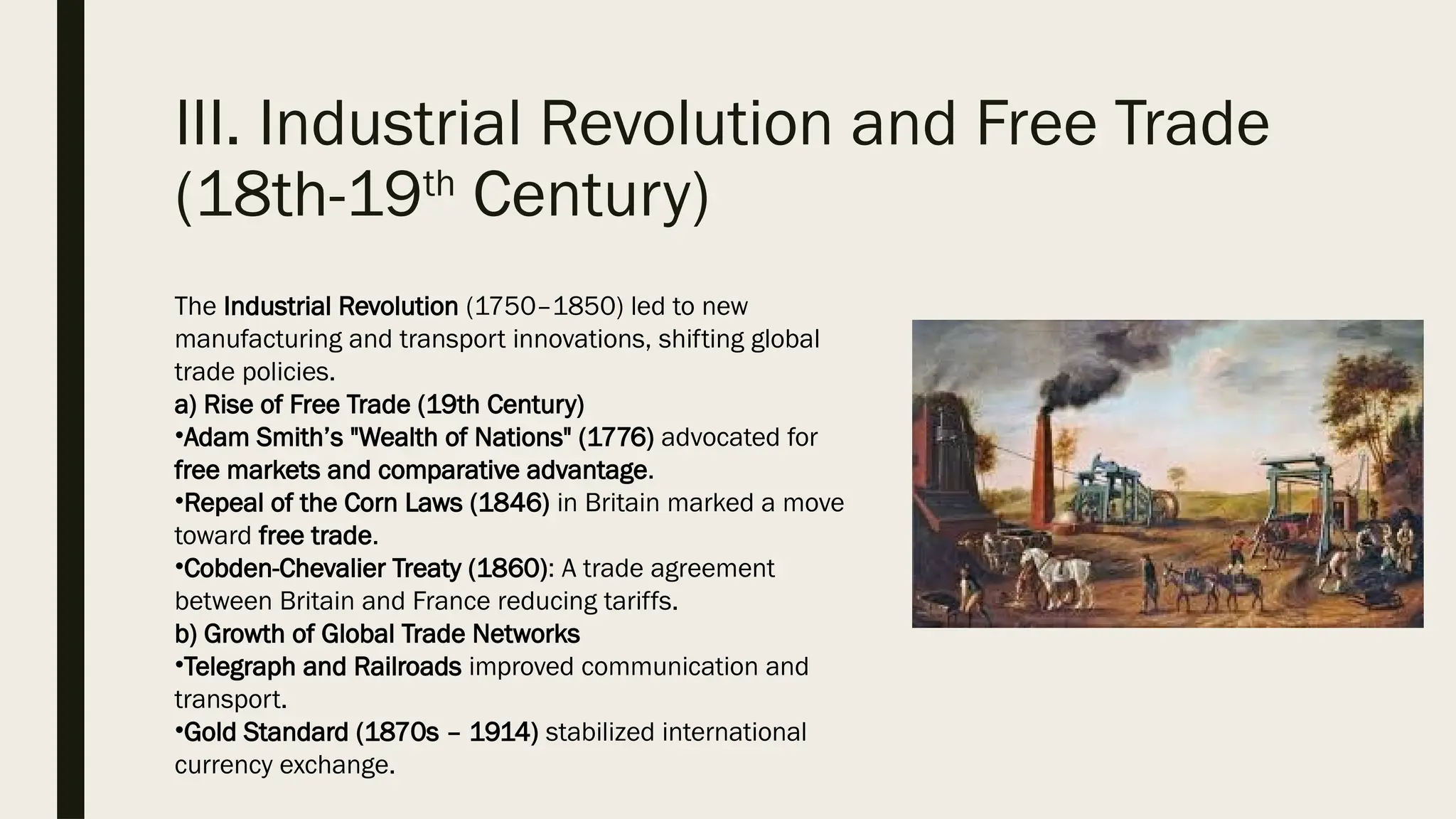
III. Industrial Revolution and Free Trade
(18th-19th
Century)
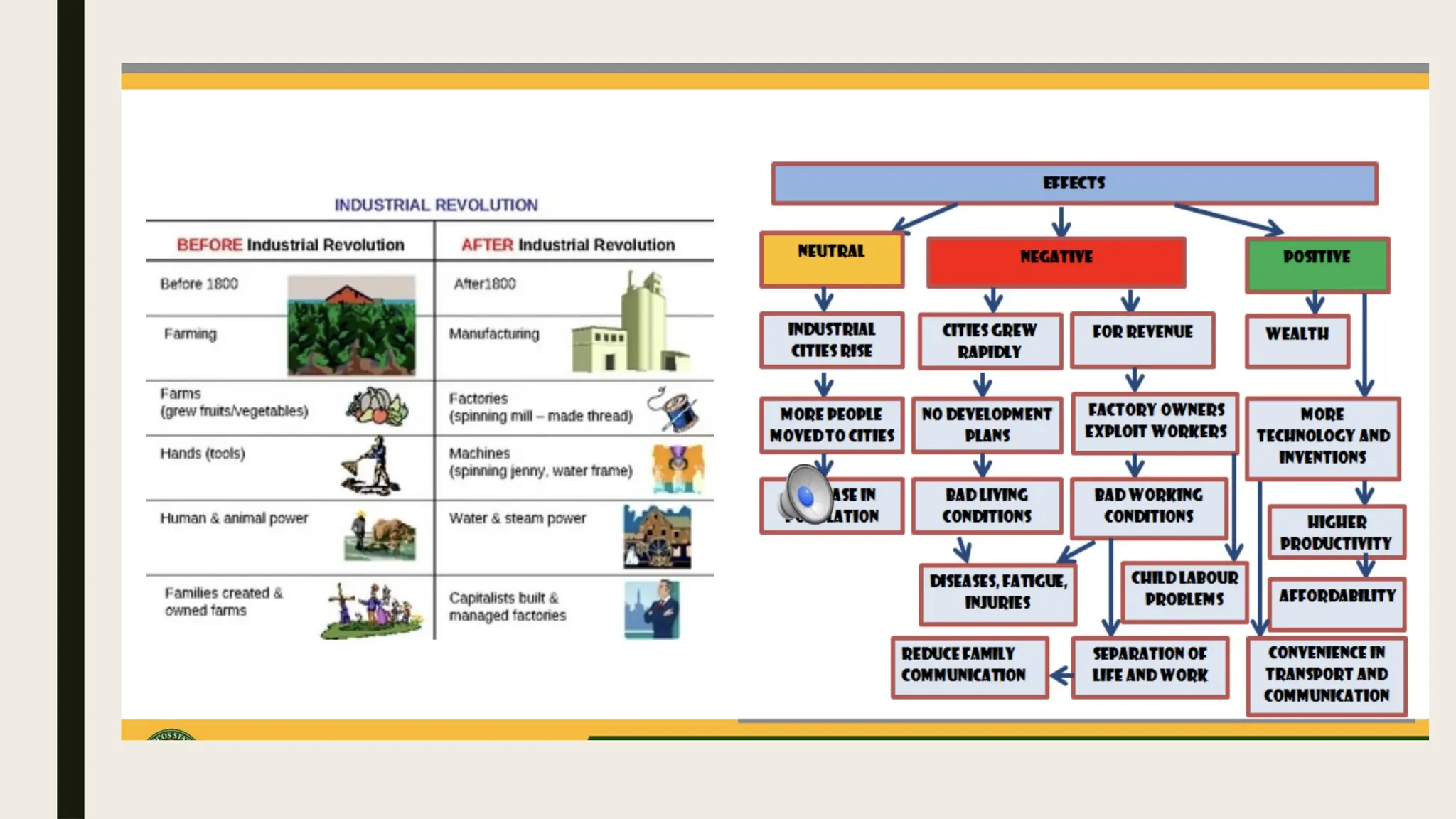
The Industrial Revolution (1750–1850) led to new
manufacturing and transport innovations, shifting global
trade policies.
a) Rise of Free Trade (19th Century)
•Adam Smith’s "Wealth of Nations" (1776) advocated for
free markets and comparative advantage.
•Repeal of the Corn Laws (1846) in Britain marked a move
toward free trade.
•Cobden-Chevalier Treaty (1860): A trade agreement
between Britain and France reducing tariffs.
b) Growth of Global Trade Networks
•Telegraph and Railroads improved communication and
transport.
•Gold Standard (1870s – 1914) stabilized international
currency exchange.
Gold Standard (1870s-1914)
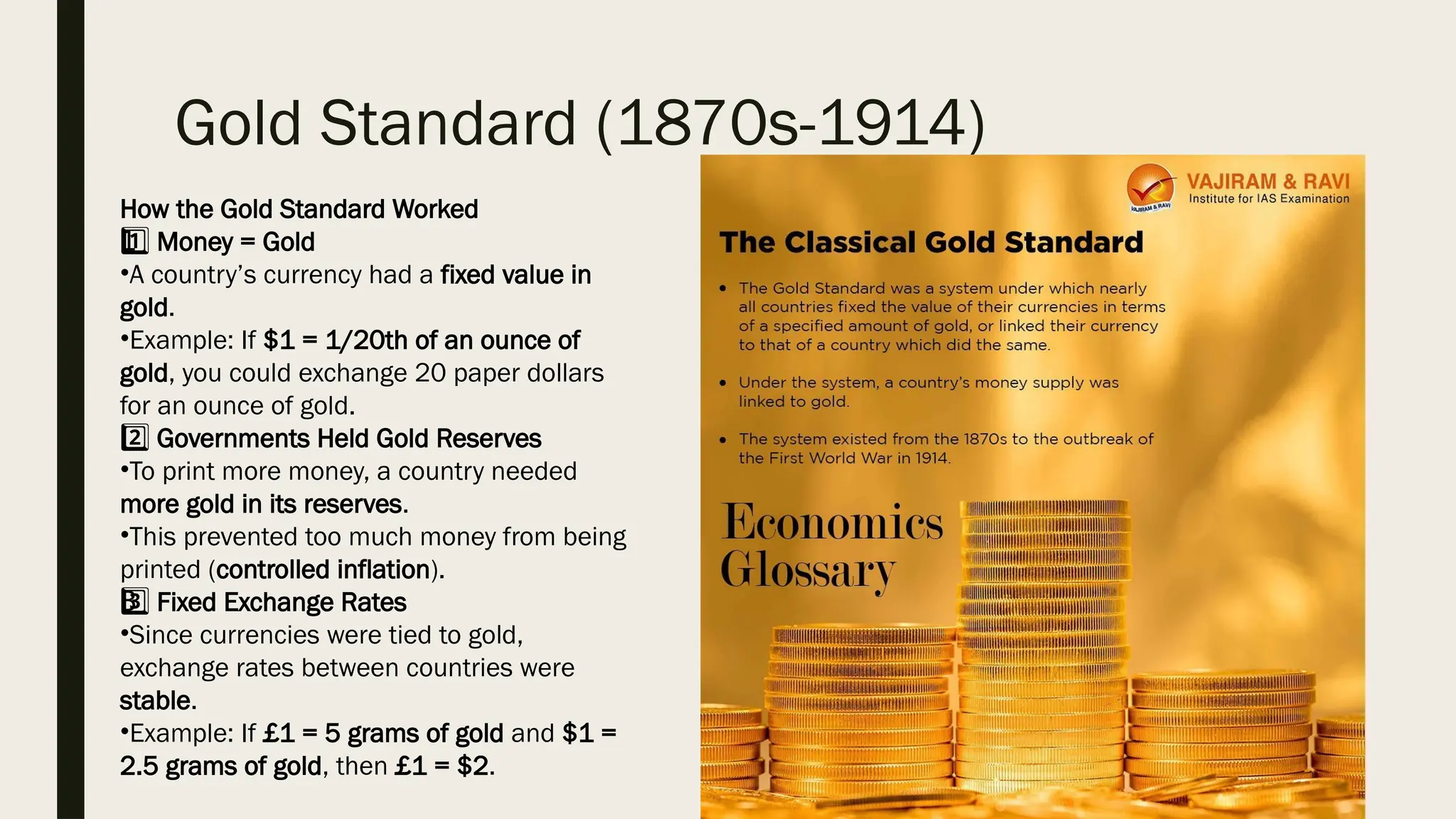
How the Gold Standard Worked
1 ️
1️⃣Money = Gold
•A country’s currency had a fixed value in
gold.
•Example: If $1 = 1/20th of an ounce of
gold, you could exchange 20 paper dollars
for an ounce of gold.
2️⃣Governments Held Gold Reserves
•To print more money, a country needed
more gold in its reserves.
•This prevented too much money from being
printed (controlled inflation).
3 ️
3️⃣Fixed Exchange Rates
•Since currencies were tied to gold,
exchange rates between countries were
stable.
•Example: If £1 = 5 grams of gold and $1 =
2.5 grams of gold, then £1 = $2.
IV. 20th
Century: Globalization and
Institutionalized Trade
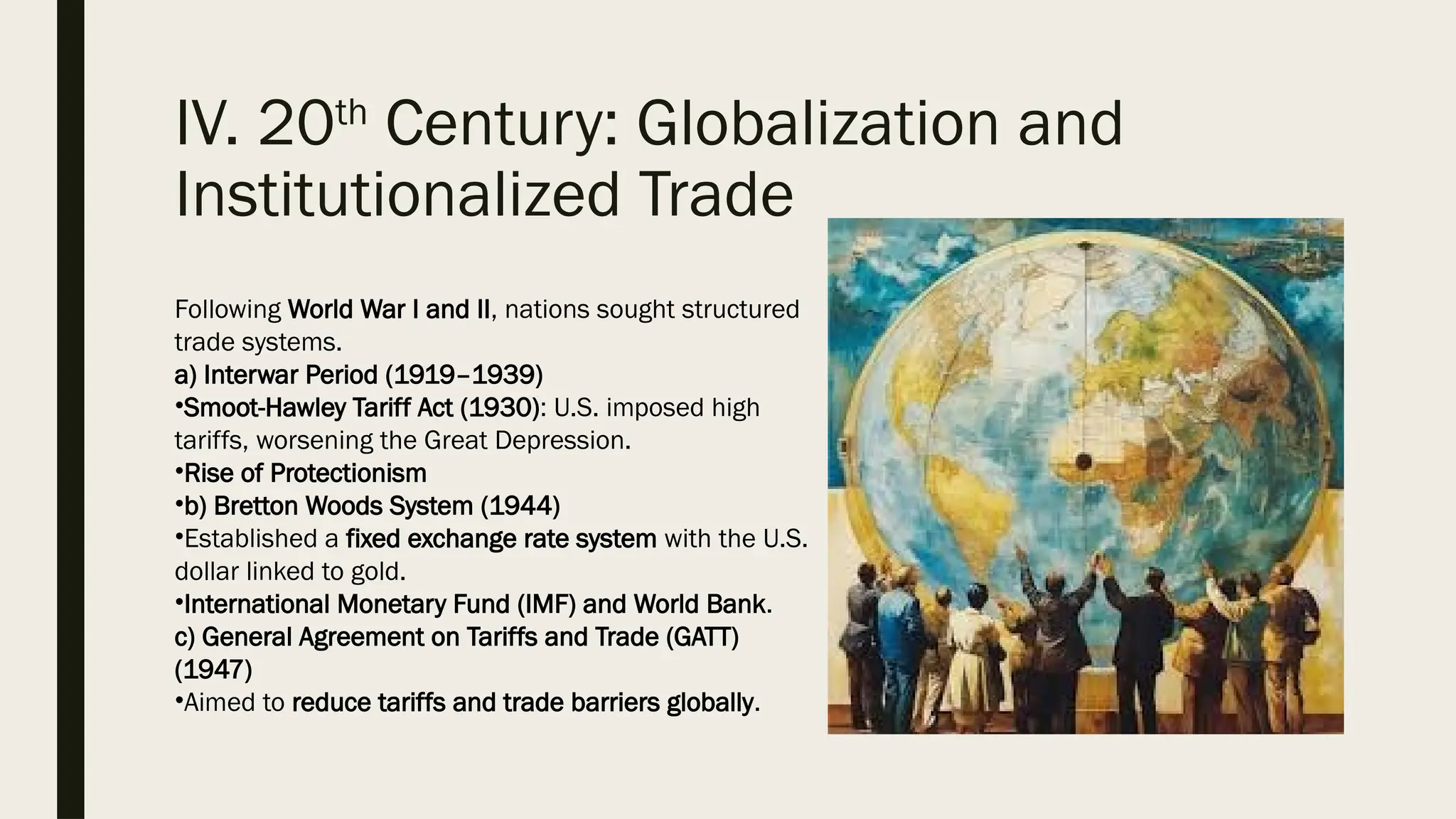
Following World War I and II, nations sought structured
trade systems.
a) Interwar Period (1919–1939)
•Smoot-Hawley Tariff Act (1930): U.S. imposed high
tariffs, worsening the Great Depression.
•Rise of Protectionism
•b) Bretton Woods System (1944)
•Established a fixed exchange rate system with the U.S.
dollar linked to gold.
•International Monetary Fund (IMF) and World Bank.
c) General Agreement on Tariffs and Trade (GATT)
(1947)
•Aimed to reduce tariffs and trade barriers globally.
1929 Stock Market Collapse and the
Great Depression
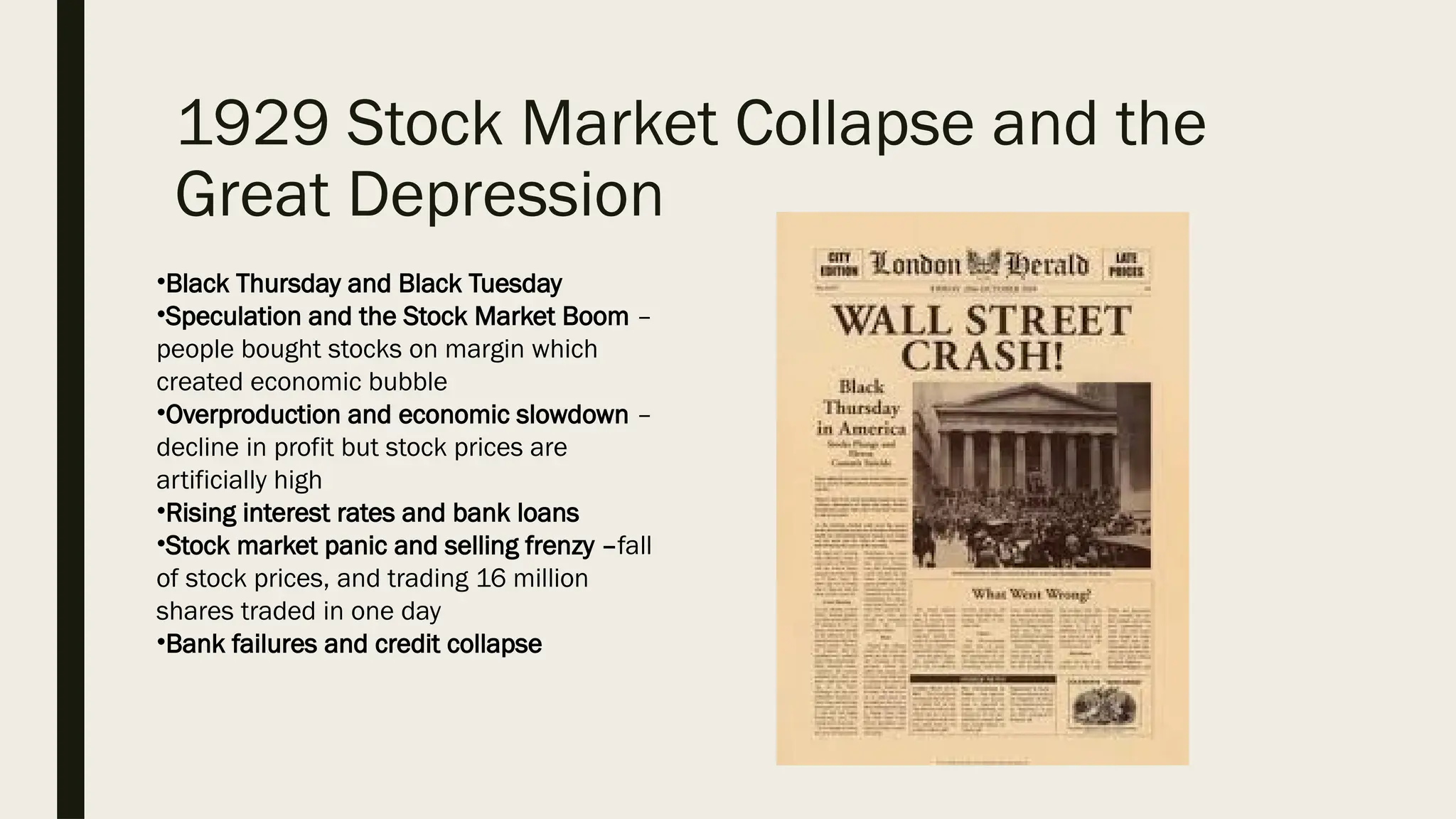
•Black Thursday and Black Tuesday
•Speculation and the Stock Market Boom –
people bought stocks on margin which
created economic bubble
•Overproduction and economic slowdown –
decline in profit but stock prices are
artificially high
•Rising interest rates and bank loans
•Stock market panic and selling frenzy –fall
of stock prices, and trading 16 million
shares traded in one day
•Bank failures and credit collapse
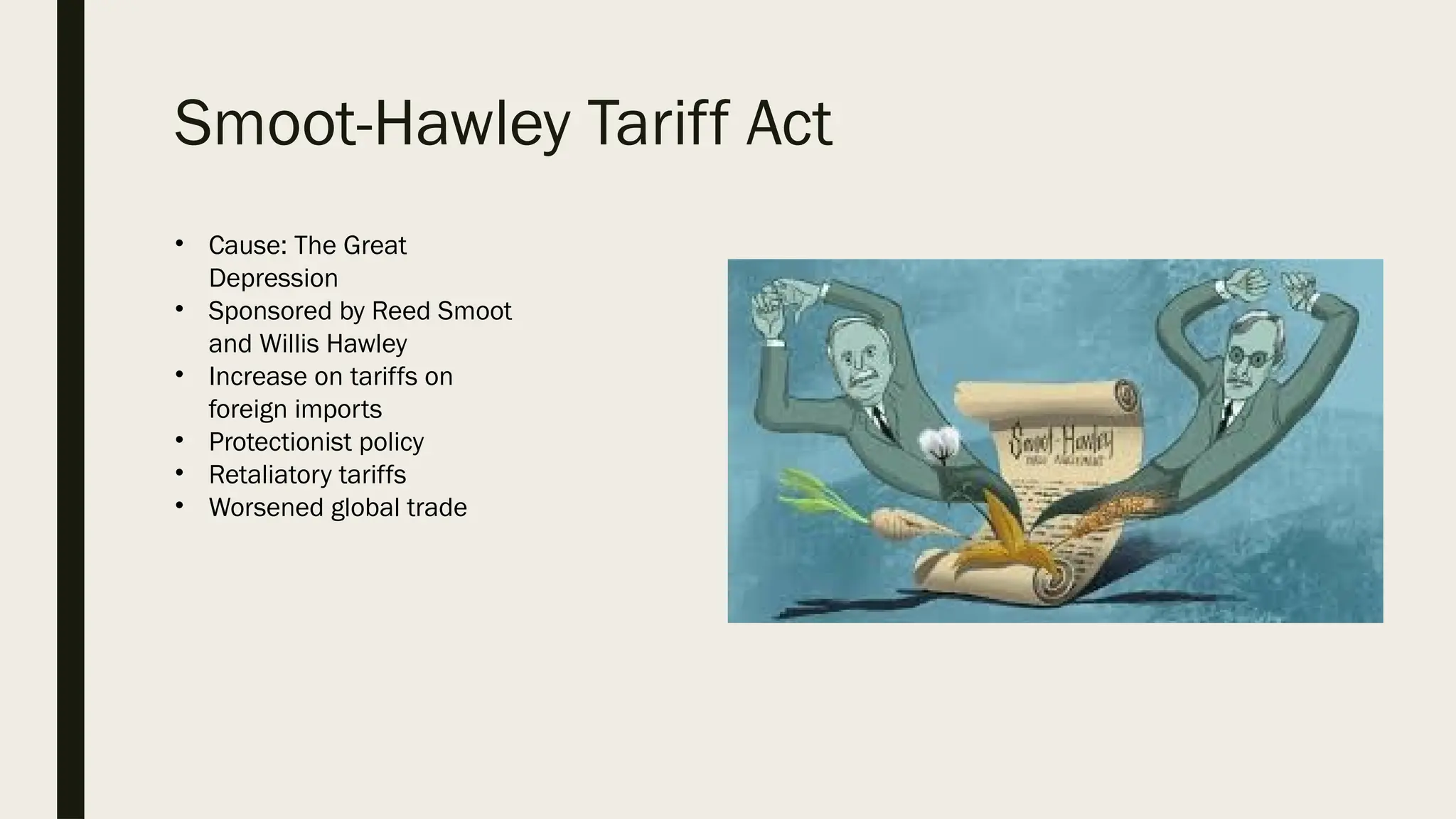
Smoot-Hawley Tariff Act
• Cause: The Great
Depression
• Sponsored by Reed Smoot
and Willis Hawley
• Increase on tariffs on
foreign imports
• Protectionist policy
• Retaliatory tariffs
• Worsened global trade
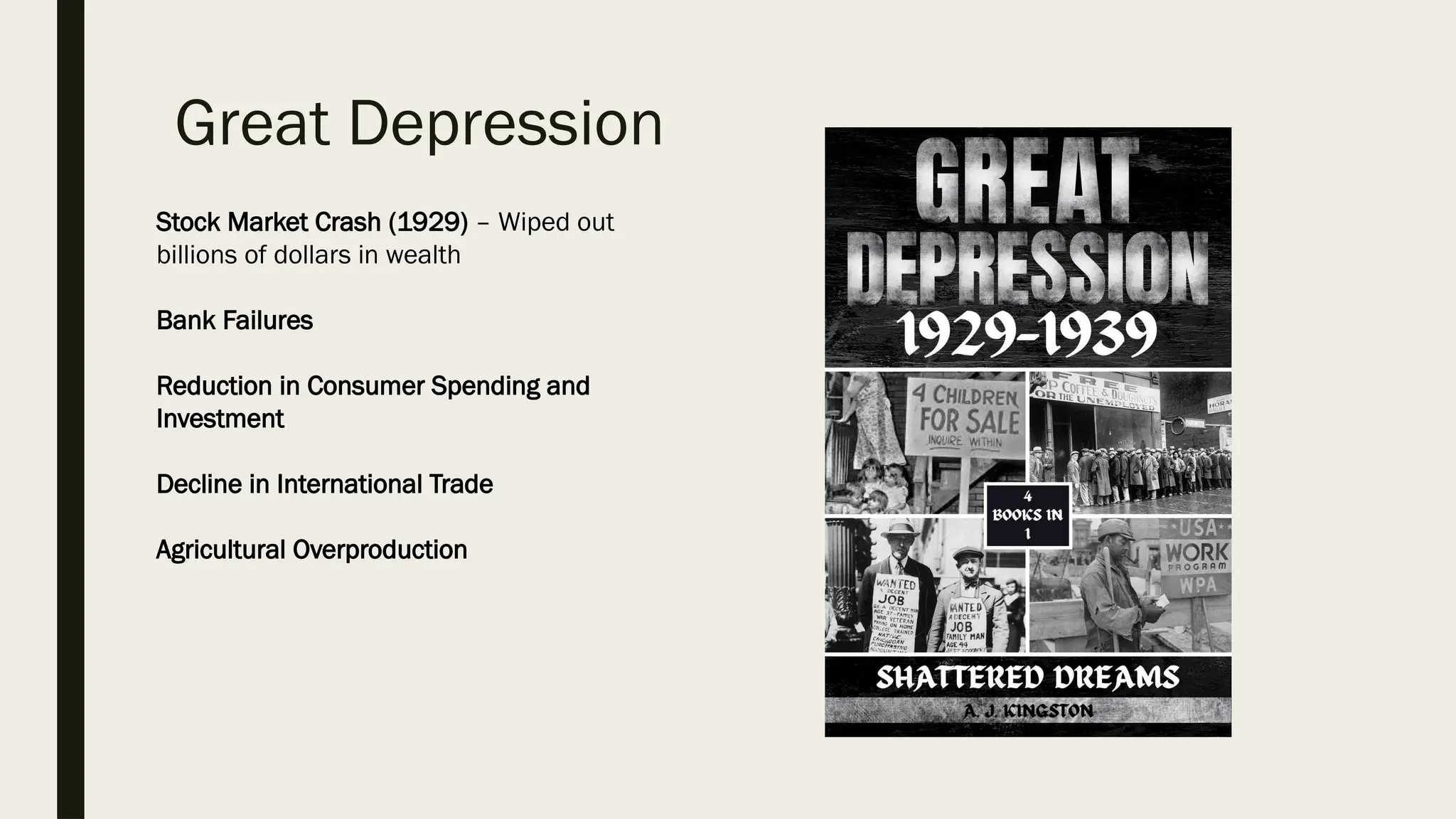
Great Depression
Stock Market Crash (1929) – Wiped out
billions of dollars in wealth
Bank Failures
Reduction in Consumer Spending and
Investment
Decline in International Trade
Agricultural Overproduction
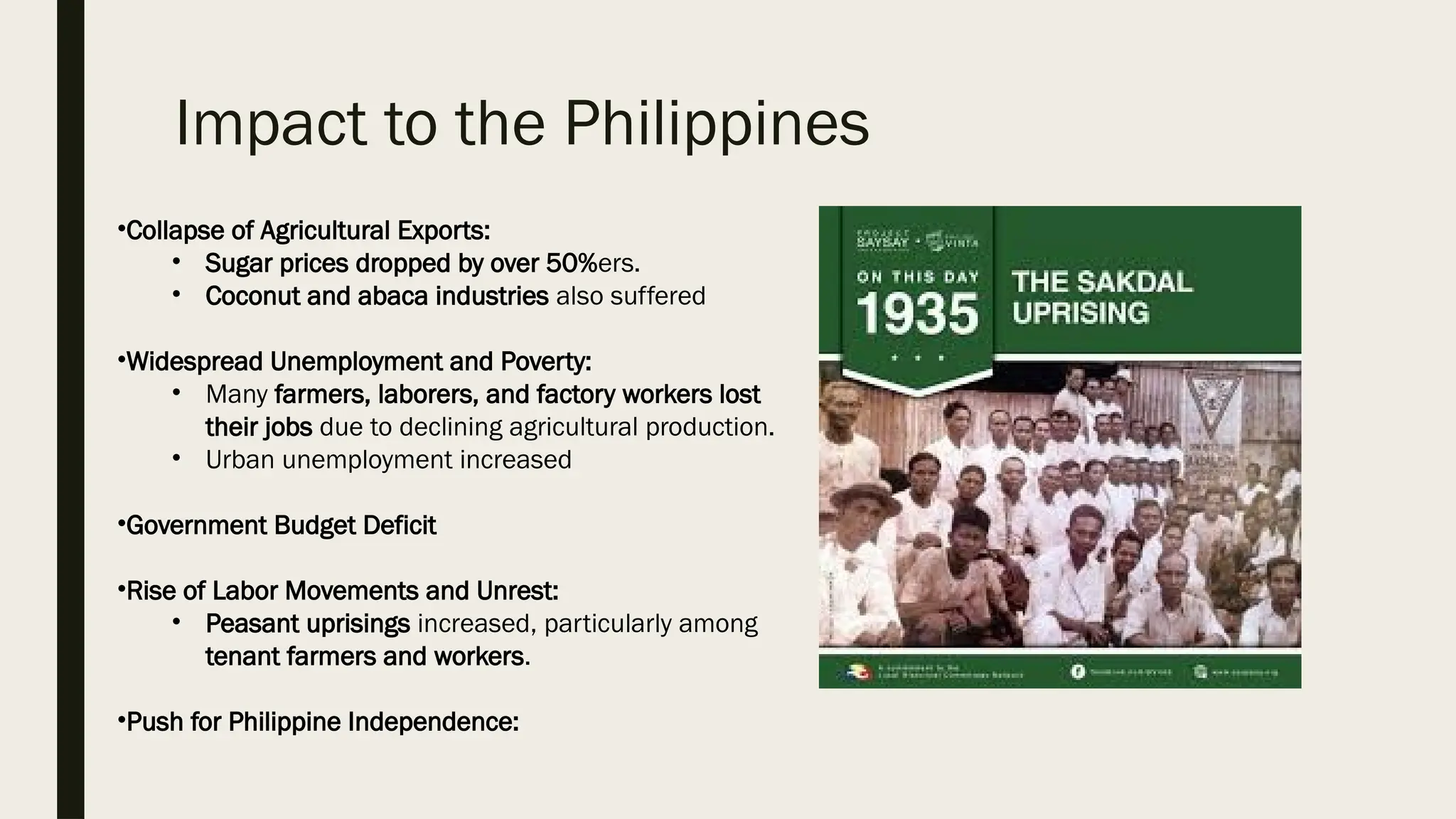
Impact to the Philippines
•Collapse of Agricultural Exports:
• Sugar prices dropped by over 50%ers.
• Coconut and abaca industries also suffered
•Widespread Unemployment and Poverty:
• Many farmers, laborers, and factory workers lost
their jobs due to declining agricultural production.
• Urban unemployment increased
•Government Budget Deficit
•Rise of Labor Movements and Unrest:
• Peasant uprisings increased, particularly among
tenant farmers and workers.
•Push for Philippine Independence:
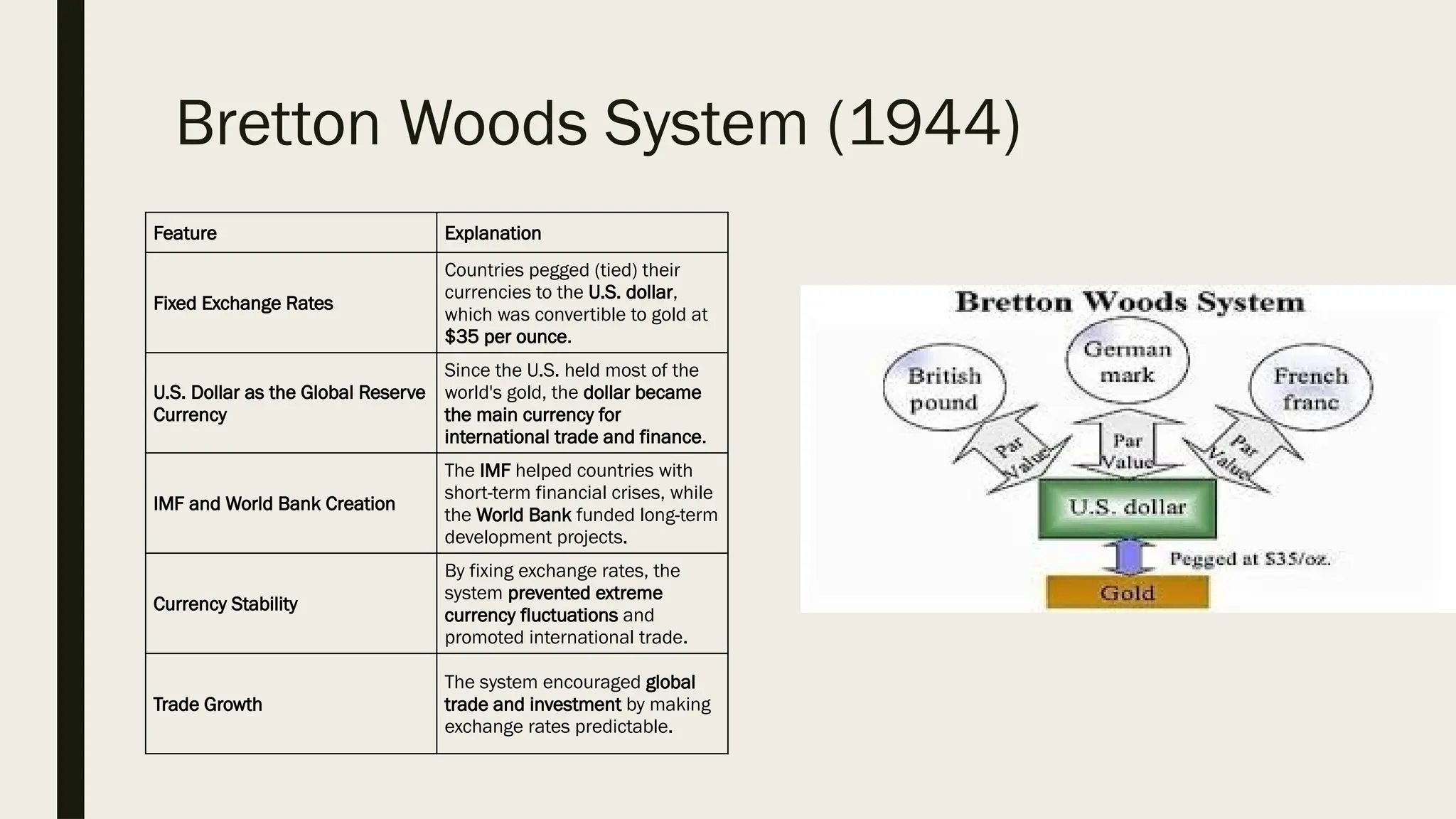
Bretton Woods System (1944)
Feature Explanation
Fixed Exchange Rates
Countries pegged (tied) their
currencies to the U.S. dollar,
which was convertible to gold at
$35 per ounce.
U.S. Dollar as the Global Reserve
Currency
Since the U.S. held most of the
world's gold, the dollar became
the main currency for
international trade and finance.
IMF and World Bank Creation
The IMF helped countries with
short-term financial crises, while
the World Bank funded long-term
development projects.
Currency Stability
By fixing exchange rates, the
system prevented extreme
currency fluctuations and
promoted international trade.
Trade Growth
The system encouraged global
trade and investment by making
exchange rates predictable.
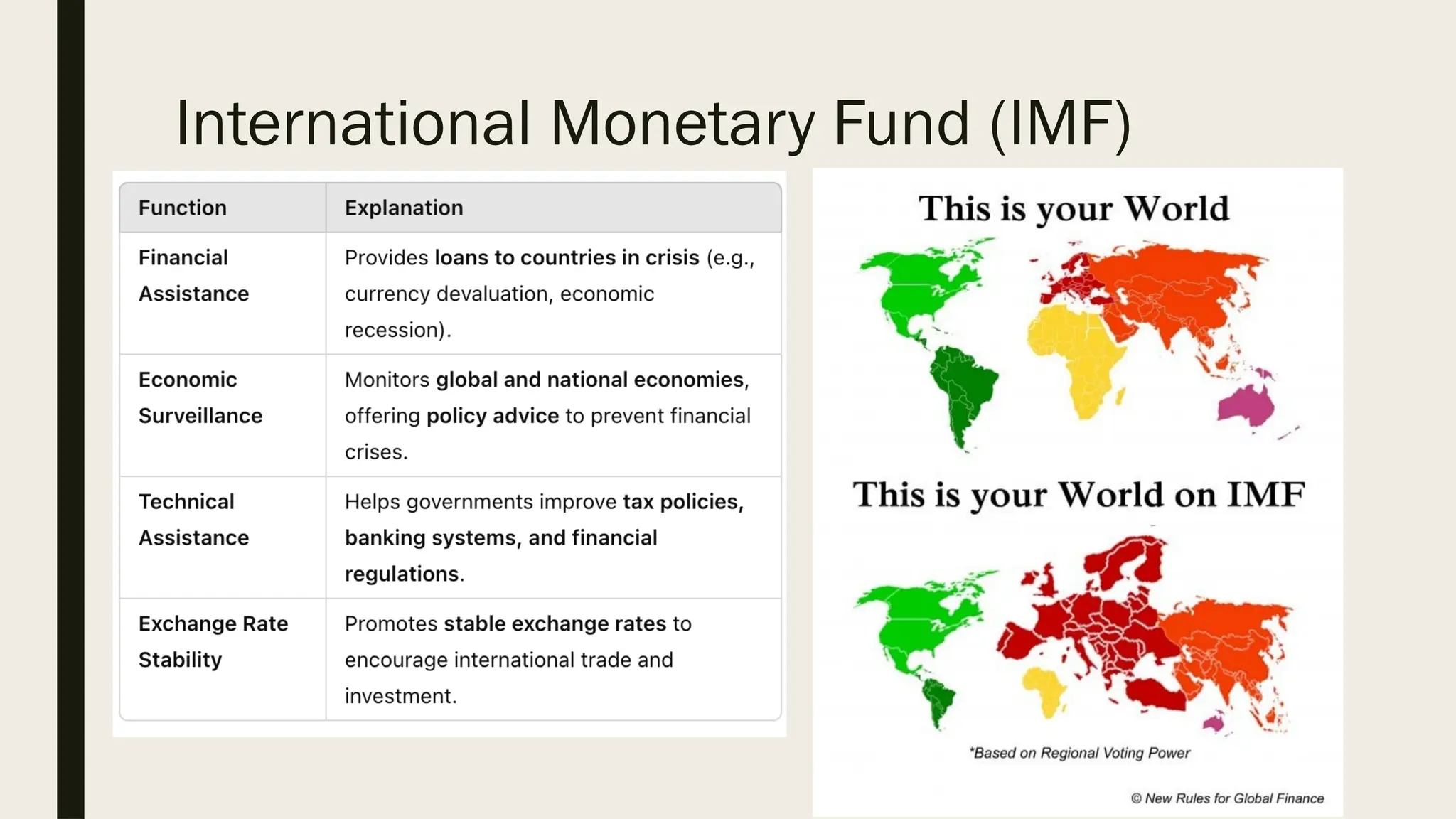
International Monetary Fund (IMF)
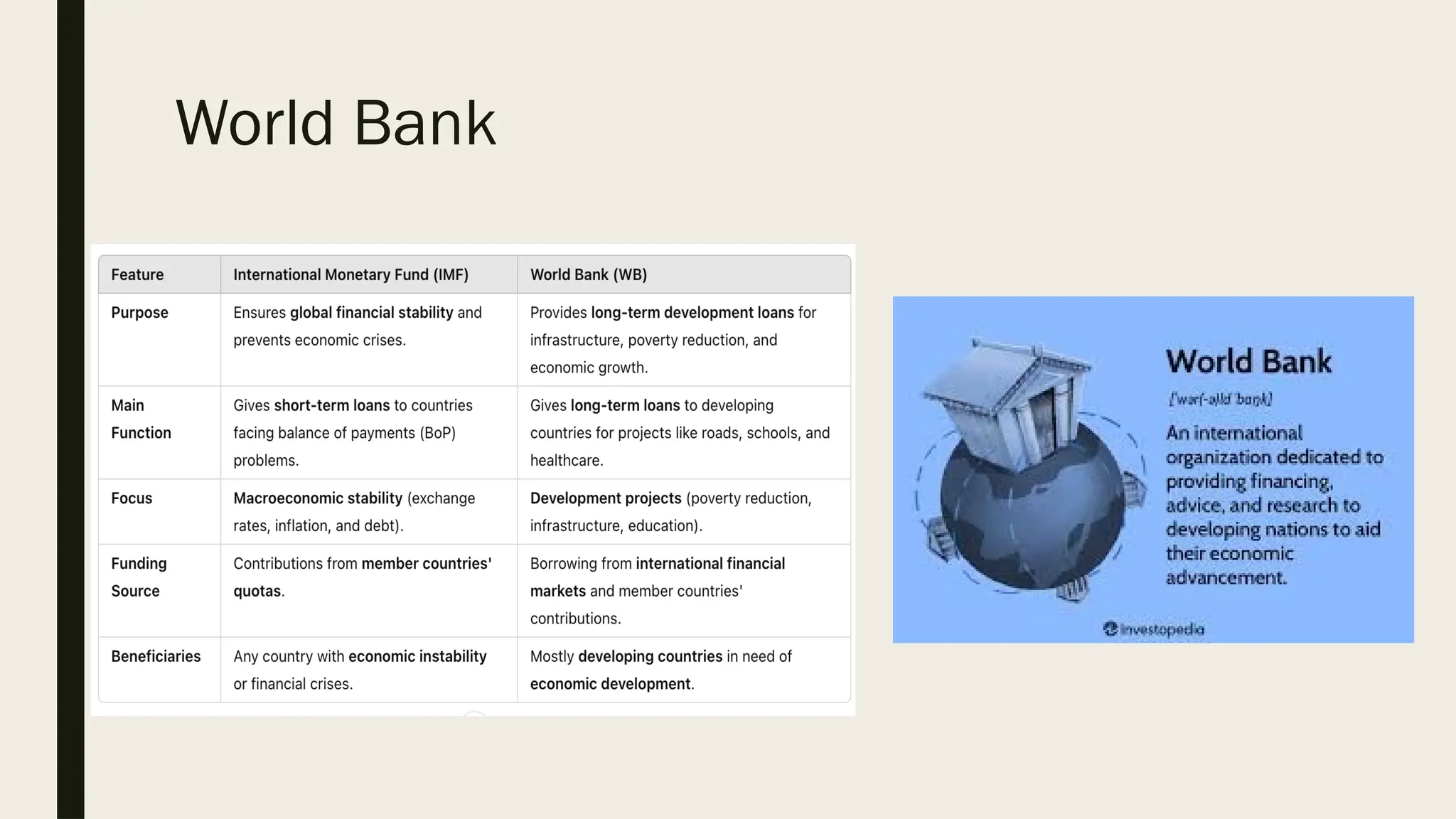
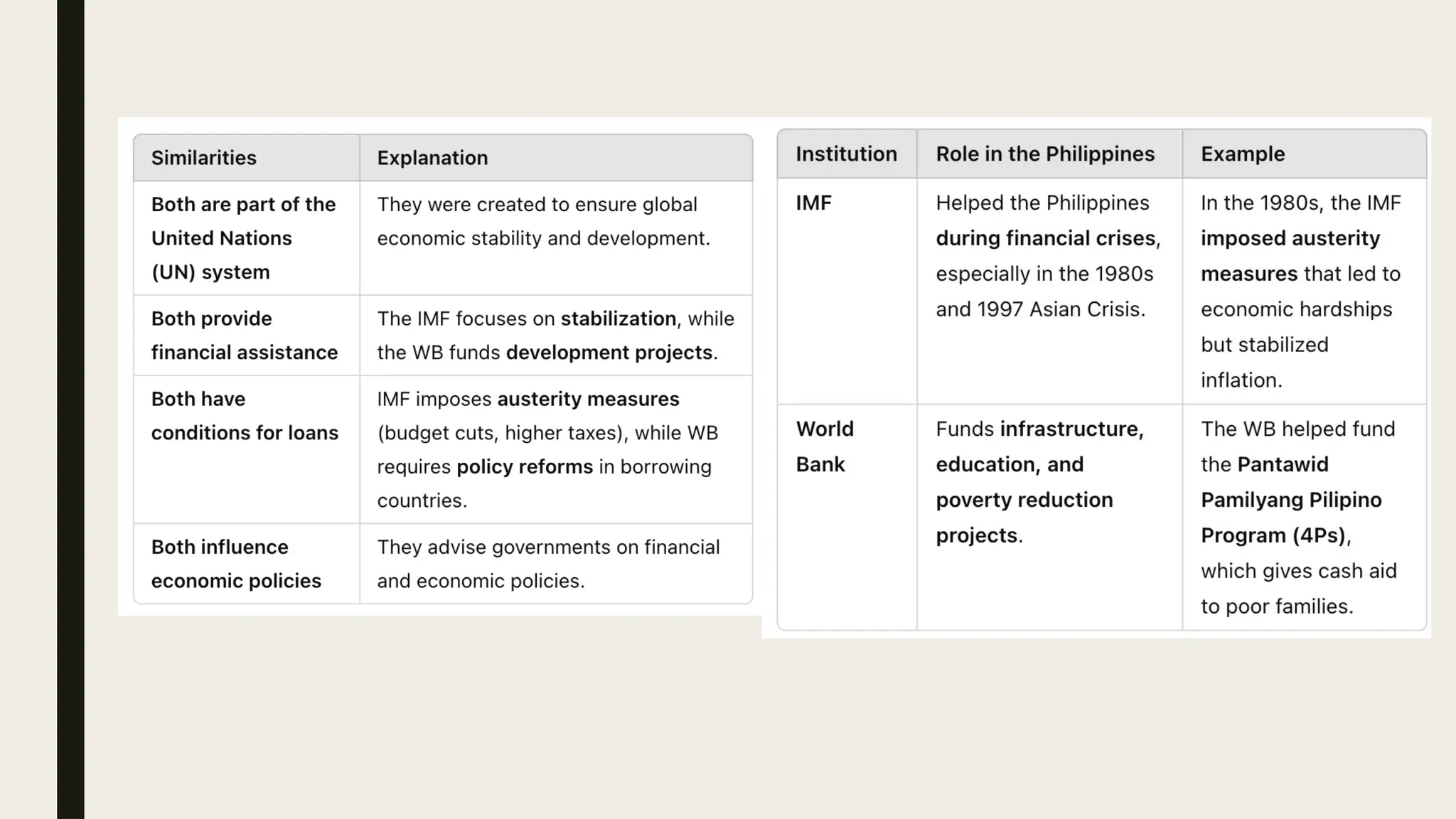
World Bank
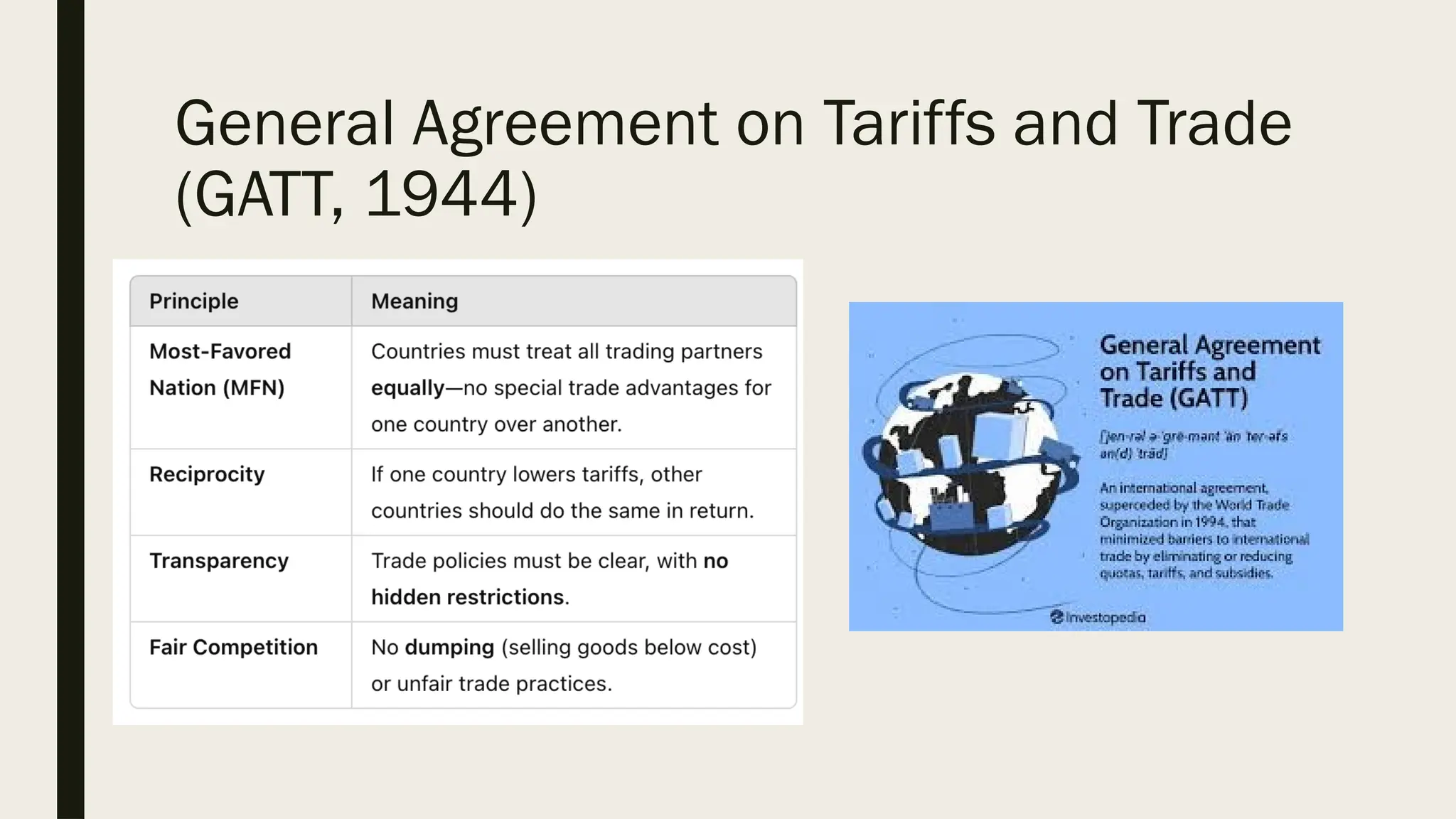
General Agreement on Tariffs and Trade
(GATT, 1944)
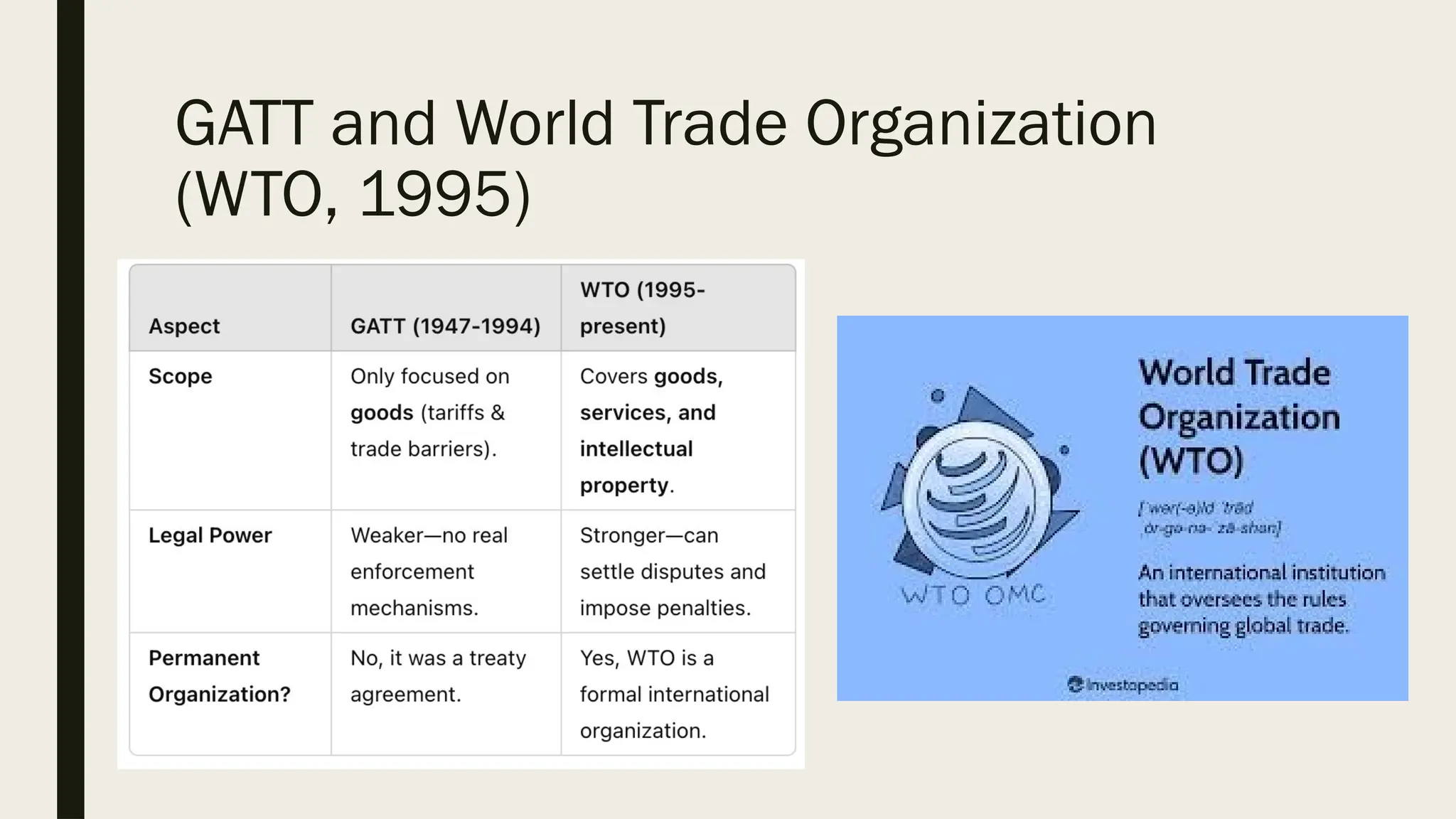
GATT and World Trade Organization
(WTO, 1995)
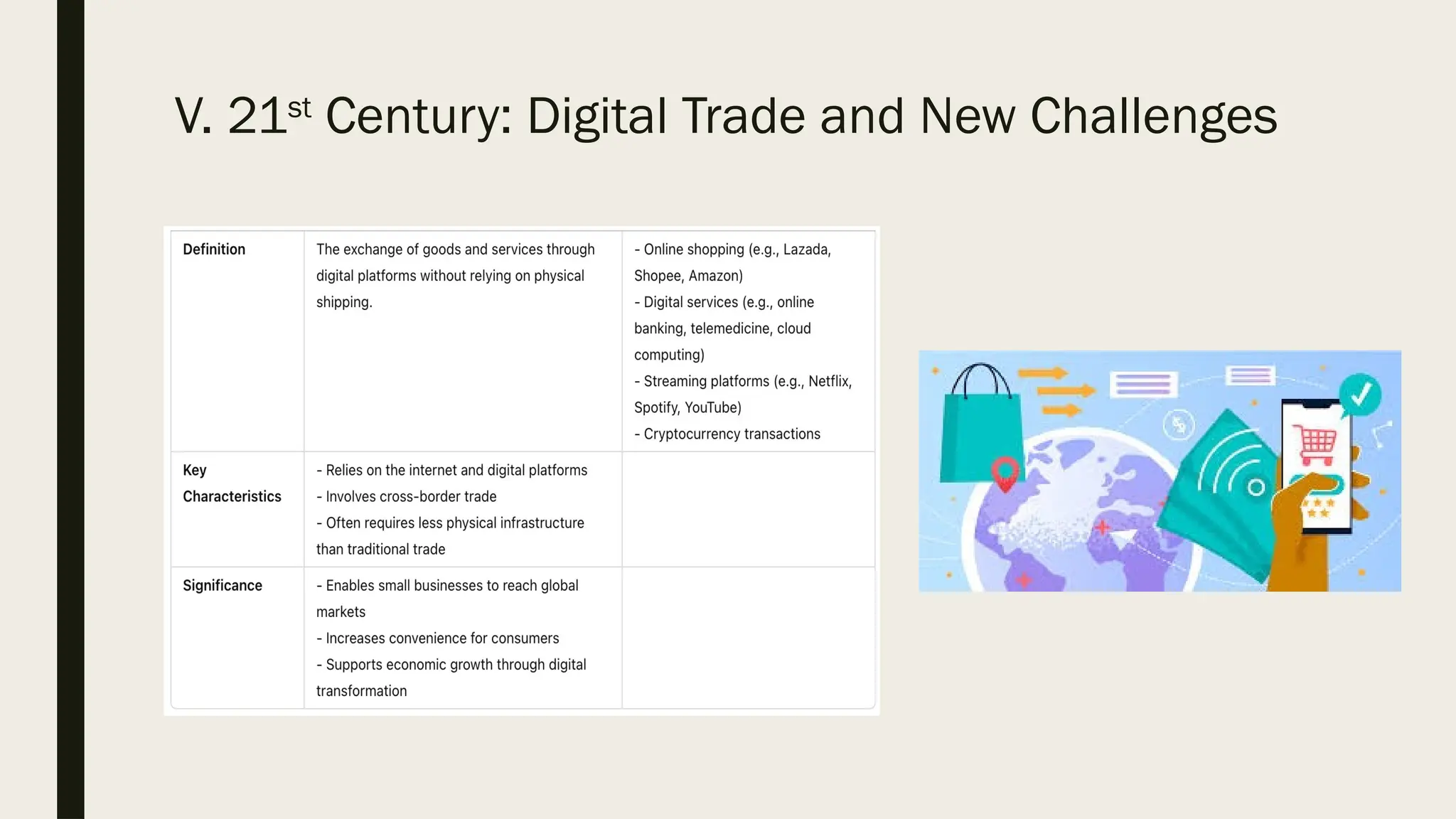
V. 21st
Century: Digital Trade and New Challenges
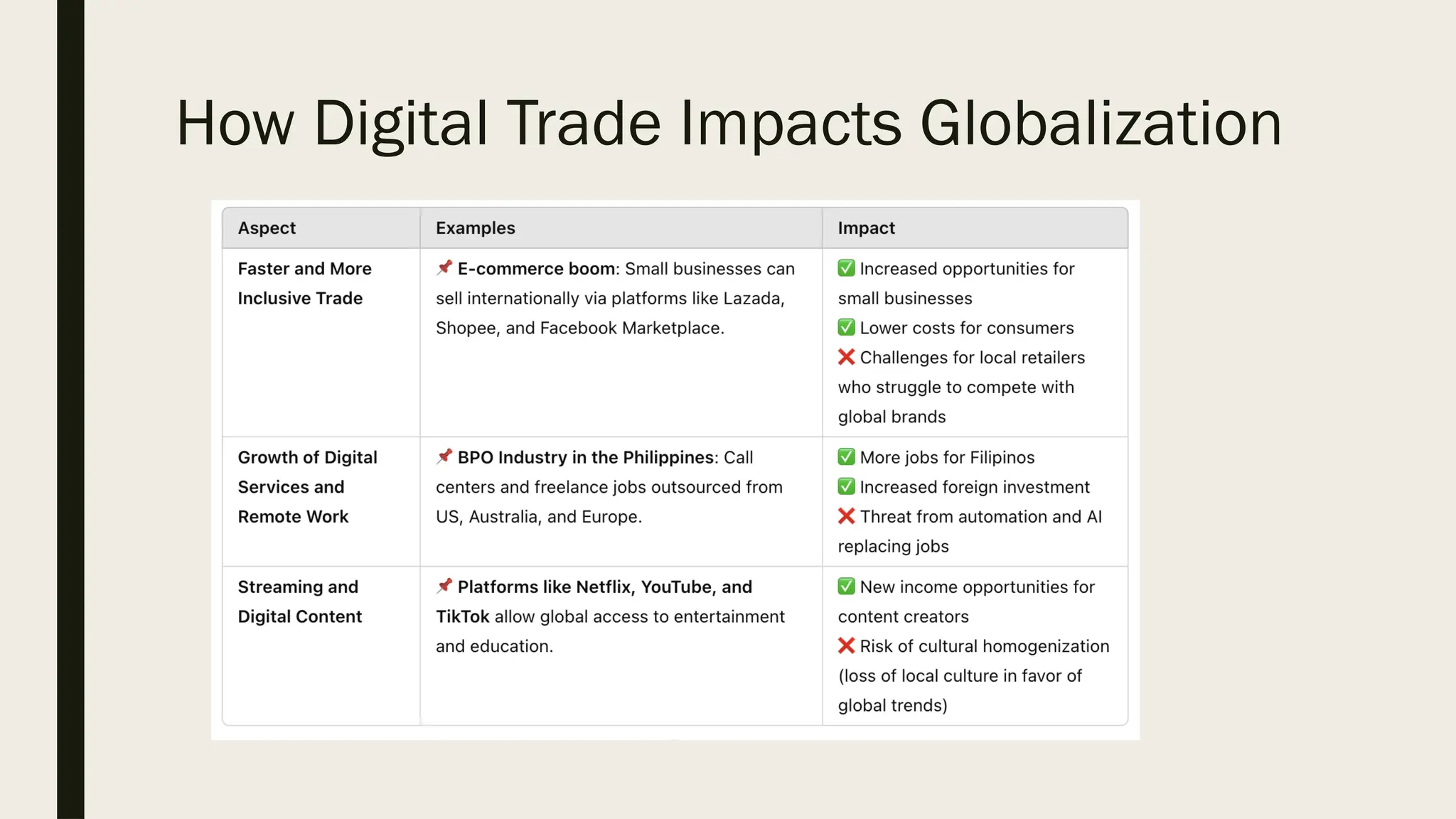
How Digital Trade Impacts Globalization
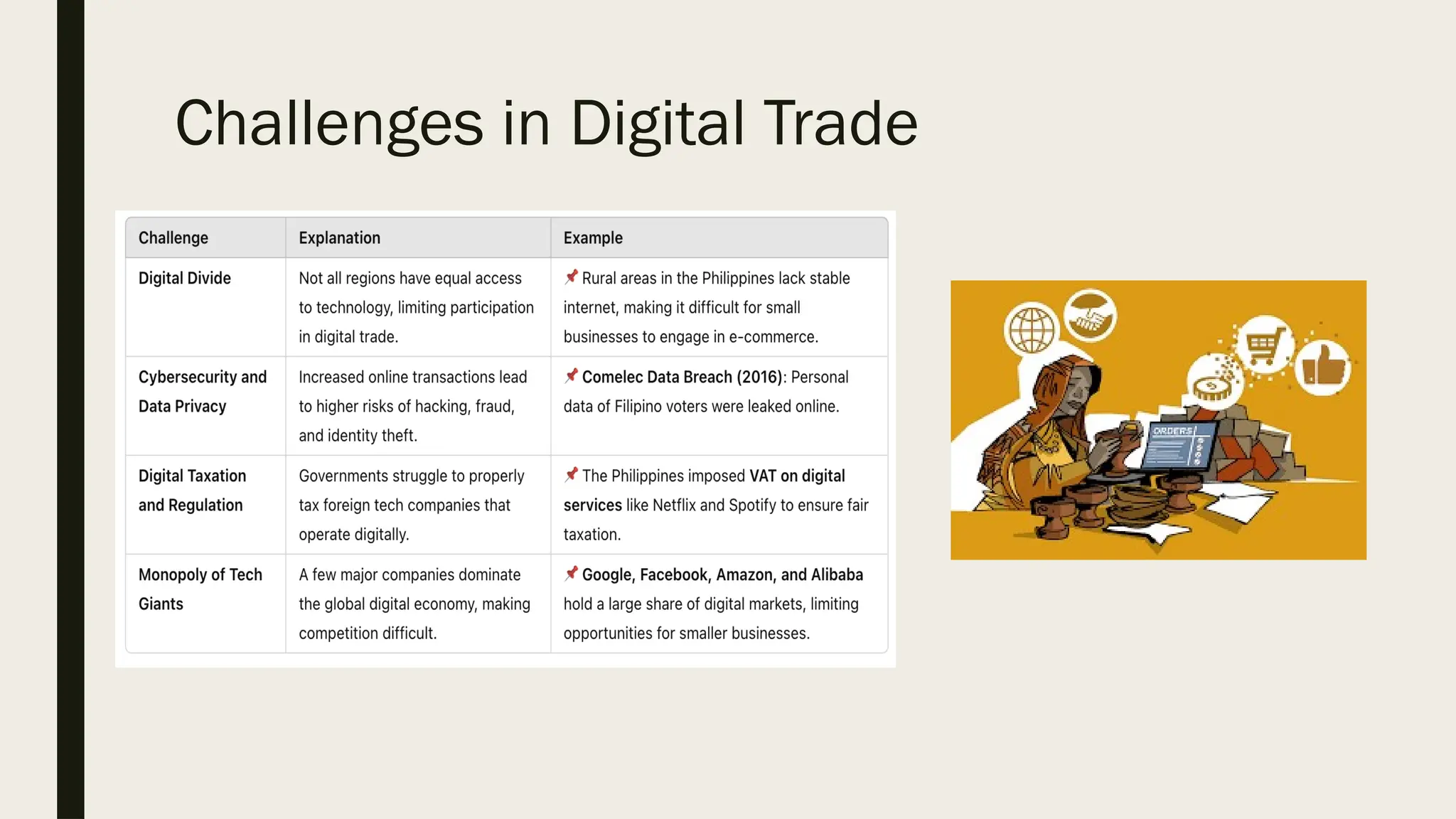
Challenges in Digital Trade

TCW Unit 2 powerpoint presentation for TCW

  • 1.
  • 2.
    Economic Globalization The InternationalMonetary Fund (IMF) defines economic globalization as: “A historical process, the result of human innovation and technological progress. It refers to the increasing integration of economies around the world, particularly through the movement of goods, services, and capital across borders. The term also refers to the movement of people (labor) and knowledge (technology) across international borders.”
  • 3.
    How does economicintegration happen? Economic globalization happens through: •Trade – import, export •Investment –Financial flows – Money moves easily across borders •Movement of people •Sharing of knowledge and technology Economic globalization - what happens in one country’s economy can easily affect others. ”Domino Effect”
  • 4.
    Increasing integration *Different economiesaround the world are becoming more connected and dependent on each other. Example: Financial crisis –domino effect; disruption of supply chain; COVID-19 pandemic effects In short, increasing integration means that countries no longer function in isolation—what happens in one place can quickly impact others.
  • 5.
    GDP increase=integration of economies 1.Tradeas a Share of GDP –Rising trade-to-GDP ratios suggest that economies are becoming more interdependent. 2.Foreign Direct Investment (FDI) Growth - businesses are expanding beyond national borders 3.Contribution of Multinational Corporations (MNCs) 4.Sectoral Shifts (Manufacturing and Services Growth) – A shift in GDP composition toward export-driven manufacturing and globally connected services 5.Technology Transfer and Productivity Gains 6.Correlation Between GDP Growth and Global Economic Trends
  • 6.
    Trade as ashare of GDP
  • 8.
  • 9.
  • 10.
    Sectoral shift The shiftfrom an agriculture-dependent economy to one driven by manufacturing and services illustrates how globalization has reshaped the Philippine economy. ✅ Manufacturing (electronics industry) connects the country to global supply chains. ✅ Services (IT-BPO industry) integrates the country into the global knowledge economy.
  • 11.
    Technology transfer andproductivity gains • Introduction of advanced engineering technology, chip design, and automation technologies • Transfer of knowledge • Training on robotic process automation (RPA) • Agricultural innovations • Renewable energy and green technology
  • 12.
    High Frequency Trading=integration of economies How It Works: 1.Super-Fast Trading – Computers buy and sell assets in fractions of a second (often in milliseconds or even microseconds). 2.Algorithm-Based – Special programs analyze market trends and make automatic trades much faster than humans can. 3.Small Profits, Big Gains – Each trade might earn only a tiny profit, but thousands or millions of trades happen daily, adding up to significant earnings.
  • 13.
    International Trading Systems(History I. Ancient Trade Networks (Pre- 15th Century) II. Age of Mercantilism (15th -18th Century) III. Industrial Revolution and Free Trade (18th -19th Century) IV. 2oth Century: Globalization and Institutionalized Trade V. Late 20th Century: WTO and Trade Blocs (1990s-Present) VI. 21st Century: Digital Trade and New Challenges
  • 14.
    I. Ancient TradeNetworks (Pre-15th Century) Before formal trade agreements, international trade was based on barter and regional exchange networks. a) Mesopotamian and Egyptian Trade (~3000 BCE) •Early civilizations in Mesopotamia and Egypt traded goods like grain, textiles, and precious metals. •The Code of Hammurabi (1754 BCE) regulated contracts and trade practices. b) Silk Road (130 BCE – 1453 CE) •Connected China, Central Asia, the Middle East, and Europe. •Traded silk, spices, and luxury goods, enabling cultural and economic exchange. c) Indian Ocean Trade (200 BCE – 1500 CE) •A vast network connecting India, Southeast Asia, the Middle East, and Africa. •Dominated by Arab, Chinese, and Indian traders using monsoon winds for navigation. d) Hanseatic League (12th – 17th Century) •A trade alliance in Northern Europe, regulating Baltic and North Sea trade. •Established early forms of trade agreements and commercial law.
  • 15.
    Mesopotamian and EgyptianTrades • Ancient civilizations • Riverine societies • International trading not global
  • 16.
  • 17.
  • 18.
  • 19.
    Hanseatic League • Allianceamong merchants • Started by guilds • Protection and defense • Baltic and Scandinavian countries • Economic and defensive alliance • Private navy • Could enforce embargoes • Acted as political force Decline: • Atlantic trade • Competition from Dutch and English merchants • Internal conflict
  • 20.
    II. Age ofMercantilism (15th -18th century) Characteristics: • Power is dependent on wealth • Gold and silver accumulation (bullionism) • Export more than import • Accumulation of wealth • Government control over trade (protectionism) • Age of colonialism
  • 21.
    Decline of Mercantilism AdamSmith’s The Wealth of Nations • Laissez fare • Real wealth is on production not stockpiling • “Invisible hand” • Specialization –division of labor • Against monopolies (government-backed BEIC, and DEIC) • Monopoly and protectionism kept prices high
  • 22.
    III. Industrial Revolutionand Free Trade (18th-19th Century) The Industrial Revolution (1750–1850) led to new manufacturing and transport innovations, shifting global trade policies. a) Rise of Free Trade (19th Century) •Adam Smith’s "Wealth of Nations" (1776) advocated for free markets and comparative advantage. •Repeal of the Corn Laws (1846) in Britain marked a move toward free trade. •Cobden-Chevalier Treaty (1860): A trade agreement between Britain and France reducing tariffs. b) Growth of Global Trade Networks •Telegraph and Railroads improved communication and transport. •Gold Standard (1870s – 1914) stabilized international currency exchange.
  • 24.
    Gold Standard (1870s-1914) Howthe Gold Standard Worked 1 ️ 1️⃣Money = Gold •A country’s currency had a fixed value in gold. •Example: If $1 = 1/20th of an ounce of gold, you could exchange 20 paper dollars for an ounce of gold. 2️⃣Governments Held Gold Reserves •To print more money, a country needed more gold in its reserves. •This prevented too much money from being printed (controlled inflation). 3 ️ 3️⃣Fixed Exchange Rates •Since currencies were tied to gold, exchange rates between countries were stable. •Example: If £1 = 5 grams of gold and $1 = 2.5 grams of gold, then £1 = $2.
  • 25.
    IV. 20th Century: Globalizationand Institutionalized Trade Following World War I and II, nations sought structured trade systems. a) Interwar Period (1919–1939) •Smoot-Hawley Tariff Act (1930): U.S. imposed high tariffs, worsening the Great Depression. •Rise of Protectionism •b) Bretton Woods System (1944) •Established a fixed exchange rate system with the U.S. dollar linked to gold. •International Monetary Fund (IMF) and World Bank. c) General Agreement on Tariffs and Trade (GATT) (1947) •Aimed to reduce tariffs and trade barriers globally.
  • 26.
    1929 Stock MarketCollapse and the Great Depression •Black Thursday and Black Tuesday •Speculation and the Stock Market Boom – people bought stocks on margin which created economic bubble •Overproduction and economic slowdown – decline in profit but stock prices are artificially high •Rising interest rates and bank loans •Stock market panic and selling frenzy –fall of stock prices, and trading 16 million shares traded in one day •Bank failures and credit collapse
  • 27.
    Smoot-Hawley Tariff Act •Cause: The Great Depression • Sponsored by Reed Smoot and Willis Hawley • Increase on tariffs on foreign imports • Protectionist policy • Retaliatory tariffs • Worsened global trade
  • 28.
    Great Depression Stock MarketCrash (1929) – Wiped out billions of dollars in wealth Bank Failures Reduction in Consumer Spending and Investment Decline in International Trade Agricultural Overproduction
  • 29.
    Impact to thePhilippines •Collapse of Agricultural Exports: • Sugar prices dropped by over 50%ers. • Coconut and abaca industries also suffered •Widespread Unemployment and Poverty: • Many farmers, laborers, and factory workers lost their jobs due to declining agricultural production. • Urban unemployment increased •Government Budget Deficit •Rise of Labor Movements and Unrest: • Peasant uprisings increased, particularly among tenant farmers and workers. •Push for Philippine Independence:
  • 30.
    Bretton Woods System(1944) Feature Explanation Fixed Exchange Rates Countries pegged (tied) their currencies to the U.S. dollar, which was convertible to gold at $35 per ounce. U.S. Dollar as the Global Reserve Currency Since the U.S. held most of the world's gold, the dollar became the main currency for international trade and finance. IMF and World Bank Creation The IMF helped countries with short-term financial crises, while the World Bank funded long-term development projects. Currency Stability By fixing exchange rates, the system prevented extreme currency fluctuations and promoted international trade. Trade Growth The system encouraged global trade and investment by making exchange rates predictable.
  • 31.
  • 32.
  • 34.
    General Agreement onTariffs and Trade (GATT, 1944)
  • 35.
    GATT and WorldTrade Organization (WTO, 1995)
  • 36.
    V. 21st Century: DigitalTrade and New Challenges
  • 37.
    How Digital TradeImpacts Globalization
  • 38.