Orientation and TrainingJuly 11, 20091:30 p.m. – 3:00 p.m. American Library Association Annual ConferenceChicago, ILAdriana GonzalezTexas A&M University
OUTLINEAbout MentoringExpectations and Benefits About LLAMA Mentoring ProgramDistance Mentoring Best PracticesPossible Discussion TopicsResources References
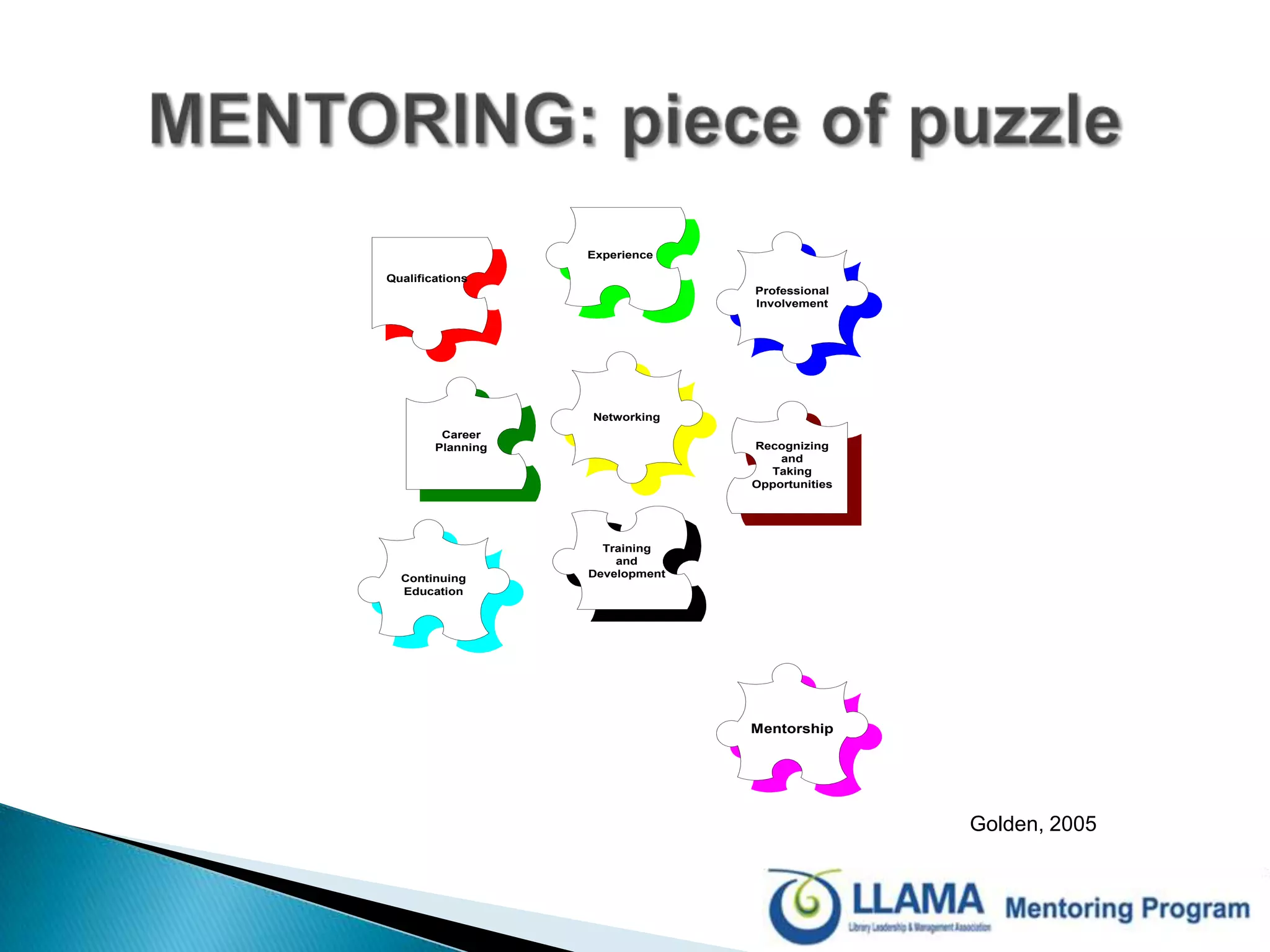
MENTORING: piece of puzzle               Golden, 2005
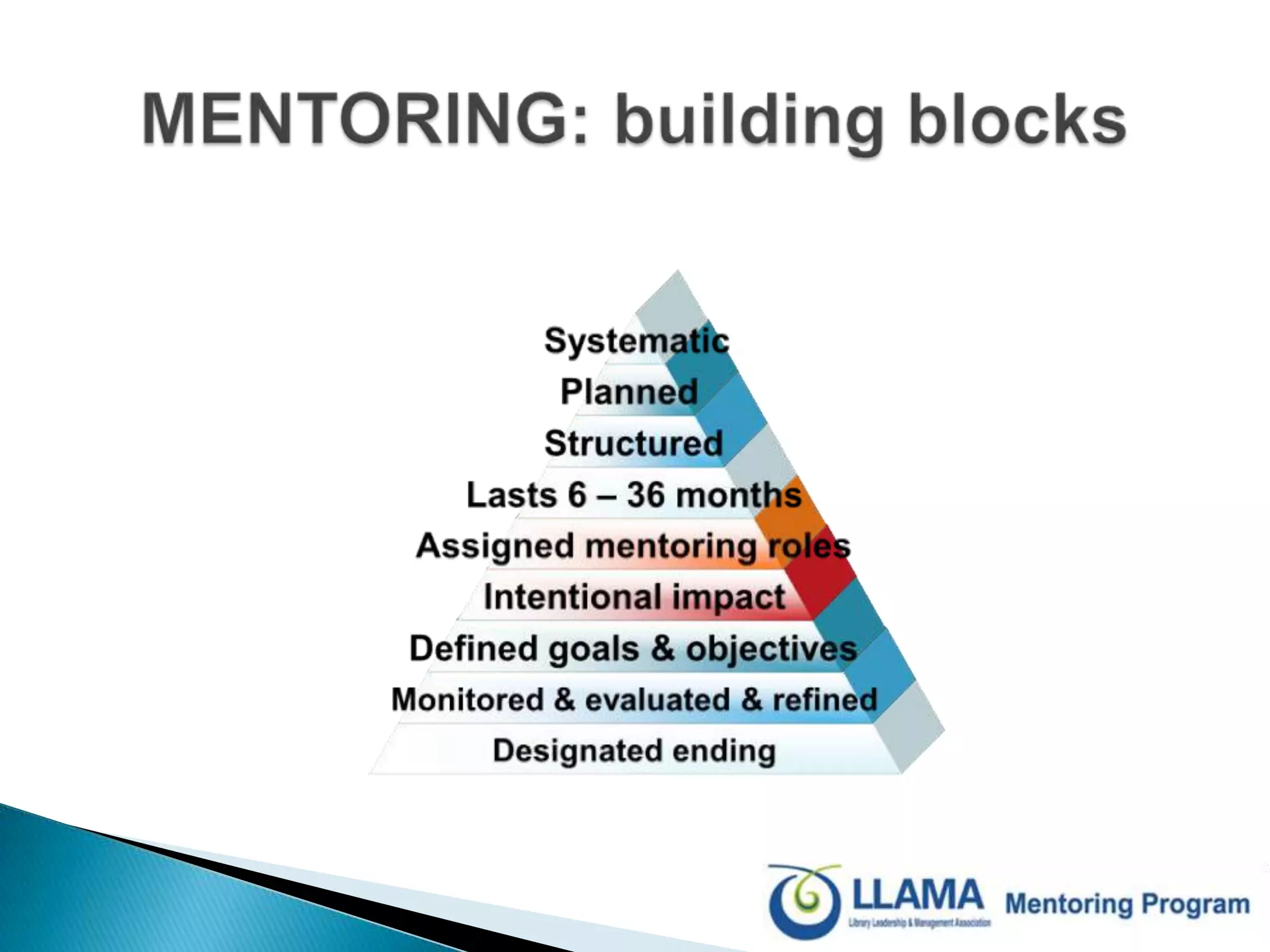
MENTORING: building blocks
“A nurturing process in which a more skilled or more experienced person, serving as a role model.... 	teaches	sponsors	encourages	counsels 	befriends	within the context of an ongoing, caring relationship between the mentor and protégé for the purpose of promoting the mentee’s professional and/or personal development.”           Anderson and Shannon,  1995“Mentoring is a relationship which gives people the opportunity to share their skills and experiences, and to grow and develop in the process.”  Peterson, 2005:  Northern Territory Office, 1998MENTORING: definitions
Formal mentoringInformal mentoringE-mentoringGroup mentoringCo-mentoringPeterson, 2005MENTORING:  different ways
MENTORING: contributing factorsPartners should get along well together
partners should mutually respect each other
partners should be committed to the relationship
partners should develop and agree upon a structure and include: length, frequency, place of meetings, and regular review of progress and development
partners’ motives and objectives should be understood by the other
partners should give each other permission to try things
partners should maintain perpetual optimismAbility to listen, openness and commitmentTime management and self-management skillsAssertiveness, realism and discretionKnowledgeable or able to find outChallenging, analytical and evaluating Ability to change and accept changeMotivated and able to demonstrate leadershipAble to identify opportunitiesHonest and able to give constructive advicePeterson, 2005:  Northern Territory Office, 1998MENTORING: essential attributes
EXPECTATIONS: mentorExpect excellence Affirm, affirm, affirm, and then affirm some moreProvide sponsorshipBe a teacher and a coachEncourage and supportOffer counsel in difficult timesProtect when necessaryStimulate growth with challenging assignmentsGive mentee exposure and promote their visibilityNurture creativityProvide correction – even when painfulNarrate growth and developmentSelf-disclosure when appropriateTeach facetingBe an intentional modelDisplay dependability                                                                   			               Johnson and  Ridley, 2004
Own learning (often mentors report as much and more learning than mentees) Opportunity to practice good developmental behaviors outside of direct line responsibilities Development of own self-awareness Greater understanding of other areas of the business and/or of other culturesClutterbuck , 2003BENEFITS:  mentor
EXPECTATIONS:  menteeDrive your mentoring experienceManage how and what you learnBuild on your strengthsSurpass your comfort limitsMake your partnership the cornerstoneActively solicit feedback from your mentorWork to become as introspective as possible; ask    your mentor about your impact on othersWork-up the courage to give your mentor feedback   about how he/she can help you bestRevisit your growth goals periodically and set new   directions as you achieve initial targetsLet your mentor know your aims and how you feel    you are progressingPerrone and Ambrose, 2005
BENEFITS:  menteeClarity  Unthreatening environmentImproved networking Practical advice  Opportunity to be challenged Transfer of knowledge Having a role modelClutterbuck, 2003
Provide an enriching and valuable opportunity for all partiesCommunicate regularly Offer solutions if duos are experiencing challengesEnsure and maintain confidentialitySolicit your opinions on mid-way and final surveysLLAMA MENTORING: we commit to
Complete LLAMA Mentoring Program Mentor/Mentee Agreement formContribute to the duo relationship and to the ProgramCommunicate regularly with your mentor Ensure and maintain confidentiality Communicate challenges to the CommitteeComplete mid-way and final surveys  LLAMA MENTORING:  you commit to
First Meeting Tool (mentor)First Meeting Tool (mentee)Meeting Tool Twelve Habits of the Toxic MentorTwelve Habits of the Toxic MenteeLLAMA MENTORING:  toolkit
DISTANCE MENTORING: via emailBe compulsive about regularly scheduled contactsPay attention to confidentialityDiscuss response time expectations (immediate, within a day, etc.)Send short, newsy e-mailsInclude your contact information, alwaysDecide together if you want to enhance your e-mail							  	Phillips-Jones, 2003
Set up regularly scheduled meetingsRemove all distractionsCall or be ready on timeHave agenda, talking-points, and questions in front of you when you begin the meetingTake notes or use the meeting formSend a summary of agreements (mentees take lead on this)Make/receive spontaneous calls (good news, compliments)Use voicemail for information, encouragement, and appreciation 			Phillips-Jones,  2003DISTANCE MENTORING: via telephone
SkypeGoogle DocsWiggioWebcamDISTANCE MENTORING:via online technologies
Career Leadership DevelopmentServing on committeesProfessional involvement activitiesRisk-takingProfessional philosophyObjectively review own philosophy for truth and coherenceGrab for the ring!Questioning certaintiesWorking through specific leadership challenges to become a better team player and team leaderNeed for expanding experience inside as well as outside of the professionPossible methods to effectively chair a committeePOSSIBLE DISCUSSION TOPICS

LLAMA Mentoring Orientation and Training

  • 1.
    Orientation and TrainingJuly11, 20091:30 p.m. – 3:00 p.m. American Library Association Annual ConferenceChicago, ILAdriana GonzalezTexas A&M University
  • 2.
    OUTLINEAbout MentoringExpectations andBenefits About LLAMA Mentoring ProgramDistance Mentoring Best PracticesPossible Discussion TopicsResources References
  • 3.
    MENTORING: piece ofpuzzle Golden, 2005
  • 4.
  • 5.
    “A nurturing processin which a more skilled or more experienced person, serving as a role model.... teaches sponsors encourages counsels befriends within the context of an ongoing, caring relationship between the mentor and protégé for the purpose of promoting the mentee’s professional and/or personal development.” Anderson and Shannon, 1995“Mentoring is a relationship which gives people the opportunity to share their skills and experiences, and to grow and develop in the process.” Peterson, 2005: Northern Territory Office, 1998MENTORING: definitions
  • 6.
    Formal mentoringInformal mentoringE-mentoringGroupmentoringCo-mentoringPeterson, 2005MENTORING: different ways
  • 7.
    MENTORING: contributing factorsPartnersshould get along well together
  • 8.
    partners should mutuallyrespect each other
  • 9.
    partners should becommitted to the relationship
  • 10.
    partners should developand agree upon a structure and include: length, frequency, place of meetings, and regular review of progress and development
  • 11.
    partners’ motives andobjectives should be understood by the other
  • 12.
    partners should giveeach other permission to try things
  • 13.
    partners should maintainperpetual optimismAbility to listen, openness and commitmentTime management and self-management skillsAssertiveness, realism and discretionKnowledgeable or able to find outChallenging, analytical and evaluating Ability to change and accept changeMotivated and able to demonstrate leadershipAble to identify opportunitiesHonest and able to give constructive advicePeterson, 2005: Northern Territory Office, 1998MENTORING: essential attributes
  • 14.
    EXPECTATIONS: mentorExpect excellenceAffirm, affirm, affirm, and then affirm some moreProvide sponsorshipBe a teacher and a coachEncourage and supportOffer counsel in difficult timesProtect when necessaryStimulate growth with challenging assignmentsGive mentee exposure and promote their visibilityNurture creativityProvide correction – even when painfulNarrate growth and developmentSelf-disclosure when appropriateTeach facetingBe an intentional modelDisplay dependability Johnson and Ridley, 2004
  • 15.
    Own learning (oftenmentors report as much and more learning than mentees) Opportunity to practice good developmental behaviors outside of direct line responsibilities Development of own self-awareness Greater understanding of other areas of the business and/or of other culturesClutterbuck , 2003BENEFITS: mentor
  • 16.
    EXPECTATIONS: menteeDriveyour mentoring experienceManage how and what you learnBuild on your strengthsSurpass your comfort limitsMake your partnership the cornerstoneActively solicit feedback from your mentorWork to become as introspective as possible; ask your mentor about your impact on othersWork-up the courage to give your mentor feedback about how he/she can help you bestRevisit your growth goals periodically and set new directions as you achieve initial targetsLet your mentor know your aims and how you feel you are progressingPerrone and Ambrose, 2005
  • 17.
    BENEFITS: menteeClarity Unthreatening environmentImproved networking Practical advice Opportunity to be challenged Transfer of knowledge Having a role modelClutterbuck, 2003
  • 18.
    Provide an enrichingand valuable opportunity for all partiesCommunicate regularly Offer solutions if duos are experiencing challengesEnsure and maintain confidentialitySolicit your opinions on mid-way and final surveysLLAMA MENTORING: we commit to
  • 19.
    Complete LLAMA MentoringProgram Mentor/Mentee Agreement formContribute to the duo relationship and to the ProgramCommunicate regularly with your mentor Ensure and maintain confidentiality Communicate challenges to the CommitteeComplete mid-way and final surveys LLAMA MENTORING: you commit to
  • 20.
    First Meeting Tool(mentor)First Meeting Tool (mentee)Meeting Tool Twelve Habits of the Toxic MentorTwelve Habits of the Toxic MenteeLLAMA MENTORING: toolkit
  • 21.
    DISTANCE MENTORING: viaemailBe compulsive about regularly scheduled contactsPay attention to confidentialityDiscuss response time expectations (immediate, within a day, etc.)Send short, newsy e-mailsInclude your contact information, alwaysDecide together if you want to enhance your e-mail Phillips-Jones, 2003
  • 22.
    Set up regularlyscheduled meetingsRemove all distractionsCall or be ready on timeHave agenda, talking-points, and questions in front of you when you begin the meetingTake notes or use the meeting formSend a summary of agreements (mentees take lead on this)Make/receive spontaneous calls (good news, compliments)Use voicemail for information, encouragement, and appreciation Phillips-Jones, 2003DISTANCE MENTORING: via telephone
  • 23.
  • 24.
    Career Leadership DevelopmentServingon committeesProfessional involvement activitiesRisk-takingProfessional philosophyObjectively review own philosophy for truth and coherenceGrab for the ring!Questioning certaintiesWorking through specific leadership challenges to become a better team player and team leaderNeed for expanding experience inside as well as outside of the professionPossible methods to effectively chair a committeePOSSIBLE DISCUSSION TOPICS
  • 25.
    Career Leadership DevelopmentProfessionaldevelopment Educational opportunitiesClarifying personal and professional goalsShadowing opportunitiesMentoring processProfessional skill-building opportunitiesTeam-building challenges and opportunitiesSkill level confidenceSense of worth as a leaderLibrary profession itself; what it means to be a librarianLeadership stylesPOSSIBLE DISCUSSION TOPICS
  • 26.
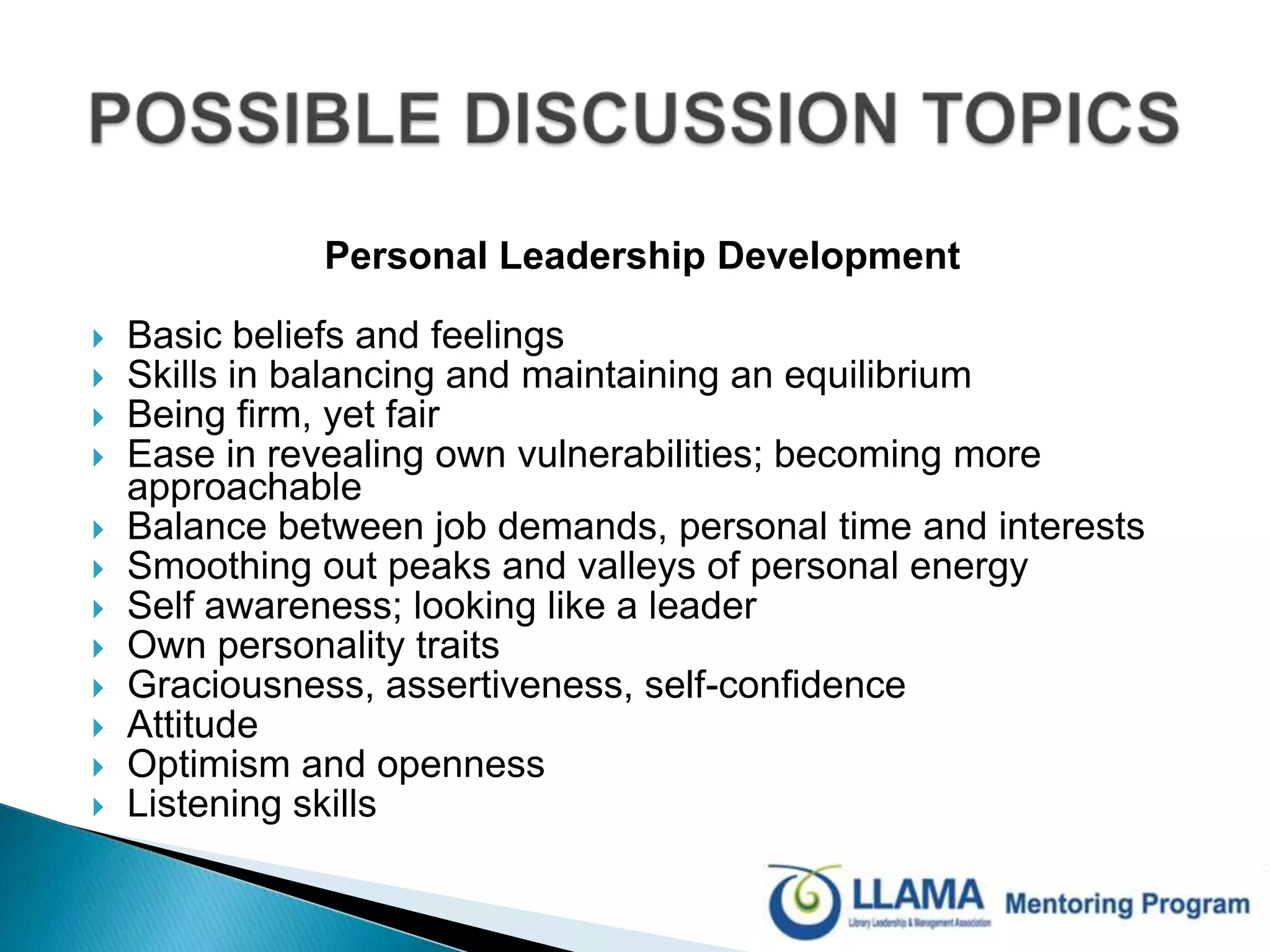
    Personal Leadership DevelopmentBasicbeliefs and feelingsSkills in balancing and maintaining an equilibriumBeing firm, yet fairEase in revealing own vulnerabilities; becoming more approachableBalance between job demands, personal time and interestsSmoothing out peaks and valleys of personal energySelf awareness; looking like a leaderOwn personality traitsGraciousness, assertiveness, self-confidenceAttitudeOptimism and opennessListening skillsPOSSIBLE DISCUSSION TOPICS
  • 27.
    LLAMA Mentoring ProgramWiki: http://www.lama.ala.org/lamawiki/index.php?title=LLAMA_Mentoring_CommitteeWeb Junction: http://www.webjunction.org/mentoring/-/resources/wjarticlesThe Mentoring WorkbookRESOURCES
  • 28.
    Anderson, and AnneLucasse Shannon, “Toward a Conceptualization of Mentoring.” Issues in Mentoring. Eds. Trevor Kerry and Anne Shelton Mayes. New York: Routledge, 1995:29.Clutterbuck, David. The Benefits of Mentoring. British Columbia: Clutterbuck Associates for Peer Resources Victoria, 2003.Golden, Janine.  The role and contribution of strategies and factors in the career successes of public library directors.  Diss. University of Pittsburgh, 2005.  Johnson, and Charles R. Ridley. The Elements of Mentoring. New York: Palgrave Macmillan, 2004. Perrone, and Larry Ambrose. The Mentee’s Navigator: Making Mentoring Happen. Chicago: Perrone-Ambrose Associates, Inc., 2005.Peterson, Jennifer Lee. The Mentoring Workbook-draft. 2005 <http://www.webjunction.org/c/document_library/get_file?folderId=439508&name=DLFE-11578.pdf>.Phillips-Jones, Linda. The Mentee’s Guide: How to Have a Successful Relationship With a Mentor. Coalition of Counseling Centers, 2003.REFERENCES
  • 29.

Editor's Notes

  • #4 -our profession is multi-faceted-holistic-different pieces work together to help us succeed and growQuestion is: Is mentoring a piece of that puzzle?ASK audience for their response -mentoring can work along with networking, career planning, etc-mentoring could play a critical role in your career development, but that is to be discovered
  • #5 There are a lot of mentoring programs out there-formal mentoring programs follow this general structure-the different levels build off of each other -provides structure
  • #6 Having a mentor is significant because they teach, sponsor, encourage, counsel, and befriend-Importantly it offer a safe environment for learning-ASK group for their definition of mentoring
  • #7 Our program is considered a formal mentoring program, however it is also an e-mentoring program since the majority of the interaction and relationship will take place virtually.
  • #8 There are factors that make a mentoring relationship effectiveRead off a few of the bullet points.emphasize the structure of their relationship. Point out that this will be a long distance relationship for most discuss options like e-mail, phone, skype, etc… to help facilitate communication over distance and that you will discuss this in detail later on in your presentation
  • #9 This applies to both mentor and menteeContributes to a successful relationship
  • #10 All mentors should have expectationsRead off a few expectationsKeeping in mind that mentors are not mentee supervisors
  • #11 Even mentors benefit from a mentoring relationshipASK mentors for other benefitsOther benefits according to Jennifer Lee Peterson (2005)Gain new insights and perspectivesIncrease job satisfactionIncrease peer recognitionDevelop and improve communication skillsShare expertise and experiences to benefit othersIncentive to stay currentHave a greater understanding of the changing skill set being brought into the profession
  • #12 While mentees may be in a learning environment, they still have expectations of their mentoring relationship-read off a few expectationsKeeping in mind that your mentor is not your supervisor, you don’t “report” to them
  • #13 -Mentees have a lot to gain from a successful mentoring relationship-read off a few bullets-ASK mentees for more benefits, what do they hope to gain Other benefits according to Jennifer Lee Peterson (2005) - clarify personal vision (duplicate) - come to recognize barriers to performance - overcome barriers - have non-threatening opportunity to ask questions about organization and profession (duplicate) - improve communication, negotiation, and decision-making and self-assessment skills - have increased opportunities for networking (duplicate) - develop new skills and knowledge and greater visibility in competencies
  • #14 -this program is successful because of you, our mentors and mentees who find value in participating and contributing to such a programOur objective is to provide a program to specifically target leadership development acknowledge though the duo may not be from the same type of library, leadership is leadership is leadership – the same skills apply no matter where you are or what you do.Attending Orientation is the first step to establishing a collaborative relationship and supports your mentoring relationshipWhen we say that we will communicate regularly, we really do mean regularlyExpect email communication from the Liaison Team: Jennifer and Amy, ASK them to standThey will send out updates, surveysWhile maintaining confidentiality, we encourage you to let us know if you are experiencing challenges. We can offer solutions, ideas,If you need to change partners, let us knowIn other words, we want to hear from you alsoASK if any questions about our role
  • #15 You are expected to contribute to the program. -active communication between the Committee and the Duos ensures that it is a successful and beneficial program for allWe value your opinions and ideas, therefore, you are expected to complete the surveysMid-way survey is at 5 monthsFinal survey at end of programASK if any questions, need clarification
  • #16 -your packets are really a toolkit filled with helpful worksheets-review each worksheet briefly-you also received the don’ts of being a mentor and mentee Earlier I talked about general expectations of mentors and mentees, but early on establish your own expectations, i.e. communication preferences, response times, etc Suggestions: have goals/objectives, self-assessment, keep a journal or log (point to Mentoring workbook for worksheet)
  • #17 Our mentoring program is distance mentoring/e-mentoring program-that presents its own set of challenges the two most common ways of communicating is by email and phone, however, be open to newer technologiesBy email you should follow some basic rulesRead off a few bullets
  • #18 We often times forget about the good ‘ol fashion telephone as a communication medium since we are bombarded with other electronic technologiesKeep in mind any time differences. It is totally acceptable to make a spontaneous call to express good news, an accomplishment, a hurdle crossed, or to simply give someone a complimentTelephone is a slightly more active/engaging mechanism
  • #19 -there are tons of collaborative online tools we can use.-ASK for any others, experiences
  • #20 - We specifically focus on LEADERSHIP development through mentoring, so here are several suggestions for discussion topicsespecially at the beginning of a mentoring relationship, and especially when paired off with someone you don’t know, it is difficult to get a conversation startedUse your meeting tool worksheet to help with that since the focus of our Program is leadership development, there are many, many different things that can be discussedRead off a few bullets
  • #21 Did I say there were MANY possible discussion topics…ASK if anyone has any other ideas not mentionedLeadership shouldn’t just be limited to career leadership but should also encompass personal leadership
  • #22 -switching gears, here are some more discussion topics that focus on personal leadership developmentIt is an opportunity to be introspective and to gain additional self-awareness as well as self-assurance.You will make mistakes along the way, your mentor will help you develop a roadmap but also help YOU develop. ASK how what other topics could be discussed for personal growth
  • #23 On our wiki we provide a tab for resources = reading material, articles, books, etc. Info about our committee, etc.If you come across a good resource, please share it with us and we will add it to the wikiAnother good online resource is Web Junction. Again, you can find helpful links through them
  • #24 -as you probably noticed on the various slides, different sources Here they are listed in case you want to do further reading- Thanks to Janine Golden who laid down the framework for this presentation through her doctoral work.
  • #25 That concludes our orientation/training session. In about a week, expect to receive a survey regarding today’s session.Any Questions?