www.Examville.com Online practice tests, live classes, tutoring, study guides Q&A, premium content and more .
THE ADRENAL GLANDS
They lie at the superior poles of the two kidneys. Each gland is composed of two  distinct parts:  1.  Adrenal Cortex – 80% 2.  Adrenal Medulla- 20%
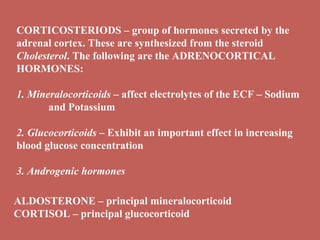
CORTICOSTERIODS – group of hormones secreted by the adrenal cortex. These are synthesized from the steroid  Cholesterol . The following are the ADRENOCORTICAL HORMONES: 1.  Mineralocorticoids  – affect electrolytes of the ECF – Sodium  and Potassium  2.  Glucocorticoids  – Exhibit an important effect in increasing blood glucose concentration 3.  Androgenic hormones  ALDOSTERONE – principal mineralocorticoid CORTISOL – principal glucocorticoid
LAYERS OF ADRENAL CORTEX AND SECRETION
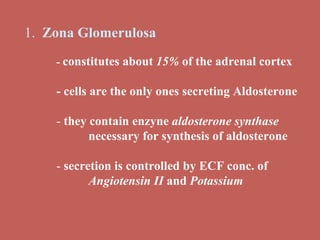
1.  Zona Glomerulosa -  constitutes about  15%  of the adrenal cortex - cells are the only ones secreting Aldosterone -  they contain enzyne  aldosterone synthase   necessary for synthesis of aldosterone -  secretion is controlled by ECF conc. of  Angiotensin II  and  Potassium
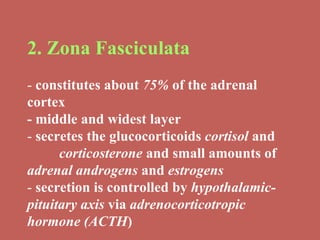
2. Zona Fasciculata   -  constitutes about  75%  of the adrenal cortex - middle and widest layer -  secretes the glucocorticoids  cortisol  and  corticosterone  and small amounts of  adrenal androgens  and  estrogens -  secretion is controlled by  hypothalamic- pituitary axis  via  adrenocorticotropic  hormone (ACTH )
3. Zona Reticularis -  secretes the adrenal androgen  hydroepiandrosterone  (DHEA)  and  androstenedione  and small  amounts of  estrogen  and some  glucocorticoids -  secretion is regulated by  ACTH   and other factor  such as  cortical androgen-stimulating  hormone  from the pituitary
 
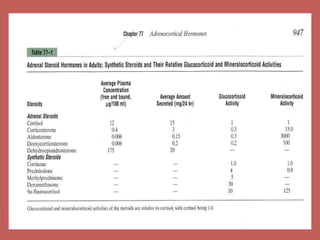
More Important Glucocorticoid Hormones including Synthetic ones: 1. Mineralocorticoids - Aldosterone  ( very potent , accounts for  90%  of all  mineralocorticoid activity -  Desoxycorticosterone  ( 1/30  as potent as aldosterone, but very  small quantities secreted -  Corticosterone  ( slight minralocorticoid activity ) -  9a-Fluococortisol  ( synthetic , slightly more potent than  aldosterone) -  Cortisol  (very slight mineralocorticoid activity, but large  quantity secreted -  Cortisone  ( synthetic , slight mineralocorticoid activity)
2.  Glucocorticoid   - Cortisol  ( very potent , accounts for about  95%  of all  glucocorticoid activity - Corticosterone  (provides  4%  of total  glucocorticoid) activity, much less potent than  cortisol) -  Cortisone  ( synthetic , almost as potent as cortisol) -  Prednisone  ( synthetic , four times as potent as cortisol) -  Methyprednisone  ( synthetic,  five tmes as potent as  cortisol) -  D examethasone  ( synthetic , 30 times as potent as  cortisol)
The Intense Glucocorticoid Activity of Dexamethasone, has almost   zero mineralocorticoid activity, thus is important drug for   stimulating   specific glucocorticoid activity
FUNCTIONS OF MINERALOCORTICOID – Aldosterone 1 .  Renal and Circulatory Effects of Aldosterone a. Aldosterone Increases Renal Tubular Reabsorption  of Sodium and Secretion of Potassium –  especially in the  principal cells of the collecting  tubules , and to lesser extent in the  distal tubules   and  collecting ducts b. Excess Aldosterone Increases ECF Volume and  Arterial Pressure but Has Only a Small Effect  on Plasma Sodium Concentration c.  Excess Aldosterone Causes Hypokalemia and Muscle  Weakness; Too little Aldosterone Causes  Hyperkalemia and Cardiac Toxicity
Hypokalemia causes severe muscle weakness  caused by alteration of the electrical excitability of the nerve and muscle fiber membranes which prevents transmission of normal action potential Deficient Aldosterone  – results to  cardiac toxicity , including  weakness of heart contraction  and development of  arrhythmia
C. Excess Aldosterone Increases Tubular Hydrogen Ion  Secretion with Resultant Mild Alkalosis -  secretion hydrogen ion in exchange for sodium in the  intercalated cells of the cortical collecting tubules 2.  Aldosterone Stimulates sodium and Potassium  Transport in Sweat Glands, Salivary Glands  and Intestinal Epithelial Cells - same effects as it has on the renal tubules
Cellular Mechanism of Aldosterone Action 1.  Aldosterone diffuses readily to the interior of the  tubular epithelial cells   2.  In the cytoplasm of the tubular cells, aldosterone combines  with specific  cytoplasmic receptor protein 3.  Aldosterone-receptor complex diffuses into the nucleus,  inducing RNA to form messenger RNA 4.  The mRNA diffuses back into the cytoplasm operating in  conjunction with the ribosomes causes protein  formation
It’s FREE to join. http://www.examville.com

997399 adrenal-glands

  • 1.
    www.Examville.com Online practicetests, live classes, tutoring, study guides Q&A, premium content and more .
  • 2.
  • 3.
    They lie atthe superior poles of the two kidneys. Each gland is composed of two distinct parts: 1. Adrenal Cortex – 80% 2. Adrenal Medulla- 20%
  • 4.
    CORTICOSTERIODS – groupof hormones secreted by the adrenal cortex. These are synthesized from the steroid Cholesterol . The following are the ADRENOCORTICAL HORMONES: 1. Mineralocorticoids – affect electrolytes of the ECF – Sodium and Potassium 2. Glucocorticoids – Exhibit an important effect in increasing blood glucose concentration 3. Androgenic hormones ALDOSTERONE – principal mineralocorticoid CORTISOL – principal glucocorticoid
  • 5.
    LAYERS OF ADRENALCORTEX AND SECRETION
  • 6.
    1. ZonaGlomerulosa - constitutes about 15% of the adrenal cortex - cells are the only ones secreting Aldosterone - they contain enzyne aldosterone synthase necessary for synthesis of aldosterone - secretion is controlled by ECF conc. of Angiotensin II and Potassium
  • 7.
    2. Zona Fasciculata - constitutes about 75% of the adrenal cortex - middle and widest layer - secretes the glucocorticoids cortisol and corticosterone and small amounts of adrenal androgens and estrogens - secretion is controlled by hypothalamic- pituitary axis via adrenocorticotropic hormone (ACTH )
  • 8.
    3. Zona Reticularis- secretes the adrenal androgen hydroepiandrosterone (DHEA) and androstenedione and small amounts of estrogen and some glucocorticoids - secretion is regulated by ACTH and other factor such as cortical androgen-stimulating hormone from the pituitary
  • 9.
  • 10.
    More Important GlucocorticoidHormones including Synthetic ones: 1. Mineralocorticoids - Aldosterone ( very potent , accounts for 90% of all mineralocorticoid activity - Desoxycorticosterone ( 1/30 as potent as aldosterone, but very small quantities secreted - Corticosterone ( slight minralocorticoid activity ) - 9a-Fluococortisol ( synthetic , slightly more potent than aldosterone) - Cortisol (very slight mineralocorticoid activity, but large quantity secreted - Cortisone ( synthetic , slight mineralocorticoid activity)
  • 11.
    2. Glucocorticoid - Cortisol ( very potent , accounts for about 95% of all glucocorticoid activity - Corticosterone (provides 4% of total glucocorticoid) activity, much less potent than cortisol) - Cortisone ( synthetic , almost as potent as cortisol) - Prednisone ( synthetic , four times as potent as cortisol) - Methyprednisone ( synthetic, five tmes as potent as cortisol) - D examethasone ( synthetic , 30 times as potent as cortisol)
  • 12.
    The Intense GlucocorticoidActivity of Dexamethasone, has almost zero mineralocorticoid activity, thus is important drug for stimulating specific glucocorticoid activity
  • 13.
    FUNCTIONS OF MINERALOCORTICOID– Aldosterone 1 . Renal and Circulatory Effects of Aldosterone a. Aldosterone Increases Renal Tubular Reabsorption of Sodium and Secretion of Potassium – especially in the principal cells of the collecting tubules , and to lesser extent in the distal tubules and collecting ducts b. Excess Aldosterone Increases ECF Volume and Arterial Pressure but Has Only a Small Effect on Plasma Sodium Concentration c. Excess Aldosterone Causes Hypokalemia and Muscle Weakness; Too little Aldosterone Causes Hyperkalemia and Cardiac Toxicity
  • 14.
    Hypokalemia causes severemuscle weakness caused by alteration of the electrical excitability of the nerve and muscle fiber membranes which prevents transmission of normal action potential Deficient Aldosterone – results to cardiac toxicity , including weakness of heart contraction and development of arrhythmia
  • 15.
    C. Excess AldosteroneIncreases Tubular Hydrogen Ion Secretion with Resultant Mild Alkalosis - secretion hydrogen ion in exchange for sodium in the intercalated cells of the cortical collecting tubules 2. Aldosterone Stimulates sodium and Potassium Transport in Sweat Glands, Salivary Glands and Intestinal Epithelial Cells - same effects as it has on the renal tubules
  • 16.
    Cellular Mechanism ofAldosterone Action 1. Aldosterone diffuses readily to the interior of the tubular epithelial cells 2. In the cytoplasm of the tubular cells, aldosterone combines with specific cytoplasmic receptor protein 3. Aldosterone-receptor complex diffuses into the nucleus, inducing RNA to form messenger RNA 4. The mRNA diffuses back into the cytoplasm operating in conjunction with the ribosomes causes protein formation
  • 17.
    It’s FREE tojoin. http://www.examville.com