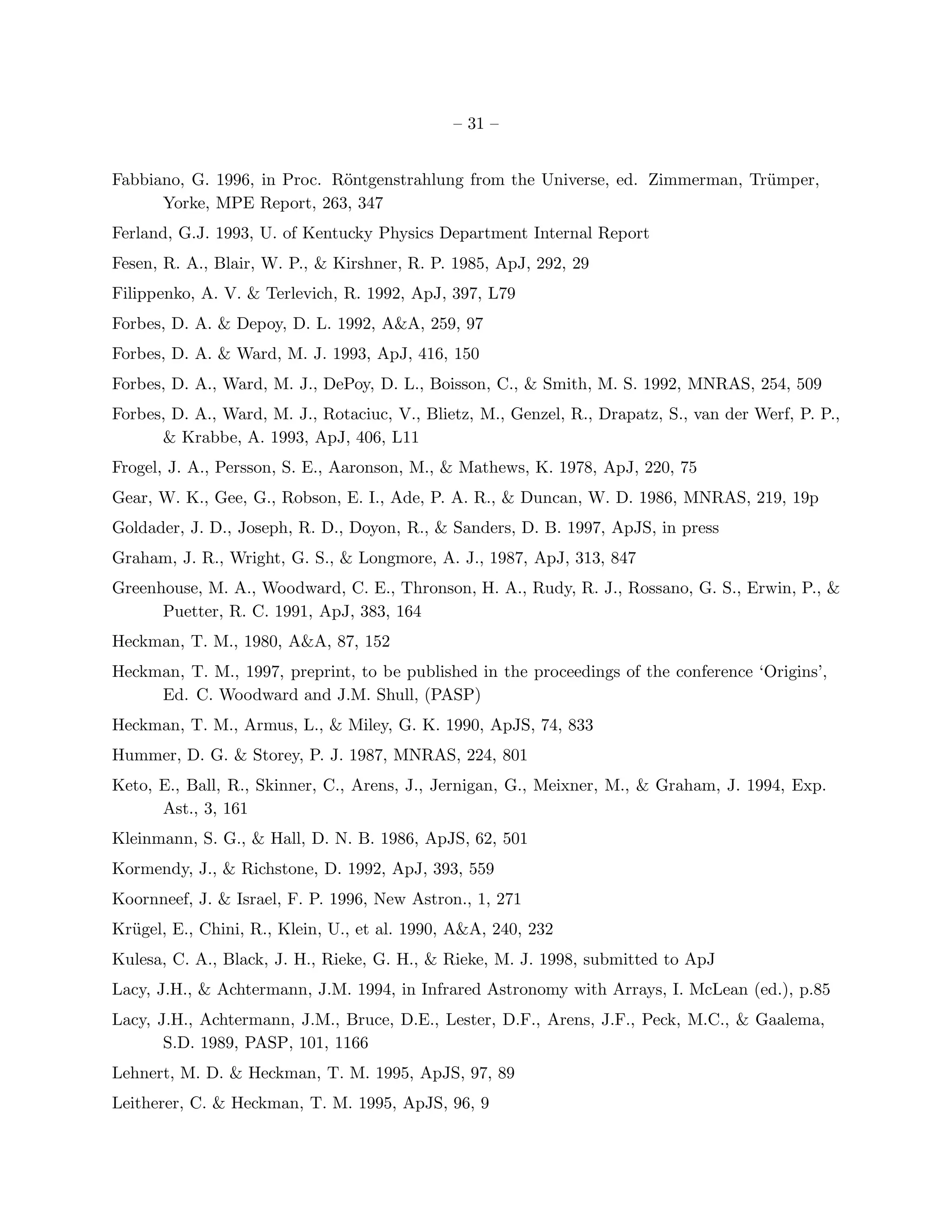
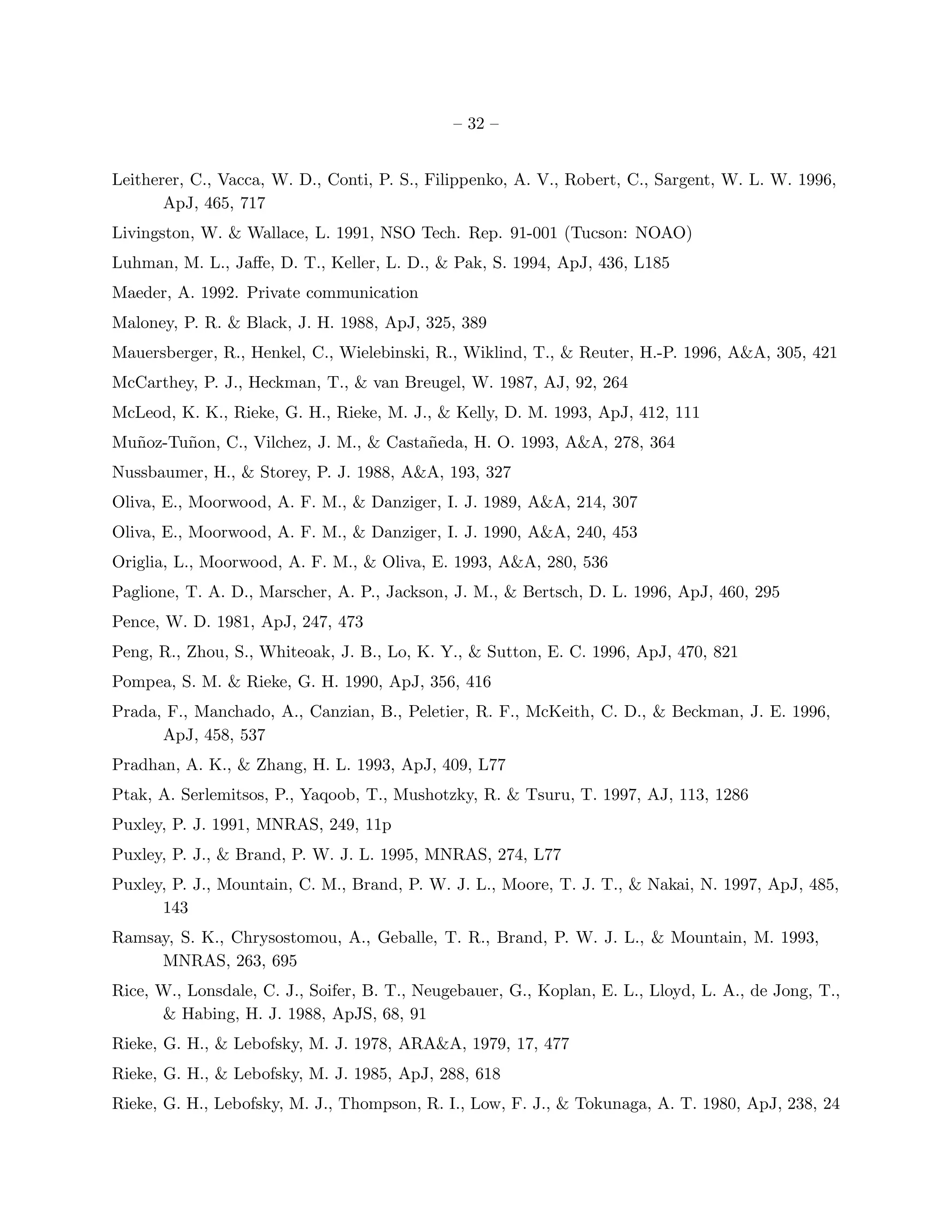
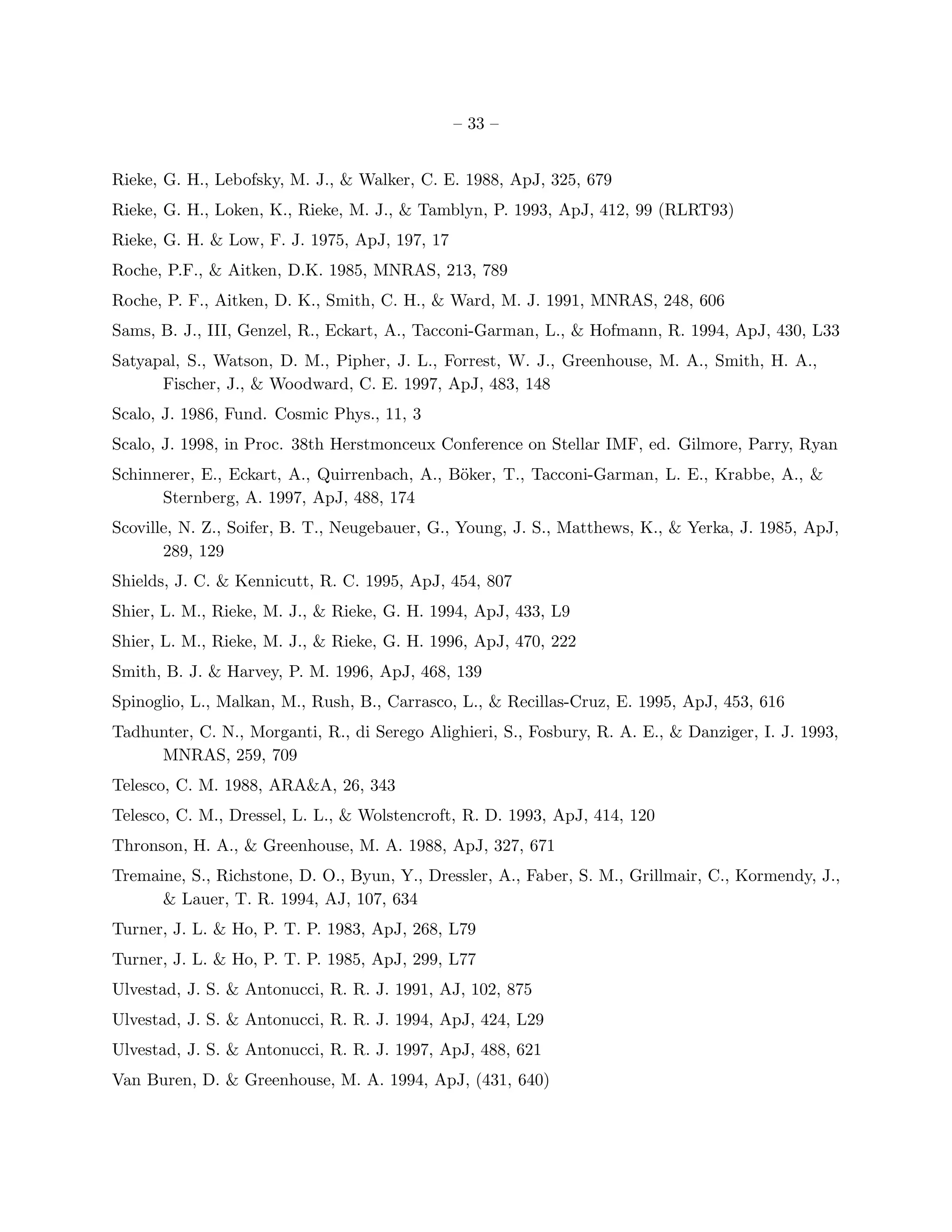
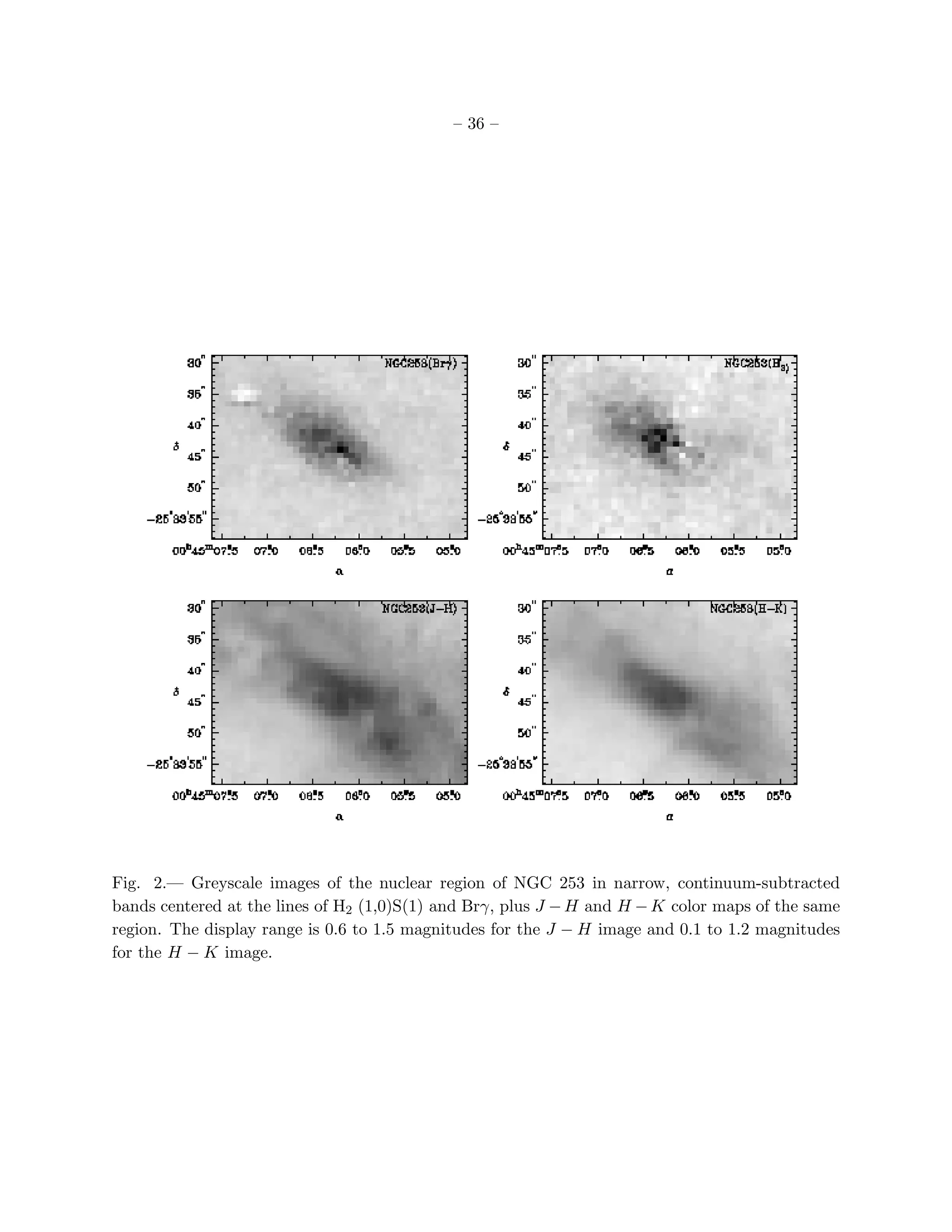
Download to read offline
. We have subtracted a composite stellar spectrum from the galaxy
spectrum to measure faint emission lines which otherwise would be buried in the
complicated continuum structure.
We use these data and data from the literature in a comprehensive re-assessment
of the starburst in this galaxy. We confirm that the [Fe II] emission is predominantly
excited by supernova explosions and show that the rate of these events can be derived
from the strength of the infrared [Fe II] lines. Although the H2 emission superficially
resembles a thermally excited spectrum, most of the H2 infrared luminosity is excited
by fluorescence in low density gas. We confirm the presence of a bar and also show
that this galaxy has a circumnuclear ring. The relation of these features to the gaseous
bar seen in CO is in agreement with the general theoretical picture of how gas can be
concentrated into galaxy centers by bars. We derive a strong upper limit of ∼ 37,000K
for the stars exciting the emission lines. We use velocity-resolved infrared spectra to
determine the mass in the starburst region. Most of this mass appears to be locked
up in the old, pre-existing stellar population. Using these constraints and others to
build an evolutionary synthesis model, we find that the IMF originally derived to fit
the starburst in M 82 also accounts for the properties of NGC 253; this IMF is similar
to a modified Salpeter IMF. The models indicate that rapid massive star formation
has been ongoing for 20-30 million years in NGC 253—that is, it is in a late phase of
1
Visiting Astronomer at the Infrared Telescope Facility, which is operated by the University of Hawaii under
contract to the National Aeronautics and Space Administration.
2
Current address: Tivoli Systems, Stonelake 6, 11000 Mopac Expressway, Suite 400, Austin, TX 78759](https://image.slidesharecdn.com/9805153v1-111220000420-phpapp02/75/9805153v1-1-2048.jpg)
![–2–
its starburst. Its optical spectrum has characteristics of a transitional HII/weak-[O I]
LINER. We model the emission line spectrum expected from a late phase starburst
and demonstrate that it reproduces these characteristics.
Subject headings: Galaxies: Individual (NGC 253) — Galaxies: Starburst — Infrared:
Galaxies
1. Introduction
A significant fraction of nearby galaxies have strong, centrally concentrated infrared sources
indicative of rapid star formation in their central few hundred parsecs (Rieke and Lebofsky
1979; Devereux, Becklin, & Scoville 1987). These so-called starburst galaxies make a dramatic
contribution to the star formation activity in the local universe; Heckman (1997) calculates
that just four galaxies (of which NGC 253 is one) are responsible for 25% of the high-mass star
formation within 10 Mpc. Local starburst galaxies serve as a model for galaxy formation and
evolution at higher redshifts. An understanding of how these events occur and evolve will require
study over the full range of scale and age. At the same time, very detailed modeling is required of
the nearest starbursts such as NGC 253 to provide templates for models of less accessible systems.
NGC 253 has been observed extensively in all accessible spectral regions (e.g., radio: Ulvestad
& Antonucci 1997; molecular line emission: Mauersberger et al. 1996; far infrared: Carral et al.
1994; mid-IR: Keto et al. 1994, Telesco, Dressel, & Wolstencroft 1993; near-IR: Sams et al. 1994
; optical: Watson et al. 1996; X-ray: Ptak et al. 1997; and gamma ray: Paglione et al. 1996).
Additional references are given in those cited above. NGC 253 was one of the first galaxies to be
studied with an evolutionary starburst model (Rieke et al. 1980). The subsequent observations
taken together have substantially expanded on our knowledge of the starburst phenomenon from
the inputs to that model, demonstrating the presence of supernovae remnants and HII regions,
young ultracompact star clusters, a hot superwind, and a host of other starburst phenomena.
Young starbursts, including NGC 253, are characterized by high levels of interstellar extinction
that can make properties deduced from optical measurements unrepresentative (e.g., Rieke et al.
1980; Puxley 1991). Consequently, infrared measurements play a critical role in defining nebular
properties, morphologies, rotation curves, and other parameters. We have added to the extensive
infrared observations of this galaxy with the deep NIR images covering a wide (∼ 7′ ) field,
narrowband images in Brγ and H2 , near- and mid-infrared spectra, and a high-resolution spectral
map of [Ne II].
Since the first models of M 82 and NGC 253 (Rieke et al. 1980), evolutionary synthesis
modeling has become an important component of starburst study (e.g., Doyon, Joseph, & Wright
1994; Leitherer & Heckman 1995 and references therein; Schinnerer et al. 1997). We interpret the
new infrared measurements with the other properties of NGC 253 through a modern synthesis](https://image.slidesharecdn.com/9805153v1-111220000420-phpapp02/75/9805153v1-2-2048.jpg)
![–3–
model (Rieke et al. 1993, hereafter RLRT93). In this way, the behavior of NGC 253 can be
related consistently to that of other galaxies we have modelled as part of a comprehensive study
of nearby starbursts: NGC 6946 (Engelbracht et al. 1996, hereafter ERRL96) and M 82 (McLeod
et al. (1993); RLRT93); a number of blue dwarf galaxies (Vanzi & Rieke 1997), and a sample
of interacting galaxies (Vanzi et al. 1998). We demonstrate that the NGC 253 starburst is at a
relatively late stage of development, during which the high rate of supernova explosions leads to
behavior that places it as a transition object between pure starbursts and weak-[O I] LINERs.
This paper is organized as follows: In §2 we describe the observations and the processing we
performed on the data. We then use our data and results from the literature to derive physical
properties of the starburst in §3. In §4 we use the properties derived in the previous section to
constrain evolutionary synthesis models of the starburst. We use the models to explore burst
parameters such as age, intensity, IMF, and star formation history. §5 discusses other results
obtained from our data or implied by the starburst modeling results. In §6 we summarize the
paper.
2. Observations and Data Reduction
2.1. Images
Broadband images in the J, H, and Ks bands as well as narrowband images with 0.5%
bandwidth filters tuned to Brγ and the (1,0)S(1) line of H2 were obtained at the Steward
Observatory 1.55m telescope using a camera equipped with a NICMOS3 array. The data were
reduced as described in ERRL96. The deep broadband images were flux-calibrated using the
UKIRT faint standard number 2 (Courteau 1994). We calibrated the Ks -band image to K-band
magnitudes using the standard-star photometry, and will hereafter refer to this image as the
K-band image. We have ignored the small color correction between the Ks and K band, since this
correction is smaller than the photometric uncertainty.
We present photometry of the nucleus in Table 1 in several circular apertures, plus a region
the size of our extracted slit aperture (used to calibrate our spectra.) Photometric errors were
estimated from the dispersion in multiple measurements of the standard star at different airmasses
and are typically 2% in the J and H bands and 4%-5% in the K band.
The broadband images are presented in Figure 1. The images have a scale of 0. 9 per′′
pixel and the coordinate system is plotted assuming that the intensity peak of the infrared
images corresponds to the position of NGC 253 quoted in NED (Nasa Extragalactic Database):
α(1950) = 00h 45m 05. 9, δ(1950) = −25◦ 33′ 40′′ . This position closely matches the position of the
s
K-band peak found by Sams et al. (1994).
The narrow-band images are presented in Figure 2. These images are the differences between
the on-line and off-line images. In the same figure, we present J − H and H − K color maps of the](https://image.slidesharecdn.com/9805153v1-111220000420-phpapp02/75/9805153v1-3-2048.jpg)
![–4–
nuclear region, which show that the galaxy colors become very red on the nucleus due to strong
extinction.
2.2. Near-IR spectra
We obtained long-slit spectra of NGC 253 in the J, H, and K bands at a resolution of ∼ 3000
with the Steward Observatory 2.3m telescope using FSpec, a near-infrared long-slit spectrometer
(Williams et al. 1993). The slit was centered on the infrared peak of the galaxy with a slit-viewing
infrared guide camera. Observing and data-reduction techniques are as described in ERRL96, with
the exception that a more precise wavelength calibration was obtained using a set of numerically
computed wavelengths for the OH airglow lines (C. Kulesa, private communication).
To correct the spectra for atmospheric absorptions, a spectrum of HR 173, a G3V star about
2◦ away from NGC 253, was taken close in time to the galaxy observations and was divided into
the galaxy spectrum. This step introduced spurious emission features into the spectrum due
to intrinsic absorptions in the standard star. To correct for these features, we multiplied our
galaxy spectrum by the high-resolution solar spectrum (smoothed to our instrumental resolution)
obtained by Livingston & Wallace (1992).
Most of the spectra were obtained with the slit oriented along the major axis of the galaxy,
while two key grating settings which cover the (1,0)S(1) line of H2 , Brγ, and the (2,0) and (3,1)
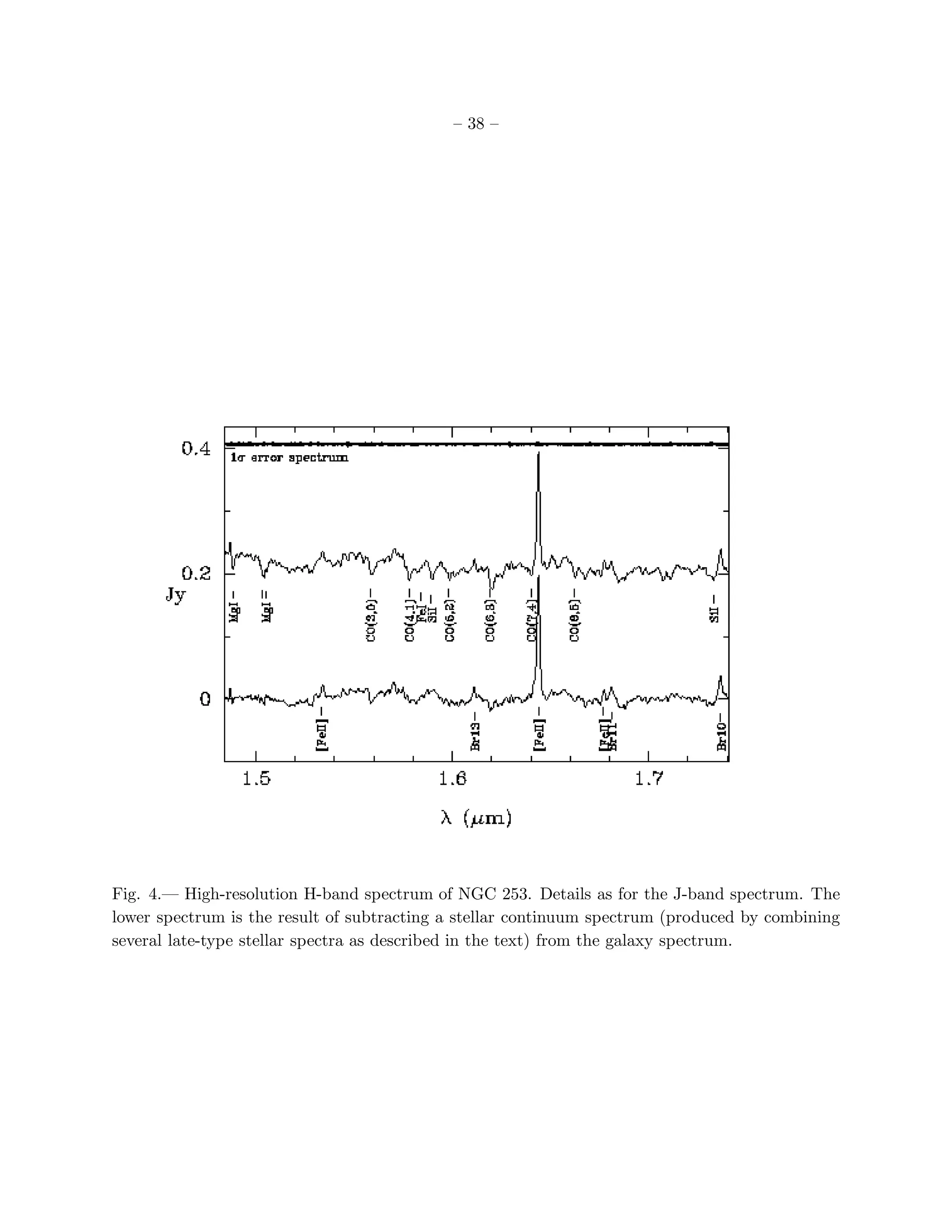
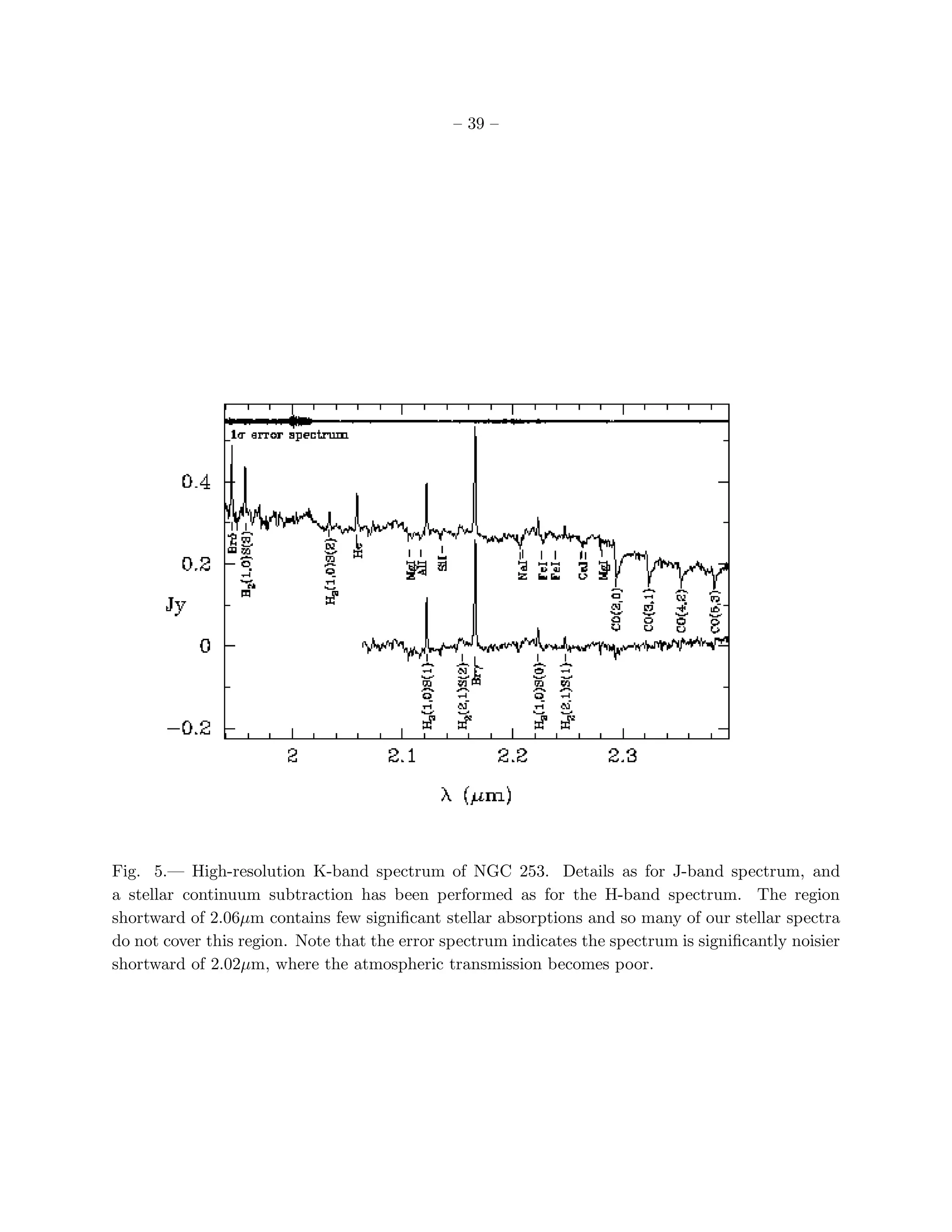
CO bands were obtained with the slit oriented along the minor axis. The J, H, and K-band spectra
′′
are presented in Figures 3, 4, and 5, respectively. Each spectrum is the sum of 10 1. 2 pixels along
the slit, centered on the intensity peak. We have computed a 1-σ uncertainty for each point in the
spectrum from the dispersion in the set of individual observations. This error spectrum is plotted
above each flux spectrum. The flux scale for each spectrum was taken from the broadband images,
using the 2. 4×12′′ aperture in Table 1.
′′
We obtained additional spectra of NGC 253 in the J and K bands at a resolution of ∼ 1200
using the same instrument and telescope. The slit was again oriented along the major axis of
the galaxy and we extracted a similar aperture from these spectra. The spectra were reduced in
a similar fashion to the high-resolution spectra, with the exception that our standard star was
HR 232, an A3V, so the only correction for intrinsic absorption was to interpolate over the H lines.
The use of a hotter standard star (in which metal lines are presumably weak or undetectable at
this resolution) to correct these spectra allows us to confirm that our correction for the intrinsic
absorptions (other than H) in the standard star used for the high-resolution data was accurate.
The low-resolution spectra (Figures 6 and 7), while lacking some of the detail in the
high-resolution ones, give access to several additional [Fe II] and H2 lines as well as some
unidentified features in the J band. The strong features beyond 2.4µm not marked as H2 lines
are narrow telluric absorptions which are poorly sampled at our low resolution and which appear
as emission features after the spectrum is divided by the standard star. All measurements taken](https://image.slidesharecdn.com/9805153v1-111220000420-phpapp02/75/9805153v1-4-2048.jpg)
![–5–
from the near-infrared spectra are derived from the high-resolution spectra when possible.
2.3. Faint emission lines
A difficulty with interpreting near-infrared spectra of starburst galaxies is that weak nebular
emission lines are lost in the structure of the stellar absorption features. To counteract this
problem, we have used a library of stellar spectra (to be published separately) to model the
galaxy continuum. We selected a suite of fifteen stars which minimized the residual continuum
when subtracted from the galaxy spectrum. The resulting mix of stars is thus not optimized
in a population synthesis sense, but was empirically chosen to be a good match to the galaxy
continuum. We redshifted the stellar spectra to the galaxy velocity, broadened them to match
the velocity dispersion in the galaxy (see §3.5.2), scaled them, and subtracted them from the
galaxy spectrum. The continuum-subtracted spectra of NGC 253 are shown in the lower parts of
Figures 4 and 5. The H-band and K-band flux measurements of emission lines presented in this
paper are taken from the continuum-subtracted spectra.
2.4. Mid-IR Spectra
We obtained spectra of the [S IV] 10.5 µm line in NGC 253 using the Irshell spectrograph
(Lacy et al. 1989) on the NASA Infrared Telescope Facility. The 10′′ long by 2′′ wide slit was
positioned across the nucleus of the galaxy at PA=61◦ . Additional spectra were measured with
parallel slit positions, one slit width to either side of the nucleus. The 10×64 Si:As array provided
1′′ sampling along the slit and a spectral resolution of 30 km s−1 . The seeing was poor and the sky
was partly cloudy. DC sky levels were monitored to identify frames that were contaminated by
clouds. A dome-temperature card, chopped against the sky, was used for flat-fielding, atmospheric
correction, and fluxing (Lacy et al. 1989). The data were reduced using a software package
developed by Achtermann (1994).
We mapped the [Ne II] 12.8µm emission from NGC 253 by using Irshell in scanning mode
(Lacy & Achtermann 1994), sweeping the slit back and forth across the galaxy by 22′′ . The
off-source positions at the ends of the scans were averaged to produce a sky frame. The data were
combined to form a 22′′ ×22′′ by 64 spectral channel data cube. A position-velocity plot of the
[Ne II] line is shown in Figure 8. The [Ne II] has a spatial extent of 6′′ and a velocity width of
150 km s−1 FWHM. The integrated [Ne II] flux is 4.6±0.1 × 10⁻¹¹ erg s−1 cm−2 . For comparison,
Roche & Aitken (1985) report a measurement of 3.3 × 10⁻¹¹ erg s−1 cm−2 .
The [S IV] spectra showed a compact (2′′ ×2′′ ) continuum source with only a hint of line
emission at a level of 5.5 × 10⁻¹⁴ erg s−1 cm−2 . Since the [Ne II] is spread over 6 spatial and 10
spectral pixels, we determined an upper limit of 3.0 × 10⁻¹³ erg s−1 cm−2 on the [S IV] flux by
summing over 6 spatial rows (see Figure 9) and 10 spectral pixels.](https://image.slidesharecdn.com/9805153v1-111220000420-phpapp02/75/9805153v1-5-2048.jpg)
![–6–
3. Starburst Parameters
The values of the parameters that characterize the NGC 253 starburst are summarized in
Table 2. They have been determined assuming a distance of 2.5 Mpc (de Vaucouleurs 1978), at the
low end of the range of 2.5-3.5 Mpc in the literature. As discussed in ERRL96, a small distance
places the most conservative constraints on our starburst models.
′′
The reference aperture we will use is 7. 5 in radius. We chose this radius because most of the
[Ne II], Brγ, and H2 flux (as measured in our spectra and narrow-band images) and the radio
flux (as measured in the continuum observations of Antonucci & Ulvestad (1988) or Turner & Ho
(1983)) arise from within it. The 10, 20 and 30µm maps of NGC 253 from Telesco, Dressel, &
Wolstencroft (1993) as well as the far-infrared measurements by Smith & Harvey (1996) also show
that most of the mid- and far-infrared flux is produced in this region.
3.1. Extinction
We can use line ratios from our spectra to determine the extinction. If the hydrogen
recombination line ratios from Table 3 obey Case B, a foreground screen model with AV = 9.2 ± 0.7
can fit them (c.f. Calzetti, Kinney, & Storchi-Bergmann 1996). (We have used an analytical fit to
the Rieke & Lebofsky 1985 extinction law, the Hummer & Storey 1987 theoretical recombination
line ratios, and have included an 8% uncertainty in the relative flux calibration in the line
ratio uncertainties.) This fit roughly agrees with the Brα strength (Beck & Beckwith 1984).
However, the mm-wave H recombination lines still suggest that a significant amount of ionized
gas may be hidden by extreme optical depths (Puxley et al. 1997). The ratio of [Fe II](1.257µm)
to [Fe II](1.644µm) should be 1.35 according to the A-values of Nussbaumer & Storey (1988),
although this value is subject to some uncertainty. The observed value is 0.68 ± 0.07 (Table 4),
which implies AV = 8.42 ± 1.26, consistent with the estimate from the H recombination lines.
The colors of our broadband images can also be used to estimate extinction. A typical evolved
stellar population has J − H and H − K colors of 0.7 and 0.2 (Aaronson 1977), and our starburst
models (RLRT93) show that the same is true for the starburst population. Our spectra show that
the near-infrared continuum is dominated by starlight, as the strengths of the absorption features
are typical of a population of supergiants and are consistent between the H and K bands, thus
arguing against veiling by a featureless continuum. Therefore, we can assume that colors redder
than nominal are purely due to reddening.
From Table 1, the near-infrared colors in our 15′′ reference aperture are J − H = 1.09 and
H − K = 0.66, implying color excesses of 0.39 and 0.46, respectively. Using an analytical fit
to the Rieke & Lebofsky (1985) extinction law and a foreground screen geometry for the dust,
E(J − H) = 0.39 corresponds to 4.26 ± 0.91 magnitudes of visual extinction while E(H − K) = 0.46
implies AV = 7.35 ± 1.33. The extinction values in the near-infrared bands implied by our H − K](https://image.slidesharecdn.com/9805153v1-111220000420-phpapp02/75/9805153v1-6-2048.jpg)
![–7–
color are AJ = 2.00 ± 0.36, AH = 1.33 ± 0.24, and AK = 0.87 ± 0.16. The extinction to the stars
appears to be slightly smaller (at ∼3σ significance) than that to the ionized region.
If we adopt a more realistic dust geometry than a foreground screen, such as the ”starburst”
model of Witt, Thronson, & Capuano (1992), we obtain a better fit to the observed colors. The
colors in the nuclear region of NGC 253 are slightly redder than the most heavily extinguished
models presented by Witt et al., so we have used polynomial fits to extrapolate beyond their
values. The models imply a total extinction to the center of the system, AV (cen), of 17.27 ± 6.78
and 19.07 ± 3.32, based on the J − H and H − K excesses respectively. Although this model
contains much more total dust than a foreground screen model, much of the light comes from
relatively unextinguished stars, so that the implied average equivalent extinction is similar to the
foreground screen case. The equivalent extinction values in the near-infrared are AJ = 1.64 ± 0.51,
AH = 1.24 ± 0.43, and AK = 0.85 ± 0.30 from the J − H color and AJ = 1.84 ± 0.32,
AH = 1.40 ± 0.24, and AK = 0.94 ± 0.16 from the H − K color.
Since the equivalent extinction values in the near infrared are similar for the two dust
geometries, the near infrared fluxes can be corrected reliably. We will adopt extinction values that
are an average of those derived from the mixed model: AK = 0.90 ± 0.17, AH = 1.32 ± 0.25, and
AJ = 1.74 ± 0.30.
We have used the H − K color map to deredden our K-band image. We assumed that the
intrinsic H − K color of the galaxy was 0.2 (so that E(H − K) = (H − K) − 0.2) and converted
the color excess to a dereddening map using the Rieke & Lebofsky (1985) extinction law. The
K-band image was then multiplied by the dereddening image to produce the extinction-corrected
K-band image of the galaxy presented in Figure 10. We also deprojected the dereddened image by
stretching it along the minor axis by a factor 1/cos(i), where we have taken i = 78◦ (Pence 1981).
The resulting image is also presented in Figure 10.
3.2. [Fe II] emission
The high sensitivity and broad wavelength coverage of our near-infrared spectra has allowed
us to measure seven [Fe II] lines, listed in Table 4, allowing an estimate of the electron density in
the [Fe II]-emitting region. We use the ratios λ1.279µm/λ1.644µm and λ1.533µm/λ1.644µm and
the models of Bautista & Pradhan (1996). In the range of interest, the diagnostic ratios we have
chosen are essentially independent of temperature. We have plotted the values of these two line
ratios (corrected for extinction) as a function of density in Figure 11. For each curve, we have
marked the range consistent with the observations as a shaded box, indicating a mean density of
∼ 5000 cm−3 .
[Fe II] emission in starbursts is thought to arise predominantly from supernova remnants. For
example, Greenhouse et al. (1991) find peaks on bright radio compact sources in the [Fe II] surface
brightness in M 82. However, these compact sources account for only a small fraction of the](https://image.slidesharecdn.com/9805153v1-111220000420-phpapp02/75/9805153v1-7-2048.jpg)
![–8–
total [Fe II] emission. Forbes & Ward (1993) find a correlation between nonthermal 6cm emission
and [Fe II]. However, the trend line is offset from that for supernova remnants. Vanzi & Rieke
(1997) explain this offset in terms of the short lifetime for the [Fe II]-emitting stage in a supernova
remnant. Our data add to the arguments favoring a supernova origin for the [Fe II], since the
density we derive is in good agreement with that observed in the supernova remnants observed by
Oliva, Moorwood, & Danziger (1989).
Vanzi & Rieke (1997) used the observed supernova rate in M 82 to derive a relation between
the [Fe II] luminosity and the supernova rate. To apply this relation, we correct our observed
[Fe II] (λ1.644µm) flux (from Table 4) to a 15′′ aperture using the ratio of the K-band fluxes in the
15′′ and 2. 4 × 12′′ apertures (this scaling is reasonable because the K-band flux is dominated by
′′
cool supergiants which are the immediate precursors to the supernova remnants). We also correct
for 1.33 magnitudes of extinction. We obtain a total [Fe II] flux of 3.8 × 10⁻¹² erg s−1 cm−2 , or
a luminosity of 2.8 × 1039 erg/s. The Vanzi & Rieke relation then implies a supernova rate of
0.03 per year. If the [Fe II]-emitting phase of each supernova remnant lasts ∼ 104 years, this
rate implies that there are currently ∼ 300 [Fe II]-emitting supernova remnants in the nucleus of
NGC 253.
Ulvestad & Antonucci (1997) find an upper limit on the supernova rate of 0.3 yr−1 . The
supernovae have also been modeled by Colina & P´rez-Olea (1992), who estimate a rate of 0.05
e
yr −1 , and by Van Buren & Greenhouse (1994) and Paglione et al. (1996), who both find 0.08
yr−1 . These estimates are all based on modeling supernova counts and hence are to first order
distance-independent. The SN rate can also be estimated from other luminosities than that of
[Fe II]. For example, if we assume the nonthermal radio flux from Turner & Ho (1983) is entirely
due to synchrotron emission from supernova remnants, we can derive a supernova rate of 0.03 yr−1
using equation (8) of Condon & Yin (1990).
All of the other rate estimates are in satisfactory agreement with our estimate using the [Fe II]
emission. Both of the luminosity-based estimates are lower than those from supernova counts by
a factor of about two. Although this difference is probably within the errors, if the galaxy were
at 3.5 Mpc (within the uncertainty in distance), the luminosity-based rates would double and the
agreement would be improved.
3.3. Temperature of the Hot Stars
The difference in ionization potentials of S++ and Ne0 makes the [S IV]/[Ne II] ratio a sensitive
indicator of the effective temperature of the UV radiation field. The ratio is also dependent on the
relative abundances of sulphur and neon, but the strong temperature dependence should dominate
in our data. We apply an extinction correction of AV = 14 mag to the mid-infrared data, based
on the Brα/Brγ data of Rieke et al. (1980). This large extinction only changes the [S IV]/[Ne II]
color by 0.26 dex (Rieke & Lebofsky 1985) to log([S IV]/[Ne II]) = −2.7, or a 3σ upper limit of](https://image.slidesharecdn.com/9805153v1-111220000420-phpapp02/75/9805153v1-8-2048.jpg)
![–9–
−1.9. We compare these values to single star photoionization Cloudy (Ferland 1993) models to
determine effective temperatures as a function of ionization parameter, obtaining upper limits of
36000 K, 38000 K, and 49000 K respectively for logU = −1.5, −2.5, and −3.5. The weak detection
of [S IV] on the central slit position implies effective temperatures of 34400 K, 36000 K, and 42300
K for the respective logU values.
The main problem with this technique is the strong dependence of the [S IV]/[Ne II] ratio on
ionization parameter. The Lyman continuum flux is 1053 s−1 (see §3.6). From Figure 2, we see
that all of the Brγ flux comes from within a radius of 7′′ , or 90 pc. From Heckman et al. (1990),
the nucleus has an electron density of at least 600 cm−3 and probably higher since dust would have
hidden the nucleus at 6700 ˚. An electron density range of 600-1000 cm−3 gives −logU = 2.2 − 2.5.
A
It would take a large amount of substructure in the nucleus with a density of ne = 104 cm−3 to
give logU = −3.5.
For the logU = −1.5 and logU = −2.5 cases, we examined a two star model, one star with
T = Tef f and the other with T = 40000 K. We determined how bright the 40000 K star would
have to be relative to the Tef f star to alter the [S IV]/[Ne II] ratio by 0.15 dex, or roughly 1σ. For
the four cases: logU, Tef f = −1.5, 34400; −1.5, 36000; −2.5, 36000; −2.5, 38000 we found that
the 40000 K star contributed the following percentages of the Lyman continuum photons: 2.5; 7.4;
6.8; 31. These percentages can be combined with the starburst models of Section 4 to determine
the age of the starburst. As discussed below, the effective temperature is unlikely to be as high
as 38000 K, so a conservative upper limit to the ionizing flux contribution by stars hotter than
40000 K is probably 15%.
Vanzi et al. (1996) suggested that the ratio HeI(1.7)/Br10 is useful to constrain the
temperature of the hot stars because it is not heavily affected by reddening or electron
temperature. Our upper limit for the 1.7µm HeI line (Table 5) corresponds to an upper limit of
HeI(1.7)/Br10 ≤ 0.2, placing an upper limit of ∼37,000K on the stellar temperature exciting the
ISM. Carral et al. (1994) use the far infrared fine structure lines to derive an effective temperature
for the exciting stars of 34, 500 ± 1, 000K.
Thus, three independent means of estimating the temperature of the exciting stars from
infrared spectra give consistent results of Tef f < 37, 000 K. The [O III]/Hβ ratio would give a
value a few thousand degrees higher than the infrared indicators. However, we show in Section
5.4 that a significant portion of the [O III] may be shock-excited in supernova remnants. Also, at
∼ 0.4 solar and higher metallicities, it is expected that [O III]/Hβ and other optical indicators
will overestimate the temperature of the photoionizing field for a variety of reasons, such as an
increase in electron temperature due to depletion onto grains or to photoelectric heating (Shields
& Kennicutt 1995). Our CLOUDY models show the infrared-line-derived temperatures to be
virtually independent of electron temperature (c.f. Vanzi et al. 1996).](https://image.slidesharecdn.com/9805153v1-111220000420-phpapp02/75/9805153v1-9-2048.jpg)


![– 12 –
with fitting standard stars. The template star for this calculation was HR 7475.
The observed velocity dispersion is the sum of the dispersions in each extracted pixel, weighted
by the luminosity profile of the galaxy. We fit a profile to the 2.3µm region of our spectrum of
NGC 253, modeling the light distribution using the η models of Tremaine et al. (1994). The
model that best fit the luminosity profile has a scale radius of 6′′ (about 73 pc at the distance of
NGC 253) and η = 3. Using this galaxy profile, we measure a mass of 3.9 ± 0.9 × 10⁸ M⊙ within
′′
a 7. 5 radius. The uncertainties in the mass determination are dominated by uncertainties in the
velocity dispersion, as the derived mass depends on the square of the velocity.
3.5.3. Mass Budget
To determine the mass we may allocate to star formation in a recent starburst, we must
subtract from the dynamical mass the mass of the old stars and molecular gas in the nucleus.
Assuming the same conversion from mass to K-band luminosity determined by ERRL96 and the
K-band luminosity derived in §3.4, this preexisting stellar population is expected to have a mass
of at least 3.3 × 10⁸ M⊙ , and is likely to be large enough that it accounts for virtually all the
stellar mass in the nucleus. The large proportion of mass in old stars confirms the theoretical
predictions that a starburst will be triggered when only 10-20% of the nuclear mass is in the form
of gas (Wada & Habe 1992; Bekki 1995). Using the standard CO to gas mass conversion, the
molecular gas mass may be as large as 1.4 × 10⁸ M⊙ (Mauersberger et al. 1996). Uncertainties
in the application of this conversion to starburst galaxies (e.g., Maloney & Black 1988; Shier
et al. 1994) led Mauersberger et al. to propose a much smaller mass of ∼ 3 × 10⁷ M⊙ based on
measurements of dust continuum and a rare isotope of CO.
The lower limit on the mass in old stars and the gas combined leave no more than
0.3 ± 0.9 × 10⁸ M⊙ , or a strong upper limit of 2.1 × 10⁸ M⊙ on the starburst mass; it is likely much
less. We show in §4 that the best-fitting starburst models indicate a mass of a few times 107 M⊙ .
3.6. Ionizing Flux
To estimate Q(H) (number of hydrogen ionizations per second), we correct the longest-
wavelength (i.e., the line least affected by extinction) hydrogen recombination line flux we observe
(Brγ) for extinction and convert it to Q(H) using the ratio I(Hβ)/I(Brγ) = 30.3 (from Hummer
& Storey 1987) and αB /αef f = 8.40. From our narrow-band images, we determine the Brγ flux in
Hβ
a 15′′ aperture to be 9.16 × 10⁻¹³ erg s−1 cm−2 . We correct this flux to 2.14 × 10⁻¹² erg s−1 cm−2
using AK = 0.9 from §3.1. The value of Q(H) implied by this Brγ flux is 1.0 × 1053 s−1 .
We obtain a similar value from our [Ne II] measurement. The dereddened (AV =14 mag)
[Ne II] flux is (6.6±0.2) × 10−11 erg s−1 cm−2 . Combined with the formula of Roche et al. (1991)](https://image.slidesharecdn.com/9805153v1-111220000420-phpapp02/75/9805153v1-12-2048.jpg)



![– 18 –
galaxy. This ring is very nearly circular, as can be seen in our deprojected image of the galaxy
in Figure 10. The ring is also apparent in the deep H-band image from Forbes & DePoy (1992),
although they do not discuss it. The bar crosses the ring and also has a length of ∼ 350′′ .
Canzian, Mundy, & Scoville (1988) show a bar in CO emission that is about 30′′ long and
oriented along the stellar bar discussed above. Thus, the configuration of molecular gas in the
nucleus of NGC 253 approximates the theoretical predictions that mutual torques between stellar
and gas bars will allow the gas to lose angular momentum and sink into the nucleus, where it
concentrates until instabilities set in that trigger a starburst.
5.2. Emission-line morphology
In Figure 8 we present position-velocity diagrams of some strong emission lines in NGC 253.
These images and the the narrow-band images in Figure 2 show that the starburst is not
distributed symmetrically along the major axis but instead is concentrated in a region north-east
of the nucleus. They also show significant differences from line to line. The H recombination
and [Ne II] have a very similar asymmetric distribution in position/velocity space. The [Fe II]
is distributed symmetrically to both sides of the nucleus. The H2 emission is distributed over
a broader region still (∼ 500 pc). These behaviors are consistent with the starburst originally
being fairly uniformly distributed around the nucleus, as indicated by the supernovae traced by
[Fe II], but now being active primarily on the nucleus and to the northeast. They also indicate
that the H2 emission is partially excited by a mechanism that extends outside the other starburst
indicators, e.g., molecular cloud collisions.
5.3. H2 emission
The excitation mechanism of H2 in starburst galaxies is under debate. The strong UV
flux should excite a significant amount of H2 . However, many of these galaxies display strong
emission in the (1,0)S(1) line (e.g., Goldader et al. 1996) but not in other H2 lines, suggesting that
collisional processes rather than fluorescent ones dominate (c.f., Black & van Dishoeck 1987).
One reason that UV-excited H2 is so difficult to detect is that its energy is emitted in a huge
number of lines, whereas thermally excited H2 emits most of its luminosity in just a few. In
low density gas, fluorescent H2 emits just 1.6% of its infrared luminosity in the readily observed
(1,0)S(1) line while thermally excited H2 emits 9% of its infrared luminosity in this line. Despite
the difficulties associated with detecting a number of very weak lines, fluorescent H2 has been
detected recently in some galaxies (Doyon et al. 1994; Kulesa et al. 1998.)
The combination of high resolution and sensitivity, broad spectral coverage, and our technique
for subtracting the stellar continuum allow us to measure an unprecedented number of H2 lines in](https://image.slidesharecdn.com/9805153v1-111220000420-phpapp02/75/9805153v1-18-2048.jpg)

![– 20 –
may be powered by mechanical energy released by supernovae and stellar winds. This possibility
is supported by the differences in distribution of [Fe II] and H2 emission in the position-velocity
plots in Figure 8.
5.4. Nature of Weak-[O I] LINERs
Although the intrinsic [O II]/[O III]5007 line ratio is difficult to determine for NGC 253
because of the strong reddening, other, less reddening-dependent diagnostic optical line ratios
indicate it is a transitional HII/weak-[O I] LINER. Filippenko & Terlevich (1992) use nebular
models to demonstrate that this class of galaxy can be excited by hot stars, with T ≥ 45, 000 K.
The locus of NGC 253 on the diagnostic plots of Filippenko & Terlevich falls even closer to
their theoretical calculations than does the zone they indicate for typical weak-[O I] LINERs.
Alternatively, it has been proposed that these LINERs are excited by shocks (e.g., Heckman 1980).
The strong arguments against the effective stellar temperature in NGC 253 being nearly
as hot as 45,000 K are difficult to reconcile with the model of Filippenko & Terlevich. In fact,
our data are difficult to reconcile with any model based on photoionization from a hard UV
spectrum, since the indications of low stellar temperature also argue against a hard UV field from
a mini-AGN or other source. Moreover, there are few other traces of a mini-AGN in this galaxy.
For example, our measurement of Brγ shows the line to be narrow with no broad wings. On
the extinction-free [O I]/Hα vs. [Fe II] 1.64µm/Brγ diagnostic diagram, NGC 253 falls near the
middle of the starburst locus (Alonso-Herrero et al. 1997). There is no hard X-ray source in the
nucleus of the galaxy, and although there is a compact radio source (Turner & Ho 1985), it is of
low luminosity.
It seems likely that the LINER-like characteristics of NGC 253 are produced by a mechanism
other than photoionization. We have shown that the [Fe II] emission is likely to be produced
directly in supernova remnants. Alonso-Herrero et al. (1997) demonstrate that NGC 253 falls
approximately on the mixing line between HII regions and supernova remnants on the [O I]/Hα vs
[Fe II]/Brγ diagram. That is, the [O I] strength is also consistent with an origin predominantly in
the same supernova remnants that produce the [Fe II], with additional H recombination emission
from HII regions.
The influence of supernovae on the observed emission line spectrum of NGC 253 can be
determined more quantitatively. We have determined an average supernova emission line spectrum
by averaging the line strengths (normalized to Hα) for 32 supernova remnants measured by
Danziger & Leibowitz (1985), Fesen, Blair & Kirshner (1985), and Blair & Kirshner (1985).
Similarly, an average ratio of [Fe II] 1.64µm/Brγ can be determined for supernovae measured by
Oliva, Moorwood & Danziger (1989; 1990). Taking Hα/Brγ = 103 from Case B, we find that
[O I]/[Fe II] ∼ 1.25. Relating these values through the H recombination lines is an essential step
because of the differing geometries in the available optical and near infrared spectra. Nonetheless,](https://image.slidesharecdn.com/9805153v1-111220000420-phpapp02/75/9805153v1-20-2048.jpg)
![– 21 –
because of the relatively small amount of infrared data, the derived ratio is somewhat uncertain.
We can predict the optical spectrum from the infrared one with: 1.) the relations derived in
the preceding paragraph; 2.) the total [Fe II] flux of 3.8 × 10⁻¹² erg s−1 cm−2 derived in Section
3.2; 3.) the total Brγ flux of 2.14 × 10⁻¹² erg s−1 cm−2 derived in Section 5.4; 4.) case B ratios
for the H recombination lines; and 5.) standard nebular calculations for the relative strengths of
photoionized lines in the optical (we have used the work of Shields & Kennicutt (1995), which
includes the effects of dust in metal-rich HII regions). We assume a stellar temperature of 38,000 K
(the lowest for which Shields & Kennicutt give calculations) and solar metallicity. We also use
the [O I]/Hα ratio for the Orion nebula to represent a typical HII region. The results of these
predictions are summarized in Table 10.
The agreement between predicted and observed line ratios is well within the uncertainties.
About 85% of the [O I] and half of the [O III] are excited in the supernovae remnants, whereas
most of the [N II], [S II], and H recombination are excited by photoionization. Although the
photoionized portion of the [O III] will decrease rapidly with decreasing stellar temperature, the
large portion of shock-excited [O III] will maintain good agreement with the observations. If the
intrinsic [O I]/[Fe II] ratio is a factor of 1.5 higher than we have used (which is within our guess of
the errors), the agreement between predictions and observations is improved and the [O III]/Hβ
ratio becomes almost independent of a decreased stellar temperature.
Thus, a combination of a metal-rich HII region photoionization model with the shocked optical
line strengths predicted by assuming the [Fe II] is produced by supernovae provides a satisfactory
fit to all the LINER-like characteristics of NGC 253. This fit involves no free parameters, other
than those determined independently of the LINER characteristics. The Filippenko & Terlevich
(1992) hot star photoionization model would predict that LINERs appear as a very early stage in
a starburst. Instead, we suggest that the LINER characteristics emerge after the stars emitting
most vigorously in the UV have died, so the HII region characteristics will fade sufficiently to
reveal the supernova shock excitation.
The decay time for ionizing flux in a starburst is only a few million years, whereas the
supernova rate is maintained for about 30 million years. Therefore, if the star-forming episodes
in starbursts are typically short in duration, of order 20 million years, then there should be a
significant population of objects in the transitional stage that produces LINER characteristics. In
agreement with this conclusion, we found in §4.2 that starburst models with these characteristics
give the best overall fit to the properties of NGC 253.
6. Conclusion
We have presented high-quality spectra of the nuclear region of NGC 253 in the J, H, and K
bands. We have constructed a composite stellar spectrum and subtracted it from that of NGC 253
to obtain accurate measurements of faint emission lines free from the spectral structure due](https://image.slidesharecdn.com/9805153v1-111220000420-phpapp02/75/9805153v1-21-2048.jpg)
![– 22 –
to stellar absorptions. We have also presented J, H, and Ks -band images, narrow-band images
in the lines of Brγ and H2 (1,0)S(1), spectra at 10.5µm, and a high-resolution spectral map at
12.8µm. We have used these data and data from the literature to perform a detailed study of the
interstellar medium and nuclear starburst in NGC 253. All of the observed properties, from the
radio through the X-ray, can be explained plausibly by a starburst. Specifically, we find:
1.) The density in the [Fe II]-emitting region is ∼ 5 × 103 cm−3 , similar to that observed for
[Fe II]-emitting regions in supernova remnants. The strength of the [Fe II] emission is consistent
with the supernova rate estimated from radio observations and predicted by starburst models.
Together, these results confirm that the [Fe II] is produced predominantly in the supernovae in the
starburst.
2.) Roughly two thirds of the infrared H2 luminosity is due to UV fluorescence. It is likely
that significant fluorescent-excited components of H2 emission in other starburst galaxies have
been missed because the distribution of emission over many relatively faint lines makes detection
difficult in spectra of modest resolution and signal to noise. If the Lyman continuum is produced
by Orion-like HII regions, they would also come within a factor of ∼ 2 of producing the fluorescent
H2 .
3.) From the MIR fine-structure lines of [S IV] and [Ne II], we find that the stars photoionizing
the gas in NGC 253 have Tef f < 37000 K, with < 15% of the ionizing flux coming from stars with
T > 40000 K. We also use an upper limit to HeI(1.7)/Br10 to place an upper limit on the stellar
temperature of ∼ 37, 000 K. These values are consistent with the temperature determination of
34, 500 ± 1, 000K derived from far infrared fine structure lines by Carral et al. (1994).
4.) The optical line ratios in NGC 253 indicate it is a HII/weak-[O I] LINER and they are fitted
well by the hot-star (T ∼ 45, 000K) photoionization models proposed for this type of active
galaxy by Filippenko & Terlevich (1992). However, the stellar temperature determinations are
inconsistent with the hot star model. The line ratios can also be fitted by a combination of a
photoionization model for metal rich HII regions excited by stars of ∼ 38,000K, and the shock
excited spectrum of supernova explosions occurring at the rate measured in the starburst. These
components fit NGC 253 with virtually no adjustment of free parameters. We suggest that many
weak-[O I] LINERs can be explained in the same manner, rather than by the presence of a
mini-AGN or by hot stars.
5.) We have used the infrared data to derive extinction-independent estimates of the primary
boundary conditions for starburst models of NGC 253: mass, NLyC , maximum stellar temperature,
bolometric luminosity, and CO absorption depth.
6.) We find that IMF8, proposed by RLRT93 as the best-fitting for M 82, also provides a good
fit to the properties of NGC 253 and suggests a starburst mass of 6 × 10⁷ M⊙ . IMF3, which was
assembled by RLRT93 to represent various representations of the local IMF, is not satisfactory
although it cannot be ruled out as absolutely as for extreme galaxies like M 82 and NGC 1614.
IMF8 is very similar to the modified Salpeter IMF that other workers have recently found gives](https://image.slidesharecdn.com/9805153v1-111220000420-phpapp02/75/9805153v1-22-2048.jpg)
![– 23 –
a good fit in starburst galaxy models. Due to the large variations or uncertainties in IMFs above
1 M⊙ , it is no longer clear whether IMF3 is a meaningful representation of the local stellar
population to be compared with those in starbursts.
7.) The model giving the best fit assumes that the star formation is extended over 20 to 30 million
years. A portion of the supernovae is associated with stars formed near the beginning of the burst,
while the ionizing flux arises from the most recently formed stars. The rate of star formation must
have declined rapidly during the last roughly 5 million years, to account for the absence of very
hot stars. This model is in agreement with our suggestion that a HII/weak-[O I] LINER can arise
from a late phase of a starburst.
This research has made use of the NASA/IPAC extragalactic database (NED) which is
operated by the Jet Propulsion Laboratory, Caltech, under contract with the National Aeronautics
and Space Administration. NSO/Kitt Peak FTS data used here were produced by NSF/NOAO.
The authors would like to thank C. A. Kulesa, J. H. Lacy, K. Luhman, R. Mauersberger, and
H.-W. Rix for useful discussions. We would like to thank NSF for support through grants
AST91-16442 and AST95-29190. DMK acknowledges support from NSF grants AST90-20292
(Texas) and AST94-53354 (Wyoming). We thank the anonymous referee and our editor, Steven
Willner, for comments which improved this paper.](https://image.slidesharecdn.com/9805153v1-111220000420-phpapp02/75/9805153v1-23-2048.jpg)
![– 25 –
Table 3. Hydrogen Recombination Line Measurements
Ratio to Brγ
Line λvac (µm) Observed Case B
Paβ 1.2822 1.66 ± 0.10 5.58
Br13 1.6114 0.10 ± 0.03 0.14
Br12 1.6412 ··· 0.18
Br11 1.6811 0.12 ± 0.03 0.24
Br10 1.7367 0.26 ± 0.05 0.32
Brδ 1.9451 0.61 ± 0.04 0.65
Brγ 2.1661 1.00 1.00
Note. — No corrections for extinction have
been made. The flux in Brγ is 2.59 ± 0.10 ×
10−13 erg s−1 cm−2 in a 2. 4×12′′ aperture.
′′
The Case B values were derived from Hummer
& Storey (1987), for n = 102 cm−3 , T =
5000 K.
Table 4. [Fe II] Lines
Transition λvac (µm) Ratio to λ1.644µm
a6 D9/2 − a4 D7/2 1.2570 0.68 ± 0.04
a6 D3/2 − a4 D3/2 1.2791 0.04 ± 0.01
a6 D5/2 − a4 D5/2 1.2947 0.13 ± 0.03
a6 D7/2 − a4 D7/2 1.3209 0.18 ± 0.02
a4 F9/2 − a4 D5/2 1.5339 0.13 ± 0.03
a4 F9/2 − a4 D7/2 1.6439 1.00
a4 F7/2 − a4 D5/2 1.6774 0.06 ± 0.02
Note. — No correction has been made for extinction.
The flux in the λ1.644µm line in a 2. 4×12′′ aperture is
′′
−13 −1 −2
3.56 ± 0.18 × 10 erg s cm .](https://image.slidesharecdn.com/9805153v1-111220000420-phpapp02/75/9805153v1-25-2048.jpg)


![– 29 –
Table 10. Predicted optical line ratios
ratio predicted observed ref.
[O I]/Hα 0.026 0.044 1
[N II]/Hα 0.78 0.78 1
[S II]/Hα 0.45 0.40 1
[O III]/Hβ 0.49 0.47 2
Note. — (1) Armus, Heckman, & Miley
1989; (2) Tadhunter et al. 1993.](https://image.slidesharecdn.com/9805153v1-111220000420-phpapp02/75/9805153v1-29-2048.jpg)





![– 42 –
Fig. 8.— Position-velocity plots along the major axis for several strong lines. NE is on the right
and SW on the left. In each case, the upper 90% of the contours are plotted. The hatched region
in the lower-left-hand corner of each plot indicates the size of a resolution element along the spatial
and dispersion axes. The [Ne II] observations were obtained in the 22′′ boxed region shown on the
plot.](https://image.slidesharecdn.com/9805153v1-111220000420-phpapp02/75/9805153v1-42-2048.jpg)
![– 43 –
Fig. 9.— MIR spectrum of the central region of NGC 253, used to determine an upper limit to the
[S IV] flux. See details in Section 2.4.](https://image.slidesharecdn.com/9805153v1-111220000420-phpapp02/75/9805153v1-43-2048.jpg)

![– 45 –
Fig. 11.— Plot of [Fe II] line ratios as a function of density. The line ratios have been corrected for
the extinction derived in §3.1. The range allowed by the observations is indicated by the shaded
regions. The diagnostic lines we have used here indicate that log(ne ) in the [Fe II] -emitting region
is 3.7 ± 0.13.](https://image.slidesharecdn.com/9805153v1-111220000420-phpapp02/75/9805153v1-45-2048.jpg)


The document presents observations of the starburst galaxy NGC 253 using near-infrared imaging and spectroscopy as well as mid-infrared spectroscopy. The observations are used to derive physical properties of the starburst such as the star formation rate, stellar population, and evolutionary stage. Evolutionary synthesis modeling is applied to interpret the observations and show that the starburst in NGC 253 is in a late phase, has been ongoing for 20-30 million years, and is consistent with a modified Salpeter initial mass function.


![Coded Agents – with UiPath SDK + LangGraph [Virtual Hands-on Workshop]](https://cdn.slidesharecdn.com/ss_thumbnails/codedagentsdeck-251215155422-5497c599-thumbnail.jpg?width=640&height=640&fit=bounds)


