Astronomy
&
Astrophysics

A&A 558, A123 (2013)
DOI: 10.1051/0004-6361/201322131
c ESO 2013

Probing the jet base of the blazar PKS 1830−211
from the chromatic variability of its lensed images
Serendipitous ALMA observations of a strong gamma-ray flare
I. Martí-Vidal1 , S. Muller1 , F. Combes2 , S. Aalto1 , A. Beelen3 , J. Darling4 , M. Guélin5,6 , C. Henkel7,8 , C. Horellou1 ,
J. M. Marcaide9 , S. Martín10 , K. M. Menten7 , Dinh-V-Trung11 , and M. Zwaan12
1
2
3
4
5
6
7
8
9
10
11
12

Department of Earth and Space Sciences, Chalmers University of Technology, Onsala Space Observatory, 43992 Onsala, Sweden
e-mail: mivan@chalmers.se
Observatoire de Paris, LERMA, CNRS, 61 Av. de l’Observatoire, 75014 Paris, France
Institut d’Astrophysique Spatiale, Bât. 121, Université Paris-Sud, 91405 Orsay Cedex, France
Center for Astrophysics and Space Astronomy, Department of Astrophysical and Planetary Sciences, Box 389,
University of Colorado, Boulder, CO 80309-0389, USA
Institut de Radioastronomie Millimétrique, 300 rue de la piscine, 38406 St Martin d’Hères, France
École Normale Supérieure/LERMA, 24 rue Lhomond, 75005 Paris, France
Max-Planck-Institut für Radioastronomie, Auf dem Hügel 69, 53121 Bonn, Germany
Astron. Dept., King Abdulaziz University, PO Box 80203, Jeddah, Saudi Arabia
Departamento de Astronomía y Astrofísica, C/ Doctor Moliner 50, 46100 Burjassot, Valencia, Spain
European Southern Observatory, Alonso de Córdova 3107, Vitacura, Casilla 19001, Santiago 19, Chile
Institute of Physics, Vietnam Academy of Science and Technology, 10 DaoTan, ThuLe, BaDinh, Hanoi, Vietnam
European Southern Observatory, Karl-Schwarzschild-Str. 2, 85748 Garching b. München, Germany

Received 24 June 2013 / Accepted 3 September 2013
ABSTRACT

The launching mechanism of the jets of active galactic nuclei is poorly constrained observationally, owing to the large distances to
these objects and the very small scales (sub-parsec) involved. To better constrain theoretical models, it is especially important to
get information from the region close to the physical base of the jet, where the plasma acceleration takes place. In this paper, we
report multi-epoch and multifrequency continuum observations of the z = 2.5 blazar PKS 1830−211 with ALMA, serendipitously
coincident with a strong γ-ray flare reported by Fermi-LAT. The blazar is lensed by a foreground z = 0.89 galaxy, with two bright
images of the compact core separated by 1 . Our ALMA observations individually resolve these two images (although not any of
their substructures), and we study the change in their relative flux ratio with time (four epochs spread over nearly three times the
time delay between the two lensed images) and frequency (between 350 and 1050 GHz, rest frame of the blazar), during the γ-ray
flare. In particular, we detect a remarkable frequency-dependent behavior of the flux ratio, which implies the presence of a chromatic
structure in the blazar (i.e., a core-shift effect). We rule out the possibility of micro- and milli-lensing effects and propose instead a
simple model of plasmon ejection in the blazar’s jet to explain the time and frequency variability of the flux ratio. We suggest that
PKS 1830−211 is likely to be one of the best sources to probe the activity at the base of a blazar’s jet at submillimeter wavelengths,
thanks to the peculiar geometry of the system. The implications of the core shift in absorption studies of the foreground z = 0.89
galaxy (e.g., constraints on the cosmological variations of fundamental constants) are discussed.
Key words. acceleration of particles – radiation mechanisms: non-thermal – quasars: individual: PKS1830-211 –
gamma rays: general – quasars: absorption lines

1. Introduction
Radio emission from the jets of active galactic nuclei (AGN)
has been extensively studied for more than 30 years. The early
model of Blandford & Königl (1979) has been successfully used
to explain most of the AGN observations at several bands and
spatial resolutions, from the radio to γ rays (e.g., Begelman
1984; Maraschi et al. 1992). One of the main successes of this
model in the radio band was the prediction of the so-called coreshift effect, i.e., the apparent shift of the core’s position with
frequency, owing to optical depth effects. The effect was later
Table 1 and Appendix A are available in electronic form at
http://www.aanda.org

discovered by Marcaide & Shapiro (1984) and then studied in
many AGN, from quasars and BL-Lacs (e.g., Kovalev et al.
2008) to low-luminosity AGN (e.g., Martí-Vidal et al. 2011).
Although jets with constant opening angles (i.e., conical jets)
can be used to model the spectra and the structures seen on
VLBI scales (e.g., Lobanov 1998), deviations from simple conical structures have been found (e.g., Asada & Nakamura 2012).
From the theoretical point of view, departures from a jet conical shape are expected from magneto-hydrodynamic collimation
effects close to the jet base. Marscher (1980) built a parametric
model of the continuum emission from AGN jets, from radio to
X-rays, based on the earlier theoretical studies by Blandford &
Rees (1974), in which these collimation effects were taken into

Article published by EDP Sciences

A123, page 1 of 12
A&A 558, A123 (2013)

account. According to this model, the jet structure can be divided into three parts: 1) the jet “nozzle” that connects the central AGN engine (i.e., the super-massive black hole, SMBH) to
the jet base; 2) the collimation region (with a concave shape),
where the trajectories of the electrons are focused towards the jet
direction, so part of the “internal” contribution to their Lorentz
factors becomes a “bulk”, or common, Lorentz factor; and 3) the
free region (with a conical shape), where the trajectory of the
plasma, once a maximum bulk Lorentz factor has been achieved,
is believed to be ballistic.
Despite the success of the standard jet model to explain the
multiband spectra and the VLBI structures seen in many radioloud AGN, the injection and launching mechanisms of the jets
are poorly understood. It is believed that the accretion of material into the SMBH triggers the injection of plasma into the
jet. This leads to the well-known disk-jet connection, or the fundamental plane model of black-hole accretion (Merloni et al.
2003). However, the exact mechanism from which the material is
brought from the infalling region of the accretion disk to the base
of the jet is unknown. Observational constraints on the emission
from the regions involved in this process (e.g., Marscher et al.
2008) are essential for the progress of the theoretical models, although limited, owing to the large distances to these objects and
the small spatial scales (sub-parsec) involved.
In the present paper, we use ALMA continuum observations
of the blazar PKS 1830−211 to follow its variability at observing
frequencies from 100 to 300 GHz. The blazar is located at a redshift of z = 2.507 ± 0.002 (Lidman etal. 1999) and is lensed by
a foreground z = 0.89 galaxy (Wiklind & Combes 1996), which
generates two bright and compact images of the core, separated
by 1 and embedded in a weaker pseudo-Einstein ring seen at radio cm wavelengths (Jauncey et al. 1991). The compact images
are located to the northeast and southwest of the pseudo-ring,
and we hereafter refer to them as NE and SW images. Due to
the steep spectral index of the pseudo-ring, only the NE and SW
images remain visible at mm/submm wavelengths (with a lens
magnification factor of about 5–6 for the NE image and 3–4 for
the SW image, e.g., Nair et al. 1993; Winn et al. 2002). The
most precise measurement of the time delay between the two
images is 27.1 ± 0.6 days (Barnacka et al. 2011, see also Lovell
et al. 1998; Wiklind & Combes 2001), with the NE image leading. Thanks to this rare geometry, it is possible to measure the
temporal and spectral variations in the flux ratio between the
two images with high accuracy at submm wavelengths. We show
that such observations can help constrain the physics of plasmon ejection in regions very close to (if not at) the base of the
collimation region in the jet.
We adopt the cosmological parameters H0
=
67.3 km s−1 Mpc−1 , ΩM = 0.315, ΩΛ = 0.685 and a flat
Universe (Planck collaboration 2013). Accordingly, 1 mas
corresponds to 8.28 pc at z = 2.5 and to 8.00 pc at z = 0.89.

2. Observations and data reduction
The observations are part of an ALMA Early Science Cycle 0
project for the spectral study of absorption lines in the z = 0.89
lensing galaxy toward PKS 1830−211 (Muller et al., in prep.).
Here, we briefly summarize the points relevant for this paper.
The observations were taken in spectral mode at frequencies around 100 GHz (B3), 250 GHz (B6), 290 GHz (B7), and
300 GHz (B7), targeting strong absorption lines of common interstellar species. The corresponding frequencies in the z = 2.5
blazar rest frame are ∼350, 880, 1020, and 1050 GHz. For each
tuning, four different 1.875 GHz-wide spectral windows were
A123, page 2 of 12

set, each counting 3840 channels separated by 0.488 kHz. Data
were taken on 9–11 April (B6 and B7), 22–23 May (B3, B6,
and B7), 4 June (B3 and B7), and 15 June 2012 (B3 and B6),
see Table 1. The project was not designed as a monitoring of
PKS 1830−211 hence the loose and irregular time sampling.
The array configuration resulted in a synthesized beam of ∼2
in B3, and ∼0.5 in B6 and B7. The two compact images of the
blazar (separated by 1 ) are easily resolved in the Fourier plane
(see below), while their individual substructure (of mas scale)
remains unresolved.
The flux calibration was performed by short observations of
Titan or Neptune. The absolute flux scale was set from a subset
of short baselines, for which the planets were not resolved. This
scaling was then bootstrapped to other sources for all baselines.
We estimate an absolute flux accuracy of ∼5% in B3 and ∼10%
in B6 and B7.
VLA observations at 15 and 22.5 GHz by Subrahmanyan
et al. (1990) reveal that the pseudo-Einstein ring has a steep spectral index (α = 1.5–2.0, with the flux S ∝ ν−α ) compared to the
two compact images (α ∼ 0.7). Extrapolating the flux density of
the components labeled C and D by Subrahmanyan et al. (1990)
to 100 GHz and higher frequencies, we checked that their contribution becomes negligible for the ALMA observations. The
continuum emission of the blazar images was thus modeled as
two point sources (NE and SW). We used an in-house developed software (uvmultifit; Martí-Vidal et al., in prep.), based
on the common-astronomy-software-applications (CASA) package1 , to perform the visibility model-fitting. Absorption lines
from the z = 0.89 galaxy and atmospheric lines were removed
from the data before the fit. These lines are narrow (∼100 km s−1 ,
at most), compared to the bandwidth of each spectral window,
and sparse, so that the remaining number of line-free channels
was always large (typically >2000). The parameter uncertainties were derived from their covariance matrix, computed at
the χ2 minimum, and scaled so that the reduced χ2 equals unity.
The estimated positions and fluxes of the NE and SW images were used to build a visibility model to perform phase
self-calibration, with one complex gain solution every 30 s. The
high dynamic range of our observations (∼1000–3000) and the
large number of antennas involved in the observations (>16) ensure that no spurious signal appears in the data after this selfcalibration process (e.g., Martí-Vidal & Marcaide 2008). After
self-calibration, the visiblity model-fitting process was repeated.
Rather than fitting the flux density of each of the two images,
we have fitted the values fNE , the flux density of the NE image, and
= fNE / fSW , their flux-density ratio. The fitting allows us to derive the ratio of flux densities between the images
with high precision and accuracy. In particular, the uncertainty
in the flux-ratio estimate is close to the inverse of the achieved
dynamic range (i.e., ∼10−3 ), and since we are comparing two
sources within the same field of view (the field of view is much
larger than the separation of 1 between the lensed images), it
is free from systematics related to instrumental (e.g., bandpass)
or observational (e.g., flux calibration) effects. We emphasize
that, to the best of our knowledge, no flux-monitoring of any
source has so far been reported at rest frequencies between 350
to 1050 GHz, with an accuracy similar to what was achieved
in the flux ratios derived from our ALMA observations toward
PKS 1830−211.

1

http://casa.nrao.edu/
I. Martí-Vidal et al.: Probing the jet base of PKS 1830−211

Fig. 1. Evolution of the flux-density ratio between the NE and the SW
images, measured for each spectral window in our ALMA observations.
The error bars are much smaller than the symbol sizes. The flux-ratio
evolution based on our jet model (see text) is overlaid for frequencies of 100 GHz (red) and 300 GHz (blue). At high frequencies (e.g.,
300 GHz), our model predicts fast and large variations of the flux ratio.

3. Results
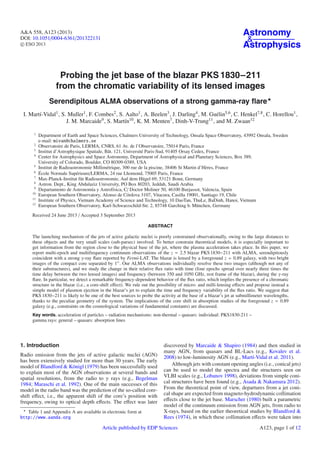
The time variations of the flux-density ratio between the two
lensed images ( = fNE / fSW ) during our ALMA observations
are shown in Fig. 1 for the different bands. Data cover a time
span of roughly three times the time delay between the two
lensed images. The flux ratio varies from a low value of ∼ 1.2
at the first data points on April 09–11 to a peak of
∼ 1.5
on 22–23 May, and then decreases to
∼ 1.3 on 04–15 June.
The frequency dependence of the ratio is particularly interesting.
While the data points do not show a large spread between bands
in April, there is a strong frequency dependence during the fluxratio increase in May, with higher ratios at higher frequencies,
which later becomes inverted in the June data points (i.e., with
higher ratios at lower frequencies). These strong changes in the
flux ratio are not clearly reflected in the flux-density evolution of
the blazar (Fig. 2).
Besides the general time variations over a monthly timescale,
we do observe rapid variations of , of a few percent, on a
much shorter timescale of hours (at 300 GHz on 23 May and
at 290 GHz on 11 April). This rapid behavior seems to be seen
at only the high frequency end, but the sparse time sampling of
our observations does not allow us to investigate the intra-day
variability further.
At cm wavelengths, Pramesh Rao & Subrahmanyan (1988)
and Nair et al. (1993) noted long ago that the flux ratio
varies with time and frequency. A (sparse) monitoring of
PKS 1830−211 at 3 mm over a time period of 12 years shows
that the flux ratio can vary around a value of ∼1.6 (see Muller
& Guélin 2008), with extreme excursions in the range 1–2. In
these 3 mm observations, however, the two images were not resolved, and the ratio was determined from the saturation of the
HCO+ J = 2–1 line at the velocity of the SW absorption, assuming a covering factor fc of unity. Since fc is actually slightly
lower than unity (Muller et al., in prep.), the flux ratio was likely
slightly overestimated with this method. Using the BIMA interferometer at 3 mm, Swift et al. (2001) resolved the two lensed
images and could measure a flux ratio
of 1.18 ± 0.06 at the
time of their observations (27–28 December 1999), within the
range of ratios reported by Muller & Guélin (2008). We should
emphasize that there has been no previous measurement of the

Fig. 2. Evolution of the submm flux density of the NE image of the
blazar. Filled symbols are the actual flux density measurements of the
NE image; empty symbols correspond to the flux densities of the SW
image shifted backwards in time by 27 days (i.e., the time delay of the
lens, Barnacka et al. 2011) and scaled up according to a quiescent flux
ratio of quiet = 1.34 (see Table 2). For each epoch and band, the flux
densities of the four ALMA spectral windows (Table 1) were averaged
together. The dashed line marks the time when the effect of the ejected
plasmon begins to be seen in the NE image, according to our model.

Fig. 3. Fermi-LAT light curve of PKS 1830−211. The dotted lines mark
the epochs of our ALMA observations. The dashed line marks the time
when the effect of the ejected plasmon begins to be seen at ALMA
frequencies in the NE image, according to our model. Only Fermi-LAT
points with a confidence level above 2σ are shown. The time binning is
of seven days.

flux-ratio variability on timescales shorter than a day, that we are
aware of.
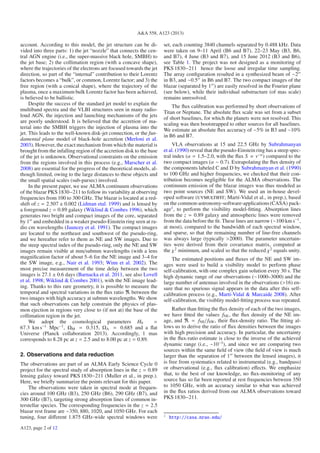
PKS 1830−211 is in the list of the Fermi Large Area
Telescope (Fermi-LAT) monitored sources and its daily light
curve can be retrieved from the Fermi-LAT website2 . Several
major γ-ray flares have been reported in the past (e.g., Ciprini
2010, 2012), with amplitude variations up to a factor of tens on
short timescales (∼hours), revealing the strong intrinsic variation
of the source (e.g., Donnarumma et al. 2011). The Fermi-LAT
light curve (for energy above 100 MeV) for year 2012, as retrieved from the Fermi-LAT public archive, is shown in Fig. 3. It
2

http://fermi.gsfc.nasa.gov/ssc/data/access/lat/msl_
lc/
A123, page 3 of 12
A&A 558, A123 (2013)

can be seen from this figure that our ALMA observations have
been performed, although serendipitously, during the time of a
major γ-ray flare, the strongest one in a period of two years,
corresponding to an increase by a factor of up to seven within
about one month. This coincidence provides us with a good opportunity to study the submm counterpart of a γ-ray flare from a
blazar.
Hereafter we discuss the interpretation of the temporal and
chromatic evolution of the flux ratio in our ALMA data. We
consider the potential effect of gravitational micro- and millilensing, showing that structural changes in the blazar’s jet are
needed anyway to explain the observations. Further, we consider a simple model of plasmon ejection, which can naturally
and simply reproduce the flux-ratio evolution and its chromatic
behavior.

4. Effects of micro- and milli-lensing?
Micro- and milli-lensing events could introduce a variability
into the flux ratio, but its chromatic changes directly imply a
chromatic structure in the blazar (i.e., a core-shift effect). The
variability in the amplification due to micro- and milli-lensing
depends on the angular size of the source, θS , relative to the typical angular size of the Einstein radius of the structure causing
the light deflection, θE . If the source is smaller than θE , then the
lensing variability can be large. Typically, an object in the lens
plane with mass M can produce lensing variability if
4 G M DLS
1
,
(1)
DOS
c2 DOS DOL
where DIJ is the angular distance from J to I, and the subindices
O, L, and S stand for observer, lens, and source, respectively.
In the case of micro-lensing, e.g., by a stellar-mass object in
the lens plane, we get a typical Einstein radius θE = 1.7 μas.
This is a very low value compared to the expected angular size
of the jet emission (e.g., Gear 1991), falling by several orders
of magnitude. Indeed, Jin et al. (2003) were able to slightly resolve the core size of PKS 1830−211 at 43 GHz in their VLBA
observations, getting diameters of ∼0.5 mas (see their Fig. 1).
In the case of a conical jet, the size of the core emission should
scale roughly as ∝ν−1 (for a concave jet, the dependence of size
on frequency is weaker). A (conservative) estimate of the core
size at our ALMA frequencies therefore falls between 70 μas
(at 300 GHz) and 215 μas (at 100 GHz), far too large to allow for an effective variability caused by micro-lensing. We note
that X-ray micro-lensing was suggested by Oshima et al. (2001)
to explain the large discrepancy between the intensity ratio at
X-ray and the magnification ratio of the two lensed images in
PKS 1830−211. The size of the blazar’s X-ray emission region,
i.e., a few Schwarzschild radii of a ∼108 M supermassive black
hole (that is a few 10 μpc), is indeed much smaller than that of
the continuum-emitting region seen at ALMA frequencies.
Increasing the mass of the perturbing object in the lens plane
by several orders of magnitude brings us to the milli-lensing
regime. Here, the timescale for an apparent motion of an object in the z = 0.89 galaxy is large: with a transverse velocity
of 1000 km s−1 , such an object would only cover an apparent
drift of ∼0.5 mpc (60 μas) within one year (observer frame).
Therefore, the timescale of milli-lensing would be too long to
explain the short timescales observed in the flux-ratio evolution
(i.e., days or a few weeks).
On the other hand, a plasmon travelling at nearly speed of
light in the blazar’s jet would cover an apparent projected distance of ∼0.2 mas in the lens plane within one month, so that
θS

θE =

A123, page 4 of 12

Conical region
Concave region

R

θ
Jet base
To observer
Fig. 4. Sketch of the path followed by the jet plasma during our observations. Not to scale. The concave region (gray) should be much smaller
than the conical region (white). Moreover, the line of sight coincides
with the precession axis of the jet tube. The precession angle is θ.

milli-lensing could not be formally ruled out to explain variabilities of a weeks or a few months. However, the intra-day variability detected in our ALMA observations cannot be explained
by milli-lensing. In any case, we emphasize that an intrinsic variability in the blazar’s jet is required for milli-lensing to work on
timescales of less than one year.

5. Intrinsic variability in the blazar
The simplest way to explain the temporal and chromatic changes
in the flux ratio is to consider intrinsic variability in the jet of the
blazar, which must indeed be variable by nature. The odd behavior in the evolution of the flux ratio, , can be explained using
a simple model of an overdensity region (plasmon), travelling
downstream of the jet. From the evolution of the flux density of
the NE image, we can set an upper bound to the flux-density
increase of only 5% at 100 GHz (observer frame) during the
flare (see Fig. 2). We note that this is probably the weakest flaring event ever detected from a blazar at submm wavelengths. In
contrast, the γ-ray emission shows a much larger variability, of
a factor of up to seven during the same period.
5.1. Model of the blazar’s jet

From 43 GHz VLBA observations, Garrett et al. (1997) and Jin
et al. (2003) have reported structural and temporal variations in
the radio core/knot images of PKS 1830−211. Jin et al. (2003)
could measure changes in the relative distance between the centroids of emission of the NE and SW images to up to 200 μas
in a few months. These changes were interpreted by Nair et al.
(2005) as due to a helical jet, with a jet precession period of
about one year (corresponding to an intrinsic period of ∼30 yr
for the source at z = 2.5), possibly due to the presence of a binary black-hole system at the center of the AGN. Morphological
changes in the continuum emission are also believed to be responsible for the time variations observed in the z = 0.89 molecular absorption (Muller & Guélin 2008).
As far as we know, there has been no further attempt to observe the evolution of PKS 1830−211’s core/jet structure at high
angular (VLBI) resolution since the observations reported by Jin
et al. (2003). We show below that our ALMA data can help shed
new light on this interesting system.
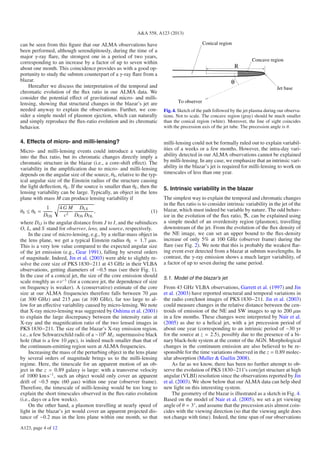
The geometry of the blazar is illustrated as a sketch in Fig. 4.
Based on the model of Nair et al. (2005), we set a jet viewing
angle of θ = 3◦ , and assume that the precession axis almost coincides with the viewing direction (so that the viewing angle does
not change with time). Indeed, the time span of our observations
I. Martí-Vidal et al.: Probing the jet base of PKS 1830−211
Table 2. Parameters of our jet model.
Parameter

Value (concave)

Value (conical)

Notes

3 deg
27 days

3 deg
27 days

Nair et al. (2005)
Barnacka et al. (2011)

2.8−3.0
1.05−1.27 pc
9.1−12.2
100 GHz
1
1.73−1.78 Jy
1.325−1.350
0.039−0.087

1.0−1.2
0.88−1.11 pc
7.8−8.7
100 GHz
1
0.9−1.1 Jy
1.350−1.370
−

1.7−2.0 mpc
200−210
19.2−19.5

1.0−1.3 mpc
110−140
18.8−19.1

Fixed

Jet viewing angle, θ
Time delay, Δτ, between the NE and SW images
Quiescent state
Power index of e− energy distribution, γ
Reference distance to the jet base, R0
Bulk Lorentz factor, Γ0 , at R0
Reference frequency, ν0
Opacity, τν0 , at ν0 and R0
Total flux density, Fν0 , at ν0
Flux-density ratio, quiet = FNE /FSW
Curvature index of the jet surface, β
Flare
Width of the overdensity region, Δ
Density contrast factor, K
Injection time of plasmon, t0 (days after 1st epoch)

is much shorter than the precession period reported by Nair et al.
(2005), so that we can consider the jet viewing angle as a constant in any case.
By fixing the viewing angle, we can numerically model the
mm-submm emission from the jet, using the parametric model
by Marscher (1980). The details of our implementation of the
Marscher’s model are described in Appendix A. We have simulated a flare in the jet as due to a narrow overdensity in the
population of synchrotron-emitting particles (hereafter, a plasmon), due to either a sudden increase in the accretion rate by the
SMBH (i.e., related to the disk-jet connexion) or triggered by
an internal shock in the jet (e.g., Mimica et al. 2004). Although
elaborated hydrodynamical codes are used to model the propagation of internal shocks in jets (e.g., Mimica et al. 2004; Böttcher
& Dermer 2010), we built a simplified model for the evolution
of the jet flare (see Appendix A), using a minimum number of
model parameters in compromise with our limited amount of observations. Then, using a time delay of 27 days between the NE
and SW images (the NE image leading), we have computed the
flux-density ratio as a function of time and observing frequency.
A direct comparison between the observed ratios and the model
predictions allowed us to constrain the defining parameters of
the jet model by means of least-squares minimization.
Our jet model depends on several parameters, which are
listed in Table 2 and described in Appendix A. We distinguish
between two kinds of fitting parameters. The first kind describes
the quiescent state of the jet: on the one hand, we have the power
index of the electron energy distribution, γ, and the bulk Lorentz
factor of the electrons, Γ; on the other, the opacity, τν0 , for a given
reference frequency, ν0 , and distance to the jet base, R0 . Finally,
the integrated flux density at the reference frequency over the
jet, Fν0 , and the flux ratio of the NE image to the SW image in
the quiescent state, quiet . For the case of a concave jet, we must
add the curvature index of the jet surface, β.
The second kind of parameter describes the flare as due to
an overdensity of plasma, which travels through the jet with the
same local bulk Lorentz factor as that of the quiescent plasma.
The parameters used here are the width of the overdensity region, Δ, the density contrast factor, K, and the time of injection
of the plasmon into the jet, t0 . An increase in the local magnetic
field is also applied, to keep a constant ratio of the particle and
field energy densities.
Regarding the fixed parameters in the model, we have the jet
viewing angle, θ (fixed to 3◦ ) and the time delay of the lens, Δτ

(fixed to 27 days). We notice that variations in these fixed parameters within reasonable limits (0.5 degrees for θ and a few days
for Δτ) do not change the conclusions reported in the following
sections (a small change in Δτ basically translates into a change
in t0 ).
The set of parameters for the quiescent and flaring stages are
listed in Table 2. We note that the large number of parameters to
be fitted (8 for a conical jet, 9 for a concave jet), together with
the limited amount of data and the nonlinearity in the behavior
of most of the parameters, makes it difficult to constrain the parameter space in a statistically robust way. Thus, instead of one
single estimate for each parameter, we explored the parameter
space and report the range of values that match the data with a
similar quality (maximum increase in the χ2 of 20% with respect
to the minimum value).
5.2. Fit to a conical jet

We show in Fig. 5 (left) the behavior of the magnetic field, particle density, bulk Lorentz factor, and flux density per unit length
of a conical-jet model fitted to our ALMA data. The values of
the parameters used are given in Table 2. The plot of model versus data is shown in Fig. 6 (top left). The general trend of the
flux-density ratios is roughly followed by the model, with higher
ratios in the May epochs and lower ratios in the June epochs.
The frequency dependence of the ratios in the June epochs is
also recovered. Regarding the spectrum (Fig. 6, bottom left), the
conical-jet model is clearly unable to reproduce the optically thin
spectrum seen in the data (α = 0.7). Indeed, nearly flat spectra
are expected from conical jets in energy equipartition between
the leptons and the magnetic field. This effect, known as the
“cosmic conspiracy”, is due to the particular dependence of all
these quantities with distance to the jet base (Marscher 1977;
Blandford & Königl 1979). However, this is only true as long
as the jet base is opaque to the radio emission. If the frequencies are high enough, the whole jet becomes optically thin and
the spectrum steepens (e.g., Marscher 1980). The peak emission
at these high frequencies is obviously located close to (it not at)
the physical base of the jet, where the conical model does not apply. The frequency range with a steep spectrum, which implies
a (nearly) optically-thin jet, should be modeled using a concave
jet, as we describe in the next section.
According to our model, the epochs on April (black; Fig. 6,
left) were taken well before the flare. Then, the epochs in May
A123, page 5 of 12
A&A 558, A123 (2013)

CONICAL

CONCAVE

Fig. 5. Quantities derived from our simplified jet model. The magnetic field B and electron density N (dashed and solid black lines) are shown as a
function of radial distance from the jet origin, normalized to their values at 10−1 pc; the Lorentz factor, Γ, (dotted line) is shown unnormalized; the
jet brightness at 100, 250, and 300 GHz (blue, green, and red lines) is shown normalized to the brightness peak at 100 GHz. Left, a fitting model
obtained assuming that the emission comes from the conical (i.e., free) jet region. Right, a fitting model assuming that the emission comes from
the concave jet region. See text for details.
CONCAVE
CONICAL
Fig. 6. Top, flux-density ratio of the NE image to the SW image. Bottom, flux density of the NE image. Circles are the ALMA data and lines are
the predictions from our best-fit jet model. Different colors correspond to different observing epochs. Left, fit to the conical-jet model. Right, fit to
the concave-jet model. The dashed line marks the lower flux-density ratio expected from an (unconstrained) previous flare (see text for details).

(red) were taken while the flare had already arrived on the
NE image (hence the higher flux-density ratios). Finally, the
epochs in June (green and blue) were taken when the flare had
already arrived on the SW image, thereby explaining the lower
flux-density ratios and the slightly higher ratios at the lower
frequencies (i.e., those frequencies for which the flare was not
strongly illuminating the SW image yet).
We must notice that the model prediction of flux-density ratios for the data taken in April falls above the data (Fig. 6, top).
An earlier flare in its final stage (i.e., illuminating only the SW
image) is needed to explain the lower ratios at these epochs.
Unfortunately, the lack of earlier data prevents us from constraining any quantity for this possible previous flare.
5.3. Fit to a concave jet

The quantities related to a concave-jet model are shown in
Fig. 5 (right). We notice the increase in the bulk Lorentz factor
A123, page 6 of 12

with distance, as well as the slower decrease in magnetic-field
strength and particle density, which steepen the synthesized
spectrum. The parameters used to generate this plot are shown
in Table 2. The peak intensity at high frequencies is located at
a distance very close to the jet origin (a few mpc). If this distance were close to the nozzle size (e.g., similar to the case of
3C 345, Marscher 1980), Fig. 5 (right) would suggest that the jet
is almost (if not completely) optically thin to the emission at our
highest frequencies. This would, indeed, steepen the observed
spectrum (as discussed in the previous section).
The plot of observed ratios vs. model is shown in Fig. 6 (top
right). The fit to the May epochs is improved, so the model can
now reproduce the spectrum (Fig. 6; bottom right). As for the
conical-jet model, an earlier flare is needed to explain the lower
flux ratios observed in April.
We notice that some flux ratios in May at 300 GHz (Fig. 6,
magenta) cannot be reproduced by the model. A rapid variability is needed in this case, since the observed ratios changed
from 1.49 to 1.54 in only about five hours. Nevertheless, it
I. Martí-Vidal et al.: Probing the jet base of PKS 1830−211

5.4. Constraints on the jet physics

As described in Appendix A, our model assumes a jet with a very
small opening angle. Indeed, our fitting parameters determine
all the proportionality constants between the distance to the jet
base R, the source function ν /κν , and the opacity τν , without any
need to use an absolute width of the jet. As a result, the magnetic
field and particle density cannot be directly determined from our
fitted parameters, unless we assume a given absolute size (i.e.,
basically, an opening angle) of the jet tube.
Nevertheless, a quantity that can be well constrained in our
model is the core shift among the observing frequencies (i.e.,
roughly speaking, the separation between the τ = 1 surfaces
at the different frequencies; Blandford  Königl 1979). Even
though the resolution of our ALMA observations is not high
enough to actually measure the core shift, we can still estimate
it indirectly based on our model. For any pair of frequencies, the
core shift is related to the time needed by the plasmon to travel
from one τ = 1 surface to the other. Since the speed of the plasmon is likely close to the speed of light, the timescale in the variability of the flux-density ratios (Fig. 6, top) constrains the distance between the cores at our three observing frequencies. We
notice, though, that the dependence of the opacity with distance
to the jet base is very smooth in the concave-jet model, so the
effect of the core shift in this model is less pronounced than in
the conical-jet model. This can be easily seen in Fig. 8, where
the complete simulation of the flux-density ratios is shown for
both the conical-jet and the concave-jet models. However, both
models still allow us to estimate the core-shift from the observed
time evolution of the flux-density ratios. From our jet models,
both conical and concave, we estimate a distance of 0.3–0.5 pc
between the cores at 100 GHz and 300 GHz. Assuming a viewing angle of 3◦ for the jet, the distance between the cores translates into a projected angular shift of 2–3 μas. However, the
blazar is lensed, and a magnification of 3–6 (depending on the
image) eventually results in an apparent core shift of 5–8 μas
between 100 and 300 GHz (for a shift of 0.5 pc)3 .
Concerning the overdensity region of emitting particles in
the jet (i.e., the plasmon), satisfactory fits are only obtained
when the density contrast is high (100) and the size is narrow
(∼1 mpc). Since the length of the radio jet (pc scale) is much
greater than the size of the plasmon, the contribution of the latter to the total submm emission is small. This would explain
the weak flux-density enhancement at submm wavelengths due
to flare dilution. In contrast, if the γ-ray emitting region is small
compared to the radio jet (e.g., Valtaoja  Teraesranta 1996), the
γ-ray flare would not be significantly diluted, and the γ-ray variability would be larger than at submm wavelengths, as observed
(Figs. 2 and 3).
3

The size amplification goes as the square root of the magnification
factor.
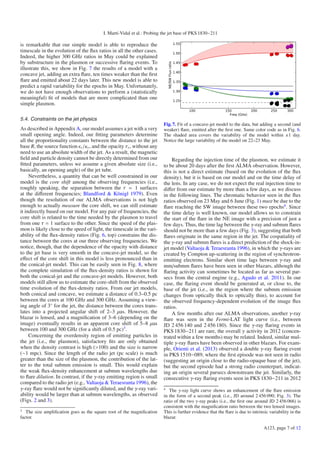
is remarkable that our simple model is able to reproduce the
timescale in the evolution of the flux ratios in all the other cases.
Indeed, the higher 300 GHz ratios in May could be explained
by substructure in the plasmon or successive flaring events. To
illustrate this, we show in Fig. 7 the results of a model with a
concave jet, adding an extra flare, ten times weaker than the first
flare and emitted about 22 days later. This new model is able to
predict a rapid variability for the epochs in May. Unfortunately,
we do not have enough observations to perform a (statistically
meaningful) fit of models that are more complicated than one
simple plasmon.
Fig. 7. Fit of a concave-jet model to the data, but adding a second (and
weaker) flare, emitted after the first one. Same color code as in Fig. 6.
The shaded area covers the variability of the model within ±1 day.
Notice the large variability of the model on 22–23 May.

Regarding the injection time of the plasmon, we estimate it
to be about 20 days after the first ALMA observation. However,
this is not a direct estimate (based on the evolution of the flux
density), but it is based on our model and on the time delay of
the lens. In any case, we do not expect the real injection time to
differ from our estimate by more than a few days, as we discuss
in the following lines. The chromatic behavior seen in the flux
ratios observed on 23 May and 6 June (Fig. 1) must be due to the
flare reaching the SW image between these two epochs4 . Since
the time delay is well known, our model allows us to constrain
the start of the flare in the NE image with a precision of just a
few days. Thus, the time lag between the γ-ray and submm flares
should not be more than a few days (Fig. 3), suggesting that both
flares originate in the same region in the jet. The cospatiality of
the γ-ray and submm flares is a direct prediction of the shock-injet model (Valtaoja  Teraesranta 1996), in which the γ-rays are
created by Compton up-scattering in the region of synchrotronemitting electrons. Similar short time lags between γ-ray and
mm/submm flares have been seen in other blazars, although the
flaring activity can sometimes be located as far as several parsecs from the central engine (e.g., Agudo et al. 2011). In our
case, the flaring event should be generated at, or close to, the
base of the jet (i.e., in the region where the submm emission
changes from optically thick to optically thin), to account for
the observed frequency-dependent evolution of the image flux
ratios.
A few months after our ALMA observations, another γ-ray
flare was seen in the Fermi-LAT light curve (i.e., between
JD 2 456 140 and 2 456 180). Since the γ-ray flaring events in
PKS 1830−211 are rare, the overall γ activity in 2012 (concentrated within a few months) may be related. Indeed, similar multiple γ-ray flares have been observed in other blazars. For example, Orienti et al. (2013) observed a double γ-ray flaring event
in PKS 1510−089, where the first episode was not seen in radio
(suggesting an origin close to the radio-opaque base of the jet),
but the second episode had a strong radio counterpart, indicating an origin several parsecs downstream the jet. Similarly, the
consecutive γ-ray flaring events seen in PKS 1830−211 in 2012
4
The γ-ray light curve shows an enhancement of the flare emission
in the form of a second peak (i.e., JD around 2 456 090; Fig. 3). The
ratio of the two γ-ray peaks (i.e., the first one around JD 2 456 066) is
consistent with the magnification ratio between the two lensed images.
This is further evidence that the flare is due to intrinsic variability in the
blazar.

A123, page 7 of 12

Probing the jet_base_of_blazar_pks1830211_from_the_chromatic_variability_of_its_lensed_images

  • 1.
    Astronomy & Astrophysics A&A 558, A123(2013) DOI: 10.1051/0004-6361/201322131 c ESO 2013 Probing the jet base of the blazar PKS 1830−211 from the chromatic variability of its lensed images Serendipitous ALMA observations of a strong gamma-ray flare I. Martí-Vidal1 , S. Muller1 , F. Combes2 , S. Aalto1 , A. Beelen3 , J. Darling4 , M. Guélin5,6 , C. Henkel7,8 , C. Horellou1 , J. M. Marcaide9 , S. Martín10 , K. M. Menten7 , Dinh-V-Trung11 , and M. Zwaan12 1 2 3 4 5 6 7 8 9 10 11 12 Department of Earth and Space Sciences, Chalmers University of Technology, Onsala Space Observatory, 43992 Onsala, Sweden e-mail: mivan@chalmers.se Observatoire de Paris, LERMA, CNRS, 61 Av. de l’Observatoire, 75014 Paris, France Institut d’Astrophysique Spatiale, Bât. 121, Université Paris-Sud, 91405 Orsay Cedex, France Center for Astrophysics and Space Astronomy, Department of Astrophysical and Planetary Sciences, Box 389, University of Colorado, Boulder, CO 80309-0389, USA Institut de Radioastronomie Millimétrique, 300 rue de la piscine, 38406 St Martin d’Hères, France École Normale Supérieure/LERMA, 24 rue Lhomond, 75005 Paris, France Max-Planck-Institut für Radioastronomie, Auf dem Hügel 69, 53121 Bonn, Germany Astron. Dept., King Abdulaziz University, PO Box 80203, Jeddah, Saudi Arabia Departamento de Astronomía y Astrofísica, C/ Doctor Moliner 50, 46100 Burjassot, Valencia, Spain European Southern Observatory, Alonso de Córdova 3107, Vitacura, Casilla 19001, Santiago 19, Chile Institute of Physics, Vietnam Academy of Science and Technology, 10 DaoTan, ThuLe, BaDinh, Hanoi, Vietnam European Southern Observatory, Karl-Schwarzschild-Str. 2, 85748 Garching b. München, Germany Received 24 June 2013 / Accepted 3 September 2013 ABSTRACT The launching mechanism of the jets of active galactic nuclei is poorly constrained observationally, owing to the large distances to these objects and the very small scales (sub-parsec) involved. To better constrain theoretical models, it is especially important to get information from the region close to the physical base of the jet, where the plasma acceleration takes place. In this paper, we report multi-epoch and multifrequency continuum observations of the z = 2.5 blazar PKS 1830−211 with ALMA, serendipitously coincident with a strong γ-ray flare reported by Fermi-LAT. The blazar is lensed by a foreground z = 0.89 galaxy, with two bright images of the compact core separated by 1 . Our ALMA observations individually resolve these two images (although not any of their substructures), and we study the change in their relative flux ratio with time (four epochs spread over nearly three times the time delay between the two lensed images) and frequency (between 350 and 1050 GHz, rest frame of the blazar), during the γ-ray flare. In particular, we detect a remarkable frequency-dependent behavior of the flux ratio, which implies the presence of a chromatic structure in the blazar (i.e., a core-shift effect). We rule out the possibility of micro- and milli-lensing effects and propose instead a simple model of plasmon ejection in the blazar’s jet to explain the time and frequency variability of the flux ratio. We suggest that PKS 1830−211 is likely to be one of the best sources to probe the activity at the base of a blazar’s jet at submillimeter wavelengths, thanks to the peculiar geometry of the system. The implications of the core shift in absorption studies of the foreground z = 0.89 galaxy (e.g., constraints on the cosmological variations of fundamental constants) are discussed. Key words. acceleration of particles – radiation mechanisms: non-thermal – quasars: individual: PKS1830-211 – gamma rays: general – quasars: absorption lines 1. Introduction Radio emission from the jets of active galactic nuclei (AGN) has been extensively studied for more than 30 years. The early model of Blandford & Königl (1979) has been successfully used to explain most of the AGN observations at several bands and spatial resolutions, from the radio to γ rays (e.g., Begelman 1984; Maraschi et al. 1992). One of the main successes of this model in the radio band was the prediction of the so-called coreshift effect, i.e., the apparent shift of the core’s position with frequency, owing to optical depth effects. The effect was later Table 1 and Appendix A are available in electronic form at http://www.aanda.org discovered by Marcaide & Shapiro (1984) and then studied in many AGN, from quasars and BL-Lacs (e.g., Kovalev et al. 2008) to low-luminosity AGN (e.g., Martí-Vidal et al. 2011). Although jets with constant opening angles (i.e., conical jets) can be used to model the spectra and the structures seen on VLBI scales (e.g., Lobanov 1998), deviations from simple conical structures have been found (e.g., Asada & Nakamura 2012). From the theoretical point of view, departures from a jet conical shape are expected from magneto-hydrodynamic collimation effects close to the jet base. Marscher (1980) built a parametric model of the continuum emission from AGN jets, from radio to X-rays, based on the earlier theoretical studies by Blandford & Rees (1974), in which these collimation effects were taken into Article published by EDP Sciences A123, page 1 of 12
  • 2.
    A&A 558, A123(2013) account. According to this model, the jet structure can be divided into three parts: 1) the jet “nozzle” that connects the central AGN engine (i.e., the super-massive black hole, SMBH) to the jet base; 2) the collimation region (with a concave shape), where the trajectories of the electrons are focused towards the jet direction, so part of the “internal” contribution to their Lorentz factors becomes a “bulk”, or common, Lorentz factor; and 3) the free region (with a conical shape), where the trajectory of the plasma, once a maximum bulk Lorentz factor has been achieved, is believed to be ballistic. Despite the success of the standard jet model to explain the multiband spectra and the VLBI structures seen in many radioloud AGN, the injection and launching mechanisms of the jets are poorly understood. It is believed that the accretion of material into the SMBH triggers the injection of plasma into the jet. This leads to the well-known disk-jet connection, or the fundamental plane model of black-hole accretion (Merloni et al. 2003). However, the exact mechanism from which the material is brought from the infalling region of the accretion disk to the base of the jet is unknown. Observational constraints on the emission from the regions involved in this process (e.g., Marscher et al. 2008) are essential for the progress of the theoretical models, although limited, owing to the large distances to these objects and the small spatial scales (sub-parsec) involved. In the present paper, we use ALMA continuum observations of the blazar PKS 1830−211 to follow its variability at observing frequencies from 100 to 300 GHz. The blazar is located at a redshift of z = 2.507 ± 0.002 (Lidman etal. 1999) and is lensed by a foreground z = 0.89 galaxy (Wiklind & Combes 1996), which generates two bright and compact images of the core, separated by 1 and embedded in a weaker pseudo-Einstein ring seen at radio cm wavelengths (Jauncey et al. 1991). The compact images are located to the northeast and southwest of the pseudo-ring, and we hereafter refer to them as NE and SW images. Due to the steep spectral index of the pseudo-ring, only the NE and SW images remain visible at mm/submm wavelengths (with a lens magnification factor of about 5–6 for the NE image and 3–4 for the SW image, e.g., Nair et al. 1993; Winn et al. 2002). The most precise measurement of the time delay between the two images is 27.1 ± 0.6 days (Barnacka et al. 2011, see also Lovell et al. 1998; Wiklind & Combes 2001), with the NE image leading. Thanks to this rare geometry, it is possible to measure the temporal and spectral variations in the flux ratio between the two images with high accuracy at submm wavelengths. We show that such observations can help constrain the physics of plasmon ejection in regions very close to (if not at) the base of the collimation region in the jet. We adopt the cosmological parameters H0 = 67.3 km s−1 Mpc−1 , ΩM = 0.315, ΩΛ = 0.685 and a flat Universe (Planck collaboration 2013). Accordingly, 1 mas corresponds to 8.28 pc at z = 2.5 and to 8.00 pc at z = 0.89. 2. Observations and data reduction The observations are part of an ALMA Early Science Cycle 0 project for the spectral study of absorption lines in the z = 0.89 lensing galaxy toward PKS 1830−211 (Muller et al., in prep.). Here, we briefly summarize the points relevant for this paper. The observations were taken in spectral mode at frequencies around 100 GHz (B3), 250 GHz (B6), 290 GHz (B7), and 300 GHz (B7), targeting strong absorption lines of common interstellar species. The corresponding frequencies in the z = 2.5 blazar rest frame are ∼350, 880, 1020, and 1050 GHz. For each tuning, four different 1.875 GHz-wide spectral windows were A123, page 2 of 12 set, each counting 3840 channels separated by 0.488 kHz. Data were taken on 9–11 April (B6 and B7), 22–23 May (B3, B6, and B7), 4 June (B3 and B7), and 15 June 2012 (B3 and B6), see Table 1. The project was not designed as a monitoring of PKS 1830−211 hence the loose and irregular time sampling. The array configuration resulted in a synthesized beam of ∼2 in B3, and ∼0.5 in B6 and B7. The two compact images of the blazar (separated by 1 ) are easily resolved in the Fourier plane (see below), while their individual substructure (of mas scale) remains unresolved. The flux calibration was performed by short observations of Titan or Neptune. The absolute flux scale was set from a subset of short baselines, for which the planets were not resolved. This scaling was then bootstrapped to other sources for all baselines. We estimate an absolute flux accuracy of ∼5% in B3 and ∼10% in B6 and B7. VLA observations at 15 and 22.5 GHz by Subrahmanyan et al. (1990) reveal that the pseudo-Einstein ring has a steep spectral index (α = 1.5–2.0, with the flux S ∝ ν−α ) compared to the two compact images (α ∼ 0.7). Extrapolating the flux density of the components labeled C and D by Subrahmanyan et al. (1990) to 100 GHz and higher frequencies, we checked that their contribution becomes negligible for the ALMA observations. The continuum emission of the blazar images was thus modeled as two point sources (NE and SW). We used an in-house developed software (uvmultifit; Martí-Vidal et al., in prep.), based on the common-astronomy-software-applications (CASA) package1 , to perform the visibility model-fitting. Absorption lines from the z = 0.89 galaxy and atmospheric lines were removed from the data before the fit. These lines are narrow (∼100 km s−1 , at most), compared to the bandwidth of each spectral window, and sparse, so that the remaining number of line-free channels was always large (typically >2000). The parameter uncertainties were derived from their covariance matrix, computed at the χ2 minimum, and scaled so that the reduced χ2 equals unity. The estimated positions and fluxes of the NE and SW images were used to build a visibility model to perform phase self-calibration, with one complex gain solution every 30 s. The high dynamic range of our observations (∼1000–3000) and the large number of antennas involved in the observations (>16) ensure that no spurious signal appears in the data after this selfcalibration process (e.g., Martí-Vidal & Marcaide 2008). After self-calibration, the visiblity model-fitting process was repeated. Rather than fitting the flux density of each of the two images, we have fitted the values fNE , the flux density of the NE image, and = fNE / fSW , their flux-density ratio. The fitting allows us to derive the ratio of flux densities between the images with high precision and accuracy. In particular, the uncertainty in the flux-ratio estimate is close to the inverse of the achieved dynamic range (i.e., ∼10−3 ), and since we are comparing two sources within the same field of view (the field of view is much larger than the separation of 1 between the lensed images), it is free from systematics related to instrumental (e.g., bandpass) or observational (e.g., flux calibration) effects. We emphasize that, to the best of our knowledge, no flux-monitoring of any source has so far been reported at rest frequencies between 350 to 1050 GHz, with an accuracy similar to what was achieved in the flux ratios derived from our ALMA observations toward PKS 1830−211. 1 http://casa.nrao.edu/
  • 3.
    I. Martí-Vidal etal.: Probing the jet base of PKS 1830−211 Fig. 1. Evolution of the flux-density ratio between the NE and the SW images, measured for each spectral window in our ALMA observations. The error bars are much smaller than the symbol sizes. The flux-ratio evolution based on our jet model (see text) is overlaid for frequencies of 100 GHz (red) and 300 GHz (blue). At high frequencies (e.g., 300 GHz), our model predicts fast and large variations of the flux ratio. 3. Results The time variations of the flux-density ratio between the two lensed images ( = fNE / fSW ) during our ALMA observations are shown in Fig. 1 for the different bands. Data cover a time span of roughly three times the time delay between the two lensed images. The flux ratio varies from a low value of ∼ 1.2 at the first data points on April 09–11 to a peak of ∼ 1.5 on 22–23 May, and then decreases to ∼ 1.3 on 04–15 June. The frequency dependence of the ratio is particularly interesting. While the data points do not show a large spread between bands in April, there is a strong frequency dependence during the fluxratio increase in May, with higher ratios at higher frequencies, which later becomes inverted in the June data points (i.e., with higher ratios at lower frequencies). These strong changes in the flux ratio are not clearly reflected in the flux-density evolution of the blazar (Fig. 2). Besides the general time variations over a monthly timescale, we do observe rapid variations of , of a few percent, on a much shorter timescale of hours (at 300 GHz on 23 May and at 290 GHz on 11 April). This rapid behavior seems to be seen at only the high frequency end, but the sparse time sampling of our observations does not allow us to investigate the intra-day variability further. At cm wavelengths, Pramesh Rao & Subrahmanyan (1988) and Nair et al. (1993) noted long ago that the flux ratio varies with time and frequency. A (sparse) monitoring of PKS 1830−211 at 3 mm over a time period of 12 years shows that the flux ratio can vary around a value of ∼1.6 (see Muller & Guélin 2008), with extreme excursions in the range 1–2. In these 3 mm observations, however, the two images were not resolved, and the ratio was determined from the saturation of the HCO+ J = 2–1 line at the velocity of the SW absorption, assuming a covering factor fc of unity. Since fc is actually slightly lower than unity (Muller et al., in prep.), the flux ratio was likely slightly overestimated with this method. Using the BIMA interferometer at 3 mm, Swift et al. (2001) resolved the two lensed images and could measure a flux ratio of 1.18 ± 0.06 at the time of their observations (27–28 December 1999), within the range of ratios reported by Muller & Guélin (2008). We should emphasize that there has been no previous measurement of the Fig. 2. Evolution of the submm flux density of the NE image of the blazar. Filled symbols are the actual flux density measurements of the NE image; empty symbols correspond to the flux densities of the SW image shifted backwards in time by 27 days (i.e., the time delay of the lens, Barnacka et al. 2011) and scaled up according to a quiescent flux ratio of quiet = 1.34 (see Table 2). For each epoch and band, the flux densities of the four ALMA spectral windows (Table 1) were averaged together. The dashed line marks the time when the effect of the ejected plasmon begins to be seen in the NE image, according to our model. Fig. 3. Fermi-LAT light curve of PKS 1830−211. The dotted lines mark the epochs of our ALMA observations. The dashed line marks the time when the effect of the ejected plasmon begins to be seen at ALMA frequencies in the NE image, according to our model. Only Fermi-LAT points with a confidence level above 2σ are shown. The time binning is of seven days. flux-ratio variability on timescales shorter than a day, that we are aware of. PKS 1830−211 is in the list of the Fermi Large Area Telescope (Fermi-LAT) monitored sources and its daily light curve can be retrieved from the Fermi-LAT website2 . Several major γ-ray flares have been reported in the past (e.g., Ciprini 2010, 2012), with amplitude variations up to a factor of tens on short timescales (∼hours), revealing the strong intrinsic variation of the source (e.g., Donnarumma et al. 2011). The Fermi-LAT light curve (for energy above 100 MeV) for year 2012, as retrieved from the Fermi-LAT public archive, is shown in Fig. 3. It 2 http://fermi.gsfc.nasa.gov/ssc/data/access/lat/msl_ lc/ A123, page 3 of 12
  • 4.
    A&A 558, A123(2013) can be seen from this figure that our ALMA observations have been performed, although serendipitously, during the time of a major γ-ray flare, the strongest one in a period of two years, corresponding to an increase by a factor of up to seven within about one month. This coincidence provides us with a good opportunity to study the submm counterpart of a γ-ray flare from a blazar. Hereafter we discuss the interpretation of the temporal and chromatic evolution of the flux ratio in our ALMA data. We consider the potential effect of gravitational micro- and millilensing, showing that structural changes in the blazar’s jet are needed anyway to explain the observations. Further, we consider a simple model of plasmon ejection, which can naturally and simply reproduce the flux-ratio evolution and its chromatic behavior. 4. Effects of micro- and milli-lensing? Micro- and milli-lensing events could introduce a variability into the flux ratio, but its chromatic changes directly imply a chromatic structure in the blazar (i.e., a core-shift effect). The variability in the amplification due to micro- and milli-lensing depends on the angular size of the source, θS , relative to the typical angular size of the Einstein radius of the structure causing the light deflection, θE . If the source is smaller than θE , then the lensing variability can be large. Typically, an object in the lens plane with mass M can produce lensing variability if 4 G M DLS 1 , (1) DOS c2 DOS DOL where DIJ is the angular distance from J to I, and the subindices O, L, and S stand for observer, lens, and source, respectively. In the case of micro-lensing, e.g., by a stellar-mass object in the lens plane, we get a typical Einstein radius θE = 1.7 μas. This is a very low value compared to the expected angular size of the jet emission (e.g., Gear 1991), falling by several orders of magnitude. Indeed, Jin et al. (2003) were able to slightly resolve the core size of PKS 1830−211 at 43 GHz in their VLBA observations, getting diameters of ∼0.5 mas (see their Fig. 1). In the case of a conical jet, the size of the core emission should scale roughly as ∝ν−1 (for a concave jet, the dependence of size on frequency is weaker). A (conservative) estimate of the core size at our ALMA frequencies therefore falls between 70 μas (at 300 GHz) and 215 μas (at 100 GHz), far too large to allow for an effective variability caused by micro-lensing. We note that X-ray micro-lensing was suggested by Oshima et al. (2001) to explain the large discrepancy between the intensity ratio at X-ray and the magnification ratio of the two lensed images in PKS 1830−211. The size of the blazar’s X-ray emission region, i.e., a few Schwarzschild radii of a ∼108 M supermassive black hole (that is a few 10 μpc), is indeed much smaller than that of the continuum-emitting region seen at ALMA frequencies. Increasing the mass of the perturbing object in the lens plane by several orders of magnitude brings us to the milli-lensing regime. Here, the timescale for an apparent motion of an object in the z = 0.89 galaxy is large: with a transverse velocity of 1000 km s−1 , such an object would only cover an apparent drift of ∼0.5 mpc (60 μas) within one year (observer frame). Therefore, the timescale of milli-lensing would be too long to explain the short timescales observed in the flux-ratio evolution (i.e., days or a few weeks). On the other hand, a plasmon travelling at nearly speed of light in the blazar’s jet would cover an apparent projected distance of ∼0.2 mas in the lens plane within one month, so that θS θE = A123, page 4 of 12 Conical region Concave region R θ Jet base To observer Fig. 4. Sketch of the path followed by the jet plasma during our observations. Not to scale. The concave region (gray) should be much smaller than the conical region (white). Moreover, the line of sight coincides with the precession axis of the jet tube. The precession angle is θ. milli-lensing could not be formally ruled out to explain variabilities of a weeks or a few months. However, the intra-day variability detected in our ALMA observations cannot be explained by milli-lensing. In any case, we emphasize that an intrinsic variability in the blazar’s jet is required for milli-lensing to work on timescales of less than one year. 5. Intrinsic variability in the blazar The simplest way to explain the temporal and chromatic changes in the flux ratio is to consider intrinsic variability in the jet of the blazar, which must indeed be variable by nature. The odd behavior in the evolution of the flux ratio, , can be explained using a simple model of an overdensity region (plasmon), travelling downstream of the jet. From the evolution of the flux density of the NE image, we can set an upper bound to the flux-density increase of only 5% at 100 GHz (observer frame) during the flare (see Fig. 2). We note that this is probably the weakest flaring event ever detected from a blazar at submm wavelengths. In contrast, the γ-ray emission shows a much larger variability, of a factor of up to seven during the same period. 5.1. Model of the blazar’s jet From 43 GHz VLBA observations, Garrett et al. (1997) and Jin et al. (2003) have reported structural and temporal variations in the radio core/knot images of PKS 1830−211. Jin et al. (2003) could measure changes in the relative distance between the centroids of emission of the NE and SW images to up to 200 μas in a few months. These changes were interpreted by Nair et al. (2005) as due to a helical jet, with a jet precession period of about one year (corresponding to an intrinsic period of ∼30 yr for the source at z = 2.5), possibly due to the presence of a binary black-hole system at the center of the AGN. Morphological changes in the continuum emission are also believed to be responsible for the time variations observed in the z = 0.89 molecular absorption (Muller & Guélin 2008). As far as we know, there has been no further attempt to observe the evolution of PKS 1830−211’s core/jet structure at high angular (VLBI) resolution since the observations reported by Jin et al. (2003). We show below that our ALMA data can help shed new light on this interesting system. The geometry of the blazar is illustrated as a sketch in Fig. 4. Based on the model of Nair et al. (2005), we set a jet viewing angle of θ = 3◦ , and assume that the precession axis almost coincides with the viewing direction (so that the viewing angle does not change with time). Indeed, the time span of our observations
  • 5.
    I. Martí-Vidal etal.: Probing the jet base of PKS 1830−211 Table 2. Parameters of our jet model. Parameter Value (concave) Value (conical) Notes 3 deg 27 days 3 deg 27 days Nair et al. (2005) Barnacka et al. (2011) 2.8−3.0 1.05−1.27 pc 9.1−12.2 100 GHz 1 1.73−1.78 Jy 1.325−1.350 0.039−0.087 1.0−1.2 0.88−1.11 pc 7.8−8.7 100 GHz 1 0.9−1.1 Jy 1.350−1.370 − 1.7−2.0 mpc 200−210 19.2−19.5 1.0−1.3 mpc 110−140 18.8−19.1 Fixed Jet viewing angle, θ Time delay, Δτ, between the NE and SW images Quiescent state Power index of e− energy distribution, γ Reference distance to the jet base, R0 Bulk Lorentz factor, Γ0 , at R0 Reference frequency, ν0 Opacity, τν0 , at ν0 and R0 Total flux density, Fν0 , at ν0 Flux-density ratio, quiet = FNE /FSW Curvature index of the jet surface, β Flare Width of the overdensity region, Δ Density contrast factor, K Injection time of plasmon, t0 (days after 1st epoch) is much shorter than the precession period reported by Nair et al. (2005), so that we can consider the jet viewing angle as a constant in any case. By fixing the viewing angle, we can numerically model the mm-submm emission from the jet, using the parametric model by Marscher (1980). The details of our implementation of the Marscher’s model are described in Appendix A. We have simulated a flare in the jet as due to a narrow overdensity in the population of synchrotron-emitting particles (hereafter, a plasmon), due to either a sudden increase in the accretion rate by the SMBH (i.e., related to the disk-jet connexion) or triggered by an internal shock in the jet (e.g., Mimica et al. 2004). Although elaborated hydrodynamical codes are used to model the propagation of internal shocks in jets (e.g., Mimica et al. 2004; Böttcher & Dermer 2010), we built a simplified model for the evolution of the jet flare (see Appendix A), using a minimum number of model parameters in compromise with our limited amount of observations. Then, using a time delay of 27 days between the NE and SW images (the NE image leading), we have computed the flux-density ratio as a function of time and observing frequency. A direct comparison between the observed ratios and the model predictions allowed us to constrain the defining parameters of the jet model by means of least-squares minimization. Our jet model depends on several parameters, which are listed in Table 2 and described in Appendix A. We distinguish between two kinds of fitting parameters. The first kind describes the quiescent state of the jet: on the one hand, we have the power index of the electron energy distribution, γ, and the bulk Lorentz factor of the electrons, Γ; on the other, the opacity, τν0 , for a given reference frequency, ν0 , and distance to the jet base, R0 . Finally, the integrated flux density at the reference frequency over the jet, Fν0 , and the flux ratio of the NE image to the SW image in the quiescent state, quiet . For the case of a concave jet, we must add the curvature index of the jet surface, β. The second kind of parameter describes the flare as due to an overdensity of plasma, which travels through the jet with the same local bulk Lorentz factor as that of the quiescent plasma. The parameters used here are the width of the overdensity region, Δ, the density contrast factor, K, and the time of injection of the plasmon into the jet, t0 . An increase in the local magnetic field is also applied, to keep a constant ratio of the particle and field energy densities. Regarding the fixed parameters in the model, we have the jet viewing angle, θ (fixed to 3◦ ) and the time delay of the lens, Δτ (fixed to 27 days). We notice that variations in these fixed parameters within reasonable limits (0.5 degrees for θ and a few days for Δτ) do not change the conclusions reported in the following sections (a small change in Δτ basically translates into a change in t0 ). The set of parameters for the quiescent and flaring stages are listed in Table 2. We note that the large number of parameters to be fitted (8 for a conical jet, 9 for a concave jet), together with the limited amount of data and the nonlinearity in the behavior of most of the parameters, makes it difficult to constrain the parameter space in a statistically robust way. Thus, instead of one single estimate for each parameter, we explored the parameter space and report the range of values that match the data with a similar quality (maximum increase in the χ2 of 20% with respect to the minimum value). 5.2. Fit to a conical jet We show in Fig. 5 (left) the behavior of the magnetic field, particle density, bulk Lorentz factor, and flux density per unit length of a conical-jet model fitted to our ALMA data. The values of the parameters used are given in Table 2. The plot of model versus data is shown in Fig. 6 (top left). The general trend of the flux-density ratios is roughly followed by the model, with higher ratios in the May epochs and lower ratios in the June epochs. The frequency dependence of the ratios in the June epochs is also recovered. Regarding the spectrum (Fig. 6, bottom left), the conical-jet model is clearly unable to reproduce the optically thin spectrum seen in the data (α = 0.7). Indeed, nearly flat spectra are expected from conical jets in energy equipartition between the leptons and the magnetic field. This effect, known as the “cosmic conspiracy”, is due to the particular dependence of all these quantities with distance to the jet base (Marscher 1977; Blandford & Königl 1979). However, this is only true as long as the jet base is opaque to the radio emission. If the frequencies are high enough, the whole jet becomes optically thin and the spectrum steepens (e.g., Marscher 1980). The peak emission at these high frequencies is obviously located close to (it not at) the physical base of the jet, where the conical model does not apply. The frequency range with a steep spectrum, which implies a (nearly) optically-thin jet, should be modeled using a concave jet, as we describe in the next section. According to our model, the epochs on April (black; Fig. 6, left) were taken well before the flare. Then, the epochs in May A123, page 5 of 12
  • 6.
    A&A 558, A123(2013) CONICAL CONCAVE Fig. 5. Quantities derived from our simplified jet model. The magnetic field B and electron density N (dashed and solid black lines) are shown as a function of radial distance from the jet origin, normalized to their values at 10−1 pc; the Lorentz factor, Γ, (dotted line) is shown unnormalized; the jet brightness at 100, 250, and 300 GHz (blue, green, and red lines) is shown normalized to the brightness peak at 100 GHz. Left, a fitting model obtained assuming that the emission comes from the conical (i.e., free) jet region. Right, a fitting model assuming that the emission comes from the concave jet region. See text for details.
  • 7.
  • 8.
  • 9.
    Fig. 6. Top,flux-density ratio of the NE image to the SW image. Bottom, flux density of the NE image. Circles are the ALMA data and lines are the predictions from our best-fit jet model. Different colors correspond to different observing epochs. Left, fit to the conical-jet model. Right, fit to the concave-jet model. The dashed line marks the lower flux-density ratio expected from an (unconstrained) previous flare (see text for details). (red) were taken while the flare had already arrived on the NE image (hence the higher flux-density ratios). Finally, the epochs in June (green and blue) were taken when the flare had already arrived on the SW image, thereby explaining the lower flux-density ratios and the slightly higher ratios at the lower frequencies (i.e., those frequencies for which the flare was not strongly illuminating the SW image yet). We must notice that the model prediction of flux-density ratios for the data taken in April falls above the data (Fig. 6, top). An earlier flare in its final stage (i.e., illuminating only the SW image) is needed to explain the lower ratios at these epochs. Unfortunately, the lack of earlier data prevents us from constraining any quantity for this possible previous flare. 5.3. Fit to a concave jet The quantities related to a concave-jet model are shown in Fig. 5 (right). We notice the increase in the bulk Lorentz factor A123, page 6 of 12 with distance, as well as the slower decrease in magnetic-field strength and particle density, which steepen the synthesized spectrum. The parameters used to generate this plot are shown in Table 2. The peak intensity at high frequencies is located at a distance very close to the jet origin (a few mpc). If this distance were close to the nozzle size (e.g., similar to the case of 3C 345, Marscher 1980), Fig. 5 (right) would suggest that the jet is almost (if not completely) optically thin to the emission at our highest frequencies. This would, indeed, steepen the observed spectrum (as discussed in the previous section). The plot of observed ratios vs. model is shown in Fig. 6 (top right). The fit to the May epochs is improved, so the model can now reproduce the spectrum (Fig. 6; bottom right). As for the conical-jet model, an earlier flare is needed to explain the lower flux ratios observed in April. We notice that some flux ratios in May at 300 GHz (Fig. 6, magenta) cannot be reproduced by the model. A rapid variability is needed in this case, since the observed ratios changed from 1.49 to 1.54 in only about five hours. Nevertheless, it
  • 10.
    I. Martí-Vidal etal.: Probing the jet base of PKS 1830−211 5.4. Constraints on the jet physics As described in Appendix A, our model assumes a jet with a very small opening angle. Indeed, our fitting parameters determine all the proportionality constants between the distance to the jet base R, the source function ν /κν , and the opacity τν , without any need to use an absolute width of the jet. As a result, the magnetic field and particle density cannot be directly determined from our fitted parameters, unless we assume a given absolute size (i.e., basically, an opening angle) of the jet tube. Nevertheless, a quantity that can be well constrained in our model is the core shift among the observing frequencies (i.e., roughly speaking, the separation between the τ = 1 surfaces at the different frequencies; Blandford Königl 1979). Even though the resolution of our ALMA observations is not high enough to actually measure the core shift, we can still estimate it indirectly based on our model. For any pair of frequencies, the core shift is related to the time needed by the plasmon to travel from one τ = 1 surface to the other. Since the speed of the plasmon is likely close to the speed of light, the timescale in the variability of the flux-density ratios (Fig. 6, top) constrains the distance between the cores at our three observing frequencies. We notice, though, that the dependence of the opacity with distance to the jet base is very smooth in the concave-jet model, so the effect of the core shift in this model is less pronounced than in the conical-jet model. This can be easily seen in Fig. 8, where the complete simulation of the flux-density ratios is shown for both the conical-jet and the concave-jet models. However, both models still allow us to estimate the core-shift from the observed time evolution of the flux-density ratios. From our jet models, both conical and concave, we estimate a distance of 0.3–0.5 pc between the cores at 100 GHz and 300 GHz. Assuming a viewing angle of 3◦ for the jet, the distance between the cores translates into a projected angular shift of 2–3 μas. However, the blazar is lensed, and a magnification of 3–6 (depending on the image) eventually results in an apparent core shift of 5–8 μas between 100 and 300 GHz (for a shift of 0.5 pc)3 . Concerning the overdensity region of emitting particles in the jet (i.e., the plasmon), satisfactory fits are only obtained when the density contrast is high (100) and the size is narrow (∼1 mpc). Since the length of the radio jet (pc scale) is much greater than the size of the plasmon, the contribution of the latter to the total submm emission is small. This would explain the weak flux-density enhancement at submm wavelengths due to flare dilution. In contrast, if the γ-ray emitting region is small compared to the radio jet (e.g., Valtaoja Teraesranta 1996), the γ-ray flare would not be significantly diluted, and the γ-ray variability would be larger than at submm wavelengths, as observed (Figs. 2 and 3). 3 The size amplification goes as the square root of the magnification factor.
  • 11.
    is remarkable thatour simple model is able to reproduce the timescale in the evolution of the flux ratios in all the other cases. Indeed, the higher 300 GHz ratios in May could be explained by substructure in the plasmon or successive flaring events. To illustrate this, we show in Fig. 7 the results of a model with a concave jet, adding an extra flare, ten times weaker than the first flare and emitted about 22 days later. This new model is able to predict a rapid variability for the epochs in May. Unfortunately, we do not have enough observations to perform a (statistically meaningful) fit of models that are more complicated than one simple plasmon.
  • 12.
    Fig. 7. Fitof a concave-jet model to the data, but adding a second (and weaker) flare, emitted after the first one. Same color code as in Fig. 6. The shaded area covers the variability of the model within ±1 day. Notice the large variability of the model on 22–23 May. Regarding the injection time of the plasmon, we estimate it to be about 20 days after the first ALMA observation. However, this is not a direct estimate (based on the evolution of the flux density), but it is based on our model and on the time delay of the lens. In any case, we do not expect the real injection time to differ from our estimate by more than a few days, as we discuss in the following lines. The chromatic behavior seen in the flux ratios observed on 23 May and 6 June (Fig. 1) must be due to the flare reaching the SW image between these two epochs4 . Since the time delay is well known, our model allows us to constrain the start of the flare in the NE image with a precision of just a few days. Thus, the time lag between the γ-ray and submm flares should not be more than a few days (Fig. 3), suggesting that both flares originate in the same region in the jet. The cospatiality of the γ-ray and submm flares is a direct prediction of the shock-injet model (Valtaoja Teraesranta 1996), in which the γ-rays are created by Compton up-scattering in the region of synchrotronemitting electrons. Similar short time lags between γ-ray and mm/submm flares have been seen in other blazars, although the flaring activity can sometimes be located as far as several parsecs from the central engine (e.g., Agudo et al. 2011). In our case, the flaring event should be generated at, or close to, the base of the jet (i.e., in the region where the submm emission changes from optically thick to optically thin), to account for the observed frequency-dependent evolution of the image flux ratios. A few months after our ALMA observations, another γ-ray flare was seen in the Fermi-LAT light curve (i.e., between JD 2 456 140 and 2 456 180). Since the γ-ray flaring events in PKS 1830−211 are rare, the overall γ activity in 2012 (concentrated within a few months) may be related. Indeed, similar multiple γ-ray flares have been observed in other blazars. For example, Orienti et al. (2013) observed a double γ-ray flaring event in PKS 1510−089, where the first episode was not seen in radio (suggesting an origin close to the radio-opaque base of the jet), but the second episode had a strong radio counterpart, indicating an origin several parsecs downstream the jet. Similarly, the consecutive γ-ray flaring events seen in PKS 1830−211 in 2012 4 The γ-ray light curve shows an enhancement of the flare emission in the form of a second peak (i.e., JD around 2 456 090; Fig. 3). The ratio of the two γ-ray peaks (i.e., the first one around JD 2 456 066) is consistent with the magnification ratio between the two lensed images. This is further evidence that the flare is due to intrinsic variability in the blazar. A123, page 7 of 12