Accepted for Publication in ApJ


                                               A Deep Chandra ACIS Study of NGC 4151. I. the X-ray
                                              Morphology of the 3 kpc-diameter Circum-nuclear Region and
arXiv:1102.2661v1 [astro-ph.CO] 14 Feb 2011


                                                               Relation to the Cold ISM
                                               Junfeng Wang1 , Giuseppina Fabbiano1 , Guido Risaliti1,2 , Martin Elvis1 , Margarita
                                              Karovska1 , Andreas Zezas1,3 , Carole G. Mundell4 , Gaelle Dumas5 , and Eva Schinnerer5

                                                                                   juwang@cfa.harvard.edu

                                                                                         ABSTRACT

                                                        We report on the imaging analysis of ∼200 ks sub-arcsecond resolution Chan-
                                                    dra ACIS-S observations of the nearby Seyfert 1 galaxy NGC 4151. Bright,
                                                    structured soft X-ray emission is observed to extend from 30 pc to 1.3 kpc in the
                                                    south-west from the nucleus, much farther than seen in earlier X-ray studies. The
                                                    terminus of the north-eastern X-ray emission is spatially coincident with a CO
                                                    gas lane, where the outflow likely encounters dense gas in the host galactic disk.
                                                    X-ray emission is also detected outside the boundaries of the ionization cone,
                                                    which indicates that the gas there is not completely shielded from the nuclear
                                                    continuum, as would be the case for a molecular torus collimating the bicone. In
                                                    the central r < 200 pc region, the subpixel processing of the ACIS data recovers
                                                    the morphological details on scales of <30 pc (<0.5′′ ) first discovered in Chandra
                                                    HRC images.
                                                        The X-ray emission is more absorbed towards the boundaries of the ionization
                                                    cone, as well as perpendicular to the bicone along the direction of a putative torus
                                                    in NGC 4151. The innermost region where X-ray emission shows the highest
                                                    hardness ratio, is spatially coincident with the near-infrared resolved H2 emission
                                                    and dusty spirals we find in an HST V − H color image. The agreement between

                                              1
                                                  Harvard-Smithsonian Center for Astrophysics, 60 Garden St, Cambridge, MA 02138
                                              2
                                                  INAF-Arcetri Observatory, Largo E, Fermi 5, I-50125 Firenze, Italy
                                              3
                                                  Physics Department, University of Crete, P.O. Box 2208, GR-710 03, Heraklion, Crete, Greece
                                              4
                                                  Astrophysics Research Institute, Liverpool John Moores University, Birkenhead CH41 1LD, UK
                                              5
                                                  Max-Planck-Institut f¨ r Astronomie, K¨nigstuhl 17, D-69117 Heidelberg, Germany
                                                                       u                o
–2–


     the observed H2 line flux and the value predicted from X-ray-irradiated molecular
     cloud models supports photo-excitation by X-rays from the active nucleus as the
     origin of the H2 line, although contribution from UV fluorescence or collisional
     excitation cannot be fully ruled out with current data. The discrepancy between
     the mass of cold molecular gas inferred from recent CO and near-infrared H2
     observations may be explained by the anomalous CO abundance in this X-ray
     dominated region. The total H2 mass derived from the X-ray observation agrees
     with the measurement in Storchi-Bergmann et al. (2009).

     Subject headings: X-rays: galaxies — galaxies: Seyfert — galaxies: ISM — ISM:
     jets and outflows — galaxies: individual (NGC 4151)


                                     1.   Introduction
                                ′
    NGC 4151 (classified as (R )SAB(rs)ab; de Vaucouleurs et al. 1991), one of the nearest
(d ∼ 13.3 Mpc, 1′′ = 65 pc; Mundell et al. 1999), and apparently brightest, active galaxy
(Seyfert 1.5, Osterbrock & Koski 1976), has been extensively studied in almost all wave-
bands (see Ulrich 2000 for a review). Because of its proximity, NGC 4151 offers a unique
opportunity to examine the fueling of the central supermassive black hole (SMBH) and its
impact on the host galaxy.
     NGC 4151 is close to face-on (inclination i ≈ 21◦ ) with a major axis position angle
(P.A.) ≈ 22◦ (Pedlar et al. 1992; Mundell et al. 1999). A biconical extended narrow line
region (ENLR) is elongated along the northeast (NE) and southwest (SW) of the active
galactic nucleus (AGN), at P.A. ∼65◦ and 230◦ , respectively (Perez et al. 1989; P´rez-e
Fournon & Wilson 1990; Penston et al. 1990; Evans et al. 1993). Clumpy ionized gas is
seen in Hubble Space Telescope (HST) narrow-band images (e.g., [OIII] λ5007˚, Boksenberg
                                                                              A
et al. 1995; Winge et al. 1999) outflowing along the bicone (Schulz 1990; Crenshaw et al.
2000; Kaiser et al. 2000; Das et al. 2005), and extending to ∼1 kpc away from the AGN. The
morphology, kinematics, and line ratio diagnostics from optical studies of NGC 4151’s ENLR
(e.g., Robinson et al. 1994; Hutchings et al. 1998; Das et al. 2005) strongly support that
AGN radiation in the optical bicone intersects with the host galactic disk, and photoionizes
ambient galactic gas that is participating in normal galactic rotation (Pedlar et al. 1992;
Evans et al. 1993; Asif et al. 1998; Mundell et al. 1999).
     Near-infrared (NIR) emission line mapping of the narrow line region (NLR) of NGC 4151
(e.g., Paβ; Storchi-Bergmann et al. 2009, 2010) shows that the ionized gas closely follows the
optical bicone, and extends outside the bicone (also found in the HST study by Kraemer et al.
–3–


2008). The molecular hydrogen (H2 ) emission distribution is perpendicular to the bicone axis
(Fernandez et al. 1999; Storchi-Bergmann et al. 2009), following approximately the P.A. of
a large scale (3.2′ × 2.5′ ) gas-rich stellar bar (∼130◦ ; Pedlar et al. 1992; Mundell et al. 1999).
Storchi-Bergmann et al. (2010) propose that H2 emission is potentially excited by X-rays
from the AGN or shocks related to the accretion flow along the large scale bar. A spatially
resolved study of the 12 CO emission (Dumas et al. 2010) finds two prominent CO gas lanes
at 1 kpc from the nucleus, but no cold molecular gas in the central 300 pc where the NIR H2
line emission peaks. Dumas et al. (2010) further suggest that the H2 line emission is likely
photo-excited by the AGN.
     The ENLR of NGC 4151 has been resolved in the soft X-rays with Einstein and ROSAT
observations (Elvis, Briel, & Henry 1983; Morse et al. 1995). Early Chandra images show
that the extended soft X-ray emission is generally correlated with the optical forbidden line
emission (e.g., Ogle et al. 2000; Yang et al. 2001), whereas the nucleus remains unresolved in
the hard X-ray band. Our recent deep Chandra observations of NGC 4151 (PI: Fabbiano) on
the circum-nuclear region are now providing detailed information on several spatial scales.
The Chandra HRC image (Wang et al. 2009) resolves the nuclear X-ray emission on spatial
scales of ∼30 pc, finding evidence for interactions between the radio outflow and NLR clouds1 .
Our deep ACIS data have led to the discovery of a large scale soft diffuse X-ray emission
(Wang et al. 2010a) extending out to ∼2 kpc from the active nucleus and filling in the
cavity in the HI 21 cm emission distribution (Asif et al. 1998; Mundell & Shone 1999). This
extended X-ray emission could be due to either hot gas in the galactic disk heated by the
nuclear outflow or gas photoionized by an outburst of the AGN (Komossa 2001; Wang et al.
2010a).
     This is the first of a series of papers where we report on the results from deep Chandra
ACIS observations of the circum-nuclear region in NGC 4151, focusing on the imaging anal-
ysis and relating the X-ray morphology to the cold interstellar medium (ISM) in the host
galactic disk. This paper is organized as follows. In § 2 we describe the observations and data
reduction; in § 3 we describe the imaging analysis and present the X-ray morphology. In § 4
we discuss the results, in particular the role of the X-ray emission in exciting the molecular
material near the AGN. We summarize our findings in § 5. In a forthcoming paper (Wang et
al. in preparation; Paper II), we will present the X-ray emission line strength maps, detailed
comparison of these maps with the ionized gas distribution using Hα and [OIII] images, and
spatially resolved spectral fitting with self-consistent photoionization models.

  1
      For a comprehensive view of the NGC 4151 nuclear structure, see Mundell et al. (2003).
–4–


                            2.   Observations and Reduction

                                      2.1.   Chandra data

     NGC 4151 was observed with Chandra for a total of ∼200 ks, using the spectroscopic
array of the Advanced CCD Imaging Spectrometer (ACIS-S; Garmire et al. 2003) in 1/8
sub-array mode during March 27-29, 2008. The nucleus of NGC 4151 was placed near the
aimpoint on the backside-illuminated S3 chip, which has a high sensitivity to soft X-rays.
The data were analyzed following the standard procedures using CIAO2 (Version 4.2) with
CALDB3 (Version 4.2.1) provided by the Chandra X-ray Center (CXC). The lightcurve from
regions free of bright sources on the S3 chip was used to remove times of high background
count rates. The cleaned data have total good exposure times of 180 ks (116 ks and 63 ks,
in ObsID 9217 and ObsID 9218, respectively). Table 1 summarizes the observations used in
this paper.
     On the 1/8 S3 chip, a total of 24 point sources were detected using a significance
threshold 10−6 with the wavelet-based algorithm wavdetect (Freeman 2002), part of the
CIAO tools. The search was performed in wavelet scales from 1 to 16 pixel (0.5′′ to 8′′ )
            √
in steps of 2. These sources are removed from the images when we perform the spectral
extraction of the diffuse emission. In addition, matching the positions of the X-ray detections
to the SDSS Data Release 7 catalog indicates an absolute astrometric accuracy of 0.3′′ .
     The two ACIS observations of NGC 4151 were taken almost uninterrupted, with identical
roll angles. The events were reprojected to the reference frame of ObsID 9217, and merged
to create a single image. The pipeline randomization was removed with the CIAO tool
acis process events. Subpixel event repositioning and binning techniques (Tsunemi et al.
2001; Mori et al. 2001; Kastner et al. 2002; Li et al. 2003, 2004) were applied to improve
the effective resolution of the ACIS images to better than 0.4′′ (Li et al. 2004). The images
with subpixel resolution presented in this paper used the energy-independent shift for the
corner split and 2-pixel split events (“static” method in Li et al. 2004).
    Spectra and instrument responses were generated using CIAO Version 4.2. The source
spectra were analyzed with XSPEC Version 12.5 (Arnaud 1996), taking background spectra
from a blank region from the same CCD node outside of the galaxy. Spectra were grouped
to have a minimum of 20 counts per energy bin to allow for χ2 fitting. When extracting
spectra, the BACKSCAL keyword (equal to the fractional area of the chip occupied by

  2
      http://cxc.harvard.edu/ciao/
  3
      http://cxc.harvard.edu/caldb/
–5–


the extraction region) was computed for the extended regions using CIAO tool specextract4 .
We restricted our modeling to photon energies between 0.3 keV and 7 keV, to avoid the
instrument calibration uncertainty at lower energies, and the higher background at high
energies. The 90% confidence interval for a single interesting parameter is reported for all
spectral fitting results.


                             2.2.   Archival Optical/NIR imaging

    To examine extinction with a color map of the circum-nuclear region of NGC 4151, we
have also retrieved from the Hubble Legacy Archive5 the HST ACS-HRC/F550M (V -band)
and NICMOS-NIC2/F160W (H-band) images. These images were acquired as part of the
Cycle 12 Program 9851 (PI: Peterson) and Cycle 7 Program 7215 (PI: Thompson), and the
details of these observations were published in Onken et al. (2007) and Thompson & Corbin
(1999), respectively. Pipeline processed images are further cleaned to remove cosmic rays
using the Laplacian Cosmic Ray Identification algorithm (van Dokkum 2001). Model PSFs
were generated with the TinyTim tool (Krist 1995) for the specific instrument and filter, and
subtracted to remove the unresolved nuclear component. The resolution of the ACS V -band
image has been degraded to match that of the H-band, by convolving with the broader
NICMOS PSF (F W HM = 0.16′′ ).


                              3.    Imaging Analysis and Results

                                3.1.   The “Raw” ACIS Image

     Chandra ACIS images of the central ∼ 30′′ × 30′′ (∼ 2 × 2 kpc) region of NGC 4151
were extracted in the 0.3–1 keV and 1–7 keV energy bands based on its X-ray spectrum.
These images, shown in Figure 1, are in good agreement with the ACIS-S image obtained by
Yang et al. (2001) and the HETG zero-order image shown by Ogle et al. (2000). However,
our deeper images are ∼7 and 20 times more sensitive than the previously published ACIS
images of this circum-nuclear region, respectively. Figure 1 clearly shows the bright nucleus
dominating at energies >1 keV and soft resolved extended regions (the streaks on both sides
of the nucleus are an artifact of the CCD readout process).

  4
      http://cxc.harvard.edu/ciao/threads/specextract/
  5
      http://hla.stsci.edu
–6–


     The SW side (along P.A.∼233◦ ) of the 0.3–1 keV emission is clumpy and clearly seen to
r = 14′′ , with fainter diffuse emission extending as far as 20′′ from the nucleus. A relatively
bright “blob” to the SW, noted in Yang et al. (2001), is located at r = 6′′ (380 pc) from the
nucleus at a P.A. of ∼227◦ (Figure 1; indicated as “A” with an arrow). Our image also shows
at least one more such clump of X-ray enhancement further out at 10′′ from the nucleus (“B”
in Figure 1). On the NE side, the soft emission is brightest at r < 5′′ and extends to 11′′
from the nucleus along P.A.∼75◦ . The soft X-ray emission along the NW–SE directions is
fainter than the NE-SW emission by a factor of 2 and is less extended (3′′ ; ∼200 pc).


  3.2.   The Nucleus: Photon pile-up and the Nuclear Point Spread Function
                                       (PSF)

     The Chandra–measured position of the Seyfert X-ray nucleus is αx (2000) = 12h 10m 32.59s ,
δx (2000) = +39◦ 24′ 21.2′′ . Given the uncertainty in the absolute astrometry, this position is
identical to the optical (α = 12h 10m 32.s 6, δ = +39◦ 24′ 21′′ , Clements 1981) and radio nuclear
positions (α = 12h 10m 32.s 6, δ = +39◦24′ 21′′ , Ulvestad et al. 2005).
     The nucleus of NGC 4151 is a well known strong X-ray source. During the exposure of
a single ACIS frame, two or more photons from such a high count rate X-ray source may
be recorded as a single event. This is known as the “pile-up effect”6 , which causes the loss
of information from the original events, resulting in a hardened source spectrum and grade
migration (Davis 2001). Aiming to study the extended X-ray emission as close to the nucleus
as possible, our observations were performed using the ACIS “1/8 sub-array” mode (0.6 s
frame time) to reduce nuclear pile-up. However, pile-up is still a concern as Yang et al.
(2001) showed that, although their observation was taken when NGC 4151 was experiencing
a low flux state, pile-up still significantly affects the inner 1.3′′ -radius region in the ACIS
image in the same mode. Before we proceed to further imaging analysis, we must evaluate
the effects of pile-up on the nuclear PSF, to exclude that some of the observed features may
be due to pile-up effects.
     We first compared the radial profiles of the observed X-ray emission to that expected
from a point source. To simulate the nuclear PSF, we need to know the intrinsic spectrum
of the heavily piled-up nucleus. The events extracted from the ACIS readout streak do not
suffer pile-up as the incoming photons during each frame readout were still recorded by the
ACIS CCD with an exposure equivalent to 40 µs per frame. We used these readout events to

  6
   For   more   information  see   Chandra   ABC    Guide        to   Pile   Up,    available   at
http://cxc.harvard.edu/ciao/download/doc/pileup_abc.ps
–7–


model the spectrum of the nucleus (Wang et al. 2010b) and obtained an absorption corrected
luminosity of L2−10keV = 1.3 × 1042 erg s−1 .
     This model was used as the input spectrum to the Chandra HRMA7 ray tracer (ChaRT8 ;
Carter et al. 2003) which was run with the same observation configurations as our ACIS
observations (Table 1). The ChaRT output was then fed into the MARX simulator9 to
project rays onto the detector and create an event file, with responses applied. We also used
MARX to simulate a piled event file using the ∼35% pile-up fraction found by Wang et
al. (2010b), in order to compare with the observed radial profiles. The effectiveness of this
procedure was demonstrated by Russell et al. (2010).
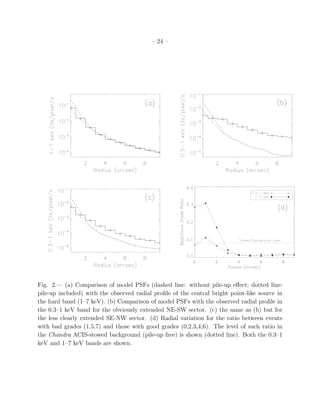
     Figure 2a compares the observed radial profiles of the nuclear region of NGC 4151 in
the 1–7 keV band with the simulated PSF of a point-like nucleus (with and without pile-up).
The count rate in the brightest inner 2 arcsec region is significantly lower than the expected
values without pile-up, and consistent with the PSF including MARX simulated pile-up. The
soft (0.3–1 keV) X-ray emission close to the nucleus is clearly resolved, both along the NE –
SW and the NW – SE direction. In both directions, the soft extended emission dominates
over the nuclear PSF wings at radii > 2′′ from the nucleus (Figure 2b and 2c). Beyond a
radius of ∼3′′ from the nucleus, the piled MARX simulations produced essentially identical
results to the simulations without pile-up, so at these larger radii pile-up is not an issue.
     As pile-up combines events of different energies and causes grade migration, another
way to estimate the importance of pile-up is using the ratio of events with “bad” ASCA
grades (1, 5, 7) to those with “good” ASCA grades (0, 2, 3, 4, 6) where a bad/good grade
ratio of < 0.1 indicates that pile-up is approximately < 10% (Russell et al. 2010). The radial
distribution of the bad/good grade ratio is shown in Figure 2d for both the 0.3–1 keV and
the 1–7 keV bands, which indicates that, beyond r ∼ 2′′ from the nucleus pile-up is no longer
significant in the 0.3–1 keV band (and beyond r ∼ 3′′ for the 1–7 keV band). We conclude
that for our analysis of the extended soft X-ray emission, the effect of pile-up is mild beyond
a radius of 2′′ from the nucleus, and effectively absent at r 3′′ .
     For imaging analysis, the major effect of pile-up on the ACIS on-axis PSF is that, the
core (where most of the photons hit) gets suppressed, because some piled events are rejected
as bad events, creating a circular “caldera” (e.g., Yang et al. 2001). At the pile-up fraction

  7
   High    Resolution   Mirror   Assembly    (van      Speybroeck   et    al.   1997);     see
http://cxc.harvard.edu/cal/Hrma/users_guide/ for details.
  8
      http://cxc.harvard.edu/chart/
  9
      http://space.mit.edu/cxc/marx/
–8–


of ∼35% encountered in this observation, there is ∼40% decrease in brightness in the core of
the PSF, but little distortion of its circular shape (Gaetz et al., private communication; see
the Chandra Proposers’ Observatory Guide [POG]10 Section 6.15.). Thus, although we will
discuss the images of extended features in the central 2′′ region that are affected by pile-up
with caution, deviations from circular shape must be related to real X-ray emission features.


                          3.3.    ACIS Images with Subpixel Binning

     Chandra HRMA’s PSF (half-power diameter HPD=0.6′′ , E ≤ 1.5 keV; see the Chandra
POG) is undersampled by the ACIS CCD pixels (0.492′′ × 0.492′′ ). To take advantage of the
telescope dithering11 to improve the sampling, a fine pixel size (0.0625′′, ∼1/8 of the native
ACIS pixel size) was used when extracting the images. This subpixel binning approach is
frequently adopted in imaging studies of X-ray jets pushing for the highest spatial resolution
(e.g., Harris et al. 2004; Siemiginowska et al. 2007; Perlman et al. 2010). In this section we
will also make use of the 50 ks Chandra observation of NGC 4151 with the High Resolution
Camera (HRC; Murray et al. 1997) presented in Wang et al. (2009).
     Figure 3 compares the 0.3–1 keV subpixel ACIS and HRC (Wang et al. 2009) images both
smoothed with a F W HM = 0.4′′ gaussian kernel. Although the raw soft band ACIS image
(Figure 2a) already shows the presence of extended emission along the NE–SW direction
and hints of split emission in both NE and SW cones, the subpixel processed ACIS image
of Figure 3a reveals more morphological details, especially the presence of several X-ray
blobs (marked as “A”, “B”, “C”, and “D” in Figure 3) and the clear bifurcation of both
the NE and SW cones. The appearance of the NE–SW soft X-ray emission is an elongated
“X”-shape with an acute apex angle, resembling edge-brightened cones (c.f. Figure 1a). We
have measured the P.A. of the brighter bifurcated SW X-ray emission: the edges are located
at 227◦ ± 8◦ and 245◦ ± 5◦ , with a full opening angle of ∼ 20◦ . The HRC image shows
the identical extended morphology for the circum-nuclear region (Figure 3b), validating that
subpixel repositioning does not introduce unwanted artifacts.
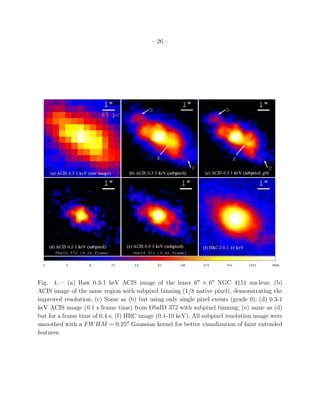
    Figures 4a and b zoom in on the inner ∼ 6′′ × 6′′ (390 pc×390 pc) nuclear region, with
and without subpixel resolution. The X-ray emission on scales of 200 pc (≈ 3′′ ) is clearly
extended along the NE-SW direction. This extent is in good agreement with the overall
morphology of the [OIII] emission (e.g. Kaiser et al. 2000; Wang et al. 2009). The ACIS

 10
      Available at http://cxc.harvard.edu/proposer/POG/
 11
      see POG Version 12 § 5.8.2, page 75 (2009).
–9–


images with subpixel binning (e.g., Figures 3a and 4b) reveal curvy extensions 2′′ away from
the nucleus (labelled as “C” and “D”), which are not discernable in the raw soft ACIS image
(Figure 4a).
     The subpixel ACIS image also shows a linear feature at P.A.=235◦ (labelled as “E” in
Figure 4b) and discrete knots in the inner region (on scales <1′′ from the nucleus). The soft
X-ray morphology is similar to that of the NLR clouds seen in HST optical images of NGC
4151 (e.g., Evans et al. 1993, Winge et al. 1999; see Wang et al. 2009 for a Chandra/HRC
and HST/WFPC2 image comparison). Corresponding outer clouds were previously detected
in deep HST images (Hutchings et al. 1998; Kaiser et al. 2000). Comparison of these features
to the [OIII] emission line clouds and radio outflows (e.g., Pedlar et al. 1992; Mundell et al.
2003), and emission modeling will be presented in Paper II.
     We emphasize that although the inner 2′′ region is affected by pile-up (§ 3.2) in the 0.3–1
keV band, the ACIS features seen in the soft X-ray emission are not observation specific or
pile-up artifacts, for the following reasons:

  1. For the on-axis nucleus, the PSF with pile-up simulated with MARX is circular, thus
     the elongated features (4′′ across) seen in the soft band cannot be due to pile-up related
     PSF distortion;

  2. Using only the single pixel events (grade 0), which give the best spatial resolution and
     are likely to be unaffected by pileup (Ballet 1999; Davis 2001), the extended features
     are clearly present (Figure 4c);

  3. Low pile-up ACIS images from Chandra archival observations of NGC 4151 (ObsID
     372) show structures of similar shape and spatial scale as the features seen in our
     images (Figures 4d and e). Because of the short frame time (0.1 s and 0.4 s) and
     a factor of two lower nuclear flux, the estimated pile-up fraction is 6% and 11% in
     these observations, respectively (Yang et al. 2001; Gonz´lez-Mart´ 2008). We also
                                                             a        ın
     examined the HETG zero-order images of NGC 4151. Although some suffer significant
     pile-up due to longer frame time and a brightened nucleus (ObsID 7830), extended
     emission along NE–SW with similar substructures as we detect is seen in ObsIDs 335
     and 7829;

  4. The PSF-deconvolved HRC image (Figure 2 in Wang et al. 2009), which is not affected
     by pile-up, shows the same extended morphology and small-scale enhancements within
     2′′ from the nucleus that are not seen in ACIS without subpixel binning.

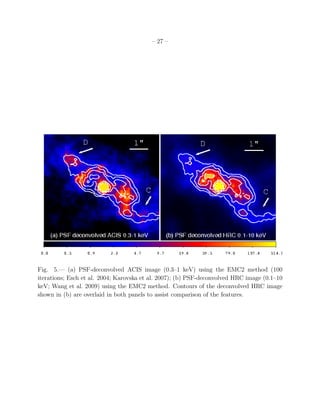
    We applied two image reconstruction techniques to the ACIS data, the Richardson-Lucy
(R-L) algorithm (Richardson 1972; Lucy 1974) and the Expectation through Markov Chain
– 10 –


Monte Carlo (EMC2) method (Esch et al. 2004; Karovska et al. 2007). Both show similar
extended morphology, although the R-L deconvolution produces more grainy restoration of
extended features. Figure 5 compares the EMC2 PSF deconvolved ACIS image with the
similarly deconvolved HRC image from Wang et al. (2009). The resemblance of the NE-SW
elongation and substructures (such as the curvy feature “C” and NE clump “D” marked in
Figure 3a) between the subpixel ACIS images and the deconvolved HRC strengthens our
confidence that the resolved features are real. However, we noticed that the X-ray clump
1′′ NE of the nucleus in the ACIS image is displaced in the HRC image (∼0.3′′ closer to
the nucleus). The morphology of the enhancement located 1′′ SW to the nucleus is also
different in two reconstructed images: it is mostly a linear north-south elongation in the
ACIS image, whereas in the HRC image it shows a tail towards SW). Two factors may cause
these discrepancies: (1) The region within 1′′ radius of the nucleus in the ACIS image is
affected by pile-up, but the accuracy of the piled PSF on this scale has not been calibrated;
yet this inaccuracy may have an impact on the reconstructed image; (2) HRC is sensitive to
photons in the energy range of 0.1–10 keV, therefore may reveal real structures that are not
seen in the 0.3–1 keV ACIS image.


       3.4.   Hardness Ratio Image of the Central 3 kpc-diameter Region

     To find regions of harder spectral index or higher X-ray obscuration, we extracted
Chandra images in the 0.3–1.0 keV and 1.0–2.0 keV bands and derived the counts ratio
C1−2keV over C0.3−1keV . These bands are sensitive to hydrogen column densities of the order
of 1022 cm−2 , and the relative changes in the ratio map have been demonstrated to reflect
variations in the X-ray absorption (Bianchi et al. 2007). The resulting hardness ratio map
of the central 50′′ (3.2 kpc) diameter region is shown in Figure 6a, with Hα (Knapen et al.
2004) and CO (Dumas et al. 2010) contours outlining the ionized gas and the cold molecular
gas lanes, respectively. Figure 6b shows the hardness ratio map of the inner 6′′ (400 pc)
diameter region.
     One obvious feature in Figure 6a is the harder (white) region extended in the NW–SE
direction (P.A. ∼150◦ ). This is approximately the P.A. of the minor axis of the galaxy and
the weak bar (Mundell & Shone 1999), and perhaps also the direction of a putative nuclear
torus, mapped in H2 emission by Storchi-Bergmann et al. (2009) (contours in Figure 6b; see
also Fernandez et al. 1999). Thus higher obscuration is plausible in this region. Coincident
with the higher hardness ratio region across the nucleus (Figure 6b) is a dark dust patch
in the V − I image (Asif et al. 1998; Ohtani et al. 2001), noted by Terlevich et al. (1991) in
their V − R image as “the red bar” (P.A.=150◦ ; 1′′ in length).
– 11 –


     To examine the extinction of the nuclear region of NGC 4151, we created the V −H color
map using HST images (§ 2.2), covering the central 10′′ × 10′′ of NGC 4151 (Figure 7). Dark
spiral features of higher extinction are clearly revealed towards the nucleus perpendicular to
the bicone direction, thanks to the high spatial resolution afforded by HST. Adopting the
extinction curve in Cardelli et al. (1989), the observed E(V − H) suggests a range between
0.5 and 1 for E(B − V ), which is equivalent to 1.5 AV         3 (mag).
     Another notable feature in Figure 6a is that the edges of the ENLR show harder emis-
sion than the inner region. To obtain quantitative constraints on the hardness ratios, we
calculated the uncertainties using the Bayesian estimation of Hardness Ratios (BEHR; Park
et al. 2006) tool provided by the California-Harvard Astro-Statistics Collaboration12 , where
the hardness ratio, HR, is defined in BEHR as (C1−2keV − C0.3−1keV )/(C1−2keV + C0.3−1keV ).
For the inner part of the cone (named R1) HR = −0.63+0.01 , for the edges of the optical
                                                           −0.02
outflow (R2) HR = −0.27 ± 0.03, and for the highest hardness ratio region perpendicular
to the cone-axis (R3) HR = −0.04 ± 0.02. Thus the hardness ratios differ significantly for
each of these regions. This is consistent with the hollow bi-cone geometry proposed in Das
et al. (2005) (see also Evans et al. 1993; Robinson et al. 1994; Hutchings et al. 1998;
Storchi-Bergmann et al. 2010), where clumpy outflowing material is mostly located along
the boundaries of the bi-cone. One side of the cone is expected to intersect an area of the
host galactic disk, and the projected appearance will be an illuminated narrow sector (e.g.,
region R1) with higher absorption along the edges, which is indeed observed here (region
R2).
     To further investigate these absorption column density variations, spectra from the three
regions above were extracted using the hardness ratio map, as outlined in Figure 8. Because
the PSF scattered emission is not negligible for the bright nucleus, we fit the spectra with
a simple model consisting of an absorbed soft thermal component and a nuclear component
(Wang et al. 2010b), allowing the normalization of the nuclear component to vary to account
for contribution from the PSF wings. Figure 9a-c show the spectra and the fits; the fitting
results are summarized in Table 2. These spectra confirm the wide range of X-ray absorption
suggested by the hardness ratio map. The edges of the cone (R2) indeed show a higher
absorbing column (NH = 7 ± 5 × 1021 cm−2 ) than the inner cone region (R1), for which only
a Galactic column (NH = 2×1020 cm−2 ; Murphy et al. 1996) is required. The highest column
density, NH = 6.5 ± 1.5 × 1022 cm−2 , is found across the nucleus (R3) and is approximately
equivalent to E(B − V ) = 10 adopting N(HI + H2 )/E(B − V ) = 5.8 × 1021 cm−2 mag−1
(Bohlin et al. 1978). This value is significantly higher than the average E(B − V ) ≈ 0.5

 12
      http://hea-www.harvard.edu/AstroStat/
– 12 –


found in the NLR (Storchi-Bergmann et al. 2009) and the E(B − V ) = 0.5 − 1.0 found in
the V − H map. Mundell et al. (1995) find an HI absorption column density of 3.9 × 10²¹
cm−2 towards the radio nucleus; the factor ∼15 higher X-ray NH suggests that most of the
intervening hydrogen is in the form of H2 or high abundances ∼ 15Z/Z⊙.


                                       4.   Discussion

                           4.1.   Extended X-ray Morphology

     This is the first time such a high sensitivity high resolution X-ray spectral imaging
of the NGC 4151 nuclear region has been obtained. The HRC image provides no spectral
information, and previous ACIS images (Ogle et al. 2000; Yang et al. 2001) either lack
sensitivity to convincingly identify the X-ray features seen in subpixel resolution, or suffer
from heavy pile-up in the inner 3′′ .
     The morphological features of the X-ray emission of NGC 4151 are summarized as
follows: (1) By pushing the spatial resolution of the ACIS image with subpixel resolution
techniques, X-ray enhancements in the innermost nuclear region (r 1′′ ) seen in the PSF-
deconvolved HRC image are recovered; (2) The extended soft X-ray emission shows the same
biconical morphology as the optical ENLR out to a radius (20′′ ; ∼1.3 kpc) larger than seen
in earlier X-ray studies (c.f. 14′′ ; ∼900 pc, Yang et al. 2001); (3) There is also firm detection
of extended X-ray emission at angles beyond the boundaries of the optical ENLR ionization
cone; (4) The observed X-ray emission is more absorbed towards the edge of the cone and
perpendicular to the cone axis at the apex of the cone.
     The two-sided, bifurcated X-ray emission morphology is consistent with the model de-
scribed in Das et al. (2005) and Storchi-Bergmann et al. (2010), in which clouds are outflow-
ing along the walls of a hollow bicone inclined 45◦ to the line of sight. One side of the cone
is expected to exit the plane at 21◦ , intersecting an elongated area of the host galactic disk.
The projected appearance (c.f. Figure 9 in Storchi-Bergmann et al. 2010) closely resembles
the observed morphology here.
     The extended X-ray emission seen perpendicular to the ENLR, along the NW-SE direc-
tion, was first suggested to be “unresolved or marginally resolved” in Yang et al. (2001). The
definitive resolved emission at angles beyond the edges of the bicone (Figure 2c) indicates
that the gas there is not completely shielded from the continuum, as would be the case for
a molecular torus collimating the bicone. This agrees well with the detection of significant
optical emission outside the emission-line bicone in the HST [OIII] and [OII] images, where
Kraemer et al. (2008) were able to model the emission lines with a weaker ionizing con-
– 13 –


tinuum, filtered by an ionized absorber partially covering the nuclear continuum, i.e. the
accretion disk wind (e.g., Elvis 2000).
     The NE soft X-ray emission reaches as far as 11′′ (700 pc) from the nucleus, then the
surface brightness decreases rapidly and significantly, by a factor of 5. This location lies
near to both the northern CO gas lane and one of the dust arcs identified in the optical
V − I color map (Asif et al. 1998, a region not covered by our V − H map). These features
are gaseous compressions in circumnuclear gas spiral arms due to the gravitational influence
of the large-scale stellar bar (Mundell et al. 1999; Dumas et al. 2010). Since the biconical
geometry (Das et al. 2005) implies that both cones are intersecting the host galactic disk,
the terminus of the NE X-ray emission is likely to occur where the NE outflow encounters
dense ISM in the galactic disk. We will discuss this boundary further in Paper II.


     4.2.   X-ray Absorption Features and Cold Material for AGN Feeding

     The features seen in the hardness ratio map (Figure 6a) also agree well with the bi-
cone models (Das et al. 2005; Storchi-Bergmann et al. 2010). In the geometry illustrated by
Das et al. (2005), the more absorbed X-ray emission seen along the bi-cone edges (R2 in
Figure 8) can be explained by higher absorption from the clumpy medium outflowing along
the wall of the SW cone, as it emerges from the galactic disk. Adopting the conical geometry
in Das et al. (2005) with an inner full opening angle of 30◦ and outer full opening angle
of 66◦ , and assuming that the NH is due to the extra optical path along the cone wall, we
estimate an average nH ∼ 10 cm−3 in the cone wall (c.f. nH = 220 cm−3 for optical clouds;
Penston et al. 1990). The region perpendicular to the bi-cone axis (R3 in Figure 8) may
represent the inward extension of the CO gas lanes.
     The innermost r ≤ 1.5′′ region (P.A.∼150◦ ) of high X-ray hardness ratio (Figure 6b) is
spatially coincident with the H2 λ2.1218 µm emission (grey contours; Storchi-Bergmann et al.
2009; Fernandez et al. 1999) and the dusty spirals in the V − H color map (Figure 7), which
may trace inflowing material feeding the AGN. Next we discuss three mechanisms that were
considered by Storchi-Bergmann et al. (2009) for the origin of H2 line emission: (1) fluores-
cence by FUV photons; (2) thermal excitation by shocks in the accretion flow towards the
nucleus, or (3) photo-excitation by X-rays from the AGN.
    (1) Fluorescence by FUV photons is ruled out by Storchi-Bergmann et al. (2009) based
on the H2 2-1 S(1)/1-0 S(1) line ratio and strong evidence for thermal equilibrium (Texc =
2155 K; Storchi-Bergmann et al. 2009) in the H2 lines. However, it is worth noting that
the peak density of 104 –105 cm− 3 in the H2 emitting region, taken at the measured value
– 14 –


within the inner 0.5 arcsec in Storchi-Bergmann et al. (2009), is above the critical density
of the rotational-vibrational transitions of H2 (∼ 104 cm−3 ; Tielens 2005). It implies that
thermalization by collisions effectively erases the signature of fluorescent excitation (Black
& van Dishoeck 1987; Draine & Bertoldi 1996; Hollenbach & Tielens 1999), therefore the
line ratio diagnostics used at lower densities may become uncertain to distinguish whether
UV fluorescence or collisional excitation is dominating the H2 emission.
     (2) H2 excitation by shocks in the accretion flow is not favored by current data. Mundell
& Shone (1999) interpreted the H2 emission as being associated with the molecular torus
obscuring the AGN which would explain its orientation perpendicular to the radio jet. The
inflows observed in HI observations (Mundell & Shone 1999) are only traced to the inner part
of the oval bar (r ≈ 20′′ ; Asif et al. 1998). On the 1 kpc scale, most of the cold molecular gas
is distributed along the curved CO lanes ∼15′′ away from the nucleus (Dumas et al. 2010)
with kinematics consistent with the disk and the bar (e.g., Mundell et al. 1999). No strong
kinematic shocks are expected, which is also consistent with the gravitational potential that
shows no important non-axisymmetric component on the relevant scales. Moreover, the
detection of H2 in this relatively high density region (nH ∼ 105 cm−3 ) is evidence against the
presence of relatively strong shocks (vs 25 km s−1 ) in this region, which would dissociate
the molecular hydrogen collisionally. However, it remains possible that weaker shock flows
exist and contribute to the H2 excitation.
      (3) Photo-excitation of H2 by the AGN can be evaluated more quantitatively following
Riffel et al. (2008) and Storchi-Bergmann et al. (2009), using the line intensities calculated
for X-ray-irradiated molecular gas by Maloney et al. (1996) and our measured parameters. A
                                                                                 0.9
key parameter is the effective ionization parameter, ξeff = 1.26 × 10⁻⁴Fx /(n5 N22 ) (Equation
12 in Maloney et al. 1996), where Fx is the incident X-ray flux, n5 is the cloud density in
units of 105 cm−3 and N22 is the absorption column in units of 1022 cm−2 . For Fx = 7.6
erg cm−2 s−1 (L2−10keV = 1 × 1042 erg s−1 ; Wang et al. 2010b) at the H2 emission peak
(∼30 pc from the nucleus; Storchi-Bergmann et al. 2009), n5 = 1, and N22 = 6.5 (Table 2),
we obtain ξeff ∼ 2 × 10⁻⁴ and an emerging H2 1-0 S(1) intensity of ∼ 8 × 10⁻⁵ erg cm−2 s−1
sr−1 . For the aperture (0.3 × 0.3 arcsec2 or 2.16 × 10⁻¹² sr) used by Storchi-Bergmann et al.
(2009), the expected value is 2 × 10⁻¹⁶ erg cm−2 s−1 . This is a factor of two higher, but
likely consistent with, the observed line flux for the same transition (1 × 10⁻¹⁶ erg cm−2 s−1 ;
Storchi-Bergmann et al. 2009), given the uncertainties in our assumptions and the models.
Thus, excitation by the X-rays from AGN can reasonably explain the observed H2 line
emission, in agreement with the conclusion drawn in Storchi-Bergmann et al. (2009). This
also indicates the X-ray radiation received by the H2 gas is comparable to that observed
along our line-of-sight, which is not blocked by a molecular torus in this direction.
– 15 –


     The X-rays from the AGN may also explain the non-detection of CO gas in contrast to
the 107 − 109 M⊙ molecular gas estimated by Storchi-Bergmann et al. (2010). Dumas et al.
(2010) showed that no CO gas was detected within the inner 300 pc of the active nucleus,
where strong H2 line emission arises. Using a standard Galactic CO-to-H2 conversion factor
of XCO = 2 × 1020 cm−2 (K km s−1 )−1 (Solomon & Barrett 1991), Dumas et al. (2010)
derived a 1-σ upper limit of 105 M⊙ for the cold molecular gas mass. They suggested that
CO itself may not be a good tracer of molecular gas in X-ray dominated regions (XDR)
close to an active nucleus, where equilibrium molecular abundances are affected (Meijerink
& Spaans 2005, 2007).
     Model 3 in Meijerink & Spaans (2005) calculated the CO/H2 abundance ratio for Fx =
1.6 erg cm−2 s−1 and n = 105.5 cm−3 (the model parameters most close to the flux and
density seen here), which is ≪ 10−4 at column densities below NH = 1023 cm−2 . For clouds
closer to the nucleus or immersed in diffuse X-ray emission, Fx can be higher, and a CO/H2
ratio of > 10−4 can only be found at column densities NH 1024 cm−2 (model 4 in Meijerink
& Spaans 2005). Given that the absorption column from the spectral fit is NH ∼ 6.5 × 10²²
cm−2 , the lack of CO perhaps can be explained by a low CO abundance relative to H2 in
the XDR.
     Assuming that most intervening material is in the form of H2 , the X-ray derived NH =
6.5 ± 1.5 × 10²² indicates a total H2 mass of 2 × 10⁷ M⊙ in the 3′′ × 3′′ (200 pc diameter)
nuclear region imaged by Storchi-Bergmann et al. (2009). This value agrees well with the
lower end of total H2 mass (107 − 109 M⊙ ) in Storchi-Bergmann et al. (2009), which was
derived using the mass of “hot” H2 (240 M⊙ ) detected in the near-IR.
     One clear prediction of the XDR scenario is that, like in shocks, the [OI] 63µm/[CII]
158µm ratio is higher ( 10) than generally found in PDRs (Maloney et al. 1996). This can
be tested with new observations using far-infrared (FIR) facilities such as PACS spectrometer
(Poglitsch et al. 2010) on board the Herschel Space Observatory (Pilbratt et al. 2010). NGC
4151 was observed as part of Herschel Key Program SHINING (PI: Sturm). They find that
the [O I] 63µm emission is highly concentrated on the central spaxel, while the [C II] 158µm
emission is more extended. The ratio of [O I] 63µm / [C II] 158µm in the central spaxel is
high, ∼11 (E. Sturm, private communication), consistent with XDR or shock models with
an effective ionization parameter of log ξeff ∼ −3 (Figure 12 in Maloney et al. 1996). We
note that this value is higher than log ξeff = −3.7 in the XDR model analysis above using
the observed X-ray flux and column density. This discrepancy might be attributed to more
than one mechanism at work exciting the H2 emission. Similar [OI]/[CII] ratios of ∼10 have
been reported in dense PDRs with no significant X-ray excitation, for example in regions
near the ionizing stars of the Orion Nebula (Boreiko & Betz 1996).
– 16 –


     In short, more investigations on the importance of UV fluorescence, shock excitation,
and X-ray excitation of H2 emission in NGC 4151 are needed to further examine the caveats
discussed above. In particular, theoretical effort on models that focus on the astrophysical
environment around AGN will be valuable to clarify the ambiguity of the H2 excitation
mechanism in NGC 4151 and in other systems in general.


                                    5.   Conclusions

     We have obtained and analyzed deep Chandra observation of NGC 4151, which demon-
strated the imaging power of ACIS with subpixel resolution to resolve the circumnuclear
X-ray emission of a nearby Seyfert galaxy.
    The X-ray structures in the nuclear region (inner 300 pc) seen in our HRC study of
NGC 4151 (Wang et al. 2009) are recovered in the deep ACIS image with subpixel resolution
techniques. Moreover, the extended soft X-ray emission of NGC 4151 reaches to a distance
of ∼1.3 kpc to the SW of the nucleus, much farther than seen in earlier X-ray studies. We
suggest that the terminus of the NE X-ray emission is likely where the NE outflow encounters
dense ISM in the galactic disk. Extended X-ray emission is firmly detected outside the
boundaries of the ionization cone, which indicates that the continuum is not completely
blocked by a molecular torus. This is consistent with the findings of optical studies where
nuclear ionizing photons were filtered by the bi-cone wind.
     The hardness ratio image and spectral fits show that the X-ray emission is more absorbed
towards the edges of the cone, as well as perpendicular to the cone axis along the P.A. of
the putative nuclear torus. These regions of different spectral hardness are consistent with
the expected features in the biconical outflow models.
     X-ray emission shows the highest hardness ratio in the innermost region, spatially co-
incident with the near-infrared resolved H2 emission and the dusty spirals revealed in the
HST (V − H) color map. All three features possibly trace the cold material feeding the
central SMBH. The agreement between the observed H2 line flux and the predicted value
from X-ray-irradiated molecular cloud models supports photo-excitation by the X-ray radi-
ation from the active nucleus, which is not blocked by a molecular torus in this direction.
However, with current data, the contribution from UV fluorescence or collisional excitation
cannot be ruled out.
    The X-rays from the AGN also explain the recent non-detection of CO gas (Dumas et al.
2010) in contrast to the presence of 107 −109 M⊙ molecular hydrogen gas (Storchi-Bergmann et al.
2009). The total H2 mass derived from the X-ray observation agrees with that expected from
– 17 –


the mass of “hot” H2 . The absorption column derived from the X-ray spectral fit, when com-
pared to the XDR models, implies that the lack of CO close to the nucleus may be explained
by its low abundance relative to H2 in the XDR.


     We thank the anonymous referee for helpful comments on the H2 excitation mechanisms.
This work is supported by NASA grant GO8-9101X. We acknowledge support from the CXC,
which is operated by the Smithsonian Astrophysical Observatory (SAO) for and on behalf of
NASA under Contract NAS8-03060. CGM acknowledges financial support from the Royal
Society and Research Councils U.K. GD was supported by DFG grants SCH 536/4-1 and
SCH 536/4-2 as part of SPP 1177. We thank Eckhard Sturm for providing the FIR line
ratios prior to publication of their work, Dan Harris and Dan Schwartz for advice on subpixel
binning. J. W. thanks T. Storchi-Bergmann and R. Riffel for providing the Gemini NIFS
maps, M. McCollough, E. Galle, M. Juda and T. Gaetz (CXC) for technical discussion on
Chandra PSF, ACIS readout streaks and HRC data reduction. This research has made use
of data obtained from the Chandra Data Archive, and software provided by the CXC in
the application packages CIAO and Sherpa. This research used observations made with the
NASA/ESA Hubble Space Telescope, and obtained from the Hubble Legacy Archive, which
is a collaboration between the Space Telescope Science Institute (STScI/NASA), the Space
Telescope European Coordinating Facility (ST-ECF/ESA) and the Canadian Astronomy
Data Centre (CADC/NRC/CSA).
    Facilities: CXO (HRC, ACIS)


                                     REFERENCES

Arnaud, K. A. 1996, Astronomical Data Analysis Software and Systems V, 101, 17

Asif, M. W., Mundell, C. G., Pedlar, A., Unger, S. W., Robinson, A., Vila-Vilaro, B., &
       Lewis, J. R. 1998, A&A, 333, 466

Ballet, J. 1999, A&AS, 135, 371

Bianchi, S., Chiaberge, M., Piconcelli, E., & Guainazzi, M. 2007, MNRAS, 374, 697

Black, J. H., & van Dishoeck, E. F. 1987, ApJ, 322, 412

Bohlin, R. C., Savage, B. D., & Drake, J. F. 1978, ApJ, 224, 132

Boksenberg, A., et al. 1995, ApJ, 440, 151
– 18 –


Boreiko, R. T., & Betz, A. L. 1996, ApJ, 464, L83

Cardelli, J. A., Clayton, G. C., & Mathis, J. S. 1989, ApJ, 345, 245

Carter, C., Karovska, M., Jerius, D., Glotfelty, K., & Beikman, S. 2003, Astronomical Data
       Analysis Software and Systems XII, 295, 477

Clements, E. D. 1981, MNRAS, 197, 829

Crenshaw, D. M., et al. 2000, AJ, 120, 1731

Das, V., et al. 2005, AJ, 130, 945

Davis, J. E. 2001, ApJ, 562, 575

Draine, B. T., & Bertoldi, F. 1996, ApJ, 468, 269

de Vaucouleurs, G., de Vaucouleurs, A., Corwin, H. G., Jr., Buta, R. J., Paturel, G., &
      Fouque, P. 1991, Volume 1-3, XII, Springer-Verlag Berlin Heidelberg New York

van Dokkum, P. G. 2001, PASP, 113, 1420

Dumas, G., Schinnerer, E., & Mundell, C. G. 2010, ApJ, 721, 911

Elvis, M., Briel, U. G., & Henry, J. P. 1983, ApJ, 268, 105

Elvis, M. 2000, ApJ, 545, 63

Evans, I. N., Tsvetanov, Z., Kriss, G. A., Ford, H. C., Caganoff, S., & Koratkar, A. P. 1993,
      ApJ, 417, 82

Esch, D. N., Connors, A., Karovska, M., & van Dyk, D. A. 2004, ApJ, 610, 1213

Fernandez, B. R., Holloway, A. J., Meaburn, J., Pedlar, A., & Mundell, C. G. 1999, MNRAS,
      305, 319

Freeman, P. E., Kashyap, V., Rosner, R., & Lamb, D. Q. 2002, ApJS, 138, 185

Garmire, G. P., Bautz, M. W., Ford, P. G., Nousek, J. A., & Ricker, G. R., Jr. 2003,
      Proc. SPIE, 4851, 28

Gonz´lez-Mart´ O., 2008, PhD Thesis, Instituto de Astrof´
    a        ın,                                        ısica de Andaluc´ Granada,
                                                                        ıa,
      Spain

Harris, D. E., Mossman, A. E., & Walker, R. C. 2004, ApJ, 615, 161
– 19 –


Hollenbach, D. J., & Tielens, A. G. G. M. 1999, Reviews of Modern Physics, 71, 173

Hutchings, J. B., et al. 1998, ApJ, 492, L115

Kaiser, M. E., et al. 2000, ApJ, 528, 260

Karovska, M., Carilli, C. L., Raymond, J. C., & Mattei, J. A. 2007, ApJ, 661, 1048

Kaspi, S., Maoz, D., Netzer, H., Peterson, B. M., Vestergaard, M., & Jannuzi, B. T. 2005,
       ApJ, 629, 61

Kastner, J. H., Li, J., Vrtilek, S. D., Gatley, I., Merrill, K. M., & Soker, N. 2002, ApJ, 581,
      1225

Knapen, J. H., Stedman, S., Bramich, D. M., Folkes, S. L., & Bradley, T. R. 2004, A&A,
     426, 1135

Komossa, S. 2001, A&A, 371, 507

Kraemer, S. B., Schmitt, H. R., & Crenshaw, D. M. 2008, ApJ, 679, 1128

Krist, J. 1995, Astronomical Data Analysis Software and Systems IV, 77, 349

Li, J., Kastner, J. H., Prigozhin, G. Y., & Schulz, N. S. 2003, ApJ, 590, 586

Li, J., Kastner, J. H., Prigozhin, G. Y., Schulz, N. S., Feigelson, E. D., & Getman, K. V.
        2004, ApJ, 610, 1204

Lucy, L. B. 1974, AJ, 79, 745

Maloney, P. R., Hollenbach, D. J., & Tielens, A. G. G. M. 1996, ApJ, 466, 561

Meijerink, R., & Spaans, M. 2005, A&A, 436, 397

Meijerink, R., Spaans, M., & Israel, F. P. 2007, A&A, 461, 793

Mori, K., Tsunemi, H., Miyata, E., Baluta, C. J., Burrows, D. N., Garmire, G. P., & Chartas,
      G. 2001, New Century of X-ray Astronomy, 251, 576

Morse, J. A., Wilson, A. S., Elvis, M., & Weaver, K. A. 1995, ApJ, 439, 121

Mundell, C. G., Pedlar, A., Baum, S. A., O’Dea, C. P., Gallimore, J. F., & Brinks, E. 1995,
     MNRAS, 272, 355

Mundell, C. G., & Shone, D. L. 1999, MNRAS, 304, 475
– 20 –


Mundell, C. G., Pedlar, A., Shone, D. L., & Robinson, A. 1999, MNRAS, 304, 481

Mundell, C. G., Wrobel, J. M., Pedlar, A., & Gallimore, J. F. 2003, ApJ, 583, 192

Murphy, E. M., Lockman, F. J., Laor, A., & Elvis, M. 1996, ApJS, 105, 369

Murray, S. S., et al. 1997, Proc. SPIE, 3114, 11

Ogle, P. M., Marshall, H. L., Lee, J. C., & Canizares, C. R. 2000, ApJ, 545, L81

Ohtani, H., Hattori, T., Miyazaki, S., Iye, M., Komiyama, Y., Sasaki, T., & Kosugi, G. 2001,
      Galaxies and their Constituents at the Highest Angular Resolutions, 205, 168

Onken, C. A., et al. 2007, ApJ, 670, 105

Osterbrock, D. E., & Koski, A. T. 1976, MNRAS, 176, 61P

Osterbrock, D. E. 1989, Astrophysics of gaseous nebulae and active galactic nuclei, Mill
      Valley, University Science Books

Park, T., Kashyap, V. L., Siemiginowska, A., van Dyk, D. A., Zezas, A., Heinke, C., &
      Wargelin, B. J. 2006, ApJ, 652, 610

Pedlar, A., Howley, P., Axon, D. J., & Unger, S. W. 1992, MNRAS, 259, 369

Perlman, E. S., et al. 2010, ApJ, 708, 171

Perez, E., Gonzalez-Delgado, R., Tadhunter, C., & Tsvetanov, Z. 1989, MNRAS, 241, 31P

P´rez-Fournon, I., & Wilson, A. S. 1990, ApJ, 356, 456
 e

Penston, M. V., et al. 1990, A&A, 236, 53

Pilbratt, G. L., et al. 2010, A&A, 518, L1

Poglitsch, A., et al. 2010, A&A, 518, L2

Richardson, W. H. 1972, Journal of the Optical Society of America (1917-1983), 62, 55

Riffel, R. A., Storchi-Bergmann, T., Winge, C., McGregor, P. J., Beck, T., & Schmitt, H.
       2008, MNRAS, 385, 1129

Robinson, A., et al. 1994, A&A, 291, 351

Russell, H. R., Fabian, A. C., Sanders, J. S., Johnstone, R. M., Blundell, K. M., Brandt,
       W. N., & Crawford, C. S. 2010, MNRAS, 402, 1561
– 21 –


Schulz, H. 1990, AJ, 99, 1442

Siemiginowska, A., Stawarz, L., Cheung, C. C., Harris, D. E., Sikora, M., Aldcroft, T. L., &
      Bechtold, J. 2007, ApJ, 657, 145

Solomon, P. M., & Barrett, J. W. 1991, Dynamics of Galaxies and Their Molecular Cloud
      Distributions, 146, 235

Storchi-Bergmann, T., McGregor, P. J., Riffel, R. A., Sim˜es Lopes, R., Beck, T., & Dopita,
                                                        o
       M. 2009, MNRAS, 394, 1148

Storchi-Bergmann, T., Lopes, R. D. S., McGregor, P. J., Riffel, R. A., Beck, T., & Martini,
       P. 2010, MNRAS, 402, 819

Tielens, A. G. G. M. 2005, The Physics and Chemistry of the Interstellar Medium, Cambridge
       University Press

Terlevich, R., Terlevich, E., Sanchez Portal, M., & Diaz, A. I. 1991, MNRAS, 249, 36

Thompson, R. I., & Corbin, M. 1999, Ap&SS, 266, 79

Tsunemi, H., Mori, K., Miyata, E., Baluta, C., Burrows, D. N., Garmire, G. P., & Chartas,
     G. 2001, ApJ, 554, 496

Ulrich, M.-H. 2000, A&A Rev., 10, 135

Ulvestad, J. S., Wong, D. S., Taylor, G. B., Gallimore, J. F., & Mundell, C. G. 2005, AJ,
       130, 936

van Speybroeck, L. P., Jerius, D., Edgar, R. J., Gaetz, T. J., Zhao, P., & Reid, P. B. 1997,
      Proc. SPIE, 3113, 89

Wang, J., Fabbiano, G., Karovska, M., Elvis, M., Risaliti, G., Zezas, A., & Mundell, C. G.
      2009, ApJ, 704, 1195

Wang, J., Fabbiano, G., Risaliti, G., Elvis, M., Mundell, C. G., Dumas, G., Schinnerer, E.,
      & Zezas, A. 2010a, ApJ, 719, L208

Wang, J., Risaliti, G., Fabbiano, G., Elvis, M., Zezas, A., & Karovska, M. 2010b, ApJ, 714,
      1497

Winge, C., Axon, D. J., Macchetto, F. D., Capetti, A., & Marconi, A. 1999, ApJ, 519, 134

Yang, Y., Wilson, A. S., & Ferruit, P. 2001, ApJ, 563, 124
– 22 –


This preprint was prepared with the AAS L TEX macros v5.2.
                                         A
– 23 –


Fig. 1.— ACIS raw image of the NGC 4151 nuclear region (a) in the soft band (0.3–1 keV).
(b) the hard band (1–7 keV). X-ray enhancements “A” and “B” are indicated with arrows.
Solid lines mark the directions of the kinematic major axis of the host galaxy (P.A.∼22◦ ,
Pedlar et al. 1992; Mundell et al. 1999), the large scale “weak fat bar” (P.A.∼130◦ ; Mundell
& Shone 1999), and the ENLR bicone (P.A.∼65◦ , Evans et al. 1993). The narrow streak
running north-south across the nucleus (present in both panels) is an artifact of the CCD
readout of the bright nucleus.
– 24 –


Fig. 2.— (a) Comparison of model PSFs (dashed line: without pile-up effect; dotted line:
pile-up included) with the observed radial profile of the central bright point-like source in
the hard band (1–7 keV). (b) Comparison of model PSFs with the observed radial profile in
the 0.3–1 keV band for the obviously extended NE-SW sector. (c) the same as (b) but for
the less clearly extended SE-NW sector. (d) Radial variation for the ratio between events
with bad grades (1,5,7) and those with good grades (0,2,3,4,6). The level of such ratio in
the Chandra ACIS-stowed background (pile-up free) is shown (dotted line). Both the 0.3–1
keV and 1–7 keV bands are shown.
– 25 –


Fig. 3.— (a) 0.3–1 keV ACIS subpixel image of NGC 4151 (1/8 native pixel); (b) 0.1–
10 keV HRC image. Both are smoothed by a F W HM = 0.4′′ Gaussian kernel for better
visualization of faint extended features.
– 26 –


Fig. 4.— (a) Raw 0.3-1 keV ACIS image of the inner 6′′ × 6′′ NGC 4151 nucleus; (b)
ACIS image of the same region with subpixel binning (1/8 native pixel), demonstrating the
improved resolution; (c) Same as (b) but using only single pixel events (grade 0); (d) 0.3-1
keV ACIS image (0.1 s frame time) from ObsID 372 with subpixel binning; (e) same as (d)
but for a frame time of 0.4 s; (f) HRC image (0.1-10 keV). All subpixel resolution image were
smoothed with a F W HM = 0.25′′ Gaussian kernel for better visualization of faint extended
features.
– 27 –


Fig. 5.— (a) PSF-deconvolved ACIS image (0.3–1 keV) using the EMC2 method (100
iterations; Esch et al. 2004; Karovska et al. 2007); (b) PSF-deconvolved HRC image (0.1–10
keV; Wang et al. 2009) using the EMC2 method. Contours of the deconvolved HRC image
shown in (b) are overlaid in both panels to assist comparison of the features.
– 28 –


                                                                                          (a)


                                10"

                        0   0.002   0.0059   0.014   0.03     0.061   0.12   0.25   0.5         1   2


                                                                                           (b)


                               1"

                        0   0.002   0.0059 0.014     0.03    0.061    0.12   0.25   0.5         1   2


Fig. 6.— (a) Hardness ratio map of the central 1′ × 1′ (3.9 kpc-across) region, defined as the
ratio of the counts in the 1–2 keV to the 0.3–1.0 keV band. Contours in white (solid) and
red (dashed) show the continuum-subtracted Hα (Knapen et al. 2004) and 12 CO emission
(Dumas et al. 2010), respectively. (b) Same as (a) but zoomed-in to the inner 6′′ region
outlined by a box in (a). The cross marks the location of the nucleus. Grey contours show
the H2 λ2.1218 µm emission (Storchi-Bergmann et al. 2009).
– 29 –


                                                               V-H
                                                       2"      3.7 (mag)


                                                               3.1


                                                               2.3


                                                               1.5


                                                               0.7
                        N

                   E
                                                               0.03


Fig. 7.— V − H color map of the NGC 4151 nuclear region from HST F550M and F160W
band images. Point source has been removed using the simulated PSF and the resolution of
F550M image was degraded to match that of the F160W image. Contours (red) are from the
X-ray hardness ratio map shown in Figure 6b. Note that residuals from diffraction spikes
can still be seen at P.A.≈40◦ /220◦ .
– 30 –


                                                             R3


                                                                                  R2

                                                                           R1


                             10"


                  0   0.14     0.28   0.42   0.56     0.7    0.84   0.98    1.1        1.3   1.4


Fig. 8.— The spectral extraction regions overlaid on the hardness ratio image. The poly-
gons outline the regions R1 (inner cone region), R2 (edges of the cone), and R3 (region
perpendicular to the bicone-axis).
– 31 –


                                                                                                       5×10⁻³
                       0.01
Counts sec−1 keV−1


                                                                                  Counts sec−1 keV−1
                                                                                                       2×10⁻³

                       10−3                                                                              10−3


                                (a) R1 (Cone Center)                                                   5×10⁻⁴   (b) R2 (Cone Edge)
                       10 −4
                            2                                                                               2

                            0                                                                               1
                                                                                                            0
χ


                                                                              χ


                         −2
                                                                                                           −1
                         −4
                                                                                                           −2
                                    0.5           1             2    5                                              0.5         1             2   5
                                                   Energy [keV]                                                                  Energy [keV]


                       0.01
Counts sec−1 keV−1


                     5×10⁻³


                     2×10⁻³
                                (c) R3 (Perpendicular to the cone)
                       10−3
                          2

                            0
χ


                         −2


                                    0.5           1             2    5
                                                   Energy [keV]


Fig. 9.— The X-ray spectra and fits obtained for three regions defined in Figure 9 that are
morphologically distinct (see text and Table 2).
– 32 –


Table 1. Log of Chandra ACIS-S Observations of NGC 4151

   Obs ID     Date             Instrument   Frame Time (s)   Exposure (ks)

   372      Mar   06,   2000    ACIS-S            0.1            0.8
   372      Mar   06,   2000    ACIS-S            0.4            6.2
   9217     Mar   29,   2008    ACIS-S            0.6            116
   9218     Mar   27,   2008    ACIS-S            0.6            63
   9219     Mar   02,   2008    HRC-I         1.6 × 10⁻⁵         49
Table 2. Spectral Fits to Extended X-ray Emission Features

 Regiona          HRb             NH          Temperature     PSF fractionc    χ2 / d.o.f.
                             [×1022cm−2 ]        [keV]            [%]

   R1        −0.63+0.01
                   −0.02          0.02d         0.28+0.02
                                                    −0.01          0.5           135/94
   R2        −0.27 ± 0.03      0.70+0.45
                                   −0.54        0.08+0.09
                                                    −0.05          0.7           66/75
   R3        −0.04 ± 0.02       6.5±1.5         1.94+0.48
                                                    −0.51          2.2          261/231

  a The regions and spectra are presented in Figure 9. R1–the central inner part of the
cone; R2–the edges of the cone; and R3–the high hardness ratio region perpendicular to
the bicone-axis.
  b Hardness   ratio is defined as (C1−2keV − C0.3−1keV )/(C1−2keV + C0.3−1keV ).
  c The   fraction of nuclear emission contributed to the extended emission.
  d Absorption   fixed at Galactic column as required by the fit.

Ngc4151 01

  • 1.
    Accepted for Publicationin ApJ A Deep Chandra ACIS Study of NGC 4151. I. the X-ray Morphology of the 3 kpc-diameter Circum-nuclear Region and arXiv:1102.2661v1 [astro-ph.CO] 14 Feb 2011 Relation to the Cold ISM Junfeng Wang1 , Giuseppina Fabbiano1 , Guido Risaliti1,2 , Martin Elvis1 , Margarita Karovska1 , Andreas Zezas1,3 , Carole G. Mundell4 , Gaelle Dumas5 , and Eva Schinnerer5 juwang@cfa.harvard.edu ABSTRACT We report on the imaging analysis of ∼200 ks sub-arcsecond resolution Chan- dra ACIS-S observations of the nearby Seyfert 1 galaxy NGC 4151. Bright, structured soft X-ray emission is observed to extend from 30 pc to 1.3 kpc in the south-west from the nucleus, much farther than seen in earlier X-ray studies. The terminus of the north-eastern X-ray emission is spatially coincident with a CO gas lane, where the outflow likely encounters dense gas in the host galactic disk. X-ray emission is also detected outside the boundaries of the ionization cone, which indicates that the gas there is not completely shielded from the nuclear continuum, as would be the case for a molecular torus collimating the bicone. In the central r < 200 pc region, the subpixel processing of the ACIS data recovers the morphological details on scales of <30 pc (<0.5′′ ) first discovered in Chandra HRC images. The X-ray emission is more absorbed towards the boundaries of the ionization cone, as well as perpendicular to the bicone along the direction of a putative torus in NGC 4151. The innermost region where X-ray emission shows the highest hardness ratio, is spatially coincident with the near-infrared resolved H2 emission and dusty spirals we find in an HST V − H color image. The agreement between 1 Harvard-Smithsonian Center for Astrophysics, 60 Garden St, Cambridge, MA 02138 2 INAF-Arcetri Observatory, Largo E, Fermi 5, I-50125 Firenze, Italy 3 Physics Department, University of Crete, P.O. Box 2208, GR-710 03, Heraklion, Crete, Greece 4 Astrophysics Research Institute, Liverpool John Moores University, Birkenhead CH41 1LD, UK 5 Max-Planck-Institut f¨ r Astronomie, K¨nigstuhl 17, D-69117 Heidelberg, Germany u o
  • 2.
    –2– the observed H2 line flux and the value predicted from X-ray-irradiated molecular cloud models supports photo-excitation by X-rays from the active nucleus as the origin of the H2 line, although contribution from UV fluorescence or collisional excitation cannot be fully ruled out with current data. The discrepancy between the mass of cold molecular gas inferred from recent CO and near-infrared H2 observations may be explained by the anomalous CO abundance in this X-ray dominated region. The total H2 mass derived from the X-ray observation agrees with the measurement in Storchi-Bergmann et al. (2009). Subject headings: X-rays: galaxies — galaxies: Seyfert — galaxies: ISM — ISM: jets and outflows — galaxies: individual (NGC 4151) 1. Introduction ′ NGC 4151 (classified as (R )SAB(rs)ab; de Vaucouleurs et al. 1991), one of the nearest (d ∼ 13.3 Mpc, 1′′ = 65 pc; Mundell et al. 1999), and apparently brightest, active galaxy (Seyfert 1.5, Osterbrock & Koski 1976), has been extensively studied in almost all wave- bands (see Ulrich 2000 for a review). Because of its proximity, NGC 4151 offers a unique opportunity to examine the fueling of the central supermassive black hole (SMBH) and its impact on the host galaxy. NGC 4151 is close to face-on (inclination i ≈ 21◦ ) with a major axis position angle (P.A.) ≈ 22◦ (Pedlar et al. 1992; Mundell et al. 1999). A biconical extended narrow line region (ENLR) is elongated along the northeast (NE) and southwest (SW) of the active galactic nucleus (AGN), at P.A. ∼65◦ and 230◦ , respectively (Perez et al. 1989; P´rez-e Fournon & Wilson 1990; Penston et al. 1990; Evans et al. 1993). Clumpy ionized gas is seen in Hubble Space Telescope (HST) narrow-band images (e.g., [OIII] λ5007˚, Boksenberg A et al. 1995; Winge et al. 1999) outflowing along the bicone (Schulz 1990; Crenshaw et al. 2000; Kaiser et al. 2000; Das et al. 2005), and extending to ∼1 kpc away from the AGN. The morphology, kinematics, and line ratio diagnostics from optical studies of NGC 4151’s ENLR (e.g., Robinson et al. 1994; Hutchings et al. 1998; Das et al. 2005) strongly support that AGN radiation in the optical bicone intersects with the host galactic disk, and photoionizes ambient galactic gas that is participating in normal galactic rotation (Pedlar et al. 1992; Evans et al. 1993; Asif et al. 1998; Mundell et al. 1999). Near-infrared (NIR) emission line mapping of the narrow line region (NLR) of NGC 4151 (e.g., Paβ; Storchi-Bergmann et al. 2009, 2010) shows that the ionized gas closely follows the optical bicone, and extends outside the bicone (also found in the HST study by Kraemer et al.
  • 3.
    –3– 2008). The molecularhydrogen (H2 ) emission distribution is perpendicular to the bicone axis (Fernandez et al. 1999; Storchi-Bergmann et al. 2009), following approximately the P.A. of a large scale (3.2′ × 2.5′ ) gas-rich stellar bar (∼130◦ ; Pedlar et al. 1992; Mundell et al. 1999). Storchi-Bergmann et al. (2010) propose that H2 emission is potentially excited by X-rays from the AGN or shocks related to the accretion flow along the large scale bar. A spatially resolved study of the 12 CO emission (Dumas et al. 2010) finds two prominent CO gas lanes at 1 kpc from the nucleus, but no cold molecular gas in the central 300 pc where the NIR H2 line emission peaks. Dumas et al. (2010) further suggest that the H2 line emission is likely photo-excited by the AGN. The ENLR of NGC 4151 has been resolved in the soft X-rays with Einstein and ROSAT observations (Elvis, Briel, & Henry 1983; Morse et al. 1995). Early Chandra images show that the extended soft X-ray emission is generally correlated with the optical forbidden line emission (e.g., Ogle et al. 2000; Yang et al. 2001), whereas the nucleus remains unresolved in the hard X-ray band. Our recent deep Chandra observations of NGC 4151 (PI: Fabbiano) on the circum-nuclear region are now providing detailed information on several spatial scales. The Chandra HRC image (Wang et al. 2009) resolves the nuclear X-ray emission on spatial scales of ∼30 pc, finding evidence for interactions between the radio outflow and NLR clouds1 . Our deep ACIS data have led to the discovery of a large scale soft diffuse X-ray emission (Wang et al. 2010a) extending out to ∼2 kpc from the active nucleus and filling in the cavity in the HI 21 cm emission distribution (Asif et al. 1998; Mundell & Shone 1999). This extended X-ray emission could be due to either hot gas in the galactic disk heated by the nuclear outflow or gas photoionized by an outburst of the AGN (Komossa 2001; Wang et al. 2010a). This is the first of a series of papers where we report on the results from deep Chandra ACIS observations of the circum-nuclear region in NGC 4151, focusing on the imaging anal- ysis and relating the X-ray morphology to the cold interstellar medium (ISM) in the host galactic disk. This paper is organized as follows. In § 2 we describe the observations and data reduction; in § 3 we describe the imaging analysis and present the X-ray morphology. In § 4 we discuss the results, in particular the role of the X-ray emission in exciting the molecular material near the AGN. We summarize our findings in § 5. In a forthcoming paper (Wang et al. in preparation; Paper II), we will present the X-ray emission line strength maps, detailed comparison of these maps with the ionized gas distribution using Hα and [OIII] images, and spatially resolved spectral fitting with self-consistent photoionization models. 1 For a comprehensive view of the NGC 4151 nuclear structure, see Mundell et al. (2003).
  • 4.
    –4– 2. Observations and Reduction 2.1. Chandra data NGC 4151 was observed with Chandra for a total of ∼200 ks, using the spectroscopic array of the Advanced CCD Imaging Spectrometer (ACIS-S; Garmire et al. 2003) in 1/8 sub-array mode during March 27-29, 2008. The nucleus of NGC 4151 was placed near the aimpoint on the backside-illuminated S3 chip, which has a high sensitivity to soft X-rays. The data were analyzed following the standard procedures using CIAO2 (Version 4.2) with CALDB3 (Version 4.2.1) provided by the Chandra X-ray Center (CXC). The lightcurve from regions free of bright sources on the S3 chip was used to remove times of high background count rates. The cleaned data have total good exposure times of 180 ks (116 ks and 63 ks, in ObsID 9217 and ObsID 9218, respectively). Table 1 summarizes the observations used in this paper. On the 1/8 S3 chip, a total of 24 point sources were detected using a significance threshold 10−6 with the wavelet-based algorithm wavdetect (Freeman 2002), part of the CIAO tools. The search was performed in wavelet scales from 1 to 16 pixel (0.5′′ to 8′′ ) √ in steps of 2. These sources are removed from the images when we perform the spectral extraction of the diffuse emission. In addition, matching the positions of the X-ray detections to the SDSS Data Release 7 catalog indicates an absolute astrometric accuracy of 0.3′′ . The two ACIS observations of NGC 4151 were taken almost uninterrupted, with identical roll angles. The events were reprojected to the reference frame of ObsID 9217, and merged to create a single image. The pipeline randomization was removed with the CIAO tool acis process events. Subpixel event repositioning and binning techniques (Tsunemi et al. 2001; Mori et al. 2001; Kastner et al. 2002; Li et al. 2003, 2004) were applied to improve the effective resolution of the ACIS images to better than 0.4′′ (Li et al. 2004). The images with subpixel resolution presented in this paper used the energy-independent shift for the corner split and 2-pixel split events (“static” method in Li et al. 2004). Spectra and instrument responses were generated using CIAO Version 4.2. The source spectra were analyzed with XSPEC Version 12.5 (Arnaud 1996), taking background spectra from a blank region from the same CCD node outside of the galaxy. Spectra were grouped to have a minimum of 20 counts per energy bin to allow for χ2 fitting. When extracting spectra, the BACKSCAL keyword (equal to the fractional area of the chip occupied by 2 http://cxc.harvard.edu/ciao/ 3 http://cxc.harvard.edu/caldb/
  • 5.
    –5– the extraction region)was computed for the extended regions using CIAO tool specextract4 . We restricted our modeling to photon energies between 0.3 keV and 7 keV, to avoid the instrument calibration uncertainty at lower energies, and the higher background at high energies. The 90% confidence interval for a single interesting parameter is reported for all spectral fitting results. 2.2. Archival Optical/NIR imaging To examine extinction with a color map of the circum-nuclear region of NGC 4151, we have also retrieved from the Hubble Legacy Archive5 the HST ACS-HRC/F550M (V -band) and NICMOS-NIC2/F160W (H-band) images. These images were acquired as part of the Cycle 12 Program 9851 (PI: Peterson) and Cycle 7 Program 7215 (PI: Thompson), and the details of these observations were published in Onken et al. (2007) and Thompson & Corbin (1999), respectively. Pipeline processed images are further cleaned to remove cosmic rays using the Laplacian Cosmic Ray Identification algorithm (van Dokkum 2001). Model PSFs were generated with the TinyTim tool (Krist 1995) for the specific instrument and filter, and subtracted to remove the unresolved nuclear component. The resolution of the ACS V -band image has been degraded to match that of the H-band, by convolving with the broader NICMOS PSF (F W HM = 0.16′′ ). 3. Imaging Analysis and Results 3.1. The “Raw” ACIS Image Chandra ACIS images of the central ∼ 30′′ × 30′′ (∼ 2 × 2 kpc) region of NGC 4151 were extracted in the 0.3–1 keV and 1–7 keV energy bands based on its X-ray spectrum. These images, shown in Figure 1, are in good agreement with the ACIS-S image obtained by Yang et al. (2001) and the HETG zero-order image shown by Ogle et al. (2000). However, our deeper images are ∼7 and 20 times more sensitive than the previously published ACIS images of this circum-nuclear region, respectively. Figure 1 clearly shows the bright nucleus dominating at energies >1 keV and soft resolved extended regions (the streaks on both sides of the nucleus are an artifact of the CCD readout process). 4 http://cxc.harvard.edu/ciao/threads/specextract/ 5 http://hla.stsci.edu
  • 6.
    –6– The SW side (along P.A.∼233◦ ) of the 0.3–1 keV emission is clumpy and clearly seen to r = 14′′ , with fainter diffuse emission extending as far as 20′′ from the nucleus. A relatively bright “blob” to the SW, noted in Yang et al. (2001), is located at r = 6′′ (380 pc) from the nucleus at a P.A. of ∼227◦ (Figure 1; indicated as “A” with an arrow). Our image also shows at least one more such clump of X-ray enhancement further out at 10′′ from the nucleus (“B” in Figure 1). On the NE side, the soft emission is brightest at r < 5′′ and extends to 11′′ from the nucleus along P.A.∼75◦ . The soft X-ray emission along the NW–SE directions is fainter than the NE-SW emission by a factor of 2 and is less extended (3′′ ; ∼200 pc). 3.2. The Nucleus: Photon pile-up and the Nuclear Point Spread Function (PSF) The Chandra–measured position of the Seyfert X-ray nucleus is αx (2000) = 12h 10m 32.59s , δx (2000) = +39◦ 24′ 21.2′′ . Given the uncertainty in the absolute astrometry, this position is identical to the optical (α = 12h 10m 32.s 6, δ = +39◦ 24′ 21′′ , Clements 1981) and radio nuclear positions (α = 12h 10m 32.s 6, δ = +39◦24′ 21′′ , Ulvestad et al. 2005). The nucleus of NGC 4151 is a well known strong X-ray source. During the exposure of a single ACIS frame, two or more photons from such a high count rate X-ray source may be recorded as a single event. This is known as the “pile-up effect”6 , which causes the loss of information from the original events, resulting in a hardened source spectrum and grade migration (Davis 2001). Aiming to study the extended X-ray emission as close to the nucleus as possible, our observations were performed using the ACIS “1/8 sub-array” mode (0.6 s frame time) to reduce nuclear pile-up. However, pile-up is still a concern as Yang et al. (2001) showed that, although their observation was taken when NGC 4151 was experiencing a low flux state, pile-up still significantly affects the inner 1.3′′ -radius region in the ACIS image in the same mode. Before we proceed to further imaging analysis, we must evaluate the effects of pile-up on the nuclear PSF, to exclude that some of the observed features may be due to pile-up effects. We first compared the radial profiles of the observed X-ray emission to that expected from a point source. To simulate the nuclear PSF, we need to know the intrinsic spectrum of the heavily piled-up nucleus. The events extracted from the ACIS readout streak do not suffer pile-up as the incoming photons during each frame readout were still recorded by the ACIS CCD with an exposure equivalent to 40 µs per frame. We used these readout events to 6 For more information see Chandra ABC Guide to Pile Up, available at http://cxc.harvard.edu/ciao/download/doc/pileup_abc.ps
  • 7.
    –7– model the spectrumof the nucleus (Wang et al. 2010b) and obtained an absorption corrected luminosity of L2−10keV = 1.3 × 1042 erg s−1 . This model was used as the input spectrum to the Chandra HRMA7 ray tracer (ChaRT8 ; Carter et al. 2003) which was run with the same observation configurations as our ACIS observations (Table 1). The ChaRT output was then fed into the MARX simulator9 to project rays onto the detector and create an event file, with responses applied. We also used MARX to simulate a piled event file using the ∼35% pile-up fraction found by Wang et al. (2010b), in order to compare with the observed radial profiles. The effectiveness of this procedure was demonstrated by Russell et al. (2010). Figure 2a compares the observed radial profiles of the nuclear region of NGC 4151 in the 1–7 keV band with the simulated PSF of a point-like nucleus (with and without pile-up). The count rate in the brightest inner 2 arcsec region is significantly lower than the expected values without pile-up, and consistent with the PSF including MARX simulated pile-up. The soft (0.3–1 keV) X-ray emission close to the nucleus is clearly resolved, both along the NE – SW and the NW – SE direction. In both directions, the soft extended emission dominates over the nuclear PSF wings at radii > 2′′ from the nucleus (Figure 2b and 2c). Beyond a radius of ∼3′′ from the nucleus, the piled MARX simulations produced essentially identical results to the simulations without pile-up, so at these larger radii pile-up is not an issue. As pile-up combines events of different energies and causes grade migration, another way to estimate the importance of pile-up is using the ratio of events with “bad” ASCA grades (1, 5, 7) to those with “good” ASCA grades (0, 2, 3, 4, 6) where a bad/good grade ratio of < 0.1 indicates that pile-up is approximately < 10% (Russell et al. 2010). The radial distribution of the bad/good grade ratio is shown in Figure 2d for both the 0.3–1 keV and the 1–7 keV bands, which indicates that, beyond r ∼ 2′′ from the nucleus pile-up is no longer significant in the 0.3–1 keV band (and beyond r ∼ 3′′ for the 1–7 keV band). We conclude that for our analysis of the extended soft X-ray emission, the effect of pile-up is mild beyond a radius of 2′′ from the nucleus, and effectively absent at r 3′′ . For imaging analysis, the major effect of pile-up on the ACIS on-axis PSF is that, the core (where most of the photons hit) gets suppressed, because some piled events are rejected as bad events, creating a circular “caldera” (e.g., Yang et al. 2001). At the pile-up fraction 7 High Resolution Mirror Assembly (van Speybroeck et al. 1997); see http://cxc.harvard.edu/cal/Hrma/users_guide/ for details. 8 http://cxc.harvard.edu/chart/ 9 http://space.mit.edu/cxc/marx/
  • 8.
    –8– of ∼35% encounteredin this observation, there is ∼40% decrease in brightness in the core of the PSF, but little distortion of its circular shape (Gaetz et al., private communication; see the Chandra Proposers’ Observatory Guide [POG]10 Section 6.15.). Thus, although we will discuss the images of extended features in the central 2′′ region that are affected by pile-up with caution, deviations from circular shape must be related to real X-ray emission features. 3.3. ACIS Images with Subpixel Binning Chandra HRMA’s PSF (half-power diameter HPD=0.6′′ , E ≤ 1.5 keV; see the Chandra POG) is undersampled by the ACIS CCD pixels (0.492′′ × 0.492′′ ). To take advantage of the telescope dithering11 to improve the sampling, a fine pixel size (0.0625′′, ∼1/8 of the native ACIS pixel size) was used when extracting the images. This subpixel binning approach is frequently adopted in imaging studies of X-ray jets pushing for the highest spatial resolution (e.g., Harris et al. 2004; Siemiginowska et al. 2007; Perlman et al. 2010). In this section we will also make use of the 50 ks Chandra observation of NGC 4151 with the High Resolution Camera (HRC; Murray et al. 1997) presented in Wang et al. (2009). Figure 3 compares the 0.3–1 keV subpixel ACIS and HRC (Wang et al. 2009) images both smoothed with a F W HM = 0.4′′ gaussian kernel. Although the raw soft band ACIS image (Figure 2a) already shows the presence of extended emission along the NE–SW direction and hints of split emission in both NE and SW cones, the subpixel processed ACIS image of Figure 3a reveals more morphological details, especially the presence of several X-ray blobs (marked as “A”, “B”, “C”, and “D” in Figure 3) and the clear bifurcation of both the NE and SW cones. The appearance of the NE–SW soft X-ray emission is an elongated “X”-shape with an acute apex angle, resembling edge-brightened cones (c.f. Figure 1a). We have measured the P.A. of the brighter bifurcated SW X-ray emission: the edges are located at 227◦ ± 8◦ and 245◦ ± 5◦ , with a full opening angle of ∼ 20◦ . The HRC image shows the identical extended morphology for the circum-nuclear region (Figure 3b), validating that subpixel repositioning does not introduce unwanted artifacts. Figures 4a and b zoom in on the inner ∼ 6′′ × 6′′ (390 pc×390 pc) nuclear region, with and without subpixel resolution. The X-ray emission on scales of 200 pc (≈ 3′′ ) is clearly extended along the NE-SW direction. This extent is in good agreement with the overall morphology of the [OIII] emission (e.g. Kaiser et al. 2000; Wang et al. 2009). The ACIS 10 Available at http://cxc.harvard.edu/proposer/POG/ 11 see POG Version 12 § 5.8.2, page 75 (2009).
  • 9.
    –9– images with subpixelbinning (e.g., Figures 3a and 4b) reveal curvy extensions 2′′ away from the nucleus (labelled as “C” and “D”), which are not discernable in the raw soft ACIS image (Figure 4a). The subpixel ACIS image also shows a linear feature at P.A.=235◦ (labelled as “E” in Figure 4b) and discrete knots in the inner region (on scales <1′′ from the nucleus). The soft X-ray morphology is similar to that of the NLR clouds seen in HST optical images of NGC 4151 (e.g., Evans et al. 1993, Winge et al. 1999; see Wang et al. 2009 for a Chandra/HRC and HST/WFPC2 image comparison). Corresponding outer clouds were previously detected in deep HST images (Hutchings et al. 1998; Kaiser et al. 2000). Comparison of these features to the [OIII] emission line clouds and radio outflows (e.g., Pedlar et al. 1992; Mundell et al. 2003), and emission modeling will be presented in Paper II. We emphasize that although the inner 2′′ region is affected by pile-up (§ 3.2) in the 0.3–1 keV band, the ACIS features seen in the soft X-ray emission are not observation specific or pile-up artifacts, for the following reasons: 1. For the on-axis nucleus, the PSF with pile-up simulated with MARX is circular, thus the elongated features (4′′ across) seen in the soft band cannot be due to pile-up related PSF distortion; 2. Using only the single pixel events (grade 0), which give the best spatial resolution and are likely to be unaffected by pileup (Ballet 1999; Davis 2001), the extended features are clearly present (Figure 4c); 3. Low pile-up ACIS images from Chandra archival observations of NGC 4151 (ObsID 372) show structures of similar shape and spatial scale as the features seen in our images (Figures 4d and e). Because of the short frame time (0.1 s and 0.4 s) and a factor of two lower nuclear flux, the estimated pile-up fraction is 6% and 11% in these observations, respectively (Yang et al. 2001; Gonz´lez-Mart´ 2008). We also a ın examined the HETG zero-order images of NGC 4151. Although some suffer significant pile-up due to longer frame time and a brightened nucleus (ObsID 7830), extended emission along NE–SW with similar substructures as we detect is seen in ObsIDs 335 and 7829; 4. The PSF-deconvolved HRC image (Figure 2 in Wang et al. 2009), which is not affected by pile-up, shows the same extended morphology and small-scale enhancements within 2′′ from the nucleus that are not seen in ACIS without subpixel binning. We applied two image reconstruction techniques to the ACIS data, the Richardson-Lucy (R-L) algorithm (Richardson 1972; Lucy 1974) and the Expectation through Markov Chain
  • 10.
    – 10 – MonteCarlo (EMC2) method (Esch et al. 2004; Karovska et al. 2007). Both show similar extended morphology, although the R-L deconvolution produces more grainy restoration of extended features. Figure 5 compares the EMC2 PSF deconvolved ACIS image with the similarly deconvolved HRC image from Wang et al. (2009). The resemblance of the NE-SW elongation and substructures (such as the curvy feature “C” and NE clump “D” marked in Figure 3a) between the subpixel ACIS images and the deconvolved HRC strengthens our confidence that the resolved features are real. However, we noticed that the X-ray clump 1′′ NE of the nucleus in the ACIS image is displaced in the HRC image (∼0.3′′ closer to the nucleus). The morphology of the enhancement located 1′′ SW to the nucleus is also different in two reconstructed images: it is mostly a linear north-south elongation in the ACIS image, whereas in the HRC image it shows a tail towards SW). Two factors may cause these discrepancies: (1) The region within 1′′ radius of the nucleus in the ACIS image is affected by pile-up, but the accuracy of the piled PSF on this scale has not been calibrated; yet this inaccuracy may have an impact on the reconstructed image; (2) HRC is sensitive to photons in the energy range of 0.1–10 keV, therefore may reveal real structures that are not seen in the 0.3–1 keV ACIS image. 3.4. Hardness Ratio Image of the Central 3 kpc-diameter Region To find regions of harder spectral index or higher X-ray obscuration, we extracted Chandra images in the 0.3–1.0 keV and 1.0–2.0 keV bands and derived the counts ratio C1−2keV over C0.3−1keV . These bands are sensitive to hydrogen column densities of the order of 1022 cm−2 , and the relative changes in the ratio map have been demonstrated to reflect variations in the X-ray absorption (Bianchi et al. 2007). The resulting hardness ratio map of the central 50′′ (3.2 kpc) diameter region is shown in Figure 6a, with Hα (Knapen et al. 2004) and CO (Dumas et al. 2010) contours outlining the ionized gas and the cold molecular gas lanes, respectively. Figure 6b shows the hardness ratio map of the inner 6′′ (400 pc) diameter region. One obvious feature in Figure 6a is the harder (white) region extended in the NW–SE direction (P.A. ∼150◦ ). This is approximately the P.A. of the minor axis of the galaxy and the weak bar (Mundell & Shone 1999), and perhaps also the direction of a putative nuclear torus, mapped in H2 emission by Storchi-Bergmann et al. (2009) (contours in Figure 6b; see also Fernandez et al. 1999). Thus higher obscuration is plausible in this region. Coincident with the higher hardness ratio region across the nucleus (Figure 6b) is a dark dust patch in the V − I image (Asif et al. 1998; Ohtani et al. 2001), noted by Terlevich et al. (1991) in their V − R image as “the red bar” (P.A.=150◦ ; 1′′ in length).
  • 11.
    – 11 – To examine the extinction of the nuclear region of NGC 4151, we created the V −H color map using HST images (§ 2.2), covering the central 10′′ × 10′′ of NGC 4151 (Figure 7). Dark spiral features of higher extinction are clearly revealed towards the nucleus perpendicular to the bicone direction, thanks to the high spatial resolution afforded by HST. Adopting the extinction curve in Cardelli et al. (1989), the observed E(V − H) suggests a range between 0.5 and 1 for E(B − V ), which is equivalent to 1.5 AV 3 (mag). Another notable feature in Figure 6a is that the edges of the ENLR show harder emis- sion than the inner region. To obtain quantitative constraints on the hardness ratios, we calculated the uncertainties using the Bayesian estimation of Hardness Ratios (BEHR; Park et al. 2006) tool provided by the California-Harvard Astro-Statistics Collaboration12 , where the hardness ratio, HR, is defined in BEHR as (C1−2keV − C0.3−1keV )/(C1−2keV + C0.3−1keV ). For the inner part of the cone (named R1) HR = −0.63+0.01 , for the edges of the optical −0.02 outflow (R2) HR = −0.27 ± 0.03, and for the highest hardness ratio region perpendicular to the cone-axis (R3) HR = −0.04 ± 0.02. Thus the hardness ratios differ significantly for each of these regions. This is consistent with the hollow bi-cone geometry proposed in Das et al. (2005) (see also Evans et al. 1993; Robinson et al. 1994; Hutchings et al. 1998; Storchi-Bergmann et al. 2010), where clumpy outflowing material is mostly located along the boundaries of the bi-cone. One side of the cone is expected to intersect an area of the host galactic disk, and the projected appearance will be an illuminated narrow sector (e.g., region R1) with higher absorption along the edges, which is indeed observed here (region R2). To further investigate these absorption column density variations, spectra from the three regions above were extracted using the hardness ratio map, as outlined in Figure 8. Because the PSF scattered emission is not negligible for the bright nucleus, we fit the spectra with a simple model consisting of an absorbed soft thermal component and a nuclear component (Wang et al. 2010b), allowing the normalization of the nuclear component to vary to account for contribution from the PSF wings. Figure 9a-c show the spectra and the fits; the fitting results are summarized in Table 2. These spectra confirm the wide range of X-ray absorption suggested by the hardness ratio map. The edges of the cone (R2) indeed show a higher absorbing column (NH = 7 ± 5 × 1021 cm−2 ) than the inner cone region (R1), for which only a Galactic column (NH = 2×1020 cm−2 ; Murphy et al. 1996) is required. The highest column density, NH = 6.5 ± 1.5 × 1022 cm−2 , is found across the nucleus (R3) and is approximately equivalent to E(B − V ) = 10 adopting N(HI + H2 )/E(B − V ) = 5.8 × 1021 cm−2 mag−1 (Bohlin et al. 1978). This value is significantly higher than the average E(B − V ) ≈ 0.5 12 http://hea-www.harvard.edu/AstroStat/
  • 12.
    – 12 – foundin the NLR (Storchi-Bergmann et al. 2009) and the E(B − V ) = 0.5 − 1.0 found in the V − H map. Mundell et al. (1995) find an HI absorption column density of 3.9 × 1021 cm−2 towards the radio nucleus; the factor ∼15 higher X-ray NH suggests that most of the intervening hydrogen is in the form of H2 or high abundances ∼ 15Z/Z⊙. 4. Discussion 4.1. Extended X-ray Morphology This is the first time such a high sensitivity high resolution X-ray spectral imaging of the NGC 4151 nuclear region has been obtained. The HRC image provides no spectral information, and previous ACIS images (Ogle et al. 2000; Yang et al. 2001) either lack sensitivity to convincingly identify the X-ray features seen in subpixel resolution, or suffer from heavy pile-up in the inner 3′′ . The morphological features of the X-ray emission of NGC 4151 are summarized as follows: (1) By pushing the spatial resolution of the ACIS image with subpixel resolution techniques, X-ray enhancements in the innermost nuclear region (r 1′′ ) seen in the PSF- deconvolved HRC image are recovered; (2) The extended soft X-ray emission shows the same biconical morphology as the optical ENLR out to a radius (20′′ ; ∼1.3 kpc) larger than seen in earlier X-ray studies (c.f. 14′′ ; ∼900 pc, Yang et al. 2001); (3) There is also firm detection of extended X-ray emission at angles beyond the boundaries of the optical ENLR ionization cone; (4) The observed X-ray emission is more absorbed towards the edge of the cone and perpendicular to the cone axis at the apex of the cone. The two-sided, bifurcated X-ray emission morphology is consistent with the model de- scribed in Das et al. (2005) and Storchi-Bergmann et al. (2010), in which clouds are outflow- ing along the walls of a hollow bicone inclined 45◦ to the line of sight. One side of the cone is expected to exit the plane at 21◦ , intersecting an elongated area of the host galactic disk. The projected appearance (c.f. Figure 9 in Storchi-Bergmann et al. 2010) closely resembles the observed morphology here. The extended X-ray emission seen perpendicular to the ENLR, along the NW-SE direc- tion, was first suggested to be “unresolved or marginally resolved” in Yang et al. (2001). The definitive resolved emission at angles beyond the edges of the bicone (Figure 2c) indicates that the gas there is not completely shielded from the continuum, as would be the case for a molecular torus collimating the bicone. This agrees well with the detection of significant optical emission outside the emission-line bicone in the HST [OIII] and [OII] images, where Kraemer et al. (2008) were able to model the emission lines with a weaker ionizing con-
  • 13.
    – 13 – tinuum,filtered by an ionized absorber partially covering the nuclear continuum, i.e. the accretion disk wind (e.g., Elvis 2000). The NE soft X-ray emission reaches as far as 11′′ (700 pc) from the nucleus, then the surface brightness decreases rapidly and significantly, by a factor of 5. This location lies near to both the northern CO gas lane and one of the dust arcs identified in the optical V − I color map (Asif et al. 1998, a region not covered by our V − H map). These features are gaseous compressions in circumnuclear gas spiral arms due to the gravitational influence of the large-scale stellar bar (Mundell et al. 1999; Dumas et al. 2010). Since the biconical geometry (Das et al. 2005) implies that both cones are intersecting the host galactic disk, the terminus of the NE X-ray emission is likely to occur where the NE outflow encounters dense ISM in the galactic disk. We will discuss this boundary further in Paper II. 4.2. X-ray Absorption Features and Cold Material for AGN Feeding The features seen in the hardness ratio map (Figure 6a) also agree well with the bi- cone models (Das et al. 2005; Storchi-Bergmann et al. 2010). In the geometry illustrated by Das et al. (2005), the more absorbed X-ray emission seen along the bi-cone edges (R2 in Figure 8) can be explained by higher absorption from the clumpy medium outflowing along the wall of the SW cone, as it emerges from the galactic disk. Adopting the conical geometry in Das et al. (2005) with an inner full opening angle of 30◦ and outer full opening angle of 66◦ , and assuming that the NH is due to the extra optical path along the cone wall, we estimate an average nH ∼ 10 cm−3 in the cone wall (c.f. nH = 220 cm−3 for optical clouds; Penston et al. 1990). The region perpendicular to the bi-cone axis (R3 in Figure 8) may represent the inward extension of the CO gas lanes. The innermost r ≤ 1.5′′ region (P.A.∼150◦ ) of high X-ray hardness ratio (Figure 6b) is spatially coincident with the H2 λ2.1218 µm emission (grey contours; Storchi-Bergmann et al. 2009; Fernandez et al. 1999) and the dusty spirals in the V − H color map (Figure 7), which may trace inflowing material feeding the AGN. Next we discuss three mechanisms that were considered by Storchi-Bergmann et al. (2009) for the origin of H2 line emission: (1) fluores- cence by FUV photons; (2) thermal excitation by shocks in the accretion flow towards the nucleus, or (3) photo-excitation by X-rays from the AGN. (1) Fluorescence by FUV photons is ruled out by Storchi-Bergmann et al. (2009) based on the H2 2-1 S(1)/1-0 S(1) line ratio and strong evidence for thermal equilibrium (Texc = 2155 K; Storchi-Bergmann et al. 2009) in the H2 lines. However, it is worth noting that the peak density of 104 –105 cm− 3 in the H2 emitting region, taken at the measured value
  • 14.
    – 14 – withinthe inner 0.5 arcsec in Storchi-Bergmann et al. (2009), is above the critical density of the rotational-vibrational transitions of H2 (∼ 104 cm−3 ; Tielens 2005). It implies that thermalization by collisions effectively erases the signature of fluorescent excitation (Black & van Dishoeck 1987; Draine & Bertoldi 1996; Hollenbach & Tielens 1999), therefore the line ratio diagnostics used at lower densities may become uncertain to distinguish whether UV fluorescence or collisional excitation is dominating the H2 emission. (2) H2 excitation by shocks in the accretion flow is not favored by current data. Mundell & Shone (1999) interpreted the H2 emission as being associated with the molecular torus obscuring the AGN which would explain its orientation perpendicular to the radio jet. The inflows observed in HI observations (Mundell & Shone 1999) are only traced to the inner part of the oval bar (r ≈ 20′′ ; Asif et al. 1998). On the 1 kpc scale, most of the cold molecular gas is distributed along the curved CO lanes ∼15′′ away from the nucleus (Dumas et al. 2010) with kinematics consistent with the disk and the bar (e.g., Mundell et al. 1999). No strong kinematic shocks are expected, which is also consistent with the gravitational potential that shows no important non-axisymmetric component on the relevant scales. Moreover, the detection of H2 in this relatively high density region (nH ∼ 105 cm−3 ) is evidence against the presence of relatively strong shocks (vs 25 km s−1 ) in this region, which would dissociate the molecular hydrogen collisionally. However, it remains possible that weaker shock flows exist and contribute to the H2 excitation. (3) Photo-excitation of H2 by the AGN can be evaluated more quantitatively following Riffel et al. (2008) and Storchi-Bergmann et al. (2009), using the line intensities calculated for X-ray-irradiated molecular gas by Maloney et al. (1996) and our measured parameters. A 0.9 key parameter is the effective ionization parameter, ξeff = 1.26 × 10⁻⁴Fx /(n5 N22 ) (Equation 12 in Maloney et al. 1996), where Fx is the incident X-ray flux, n5 is the cloud density in units of 105 cm−3 and N22 is the absorption column in units of 1022 cm−2 . For Fx = 7.6 erg cm−2 s−1 (L2−10keV = 1 × 1042 erg s−1 ; Wang et al. 2010b) at the H2 emission peak (∼30 pc from the nucleus; Storchi-Bergmann et al. 2009), n5 = 1, and N22 = 6.5 (Table 2), we obtain ξeff ∼ 2 × 10⁻⁴ and an emerging H2 1-0 S(1) intensity of ∼ 8 × 10⁻⁵ erg cm−2 s−1 sr−1 . For the aperture (0.3 × 0.3 arcsec2 or 2.16 × 10⁻¹² sr) used by Storchi-Bergmann et al. (2009), the expected value is 2 × 10⁻¹⁶ erg cm−2 s−1 . This is a factor of two higher, but likely consistent with, the observed line flux for the same transition (1 × 10⁻¹⁶ erg cm−2 s−1 ; Storchi-Bergmann et al. 2009), given the uncertainties in our assumptions and the models. Thus, excitation by the X-rays from AGN can reasonably explain the observed H2 line emission, in agreement with the conclusion drawn in Storchi-Bergmann et al. (2009). This also indicates the X-ray radiation received by the H2 gas is comparable to that observed along our line-of-sight, which is not blocked by a molecular torus in this direction.
  • 15.
    – 15 – The X-rays from the AGN may also explain the non-detection of CO gas in contrast to the 107 − 109 M⊙ molecular gas estimated by Storchi-Bergmann et al. (2010). Dumas et al. (2010) showed that no CO gas was detected within the inner 300 pc of the active nucleus, where strong H2 line emission arises. Using a standard Galactic CO-to-H2 conversion factor of XCO = 2 × 1020 cm−2 (K km s−1 )−1 (Solomon & Barrett 1991), Dumas et al. (2010) derived a 1-σ upper limit of 105 M⊙ for the cold molecular gas mass. They suggested that CO itself may not be a good tracer of molecular gas in X-ray dominated regions (XDR) close to an active nucleus, where equilibrium molecular abundances are affected (Meijerink & Spaans 2005, 2007). Model 3 in Meijerink & Spaans (2005) calculated the CO/H2 abundance ratio for Fx = 1.6 erg cm−2 s−1 and n = 105.5 cm−3 (the model parameters most close to the flux and density seen here), which is ≪ 10−4 at column densities below NH = 1023 cm−2 . For clouds closer to the nucleus or immersed in diffuse X-ray emission, Fx can be higher, and a CO/H2 ratio of > 10−4 can only be found at column densities NH 1024 cm−2 (model 4 in Meijerink & Spaans 2005). Given that the absorption column from the spectral fit is NH ∼ 6.5 × 1022 cm−2 , the lack of CO perhaps can be explained by a low CO abundance relative to H2 in the XDR. Assuming that most intervening material is in the form of H2 , the X-ray derived NH = 6.5 ± 1.5 × 10²² indicates a total H2 mass of 2 × 10⁷ M⊙ in the 3′′ × 3′′ (200 pc diameter) nuclear region imaged by Storchi-Bergmann et al. (2009). This value agrees well with the lower end of total H2 mass (107 − 109 M⊙ ) in Storchi-Bergmann et al. (2009), which was derived using the mass of “hot” H2 (240 M⊙ ) detected in the near-IR. One clear prediction of the XDR scenario is that, like in shocks, the [OI] 63µm/[CII] 158µm ratio is higher ( 10) than generally found in PDRs (Maloney et al. 1996). This can be tested with new observations using far-infrared (FIR) facilities such as PACS spectrometer (Poglitsch et al. 2010) on board the Herschel Space Observatory (Pilbratt et al. 2010). NGC 4151 was observed as part of Herschel Key Program SHINING (PI: Sturm). They find that the [O I] 63µm emission is highly concentrated on the central spaxel, while the [C II] 158µm emission is more extended. The ratio of [O I] 63µm / [C II] 158µm in the central spaxel is high, ∼11 (E. Sturm, private communication), consistent with XDR or shock models with an effective ionization parameter of log ξeff ∼ −3 (Figure 12 in Maloney et al. 1996). We note that this value is higher than log ξeff = −3.7 in the XDR model analysis above using the observed X-ray flux and column density. This discrepancy might be attributed to more than one mechanism at work exciting the H2 emission. Similar [OI]/[CII] ratios of ∼10 have been reported in dense PDRs with no significant X-ray excitation, for example in regions near the ionizing stars of the Orion Nebula (Boreiko & Betz 1996).
  • 16.
    – 16 – In short, more investigations on the importance of UV fluorescence, shock excitation, and X-ray excitation of H2 emission in NGC 4151 are needed to further examine the caveats discussed above. In particular, theoretical effort on models that focus on the astrophysical environment around AGN will be valuable to clarify the ambiguity of the H2 excitation mechanism in NGC 4151 and in other systems in general. 5. Conclusions We have obtained and analyzed deep Chandra observation of NGC 4151, which demon- strated the imaging power of ACIS with subpixel resolution to resolve the circumnuclear X-ray emission of a nearby Seyfert galaxy. The X-ray structures in the nuclear region (inner 300 pc) seen in our HRC study of NGC 4151 (Wang et al. 2009) are recovered in the deep ACIS image with subpixel resolution techniques. Moreover, the extended soft X-ray emission of NGC 4151 reaches to a distance of ∼1.3 kpc to the SW of the nucleus, much farther than seen in earlier X-ray studies. We suggest that the terminus of the NE X-ray emission is likely where the NE outflow encounters dense ISM in the galactic disk. Extended X-ray emission is firmly detected outside the boundaries of the ionization cone, which indicates that the continuum is not completely blocked by a molecular torus. This is consistent with the findings of optical studies where nuclear ionizing photons were filtered by the bi-cone wind. The hardness ratio image and spectral fits show that the X-ray emission is more absorbed towards the edges of the cone, as well as perpendicular to the cone axis along the P.A. of the putative nuclear torus. These regions of different spectral hardness are consistent with the expected features in the biconical outflow models. X-ray emission shows the highest hardness ratio in the innermost region, spatially co- incident with the near-infrared resolved H2 emission and the dusty spirals revealed in the HST (V − H) color map. All three features possibly trace the cold material feeding the central SMBH. The agreement between the observed H2 line flux and the predicted value from X-ray-irradiated molecular cloud models supports photo-excitation by the X-ray radi- ation from the active nucleus, which is not blocked by a molecular torus in this direction. However, with current data, the contribution from UV fluorescence or collisional excitation cannot be ruled out. The X-rays from the AGN also explain the recent non-detection of CO gas (Dumas et al. 2010) in contrast to the presence of 107 −109 M⊙ molecular hydrogen gas (Storchi-Bergmann et al. 2009). The total H2 mass derived from the X-ray observation agrees with that expected from
  • 17.
    – 17 – themass of “hot” H2 . The absorption column derived from the X-ray spectral fit, when com- pared to the XDR models, implies that the lack of CO close to the nucleus may be explained by its low abundance relative to H2 in the XDR. We thank the anonymous referee for helpful comments on the H2 excitation mechanisms. This work is supported by NASA grant GO8-9101X. We acknowledge support from the CXC, which is operated by the Smithsonian Astrophysical Observatory (SAO) for and on behalf of NASA under Contract NAS8-03060. CGM acknowledges financial support from the Royal Society and Research Councils U.K. GD was supported by DFG grants SCH 536/4-1 and SCH 536/4-2 as part of SPP 1177. We thank Eckhard Sturm for providing the FIR line ratios prior to publication of their work, Dan Harris and Dan Schwartz for advice on subpixel binning. J. W. thanks T. Storchi-Bergmann and R. Riffel for providing the Gemini NIFS maps, M. McCollough, E. Galle, M. Juda and T. Gaetz (CXC) for technical discussion on Chandra PSF, ACIS readout streaks and HRC data reduction. This research has made use of data obtained from the Chandra Data Archive, and software provided by the CXC in the application packages CIAO and Sherpa. This research used observations made with the NASA/ESA Hubble Space Telescope, and obtained from the Hubble Legacy Archive, which is a collaboration between the Space Telescope Science Institute (STScI/NASA), the Space Telescope European Coordinating Facility (ST-ECF/ESA) and the Canadian Astronomy Data Centre (CADC/NRC/CSA). Facilities: CXO (HRC, ACIS) REFERENCES Arnaud, K. A. 1996, Astronomical Data Analysis Software and Systems V, 101, 17 Asif, M. W., Mundell, C. G., Pedlar, A., Unger, S. W., Robinson, A., Vila-Vilaro, B., & Lewis, J. R. 1998, A&A, 333, 466 Ballet, J. 1999, A&AS, 135, 371 Bianchi, S., Chiaberge, M., Piconcelli, E., & Guainazzi, M. 2007, MNRAS, 374, 697 Black, J. H., & van Dishoeck, E. F. 1987, ApJ, 322, 412 Bohlin, R. C., Savage, B. D., & Drake, J. F. 1978, ApJ, 224, 132 Boksenberg, A., et al. 1995, ApJ, 440, 151
  • 18.
    – 18 – Boreiko,R. T., & Betz, A. L. 1996, ApJ, 464, L83 Cardelli, J. A., Clayton, G. C., & Mathis, J. S. 1989, ApJ, 345, 245 Carter, C., Karovska, M., Jerius, D., Glotfelty, K., & Beikman, S. 2003, Astronomical Data Analysis Software and Systems XII, 295, 477 Clements, E. D. 1981, MNRAS, 197, 829 Crenshaw, D. M., et al. 2000, AJ, 120, 1731 Das, V., et al. 2005, AJ, 130, 945 Davis, J. E. 2001, ApJ, 562, 575 Draine, B. T., & Bertoldi, F. 1996, ApJ, 468, 269 de Vaucouleurs, G., de Vaucouleurs, A., Corwin, H. G., Jr., Buta, R. J., Paturel, G., & Fouque, P. 1991, Volume 1-3, XII, Springer-Verlag Berlin Heidelberg New York van Dokkum, P. G. 2001, PASP, 113, 1420 Dumas, G., Schinnerer, E., & Mundell, C. G. 2010, ApJ, 721, 911 Elvis, M., Briel, U. G., & Henry, J. P. 1983, ApJ, 268, 105 Elvis, M. 2000, ApJ, 545, 63 Evans, I. N., Tsvetanov, Z., Kriss, G. A., Ford, H. C., Caganoff, S., & Koratkar, A. P. 1993, ApJ, 417, 82 Esch, D. N., Connors, A., Karovska, M., & van Dyk, D. A. 2004, ApJ, 610, 1213 Fernandez, B. R., Holloway, A. J., Meaburn, J., Pedlar, A., & Mundell, C. G. 1999, MNRAS, 305, 319 Freeman, P. E., Kashyap, V., Rosner, R., & Lamb, D. Q. 2002, ApJS, 138, 185 Garmire, G. P., Bautz, M. W., Ford, P. G., Nousek, J. A., & Ricker, G. R., Jr. 2003, Proc. SPIE, 4851, 28 Gonz´lez-Mart´ O., 2008, PhD Thesis, Instituto de Astrof´ a ın, ısica de Andaluc´ Granada, ıa, Spain Harris, D. E., Mossman, A. E., & Walker, R. C. 2004, ApJ, 615, 161
  • 19.
    – 19 – Hollenbach,D. J., & Tielens, A. G. G. M. 1999, Reviews of Modern Physics, 71, 173 Hutchings, J. B., et al. 1998, ApJ, 492, L115 Kaiser, M. E., et al. 2000, ApJ, 528, 260 Karovska, M., Carilli, C. L., Raymond, J. C., & Mattei, J. A. 2007, ApJ, 661, 1048 Kaspi, S., Maoz, D., Netzer, H., Peterson, B. M., Vestergaard, M., & Jannuzi, B. T. 2005, ApJ, 629, 61 Kastner, J. H., Li, J., Vrtilek, S. D., Gatley, I., Merrill, K. M., & Soker, N. 2002, ApJ, 581, 1225 Knapen, J. H., Stedman, S., Bramich, D. M., Folkes, S. L., & Bradley, T. R. 2004, A&A, 426, 1135 Komossa, S. 2001, A&A, 371, 507 Kraemer, S. B., Schmitt, H. R., & Crenshaw, D. M. 2008, ApJ, 679, 1128 Krist, J. 1995, Astronomical Data Analysis Software and Systems IV, 77, 349 Li, J., Kastner, J. H., Prigozhin, G. Y., & Schulz, N. S. 2003, ApJ, 590, 586 Li, J., Kastner, J. H., Prigozhin, G. Y., Schulz, N. S., Feigelson, E. D., & Getman, K. V. 2004, ApJ, 610, 1204 Lucy, L. B. 1974, AJ, 79, 745 Maloney, P. R., Hollenbach, D. J., & Tielens, A. G. G. M. 1996, ApJ, 466, 561 Meijerink, R., & Spaans, M. 2005, A&A, 436, 397 Meijerink, R., Spaans, M., & Israel, F. P. 2007, A&A, 461, 793 Mori, K., Tsunemi, H., Miyata, E., Baluta, C. J., Burrows, D. N., Garmire, G. P., & Chartas, G. 2001, New Century of X-ray Astronomy, 251, 576 Morse, J. A., Wilson, A. S., Elvis, M., & Weaver, K. A. 1995, ApJ, 439, 121 Mundell, C. G., Pedlar, A., Baum, S. A., O’Dea, C. P., Gallimore, J. F., & Brinks, E. 1995, MNRAS, 272, 355 Mundell, C. G., & Shone, D. L. 1999, MNRAS, 304, 475
  • 20.
    – 20 – Mundell,C. G., Pedlar, A., Shone, D. L., & Robinson, A. 1999, MNRAS, 304, 481 Mundell, C. G., Wrobel, J. M., Pedlar, A., & Gallimore, J. F. 2003, ApJ, 583, 192 Murphy, E. M., Lockman, F. J., Laor, A., & Elvis, M. 1996, ApJS, 105, 369 Murray, S. S., et al. 1997, Proc. SPIE, 3114, 11 Ogle, P. M., Marshall, H. L., Lee, J. C., & Canizares, C. R. 2000, ApJ, 545, L81 Ohtani, H., Hattori, T., Miyazaki, S., Iye, M., Komiyama, Y., Sasaki, T., & Kosugi, G. 2001, Galaxies and their Constituents at the Highest Angular Resolutions, 205, 168 Onken, C. A., et al. 2007, ApJ, 670, 105 Osterbrock, D. E., & Koski, A. T. 1976, MNRAS, 176, 61P Osterbrock, D. E. 1989, Astrophysics of gaseous nebulae and active galactic nuclei, Mill Valley, University Science Books Park, T., Kashyap, V. L., Siemiginowska, A., van Dyk, D. A., Zezas, A., Heinke, C., & Wargelin, B. J. 2006, ApJ, 652, 610 Pedlar, A., Howley, P., Axon, D. J., & Unger, S. W. 1992, MNRAS, 259, 369 Perlman, E. S., et al. 2010, ApJ, 708, 171 Perez, E., Gonzalez-Delgado, R., Tadhunter, C., & Tsvetanov, Z. 1989, MNRAS, 241, 31P P´rez-Fournon, I., & Wilson, A. S. 1990, ApJ, 356, 456 e Penston, M. V., et al. 1990, A&A, 236, 53 Pilbratt, G. L., et al. 2010, A&A, 518, L1 Poglitsch, A., et al. 2010, A&A, 518, L2 Richardson, W. H. 1972, Journal of the Optical Society of America (1917-1983), 62, 55 Riffel, R. A., Storchi-Bergmann, T., Winge, C., McGregor, P. J., Beck, T., & Schmitt, H. 2008, MNRAS, 385, 1129 Robinson, A., et al. 1994, A&A, 291, 351 Russell, H. R., Fabian, A. C., Sanders, J. S., Johnstone, R. M., Blundell, K. M., Brandt, W. N., & Crawford, C. S. 2010, MNRAS, 402, 1561
  • 21.
    – 21 – Schulz,H. 1990, AJ, 99, 1442 Siemiginowska, A., Stawarz, L., Cheung, C. C., Harris, D. E., Sikora, M., Aldcroft, T. L., & Bechtold, J. 2007, ApJ, 657, 145 Solomon, P. M., & Barrett, J. W. 1991, Dynamics of Galaxies and Their Molecular Cloud Distributions, 146, 235 Storchi-Bergmann, T., McGregor, P. J., Riffel, R. A., Sim˜es Lopes, R., Beck, T., & Dopita, o M. 2009, MNRAS, 394, 1148 Storchi-Bergmann, T., Lopes, R. D. S., McGregor, P. J., Riffel, R. A., Beck, T., & Martini, P. 2010, MNRAS, 402, 819 Tielens, A. G. G. M. 2005, The Physics and Chemistry of the Interstellar Medium, Cambridge University Press Terlevich, R., Terlevich, E., Sanchez Portal, M., & Diaz, A. I. 1991, MNRAS, 249, 36 Thompson, R. I., & Corbin, M. 1999, Ap&SS, 266, 79 Tsunemi, H., Mori, K., Miyata, E., Baluta, C., Burrows, D. N., Garmire, G. P., & Chartas, G. 2001, ApJ, 554, 496 Ulrich, M.-H. 2000, A&A Rev., 10, 135 Ulvestad, J. S., Wong, D. S., Taylor, G. B., Gallimore, J. F., & Mundell, C. G. 2005, AJ, 130, 936 van Speybroeck, L. P., Jerius, D., Edgar, R. J., Gaetz, T. J., Zhao, P., & Reid, P. B. 1997, Proc. SPIE, 3113, 89 Wang, J., Fabbiano, G., Karovska, M., Elvis, M., Risaliti, G., Zezas, A., & Mundell, C. G. 2009, ApJ, 704, 1195 Wang, J., Fabbiano, G., Risaliti, G., Elvis, M., Mundell, C. G., Dumas, G., Schinnerer, E., & Zezas, A. 2010a, ApJ, 719, L208 Wang, J., Risaliti, G., Fabbiano, G., Elvis, M., Zezas, A., & Karovska, M. 2010b, ApJ, 714, 1497 Winge, C., Axon, D. J., Macchetto, F. D., Capetti, A., & Marconi, A. 1999, ApJ, 519, 134 Yang, Y., Wilson, A. S., & Ferruit, P. 2001, ApJ, 563, 124
  • 22.
    – 22 – Thispreprint was prepared with the AAS L TEX macros v5.2. A
  • 23.
    – 23 – Fig.1.— ACIS raw image of the NGC 4151 nuclear region (a) in the soft band (0.3–1 keV). (b) the hard band (1–7 keV). X-ray enhancements “A” and “B” are indicated with arrows. Solid lines mark the directions of the kinematic major axis of the host galaxy (P.A.∼22◦ , Pedlar et al. 1992; Mundell et al. 1999), the large scale “weak fat bar” (P.A.∼130◦ ; Mundell & Shone 1999), and the ENLR bicone (P.A.∼65◦ , Evans et al. 1993). The narrow streak running north-south across the nucleus (present in both panels) is an artifact of the CCD readout of the bright nucleus.
  • 24.
    – 24 – Fig.2.— (a) Comparison of model PSFs (dashed line: without pile-up effect; dotted line: pile-up included) with the observed radial profile of the central bright point-like source in the hard band (1–7 keV). (b) Comparison of model PSFs with the observed radial profile in the 0.3–1 keV band for the obviously extended NE-SW sector. (c) the same as (b) but for the less clearly extended SE-NW sector. (d) Radial variation for the ratio between events with bad grades (1,5,7) and those with good grades (0,2,3,4,6). The level of such ratio in the Chandra ACIS-stowed background (pile-up free) is shown (dotted line). Both the 0.3–1 keV and 1–7 keV bands are shown.
  • 25.
    – 25 – Fig.3.— (a) 0.3–1 keV ACIS subpixel image of NGC 4151 (1/8 native pixel); (b) 0.1– 10 keV HRC image. Both are smoothed by a F W HM = 0.4′′ Gaussian kernel for better visualization of faint extended features.
  • 26.
    – 26 – Fig.4.— (a) Raw 0.3-1 keV ACIS image of the inner 6′′ × 6′′ NGC 4151 nucleus; (b) ACIS image of the same region with subpixel binning (1/8 native pixel), demonstrating the improved resolution; (c) Same as (b) but using only single pixel events (grade 0); (d) 0.3-1 keV ACIS image (0.1 s frame time) from ObsID 372 with subpixel binning; (e) same as (d) but for a frame time of 0.4 s; (f) HRC image (0.1-10 keV). All subpixel resolution image were smoothed with a F W HM = 0.25′′ Gaussian kernel for better visualization of faint extended features.
  • 27.
    – 27 – Fig.5.— (a) PSF-deconvolved ACIS image (0.3–1 keV) using the EMC2 method (100 iterations; Esch et al. 2004; Karovska et al. 2007); (b) PSF-deconvolved HRC image (0.1–10 keV; Wang et al. 2009) using the EMC2 method. Contours of the deconvolved HRC image shown in (b) are overlaid in both panels to assist comparison of the features.
  • 28.
    – 28 – (a) 10" 0 0.002 0.0059 0.014 0.03 0.061 0.12 0.25 0.5 1 2 (b) 1" 0 0.002 0.0059 0.014 0.03 0.061 0.12 0.25 0.5 1 2 Fig. 6.— (a) Hardness ratio map of the central 1′ × 1′ (3.9 kpc-across) region, defined as the ratio of the counts in the 1–2 keV to the 0.3–1.0 keV band. Contours in white (solid) and red (dashed) show the continuum-subtracted Hα (Knapen et al. 2004) and 12 CO emission (Dumas et al. 2010), respectively. (b) Same as (a) but zoomed-in to the inner 6′′ region outlined by a box in (a). The cross marks the location of the nucleus. Grey contours show the H2 λ2.1218 µm emission (Storchi-Bergmann et al. 2009).
  • 29.
    – 29 – V-H 2" 3.7 (mag) 3.1 2.3 1.5 0.7 N E 0.03 Fig. 7.— V − H color map of the NGC 4151 nuclear region from HST F550M and F160W band images. Point source has been removed using the simulated PSF and the resolution of F550M image was degraded to match that of the F160W image. Contours (red) are from the X-ray hardness ratio map shown in Figure 6b. Note that residuals from diffraction spikes can still be seen at P.A.≈40◦ /220◦ .
  • 30.
    – 30 – R3 R2 R1 10" 0 0.14 0.28 0.42 0.56 0.7 0.84 0.98 1.1 1.3 1.4 Fig. 8.— The spectral extraction regions overlaid on the hardness ratio image. The poly- gons outline the regions R1 (inner cone region), R2 (edges of the cone), and R3 (region perpendicular to the bicone-axis).
  • 31.
    – 31 – 5×10⁻³ 0.01 Counts sec−1 keV−1 Counts sec−1 keV−1 2×10⁻³ 10−3 10−3 (a) R1 (Cone Center) 5×10⁻⁴ (b) R2 (Cone Edge) 10 −4 2 2 0 1 0 χ χ −2 −1 −4 −2 0.5 1 2 5 0.5 1 2 5 Energy [keV] Energy [keV] 0.01 Counts sec−1 keV−1 5×10⁻³ 2×10⁻³ (c) R3 (Perpendicular to the cone) 10−3 2 0 χ −2 0.5 1 2 5 Energy [keV] Fig. 9.— The X-ray spectra and fits obtained for three regions defined in Figure 9 that are morphologically distinct (see text and Table 2).
  • 32.
    – 32 – Table1. Log of Chandra ACIS-S Observations of NGC 4151 Obs ID Date Instrument Frame Time (s) Exposure (ks) 372 Mar 06, 2000 ACIS-S 0.1 0.8 372 Mar 06, 2000 ACIS-S 0.4 6.2 9217 Mar 29, 2008 ACIS-S 0.6 116 9218 Mar 27, 2008 ACIS-S 0.6 63 9219 Mar 02, 2008 HRC-I 1.6 × 10⁻⁵ 49
  • 33.
    Table 2. SpectralFits to Extended X-ray Emission Features Regiona HRb NH Temperature PSF fractionc χ2 / d.o.f. [×1022cm−2 ] [keV] [%] R1 −0.63+0.01 −0.02 0.02d 0.28+0.02 −0.01 0.5 135/94 R2 −0.27 ± 0.03 0.70+0.45 −0.54 0.08+0.09 −0.05 0.7 66/75 R3 −0.04 ± 0.02 6.5±1.5 1.94+0.48 −0.51 2.2 261/231 a The regions and spectra are presented in Figure 9. R1–the central inner part of the cone; R2–the edges of the cone; and R3–the high hardness ratio region perpendicular to the bicone-axis. b Hardness ratio is defined as (C1−2keV − C0.3−1keV )/(C1−2keV + C0.3−1keV ). c The fraction of nuclear emission contributed to the extended emission. d Absorption fixed at Galactic column as required by the fit.