Diesel Injection Pump
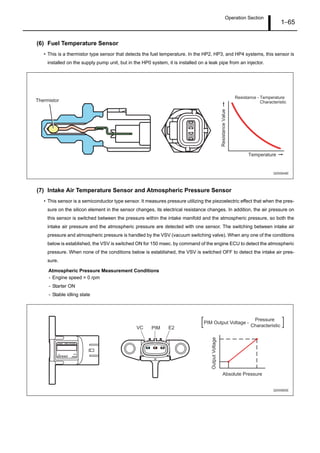
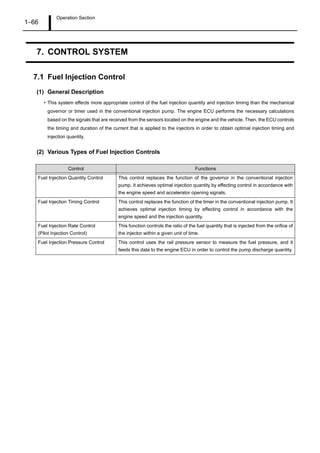
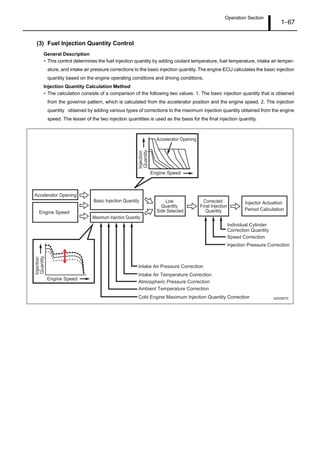
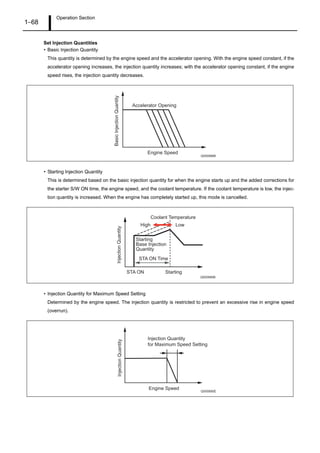
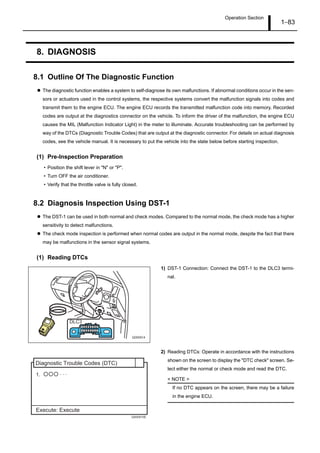
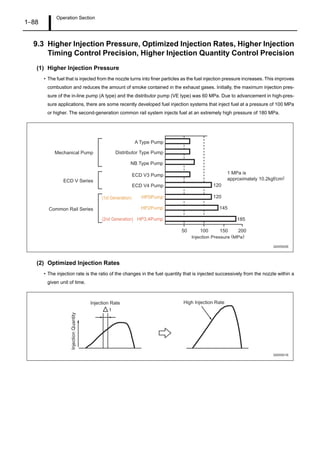
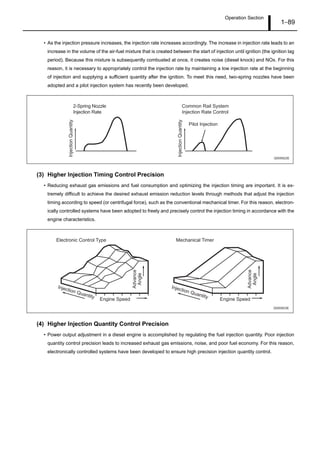
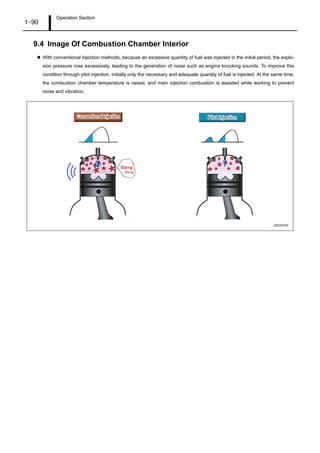
COMMON RAIL SYSTEM (CRS)
OPERATION
September, 2007
00400534E
SERVICE MANUAL
© 2007 DENSO CORPORATION
All Rights Reserved. This book may not be reproduced
or copied, in whole or in part, without the written
permission of the publisher.
Revision History
Revision History
Date Revision Contents
2007. 09 • SCV: Explanation of compact SCV added to "Suction Control Valve (SCV)". (Operation: Refer
to page 1-30.)
• "Repair" section added.
Table of Contents
Table of Contents
Operation Section
1. GENERAL DESCRIPTION
1.1 Changes In Environment Surrounding The Diesel Engine . . . . . . . . . . . . . . . . . . . . . . . . . . . . . . . . . . . . . . . . 1-1
1.2 Demands On Fuel Injection System . . . . . . . . . . . . . . . . . . . . . . . . . . . . . . . . . . . . . . . . . . . . . . . . . . . . . . . . . 1-2
1.3 Types Of And Transitions In ECD (ELECTRONICALLY CONTROLLED DIESEL) Systems . . . . . . . . . . . . . . 1-3
1.4 Common Rail System Characteristics. . . . . . . . . . . . . . . . . . . . . . . . . . . . . . . . . . . . . . . . . . . . . . . . . . . . . . . . 1-4
1.5 Common Rail System And Supply Pump Transitions . . . . . . . . . . . . . . . . . . . . . . . . . . . . . . . . . . . . . . . . . . . . 1-5
1.6 Injector Transitions . . . . . . . . . . . . . . . . . . . . . . . . . . . . . . . . . . . . . . . . . . . . . . . . . . . . . . . . . . . . . . . . . . . . . . 1-5
1.7 Common Rail System Configuration . . . . . . . . . . . . . . . . . . . . . . . . . . . . . . . . . . . . . . . . . . . . . . . . . . . . . . . . . 1-6
2. COMMON RAIL SYSTEM OUTLINE
2.1 Layout of Main Components . . . . . . . . . . . . . . . . . . . . . . . . . . . . . . . . . . . . . . . . . . . . . . . . . . . . . . . . . . . . . . . 1-7
3. SUPPLY PUMP DESCRIPTION
3.1 HP0 Type. . . . . . . . . . . . . . . . . . . . . . . . . . . . . . . . . . . . . . . . . . . . . . . . . . . . . . . . . . . . . . . . . . . . . . . . . . . . . 1-12
3.2 HP2 Type. . . . . . . . . . . . . . . . . . . . . . . . . . . . . . . . . . . . . . . . . . . . . . . . . . . . . . . . . . . . . . . . . . . . . . . . . . . . . 1-18
3.3 HP3 Type. . . . . . . . . . . . . . . . . . . . . . . . . . . . . . . . . . . . . . . . . . . . . . . . . . . . . . . . . . . . . . . . . . . . . . . . . . . . . 1-27
3.4 HP4 Type. . . . . . . . . . . . . . . . . . . . . . . . . . . . . . . . . . . . . . . . . . . . . . . . . . . . . . . . . . . . . . . . . . . . . . . . . . . . . 1-41
4. RAIL DESCCRIPTION
4.1 Rail Functions and Composition . . . . . . . . . . . . . . . . . . . . . . . . . . . . . . . . . . . . . . . . . . . . . . . . . . . . . . . . . . . 1-46
4.2 Component Part Construction and Operation . . . . . . . . . . . . . . . . . . . . . . . . . . . . . . . . . . . . . . . . . . . . . . . . . 1-46
5. INJECTOR DESCRIPTION
5.1 General Description. . . . . . . . . . . . . . . . . . . . . . . . . . . . . . . . . . . . . . . . . . . . . . . . . . . . . . . . . . . . . . . . . . . . . 1-50
5.2 Injector Construction and Features . . . . . . . . . . . . . . . . . . . . . . . . . . . . . . . . . . . . . . . . . . . . . . . . . . . . . . . . . 1-51
5.3 Injector Operation . . . . . . . . . . . . . . . . . . . . . . . . . . . . . . . . . . . . . . . . . . . . . . . . . . . . . . . . . . . . . . . . . . . . . . 1-54
5.4 Injector Actuation Circuit . . . . . . . . . . . . . . . . . . . . . . . . . . . . . . . . . . . . . . . . . . . . . . . . . . . . . . . . . . . . . . . . . 1-54
5.5 Other Injector Component Parts . . . . . . . . . . . . . . . . . . . . . . . . . . . . . . . . . . . . . . . . . . . . . . . . . . . . . . . . . . . 1-56
6. DESCRIPTION OF CONTROL SYSTEM COMPONENTS
6.1 Engine Control System Diagram (Reference) . . . . . . . . . . . . . . . . . . . . . . . . . . . . . . . . . . . . . . . . . . . . . . . . 1-59
6.2 Engine ECU (Electronic Control Unit) . . . . . . . . . . . . . . . . . . . . . . . . . . . . . . . . . . . . . . . . . . . . . . . . . . . . . . . 1-60
6.3 EDU (Electronic Driving Unit) . . . . . . . . . . . . . . . . . . . . . . . . . . . . . . . . . . . . . . . . . . . . . . . . . . . . . . . . . . . . . 1-60
6.4 Various Sensors . . . . . . . . . . . . . . . . . . . . . . . . . . . . . . . . . . . . . . . . . . . . . . . . . . . . . . . . . . . . . . . . . . . . . . . 1-61
7. CONTROL SYSTEM
7.1 Fuel Injection Control. . . . . . . . . . . . . . . . . . . . . . . . . . . . . . . . . . . . . . . . . . . . . . . . . . . . . . . . . . . . . . . . . . . . 1-66
7.2 E-EGR System (Electric-Exhaust Gas Recirculation) . . . . . . . . . . . . . . . . . . . . . . . . . . . . . . . . . . . . . . . . . . . 1-76
7.3 Electronically Controlled Throttle (Not Made By DENSO). . . . . . . . . . . . . . . . . . . . . . . . . . . . . . . . . . . . . . . . 1-78
7.4 Exhaust Gas Control System . . . . . . . . . . . . . . . . . . . . . . . . . . . . . . . . . . . . . . . . . . . . . . . . . . . . . . . . . . . . . 1-79
7.5 DPF System (Diesel Particulate Filter) . . . . . . . . . . . . . . . . . . . . . . . . . . . . . . . . . . . . . . . . . . . . . . . . . . . . . . 1-80
7.6 DPNR SYSTEM (DIESEL PARTICULATE NOx REDUCTION). . . . . . . . . . . . . . . . . . . . . . . . . . . . . . . . . . . . 1-82
Table of Contents
8. DIAGNOSIS
8.1 Outline Of The Diagnostic Function. . . . . . . . . . . . . . . . . . . . . . . . . . . . . . . . . . . . . . . . . . . . . . . . . . . . . . . . . 1-83
8.2 Diagnosis Inspection Using DST-1 . . . . . . . . . . . . . . . . . . . . . . . . . . . . . . . . . . . . . . . . . . . . . . . . . . . . . . . . . 1-83
8.3 Diagnosis Inspection Using The MIL (Malfunction Indicator Light) . . . . . . . . . . . . . . . . . . . . . . . . . . . . . . . . . 1-84
8.4 Throttle Body Function Inspection. . . . . . . . . . . . . . . . . . . . . . . . . . . . . . . . . . . . . . . . . . . . . . . . . . . . . . . . . . 1-86
9. END OF VOLUME MATERIALS
9.1 Particulate Matter (PM) . . . . . . . . . . . . . . . . . . . . . . . . . . . . . . . . . . . . . . . . . . . . . . . . . . . . . . . . . . . . . . . . . . 1-87
9.2 Common Rail Type Fuel Injection System Development History And The World’s Manufacturers. . . . . . . . . 1-87
9.3 Higher Injection Pressure, Optimized Injection Rates, Higher Injection Timing Control Precision, Higher Injection
Quantity Control Precision. . . . . . . . . . . . . . . . . . . . . . . . . . . . . . . . . . . . . . . . . . . . . . . . . . . . . . . . . . . . . . . . 1-88
9.4 Image Of Combustion Chamber Interior . . . . . . . . . . . . . . . . . . . . . . . . . . . . . . . . . . . . . . . . . . . . . . . . . . . . . 1-90
Repair Section
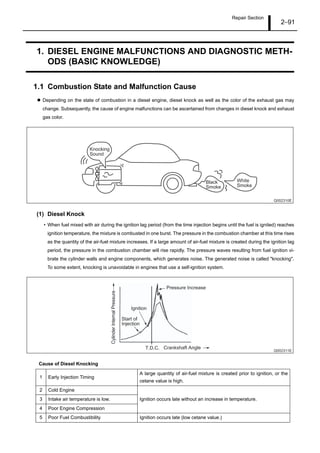
1. DIESEL ENGINE MALFUNCTIONS AND DIAGNOSTIC METHODS (BASIC KNOWL-
EDGE)
1.1 Combustion State and Malfunction Cause . . . . . . . . . . . . . . . . . . . . . . . . . . . . . . . . . . . . . . . . . . . . . . . . . . . 2-91
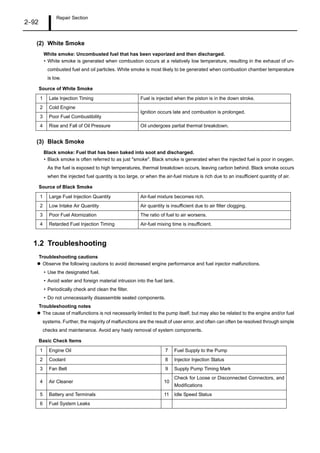
1.2 Troubleshooting. . . . . . . . . . . . . . . . . . . . . . . . . . . . . . . . . . . . . . . . . . . . . . . . . . . . . . . . . . . . . . . . . . . . . . . . 2-92
2. DIAGNOSIS OVERVIEW
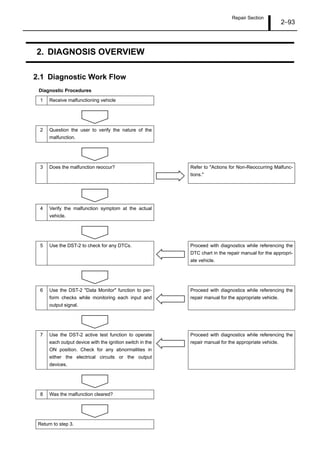
2.1 Diagnostic Work Flow . . . . . . . . . . . . . . . . . . . . . . . . . . . . . . . . . . . . . . . . . . . . . . . . . . . . . . . . . . . . . . . . . . . 2-93
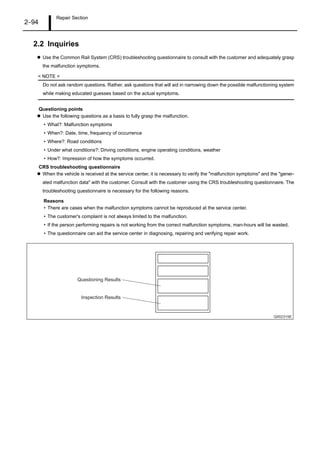
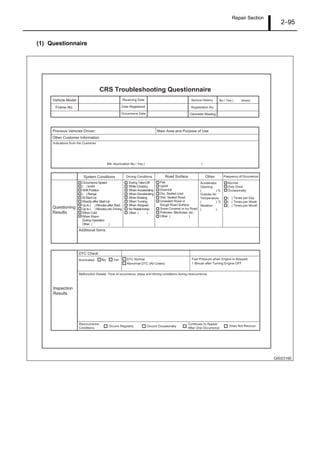
2.2 Inquiries. . . . . . . . . . . . . . . . . . . . . . . . . . . . . . . . . . . . . . . . . . . . . . . . . . . . . . . . . . . . . . . . . . . . . . . . . . . . . . 2-94
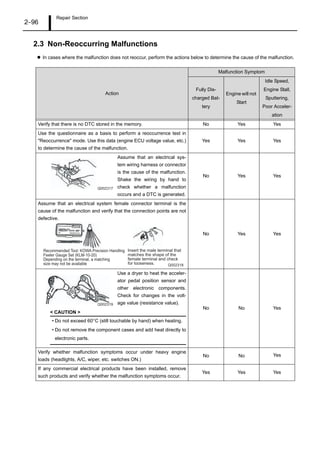
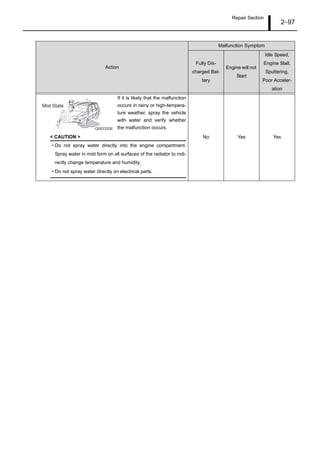
2.3 Non-Reoccurring Malfunctions . . . . . . . . . . . . . . . . . . . . . . . . . . . . . . . . . . . . . . . . . . . . . . . . . . . . . . . . . . . . 2-96
3. DTC READING (FOR TOYOTA VEHICLES)
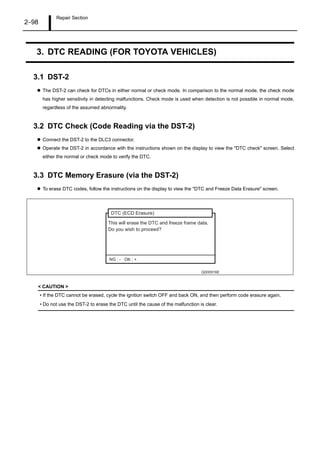
3.1 DST-2 . . . . . . . . . . . . . . . . . . . . . . . . . . . . . . . . . . . . . . . . . . . . . . . . . . . . . . . . . . . . . . . . . . . . . . . . . . . . . . . 2-98
3.2 DTC Check (Code Reading via the DST-2). . . . . . . . . . . . . . . . . . . . . . . . . . . . . . . . . . . . . . . . . . . . . . . . . . . 2-98
3.3 DTC Memory Erasure (via the DST-2) . . . . . . . . . . . . . . . . . . . . . . . . . . . . . . . . . . . . . . . . . . . . . . . . . . . . . . 2-98
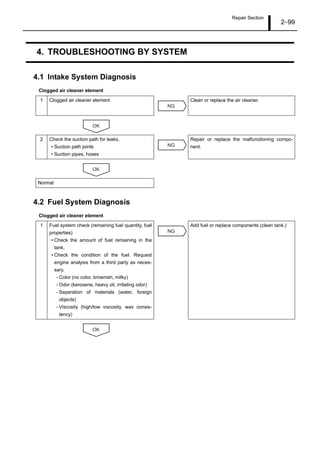
4. TROUBLESHOOTING BY SYSTEM
4.1 Intake System Diagnosis. . . . . . . . . . . . . . . . . . . . . . . . . . . . . . . . . . . . . . . . . . . . . . . . . . . . . . . . . . . . . . . . . 2-99
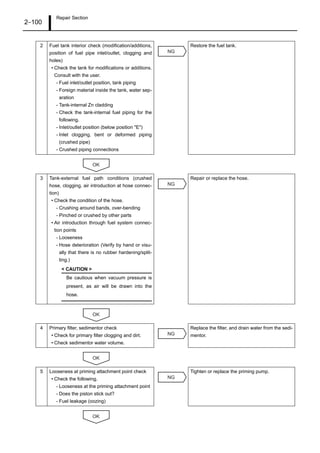
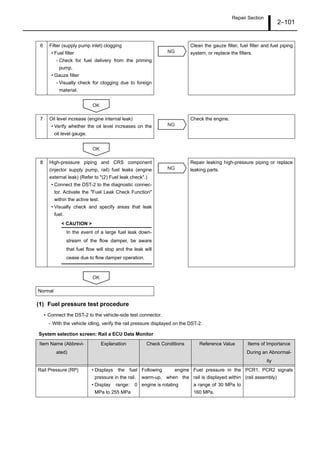
4.2 Fuel System Diagnosis . . . . . . . . . . . . . . . . . . . . . . . . . . . . . . . . . . . . . . . . . . . . . . . . . . . . . . . . . . . . . . . . . . 2-99
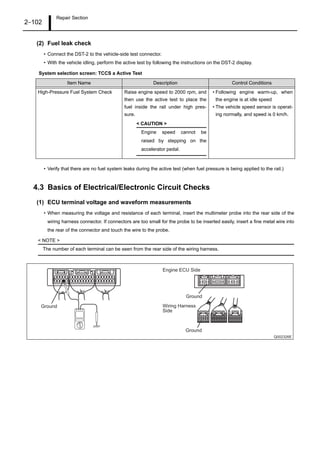
4.3 Basics of Electrical/Electronic Circuit Checks . . . . . . . . . . . . . . . . . . . . . . . . . . . . . . . . . . . . . . . . . . . . . . . . 2-102
5. TROUBLESHOOTING
5.1 Troubleshooting According to Malfunction Symptom (for TOYOTA Vehicles). . . . . . . . . . . . . . . . . . . . . . . . 2-107
5.2 Other Malfunction Symptoms . . . . . . . . . . . . . . . . . . . . . . . . . . . . . . . . . . . . . . . . . . . . . . . . . . . . . . . . . . . . 2-122
6. DIAGNOSIS CODES (DTC)
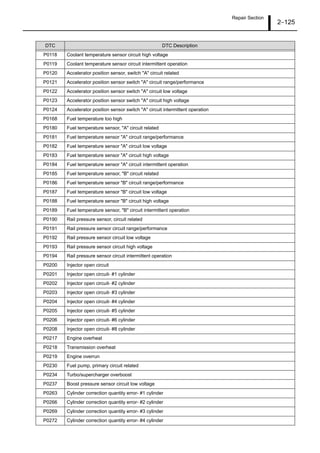
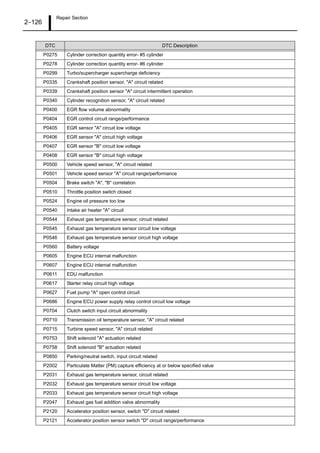
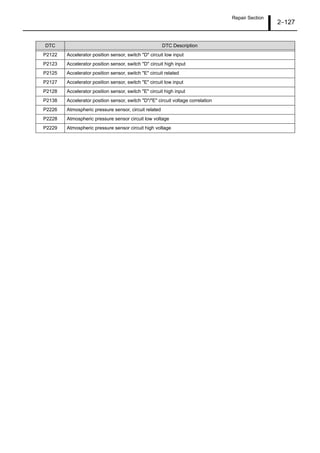
6.1 DTC Chart (Example) . . . . . . . . . . . . . . . . . . . . . . . . . . . . . . . . . . . . . . . . . . . . . . . . . . . . . . . . . . . . . . . . . . 2-124
Operation Section
1–1
1. GENERAL DESCRIPTION
1.1 Changes In Environment Surrounding The Diesel Engine
Throughout the world, there is a desperate need to improve vehicle fuel economy for the purposes of preventing global
warming and reducing exhaust gas emissions that affect human health. Diesel engine vehicles are highly acclaimed in
Europe, due to the good fuel economy that diesel fuel offers. On the other hand, the "nitrogen oxides (NOx)" and "par-
ticulate matter (PM)" contained in the exhaust gas must be greatly reduced to meet exhaust gas regulations, and tech-
nology is being actively developed for the sake of improved fuel economy and reduced exhaust gases.
(1) Demands on Diesel Vehicles
• Reduce exhaust gases (NOx, PM, carbon monoxide (CO), hydrocarbon (HC) and smoke).
• Improve fuel economy.
• Reduce noise.
• Improve power output and driving performance.
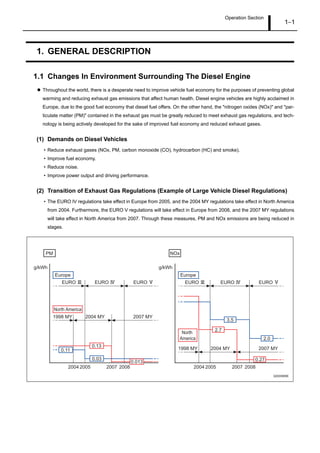
(2) Transition of Exhaust Gas Regulations (Example of Large Vehicle Diesel Regulations)
• The EURO IV regulations take effect in Europe from 2005, and the 2004 MY regulations take effect in North America
from 2004. Furthermore, the EURO V regulations will take effect in Europe from 2008, and the 2007 MY regulations
will take effect in North America from 2007. Through these measures, PM and NOx emissions are being reduced in
stages.
Q000989E
PM
g/kWh
NOx
g/kWh
2005 20082004 2007
3.5
2.0
2.7
0.27
1998 MY 2004 MY 2007 MY
EURO EURO EURO EURO EURO EURO
1998 MY 2004 MY 2007 MY
0.013
0.13
0.11
0.03
Europe Europe
North America
North
America
2005 20082004 2007
Operation Section
1–2
1.2 Demands On Fuel Injection System
In order to address the various demands that are imposed on diesel vehicles, the fuel injection system (including the
injection pump and nozzles) plays a significant role because it directly affects the performance of the engine and the
vehicle. Some of the demands are: higher injection pressure, optimized injection rate, higher precision of injection timing
control, and higher precision of injection quantity control.
< NOTE >
For further information on higher injection pressure, optimized injection rate, higher precision of injection timing control,
and higher precision of injection quantity control, see the material at the end of this document.
Operation Section
1–3
1.3 Types Of And Transitions In ECD (ELECTRONICALLY CONTROLLED
DIESEL) Systems
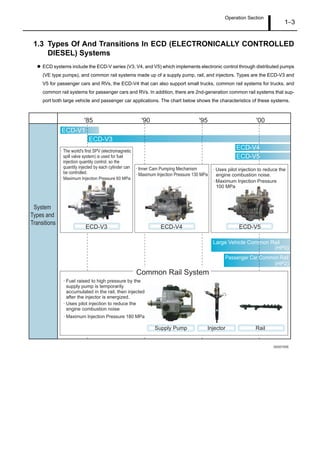
ECD systems include the ECD-V series (V3, V4, and V5) which implements electronic control through distributed pumps
(VE type pumps), and common rail systems made up of a supply pump, rail, and injectors. Types are the ECD-V3 and
V5 for passenger cars and RVs, the ECD-V4 that can also support small trucks, common rail systems for trucks, and
common rail systems for passenger cars and RVs. In addition, there are 2nd-generation common rail systems that sup-
port both large vehicle and passenger car applications. The chart below shows the characteristics of these systems.
ECD-V1
ECD-V3
ECD-V4
ECD-V5
'85 '90 '95 '00
Large Vehicle Common Rail
(HP0)
(HP2)
Passenger Car Common Rail
Common Rail System
· Maximum Injection Pressure 180 MPa
· Uses pilot injection to reduce the
engine combustion noise
· Fuel raised to high pressure by the
supply pump is temporarily
accumulated in the rail, then injected
after the injector is energized.
System
Types and
Transitions
· Maximum Injection Pressure 130 MPa
· Inner Cam Pumping Mechanism
· Maximum Injection Pressure
100 MPa
· Uses pilot injection to reduce the
engine combustion noise.
Supply Pump Injector Rail
· The world's first SPV (electromagnetic
spill valve system) is used for fuel
injection quantity control, so the
quantity injected by each cylinder can
be controlled.
· Maximum Injection Pressure 60 MPa
Q000750E
ECD-V3 ECD-V4 ECD-V5
Operation Section
1–4
1.4 Common Rail System Characteristics
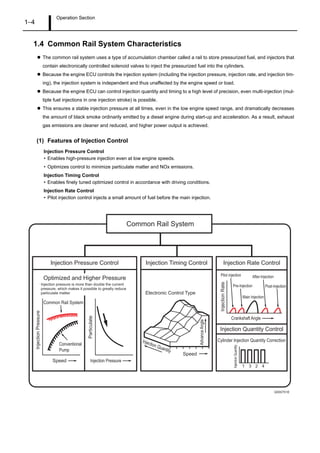
The common rail system uses a type of accumulation chamber called a rail to store pressurized fuel, and injectors that
contain electronically controlled solenoid valves to inject the pressurized fuel into the cylinders.
Because the engine ECU controls the injection system (including the injection pressure, injection rate, and injection tim-
ing), the injection system is independent and thus unaffected by the engine speed or load.
Because the engine ECU can control injection quantity and timing to a high level of precision, even multi-injection (mul-
tiple fuel injections in one injection stroke) is possible.
This ensures a stable injection pressure at all times, even in the low engine speed range, and dramatically decreases
the amount of black smoke ordinarily emitted by a diesel engine during start-up and acceleration. As a result, exhaust
gas emissions are cleaner and reduced, and higher power output is achieved.
(1) Features of Injection Control
Injection Pressure Control
• Enables high-pressure injection even at low engine speeds.
• Optimizes control to minimize particulate matter and NOx emissions.
Injection Timing Control
• Enables finely tuned optimized control in accordance with driving conditions.
Injection Rate Control
• Pilot injection control injects a small amount of fuel before the main injection.
· Injection pressure is more than double the current
pressure, which makes it possible to greatly reduce
particulate matter.
Common Rail System
Injection Pressure Control Injection Timing Control Injection Rate Control
Injection Quantity Control
Electronic Control Type
Common Rail System
Conventional
Pump
Optimized and Higher Pressure
Speed
Speed
Injection Quantity
Injection Pressure
Pre-Injection
Pilot injection After-Injection
Post-Injection
Main Injection
1 3 2 4
InjectionPressure
Particulate
InjectionRate
Crankshaft Angle
Cylinder Injection Quantity Correction
InjectionQuantity
AdvanceAngle
Q000751E
Operation Section
1–5
1.5 Common Rail System And Supply Pump Transitions
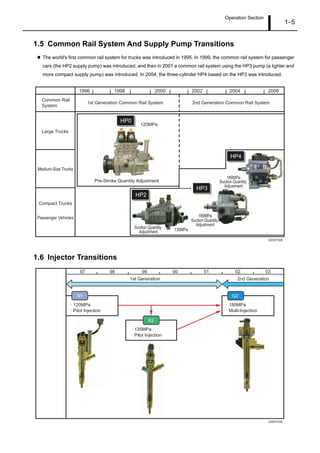
The world's first common rail system for trucks was introduced in 1995. In 1999, the common rail system for passenger
cars (the HP2 supply pump) was introduced, and then in 2001 a common rail system using the HP3 pump (a lighter and
more compact supply pump) was introduced. In 2004, the three-cylinder HP4 based on the HP3 was introduced.
1.6 Injector Transitions
Q000752E
1996 1998 2000 2002 2004 2006
120MPa
180MPa
135MPa
HP0
HP2
HP3
Large Trucks
Medium-Size Trucks
Common Rail
System
1st Generation Common Rail System 2nd Generation Common Rail System
Passenger Vehicles
Compact Trucks
Suction Quantity
Adjustment
Suction Quantity
Adjustment
Suction Quantity
Adjustment
Pre-Stroke Quantity Adjustment
180MPa
HP4
Q000753E
· 180MPa
· 135MPa
· 120MPa
X1 G2
97 98 99 00 01 02 03
1st Generation 2nd Generation
· Multi-Injection
· Pilot Injection
· Pilot Injection
X2
Operation Section
1–6
1.7 Common Rail System Configuration
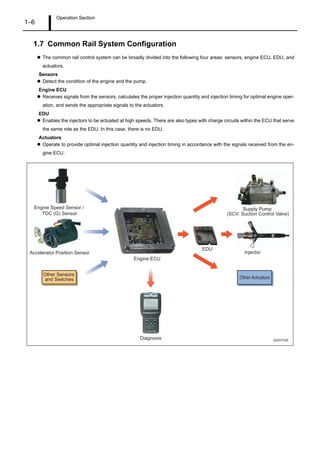
The common rail control system can be broadly divided into the following four areas: sensors, engine ECU, EDU, and
actuators.
Sensors
Detect the condition of the engine and the pump.
Engine ECU
Receives signals from the sensors, calculates the proper injection quantity and injection timing for optimal engine oper-
ation, and sends the appropriate signals to the actuators.
EDU
Enables the injectors to be actuated at high speeds. There are also types with charge circuits within the ECU that serve
the same role as the EDU. In this case, there is no EDU.
Actuators
Operate to provide optimal injection quantity and injection timing in accordance with the signals received from the en-
gine ECU.
Engine Speed Sensor /
TDC (G) Sensor
Accelerator Position Sensor
Other Sensors
and Switches
Engine ECU
EDU
Supply Pump
(SCV: Suction Control Valve)
Injector
Other Actuators
Diagnosis Q000754E
Operation Section
1–7
2. COMMON RAIL SYSTEM OUTLINE
2.1 Layout of Main Components
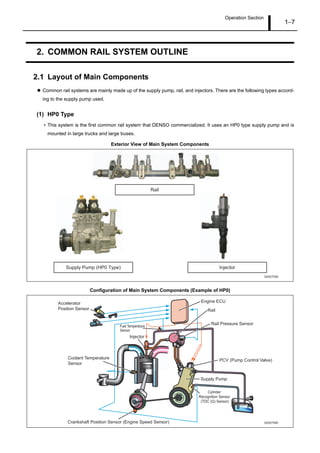
Common rail systems are mainly made up of the supply pump, rail, and injectors. There are the following types accord-
ing to the supply pump used.
(1) HP0 Type
• This system is the first common rail system that DENSO commercialized. It uses an HP0 type supply pump and is
mounted in large trucks and large buses.
Exterior View of Main System Components
Configuration of Main System Components (Example of HP0)
Q000755E
InjectorSupply Pump (HP0 Type)
Rail
Q000756E
Supply Pump
PCV (Pump Control Valve)
Cylinder
Recognition Sensor
(TDC (G) Sensor)
Rail Pressure Sensor
Rail
Engine ECU
Injector
Accelerator
Position Sensor
Crankshaft Position Sensor (Engine Speed Sensor)
Fuel Temperature
Sensor
Coolant Temperature
Sensor
Operation Section
1–8
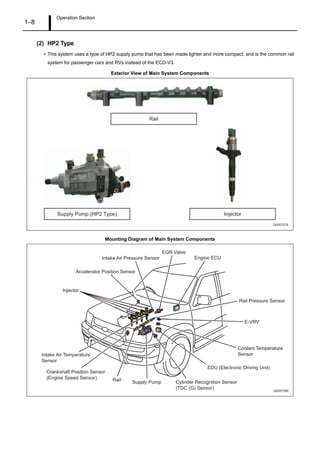
(2) HP2 Type
• This system uses a type of HP2 supply pump that has been made lighter and more compact, and is the common rail
system for passenger cars and RVs instead of the ECD-V3.
Exterior View of Main System Components
Mounting Diagram of Main System Components
Q000757E
InjectorSupply Pump (HP2 Type)
Rail
Engine ECU
EDU (Electronic Driving Unit)
EGR Valve
E-VRV
Intake Air Temperature
Sensor
Intake Air Pressure Sensor
Injector
Crankshaft Position Sensor
(Engine Speed Sensor) Rail Supply Pump Cylinder Recognition Sensor
(TDC (G) Sensor)
Rail Pressure Sensor
Accelerator Position Sensor
Coolant Temperature
Sensor
Q000758E
Operation Section
1–9
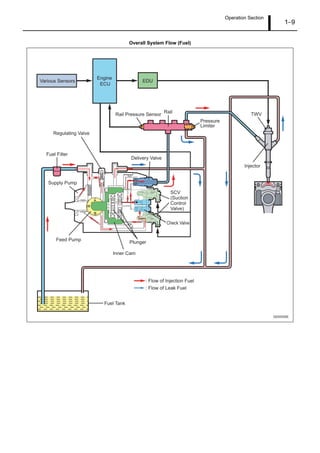
Overall System Flow (Fuel)
Q000926E
Supply Pump
Plunger
Feed Pump
Delivery Valve
SCV
(Suction
Control
Valve)
Inner Cam
Regulating Valve
Check Valve
Rail
Rail Pressure Sensor
Pressure
Limiter
Injector
TWV
Engine
ECU
EDUVarious Sensors
Fuel Filter
Fuel Tank
: Flow of Injection Fuel
: Flow of Leak Fuel
Operation Section
1–10
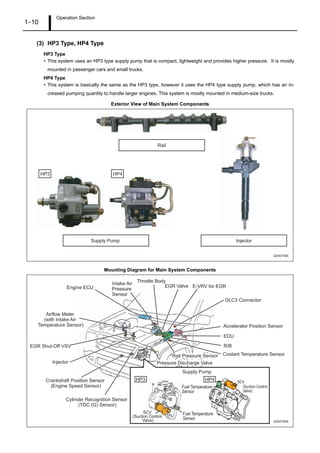
(3) HP3 Type, HP4 Type
HP3 Type
• This system uses an HP3 type supply pump that is compact, lightweight and provides higher pressure. It is mostly
mounted in passenger cars and small trucks.
HP4 Type
• This system is basically the same as the HP3 type, however it uses the HP4 type supply pump, which has an in-
creased pumping quantity to handle larger engines. This system is mostly mounted in medium-size trucks.
Exterior View of Main System Components
Mounting Diagram for Main System Components
Q000759E
HP3 HP4
InjectorSupply Pump
Rail
Q000760E
Supply Pump
SCV
(Suction Control
Valve)
Fuel Temperature
Sensor
Fuel Temperature
Sensor
Injector
Engine ECU
EDU
DLC3 Connector
R/B
EGR Valve E-VRV for EGR
EGR Shut-Off VSV
Throttle Body
Crankshaft Position Sensor
(Engine Speed Sensor)
Cylinder Recognition Sensor
(TDC (G) Sensor)
Accelerator Position Sensor
Intake Air
Pressure
Sensor
Airflow Meter
(with Intake Air
Temperature Sensor)
Coolant Temperature Sensor
HP3 HP4
(Suction Control
Valve)
SCV
Pressure Discharge Valve
Rail Pressure Sensor
Operation Section
1–11
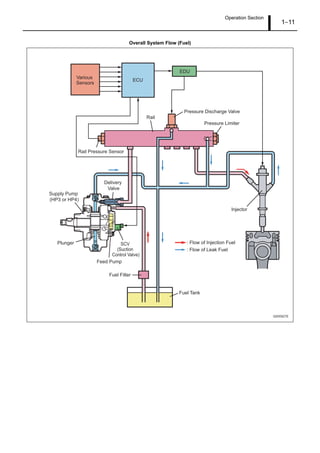
Overall System Flow (Fuel)
Q000927E
Supply Pump
(HP3 or HP4)
Plunger
Feed Pump
Delivery
Valve
SCV
(Suction
Control Valve)
Rail
Rail Pressure Sensor
Pressure Discharge Valve
Pressure Limiter
Injector
ECU
EDU
Various
Sensors
Fuel Filter
Fuel Tank
: Flow of Injection Fuel
: Flow of Leak Fuel
Operation Section
1–12
3. SUPPLY PUMP DESCRIPTION
3.1 HP0 Type
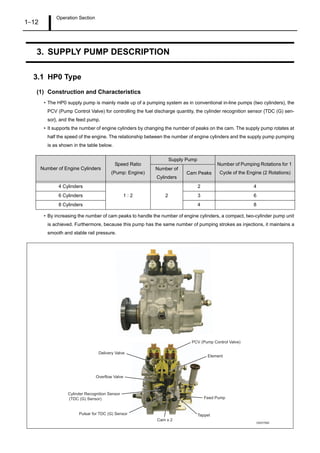
(1) Construction and Characteristics
• The HP0 supply pump is mainly made up of a pumping system as in conventional in-line pumps (two cylinders), the
PCV (Pump Control Valve) for controlling the fuel discharge quantity, the cylinder recognition sensor {TDC (G) sen-
sor}, and the feed pump.
• It supports the number of engine cylinders by changing the number of peaks on the cam. The supply pump rotates at
half the speed of the engine. The relationship between the number of engine cylinders and the supply pump pumping
is as shown in the table below.
• By increasing the number of cam peaks to handle the number of engine cylinders, a compact, two-cylinder pump unit
is achieved. Furthermore, because this pump has the same number of pumping strokes as injections, it maintains a
smooth and stable rail pressure.
Number of Engine Cylinders
Speed Ratio
(Pump: Engine)
Supply Pump
Number of Pumping Rotations for 1
Cycle of the Engine (2 Rotations)
Number of
Cylinders
Cam Peaks
4 Cylinders
1 : 2 2
2 4
6 Cylinders 3 6
8 Cylinders 4 8
Feed Pump
Delivery Valve
Cam x 2
PCV (Pump Control Valve)
Tappet
Element
Cylinder Recognition Sensor
(TDC (G) Sensor)
Pulsar for TDC (G) Sensor
Overflow Valve
Q000768E
Operation Section
1–13
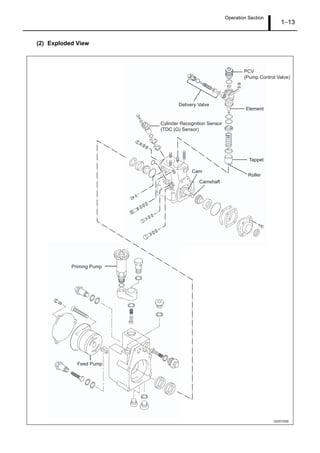
(2) Exploded View
Q000769E
PCV
(Pump Control Valve)
Delivery Valve
Element
Cylinder Recognition Sensor
(TDC (G) Sensor)
Roller
Cam
Camshaft
Tappet
Feed Pump
Priming Pump
Operation Section
1–14
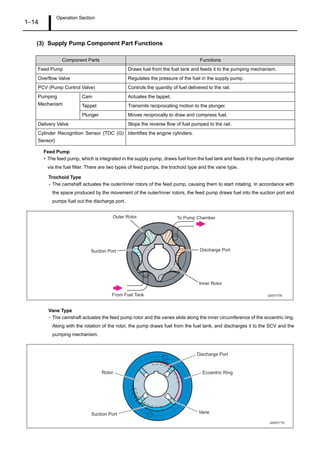
(3) Supply Pump Component Part Functions
Feed Pump
• The feed pump, which is integrated in the supply pump, draws fuel from the fuel tank and feeds it to the pump chamber
via the fuel filter. There are two types of feed pumps, the trochoid type and the vane type.
Trochoid Type
- The camshaft actuates the outer/inner rotors of the feed pump, causing them to start rotating. In accordance with
the space produced by the movement of the outer/inner rotors, the feed pump draws fuel into the suction port and
pumps fuel out the discharge port.
Vane Type
- The camshaft actuates the feed pump rotor and the vanes slide along the inner circumference of the eccentric ring.
Along with the rotation of the rotor, the pump draws fuel from the fuel tank, and discharges it to the SCV and the
pumping mechanism.
Component Parts Functions
Feed Pump Draws fuel from the fuel tank and feeds it to the pumping mechanism.
Overflow Valve Regulates the pressure of the fuel in the supply pump.
PCV (Pump Control Valve) Controls the quantity of fuel delivered to the rail.
Pumping
Mechanism
Cam Actuates the tappet.
Tappet Transmits reciprocating motion to the plunger.
Plunger Moves reciprocally to draw and compress fuel.
Delivery Valve Stops the reverse flow of fuel pumped to the rail.
Cylinder Recognition Sensor {TDC (G)
Sensor}
Identifies the engine cylinders.
To Pump Chamber
From Fuel Tank
Outer Rotor
Inner Rotor
Suction Port Discharge Port
Q000770E
Suction Port
Discharge Port
Rotor Eccentric Ring
Vane
Q000771E
Operation Section
1–15
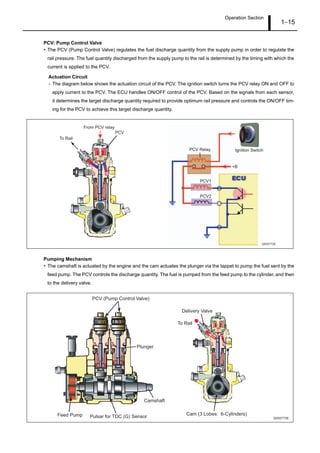
PCV: Pump Control Valve
• The PCV (Pump Control Valve) regulates the fuel discharge quantity from the supply pump in order to regulate the
rail pressure. The fuel quantity discharged from the supply pump to the rail is determined by the timing with which the
current is applied to the PCV.
Actuation Circuit
- The diagram below shows the actuation circuit of the PCV. The ignition switch turns the PCV relay ON and OFF to
apply current to the PCV. The ECU handles ON/OFF control of the PCV. Based on the signals from each sensor,
it determines the target discharge quantity required to provide optimum rail pressure and controls the ON/OFF tim-
ing for the PCV to achieve this target discharge quantity.
Pumping Mechanism
• The camshaft is actuated by the engine and the cam actuates the plunger via the tappet to pump the fuel sent by the
feed pump. The PCV controls the discharge quantity. The fuel is pumped from the feed pump to the cylinder, and then
to the delivery valve.
PCV
Ignition Switch
+B
PCV Relay
PCV1
PCV2
From PCV relay
To Rail
Q000772E
Q000773E
Camshaft
Feed Pump
PCV (Pump Control Valve)
Pulsar for TDC (G) Sensor
Delivery Valve
Cam (3 Lobes: 6-Cylinders)
Plunger
To Rail
Operation Section
1–16
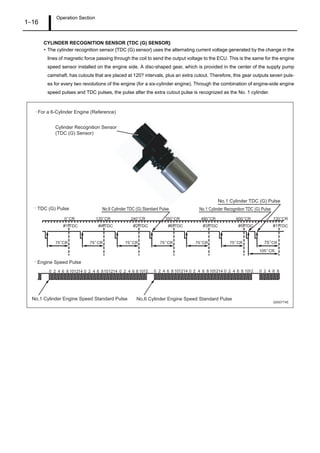
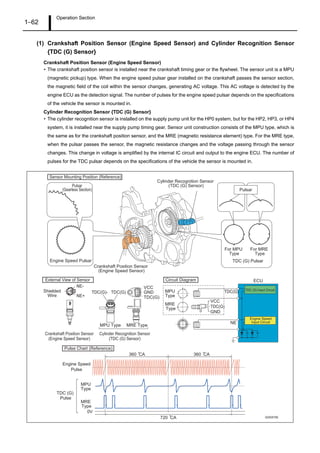
CYLINDER RECOGNITION SENSOR {TDC (G) SENSOR}
• The cylinder recognition sensor {TDC (G) sensor} uses the alternating current voltage generated by the change in the
lines of magnetic force passing through the coil to send the output voltage to the ECU. This is the same for the engine
speed sensor installed on the engine side. A disc-shaped gear, which is provided in the center of the supply pump
camshaft, has cutouts that are placed at 120? intervals, plus an extra cutout. Therefore, this gear outputs seven puls-
es for every two revolutions of the engine (for a six-cylinder engine). Through the combination of engine-side engine
speed pulses and TDC pulses, the pulse after the extra cutout pulse is recognized as the No. 1 cylinder.
Q000774E
0 2 4 6 8 101214 0 2 4 6 8101214 0 2 4 6 8 1012 0 2 4 6 8 101214 0 2 4 6 8 101214 0 2 4 6 8 0 2 4 6 81012
Cylinder Recognition Sensor
(TDC (G) Sensor)
No.6 Cylinder TDC (G) Standard Pulse No.1 Cylinder Recognition TDC (G) Pulse
No.1 Cylinder TDC (G) Pulse
No.1 Cylinder Engine Speed Standard Pulse No.6 Cylinder Engine Speed Standard Pulse
· TDC (G) Pulse
· Engine Speed Pulse
· For a 6-Cylinder Engine (Reference)
Operation Section
1–17
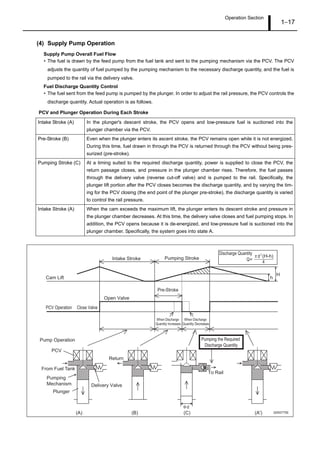
(4) Supply Pump Operation
Supply Pump Overall Fuel Flow
• The fuel is drawn by the feed pump from the fuel tank and sent to the pumping mechanism via the PCV. The PCV
adjusts the quantity of fuel pumped by the pumping mechanism to the necessary discharge quantity, and the fuel is
pumped to the rail via the delivery valve.
Fuel Discharge Quantity Control
• The fuel sent from the feed pump is pumped by the plunger. In order to adjust the rail pressure, the PCV controls the
discharge quantity. Actual operation is as follows.
PCV and Plunger Operation During Each Stroke
Intake Stroke (A) In the plunger's descent stroke, the PCV opens and low-pressure fuel is suctioned into the
plunger chamber via the PCV.
Pre-Stroke (B) Even when the plunger enters its ascent stroke, the PCV remains open while it is not energized.
During this time, fuel drawn in through the PCV is returned through the PCV without being pres-
surized (pre-stroke).
Pumping Stroke (C) At a timing suited to the required discharge quantity, power is supplied to close the PCV, the
return passage closes, and pressure in the plunger chamber rises. Therefore, the fuel passes
through the delivery valve (reverse cut-off valve) and is pumped to the rail. Specifically, the
plunger lift portion after the PCV closes becomes the discharge quantity, and by varying the tim-
ing for the PCV closing (the end point of the plunger pre-stroke), the discharge quantity is varied
to control the rail pressure.
Intake Stroke (A) When the cam exceeds the maximum lift, the plunger enters its descent stroke and pressure in
the plunger chamber decreases. At this time, the delivery valve closes and fuel pumping stops. In
addition, the PCV opens because it is de-energized, and low-pressure fuel is suctioned into the
plunger chamber. Specifically, the system goes into state A.
Q000775E
Cam Lift
PCV Operation Close Valve
Intake Stroke Pumping Stroke
Pre-Stroke
Open Valve
PCV
Pump Operation
Plunger
Return
When Discharge
Quantity Increases
When Discharge
Quantity Decreases
To Rail
Pumping the Required
Discharge Quantity
H
Discharge Quantity
h
Q=
4
2
d (H-h)
(A) (B) (C) (A')
Delivery Valve
From Fuel Tank
Pumping
Mechanism
d
Operation Section
1–18
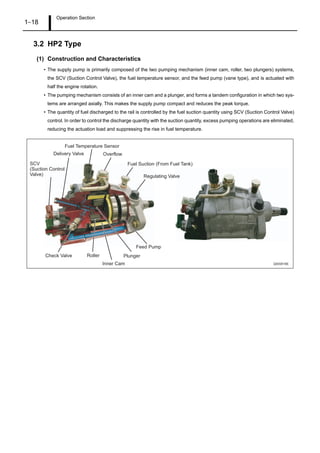
3.2 HP2 Type
(1) Construction and Characteristics
• The supply pump is primarily composed of the two pumping mechanism (inner cam, roller, two plungers) systems,
the SCV (Suction Control Valve), the fuel temperature sensor, and the feed pump (vane type), and is actuated with
half the engine rotation.
• The pumping mechanism consists of an inner cam and a plunger, and forms a tandem configuration in which two sys-
tems are arranged axially. This makes the supply pump compact and reduces the peak torque.
• The quantity of fuel discharged to the rail is controlled by the fuel suction quantity using SCV (Suction Control Valve)
control. In order to control the discharge quantity with the suction quantity, excess pumping operations are eliminated,
reducing the actuation load and suppressing the rise in fuel temperature.
Regulating Valve
Plunger
Feed Pump
Inner Cam
Roller
Fuel Temperature Sensor
Delivery Valve
SCV
(Suction Control
Valve)
Check Valve
Overflow
Fuel Suction (From Fuel Tank)
Q000818E
Operation Section
1–19
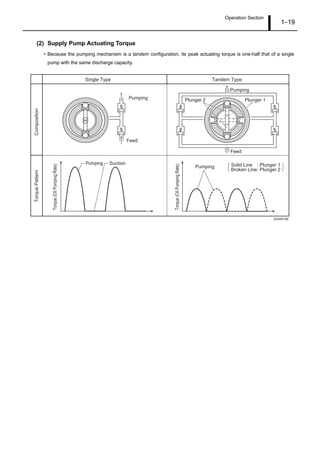
(2) Supply Pump Actuating Torque
• Because the pumping mechanism is a tandem configuration, its peak actuating torque is one-half that of a single
pump with the same discharge capacity.
Pumping
Pumping
Pumping
Suction
Pumping
Feed
Feed
Plunger 2 Plunger 1
Torque(OilPumpingRate)
Composition
Single Type Tandem Type
TorquePattern
Solid Line : Plunger 1
Broken Line: Plunger 2
Q000819E
Operation Section
1–20
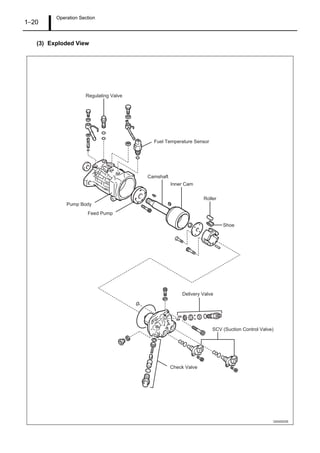
(3) Exploded View
Pump Body
Feed Pump
Camshaft
Inner Cam
Roller
Shoe
Delivery Valve
SCV (Suction Control Valve)
Check Valve
Fuel Temperature Sensor
Regulating Valve
Q000820E
Operation Section
1–21
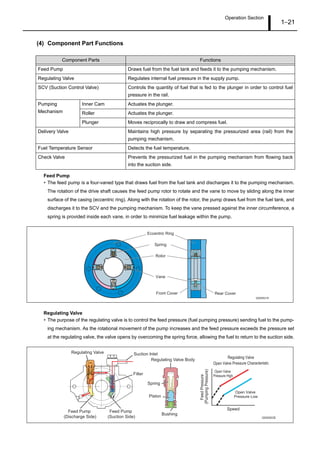
(4) Component Part Functions
Feed Pump
• The feed pump is a four-vaned type that draws fuel from the fuel tank and discharges it to the pumping mechanism.
The rotation of the drive shaft causes the feed pump rotor to rotate and the vane to move by sliding along the inner
surface of the casing (eccentric ring). Along with the rotation of the rotor, the pump draws fuel from the fuel tank, and
discharges it to the SCV and the pumping mechanism. To keep the vane pressed against the inner circumference, a
spring is provided inside each vane, in order to minimize fuel leakage within the pump.
Regulating Valve
• The purpose of the regulating valve is to control the feed pressure (fuel pumping pressure) sending fuel to the pump-
ing mechanism. As the rotational movement of the pump increases and the feed pressure exceeds the pressure set
at the regulating valve, the valve opens by overcoming the spring force, allowing the fuel to return to the suction side.
Component Parts Functions
Feed Pump Draws fuel from the fuel tank and feeds it to the pumping mechanism.
Regulating Valve Regulates internal fuel pressure in the supply pump.
SCV (Suction Control Valve) Controls the quantity of fuel that is fed to the plunger in order to control fuel
pressure in the rail.
Pumping
Mechanism
Inner Cam Actuates the plunger.
Roller Actuates the plunger.
Plunger Moves reciprocally to draw and compress fuel.
Delivery Valve Maintains high pressure by separating the pressurized area (rail) from the
pumping mechanism.
Fuel Temperature Sensor Detects the fuel temperature.
Check Valve Prevents the pressurized fuel in the pumping mechanism from flowing back
into the suction side.
Q000821E
Rotor
Eccentric Ring
Spring
Vane
Front Cover Rear Cover
Regulating Valve
Open Valve Pressure Characteristic
Open Valve
Pressure High
Open Valve
Pressure Low
Speed
FeedPressure
(PumpingPressure)
Regulating Valve
Feed Pump
(Discharge Side)
Suction Inlet
Filter
Feed Pump
(Suction Side)
Regulating Valve Body
Spring
Piston
Bushing
Q000822E
Operation Section
1–22
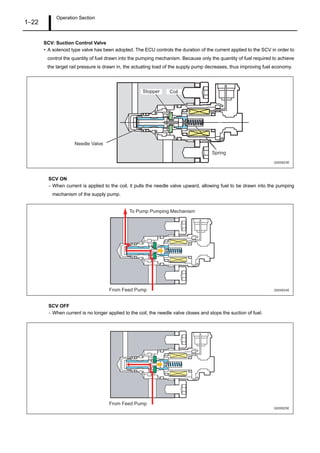
SCV: Suction Control Valve
• A solenoid type valve has been adopted. The ECU controls the duration of the current applied to the SCV in order to
control the quantity of fuel drawn into the pumping mechanism. Because only the quantity of fuel required to achieve
the target rail pressure is drawn in, the actuating load of the supply pump decreases, thus improving fuel economy.
SCV ON
- When current is applied to the coil, it pulls the needle valve upward, allowing fuel to be drawn into the pumping
mechanism of the supply pump.
SCV OFF
- When current is no longer applied to the coil, the needle valve closes and stops the suction of fuel.
Needle Valve
Spring
Stopper Coil
Q000823E
To Pump Pumping Mechanism
From Feed Pump Q000824E
From Feed Pump
Q000825E
Operation Section
1–23
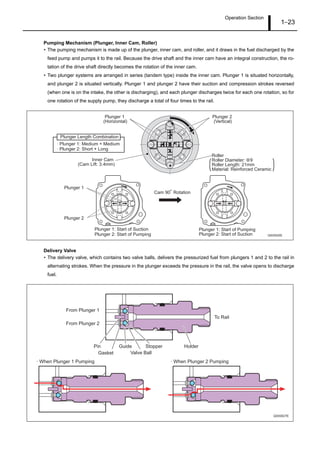
Pumping Mechanism (Plunger, Inner Cam, Roller)
• The pumping mechanism is made up of the plunger, inner cam, and roller, and it draws in the fuel discharged by the
feed pump and pumps it to the rail. Because the drive shaft and the inner cam have an integral construction, the ro-
tation of the drive shaft directly becomes the rotation of the inner cam.
• Two plunger systems are arranged in series (tandem type) inside the inner cam. Plunger 1 is situated horizontally,
and plunger 2 is situated vertically. Plunger 1 and plunger 2 have their suction and compression strokes reversed
(when one is on the intake, the other is discharging), and each plunger discharges twice for each one rotation, so for
one rotation of the supply pump, they discharge a total of four times to the rail.
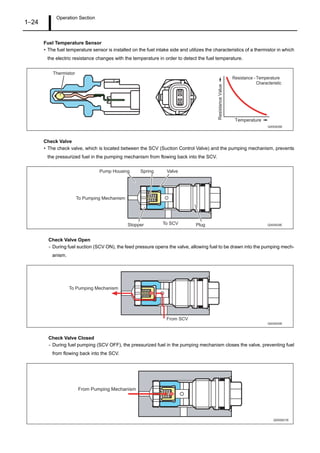
Delivery Valve
• The delivery valve, which contains two valve balls, delivers the pressurized fuel from plungers 1 and 2 to the rail in
alternating strokes. When the pressure in the plunger exceeds the pressure in the rail, the valve opens to discharge
fuel.
Inner Cam
(Cam Lift: 3.4mm)
Roller
Roller Diameter: 9
Roller Length: 21mm
Material: Reinforced Ceramic
Plunger 1
(Horizontal)
Plunger 2
(Vertical)
· Plunger 1: Medium + Medium
· Plunger 2: Short + Long
Plunger Length Combination
Cam 90 Rotation
Plunger 1: Start of Pumping
Plunger 2: Start of Suction
Plunger 1: Start of Suction
Plunger 2: Start of Pumping
Plunger 1
Plunger 2
Q000826E
From Plunger 1
From Plunger 2
Pin
Gasket
Guide
Valve Ball
Stopper Holder
To Rail
· When Plunger 1 Pumping · When Plunger 2 Pumping
Q000827E
Operation Section
1–24
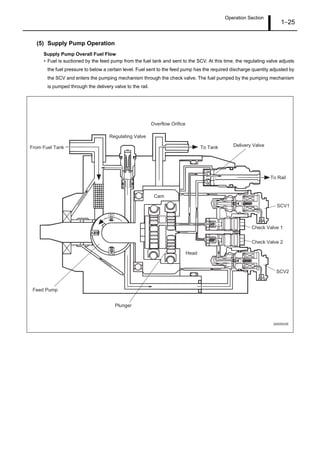
Fuel Temperature Sensor
• The fuel temperature sensor is installed on the fuel intake side and utilizes the characteristics of a thermistor in which
the electric resistance changes with the temperature in order to detect the fuel temperature.
Check Valve
• The check valve, which is located between the SCV (Suction Control Valve) and the pumping mechanism, prevents
the pressurized fuel in the pumping mechanism from flowing back into the SCV.
Check Valve Open
- During fuel suction (SCV ON), the feed pressure opens the valve, allowing fuel to be drawn into the pumping mech-
anism.
Check Valve Closed
- During fuel pumping (SCV OFF), the pressurized fuel in the pumping mechanism closes the valve, preventing fuel
from flowing back into the SCV.
Resistance - Temperature
Characteristic
Temperature
ResistanceValue
Thermistor
Q000828E
Pump Housing Spring Valve
Stopper PlugTo SCV
To Pumping Mechanism
Q000829E
From SCV
To Pumping Mechanism
Q000830E
From Pumping Mechanism
Q000831E
Operation Section
1–25
(5) Supply Pump Operation
Supply Pump Overall Fuel Flow
• Fuel is suctioned by the feed pump from the fuel tank and sent to the SCV. At this time, the regulating valve adjusts
the fuel pressure to below a certain level. Fuel sent to the feed pump has the required discharge quantity adjusted by
the SCV and enters the pumping mechanism through the check valve. The fuel pumped by the pumping mechanism
is pumped through the delivery valve to the rail.
From Fuel Tank
Feed Pump
Plunger
Cam
Head
SCV2
Check Valve 1
Check Valve 2
SCV1
To Rail
Delivery ValveTo Tank
Overflow Orifice
Regulating Valve
Q000832E
Operation Section
1–26
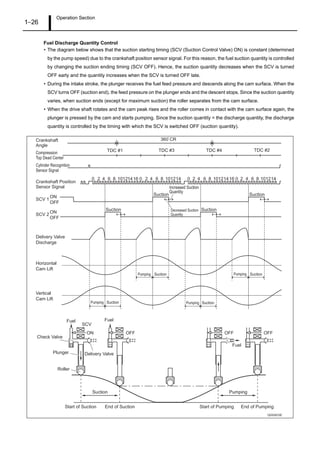
Fuel Discharge Quantity Control
• The diagram below shows that the suction starting timing (SCV (Suction Control Valve) ON) is constant (determined
by the pump speed) due to the crankshaft position sensor signal. For this reason, the fuel suction quantity is controlled
by changing the suction ending timing (SCV OFF). Hence, the suction quantity decreases when the SCV is turned
OFF early and the quantity increases when the SCV is turned OFF late.
• During the intake stroke, the plunger receives the fuel feed pressure and descends along the cam surface. When the
SCV turns OFF (suction end), the feed pressure on the plunger ends and the descent stops. Since the suction quantity
varies, when suction ends (except for maximum suction) the roller separates from the cam surface.
• When the drive shaft rotates and the cam peak rises and the roller comes in contact with the cam surface again, the
plunger is pressed by the cam and starts pumping. Since the suction quantity = the discharge quantity, the discharge
quantity is controlled by the timing with which the SCV is switched OFF (suction quantity).
0 2 4 6 8 10121416 0 2 4 6 8 101214 0 2 4 6 8 10121416 0 2 4 6 8 101214
Suction Suction
Suction SuctionDecreased Suction
Quantity
Increased Suction
Quantity
ON
OFF
SCV 1
SCV 2
Suction Pumping
Start of Suction End of Suction Start of Pumping End of Pumping
360 CR
TDC #1 TDC #3 TDC #4 TDC #2
Cylinder Recognition
Sensor Signal
Crankshaft Position
Sensor Signal
ON
OFF
Crankshaft
Angle
Compression
Top Dead Center
Fuel
ON
Plunger
Roller
OFF
Fuel
OFF
Fuel
OFF
Delivery Valve
Discharge
Horizontal
Cam Lift
Vertical
Cam Lift
Check Valve
SCV
Pumping Suction
Pumping SuctionPumping Suction
Pumping Suction
Delivery Valve
Q000833E
Operation Section
1–27
3.3 HP3 Type
(1) Construction and Characteristics
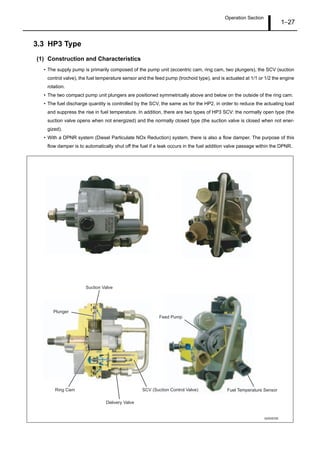
• The supply pump is primarily composed of the pump unit (eccentric cam, ring cam, two plungers), the SCV (suction
control valve), the fuel temperature sensor and the feed pump (trochoid type), and is actuated at 1/1 or 1/2 the engine
rotation.
• The two compact pump unit plungers are positioned symmetrically above and below on the outside of the ring cam.
• The fuel discharge quantity is controlled by the SCV, the same as for the HP2, in order to reduce the actuating load
and suppress the rise in fuel temperature. In addition, there are two types of HP3 SCV: the normally open type (the
suction valve opens when not energized) and the normally closed type (the suction valve is closed when not ener-
gized).
• With a DPNR system (Diesel Particulate NOx Reduction) system, there is also a flow damper. The purpose of this
flow damper is to automatically shut off the fuel if a leak occurs in the fuel addition valve passage within the DPNR.
Q000835E
Suction Valve
Plunger
Ring Cam SCV (Suction Control Valve)
Delivery Valve
Feed Pump
Fuel Temperature Sensor
Operation Section
1–28
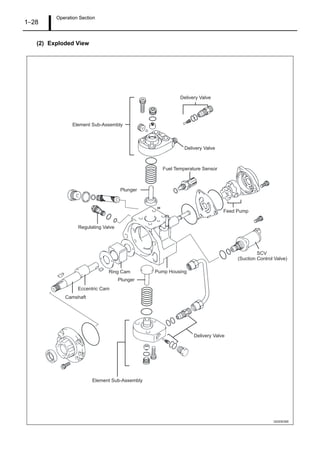
(2) Exploded View
Q000836E
Pump Housing
Camshaft
Eccentric Cam
Ring Cam
Feed Pump
Plunger
Element Sub-Assembly
SCV
(Suction Control Valve)
Regulating Valve
Fuel Temperature Sensor
Delivery Valve
Delivery Valve
Delivery Valve
Element Sub-Assembly
Plunger
Operation Section
1–29
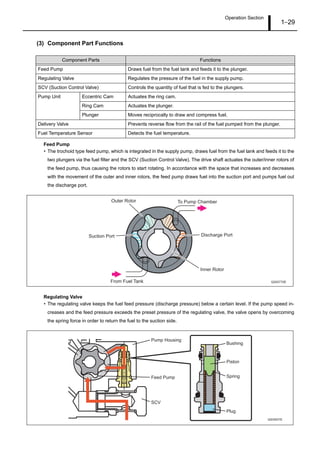
(3) Component Part Functions
Feed Pump
• The trochoid type feed pump, which is integrated in the supply pump, draws fuel from the fuel tank and feeds it to the
two plungers via the fuel filter and the SCV (Suction Control Valve). The drive shaft actuates the outer/inner rotors of
the feed pump, thus causing the rotors to start rotating. In accordance with the space that increases and decreases
with the movement of the outer and inner rotors, the feed pump draws fuel into the suction port and pumps fuel out
the discharge port.
Regulating Valve
• The regulating valve keeps the fuel feed pressure (discharge pressure) below a certain level. If the pump speed in-
creases and the feed pressure exceeds the preset pressure of the regulating valve, the valve opens by overcoming
the spring force in order to return the fuel to the suction side.
Component Parts Functions
Feed Pump Draws fuel from the fuel tank and feeds it to the plunger.
Regulating Valve Regulates the pressure of the fuel in the supply pump.
SCV (Suction Control Valve) Controls the quantity of fuel that is fed to the plungers.
Pump Unit Eccentric Cam Actuates the ring cam.
Ring Cam Actuates the plunger.
Plunger Moves reciprocally to draw and compress fuel.
Delivery Valve Prevents reverse flow from the rail of the fuel pumped from the plunger.
Fuel Temperature Sensor Detects the fuel temperature.
To Pump Chamber
From Fuel Tank
Outer Rotor
Inner Rotor
Suction Port Discharge Port
Q000770E
Bushing
Piston
Spring
Plug
Feed Pump
SCV
Pump Housing
Q000837E
Operation Section
1–30
Suction Control Valve (SCV)
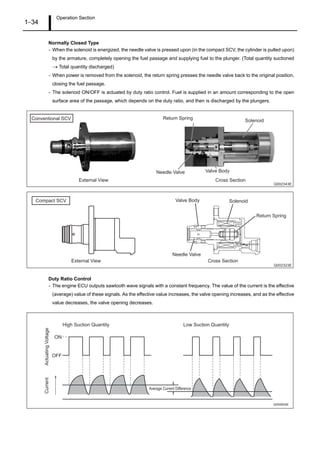
• In contrast to the HP2, the SCV for the HP3 supply pump is equipped with a linear solenoid valve. The fuel flow vol-
ume supplied to the high-pressure plunger is controlled by adjusting the engine ECU supplies power to the SCV (duty
ratio control). When current flows to the SCV, the internal armature moves according to the duty ratio. The armature
moves the needle valve, controlling the fuel flow volume according to the amount that the valve body fuel path is
blocked. Control is performed so that the supply pump suctions only the necessary fuel quantity to achieve the target
rail pressure. As a result, the supply pump actuation load is reduced.
• There are two types of HP3 SCV: the normally open type (the suction valve opens when not energized) and the nor-
mally closed type (the suction valve is closed when not energized). The operation of each type is the reverse of that
of the other.
• In recent years, a compact SCV has been developed. Compared to the conventional SCV, the position of the return
spring and needle valve in the compact SCV are reversed. For this reason, operation is also reversed.
Normally Open Type
- When the solenoid is not energized, the return spring pushes against the needle valve, completely opening the fuel
passage and supplying fuel to the plungers. (Total quantity suctioned → Total quantity discharged)
- When the solenoid is energized, the armature pushes the needle valve, which compresses the return spring and
closes the fuel passage. In contrast, the needle valve in the compact SCV is pulled upon, which compresses the
return spring and closes the fuel passage.
- The solenoid ON/OFF is actuated by duty ratio control. Fuel is supplied in an amount corresponding to the open
surface area of the passage, which depends on the duty ratio, and then is discharged by the plungers.
Q002340E
Conventional SCV
External View
Return Spring Solenoid
Valve Body
Cross Section
Needle Valve
Q002309E
Return Spring
Solenoid
Valve Body
Needle Valve
Compact SCV
External View Cross Section
Operation Section
1–31
Duty Ratio Control
- The engine ECU outputs sawtooth wave signals with a constant frequency. The value of the current is the effective
(average) value of these signals. As the effective value increases, the valve opening decreases, and as the effec-
tive value decreases, the valve opening increases.
When the SCV Energized Duration (Duty ON Time) is Short
- When the SCV energization time is short, the average current flowing through the solenoid is small. As a result, the
needle valve is returned by spring force, creating a large valve opening. Subsequently, the fuel suction quantity
increases.
QD0710E
Average Current Difference
ActuatingVoltage
ON
OFF
Current
Low Suction Quantity High Suction Quantity
Q002341E
Needle
Valve
Large Valve
Opening
SCV
Feed Pump
Conventional SCV
Operation Section
1–32
When the SCV Energized Duration (Duty ON Time) is Long
- When the energization time is long, the average current flowing to the solenoid is large. As a result, the needle
valve is pressed out (in the compact SCV, the needle valve is pulled), creating a small valve opening. Subsequently,
the fuel suction quantity decreases.
Q002321E
Compact SCV
Needle Valve
Large
Opening
Feed Pump
Q002342E
Needle
Valve
Small
Opening
SCV
Feed Pump
Conventional SCV
Operation Section
1–33
Q002322E
Small Valve
Opening
Compact SCV
Needle Valve
SCV
Feed Pump
Operation Section
1–34
Normally Closed Type
- When the solenoid is energized, the needle valve is pressed upon (in the compact SCV, the cylinder is pulled upon)
by the armature, completely opening the fuel passage and supplying fuel to the plunger. (Total quantity suctioned
→ Total quantity discharged)
- When power is removed from the solenoid, the return spring presses the needle valve back to the original position,
closing the fuel passage.
- The solenoid ON/OFF is actuated by duty ratio control. Fuel is supplied in an amount corresponding to the open
surface area of the passage, which depends on the duty ratio, and then is discharged by the plungers.
Duty Ratio Control
- The engine ECU outputs sawtooth wave signals with a constant frequency. The value of the current is the effective
(average) value of these signals. As the effective value increases, the valve opening increases, and as the effective
value decreases, the valve opening decreases.
Q002343E
Cross SectionExternal View
Return Spring Solenoid
Valve BodyNeedle Valve
Conventional SCV
Q002323E
Cross SectionExternal View
Return Spring
SolenoidValve Body
Needle Valve
Compact SCV
Q000844E
Average Current Difference
ActuatingVoltage
ON
OFF
Current
High Suction Quantity Low Suction Quantity
Operation Section
1–35
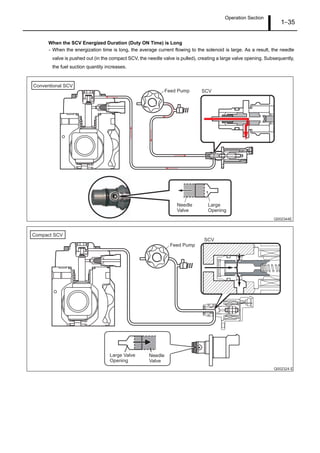
When the SCV Energized Duration (Duty ON Time) is Long
- When the energization time is long, the average current flowing to the solenoid is large. As a result, the needle
valve is pushed out (in the compact SCV, the needle valve is pulled), creating a large valve opening. Subsequently,
the fuel suction quantity increases.
Q002344E
Needle
Valve
Large
Opening
SCVFeed Pump
Conventional SCV
Q002324 E
Large Valve
Opening
Compact SCV
Needle
Valve
SCV
Feed Pump
Operation Section
1–36
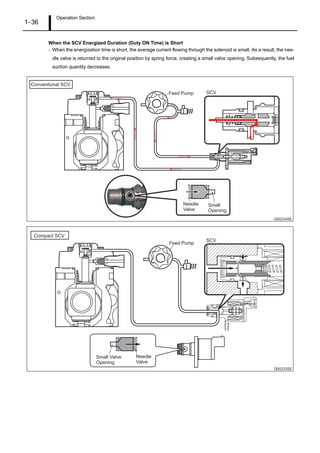
When the SCV Energized Duration (Duty ON Time) is Short
- When the energization time is short, the average current flowing through the solenoid is small. As a result, the nee-
dle valve is returned to the original position by spring force, creating a small valve opening. Subsequently, the fuel
suction quantity decreases.
Q002345E
SCVFeed Pump
Small
Opening
Needle
Valve
Conventional SCV
Q002325E
Needle
Valve
Small Valve
Opening
Compact SCV
SCV
Feed Pump
Operation Section
1–37
Pump Unit (Eccentric Cam, Ring Cam, Plunger)
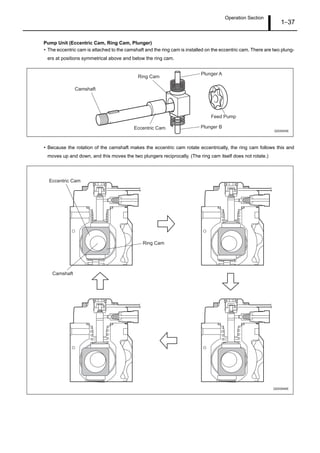
• The eccentric cam is attached to the camshaft and the ring cam is installed on the eccentric cam. There are two plung-
ers at positions symmetrical above and below the ring cam.
• Because the rotation of the camshaft makes the eccentric cam rotate eccentrically, the ring cam follows this and
moves up and down, and this moves the two plungers reciprocally. (The ring cam itself does not rotate.)
Plunger A
Ring Cam
Feed Pump
Plunger B
Camshaft
Eccentric Cam
Q000845E
Q000846E
Ring Cam
Eccentric Cam
Camshaft
Operation Section
1–38
Delivery Valve
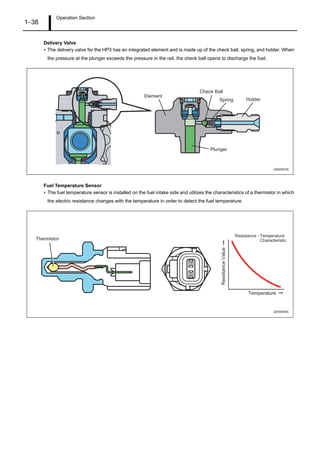
• The delivery valve for the HP3 has an integrated element and is made up of the check ball, spring, and holder. When
the pressure at the plunger exceeds the pressure in the rail, the check ball opens to discharge the fuel.
Fuel Temperature Sensor
• The fuel temperature sensor is installed on the fuel intake side and utilizes the characteristics of a thermistor in which
the electric resistance changes with the temperature in order to detect the fuel temperature.
Element
Check Ball
Spring Holder
Plunger
Q000847E
Resistance - Temperature
Characteristic
Temperature
ResistanceValue
Thermistor
Q000848E
Operation Section
1–39
(4) Supply Pump Operation
Supply Pump Overall Fuel Flow
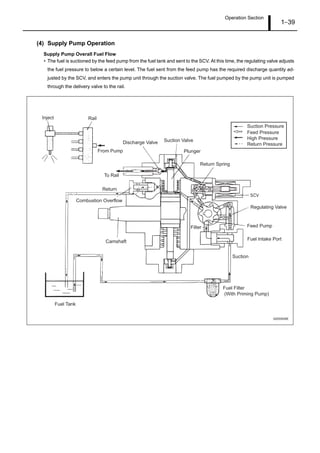
• The fuel is suctioned by the feed pump from the fuel tank and sent to the SCV. At this time, the regulating valve adjusts
the fuel pressure to below a certain level. The fuel sent from the feed pump has the required discharge quantity ad-
justed by the SCV, and enters the pump unit through the suction valve. The fuel pumped by the pump unit is pumped
through the delivery valve to the rail.
Filter
From Pump
To Rail
Q000849E
Inject Rail
Discharge Valve Suction Valve
Plunger
Return Spring
Return
Combustion Overflow
Camshaft
Fuel Tank
Fuel Filter
(With Priming Pump)
Suction
Fuel Intake Port
Feed Pump
Regulating Valve
Suction Pressure
Feed Pressure
High Pressure
Return Pressure
Operation Section
1–40
Operation
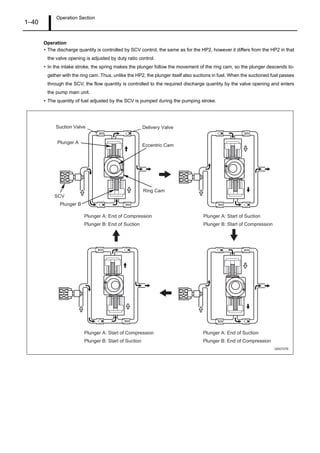
• The discharge quantity is controlled by SCV control, the same as for the HP2, however it differs from the HP2 in that
the valve opening is adjusted by duty ratio control.
• In the intake stroke, the spring makes the plunger follow the movement of the ring cam, so the plunger descends to-
gether with the ring cam. Thus, unlike the HP2, the plunger itself also suctions in fuel. When the suctioned fuel passes
through the SCV, the flow quantity is controlled to the required discharge quantity by the valve opening and enters
the pump main unit.
• The quantity of fuel adjusted by the SCV is pumped during the pumping stroke.
SCV
Plunger B
Plunger A
Eccentric Cam
Delivery ValveSuction Valve
Ring Cam
Plunger A: End of Compression
Plunger B: End of Suction
Plunger A: End of Suction
Plunger B: End of Compression
Plunger B: Start of Compression
Plunger A: Start of Suction
Plunger B: Start of Suction
Plunger A: Start of Compression
QD0707E
Operation Section
1–41
3.4 HP4 Type
(1) Construction and Characteristics
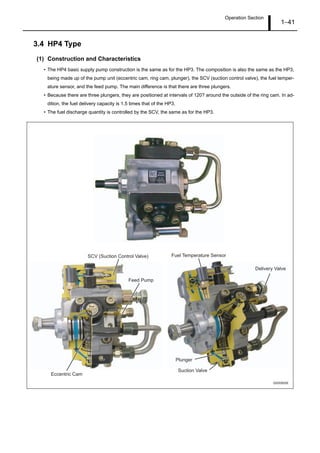
• The HP4 basic supply pump construction is the same as for the HP3. The composition is also the same as the HP3,
being made up of the pump unit (eccentric cam, ring cam, plunger), the SCV (suction control valve), the fuel temper-
ature sensor, and the feed pump. The main difference is that there are three plungers.
• Because there are three plungers, they are positioned at intervals of 120? around the outside of the ring cam. In ad-
dition, the fuel delivery capacity is 1.5 times that of the HP3.
• The fuel discharge quantity is controlled by the SCV, the same as for the HP3.
Q000850E
Suction Valve
Plunger
Eccentric Cam
SCV (Suction Control Valve)
Delivery Valve
Feed Pump
Fuel Temperature Sensor
Operation Section
1–42
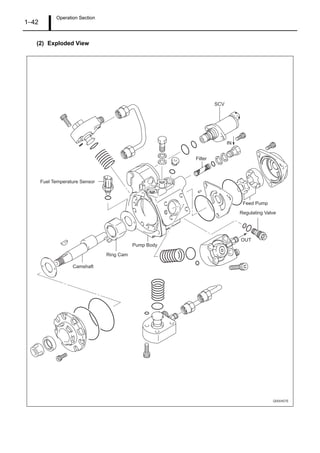
(2) Exploded View
Q000457E
SCV
Fuel Temperature Sensor
Filter
Feed Pump
Regulating Valve
Pump Body
Ring Cam
Camshaft
IN
OUT
Operation Section
1–43
(3) Component Part Functions
• The HP4 supply pump component parts and functions are basically the same as for the HP3. The explanations below
only cover those points on which the HP4 differs from the HP3. For other parts, see the appropriate item in the expla-
nation of the HP3.
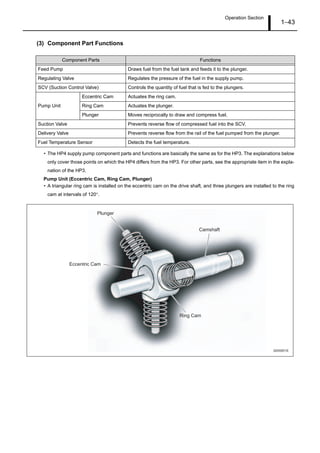
Pump Unit (Eccentric Cam, Ring Cam, Plunger)
• A triangular ring cam is installed on the eccentric cam on the drive shaft, and three plungers are installed to the ring
cam at intervals of 120°.
Component Parts Functions
Feed Pump Draws fuel from the fuel tank and feeds it to the plunger.
Regulating Valve Regulates the pressure of the fuel in the supply pump.
SCV (Suction Control Valve) Controls the quantity of fuel that is fed to the plungers.
Pump Unit
Eccentric Cam Actuates the ring cam.
Ring Cam Actuates the plunger.
Plunger Moves reciprocally to draw and compress fuel.
Suction Valve Prevents reverse flow of compressed fuel into the SCV.
Delivery Valve Prevents reverse flow from the rail of the fuel pumped from the plunger.
Fuel Temperature Sensor Detects the fuel temperature.
Ring Cam
Plunger
Camshaft
Eccentric Cam
Q000851E
Operation Section
1–44
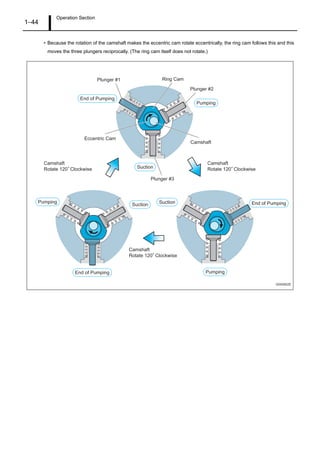
• Because the rotation of the camshaft makes the eccentric cam rotate eccentrically, the ring cam follows this and this
moves the three plungers reciprocally. (The ring cam itself does not rotate.)
Plunger #1
Plunger #2
Eccentric Cam
Camshaft
Camshaft
Rotate 120 Clockwise
Camshaft
Rotate 120 Clockwise
Camshaft
Rotate 120 Clockwise
Ring Cam
Plunger #3
End of Pumping
End of Pumping
End of Pumping
Pumping
Pumping
Pumping
Suction
SuctionSuction
D000852E
Operation Section
1–45
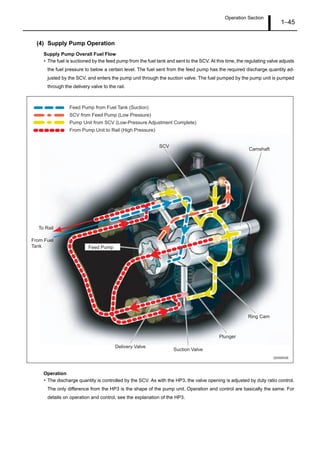
(4) Supply Pump Operation
Supply Pump Overall Fuel Flow
• The fuel is suctioned by the feed pump from the fuel tank and sent to the SCV. At this time, the regulating valve adjusts
the fuel pressure to below a certain level. The fuel sent from the feed pump has the required discharge quantity ad-
justed by the SCV, and enters the pump unit through the suction valve. The fuel pumped by the pump unit is pumped
through the delivery valve to the rail.
Operation
• The discharge quantity is controlled by the SCV. As with the HP3, the valve opening is adjusted by duty ratio control.
The only difference from the HP3 is the shape of the pump unit. Operation and control are basically the same. For
details on operation and control, see the explanation of the HP3.
Q000853E
Feed Pump from Fuel Tank (Suction)
SCV from Feed Pump (Low Pressure)
Pump Unit from SCV (Low-Pressure Adjustment Complete)
From Pump Unit to Rail (High Pressure)
From Fuel
Tank
To Rail
Plunger
Suction Valve
Delivery Valve
Ring Cam
Camshaft
SCV
Feed Pump
Operation Section
1–46
4. RAIL DESCCRIPTION
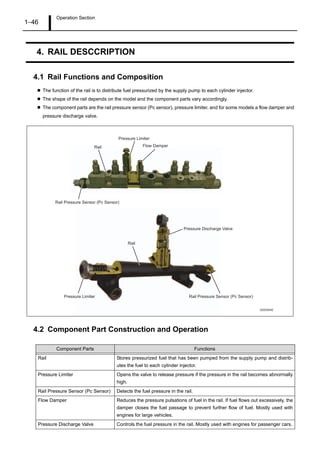
4.1 Rail Functions and Composition
The function of the rail is to distribute fuel pressurized by the supply pump to each cylinder injector.
The shape of the rail depends on the model and the component parts vary accordingly.
The component parts are the rail pressure sensor (Pc sensor), pressure limiter, and for some models a flow damper and
pressure discharge valve.
4.2 Component Part Construction and Operation
Component Parts Functions
Rail Stores pressurized fuel that has been pumped from the supply pump and distrib-
utes the fuel to each cylinder injector.
Pressure Limiter Opens the valve to release pressure if the pressure in the rail becomes abnormally
high.
Rail Pressure Sensor (Pc Sensor) Detects the fuel pressure in the rail.
Flow Damper Reduces the pressure pulsations of fuel in the rail. If fuel flows out excessively, the
damper closes the fuel passage to prevent further flow of fuel. Mostly used with
engines for large vehicles.
Pressure Discharge Valve Controls the fuel pressure in the rail. Mostly used with engines for passenger cars.
Rail
Rail
Pressure Limiter
Pressure Limiter
Rail Pressure Sensor (Pc Sensor)
Flow Damper
Pressure Discharge Valve
Q000854E
Operation Section
1–47
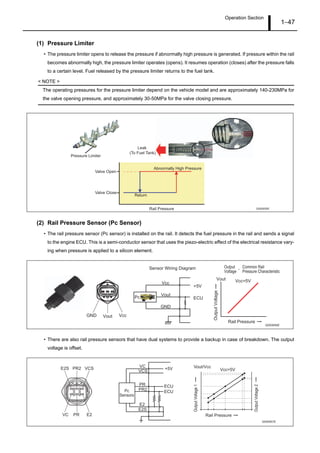
(1) Pressure Limiter
• The pressure limiter opens to release the pressure if abnormally high pressure is generated. If pressure within the rail
becomes abnormally high, the pressure limiter operates (opens). It resumes operation (closes) after the pressure falls
to a certain level. Fuel released by the pressure limiter returns to the fuel tank.
< NOTE >
The operating pressures for the pressure limiter depend on the vehicle model and are approximately 140-230MPa for
the valve opening pressure, and approximately 30-50MPa for the valve closing pressure.
(2) Rail Pressure Sensor (Pc Sensor)
• The rail pressure sensor (Pc sensor) is installed on the rail. It detects the fuel pressure in the rail and sends a signal
to the engine ECU. This is a semi-conductor sensor that uses the piezo-electric effect of the electrical resistance vary-
ing when pressure is applied to a silicon element.
• There are also rail pressure sensors that have dual systems to provide a backup in case of breakdown. The output
voltage is offset.
Pressure Limiter
Leak
(To Fuel Tank)
Valve Open
Valve Close
Rail Pressure
Abnormally High Pressure
Return
Q000855E
GND
Vout
Sensor Wiring Diagram Common Rail
Pressure Characteristic
Output
Voltage
-
Rail Pressure
OutputVoltage
Vcc
+5V
ECUPc
Vout Vcc=5V
GND Vout Vcc
Q000856E
Q000857E
E2S PR2 VCS
VC PR E2
Pc
Sensors
VC
VCS
PR2
PR
E2
E2S
+5V
ECU
ECU
Vout/Vcc
Vcc=5V
Rail Pressure
OutputVoltage1
OutputVoltage2
Operation Section
1–48
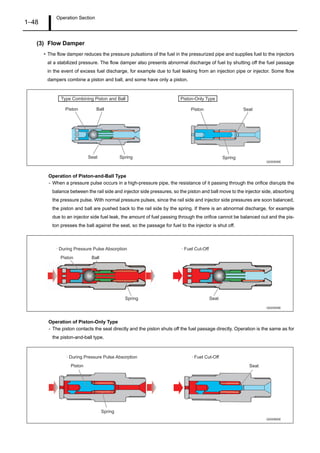
(3) Flow Damper
• The flow damper reduces the pressure pulsations of the fuel in the pressurized pipe and supplies fuel to the injectors
at a stabilized pressure. The flow damper also presents abnormal discharge of fuel by shutting off the fuel passage
in the event of excess fuel discharge, for example due to fuel leaking from an injection pipe or injector. Some flow
dampers combine a piston and ball, and some have only a piston.
Operation of Piston-and-Ball Type
- When a pressure pulse occurs in a high-pressure pipe, the resistance of it passing through the orifice disrupts the
balance between the rail side and injector side pressures, so the piston and ball move to the injector side, absorbing
the pressure pulse. With normal pressure pulses, since the rail side and injector side pressures are soon balanced,
the piston and ball are pushed back to the rail side by the spring. If there is an abnormal discharge, for example
due to an injector side fuel leak, the amount of fuel passing through the orifice cannot be balanced out and the pis-
ton presses the ball against the seat, so the passage for fuel to the injector is shut off.
Operation of Piston-Only Type
- The piston contacts the seat directly and the piston shuts off the fuel passage directly. Operation is the same as for
the piston-and-ball type.
Q000858E
Piston Ball
Seat Spring
Piston
Spring
Seat
Type Combining Piston and Ball Piston-Only Type
Q000859E
· During Pressure Pulse Absorption · Fuel Cut-Off
Piston Ball
SeatSpring
Q000860E
· During Pressure Pulse Absorption · Fuel Cut-Off
Piston
Spring
Seat
Operation Section
1–49
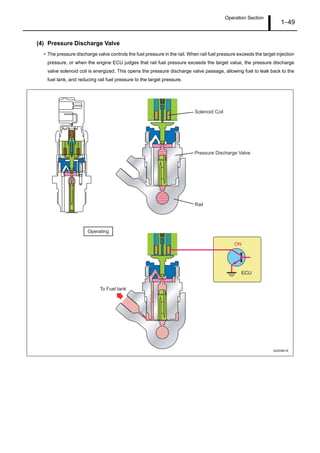
(4) Pressure Discharge Valve
• The pressure discharge valve controls the fuel pressure in the rail. When rail fuel pressure exceeds the target injection
pressure, or when the engine ECU judges that rail fuel pressure exceeds the target value, the pressure discharge
valve solenoid coil is energized. This opens the pressure discharge valve passage, allowing fuel to leak back to the
fuel tank, and reducing rail fuel pressure to the target pressure.
Q000861E
Pressure Discharge Valve
Rail
ON
ECU
To Fuel tank
Operating
Solenoid Coil
Operation Section
1–50
5. INJECTOR DESCRIPTION
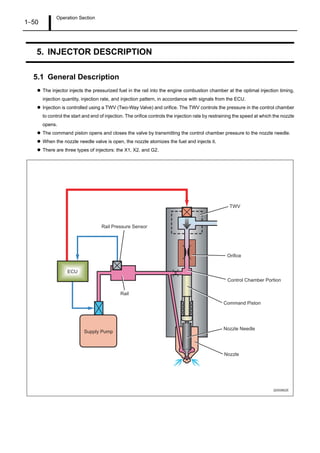
5.1 General Description
The injector injects the pressurized fuel in the rail into the engine combustion chamber at the optimal injection timing,
injection quantity, injection rate, and injection pattern, in accordance with signals from the ECU.
Injection is controlled using a TWV (Two-Way Valve) and orifice. The TWV controls the pressure in the control chamber
to control the start and end of injection. The orifice controls the injection rate by restraining the speed at which the nozzle
opens.
The command piston opens and closes the valve by transmitting the control chamber pressure to the nozzle needle.
When the nozzle needle valve is open, the nozzle atomizes the fuel and injects it.
There are three types of injectors: the X1, X2, and G2.
Q000862E
ECU
Supply Pump
Nozzle
Command Piston
Control Chamber Portion
Orifice
TWV
Rail
Rail Pressure Sensor
Nozzle Needle
Operation Section
1–51
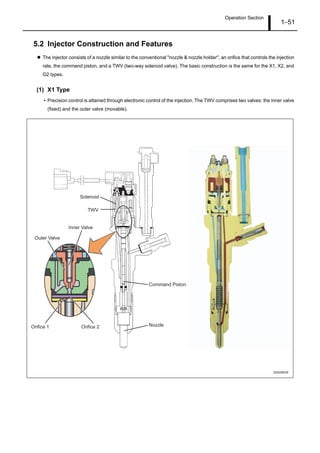
5.2 Injector Construction and Features
The injector consists of a nozzle similar to the conventional "nozzle & nozzle holder", an orifice that controls the injection
rate, the command piston, and a TWV (two-way solenoid valve). The basic construction is the same for the X1, X2, and
G2 types.
(1) X1 Type
• Precision control is attained through electronic control of the injection. The TWV comprises two valves: the inner valve
(fixed) and the outer valve (movable).
Q000863E
Nozzle
Command Piston
TWV
Solenoid
Orifice 1 Orifice 2
Inner Valve
Outer Valve
Operation Section
1–52
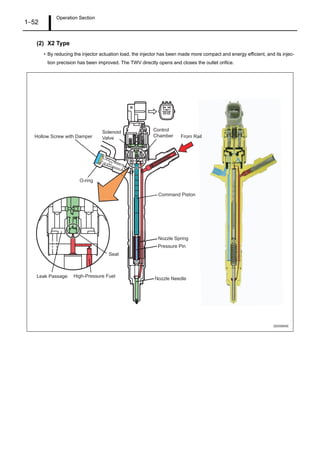
(2) X2 Type
• By reducing the injector actuation load, the injector has been made more compact and energy efficient, and its injec-
tion precision has been improved. The TWV directly opens and closes the outlet orifice.
Control
Chamber
Solenoid
ValveHollow Screw with Damper
O-ring
Command Piston
Nozzle Spring
Pressure Pin
Nozzle Needle
Seat
High-Pressure FuelLeak Passage
From Rail
Q000864E
Operation Section
1–53
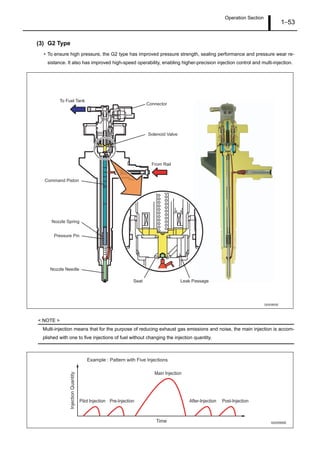
(3) G2 Type
• To ensure high pressure, the G2 type has improved pressure strength, sealing performance and pressure wear re-
sistance. It also has improved high-speed operability, enabling higher-precision injection control and multi-injection.
< NOTE >
Multi-injection means that for the purpose of reducing exhaust gas emissions and noise, the main injection is accom-
plished with one to five injections of fuel without changing the injection quantity.
Q000865E
Connector
Solenoid Valve
Command Piston
Nozzle Spring
Pressure Pin
Nozzle Needle
Seat Leak Passage
From Rail
To Fuel Tank
Example : Pattern with Five Injections
Time
Pre-InjectionPilot Injection After-Injection
Main Injection
Post-Injection
InjectionQuantity
Q000866E
Operation Section
1–54
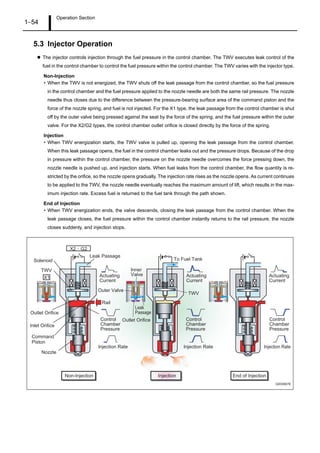
5.3 Injector Operation
The injector controls injection through the fuel pressure in the control chamber. The TWV executes leak control of the
fuel in the control chamber to control the fuel pressure within the control chamber. The TWV varies with the injector type.
Non-Injection
• When the TWV is not energized, the TWV shuts off the leak passage from the control chamber, so the fuel pressure
in the control chamber and the fuel pressure applied to the nozzle needle are both the same rail pressure. The nozzle
needle thus closes due to the difference between the pressure-bearing surface area of the command piston and the
force of the nozzle spring, and fuel is not injected. For the X1 type, the leak passage from the control chamber is shut
off by the outer valve being pressed against the seat by the force of the spring, and the fuel pressure within the outer
valve. For the X2/G2 types, the control chamber outlet orifice is closed directly by the force of the spring.
Injection
• When TWV energization starts, the TWV valve is pulled up, opening the leak passage from the control chamber.
When this leak passage opens, the fuel in the control chamber leaks out and the pressure drops. Because of the drop
in pressure within the control chamber, the pressure on the nozzle needle overcomes the force pressing down, the
nozzle needle is pushed up, and injection starts. When fuel leaks from the control chamber, the flow quantity is re-
stricted by the orifice, so the nozzle opens gradually. The injection rate rises as the nozzle opens. As current continues
to be applied to the TWV, the nozzle needle eventually reaches the maximum amount of lift, which results in the max-
imum injection rate. Excess fuel is returned to the fuel tank through the path shown.
End of Injection
• When TWV energization ends, the valve descends, closing the leak passage from the control chamber. When the
leak passage closes, the fuel pressure within the control chamber instantly returns to the rail pressure, the nozzle
closes suddenly, and injection stops.
Q000867E
Outer Valve
Injection Rate
Control
Chamber
Pressure
Control
Chamber
Pressure
Control
Chamber
Pressure
Solenoid
TWV
Outlet Orifice
Inlet Orifice
Command
Piston
Nozzle
Injection Rate Injection Rate
Non-Injection Injection End of Injection
Rail
X1
X2 · G2
Outlet Orifice
Actuating
Current
Actuating
Current
Actuating
Current
Inner
Valve
To Fuel Tank
Leak Passage
Leak
Passage
TWV
Operation Section
1–55
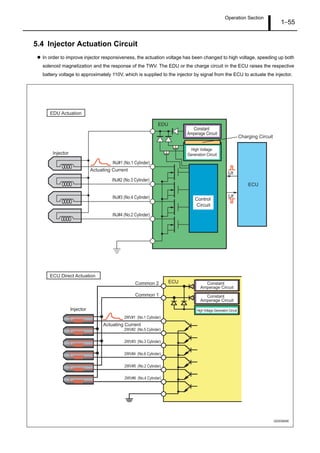
5.4 Injector Actuation Circuit
In order to improve injector responsiveness, the actuation voltage has been changed to high voltage, speeding up both
solenoid magnetization and the response of the TWV. The EDU or the charge circuit in the ECU raises the respective
battery voltage to approximately 110V, which is supplied to the injector by signal from the ECU to actuate the injector.
Q000868E
INJ#1 (No.1 Cylinder)
ECU
Injector
INJ#2 (No.3 Cylinder)
INJ#3 (No.4 Cylinder)
INJ#4 (No.2 Cylinder)
Charging Circuit
IJt
IJf
EDU
Actuating Current
ECU
Actuating Current
ECU Direct Actuation
EDU Actuation
2WV#3 (No.3 Cylinder)
2WV#4 (No.6 Cylinder)
2WV#5 (No.2 Cylinder)
2WV#6 (No.4 Cylinder)
Injector
Common 2
Common 1
2WV#1 (No.1 Cylinder)
2WV#2 (No.5 Cylinder)
Constant
Amperage Circuit
High Voltage
Generation Circuit
Control
Circuit
Constant
Amperage Circuit
Constant
Amperage Circuit
High Voltage Generation Circuit
Operation Section
1–56
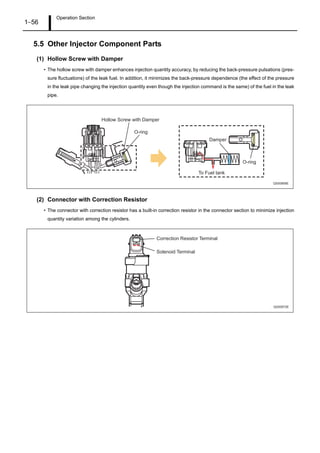
5.5 Other Injector Component Parts
(1) Hollow Screw with Damper
• The hollow screw with damper enhances injection quantity accuracy, by reducing the back-pressure pulsations (pres-
sure fluctuations) of the leak fuel. In addition, it minimizes the back-pressure dependence (the effect of the pressure
in the leak pipe changing the injection quantity even though the injection command is the same) of the fuel in the leak
pipe.
(2) Connector with Correction Resistor
• The connector with correction resistor has a built-in correction resistor in the connector section to minimize injection
quantity variation among the cylinders.
Q000869E
Hollow Screw with Damper
O-ring
O-ring
Damper
To Fuel tank
Q000870E
Correction Resistor Terminal
Solenoid Terminal
Operation Section
1–57
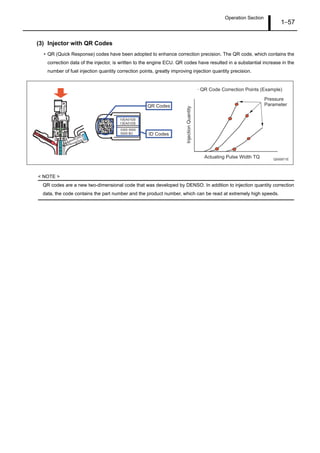
(3) Injector with QR Codes
• QR (Quick Response) codes have been adopted to enhance correction precision. The QR code, which contains the
correction data of the injector, is written to the engine ECU. QR codes have resulted in a substantial increase in the
number of fuel injection quantity correction points, greatly improving injection quantity precision.
< NOTE >
QR codes are a new two-dimensional code that was developed by DENSO. In addition to injection quantity correction
data, the code contains the part number and the product number, which can be read at extremely high speeds.
Q000871E
InjectionQuantity
Actuating Pulse Width TQ
Pressure
Parameter
· QR Code Correction Points (Example)
10EA01EB
13EA01EB
0300 0000
0000 BC
QR Codes
ID Codes
Operation Section
1–58
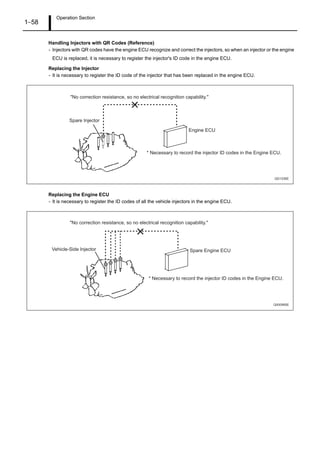
Handling Injectors with QR Codes (Reference)
- Injectors with QR codes have the engine ECU recognize and correct the injectors, so when an injector or the engine
ECU is replaced, it is necessary to register the injector's ID code in the engine ECU.
Replacing the Injector
- It is necessary to register the ID code of the injector that has been replaced in the engine ECU.
Replacing the Engine ECU
- It is necessary to register the ID codes of all the vehicle injectors in the engine ECU.
QD1536E
Engine ECU
Spare Injector
"No correction resistance, so no electrical recognition capability."
* Necessary to record the injector ID codes in the Engine ECU.
"No correction resistance, so no electrical recognition capability."
* Necessary to record the injector ID codes in the Engine ECU.
Q000985E
Vehicle-Side Injector Spare Engine ECU
Operation Section
1–59
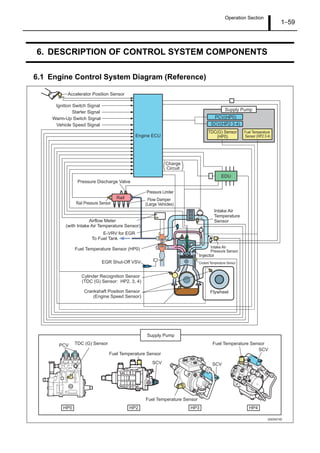
6. DESCRIPTION OF CONTROL SYSTEM COMPONENTS
6.1 Engine Control System Diagram (Reference)
Q000874E
Rail
Rail Pressure Sensor
Pressure Discharge Valve
Pressure Limiter
Injector
Engine ECU
EDU
E-VRV for EGR
EGR Shut-Off VSV
Crankshaft Position Sensor
(Engine Speed Sensor)
Cylinder Recognition Sensor
(TDC (G) Sensor: HP2, 3, 4)
Accelerator Position Sensor
Intake Air
Temperature
SensorAirflow Meter
(with Intake Air Temperature Sensor)
Coolant Temperature Sensor
Intake Air
Pressure Sensor
Ignition Switch Signal
Starter Signal
Warm-Up Switch Signal
Vehicle Speed Signal
Supply Pump
TDC(G) Sensor
(HP0)
SCV(HP2·3·4)
Fuel Temperature
Sensor (HP2·3·4)
PCV(HP0)
To Fuel Tank
Charge
Circuit
Flow Damper
(Large Vehicles)
PCV TDC (G) Sensor
Fuel Temperature Sensor
SCV
Fuel Temperature Sensor
SCV
SCV
Supply Pump
HP0 HP2 HP3 HP4
Fuel Temperature Sensor (HP0)
Flywheel
Operation Section
1–60
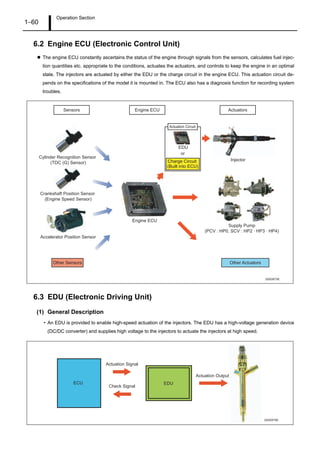
6.2 Engine ECU (Electronic Control Unit)
The engine ECU constantly ascertains the status of the engine through signals from the sensors, calculates fuel injec-
tion quantities etc. appropriate to the conditions, actuates the actuators, and controls to keep the engine in an optimal
state. The injectors are actuated by either the EDU or the charge circuit in the engine ECU. This actuation circuit de-
pends on the specifications of the model it is mounted in. The ECU also has a diagnosis function for recording system
troubles.
6.3 EDU (Electronic Driving Unit)
(1) General Description
• An EDU is provided to enable high-speed actuation of the injectors. The EDU has a high-voltage generation device
(DC/DC converter) and supplies high voltage to the injectors to actuate the injectors at high speed.
Q000875E
Sensors Engine ECU Actuators
Cylinder Recognition Sensor
(TDC (G) Sensor)
Crankshaft Position Sensor
(Engine Speed Sensor)
Accelerator Position Sensor
Other Sensors
Engine ECU
Injector
Supply Pump
(PCV : HP0, SCV : HP2 · HP3 · HP4)
Other Actuators
Charge Circuit
(Built into ECU)
or
EDU
Actuation Circuit
ECU EDU
Actuation Signal
Check Signal
Actuation Output
Q000876E
Operation Section
1–61
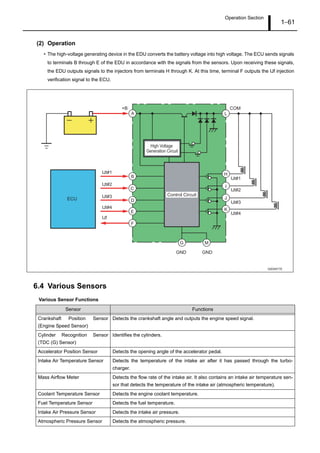
(2) Operation
• The high-voltage generating device in the EDU converts the battery voltage into high voltage. The ECU sends signals
to terminals B through E of the EDU in accordance with the signals from the sensors. Upon receiving these signals,
the EDU outputs signals to the injectors from terminals H through K. At this time, terminal F outputs the IJf injection
verification signal to the ECU.
6.4 Various Sensors
Various Sensor Functions
Sensor Functions
Crankshaft Position Sensor
(Engine Speed Sensor)
Detects the crankshaft angle and outputs the engine speed signal.
Cylinder Recognition Sensor
(TDC (G) Sensor)
Identifies the cylinders.
Accelerator Position Sensor Detects the opening angle of the accelerator pedal.
Intake Air Temperature Sensor Detects the temperature of the intake air after it has passed through the turbo-
charger.
Mass Airflow Meter Detects the flow rate of the intake air. It also contains an intake air temperature sen-
sor that detects the temperature of the intake air (atmospheric temperature).
Coolant Temperature Sensor Detects the engine coolant temperature.
Fuel Temperature Sensor Detects the fuel temperature.
Intake Air Pressure Sensor Detects the intake air pressure.
Atmospheric Pressure Sensor Detects the atmospheric pressure.
GND GND
High Voltage
Generation Circuit
Control Circuit
A L
B
IJt#1
IJt#1
COM+B
IJt#2
IJt#3
IJt#4
IJt#2
IJt#3
IJt#4
IJf
C
D
E
F
G M
H
I
J
K
ECU
Q000877E
Operation Section
1–62
(1) Crankshaft Position Sensor (Engine Speed Sensor) and Cylinder Recognition Sensor
{TDC (G) Sensor}
Crankshaft Position Sensor (Engine Speed Sensor)
• The crankshaft position sensor is installed near the crankshaft timing gear or the flywheel. The sensor unit is a MPU
(magnetic pickup) type. When the engine speed pulsar gear installed on the crankshaft passes the sensor section,
the magnetic field of the coil within the sensor changes, generating AC voltage. This AC voltage is detected by the
engine ECU as the detection signal. The number of pulses for the engine speed pulsar depends on the specifications
of the vehicle the sensor is mounted in.
Cylinder Recognition Sensor {TDC (G) Sensor}
• The cylinder recognition sensor is installed on the supply pump unit for the HP0 system, but for the HP2, HP3, or HP4
system, it is installed near the supply pump timing gear. Sensor unit construction consists of the MPU type, which is
the same as for the crankshaft position sensor, and the MRE (magnetic resistance element) type. For the MRE type,
when the pulsar passes the sensor, the magnetic resistance changes and the voltage passing through the sensor
changes. This change in voltage is amplified by the internal IC circuit and output to the engine ECU. The number of
pulses for the TDC pulsar depends on the specifications of the vehicle the sensor is mounted in.
Sensor Mounting Position (Reference)
NE+
NE-
VCC
TDC(G)
GND
TDC(G)TDC(G)-
TDC(G)
GND
VCC
NE
TDC (G)
Pulse
TDC(G)
ECU
0V
360 CA 360 CA
720 CA
Engine Speed Pulsar TDC (G) Pulsar
Q000878E
Pulsar
(Gearless Section)
Crankshaft Position Sensor
(Engine Speed Sensor)
Cylinder Recognition Sensor
(TDC (G) Sensor)
Pulsar
For MPU
Type
For MRE
Type
MPU Type
MPU
Type
MRE Type
MRE
Type
MPU
Type
MRE
Type
External View of Sensor
Shielded
Wire
Crankshaft Position Sensor
(Engine Speed Sensor)
Cylinder Recognition Sensor
(TDC (G) Sensor)
TDC (G) Input Circuit
Engine Speed
Input Circuit
Circuit Diagram
Pulse Chart (Reference)
Engine Speed
Pulse
Operation Section
1–63
(2) Accelerator Position Sensor
• The accelerator position sensor converts the accelerator opening into an electric signal and outputs it to the engine
ECU. There are two types of accelerator position sensor: the hall element type and the contact type. In addition, to
provide backup in the event of breakdown, there are two systems and the output voltage is offset.
Hall Element Type
- This sensor uses a hall element to generate voltage from change in the direction of the magnetic field. A magnet
is installed on the shaft that rotates linked with the accelerator pedal, and the rotation of this shaft changes the mag-
netic field of the Hall element. The voltage generated by this change in the magnetic field is amplified by an amplifier
and input to the engine ECU.
Contact Type
- The sensor uses a contact-type variable resistor. Since the lever moves linked with the accelerator pedal, the sen-
sor resistance value varies with the accelerator pedal opening. Therefore, the voltage passing the sensor changes,
and this voltage is input to the engine ECU as the accelerator opening signal.
Q000879E
4
3
2
1
0 50 100
VACCPOutputVoltage(V)
Accelerator Opening (%)Hall Elements (2)
Magnets (Pair)
Amplifier No. 1
Amplifier No. 2
+5V
+5V
A-VCC
A-VCC
VACCP1
VACCP2
A-GND
A-GND
ECU
Accelerator PedalAccelerator Pedal
VPA2
VPA1
EP2 VPA2 VCP2 EP1 VPA1 VCP1
Accelerator Position Sensor Circuit Diagram
OutputVoltage
Accelerator Pedal Position
Accelerator Position Sensor
Fully Open
Fully Open
Fully
Open
Q000880E
Fully
Closed
Fully Closed
Fully Closed
Accelerator Position Sensor
Output Voltage Characteristic
Operation Section
1–64
(3) Intake Air Temperature Sensor
• The intake air temperature sensor detects the temperature of the intake air after it has passed the turbocharger. The
sensor portion that detects the temperature contains a thermistor. The thermistor, which has an electrical resistance
that changes with temperature, is used to detect the intake air temperature.
(4) Mass Airflow Meter (with Built-In Intake Air Temperature Sensor)
• The mass air flow meter is installed behind the air cleaner and detects the intake air flow (mass flow). This sensor is
a hot-wire type. Since the electrical resistance of the hot wire varies with the temperature, this characteristic is utilized
to measure the intake air quantity. The mass airflow meter also has a built-in intake air temperature sensor (thermistor
type) and detects the intake air temperature (atmospheric temperature).
(5) Coolant Temperature Sensor
• The coolant temperature sensor is installed on the cylinder block and detects the coolant temperature. This sensor is
a thermistor type.
Thermistor
Q000881E
Resistance
Temperature
Resistance - Temperature
Characteristic
E2THAFVGE2G+B
Temperature
Temperature
Characteristic
C ( F)
Intake Air
Temperature
Sensor
Hot Wire
Q000882E
Resistance
Intake Air Temperature
Sensor Resistance
-
Q000883E
Coolant Temperature
ResistanceValue
+5V
VTHW
A-GND
ECU
Thermistor
Coolant Temperature
Sensor Resistance
Water Temperature
Characteristic
-
Operation Section
1–65
(6) Fuel Temperature Sensor
• This is a thermistor type sensor that detects the fuel temperature. In the HP2, HP3, and HP4 systems, this sensor is
installed on the supply pump unit, but in the HP0 system, it is installed on a leak pipe from an injector.
(7) Intake Air Temperature Sensor and Atmospheric Pressure Sensor
• This sensor is a semiconductor type sensor. It measures pressure utilizing the piezoelectric effect that when the pres-
sure on the silicon element in the sensor changes, its electrical resistance changes. In addition, the air pressure on
this sensor is switched between the pressure within the intake manifold and the atmospheric pressure, so both the
intake air pressure and the atmospheric pressure are detected with one sensor. The switching between intake air
pressure and atmospheric pressure is handled by the VSV (vacuum switching valve). When any one of the conditions
below is established, the VSV is switched ON for 150 msec. by command of the engine ECU to detect the atmospheric
pressure. When none of the conditions below is established, the VSV is switched OFF to detect the intake air pres-
sure.
Atmospheric Pressure Measurement Conditions
- Engine speed = 0 rpm
- Starter ON
- Stable idling state
Resistance - Temperature
Characteristic
Temperature
ResistanceValue
Thermistor
Q000848E
Q000885E
VC PIM E2
Absolute Pressure
PIM Output Voltage -
Pressure
Characteristic
OutputVoltage
Operation Section
1–66
7. CONTROL SYSTEM
7.1 Fuel Injection Control
(1) General Description
• This system effects more appropriate control of the fuel injection quantity and injection timing than the mechanical
governor or timer used in the conventional injection pump. The engine ECU performs the necessary calculations
based on the signals that are received from the sensors located on the engine and the vehicle. Then, the ECU controls
the timing and duration of the current that is applied to the injectors in order to obtain optimal injection timing and
injection quantity.
(2) Various Types of Fuel Injection Controls
Control Functions
Fuel Injection Quantity Control This control replaces the function of the governor in the conventional injection
pump. It achieves optimal injection quantity by effecting control in accordance with
the engine speed and accelerator opening signals.
Fuel Injection Timing Control This control replaces the function of the timer in the conventional injection pump. It
achieves optimal injection timing by effecting control in accordance with the
engine speed and the injection quantity.
Fuel Injection Rate Control
(Pilot Injection Control)
This function controls the ratio of the fuel quantity that is injected from the orifice of
the injector within a given unit of time.
Fuel Injection Pressure Control This control uses the rail pressure sensor to measure the fuel pressure, and it
feeds this data to the engine ECU in order to control the pump discharge quantity.
Operation Section
1–67
(3) Fuel Injection Quantity Control
General Description
• This control determines the fuel injection quantity by adding coolant temperature, fuel temperature, intake air temper-
ature, and intake air pressure corrections to the basic injection quantity. The engine ECU calculates the basic injection
quantity based on the engine operating conditions and driving conditions.
Injection Quantity Calculation Method
• The calculation consists of a comparison of the following two values: 1. The basic injection quantity that is obtained
from the governor pattern, which is calculated from the accelerator position and the engine speed. 2. The injection
quantity obtained by adding various types of corrections to the maximum injection quantity obtained from the engine
speed. The lesser of the two injection quantities is used as the basis for the final injection quantity.
Q000887E
Engine Speed
Engine Speed
Accelerator Opening
Injection
Quantity
Injection
Quantity
Accelerator Opening
Engine Speed
Basic Injection Quantity
Maximum Injection Quantity
Low
Quantity
Side Selected
Corrected
Final Injection
Quantity
Injector Actuation
Period Calculation
Individual Cylinder
Correction Quantity
Intake Air Pressure Correction
Atmospheric Pressure Correction
Cold Engine Maximum Injection Quantity Correction
Ambient Temperature Correction
Intake Air Temperature Correction
Speed Correction
Injection Pressure Correction
Operation Section
1–68
Set Injection Quantities
• Basic Injection Quantity
This quantity is determined by the engine speed and the accelerator opening. With the engine speed constant, if the
accelerator opening increases, the injection quantity increases; with the accelerator opening constant, if the engine
speed rises, the injection quantity decreases.
• Starting Injection Quantity
This is determined based on the basic injection quantity for when the engine starts up and the added corrections for
the starter S/W ON time, the engine speed, and the coolant temperature. If the coolant temperature is low, the injec-
tion quantity is increased. When the engine has completely started up, this mode is cancelled.
• Injection Quantity for Maximum Speed Setting
Determined by the engine speed. The injection quantity is restricted to prevent an excessive rise in engine speed
(overrun).
BasicInjectionQuantity
Engine Speed
Accelerator Opening
Q000888E
InjectionQuantity
STA ON Time
STA ON Starting
Starting
Base Injection
Quantity
Coolant Temperature
High Low
Q000889E
InjectionQuantity
Engine Speed
Injection Quantity
for Maximum Speed Setting
Q000890E
Operation Section
1–69
• Maximum Injection Quantity
This is determined based on the basic maximum injection quantity determined by the engine speed, and the added
corrections for coolant temperature, fuel temperature, intake air temperature, atmospheric temperature, intake air
pressure, atmospheric pressure, and full Q adjustment resistance (only for the 1st generation HP0 system), etc.
Corrections
• Cold Engine Maximum Injection Quantity Correction
When the coolant temperature is low, whether during start-up or during normal operation, this correction increases
the injection quantity.
• Intake Air Pressure Correction
When the intake air pressure is low, the maximum injection quantity is restricted in order to reduce the emission of
black smoke.
QB0717E
Engine Speed
BasicMaximum
InjectionQuantityInjectionQuantity
Engine Speed
Q000891E
Q000892E
Engine Speed
Intake Air Pressure
Correction Quantity
InjectionQuantity
Operation Section
1–70
• Atmospheric Pressure Correction
The maximum injection quantity is increased and decreased according to the atmospheric pressure. When the atmo-
spheric pressure is high, the maximum injection quantity is increased.
• Injection Quantity Delay Correction for Acceleration
During acceleration, if there is a large change in the accelerator pedal opening, the injection quantity increase is de-
layed in order to prevent black smoke emissions.
• Full Q Adjustment Resistance (Only for 1st Generation HP0 Systems)
The full Q resistance is for correcting the injection quantity for a full load. The maximum injection quantity is increased
or decreased by the car manufacturer to match to standards. There are 15 types of full Q adjustment resistance. The
appropriate one is selected and used.
Q000893E
Engine Speed
Atmospheric Pressure
Correction QuantityInjectionQuantity
Q000487E
Time
Change in Accelerator
Pedal Position
Injection Quantity
After Correction
Delay
InjectionQuantity
+5V
ECU
VLQC
A-GND
Quantity Adjustment
Resistor Correction Voltage
QuantityAdjustment
CorrectionInjectionQuantity
Operation Section
1–71
(4) Fuel Injection Rate Control
• Although the injection rate increases with the adoption of high-pressure fuel injection, the ignition lag, which is the
delay from the start of injection to the beginning of combustion, cannot be shortened to less than a certain period of
time. Therefore, the quantity of fuel injected until ignition takes place increases (the initial injection rate is too high),
resulting in explosive combustion simultaneous with ignition, and an increase in NOx and sound. To counteract this
situation, pilot injection is provided to keep the initial injection at the minimum requirement rate, to dampen the primary
explosive combustion, and to reduce NOx and noise.
Q000895E
Injection Rate
Heat Release Rate
Large First-Stage
Combustion
Small First-Stage
Combustion
Crankshaft Angle (deg) Crankshaft Angle (deg)
-20 TDC 20 40 -20 TDC 20 40
[Ordinary Injection] [Pilot Injection]
Operation Section
1–72
(5) Fuel Injection Timing Control
• The fuel injection timing is controlled by the timing of the current applied to the injectors. After the main injection period
is decided, the pilot injection and other injection timing is determined.
Main Injection Timing
- The basic injection timing is calculated from the engine speed (engine speed pulse) and the final injection quantity,
to which various types of corrections are added in order to determine the optimal main injection timing.
Pilot Injection Timing (Pilot Interval)
- Pilot injection timing is controlled by adding a pilot interval value to the main injection. The pilot interval is calculated
based on the final injection quantity, engine speed, coolant temperature, atmospheric temperature, and atmospher-
ic pressure (map correction). The pilot interval at the time the engine is started is calculated from the coolant tem-
perature and engine speed.
Q000896E
Actual Top Dead Center
Pilot Injection Main Injection
Pilot Injection Timing
Pilot Interval
Main Injection Timing
1. Outline of Injection Timing Control Timing
2. Injection Timing Calculation Method
Engine Speed
Injection Quantity
Basic Injection
Timing
Correction
Main
Injection Timing
Battery Voltage Correction
Intake Air Pressure Correction
Atmospheric Pressure Correction
Intake Air Temperature Correction
Coolant Temperature Correction
Pilot Interval Basic Injection
Timing
PilotInterval
Engine Speed
BasicInjectionTiming
Pilot
Injection Timing
NE
INJ
lift
10
Engine Speed
Engine Speed
Pulse
Injector Solenoid Valve
Control Pulse
Nozzle Needle
Lift
Operation Section
1–73
Split Injection
- The purpose of split injection is to improve the startability of a cold engine. Before the conventional main injection
takes place, this function injects two or more extremely small injections of fuel.
Multi-Injection Control (Only for Some Models)
- Multi-injection control is when small injections (up to four times) are carried out before and after the main injection
in accordance with the state of the main injection and engine operation. This interval (the time A-D in the diagram
below) is based on the final injection quantity, engine speed, coolant temperature, and atmospheric pressure (map
correction). The interval during start-up is based on the coolant temperature and engine speed.
(6) Fuel Injection Pressure Control
• The engine ECU calculates the fuel injection pressure, which is determined by the final injection quantity and the en-
gine speed. The calculation is based on the coolant temperature and engine speed during start-up.
Q000897E
Main Injection Main Injection
Pilot Injection
Pilot Injection
Pilot Injection
Multi-Injection
This is the same as conventional
fuel injection.
Before the main injection, a small
quantity of fuel is injected.
If the temperature is low when the engine
starts, a small quantity of fuel is injected
divided over multiple injections before the
main injection.
Pre-Injection
Q000898E
TDC
A C DB
TDC (G) Pulse
Injection Rate
Q000899E
Engine Speed
Final Injection Quantity
RailPressure
Operation Section
1–74
(7) Other Injection Quantity Control
Idle Speed Control (ISC) System
• The idle speed control system controls the idle speed by regulating the injection quantity in order to match the actual
speed to the target speed calculated by the computer. The ISC can be automatic ISC or manual ISC.
Automatic ISC
- With automatic ISC, the engine ECU sets the target speed. The target engine speed varies with the type of trans-
mission (automatic or manual), whether the air conditioner is ON or OFF, the shift position, and the coolant temper-
ature.
Idle Speed Control Conditions
Conditions When Control Starts Conditions Affecting Control
· Idle Switch
· Accelerator Opening
· Vehicle Speed
· Water Temperature
· Air Conditioning Load
· Shift Position
Engine ECU
Target Engine Speed Calculation Comparison
Fuel injection Quantity Correction
Actual Engine Speed
ActuatorsFuel Injection Quantity Instruction
Q000900E
Operation Section
1–75
Manual ISC
- The idle engine speed is controlled by the setting on the idle setting button at the driver's seat.
Idle Vibration Reduction Control
- This control reduces engine vibration during idle. To achieve smooth engine operation, it compares the angle
speeds (times) of the cylinders and regulates injection quantity for each individual cylinder in the event of a large
difference.
ECU
A-GND
V-IMC
A-VCC +5V
IMC Volume Terminal Voltage
Q000901E
TargetEngineSpeed
Q000902E
t4t3t1
#1 #3 #4
#1 #1 #3 #4 #2#3 #4 #2
(Make the t for all the cylinders equal.)
Angular Speed
Crankshaft Angle Crankshaft AngleCorrection
Operation Section
1–76
7.2 E-EGR System (Electric-Exhaust Gas Recirculation)
(1) General Description
• The E-EGR system is an electronically controlled EGR system. The EGR system recirculates a portion of the exhaust
gases into the intake manifold in order to lower the combustion chamber temperature and reduce NOx emissions.
However, operation of the EGR system may reduce engine power output and affect drivability. For this reason, in the
E-EGR system, the engine ECU controls the EGR to achieve an optimal EGR amount.
Operation Conditions Example
- This operates in the operation region fulfilling the starting conditions below (one example).
(2) Operation
• After the vacuum pump generates a vacuum, the E-VRV (electric-vacuum regulation valve) regulates the vacuum and
directs it to the diaphragm chamber of the EGR valve. In response to this vacuum, the diaphragm pushes the spring
downward, which determines the opening of the EGR valve and controls the EGR volume.
• The EGR cooler, which is provided in the EGR passage between the cylinder head and the intake passage, cools the
EGR in order to increase the EGR volume.
• The EGR cutoff VSV, which opens the diaphragm chamber to the atmosphere when the EGR valve is closed, helps
to improve response.
InjectionQuantity
Engine Speed
· Engine Operating Conditions
· · · · · Except during engine warm-up and startup,
does not overheat, etc.
· EGR Operating Range
· · · · · · · · For Engine Medium Load
Q000501E
Q000903E
EGR Cooler
EGR Valve
Coolant
Diaphragm
Vacuum Damper
Spring
EGR Shut-Off VSV
Vacuum Pump
E-VRV
Control Unit
Engine Speed
Accelerator Opening
Intake Air Pressure And
Atmospheric Pressure
Coolant Temperature
Intake Air
Relationship Between Vacuum and EGR Valve Opening
Low
Small
High
Large
Vacuum
EGR Valve Opening
Engine
Exhaust
Manifold
Operation Section
1–77
To Increase the EGR Quantity
- The E-VRV duty ratio is controlled*1. In the stable condition shown in the bottom center diagram, an increase in the
current that is applied to the coil causes the attraction force FM in the coil to increase. When this force becomes
greater than the vacuum force FV that acts on the diaphragm, the moving core moves downward. Along with this
movement, the port from the vacuum pump to the upper chamber of the diaphragm opens. Consequently, the out-
put vacuum increases, which causes the EGR valve to open and the EGR volume to increase. Meanwhile, because
"increased output vacuum equals increased FV", the moving core moves upward with the increase in FV. When
FM and FV are equal, the port closes and the forces stabilize. Because the vacuum circuit of the EGR is a closed
loop, it maintains the vacuum in a stabilized state, provided there are no changes in the amperage.
< NOTE >
*1 : The engine ECU outputs sawtooth wave signals with a constant frequency. The value of the current is the effective (average) value of these
signals. For details, see the explanation of the HP3 supply pump and SCV.
To Decrease the EGR Volume
- A decrease in the current that is applied to the coil causes FV to become greater than FM. As a result, the dia-
phragm moves upward. The moving core also moves upward in conjunction with the movement of the diaphragm,
causing the valve that seals the upper and lower diaphragm chambers to open. Consequently, the atmospheric
pressure in the lower chamber enters the upper chamber, thus reducing the output vacuum. This causes the EGR
valve to close and the EGR volume to decrease. Because "decreased output vacuum equals decreased FV", the
moving core moves downward with the decrease in FV. When FM and FV are equal, the port closes and the forces
stabilize.
FV
FM
FM > FV
EGR Quantity Increased
FM < FV
EGR Quantity Decreased
To EGR Valve
From Vacuum Pump
Atmosphere
Valve
Spring
Coil
Stator Core
Diaphragm
Moving Core
Q000904E
Operation Section
1–78
7.3 Electronically Controlled Throttle (Not Made By DENSO)
(1) General Description
• The electronically controlled throttle is located upstream of the EGR valve in the intake manifold. It controls the throttle
valve at an optimal angle to regulate the EGR gas and reduce noise and harmful exhaust gases.
(2) Operation
• Signals from the engine ECU actuate the stepping motor, which regulates the throttle valve opening.
EGR Control
• To further increase the EGR volume when the EGR valve is fully open, the vacuum in the intake manifold can be in-
creased by reducing the throttle valve opening, which restricts the flow of the intake air.
Noise and Exhaust Gas Reduction
• When the engine is being started, the throttle valve opens fully to reduce the emissions of white and black smoke.
• When the engine is being stopped, the throttle valve closes fully to reduce vibration and noise.
• During normal driving, the throttle valve opening is controlled in accordance with the engine conditions, coolant tem-
perature, and atmospheric pressure.
Stepping Motor
Throttle Valve
Q000905E
Operation Section
1–79
7.4 Exhaust Gas Control System
(1) General Description
• The exhaust gas control system is provided to improve warm-up and heater performance. This system actuates the
exhaust gas control valve VSV, which is attached to the exhaust manifold. It increases the exhaust pressure to in-
crease the exhaust temperature and engine load, in order to improve warm-up and heater performance.
(2) Operation
• The exhaust gas control system operates when the warm-up switch is ON, and all the conditions listed below have
been met.
Operation Conditions
- The EGR is operating.
- The coolant temperature is below 70°C.
- The ambient temperature is below 5°C.
- A minimum of 10 seconds have elapsed after starting the engine.
- The engine speed and fuel injection quantity are in the state shown in the graph below.
Air Cleaner
Exhaust Gas
Control Valve
Exhaust Gas
Control Valve
Vacuum Pump
VSV
Turbo Pressure
Sensor
Coolant Temperature
Sensor
EGR Valve Position
Sensor
Warm-Up Switch
Mass Airflow Meter
Cylinder
Recognition Sensor
(TDC (G) Sensor)
Accelerator
Position Sensor
Atmospheric
Pressure Sensor
ECU
Q000906E
Q000907E
WARM UP
Engine Speed
Operating Range
Extremely Low Torque
or Engine Speed Range
[Exhaust Gas Control System Operating Range]
InjectionQuantity
Operation Section
1–80
7.5 DPF System (Diesel Particulate Filter)
(1) General Description
• This system reduces emissions of PM (particulate matter). In order to collect PM, a DPF cleaner with built-in catalytic
filter is mounted on the center pipe. The collected PM is handled with combustion processing during operation.
(2) System Configuration
(3) Various Sensors
Exhaust Gas Temperature Sensor
• The exhaust gas temperature sensor is installed to the front and rear of the DPF to detect the temperature in these
positions. The engine ECU controls the exhaust temperature for PM combustion based on the signals from this sen-
sor. The sensor element is a thermistor.
Q000908E
Rail
G2 Injector
Intercooler
VNT Actuator
Equilibrium
Actuator
EGR Cooler
Intake Air
Pressure Sensor
EGR Valve
Supply Pump
DPF (with
Oxidation Catalyst)
Exhaust Gas
Temperature Sensor
Exhaust Gas Temperature Sensor
Differential Pressure Sensor
ECU & EDU
Q000909E
Exhaust Gas Temperature ( )
Thermistor Element
Cover
ResistanceValue()
Operation Section
1–81
Differential Pressure Sensor
• The differential pressure sensor detects the difference in pressure at the front and rear of the DPF, and outputs a sig-
nal to the engine ECU. The sensor portion is a semiconductor type pressure sensor that utilizes the piezoelectric ef-
fect through a silicon element, and amplifies and outputs the voltage with its IC circuit. When PM is collected and
accumulated in the DPF, the filter clogs and the difference in pressure at the front and rear of the DPF increases.
Therefore, based on the signals from this sensor, the engine ECU judges whether or not to subject PM to combustion
processing.
(4) Operation
• By optimizing the injection pattern and controlling the exhaust gas temperature based on the exhaust gas temperature
and the difference in pressure at the front and rear of the DPF, PM is collected, oxidized, and self-combusted. When
the exhaust temperature is low, adding after-injection after the main injection raises the exhaust gas temperature to
approximately 250?C and promotes oxidation of the PM. When the PM is collected and accumulated, the post-injec-
tion is added and HC is added to the catalyst to raise the catalyst temperature to 600?C, which is the self-combustion
temperature for PM. This combusts the accumulated PM in a short time. The engine ECU controls the A, B, and C
times and the injection times.
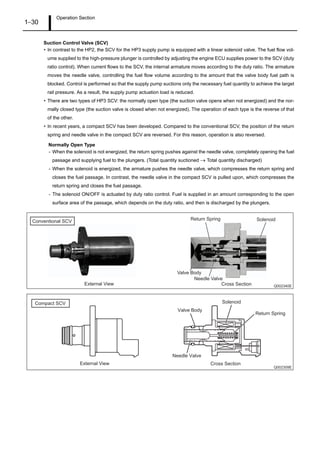
Q000910E
GND
VP
VC
Pressure (kPa)
OutputVoltageVP(V)
TDC A
B C
After-Injection Post-Injection
Q000506E
Operation Section
1–82
7.6 DPNR SYSTEM (DIESEL PARTICULATE NOx REDUCTION)
(1) General Description
• This system reduces the emissions of PM (particulate matter) and NOx. The DPNR catalyst mounted in the center
pipe collects and regenerates PM and reduces NOx all at the same time. The collected PM is handled with combus-
tion processing during operation.
(2) System Configuration
Q000911E
Supply Pump Exhaust Gas Cleaning
Device Switch
Exhaust Gas Cleaning
Device Display Lamp
Injector
DPNR Catalyst
Oxidation Catalyst
A/F Sensor
Exhaust Gas Temperature SensorDifferential Pressure SensorNSR
A/F Sensor
Fuel Addition Valve
Oxidation Catalyst
Before EGR Cooler
Engine ECU
Exhaust
Retarder VSV
Exhaust Retarder
Intake Restriction Valve
Operation Section
1–83
8. DIAGNOSIS
8.1 Outline Of The Diagnostic Function
The diagnostic function enables a system to self-diagnose its own malfunctions. If abnormal conditions occur in the sen-
sors or actuators used in the control systems, the respective systems convert the malfunction signals into codes and
transmit them to the engine ECU. The engine ECU records the transmitted malfunction code into memory. Recorded
codes are output at the diagnostics connector on the vehicle. To inform the driver of the malfunction, the engine ECU
causes the MIL (Malfunction Indicator Light) in the meter to illuminate. Accurate troubleshooting can be performed by
way of the DTCs (Diagnostic Trouble Codes) that are output at the diagnostic connector. For details on actual diagnosis
codes, see the vehicle manual. It is necessary to put the vehicle into the state below before starting inspection.
(1) Pre-Inspection Preparation
• Position the shift lever in "N" or "P".
• Turn OFF the air conditioner.
• Verify that the throttle valve is fully closed.
8.2 Diagnosis Inspection Using DST-1
The DST-1 can be used in both normal and check modes. Compared to the normal mode, the check mode has a higher
sensitivity to detect malfunctions.
The check mode inspection is performed when normal codes are output in the normal mode, despite the fact that there
may be malfunctions in the sensor signal systems.
(1) Reading DTCs
1) DST-1 Connection: Connect the DST-1 to the DLC3 termi-
nal.
2) Reading DTCs: Operate in accordance with the instructions
shown on the screen to display the "DTC check" screen. Se-
lect either the normal or check mode and read the DTC.
< NOTE >
If no DTC appears on the screen, there may be a failure
in the engine ECU.
16 15 14 13 12 11 10 9
8 7 6 5 4 3 2 1
DLC3
Q000914
Diagnostic Trouble Codes (DTC)
1. · · ·
Execute: Execute
Q000915E
Operation Section
1–84
3) Checking the Freeze Frame Data: If the symptom that out-
puts a DTC cannot be duplicated, check the freeze frame
data.
4) Erasing DTCs from memory: Operate in accordance with
the instructions shown on the screen to display the "DTC
check" screen. Select "Erase DTCs" to erase the DTCs.
< NOTE >
If it is not possible to erase the DTC, turn the ignition
switch OFF, and repeat the process.
5) Wiring Harness and Connector Open Circuit Check
< NOTE >
If the DTC output during a diagnostic inspection (in the
check mode) has identified the system with a malfunction,
use the method indicated below to narrow down the area
of the malfunction.
• Erasing DTCs from memory: After reading the DTCs in check mode, erase the DTCs from memory.
• Starting the Engine: Select the check mode and start the engine.
• Malfunctioning system check 1: While the engine is running at idle, shake the wiring harness and connectors of the
system that output the malfunction during the diagnosis (check mode) inspection.
• Malfunctioning system check 2: If the MIL (Malfunction Indicator Light) illuminates when the wiring harness and con-
nectors are shaken, there is a poor contact in the wiring harness or connectors in that area.
8.3 Diagnosis Inspection Using The MIL (Malfunction Indicator Light)
Before reading a DTC, turn the ignition switch ON to make sure the MIL (Malfunction Indicator Light) illuminates.
Inspections in the check mode cannot be performed.
(1) Reading DTCs
Short circuiting the connector
• Using the STT, short circuit between DLC1 terminals 8 (TE1) and 3 (E1) or between DLC3 terminals 13 (TC) and 4
(CG).
< CAUTION >
Never connect the wrong terminals of the connectors as this will lead to a malfunction.
Q000916E
This will erase the DTC and freeze frame data.
Do you wish to proceed?
DTC (ECD Erasure)
NG : - OK : +
4
TE1
E1
TC
CG
1 2 3 5 6 18
7 8 9 10 11 20
12 13 14 15 16 17 21 22 23
19
16 15 14 13 12 11 10 9
8 7 6 5 4 3 2 1
DLC1 DLC3
Q000917E
Operation Section
1–85
Reading DTCs 1
• Turn the ignition switch ON and count the number of times the MIL (Malfunction Indicator Light) blinks
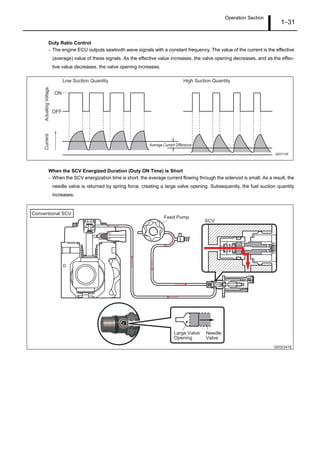
< NOTE >
• If the MIL (Malfunction Indicator Light) does not output a code (the light does not blink), there may be an open circuit in
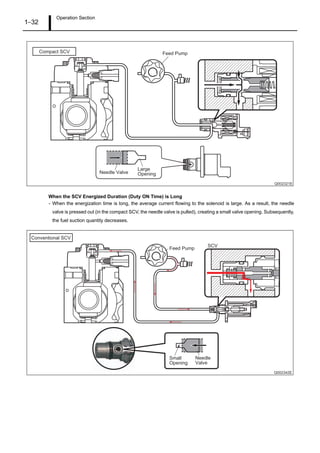
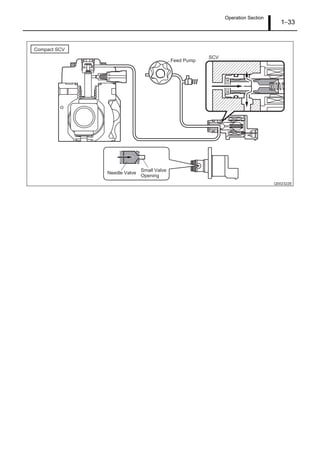
the TC terminal system or a failure in the engine ECU.
• If the malfunction indicator light is constantly ON, there may be a short (pinching) in the wiring harness or a failure in
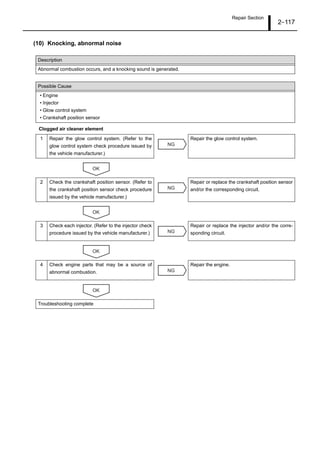
the engine ECU.
• If meaningless DTCs are output, there may be a malfunction in the engine ECU.
• If the MIL (Malfunction Indicator Light) illuminates without outputting a DTC while the engine operates at a minimum
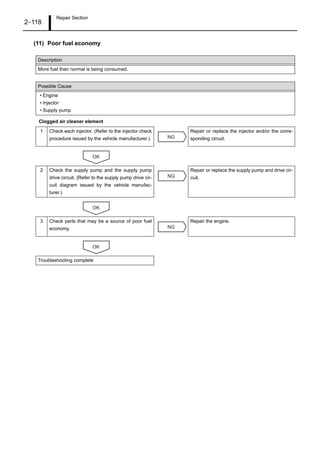
speed of 1000rpm, turn the ignition switch OFF once; then resume the inspection.
Reading DTCs 2
• If an abnormal DTC has been output, check it against the DTC list.
Erasing DTCs from memory
• Remove the ECD fuse (15A); after 15 seconds have elapsed, re-install the fuse.
< CAUTION >
After completing the inspection of the ECD system, erase the DTC memory, and make sure the normal code is output.
0.26sec 0.26sec
0.26sec
ON
OFF
ON
OFF
0.52sec 1.5sec 2.5sec 1.5sec 4.5sec
4.5sec
0.52sec 0.52sec
· Normal Operation
· Malfunction (Codes "12" and "23" are output.)
Jump Terminals TE1 and TC
Repeat
Repeat Thereafter
Malfunction
Indicator Light
Q000918E
ECD Fuse (15A)
Engine Compartment Relay Block
Q000919E
Operation Section
1–86
8.4 Throttle Body Function Inspection
< CAUTION >
• Be sure to inspect the function of the throttle body after it has been disassembled and reassembled, or after any of its
components have been removed and reinstalled.
• Verifying Throttle Motor: Verify that the motor generates an operating sound when the ignition switch is turned ON.
Also, verify that there is no interference sound.
(1) Erasing DTCs
1) Connect the DST-1 to the DLC3 connector.
2) Operate in accordance with the instructions shown on the
screen to display the "DTC check" screen. Select "Erase
DTCs" to erase the DTCs.
(2) Inspection
• Start the engine and make sure the MIL (Malfunction Indicator Light) does not illuminate and the engine speed is with-
in standards when the air conditioner is turned ON and OFF after the engine has warmed up.
< CAUTION >
Make sure no electrical load is applied.
(3) Final Inspection
• After inspecting the throttle body function, drive test the vehicle to confirm that operation is normal.
16 15 14 13 12 11 10 9
8 7 6 5 4 3 2 1
DLC3
Q000914
Q000916E
This will erase the DTC and freeze frame data.
Do you wish to proceed?
DTC (ECD Erasure)
NG : - OK : +
Operation Section
1–87
9. END OF VOLUME MATERIALS
9.1 Particulate Matter (PM)
At high concentration levels, this substance is known to affect the respiratory system. It consists of soluble organic mat-
ter such as unburned oil, unburned diesel fuel, and other "soluble organic matter" in the exhaust gases, and insoluble
organic matter such as soot (black smoke) and sulfuric acid gas.
9.2 Common Rail Type Fuel Injection System Development History And
The World’s Manufacturers
The conventional injection pump faced certain issues such as injection pressure that depended on engine speed, and
limits on the maximum fuel pressure. Other types of injection control such as pilot injection also faced some difficulties.
Addressing these issues in a revolutionary manner, DENSO led the world by introducing a commercial application of
the common rail fuel injection system.
Two types of common rail fuel injection systems are in use today. One is the common rail system that pressurizes the
fuel and injects it directly into the cylinders. DENSO was the first in the world to introduce a commercial application of
this system. This system, which is undergoing further development, has been adopted in passenger car applications.
Other companies, such as R. Bosch, Siemens, and Delphi also offer their commercial versions of this system today. The
other system is the Hydraulic Electric Unit Injection (HEUI) system, which was developed by Caterpillar in the United
States. This system uses pressurized engine oil to pressurize the fuel by actuating the piston of the nozzle (injector)
through which the pressurized fuel is injected.
Operation Section
1–88
9.3 Higher Injection Pressure, Optimized Injection Rates, Higher Injection
Timing Control Precision, Higher Injection Quantity Control Precision
(1) Higher Injection Pressure
• The fuel that is injected from the nozzle turns into finer particles as the fuel injection pressure increases. This improves
combustion and reduces the amount of smoke contained in the exhaust gases. Initially, the maximum injection pres-
sure of the in-line pump (A type) and the distributor pump (VE type) was 60 MPa. Due to advancement in high-pres-
sure applications, there are some recently developed fuel injection systems that inject fuel at a pressure of 100 MPa
or higher. The second-generation common rail system injects fuel at an extremely high pressure of 180 MPa.
(2) Optimized Injection Rates
• The injection rate is the ratio of the changes in the fuel quantity that is injected successively from the nozzle within a
given unit of time.
Q000920E
50
Common Rail Series
100 150 200
185
145
120
120
ECD V Series
Mechanical Pump
Injection Pressure (MPa)
A Type Pump
Distributor Type Pump
NB Type Pump
ECD V4 Pump
HP0Pump
HP2Pump
HP3,4Pump
ECD V3 Pump
(1st Generation)
(2nd Generation)
1 MPa is
approximately 10.2kgf/cm2
t
Injection Rate High Injection Rate
InjectionQuantity
Q000921E
Operation Section
1–89
• As the injection pressure increases, the injection rate increases accordingly. The increase in injection rate leads to an
increase in the volume of the air-fuel mixture that is created between the start of injection until ignition (the ignition lag
period). Because this mixture is subsequently combusted at once, it creates noise (diesel knock) and NOx. For this
reason, it is necessary to appropriately control the injection rate by maintaining a low injection rate at the beginning
of injection and supplying a sufficient quantity after the ignition. To meet this need, two-spring nozzles have been
adopted and a pilot injection system has recently been developed.
(3) Higher Injection Timing Control Precision
• Reducing exhaust gas emissions and fuel consumption and optimizing the injection timing are important. It is ex-
tremely difficult to achieve the desired exhaust emission reduction levels through methods that adjust the injection
timing according to speed (or centrifugal force), such as the conventional mechanical timer. For this reason, electron-
ically controlled systems have been adopted to freely and precisely control the injection timing in accordance with the
engine characteristics.
(4) Higher Injection Quantity Control Precision
• Power output adjustment in a diesel engine is accomplished by regulating the fuel injection quantity. Poor injection
quantity control precision leads to increased exhaust gas emissions, noise, and poor fuel economy. For this reason,
electronically controlled systems have been developed to ensure high precision injection quantity control.
2-Spring Nozzle
Injection Rate
Common Rail System
Injection Rate Control
InjectionQuantity
InjectionQuantity
Pilot Injection
Q000922E
Electronic Control Type Mechanical Timer
Engine Speed Engine Speed
Injection Quantity
Injection Quantity
Advance
Angle
Advance
Angle
Q000923E
Operation Section
1–90
9.4 Image Of Combustion Chamber Interior
With conventional injection methods, because an excessive quantity of fuel was injected in the initial period, the explo-
sion pressure rose excessively, leading to the generation of noise such as engine knocking sounds. To improve this
condition through pilot injection, initially only the necessary and adequate quantity of fuel is injected. At the same time,
the combustion chamber temperature is raised, and main injection combustion is assisted while working to prevent
noise and vibration.
Conventional Injection Pilot Injection
Q000924E
Repair Section
2–91
1. DIESEL ENGINE MALFUNCTIONS AND DIAGNOSTIC METH-
ODS (BASIC KNOWLEDGE)
1.1 Combustion State and Malfunction Cause
Depending on the state of combustion in a diesel engine, diesel knock as well as the color of the exhaust gas may
change. Subsequently, the cause of engine malfunctions can be ascertained from changes in diesel knock and exhaust
gas color.
(1) Diesel Knock
• When fuel mixed with air during the ignition lag period (from the time injection begins until the fuel is ignited) reaches
ignition temperature, the mixture is combusted in one burst. The pressure in the combustion chamber at this time rises
as the quantity of the air-fuel mixture increases. If a large amount of air-fuel mixture is created during the ignition lag
period, the pressure in the combustion chamber will rise rapidly. The pressure waves resulting from fuel ignition vi-
brate the cylinder walls and engine components, which generates noise. The generated noise is called "knocking".
To some extent, knocking is unavoidable in engines that use a self-ignition system.
Cause of Diesel Knocking
1 Early Injection Timing
A large quantity of air-fuel mixture is created prior to ignition, or the
cetane value is high.
2 Cold Engine
Ignition occurs late without an increase in temperature.3 Intake air temperature is low.
4 Poor Engine Compression
5 Poor Fuel Combustibility Ignition occurs late (low cetane value.)
Q002310E
Knocking
Sound
Black
Smoke
White
Smoke
Q002311E
CylinderInternalPressure
Crankshaft AngleT.D.C.
Start of
Injection
Ignition
Pressure Increase
Repair Section
2–92
(2) White Smoke
White smoke: Uncombusted fuel that has been vaporized and then discharged.
• White smoke is generated when combustion occurs at a relatively low temperature, resulting in the exhaust of un-
combusted fuel and oil particles. White smoke is most likely to be generated when combustion chamber temperature
is low.
Source of White Smoke
(3) Black Smoke
Black smoke: Fuel that has been baked into soot and discharged.
• Black smoke is often referred to as just "smoke". Black smoke is generated when the injected fuel is poor in oxygen.
As the fuel is exposed to high temperatures, thermal breakdown occurs, leaving carbon behind. Black smoke occurs
when the injected fuel quantity is too large, or when the air-fuel mixture is rich due to an insufficient quantity of air.
Source of Black Smoke
1.2 Troubleshooting
Troubleshooting cautions
Observe the following cautions to avoid decreased engine performance and fuel injector malfunctions.
• Use the designated fuel.
• Avoid water and foreign material intrusion into the fuel tank.
• Periodically check and clean the filter.
• Do not unnecessarily disassemble sealed components.
Troubleshooting notes
The cause of malfunctions is not necessarily limited to the pump itself, but may also be related to the engine and/or fuel
systems. Further, the majority of malfunctions are the result of user error, and often can often be resolved through simple
checks and maintenance. Avoid any hasty removal of system components.
Basic Check Items
1 Late Injection Timing Fuel is injected when the piston is in the down stroke.
2 Cold Engine
Ignition occurs late and combustion is prolonged.
3 Poor Fuel Combustibility
4 Rise and Fall of Oil Pressure Oil undergoes partial thermal breakdown.
1 Large Fuel Injection Quantity Air-fuel mixture becomes rich.
2 Low Intake Air Quantity Air quantity is insufficient due to air filter clogging.
3 Poor Fuel Atomization The ratio of fuel to air worsens.
4 Retarded Fuel Injection Timing Air-fuel mixing time is insufficient.
1 Engine Oil 7 Fuel Supply to the Pump
2 Coolant 8 Injector Injection Status
3 Fan Belt 9 Supply Pump Timing Mark
4 Air Cleaner 10
Check for Loose or Disconnected Connectors, and
Modifications
5 Battery and Terminals 11 Idle Speed Status
6 Fuel System Leaks
Repair Section
2–93
2. DIAGNOSIS OVERVIEW
2.1 Diagnostic Work Flow
Diagnostic Procedures
1 Receive malfunctioning vehicle
2 Question the user to verify the nature of the
malfunction.
3 Does the malfunction reoccur? Refer to "Actions for Non-Reoccurring Malfunc-
tions."
4 Verify the malfunction symptom at the actual
vehicle.
5 Use the DST-2 to check for any DTCs. Proceed with diagnostics while referencing the
DTC chart in the repair manual for the appropri-
ate vehicle.
6 Use the DST-2 "Data Monitor" function to per-
form checks while monitoring each input and
output signal.
Proceed with diagnostics while referencing the
repair manual for the appropriate vehicle.
7 Use the DST-2 active test function to operate
each output device with the ignition switch in the
ON position. Check for any abnormalities in
either the electrical circuits or the output
devices.
Proceed with diagnostics while referencing the
repair manual for the appropriate vehicle.
8 Was the malfunction cleared?
Return to step 3.
Repair Section
2–94
2.2 Inquiries
Use the Common Rail System (CRS) troubleshooting questionnaire to consult with the customer and adequately grasp
the malfunction symptoms.
< NOTE >
Do not ask random questions. Rather, ask questions that will aid in narrowing down the possible malfunctioning system
while making educated guesses based on the actual symptoms.
Questioning points
Use the following questions as a basis to fully grasp the malfunction.
• What?: Malfunction symptoms
• When?: Date, time, frequency of occurrence
• Where?: Road conditions
• Under what conditions?: Driving conditions, engine operating conditions, weather
• How?: Impression of how the symptoms occurred.
CRS troubleshooting questionnaire
When the vehicle is received at the service center, it is necessary to verify the "malfunction symptoms" and the "gener-
ated malfunction data" with the customer. Consult with the customer using the CRS troubleshooting questionnaire. The
troubleshooting questionnaire is necessary for the following reasons.
Reasons
• There are cases when the malfunction symptoms cannot be reproduced at the service center.
• The customer's complaint is not always limited to the malfunction.
• If the person performing repairs is not working from the correct malfunction symptoms, man-hours will be wasted.
• The questionnaire can aid the service center in diagnosing, repairing and verifying repair work.
Q002315E
Questioning Results
Inspection Results
Repair Section
2–95
(1) Questionnaire
Q002316E
CRS Troubleshooting Questionnaire
Vehicle Model
Previous Vehicles Driven:
Other Customer Information
Indications from the Customer
Questioning
Results
System Conditions Driving Conditions Road Surface Other Frequency of Occurrence
MIL Illumination No / Yes ( )
Main Area and Purpose of Use
Receiving Date
Date Registered
Occurrence Date
Service History No / Yes ( times)
Registration No.
Odometer Reading
Frame No.
Occurrence Speed
( ) km/hr
Shift Position
( ) Range
At Start-Up
Directly after Start-Up
Up to ( ) Minutes after Start
Up to ( ) Minutes into Driving
When Cold
When Warm
During Operation
Other ( )
During Take-Off
While Cruising
When Accelerating
When Decelerating
When Braking
When Turning
When Stopped
No Relationship
Other ( )
Flat
Uphill
Downhill
Dry, Sealed road
Wet, Sealed Road
Unsealed Road or
Rough Road Surface
Snow-Covered or Icy Road
Potholes, Manholes, etc.
Other ( )
Accelerator
Opening
( ) %
Outside Air
Temperature
( ) C
Weather
( )
Normal
Only Once
Occasionally
( ) Times per Day
( ) Times per Week
( ) Times per Month
Reoccurrence
Conditions
Occurs Regularly Occurs Occasionally
Continues to Appear
After One Occurrence
Does Not Reoccur
Malfunction Details: Time of occurrence, place and driving conditions during reoccurrence.
Fuel Pressure when Engine is Stopped
1 Minute after Turning Engine OFF
DTC Normal
Abnormal DTC (All Codes)
Illuminated No Yes
DTC Check
Inspection
Results
Additional Items
o
Repair Section
2–96
2.3 Non-Reoccurring Malfunctions
In cases where the malfunction does not reoccur, perform the actions below to determine the cause of the malfunction.
Action
Malfunction Symptom
Fully Dis-
charged Bat-
tery
Engine will not
Start
Idle Speed,
Engine Stall,
Sputtering,
Poor Acceler-
ation
Verify that there is no DTC stored in the memory. No Yes Yes
Use the questionnaire as a basis to perform a reoccurrence test in
"Reoccurrence" mode. Use this data (engine ECU voltage value, etc.)
to determine the cause of the malfunction.
Yes Yes Yes
Assume that an electrical sys-
tem wiring harness or connector
is the cause of the malfunction.
Shake the wiring by hand to
check whether a malfunction
occurs and a DTC is generated.
No Yes Yes
Assume that an electrical system female connector terminal is the
cause of the malfunction and verify that the connection points are not
defective.
No Yes Yes
Use a dryer to heat the acceler-
ator pedal position sensor and
other electronic components.
Check for changes in the volt-
age value (resistance value).
< CAUTION >
• Do not exceed 60°C (still touchable by hand) when heating.
• Do not remove the component cases and add heat directly to
electronic parts.
No No Yes
Verify whether malfunction symptoms occur under heavy engine
loads (headlights, A/C, wiper, etc. switches ON.)
No No Yes
If any commercial electrical products have been installed, remove
such products and verify whether the malfunction symptoms occur.
Yes Yes Yes
Q002317
Recommended Tool: KOWA Precision Handling
Feeler Gauge Set (KLM-10-20)
Depending on the terminal, a matching
size may not be available
Insert the male terminal that
matches the shape of the
female terminal and check
for looseness. Q002318
Q002319
Repair Section
2–97
If it is likely that the malfunction
occurs in rainy or high-tempera-
ture weather, spray the vehicle
with water and verify whether
the malfunction occurs.
< CAUTION >
• Do not spray water directly into the engine compartment.
Spray water in mist form on all surfaces of the radiator to indi-
rectly change temperature and humidity.
• Do not spray water directly on electrical parts.
No Yes Yes
Action
Malfunction Symptom
Fully Dis-
charged Bat-
tery
Engine will not
Start
Idle Speed,
Engine Stall,
Sputtering,
Poor Acceler-
ation
Mist State
Q002320E
Repair Section
2–98
3. DTC READING (FOR TOYOTA VEHICLES)
3.1 DST-2
The DST-2 can check for DTCs in either normal or check mode. In comparison to the normal mode, the check mode
has higher sensitivity in detecting malfunctions. Check mode is used when detection is not possible in normal mode,
regardless of the assumed abnormality.
3.2 DTC Check (Code Reading via the DST-2)
Connect the DST-2 to the DLC3 connector.
Operate the DST-2 in accordance with the instructions shown on the display to view the "DTC check" screen. Select
either the normal or check mode to verify the DTC.
3.3 DTC Memory Erasure (via the DST-2)
To erase DTC codes, follow the instructions on the display to view the "DTC and Freeze Data Erasure" screen.
< CAUTION >
• If the DTC cannot be erased, cycle the ignition switch OFF and back ON, and then perform code erasure again.
• Do not use the DST-2 to erase the DTC until the cause of the malfunction is clear.
Q000916E
This will erase the DTC and freeze frame data.
Do you wish to proceed?
DTC (ECD Erasure)
NG : - OK : +
Repair Section
2–99
4. TROUBLESHOOTING BY SYSTEM
4.1 Intake System Diagnosis
Clogged air cleaner element
4.2 Fuel System Diagnosis
Clogged air cleaner element
1 Clogged air cleaner element Clean or replace the air cleaner.
2 Check the suction path for leaks.
• Suction path joints
• Suction pipes, hoses
Repair or replace the malfunctioning compo-
nent.
Normal
1 Fuel system check (remaining fuel quantity, fuel
properties)
• Check the amount of fuel remaining in the
tank.
• Check the condition of the fuel. Request
engine analysis from a third party as neces-
sary.
- Color (no color, brownish, milky)
- Odor (kerosene, heavy oil, irritating odor)
- Separation of materials (water, foreign
objects)
- Viscosity (high/low viscosity, wax consis-
tency)
Add fuel or replace components (clean tank.)
NG
OK
NG
OK
NG
OK
Repair Section
2–100
2 Fuel tank interior check (modification/additions,
position of fuel pipe inlet/outlet, clogging and
holes)
• Check the tank for modifications or additions.
Consult with the user.
- Fuel inlet/outlet position, tank piping
- Foreign material inside the tank, water sep-
aration
- Tank-internal Zn cladding
- Check the tank-internal fuel piping for the
following.
- Inlet/outlet position (below position "E")
- Inlet clogging, bent or deformed piping
(crushed pipe)
- Crushed piping connections
Restore the fuel tank.
3 Tank-external fuel path conditions (crushed
hose, clogging, air introduction at hose connec-
tion)
• Check the condition of the hose.
- Crushing around bands, over-bending
- Pinched or crushed by other parts
• Air introduction through fuel system connec-
tion points
- Looseness
- Hose deterioration (Verify by hand or visu-
ally that there is no rubber hardening/split-
ting.)
< CAUTION >
Be cautious when vacuum pressure is
present, as air will be drawn into the
hose.
Repair or replace the hose.
4 Primary filter, sedimentor check
• Check for primary filter clogging and dirt.
• Check sedimentor water volume.
Replace the filter, and drain water from the sedi-
mentor.
5 Looseness at priming attachment point check
• Check the following.
- Looseness at the priming attachment point
- Does the piston stick out?
- Fuel leakage (oozing)
Tighten or replace the priming pump.
NG
OK
NG
OK
NG
OK
NG
OK
Repair Section
2–101
(1) Fuel pressure test procedure
• Connect the DST-2 to the vehicle-side test connector.
- With the vehicle idling, verify the rail pressure displayed on the DST-2.
System selection screen: Rail a ECU Data Monitor
6 Filter (supply pump inlet) clogging
• Fuel filter
- Check for fuel delivery from the priming
pump.
• Gauze filter
- Visually check for clogging due to foreign
material.
Clean the gauze filter, fuel filter and fuel piping
system, or replace the filters.
7 Oil level increase (engine internal leak)
• Verify whether the oil level increases on the
oil level gauge.
Check the engine.
8 High-pressure piping and CRS component
(injector supply pump, rail) fuel leaks (engine
external leak) (Refer to "(2) Fuel leak check".)
• Connect the DST-2 to the diagnostic connec-
tor. Activate the "Fuel Leak Check Function"
within the active test.
• Visually check and specify areas that leak
fuel.
< CAUTION >
In the event of a large fuel leak down-
stream of the flow damper, be aware
that fuel flow will stop and the leak will
cease due to flow damper operation.
Repair leaking high-pressure piping or replace
leaking parts.
Normal
Item Name (Abbrevi-
ated)
Explanation Check Conditions Reference Value Items of Importance
During an Abnormal-
ity
Rail Pressure (RP) • Displays the fuel
pressure in the rail.
• Display range: 0
MPa to 255 MPa
Following engine
warm-up, when the
engine is rotating
Fuel pressure in the
rail is displayed within
a range of 30 MPa to
160 MPa.
PCR1, PCR2 signals
(rail assembly)
NG
OK
NG
OK
NG
OK
Repair Section
2–102
(2) Fuel leak check
• Connect the DST-2 to the vehicle-side test connector.
• With the vehicle idling, perform the active test by following the instructions on the DST-2 display.
System selection screen: TCCS a Active Test
• Verify that there are no fuel system leaks during the active test (when fuel pressure is being applied to the rail.)
4.3 Basics of Electrical/Electronic Circuit Checks
(1) ECU terminal voltage and waveform measurements
• When measuring the voltage and resistance of each terminal, insert the multimeter probe into the rear side of the
wiring harness connector. If connectors are too small for the probe to be inserted easily, insert a fine metal wire into
the rear of the connector and touch the wire to the probe.
< NOTE >
The number of each terminal can be seen from the rear side of the wiring harness.
Item Name Description Control Conditions
High-Pressure Fuel System Check Raise engine speed to 2000 rpm, and
then use the active test to place the
fuel inside the rail under high pres-
sure.
< CAUTION >
Engine speed cannot be
raised by stepping on the
accelerator pedal.
• Following engine warm-up, when
the engine is at idle speed
• The vehicle speed sensor is operat-
ing normally, and speed is 0 km/h.
Q002326E
Ground
Ground
Ground
Engine ECU Side
Wiring Harness
Side
Repair Section
2–103
(2) Open circuit check
• When dealing with a wiring harness open circuit like that depicted in diagram 1, check continuity and/or voltage to
determine the location of the open circuit.
Continuity Check
1) Remove connectors "A" and "C", and then measure resis-
tance between the two.
< NOTE >
Measure resistance while gently shaking the wiring har-
ness up and down, and side-to-side.
2) As shown in diagram 2, there is no continuity (open circuit)
between terminal 1 of connector "A" and terminal 1 of con-
nector "C". However, there is continuity between terminal 2
of connector "A" and terminal 2 of connector "C". Therefore,
there is an open circuit between terminal 1 of connector "A"
and terminal 1 of connector "C".
3) Remove connector "B" and measure the connector resis-
tance.
4) As shown in diagram 3, there is continuity between terminal
1 of connector "A" and terminal 1 of connector "B1". Howev-
er, there is no continuity (open circuit) between terminal 1 of
connector "B2" and terminal 1 of connector "C". Therefore,
there is an open circuit between terminal 1 of connector "B2"
and terminal 1 of connector "C".
Q002327E
Diagram 1 Engine ECU
Sensor
Open
Circuit
1 1 1 1
2 2 2 2
ABC
Q002328E
Diagram 2
Sensor
Engine
ECU
1
2 2
1
2
ABC
Standard Value 1Ω or less
Q002329E
Diagram 3
Sensor
Engine
ECU
1
2
1
2
1
2
1
2
AC B2 B1
Repair Section
2–104
Voltage Check
1) For the circuit that applies voltage to the ECU connector ter-
minals, check for an open circuit by performing a voltage
check.
2) As shown in diagram 4, with all connectors connected, mea-
sure the voltage for the ECU 5 V output terminal between
the body ground and terminal 1 of connector "A". Next mea-
sure voltage for terminal 1 of connector "B" and terminal 1 of
connector "C" in the same fashion.
3) The faulty circuit and measurement results are shown be-
low.
(3) Short circuit check
• As shown in diagram 5, if there is a short in the wiring harness ground, perform a "Ground Continuity Check" to de-
termine the cause of the short.
Q002330E
Diagram 4
Sensor
1
2 2
11
2
ABC
0 V
5 V
5 V
Measurement
Results
• Voltage between terminal 1 of con-
nector "A" and the body ground is 5
V.
• Voltage between terminal 1 of con-
nector "B" and the body ground is 5
V.
• Voltage between terminal 1 of con-
nector "C" and the body ground is 0
V.
Faulty Item
There is an open circuit in the wiring
harness between terminal 1 of connec-
tor "B" and terminal 1 of connector "C".
Q002331E
Diagram 5
Sensor
Engine ECU
Short
Circuit
Repair Section
2–105
Ground Continuity Check
1) Remove connector "A" and connector "C", and then mea-
sure the resistance respectively between terminals 1 and 2
of connector "A" and ground.
< NOTE >
Measure resistance while gently shaking the wiring har-
ness up and down, and side-to-side.
2) As shown in diagram 6, there is continuity between terminal
1 of connector "A" and the body ground (short circuit). How-
ever, there is no continuity between terminal 2 of connector
"A" and the body ground. Therefore, there is a short circuit
between terminal 1 of connector "A" and terminal 1 of con-
nector "C".
3) Remove connector "B" and measure the resistance be-
tween terminal 1 of connector "A" and the body ground, and
between terminal 1 of connector "B2" and the body ground.
4) The faulty circuit and measurement results are shown be-
low.
Q002332E
Diagram 6
Sensor
Engine
ECU
1
2 2
11
2
ABC
Standard Value 1Ω or less
Q002333E
Diagram 7
Sensor
Engine
ECU
1
2
1
2
1
2
1
2
AC B2 B1
Measurement
Results
• There is no continuity between termi-
nal 1 of connector "A" and the body
ground.
• There is continuity between terminal
1 of connector "B2" and the body
ground.
Faulty Item There is a short circuit between terminal
1 of connector "B2" and terminal 1 of
connector "C".
Repair Section
2–106
(4) Connector connection fault verification method
• Simultaneously perform the data monitor and connector voltage measurements.
Q002334E
1. Read the "Coolant Temperature Output Voltage" value using the DST-2 data monitor.
2. Measure the voltage directly from the corresponding ECU terminal.
Ex.) Coolant temperature sensor
If "1" is unsatisfactory and "2" is satisfactory, the connector connection is judged as faulty.
Since some malfunctions only occur intermittently, measure voltage while pulling and shaking the
wires in order to try to get the malfunction to reoccur.
Voltage Measurement
No.2 - 34P No.5 - 31P
35 41 137 143
62 69 162 167
Repair Section
2–107
5. TROUBLESHOOTING
5.1 Troubleshooting According to Malfunction Symptom (for TOYOTA Ve-
hicles)
(1) Malfunction Indicator Lamp (MIL) is lit.
Clogged air cleaner element
(2) The engine is hard to start.
Clogged air cleaner element
Description
The check engine warning light is lit when the engine is running, or before the engine is started.
Possible Cause
The DTC is recorded in the engine ECU.
1 Connect the DST-2 and read the DTC. Inspect the check engine warning light circuit.
Troubleshoot the corresponding DTC.
Description
The starter turns at normal speed, but the engine takes too long to start.
Possible Cause
• Start signal circuit
• Glow control system
• Crankshaft position sensor
• Engine ECU power supply circuit
• Injector
• Supply pump
• Cylinder recognition sensor
1 Use the DST-2 to verify whether the coolant
temperature is at the glow system operating
temperature. In addition, verify whether battery
voltage is being supplied to the glow plugs at
the designated times.
Repair the glow control system. (Refer to the
glow control system check procedure issued by
the vehicle manufacturer.)
2 Use the DST-2 to monitor engine speed while
cranking the engine. Verify whether engine
speed is being correctly output.
Check the crankshaft position sensor. (Refer to
the crankshaft position sensor check procedure
issued by the vehicle manufacturer.)
NG
OK
NG
OK
NG
Repair Section
2–108
3 Verify the output waveform of the cylinder rec-
ognition sensor. (Refer to the cylinder recogni-
tion sensor check procedure issued by the
vehicle manufacturer.)
Repair or replace the cylinder recognition sen-
sor and/or the corresponding circuit.
4 Check each injector. (Refer to the injector check
procedure issued by the vehicle manufacturer.)
Repair or replace the injector and/or the corre-
sponding circuit.
5 Verify whether there is a start signal when
cranking the engine by checking the engine
ECU start signal terminal.
Repair the start signal circuit.
6 Check the engine ECU power supply. (Refer to
the engine ECU power supply circuit diagram
issued by the vehicle manufacturer.)
Repair the engine ECU power supply.
7 Check the supply pump and the supply pump
drive circuit. (Refer to the supply pump drive cir-
cuit diagram issued by the vehicle manufac-
turer.)
Repair or replace the supply pump and drive cir-
cuit.
Troubleshooting complete
OK
NG
OK
NG
OK
NG
OK
NG
OK
NG
OK
Repair Section
2–109
(3) The engine stalls when idling.
Clogged air cleaner element
Description
The engine stalls after starting or when idling.
Possible Cause
• Crankshaft position sensor
• Engine ECU power supply circuit
• Injector
• Supply pump
• Engine cooling system
• Start signal circuit
1 Verify that the engine is not overheated. Repair the engine cooling system.
2 Check the crankshaft position sensor output
waveform. (Refer to the crankshaft position sen-
sor check procedure issued by the vehicle man-
ufacturer.)
Repair or replace the crankshaft position sensor
and/or the corresponding circuit.
3 Check each injector. (Refer to the injector check
procedure issued by the vehicle manufacturer.)
Repair or replace the injector and/or the corre-
sponding circuit.
4 Verify whether there is a start signal when
cranking the engine by checking the engine
ECU start signal terminal.
Repair the start signal circuit.
5 Check the engine ECU power supply. (Refer to
the engine ECU power supply circuit diagram
issued by the vehicle manufacturer.)
Repair the engine ECU power supply.
6 Check the supply pump and the supply pump
drive circuit. (Refer to the supply pump drive cir-
cuit diagram issued by the vehicle manufac-
turer.)
Repair or replace the supply pump and drive cir-
cuit.
Troubleshooting complete
NG
OK
NG
OK
NG
OK
NG
OK
NG
OK
NG
OK
Repair Section
2–110
(4) The engine cranks normally, but does not start.
Clogged air cleaner element
Description
The engine is cranked at the normal speed, but does not start.
Possible Cause
• Crankshaft position sensor
• Engine ECU power supply circuit
• Injector
• Supply pump
• Start signal circuit
1 Use the DST-2 to verify whether the coolant
temperature is at the glow system operating
temperature. In addition, verify whether battery
voltage is being supplied to the glow plugs at
the designated times.
Repair the glow control system. (Refer to the
glow control system check procedure issued by
the vehicle manufacturer.)
2 Monitor engine speed while cranking the
engine. Verify whether engine speed is being
correctly output.
Check the crankshaft position sensor. (Refer to
the crankshaft position sensor check procedure
issued by the vehicle manufacturer.)
3 Verify whether there is a start signal when
cranking the engine by checking the engine
ECU start signal terminal.
Repair the start signal circuit.
4 Check the engine ECU power supply. (Refer to
the engine ECU power supply circuit diagram
issued by the vehicle manufacturer.)
Repair the engine ECU power supply.
5 Check each injector. (Refer to the injector check
procedure issued by the vehicle manufacturer.)
Repair or replace the injector and/or the corre-
sponding circuit.
6 Check the supply pump and the supply pump
drive circuit. (Refer to the supply pump drive cir-
cuit diagram issued by the vehicle manufac-
turer.)
Repair or replace the supply pump and drive cir-
cuit.
Troubleshooting complete
NG
OK
NG
OK
NG
OK
NG
OK
NG
OK
NG
OK
Repair Section
2–111
(5) Idle instability following engine start
Clogged air cleaner element
Description
Idle speed after starting the engine is abnormal.
Possible Cause
• Injector
• Supply pump
• Fuel filter
• Engine ECU
• Rail pressure sensor
1 Check each injector. (Refer to the injector check
procedure issued by the vehicle manufacturer.)
Repair or replace the injector and/or the corre-
sponding circuit.
2 Check the fuel filter. Replace the fuel filter.
3 Check the supply pump and the supply pump
drive circuit. (Refer to the supply pump drive cir-
cuit diagram issued by the vehicle manufac-
turer.)
Repair or replace the supply pump and drive cir-
cuit.
4 Check the rail pressure sensor and the corre-
sponding circuit. (Refer to the rail pressure sen-
sor check procedure issued by the vehicle
manufacturer.)
Repair or replace the rail pressure sensor and
the corresponding circuit.
Troubleshooting complete
NG
OK
NG
OK
NG
OK
NG
OK
Repair Section
2–112
(6) The engine returns to idle speed too slowly, or does not return at all.
Clogged air cleaner element
Description
The time required for the engine to return to idle speed is longer than normal, or the engine does not return to idle
speed.
Possible Cause
• Accelerator position sensor
• Injector
• Supply pump
1 Perform the accelerator pedal position sensor
function check. (Refer to the accelerator posi-
tion pedal sensor check procedure issued by
the vehicle manufacturer.)
Repair or replace the accelerator position sen-
sor and/or the corresponding circuit.
2 Check each injector. (Refer to the injector check
procedure issued by the vehicle manufacturer.)
Repair or replace the injector and/or the corre-
sponding circuit.
3 Check the supply pump and the supply pump
drive circuit. (Refer to the supply pump drive cir-
cuit diagram issued by the vehicle manufac-
turer.)
Repair or replace the supply pump and drive cir-
cuit.
Troubleshooting complete
NG
OK
NG
OK
NG
OK
Repair Section
2–113
(7) Rough idle
Clogged air cleaner element
Description
Idle speed fluctuates, causing the engine to vibrate.
Possible Cause
• Engine cooling system
• Crankshaft position sensor
• Engine
• Supply pump
• Injector
1 Check parts that may be a source of abnormal
engine vibration.
Repair the engine.
2 Check each injector. (Refer to the injector check
procedure issued by the vehicle manufacturer.)
Repair or replace the injector and/or the corre-
sponding circuit.
3 Verify that the engine is not overheated. Repair the engine cooling system.
4 Check the crankshaft position sensor. (Refer to
the crankshaft position sensor check procedure
issued by the vehicle manufacturer.)
Repair or replace the crankshaft position sensor
and/or the corresponding circuit.
5 Check the supply pump and the supply pump
drive circuit. (Refer to the supply pump drive cir-
cuit diagram issued by the vehicle manufac-
turer.)
Repair or replace the supply pump and drive cir-
cuit.
Troubleshooting complete
NG
OK
NG
OK
NG
OK
NG
OK
NG
OK
Repair Section
2–114
(8) The engine stalls when decelerating.
Clogged air cleaner element
Description
The engine suddenly stops when decelerating.
Possible Cause
• Engine cooling system
• Crankshaft position sensor
• Engine ECU power supply circuit
• Supply pump
• Injector
• Start signal circuit
1 Verify that the engine is not overheated. Repair the engine cooling system.
2 Check the crankshaft position sensor. (Refer to
the crankshaft position sensor check procedure
issued by the vehicle manufacturer.)
Repair or replace the crankshaft position sensor
and/or the corresponding circuit.
3 Check each injector. (Refer to the injector check
procedure issued by the vehicle manufacturer.)
Repair or replace the injector and/or the corre-
sponding circuit.
4 Verify whether there is a start signal when
cranking the engine by checking the engine
ECU start signal terminal.
Repair the start signal circuit.
5 Check the engine ECU power supply. (Refer to
the engine ECU power supply circuit diagram
issued by the vehicle manufacturer.)
Repair the engine ECU power supply.
6 Check the supply pump and the supply pump
drive circuit. (Refer to the supply pump drive cir-
cuit diagram issued by the vehicle manufac-
turer.)
Repair or replace the supply pump and drive cir-
cuit.
Troubleshooting complete
NG
OK
NG
OK
NG
OK
NG
OK
NG
OK
NG
OK
Repair Section
2–115
(9) Poor engine output, poor acceleration
Clogged air cleaner element
Description
Deficient engine performance.
Possible Cause
• EGR system
• Injector
• Mass Air Flow (MAF) meter
• Crankshaft position sensor
• Accelerator position sensor
• Boost pressure sensor
• Supply pump
• Start signal circuit
• Air cleaner, duct
1 Check for air cleaner clogging and/or damage. Replace the air cleaner or repair the air duct.
2 Verify that the engine is not overheated. Repair the engine cooling system.
3 Check the crankshaft position sensor. (Refer to
the crankshaft position sensor check procedure
issued by the vehicle manufacturer.)
Repair or replace the crankshaft position sensor
and/or the corresponding circuit.
4 Check each injector. (Refer to the injector check
procedure issued by the vehicle manufacturer.)
Repair or replace the injector and/or the corre-
sponding circuit.
5 Verify whether there is a start signal when
cranking the engine by checking the engine
ECU start signal terminal.
Repair the start signal circuit.
6 Check the MAF meter and the corresponding
circuit. (Refer to the MAF meter check proce-
dure issued by the vehicle manufacturer.)
Repair or replace the MAF meter and/or the cor-
responding circuit.
NG
OK
NG
OK
NG
OK
NG
OK
NG
OK
NG
OK
Repair Section
2–116
7 Check the Exhaust Gas Recirculation (EGR)
system. (Refer to the EGR system check proce-
dure issued by the vehicle manufacturer.)
Repair or replace the EGR system.
8 Perform the accelerator pedal position sensor
function check. (Refer to the accelerator posi-
tion pedal sensor check procedure issued by
the vehicle manufacturer.)
Repair or replace the accelerator position sen-
sor and/or the corresponding circuit.
9 Check the boost pressure sensor and the corre-
sponding circuit. (Refer to the boost pressure
sensor check procedure issued by the vehicle
manufacturer.)
Repair or replace the boost pressure sensor
and/or the corresponding circuit.
10 Check the supply pump and the supply pump
drive circuit. (Refer to the supply pump drive cir-
cuit diagram issued by the vehicle manufac-
turer.)
Repair or replace the supply pump and drive cir-
cuit.
Troubleshooting complete
NG
OK
NG
OK
NG
OK
NG
OK
Repair Section
2–117
(10) Knocking, abnormal noise
Clogged air cleaner element
Description
Abnormal combustion occurs, and a knocking sound is generated.
Possible Cause
• Engine
• Injector
• Glow control system
• Crankshaft position sensor
1 Repair the glow control system. (Refer to the
glow control system check procedure issued by
the vehicle manufacturer.)
Repair the glow control system.
2 Check the crankshaft position sensor. (Refer to
the crankshaft position sensor check procedure
issued by the vehicle manufacturer.)
Repair or replace the crankshaft position sensor
and/or the corresponding circuit.
3 Check each injector. (Refer to the injector check
procedure issued by the vehicle manufacturer.)
Repair or replace the injector and/or the corre-
sponding circuit.
4 Check engine parts that may be a source of
abnormal combustion.
Repair the engine.
Troubleshooting complete
NG
OK
NG
OK
NG
OK
NG
OK
Repair Section
2–118
(11) Poor fuel economy
Clogged air cleaner element
Description
More fuel than normal is being consumed.
Possible Cause
• Engine
• Injector
• Supply pump
1 Check each injector. (Refer to the injector check
procedure issued by the vehicle manufacturer.)
Repair or replace the injector and/or the corre-
sponding circuit.
2 Check the supply pump and the supply pump
drive circuit. (Refer to the supply pump drive cir-
cuit diagram issued by the vehicle manufac-
turer.)
Repair or replace the supply pump and drive cir-
cuit.
3 Check parts that may be a source of poor fuel
economy.
Repair the engine.
Troubleshooting complete
NG
OK
NG
OK
NG
OK
R e p a i r S e c t i o n
2–119
(12) Black Smoke
Clogged air cleaner element
Description
Black smoke is being exhausted.
Possible Cause
• Injector
• Supply pump
• EGR system
• Engine ECU
• Electronic control throttle
• Rail pressure sensor
• Mass Air Flow (MAF) meter
• Boost pressure sensor
1 Check for air cleaner clogging and/or damage. Replace the air cleaner or repair the air duct.
2 Check the electronic control throttle and the cor-
responding circuit. (Refer to the electronic con-
trol throttle check procedure issued by the
vehicle manufacturer.)
Repair or replace the electronic control throttle
and/or the corresponding circuit.
3 Check the MAF meter and the corresponding
circuit. (Refer to the MAF meter check proce-
dure issued by the vehicle manufacturer.)
Repair or replace the MAF meter and/or the cor-
responding circuit.
4 Check the Exhaust Gas Recirculation (EGR)
system. (Refer to the EGR system check proce-
dure issued by the vehicle manufacturer.)
Repair or replace the EGR system.
5 Check the boost pressure sensor and the corre-
sponding circuit. (Refer to the boost pressure
sensor check procedure issued by the vehicle
manufacturer.)
Repair or replace the boost pressure sensor
and/or the corresponding circuit.
6 Check the rail pressure sensor and the corre-
sponding circuit. (Refer to the rail pressure sen-
sor check procedure issued by the vehicle
manufacturer.)
Repair or replace the rail pressure sensor and
the corresponding circuit.
NG
OK
NG
OK
NG
OK
NG
OK
NG
OK
NG
Repair Section
2–120
7 Check each injector. (Refer to the injector check
procedure issued by the vehicle manufacturer.)
Repair or replace the injector and/or the corre-
sponding circuit.
8 Check the engine ECU power supply. (Refer to
the engine ECU power supply circuit diagram
issued by the vehicle manufacturer.)
Repair the engine ECU power supply.
9 Check the supply pump and the supply pump
drive circuit. (Refer to the supply pump drive cir-
cuit diagram issued by the vehicle manufac-
turer.)
Repair or replace the supply pump and drive cir-
cuit.
Troubleshooting complete
OK
NG
OK
NG
OK
NG
OK
Repair Section
2–121
(13) White smoke
Clogged air cleaner element
Description
White smoke is being exhausted.
Possible Cause
• Fuel filter
• Injector
• Supply pump
• EGR system
• Engine ECU
• Electronic control throttle
• Rail pressure sensor
1 Check the fuel filter. Replace the fuel filter.
2 Check each injector. (Refer to the injector check
procedure issued by the vehicle manufacturer.)
Repair or replace the injector and/or the corre-
sponding circuit.
3 Check the Exhaust Gas Recirculation (EGR)
system. (Refer to the EGR system check proce-
dure issued by the vehicle manufacturer.)
Repair or replace the EGR system.
4 Check the supply pump and the supply pump
drive circuit. (Refer to the supply pump drive cir-
cuit diagram issued by the vehicle manufac-
turer.)
Repair or replace the supply pump and drive cir-
cuit.
5 Check the rail pressure sensor and the corre-
sponding circuit. (Refer to the rail pressure sen-
sor check procedure issued by the vehicle
manufacturer.)
Repair or replace the rail pressure sensor and
the corresponding circuit.
6 Check the electronic control throttle and the cor-
responding circuit. (Refer to the electronic con-
trol throttle check procedure issued by the
vehicle manufacturer.)
Repair or replace the electronic control throttle
and/or the corresponding circuit.
Troubleshooting complete
NG
OK
NG
OK
NG
OK
NG
OK
NG
OK
NG
OK
Repair Section
2–122
5.2 Other Malfunction Symptoms
Malfunctions caused by components other than the CRS
There are occasions when a malfunction that appears to be generated by the CRS is actually caused by a different com-
ponent or system. For instance, engine mechanical parts and the fuel system may cause malfunction symptoms iden-
tical to symptoms generated by the CRS. When troubleshooting, do not simply assume that the source of a malfunction
is the CRS. Consider all causes should be exhaustively considered while verifying the list below.
Malfunction
Symptom
Faulty Item Cause Action
Insufficient
Power
Intake system Clogged air cleaner element Clean or replace the air cleaner element.
Fuel system
Air mixed with the fuel system Perform fuel system air bleeding.
Faulty fuel filter Replace the filter.
Insufficient fuel Add fuel and perform fuel system air
bleeding.
Improper fuel Switch to the correct fuel.
Engine
Compression pressure abnormality Refer to the engine repair manual.
Piston, cylinder liner and/or piston ring
Other Overheat
Faulty starting
Intake system Clogged air cleaner element Clean or replace the air cleaner element.
Fuel system
Insufficient fuel Add fuel and perform fuel system air
bleeding.
Improper fuel Replace the filter.
Fuel system clog Clean the fuel system.
Air introduction through fuel system con-
nection points
Tighten all connections.
Fuel filter clog Replace the fuel filter.
Loose injection piping connections Tighten connecting nuts.
Electrical sys-
tem
Faulty battery Check the battery.
Faulty starter wiring Replace the starter wiring.
Loose battery cables Tighten the battery terminal connections,
or replace the cables.
Faulty starting
Electrical sys-
tem
Faulty starter operation Replace the starter assembly.
Faulty glow plug system Replace the glow plugs.
Lubrication
system
Excessive engine oil viscosity Replace with oil of appropriate viscosity.
Engine
Burnt pistons Replace the piston, piston ring and cylin-
der liner.
Burnt bearings Replace the bearing and crankshaft.
Low compression pressure Overhaul the engine.
Other
Ring gear damage Replace the ring gear and/or starter pin-
ion gear.
Repair Section
2–123
Faulty idling Engine
Poor valve clearance Adjust the valve clearance or replace the
bearing.
Poor valve seat contact Break in, or replace the valve and valve
seat.
Low coolant temperature Perform warm-up operation.
Large difference in cylinder-to-cylinder
compression pressure
Overhaul the engine.
Malfunction
Symptom
Faulty Item Cause Action
Repair Section
2–124
6. DIAGNOSIS CODES (DTC)
6.1 DTC Chart (Example)
DTC Structure
P####: Powertrain-related (engine, drive system)
U####: Network-related (vehicle communication)
DTC Assignment
PO###: Determined by SAE/ISO
P1###: Determined by manufacturer
P2###: Determined by manufacturer
P3###: Mixture of items determined by SAE/ISO and items determined by the vehicle manufacturer.
DTC Chart (example for HINO and TOYOTA vehicles)
DTC codes that apply to the CRS are listed below (compatible with the DST-2.)
DTC DTC Description
P0006 Fuel shutoff valve "A" control circuit low voltage
P0007 Fuel shutoff valve "A" control circuit high voltage
P0016 Crankshaft position sensor, cylinder recognition sensor correlation
P0030 A/F sensor heater control circuit
P0031 A/F sensor heater control circuit low voltage
P0032 A/F sensor heater control circuit high voltage
P0036 A/F sensor heater control circuit
P0037 A/F sensor heater control circuit low voltage
P0045 Turbo/supercharger control solenoid open circuit
P0049 Turbo/supercharger overspeed
P0087 Fuel/rail pressure too low
P0088 Fuel/rail pressure too high
P0093 Fuel system leak maximum quantity detection
P0095 Intake air temperature sensor 2, circuit related
P0097 Intake air temperature sensor 2 circuit low voltage
P0098 Intake air temperature sensor 2 circuit high voltage
P0100 Mass Air Flow (MAF) meter, circuit related
P0101 MAF meter circuit range/performance
P0102 MAF meter circuit low input
P0103 MAF meter circuit high input
P0105 Boost pressure sensor, circuit related
P0107 Boost pressure sensor circuit low input
P0108 Boost pressure sensor circuit high input
P0112 Boost pressure sensor 1 circuit low voltage
P0113 Boost pressure sensor 1 circuit high voltage
P0115 Coolant temperature sensor, circuit related
P0117 Coolant temperature sensor circuit low voltage
Repair Section
2–125
P0118 Coolant temperature sensor circuit high voltage
P0119 Coolant temperature sensor circuit intermittent operation
P0120 Accelerator position sensor, switch "A" circuit related
P0121 Accelerator position sensor switch "A" circuit range/performance
P0122 Accelerator position sensor switch "A" circuit low voltage
P0123 Accelerator position sensor switch "A" circuit high voltage
P0124 Accelerator position sensor switch "A" circuit intermittent operation
P0168 Fuel temperature too high
P0180 Fuel temperature sensor, "A" circuit related
P0181 Fuel temperature sensor "A" circuit range/performance
P0182 Fuel temperature sensor "A" circuit low voltage
P0183 Fuel temperature sensor "A" circuit high voltage
P0184 Fuel temperature sensor "A" circuit intermittent operation
P0185 Fuel temperature sensor, "B" circuit related
P0186 Fuel temperature sensor "B" circuit range/performance
P0187 Fuel temperature sensor "B" circuit low voltage
P0188 Fuel temperature sensor "B" circuit high voltage
P0189 Fuel temperature sensor, "B" circuit intermittent operation
P0190 Rail pressure sensor, circuit related
P0191 Rail pressure sensor circuit range/performance
P0192 Rail pressure sensor circuit low voltage
P0193 Rail pressure sensor circuit high voltage
P0194 Rail pressure sensor circuit intermittent operation
P0200 Injector open circuit
P0201 Injector open circuit- #1 cylinder
P0202 Injector open circuit- #2 cylinder
P0203 Injector open circuit- #3 cylinder
P0204 Injector open circuit- #4 cylinder
P0205 Injector open circuit- #5 cylinder
P0206 Injector open circuit- #6 cylinder
P0208 Injector open circuit- #8 cylinder
P0217 Engine overheat
P0218 Transmission overheat
P0219 Engine overrun
P0230 Fuel pump, primary circuit related
P0234 Turbo/supercharger overboost
P0237 Boost pressure sensor circuit low voltage
P0263 Cylinder correction quantity error- #1 cylinder
P0266 Cylinder correction quantity error- #2 cylinder
P0269 Cylinder correction quantity error- #3 cylinder
P0272 Cylinder correction quantity error- #4 cylinder
DTC DTC Description
Repair Section
2–126
P0275 Cylinder correction quantity error- #5 cylinder
P0278 Cylinder correction quantity error- #6 cylinder
P0299 Turbo/supercharger supercharge deficiency
P0335 Crankshaft position sensor, "A" circuit related
P0339 Crankshaft position sensor "A" circuit intermittent operation
P0340 Cylinder recognition sensor, "A" circuit related
P0400 EGR flow volume abnormality
P0404 EGR control circuit range/performance
P0405 EGR sensor "A" circuit low voltage
P0406 EGR sensor "A" circuit high voltage
P0407 EGR sensor "B" circuit low voltage
P0408 EGR sensor "B" circuit high voltage
P0500 Vehicle speed sensor, "A" circuit related
P0501 Vehicle speed sensor "A" circuit range/performance
P0504 Brake switch "A", "B" correlation
P0510 Throttle position switch closed
P0524 Engine oil pressure too low
P0540 Intake air heater "A" circuit
P0544 Exhaust gas temperature sensor, circuit related
P0545 Exhaust gas temperature sensor circuit low voltage
P0546 Exhaust gas temperature sensor circuit high voltage
P0560 Battery voltage
P0605 Engine ECU internal malfunction
P0607 Engine ECU internal malfunction
P0611 EDU malfunction
P0617 Starter relay circuit high voltage
P0627 Fuel pump "A" open control circuit
P0686 Engine ECU power supply relay control circuit low voltage
P0704 Clutch switch input circuit abnormality
P0710 Transmission oil temperature sensor, "A" circuit related
P0715 Turbine speed sensor, "A" circuit related
P0753 Shift solenoid "A" actuation related
P0758 Shift solenoid "B" actuation related
P0850 Parking/neutral switch, input circuit related
P2002 Particulate Matter (PM) capture efficiency at or below specified value
P2031 Exhaust gas temperature sensor, circuit related
P2032 Exhaust gas temperature sensor circuit low voltage
P2033 Exhaust gas temperature sensor circuit high voltage
P2047 Exhaust gas fuel addition valve abnormality
P2120 Accelerator position sensor, switch "D" circuit related
P2121 Accelerator position sensor switch "D" circuit range/performance
DTC DTC Description
Repair Section
2–127
P2122 Accelerator position sensor, switch "D" circuit low input
P2123 Accelerator position sensor, switch "D" circuit high input
P2125 Accelerator position sensor, switch "E" circuit related
P2127 Accelerator position sensor, switch "E" circuit low input
P2128 Accelerator position sensor, switch "E" circuit high input
P2138 Accelerator position sensor, switch "D"/"E" circuit voltage correlation
P2226 Atmospheric pressure sensor, circuit related
P2228 Atmospheric pressure sensor circuit low voltage
P2229 Atmospheric pressure sensor circuit high voltage
DTC DTC Description
Repair Section
2–128
DENSO CORPORATION
Service Department
Edited and published by:
1-1 Showa-cho, Kariya, Aichi Prefecture, Japan
Published : August 2004
Second Issu: September 2007

Denso hp-3 servis manual

  • 1.
    Diesel Injection Pump COMMONRAIL SYSTEM (CRS) OPERATION September, 2007 00400534E SERVICE MANUAL
  • 2.
    © 2007 DENSOCORPORATION All Rights Reserved. This book may not be reproduced or copied, in whole or in part, without the written permission of the publisher.
  • 3.
    Revision History Revision History DateRevision Contents 2007. 09 • SCV: Explanation of compact SCV added to "Suction Control Valve (SCV)". (Operation: Refer to page 1-30.) • "Repair" section added.
  • 4.
    Table of Contents Tableof Contents Operation Section 1. GENERAL DESCRIPTION 1.1 Changes In Environment Surrounding The Diesel Engine . . . . . . . . . . . . . . . . . . . . . . . . . . . . . . . . . . . . . . . . 1-1 1.2 Demands On Fuel Injection System . . . . . . . . . . . . . . . . . . . . . . . . . . . . . . . . . . . . . . . . . . . . . . . . . . . . . . . . . 1-2 1.3 Types Of And Transitions In ECD (ELECTRONICALLY CONTROLLED DIESEL) Systems . . . . . . . . . . . . . . 1-3 1.4 Common Rail System Characteristics. . . . . . . . . . . . . . . . . . . . . . . . . . . . . . . . . . . . . . . . . . . . . . . . . . . . . . . . 1-4 1.5 Common Rail System And Supply Pump Transitions . . . . . . . . . . . . . . . . . . . . . . . . . . . . . . . . . . . . . . . . . . . . 1-5 1.6 Injector Transitions . . . . . . . . . . . . . . . . . . . . . . . . . . . . . . . . . . . . . . . . . . . . . . . . . . . . . . . . . . . . . . . . . . . . . . 1-5 1.7 Common Rail System Configuration . . . . . . . . . . . . . . . . . . . . . . . . . . . . . . . . . . . . . . . . . . . . . . . . . . . . . . . . . 1-6 2. COMMON RAIL SYSTEM OUTLINE 2.1 Layout of Main Components . . . . . . . . . . . . . . . . . . . . . . . . . . . . . . . . . . . . . . . . . . . . . . . . . . . . . . . . . . . . . . . 1-7 3. SUPPLY PUMP DESCRIPTION 3.1 HP0 Type. . . . . . . . . . . . . . . . . . . . . . . . . . . . . . . . . . . . . . . . . . . . . . . . . . . . . . . . . . . . . . . . . . . . . . . . . . . . . 1-12 3.2 HP2 Type. . . . . . . . . . . . . . . . . . . . . . . . . . . . . . . . . . . . . . . . . . . . . . . . . . . . . . . . . . . . . . . . . . . . . . . . . . . . . 1-18 3.3 HP3 Type. . . . . . . . . . . . . . . . . . . . . . . . . . . . . . . . . . . . . . . . . . . . . . . . . . . . . . . . . . . . . . . . . . . . . . . . . . . . . 1-27 3.4 HP4 Type. . . . . . . . . . . . . . . . . . . . . . . . . . . . . . . . . . . . . . . . . . . . . . . . . . . . . . . . . . . . . . . . . . . . . . . . . . . . . 1-41 4. RAIL DESCCRIPTION 4.1 Rail Functions and Composition . . . . . . . . . . . . . . . . . . . . . . . . . . . . . . . . . . . . . . . . . . . . . . . . . . . . . . . . . . . 1-46 4.2 Component Part Construction and Operation . . . . . . . . . . . . . . . . . . . . . . . . . . . . . . . . . . . . . . . . . . . . . . . . . 1-46 5. INJECTOR DESCRIPTION 5.1 General Description. . . . . . . . . . . . . . . . . . . . . . . . . . . . . . . . . . . . . . . . . . . . . . . . . . . . . . . . . . . . . . . . . . . . . 1-50 5.2 Injector Construction and Features . . . . . . . . . . . . . . . . . . . . . . . . . . . . . . . . . . . . . . . . . . . . . . . . . . . . . . . . . 1-51 5.3 Injector Operation . . . . . . . . . . . . . . . . . . . . . . . . . . . . . . . . . . . . . . . . . . . . . . . . . . . . . . . . . . . . . . . . . . . . . . 1-54 5.4 Injector Actuation Circuit . . . . . . . . . . . . . . . . . . . . . . . . . . . . . . . . . . . . . . . . . . . . . . . . . . . . . . . . . . . . . . . . . 1-54 5.5 Other Injector Component Parts . . . . . . . . . . . . . . . . . . . . . . . . . . . . . . . . . . . . . . . . . . . . . . . . . . . . . . . . . . . 1-56 6. DESCRIPTION OF CONTROL SYSTEM COMPONENTS 6.1 Engine Control System Diagram (Reference) . . . . . . . . . . . . . . . . . . . . . . . . . . . . . . . . . . . . . . . . . . . . . . . . 1-59 6.2 Engine ECU (Electronic Control Unit) . . . . . . . . . . . . . . . . . . . . . . . . . . . . . . . . . . . . . . . . . . . . . . . . . . . . . . . 1-60 6.3 EDU (Electronic Driving Unit) . . . . . . . . . . . . . . . . . . . . . . . . . . . . . . . . . . . . . . . . . . . . . . . . . . . . . . . . . . . . . 1-60 6.4 Various Sensors . . . . . . . . . . . . . . . . . . . . . . . . . . . . . . . . . . . . . . . . . . . . . . . . . . . . . . . . . . . . . . . . . . . . . . . 1-61 7. CONTROL SYSTEM 7.1 Fuel Injection Control. . . . . . . . . . . . . . . . . . . . . . . . . . . . . . . . . . . . . . . . . . . . . . . . . . . . . . . . . . . . . . . . . . . . 1-66 7.2 E-EGR System (Electric-Exhaust Gas Recirculation) . . . . . . . . . . . . . . . . . . . . . . . . . . . . . . . . . . . . . . . . . . . 1-76 7.3 Electronically Controlled Throttle (Not Made By DENSO). . . . . . . . . . . . . . . . . . . . . . . . . . . . . . . . . . . . . . . . 1-78 7.4 Exhaust Gas Control System . . . . . . . . . . . . . . . . . . . . . . . . . . . . . . . . . . . . . . . . . . . . . . . . . . . . . . . . . . . . . 1-79 7.5 DPF System (Diesel Particulate Filter) . . . . . . . . . . . . . . . . . . . . . . . . . . . . . . . . . . . . . . . . . . . . . . . . . . . . . . 1-80 7.6 DPNR SYSTEM (DIESEL PARTICULATE NOx REDUCTION). . . . . . . . . . . . . . . . . . . . . . . . . . . . . . . . . . . . 1-82
  • 5.
    Table of Contents 8.DIAGNOSIS 8.1 Outline Of The Diagnostic Function. . . . . . . . . . . . . . . . . . . . . . . . . . . . . . . . . . . . . . . . . . . . . . . . . . . . . . . . . 1-83 8.2 Diagnosis Inspection Using DST-1 . . . . . . . . . . . . . . . . . . . . . . . . . . . . . . . . . . . . . . . . . . . . . . . . . . . . . . . . . 1-83 8.3 Diagnosis Inspection Using The MIL (Malfunction Indicator Light) . . . . . . . . . . . . . . . . . . . . . . . . . . . . . . . . . 1-84 8.4 Throttle Body Function Inspection. . . . . . . . . . . . . . . . . . . . . . . . . . . . . . . . . . . . . . . . . . . . . . . . . . . . . . . . . . 1-86 9. END OF VOLUME MATERIALS 9.1 Particulate Matter (PM) . . . . . . . . . . . . . . . . . . . . . . . . . . . . . . . . . . . . . . . . . . . . . . . . . . . . . . . . . . . . . . . . . . 1-87 9.2 Common Rail Type Fuel Injection System Development History And The World’s Manufacturers. . . . . . . . . 1-87 9.3 Higher Injection Pressure, Optimized Injection Rates, Higher Injection Timing Control Precision, Higher Injection Quantity Control Precision. . . . . . . . . . . . . . . . . . . . . . . . . . . . . . . . . . . . . . . . . . . . . . . . . . . . . . . . . . . . . . . . 1-88 9.4 Image Of Combustion Chamber Interior . . . . . . . . . . . . . . . . . . . . . . . . . . . . . . . . . . . . . . . . . . . . . . . . . . . . . 1-90 Repair Section 1. DIESEL ENGINE MALFUNCTIONS AND DIAGNOSTIC METHODS (BASIC KNOWL- EDGE) 1.1 Combustion State and Malfunction Cause . . . . . . . . . . . . . . . . . . . . . . . . . . . . . . . . . . . . . . . . . . . . . . . . . . . 2-91 1.2 Troubleshooting. . . . . . . . . . . . . . . . . . . . . . . . . . . . . . . . . . . . . . . . . . . . . . . . . . . . . . . . . . . . . . . . . . . . . . . . 2-92 2. DIAGNOSIS OVERVIEW 2.1 Diagnostic Work Flow . . . . . . . . . . . . . . . . . . . . . . . . . . . . . . . . . . . . . . . . . . . . . . . . . . . . . . . . . . . . . . . . . . . 2-93 2.2 Inquiries. . . . . . . . . . . . . . . . . . . . . . . . . . . . . . . . . . . . . . . . . . . . . . . . . . . . . . . . . . . . . . . . . . . . . . . . . . . . . . 2-94 2.3 Non-Reoccurring Malfunctions . . . . . . . . . . . . . . . . . . . . . . . . . . . . . . . . . . . . . . . . . . . . . . . . . . . . . . . . . . . . 2-96 3. DTC READING (FOR TOYOTA VEHICLES) 3.1 DST-2 . . . . . . . . . . . . . . . . . . . . . . . . . . . . . . . . . . . . . . . . . . . . . . . . . . . . . . . . . . . . . . . . . . . . . . . . . . . . . . . 2-98 3.2 DTC Check (Code Reading via the DST-2). . . . . . . . . . . . . . . . . . . . . . . . . . . . . . . . . . . . . . . . . . . . . . . . . . . 2-98 3.3 DTC Memory Erasure (via the DST-2) . . . . . . . . . . . . . . . . . . . . . . . . . . . . . . . . . . . . . . . . . . . . . . . . . . . . . . 2-98 4. TROUBLESHOOTING BY SYSTEM 4.1 Intake System Diagnosis. . . . . . . . . . . . . . . . . . . . . . . . . . . . . . . . . . . . . . . . . . . . . . . . . . . . . . . . . . . . . . . . . 2-99 4.2 Fuel System Diagnosis . . . . . . . . . . . . . . . . . . . . . . . . . . . . . . . . . . . . . . . . . . . . . . . . . . . . . . . . . . . . . . . . . . 2-99 4.3 Basics of Electrical/Electronic Circuit Checks . . . . . . . . . . . . . . . . . . . . . . . . . . . . . . . . . . . . . . . . . . . . . . . . 2-102 5. TROUBLESHOOTING 5.1 Troubleshooting According to Malfunction Symptom (for TOYOTA Vehicles). . . . . . . . . . . . . . . . . . . . . . . . 2-107 5.2 Other Malfunction Symptoms . . . . . . . . . . . . . . . . . . . . . . . . . . . . . . . . . . . . . . . . . . . . . . . . . . . . . . . . . . . . 2-122 6. DIAGNOSIS CODES (DTC) 6.1 DTC Chart (Example) . . . . . . . . . . . . . . . . . . . . . . . . . . . . . . . . . . . . . . . . . . . . . . . . . . . . . . . . . . . . . . . . . . 2-124
  • 6.
    Operation Section 1–1 1. GENERALDESCRIPTION 1.1 Changes In Environment Surrounding The Diesel Engine Throughout the world, there is a desperate need to improve vehicle fuel economy for the purposes of preventing global warming and reducing exhaust gas emissions that affect human health. Diesel engine vehicles are highly acclaimed in Europe, due to the good fuel economy that diesel fuel offers. On the other hand, the "nitrogen oxides (NOx)" and "par- ticulate matter (PM)" contained in the exhaust gas must be greatly reduced to meet exhaust gas regulations, and tech- nology is being actively developed for the sake of improved fuel economy and reduced exhaust gases. (1) Demands on Diesel Vehicles • Reduce exhaust gases (NOx, PM, carbon monoxide (CO), hydrocarbon (HC) and smoke). • Improve fuel economy. • Reduce noise. • Improve power output and driving performance. (2) Transition of Exhaust Gas Regulations (Example of Large Vehicle Diesel Regulations) • The EURO IV regulations take effect in Europe from 2005, and the 2004 MY regulations take effect in North America from 2004. Furthermore, the EURO V regulations will take effect in Europe from 2008, and the 2007 MY regulations will take effect in North America from 2007. Through these measures, PM and NOx emissions are being reduced in stages. Q000989E PM g/kWh NOx g/kWh 2005 20082004 2007 3.5 2.0 2.7 0.27 1998 MY 2004 MY 2007 MY EURO EURO EURO EURO EURO EURO 1998 MY 2004 MY 2007 MY 0.013 0.13 0.11 0.03 Europe Europe North America North America 2005 20082004 2007
  • 7.
    Operation Section 1–2 1.2 DemandsOn Fuel Injection System In order to address the various demands that are imposed on diesel vehicles, the fuel injection system (including the injection pump and nozzles) plays a significant role because it directly affects the performance of the engine and the vehicle. Some of the demands are: higher injection pressure, optimized injection rate, higher precision of injection timing control, and higher precision of injection quantity control. < NOTE > For further information on higher injection pressure, optimized injection rate, higher precision of injection timing control, and higher precision of injection quantity control, see the material at the end of this document.
  • 8.
    Operation Section 1–3 1.3 TypesOf And Transitions In ECD (ELECTRONICALLY CONTROLLED DIESEL) Systems ECD systems include the ECD-V series (V3, V4, and V5) which implements electronic control through distributed pumps (VE type pumps), and common rail systems made up of a supply pump, rail, and injectors. Types are the ECD-V3 and V5 for passenger cars and RVs, the ECD-V4 that can also support small trucks, common rail systems for trucks, and common rail systems for passenger cars and RVs. In addition, there are 2nd-generation common rail systems that sup- port both large vehicle and passenger car applications. The chart below shows the characteristics of these systems. ECD-V1 ECD-V3 ECD-V4 ECD-V5 '85 '90 '95 '00 Large Vehicle Common Rail (HP0) (HP2) Passenger Car Common Rail Common Rail System · Maximum Injection Pressure 180 MPa · Uses pilot injection to reduce the engine combustion noise · Fuel raised to high pressure by the supply pump is temporarily accumulated in the rail, then injected after the injector is energized. System Types and Transitions · Maximum Injection Pressure 130 MPa · Inner Cam Pumping Mechanism · Maximum Injection Pressure 100 MPa · Uses pilot injection to reduce the engine combustion noise. Supply Pump Injector Rail · The world's first SPV (electromagnetic spill valve system) is used for fuel injection quantity control, so the quantity injected by each cylinder can be controlled. · Maximum Injection Pressure 60 MPa Q000750E ECD-V3 ECD-V4 ECD-V5
  • 9.
    Operation Section 1–4 1.4 CommonRail System Characteristics The common rail system uses a type of accumulation chamber called a rail to store pressurized fuel, and injectors that contain electronically controlled solenoid valves to inject the pressurized fuel into the cylinders. Because the engine ECU controls the injection system (including the injection pressure, injection rate, and injection tim- ing), the injection system is independent and thus unaffected by the engine speed or load. Because the engine ECU can control injection quantity and timing to a high level of precision, even multi-injection (mul- tiple fuel injections in one injection stroke) is possible. This ensures a stable injection pressure at all times, even in the low engine speed range, and dramatically decreases the amount of black smoke ordinarily emitted by a diesel engine during start-up and acceleration. As a result, exhaust gas emissions are cleaner and reduced, and higher power output is achieved. (1) Features of Injection Control Injection Pressure Control • Enables high-pressure injection even at low engine speeds. • Optimizes control to minimize particulate matter and NOx emissions. Injection Timing Control • Enables finely tuned optimized control in accordance with driving conditions. Injection Rate Control • Pilot injection control injects a small amount of fuel before the main injection. · Injection pressure is more than double the current pressure, which makes it possible to greatly reduce particulate matter. Common Rail System Injection Pressure Control Injection Timing Control Injection Rate Control Injection Quantity Control Electronic Control Type Common Rail System Conventional Pump Optimized and Higher Pressure Speed Speed Injection Quantity Injection Pressure Pre-Injection Pilot injection After-Injection Post-Injection Main Injection 1 3 2 4 InjectionPressure Particulate InjectionRate Crankshaft Angle Cylinder Injection Quantity Correction InjectionQuantity AdvanceAngle Q000751E
  • 10.
    Operation Section 1–5 1.5 CommonRail System And Supply Pump Transitions The world's first common rail system for trucks was introduced in 1995. In 1999, the common rail system for passenger cars (the HP2 supply pump) was introduced, and then in 2001 a common rail system using the HP3 pump (a lighter and more compact supply pump) was introduced. In 2004, the three-cylinder HP4 based on the HP3 was introduced. 1.6 Injector Transitions Q000752E 1996 1998 2000 2002 2004 2006 120MPa 180MPa 135MPa HP0 HP2 HP3 Large Trucks Medium-Size Trucks Common Rail System 1st Generation Common Rail System 2nd Generation Common Rail System Passenger Vehicles Compact Trucks Suction Quantity Adjustment Suction Quantity Adjustment Suction Quantity Adjustment Pre-Stroke Quantity Adjustment 180MPa HP4 Q000753E · 180MPa · 135MPa · 120MPa X1 G2 97 98 99 00 01 02 03 1st Generation 2nd Generation · Multi-Injection · Pilot Injection · Pilot Injection X2
  • 11.
    Operation Section 1–6 1.7 CommonRail System Configuration The common rail control system can be broadly divided into the following four areas: sensors, engine ECU, EDU, and actuators. Sensors Detect the condition of the engine and the pump. Engine ECU Receives signals from the sensors, calculates the proper injection quantity and injection timing for optimal engine oper- ation, and sends the appropriate signals to the actuators. EDU Enables the injectors to be actuated at high speeds. There are also types with charge circuits within the ECU that serve the same role as the EDU. In this case, there is no EDU. Actuators Operate to provide optimal injection quantity and injection timing in accordance with the signals received from the en- gine ECU. Engine Speed Sensor / TDC (G) Sensor Accelerator Position Sensor Other Sensors and Switches Engine ECU EDU Supply Pump (SCV: Suction Control Valve) Injector Other Actuators Diagnosis Q000754E
  • 12.
    Operation Section 1–7 2. COMMONRAIL SYSTEM OUTLINE 2.1 Layout of Main Components Common rail systems are mainly made up of the supply pump, rail, and injectors. There are the following types accord- ing to the supply pump used. (1) HP0 Type • This system is the first common rail system that DENSO commercialized. It uses an HP0 type supply pump and is mounted in large trucks and large buses. Exterior View of Main System Components Configuration of Main System Components (Example of HP0) Q000755E InjectorSupply Pump (HP0 Type) Rail Q000756E Supply Pump PCV (Pump Control Valve) Cylinder Recognition Sensor (TDC (G) Sensor) Rail Pressure Sensor Rail Engine ECU Injector Accelerator Position Sensor Crankshaft Position Sensor (Engine Speed Sensor) Fuel Temperature Sensor Coolant Temperature Sensor
  • 13.
    Operation Section 1–8 (2) HP2Type • This system uses a type of HP2 supply pump that has been made lighter and more compact, and is the common rail system for passenger cars and RVs instead of the ECD-V3. Exterior View of Main System Components Mounting Diagram of Main System Components Q000757E InjectorSupply Pump (HP2 Type) Rail Engine ECU EDU (Electronic Driving Unit) EGR Valve E-VRV Intake Air Temperature Sensor Intake Air Pressure Sensor Injector Crankshaft Position Sensor (Engine Speed Sensor) Rail Supply Pump Cylinder Recognition Sensor (TDC (G) Sensor) Rail Pressure Sensor Accelerator Position Sensor Coolant Temperature Sensor Q000758E
  • 14.
    Operation Section 1–9 Overall SystemFlow (Fuel) Q000926E Supply Pump Plunger Feed Pump Delivery Valve SCV (Suction Control Valve) Inner Cam Regulating Valve Check Valve Rail Rail Pressure Sensor Pressure Limiter Injector TWV Engine ECU EDUVarious Sensors Fuel Filter Fuel Tank : Flow of Injection Fuel : Flow of Leak Fuel
  • 15.
    Operation Section 1–10 (3) HP3Type, HP4 Type HP3 Type • This system uses an HP3 type supply pump that is compact, lightweight and provides higher pressure. It is mostly mounted in passenger cars and small trucks. HP4 Type • This system is basically the same as the HP3 type, however it uses the HP4 type supply pump, which has an in- creased pumping quantity to handle larger engines. This system is mostly mounted in medium-size trucks. Exterior View of Main System Components Mounting Diagram for Main System Components Q000759E HP3 HP4 InjectorSupply Pump Rail Q000760E Supply Pump SCV (Suction Control Valve) Fuel Temperature Sensor Fuel Temperature Sensor Injector Engine ECU EDU DLC3 Connector R/B EGR Valve E-VRV for EGR EGR Shut-Off VSV Throttle Body Crankshaft Position Sensor (Engine Speed Sensor) Cylinder Recognition Sensor (TDC (G) Sensor) Accelerator Position Sensor Intake Air Pressure Sensor Airflow Meter (with Intake Air Temperature Sensor) Coolant Temperature Sensor HP3 HP4 (Suction Control Valve) SCV Pressure Discharge Valve Rail Pressure Sensor
  • 16.
    Operation Section 1–11 Overall SystemFlow (Fuel) Q000927E Supply Pump (HP3 or HP4) Plunger Feed Pump Delivery Valve SCV (Suction Control Valve) Rail Rail Pressure Sensor Pressure Discharge Valve Pressure Limiter Injector ECU EDU Various Sensors Fuel Filter Fuel Tank : Flow of Injection Fuel : Flow of Leak Fuel
  • 17.
    Operation Section 1–12 3. SUPPLYPUMP DESCRIPTION 3.1 HP0 Type (1) Construction and Characteristics • The HP0 supply pump is mainly made up of a pumping system as in conventional in-line pumps (two cylinders), the PCV (Pump Control Valve) for controlling the fuel discharge quantity, the cylinder recognition sensor {TDC (G) sen- sor}, and the feed pump. • It supports the number of engine cylinders by changing the number of peaks on the cam. The supply pump rotates at half the speed of the engine. The relationship between the number of engine cylinders and the supply pump pumping is as shown in the table below. • By increasing the number of cam peaks to handle the number of engine cylinders, a compact, two-cylinder pump unit is achieved. Furthermore, because this pump has the same number of pumping strokes as injections, it maintains a smooth and stable rail pressure. Number of Engine Cylinders Speed Ratio (Pump: Engine) Supply Pump Number of Pumping Rotations for 1 Cycle of the Engine (2 Rotations) Number of Cylinders Cam Peaks 4 Cylinders 1 : 2 2 2 4 6 Cylinders 3 6 8 Cylinders 4 8 Feed Pump Delivery Valve Cam x 2 PCV (Pump Control Valve) Tappet Element Cylinder Recognition Sensor (TDC (G) Sensor) Pulsar for TDC (G) Sensor Overflow Valve Q000768E
  • 18.
    Operation Section 1–13 (2) ExplodedView Q000769E PCV (Pump Control Valve) Delivery Valve Element Cylinder Recognition Sensor (TDC (G) Sensor) Roller Cam Camshaft Tappet Feed Pump Priming Pump
  • 19.
    Operation Section 1–14 (3) SupplyPump Component Part Functions Feed Pump • The feed pump, which is integrated in the supply pump, draws fuel from the fuel tank and feeds it to the pump chamber via the fuel filter. There are two types of feed pumps, the trochoid type and the vane type. Trochoid Type - The camshaft actuates the outer/inner rotors of the feed pump, causing them to start rotating. In accordance with the space produced by the movement of the outer/inner rotors, the feed pump draws fuel into the suction port and pumps fuel out the discharge port. Vane Type - The camshaft actuates the feed pump rotor and the vanes slide along the inner circumference of the eccentric ring. Along with the rotation of the rotor, the pump draws fuel from the fuel tank, and discharges it to the SCV and the pumping mechanism. Component Parts Functions Feed Pump Draws fuel from the fuel tank and feeds it to the pumping mechanism. Overflow Valve Regulates the pressure of the fuel in the supply pump. PCV (Pump Control Valve) Controls the quantity of fuel delivered to the rail. Pumping Mechanism Cam Actuates the tappet. Tappet Transmits reciprocating motion to the plunger. Plunger Moves reciprocally to draw and compress fuel. Delivery Valve Stops the reverse flow of fuel pumped to the rail. Cylinder Recognition Sensor {TDC (G) Sensor} Identifies the engine cylinders. To Pump Chamber From Fuel Tank Outer Rotor Inner Rotor Suction Port Discharge Port Q000770E Suction Port Discharge Port Rotor Eccentric Ring Vane Q000771E
  • 20.
    Operation Section 1–15 PCV: PumpControl Valve • The PCV (Pump Control Valve) regulates the fuel discharge quantity from the supply pump in order to regulate the rail pressure. The fuel quantity discharged from the supply pump to the rail is determined by the timing with which the current is applied to the PCV. Actuation Circuit - The diagram below shows the actuation circuit of the PCV. The ignition switch turns the PCV relay ON and OFF to apply current to the PCV. The ECU handles ON/OFF control of the PCV. Based on the signals from each sensor, it determines the target discharge quantity required to provide optimum rail pressure and controls the ON/OFF tim- ing for the PCV to achieve this target discharge quantity. Pumping Mechanism • The camshaft is actuated by the engine and the cam actuates the plunger via the tappet to pump the fuel sent by the feed pump. The PCV controls the discharge quantity. The fuel is pumped from the feed pump to the cylinder, and then to the delivery valve. PCV Ignition Switch +B PCV Relay PCV1 PCV2 From PCV relay To Rail Q000772E Q000773E Camshaft Feed Pump PCV (Pump Control Valve) Pulsar for TDC (G) Sensor Delivery Valve Cam (3 Lobes: 6-Cylinders) Plunger To Rail
  • 21.
    Operation Section 1–16 CYLINDER RECOGNITIONSENSOR {TDC (G) SENSOR} • The cylinder recognition sensor {TDC (G) sensor} uses the alternating current voltage generated by the change in the lines of magnetic force passing through the coil to send the output voltage to the ECU. This is the same for the engine speed sensor installed on the engine side. A disc-shaped gear, which is provided in the center of the supply pump camshaft, has cutouts that are placed at 120? intervals, plus an extra cutout. Therefore, this gear outputs seven puls- es for every two revolutions of the engine (for a six-cylinder engine). Through the combination of engine-side engine speed pulses and TDC pulses, the pulse after the extra cutout pulse is recognized as the No. 1 cylinder. Q000774E 0 2 4 6 8 101214 0 2 4 6 8101214 0 2 4 6 8 1012 0 2 4 6 8 101214 0 2 4 6 8 101214 0 2 4 6 8 0 2 4 6 81012 Cylinder Recognition Sensor (TDC (G) Sensor) No.6 Cylinder TDC (G) Standard Pulse No.1 Cylinder Recognition TDC (G) Pulse No.1 Cylinder TDC (G) Pulse No.1 Cylinder Engine Speed Standard Pulse No.6 Cylinder Engine Speed Standard Pulse · TDC (G) Pulse · Engine Speed Pulse · For a 6-Cylinder Engine (Reference)
  • 22.
    Operation Section 1–17 (4) SupplyPump Operation Supply Pump Overall Fuel Flow • The fuel is drawn by the feed pump from the fuel tank and sent to the pumping mechanism via the PCV. The PCV adjusts the quantity of fuel pumped by the pumping mechanism to the necessary discharge quantity, and the fuel is pumped to the rail via the delivery valve. Fuel Discharge Quantity Control • The fuel sent from the feed pump is pumped by the plunger. In order to adjust the rail pressure, the PCV controls the discharge quantity. Actual operation is as follows. PCV and Plunger Operation During Each Stroke Intake Stroke (A) In the plunger's descent stroke, the PCV opens and low-pressure fuel is suctioned into the plunger chamber via the PCV. Pre-Stroke (B) Even when the plunger enters its ascent stroke, the PCV remains open while it is not energized. During this time, fuel drawn in through the PCV is returned through the PCV without being pres- surized (pre-stroke). Pumping Stroke (C) At a timing suited to the required discharge quantity, power is supplied to close the PCV, the return passage closes, and pressure in the plunger chamber rises. Therefore, the fuel passes through the delivery valve (reverse cut-off valve) and is pumped to the rail. Specifically, the plunger lift portion after the PCV closes becomes the discharge quantity, and by varying the tim- ing for the PCV closing (the end point of the plunger pre-stroke), the discharge quantity is varied to control the rail pressure. Intake Stroke (A) When the cam exceeds the maximum lift, the plunger enters its descent stroke and pressure in the plunger chamber decreases. At this time, the delivery valve closes and fuel pumping stops. In addition, the PCV opens because it is de-energized, and low-pressure fuel is suctioned into the plunger chamber. Specifically, the system goes into state A. Q000775E Cam Lift PCV Operation Close Valve Intake Stroke Pumping Stroke Pre-Stroke Open Valve PCV Pump Operation Plunger Return When Discharge Quantity Increases When Discharge Quantity Decreases To Rail Pumping the Required Discharge Quantity H Discharge Quantity h Q= 4 2 d (H-h) (A) (B) (C) (A') Delivery Valve From Fuel Tank Pumping Mechanism d
  • 23.
    Operation Section 1–18 3.2 HP2Type (1) Construction and Characteristics • The supply pump is primarily composed of the two pumping mechanism (inner cam, roller, two plungers) systems, the SCV (Suction Control Valve), the fuel temperature sensor, and the feed pump (vane type), and is actuated with half the engine rotation. • The pumping mechanism consists of an inner cam and a plunger, and forms a tandem configuration in which two sys- tems are arranged axially. This makes the supply pump compact and reduces the peak torque. • The quantity of fuel discharged to the rail is controlled by the fuel suction quantity using SCV (Suction Control Valve) control. In order to control the discharge quantity with the suction quantity, excess pumping operations are eliminated, reducing the actuation load and suppressing the rise in fuel temperature. Regulating Valve Plunger Feed Pump Inner Cam Roller Fuel Temperature Sensor Delivery Valve SCV (Suction Control Valve) Check Valve Overflow Fuel Suction (From Fuel Tank) Q000818E
  • 24.
    Operation Section 1–19 (2) SupplyPump Actuating Torque • Because the pumping mechanism is a tandem configuration, its peak actuating torque is one-half that of a single pump with the same discharge capacity. Pumping Pumping Pumping Suction Pumping Feed Feed Plunger 2 Plunger 1 Torque(OilPumpingRate) Torque(OilPumpingRate) Composition Single Type Tandem Type TorquePattern Solid Line : Plunger 1 Broken Line: Plunger 2 Q000819E
  • 25.
    Operation Section 1–20 (3) ExplodedView Pump Body Feed Pump Camshaft Inner Cam Roller Shoe Delivery Valve SCV (Suction Control Valve) Check Valve Fuel Temperature Sensor Regulating Valve Q000820E
  • 26.
    Operation Section 1–21 (4) ComponentPart Functions Feed Pump • The feed pump is a four-vaned type that draws fuel from the fuel tank and discharges it to the pumping mechanism. The rotation of the drive shaft causes the feed pump rotor to rotate and the vane to move by sliding along the inner surface of the casing (eccentric ring). Along with the rotation of the rotor, the pump draws fuel from the fuel tank, and discharges it to the SCV and the pumping mechanism. To keep the vane pressed against the inner circumference, a spring is provided inside each vane, in order to minimize fuel leakage within the pump. Regulating Valve • The purpose of the regulating valve is to control the feed pressure (fuel pumping pressure) sending fuel to the pump- ing mechanism. As the rotational movement of the pump increases and the feed pressure exceeds the pressure set at the regulating valve, the valve opens by overcoming the spring force, allowing the fuel to return to the suction side. Component Parts Functions Feed Pump Draws fuel from the fuel tank and feeds it to the pumping mechanism. Regulating Valve Regulates internal fuel pressure in the supply pump. SCV (Suction Control Valve) Controls the quantity of fuel that is fed to the plunger in order to control fuel pressure in the rail. Pumping Mechanism Inner Cam Actuates the plunger. Roller Actuates the plunger. Plunger Moves reciprocally to draw and compress fuel. Delivery Valve Maintains high pressure by separating the pressurized area (rail) from the pumping mechanism. Fuel Temperature Sensor Detects the fuel temperature. Check Valve Prevents the pressurized fuel in the pumping mechanism from flowing back into the suction side. Q000821E Rotor Eccentric Ring Spring Vane Front Cover Rear Cover Regulating Valve Open Valve Pressure Characteristic Open Valve Pressure High Open Valve Pressure Low Speed FeedPressure (PumpingPressure) Regulating Valve Feed Pump (Discharge Side) Suction Inlet Filter Feed Pump (Suction Side) Regulating Valve Body Spring Piston Bushing Q000822E
  • 27.
    Operation Section 1–22 SCV: SuctionControl Valve • A solenoid type valve has been adopted. The ECU controls the duration of the current applied to the SCV in order to control the quantity of fuel drawn into the pumping mechanism. Because only the quantity of fuel required to achieve the target rail pressure is drawn in, the actuating load of the supply pump decreases, thus improving fuel economy. SCV ON - When current is applied to the coil, it pulls the needle valve upward, allowing fuel to be drawn into the pumping mechanism of the supply pump. SCV OFF - When current is no longer applied to the coil, the needle valve closes and stops the suction of fuel. Needle Valve Spring Stopper Coil Q000823E To Pump Pumping Mechanism From Feed Pump Q000824E From Feed Pump Q000825E
  • 28.
    Operation Section 1–23 Pumping Mechanism(Plunger, Inner Cam, Roller) • The pumping mechanism is made up of the plunger, inner cam, and roller, and it draws in the fuel discharged by the feed pump and pumps it to the rail. Because the drive shaft and the inner cam have an integral construction, the ro- tation of the drive shaft directly becomes the rotation of the inner cam. • Two plunger systems are arranged in series (tandem type) inside the inner cam. Plunger 1 is situated horizontally, and plunger 2 is situated vertically. Plunger 1 and plunger 2 have their suction and compression strokes reversed (when one is on the intake, the other is discharging), and each plunger discharges twice for each one rotation, so for one rotation of the supply pump, they discharge a total of four times to the rail. Delivery Valve • The delivery valve, which contains two valve balls, delivers the pressurized fuel from plungers 1 and 2 to the rail in alternating strokes. When the pressure in the plunger exceeds the pressure in the rail, the valve opens to discharge fuel. Inner Cam (Cam Lift: 3.4mm) Roller Roller Diameter: 9 Roller Length: 21mm Material: Reinforced Ceramic Plunger 1 (Horizontal) Plunger 2 (Vertical) · Plunger 1: Medium + Medium · Plunger 2: Short + Long Plunger Length Combination Cam 90 Rotation Plunger 1: Start of Pumping Plunger 2: Start of Suction Plunger 1: Start of Suction Plunger 2: Start of Pumping Plunger 1 Plunger 2 Q000826E From Plunger 1 From Plunger 2 Pin Gasket Guide Valve Ball Stopper Holder To Rail · When Plunger 1 Pumping · When Plunger 2 Pumping Q000827E
  • 29.
    Operation Section 1–24 Fuel TemperatureSensor • The fuel temperature sensor is installed on the fuel intake side and utilizes the characteristics of a thermistor in which the electric resistance changes with the temperature in order to detect the fuel temperature. Check Valve • The check valve, which is located between the SCV (Suction Control Valve) and the pumping mechanism, prevents the pressurized fuel in the pumping mechanism from flowing back into the SCV. Check Valve Open - During fuel suction (SCV ON), the feed pressure opens the valve, allowing fuel to be drawn into the pumping mech- anism. Check Valve Closed - During fuel pumping (SCV OFF), the pressurized fuel in the pumping mechanism closes the valve, preventing fuel from flowing back into the SCV. Resistance - Temperature Characteristic Temperature ResistanceValue Thermistor Q000828E Pump Housing Spring Valve Stopper PlugTo SCV To Pumping Mechanism Q000829E From SCV To Pumping Mechanism Q000830E From Pumping Mechanism Q000831E
  • 30.
    Operation Section 1–25 (5) SupplyPump Operation Supply Pump Overall Fuel Flow • Fuel is suctioned by the feed pump from the fuel tank and sent to the SCV. At this time, the regulating valve adjusts the fuel pressure to below a certain level. Fuel sent to the feed pump has the required discharge quantity adjusted by the SCV and enters the pumping mechanism through the check valve. The fuel pumped by the pumping mechanism is pumped through the delivery valve to the rail. From Fuel Tank Feed Pump Plunger Cam Head SCV2 Check Valve 1 Check Valve 2 SCV1 To Rail Delivery ValveTo Tank Overflow Orifice Regulating Valve Q000832E
  • 31.
    Operation Section 1–26 Fuel DischargeQuantity Control • The diagram below shows that the suction starting timing (SCV (Suction Control Valve) ON) is constant (determined by the pump speed) due to the crankshaft position sensor signal. For this reason, the fuel suction quantity is controlled by changing the suction ending timing (SCV OFF). Hence, the suction quantity decreases when the SCV is turned OFF early and the quantity increases when the SCV is turned OFF late. • During the intake stroke, the plunger receives the fuel feed pressure and descends along the cam surface. When the SCV turns OFF (suction end), the feed pressure on the plunger ends and the descent stops. Since the suction quantity varies, when suction ends (except for maximum suction) the roller separates from the cam surface. • When the drive shaft rotates and the cam peak rises and the roller comes in contact with the cam surface again, the plunger is pressed by the cam and starts pumping. Since the suction quantity = the discharge quantity, the discharge quantity is controlled by the timing with which the SCV is switched OFF (suction quantity). 0 2 4 6 8 10121416 0 2 4 6 8 101214 0 2 4 6 8 10121416 0 2 4 6 8 101214 Suction Suction Suction SuctionDecreased Suction Quantity Increased Suction Quantity ON OFF SCV 1 SCV 2 Suction Pumping Start of Suction End of Suction Start of Pumping End of Pumping 360 CR TDC #1 TDC #3 TDC #4 TDC #2 Cylinder Recognition Sensor Signal Crankshaft Position Sensor Signal ON OFF Crankshaft Angle Compression Top Dead Center Fuel ON Plunger Roller OFF Fuel OFF Fuel OFF Delivery Valve Discharge Horizontal Cam Lift Vertical Cam Lift Check Valve SCV Pumping Suction Pumping SuctionPumping Suction Pumping Suction Delivery Valve Q000833E
  • 32.
    Operation Section 1–27 3.3 HP3Type (1) Construction and Characteristics • The supply pump is primarily composed of the pump unit (eccentric cam, ring cam, two plungers), the SCV (suction control valve), the fuel temperature sensor and the feed pump (trochoid type), and is actuated at 1/1 or 1/2 the engine rotation. • The two compact pump unit plungers are positioned symmetrically above and below on the outside of the ring cam. • The fuel discharge quantity is controlled by the SCV, the same as for the HP2, in order to reduce the actuating load and suppress the rise in fuel temperature. In addition, there are two types of HP3 SCV: the normally open type (the suction valve opens when not energized) and the normally closed type (the suction valve is closed when not ener- gized). • With a DPNR system (Diesel Particulate NOx Reduction) system, there is also a flow damper. The purpose of this flow damper is to automatically shut off the fuel if a leak occurs in the fuel addition valve passage within the DPNR. Q000835E Suction Valve Plunger Ring Cam SCV (Suction Control Valve) Delivery Valve Feed Pump Fuel Temperature Sensor
  • 33.
    Operation Section 1–28 (2) ExplodedView Q000836E Pump Housing Camshaft Eccentric Cam Ring Cam Feed Pump Plunger Element Sub-Assembly SCV (Suction Control Valve) Regulating Valve Fuel Temperature Sensor Delivery Valve Delivery Valve Delivery Valve Element Sub-Assembly Plunger
  • 34.
    Operation Section 1–29 (3) ComponentPart Functions Feed Pump • The trochoid type feed pump, which is integrated in the supply pump, draws fuel from the fuel tank and feeds it to the two plungers via the fuel filter and the SCV (Suction Control Valve). The drive shaft actuates the outer/inner rotors of the feed pump, thus causing the rotors to start rotating. In accordance with the space that increases and decreases with the movement of the outer and inner rotors, the feed pump draws fuel into the suction port and pumps fuel out the discharge port. Regulating Valve • The regulating valve keeps the fuel feed pressure (discharge pressure) below a certain level. If the pump speed in- creases and the feed pressure exceeds the preset pressure of the regulating valve, the valve opens by overcoming the spring force in order to return the fuel to the suction side. Component Parts Functions Feed Pump Draws fuel from the fuel tank and feeds it to the plunger. Regulating Valve Regulates the pressure of the fuel in the supply pump. SCV (Suction Control Valve) Controls the quantity of fuel that is fed to the plungers. Pump Unit Eccentric Cam Actuates the ring cam. Ring Cam Actuates the plunger. Plunger Moves reciprocally to draw and compress fuel. Delivery Valve Prevents reverse flow from the rail of the fuel pumped from the plunger. Fuel Temperature Sensor Detects the fuel temperature. To Pump Chamber From Fuel Tank Outer Rotor Inner Rotor Suction Port Discharge Port Q000770E Bushing Piston Spring Plug Feed Pump SCV Pump Housing Q000837E
  • 35.
    Operation Section 1–30 Suction ControlValve (SCV) • In contrast to the HP2, the SCV for the HP3 supply pump is equipped with a linear solenoid valve. The fuel flow vol- ume supplied to the high-pressure plunger is controlled by adjusting the engine ECU supplies power to the SCV (duty ratio control). When current flows to the SCV, the internal armature moves according to the duty ratio. The armature moves the needle valve, controlling the fuel flow volume according to the amount that the valve body fuel path is blocked. Control is performed so that the supply pump suctions only the necessary fuel quantity to achieve the target rail pressure. As a result, the supply pump actuation load is reduced. • There are two types of HP3 SCV: the normally open type (the suction valve opens when not energized) and the nor- mally closed type (the suction valve is closed when not energized). The operation of each type is the reverse of that of the other. • In recent years, a compact SCV has been developed. Compared to the conventional SCV, the position of the return spring and needle valve in the compact SCV are reversed. For this reason, operation is also reversed. Normally Open Type - When the solenoid is not energized, the return spring pushes against the needle valve, completely opening the fuel passage and supplying fuel to the plungers. (Total quantity suctioned → Total quantity discharged) - When the solenoid is energized, the armature pushes the needle valve, which compresses the return spring and closes the fuel passage. In contrast, the needle valve in the compact SCV is pulled upon, which compresses the return spring and closes the fuel passage. - The solenoid ON/OFF is actuated by duty ratio control. Fuel is supplied in an amount corresponding to the open surface area of the passage, which depends on the duty ratio, and then is discharged by the plungers. Q002340E Conventional SCV External View Return Spring Solenoid Valve Body Cross Section Needle Valve Q002309E Return Spring Solenoid Valve Body Needle Valve Compact SCV External View Cross Section
  • 36.
    Operation Section 1–31 Duty RatioControl - The engine ECU outputs sawtooth wave signals with a constant frequency. The value of the current is the effective (average) value of these signals. As the effective value increases, the valve opening decreases, and as the effec- tive value decreases, the valve opening increases. When the SCV Energized Duration (Duty ON Time) is Short - When the SCV energization time is short, the average current flowing through the solenoid is small. As a result, the needle valve is returned by spring force, creating a large valve opening. Subsequently, the fuel suction quantity increases. QD0710E Average Current Difference ActuatingVoltage ON OFF Current Low Suction Quantity High Suction Quantity Q002341E Needle Valve Large Valve Opening SCV Feed Pump Conventional SCV
  • 37.
    Operation Section 1–32 When theSCV Energized Duration (Duty ON Time) is Long - When the energization time is long, the average current flowing to the solenoid is large. As a result, the needle valve is pressed out (in the compact SCV, the needle valve is pulled), creating a small valve opening. Subsequently, the fuel suction quantity decreases. Q002321E Compact SCV Needle Valve Large Opening Feed Pump Q002342E Needle Valve Small Opening SCV Feed Pump Conventional SCV
  • 38.
  • 39.
    Operation Section 1–34 Normally ClosedType - When the solenoid is energized, the needle valve is pressed upon (in the compact SCV, the cylinder is pulled upon) by the armature, completely opening the fuel passage and supplying fuel to the plunger. (Total quantity suctioned → Total quantity discharged) - When power is removed from the solenoid, the return spring presses the needle valve back to the original position, closing the fuel passage. - The solenoid ON/OFF is actuated by duty ratio control. Fuel is supplied in an amount corresponding to the open surface area of the passage, which depends on the duty ratio, and then is discharged by the plungers. Duty Ratio Control - The engine ECU outputs sawtooth wave signals with a constant frequency. The value of the current is the effective (average) value of these signals. As the effective value increases, the valve opening increases, and as the effective value decreases, the valve opening decreases. Q002343E Cross SectionExternal View Return Spring Solenoid Valve BodyNeedle Valve Conventional SCV Q002323E Cross SectionExternal View Return Spring SolenoidValve Body Needle Valve Compact SCV Q000844E Average Current Difference ActuatingVoltage ON OFF Current High Suction Quantity Low Suction Quantity
  • 40.
    Operation Section 1–35 When theSCV Energized Duration (Duty ON Time) is Long - When the energization time is long, the average current flowing to the solenoid is large. As a result, the needle valve is pushed out (in the compact SCV, the needle valve is pulled), creating a large valve opening. Subsequently, the fuel suction quantity increases. Q002344E Needle Valve Large Opening SCVFeed Pump Conventional SCV Q002324 E Large Valve Opening Compact SCV Needle Valve SCV Feed Pump
  • 41.
    Operation Section 1–36 When theSCV Energized Duration (Duty ON Time) is Short - When the energization time is short, the average current flowing through the solenoid is small. As a result, the nee- dle valve is returned to the original position by spring force, creating a small valve opening. Subsequently, the fuel suction quantity decreases. Q002345E SCVFeed Pump Small Opening Needle Valve Conventional SCV Q002325E Needle Valve Small Valve Opening Compact SCV SCV Feed Pump
  • 42.
    Operation Section 1–37 Pump Unit(Eccentric Cam, Ring Cam, Plunger) • The eccentric cam is attached to the camshaft and the ring cam is installed on the eccentric cam. There are two plung- ers at positions symmetrical above and below the ring cam. • Because the rotation of the camshaft makes the eccentric cam rotate eccentrically, the ring cam follows this and moves up and down, and this moves the two plungers reciprocally. (The ring cam itself does not rotate.) Plunger A Ring Cam Feed Pump Plunger B Camshaft Eccentric Cam Q000845E Q000846E Ring Cam Eccentric Cam Camshaft
  • 43.
    Operation Section 1–38 Delivery Valve •The delivery valve for the HP3 has an integrated element and is made up of the check ball, spring, and holder. When the pressure at the plunger exceeds the pressure in the rail, the check ball opens to discharge the fuel. Fuel Temperature Sensor • The fuel temperature sensor is installed on the fuel intake side and utilizes the characteristics of a thermistor in which the electric resistance changes with the temperature in order to detect the fuel temperature. Element Check Ball Spring Holder Plunger Q000847E Resistance - Temperature Characteristic Temperature ResistanceValue Thermistor Q000848E
  • 44.
    Operation Section 1–39 (4) SupplyPump Operation Supply Pump Overall Fuel Flow • The fuel is suctioned by the feed pump from the fuel tank and sent to the SCV. At this time, the regulating valve adjusts the fuel pressure to below a certain level. The fuel sent from the feed pump has the required discharge quantity ad- justed by the SCV, and enters the pump unit through the suction valve. The fuel pumped by the pump unit is pumped through the delivery valve to the rail. Filter From Pump To Rail Q000849E Inject Rail Discharge Valve Suction Valve Plunger Return Spring Return Combustion Overflow Camshaft Fuel Tank Fuel Filter (With Priming Pump) Suction Fuel Intake Port Feed Pump Regulating Valve Suction Pressure Feed Pressure High Pressure Return Pressure
  • 45.
    Operation Section 1–40 Operation • Thedischarge quantity is controlled by SCV control, the same as for the HP2, however it differs from the HP2 in that the valve opening is adjusted by duty ratio control. • In the intake stroke, the spring makes the plunger follow the movement of the ring cam, so the plunger descends to- gether with the ring cam. Thus, unlike the HP2, the plunger itself also suctions in fuel. When the suctioned fuel passes through the SCV, the flow quantity is controlled to the required discharge quantity by the valve opening and enters the pump main unit. • The quantity of fuel adjusted by the SCV is pumped during the pumping stroke. SCV Plunger B Plunger A Eccentric Cam Delivery ValveSuction Valve Ring Cam Plunger A: End of Compression Plunger B: End of Suction Plunger A: End of Suction Plunger B: End of Compression Plunger B: Start of Compression Plunger A: Start of Suction Plunger B: Start of Suction Plunger A: Start of Compression QD0707E
  • 46.
    Operation Section 1–41 3.4 HP4Type (1) Construction and Characteristics • The HP4 basic supply pump construction is the same as for the HP3. The composition is also the same as the HP3, being made up of the pump unit (eccentric cam, ring cam, plunger), the SCV (suction control valve), the fuel temper- ature sensor, and the feed pump. The main difference is that there are three plungers. • Because there are three plungers, they are positioned at intervals of 120? around the outside of the ring cam. In ad- dition, the fuel delivery capacity is 1.5 times that of the HP3. • The fuel discharge quantity is controlled by the SCV, the same as for the HP3. Q000850E Suction Valve Plunger Eccentric Cam SCV (Suction Control Valve) Delivery Valve Feed Pump Fuel Temperature Sensor
  • 47.
    Operation Section 1–42 (2) ExplodedView Q000457E SCV Fuel Temperature Sensor Filter Feed Pump Regulating Valve Pump Body Ring Cam Camshaft IN OUT
  • 48.
    Operation Section 1–43 (3) ComponentPart Functions • The HP4 supply pump component parts and functions are basically the same as for the HP3. The explanations below only cover those points on which the HP4 differs from the HP3. For other parts, see the appropriate item in the expla- nation of the HP3. Pump Unit (Eccentric Cam, Ring Cam, Plunger) • A triangular ring cam is installed on the eccentric cam on the drive shaft, and three plungers are installed to the ring cam at intervals of 120°. Component Parts Functions Feed Pump Draws fuel from the fuel tank and feeds it to the plunger. Regulating Valve Regulates the pressure of the fuel in the supply pump. SCV (Suction Control Valve) Controls the quantity of fuel that is fed to the plungers. Pump Unit Eccentric Cam Actuates the ring cam. Ring Cam Actuates the plunger. Plunger Moves reciprocally to draw and compress fuel. Suction Valve Prevents reverse flow of compressed fuel into the SCV. Delivery Valve Prevents reverse flow from the rail of the fuel pumped from the plunger. Fuel Temperature Sensor Detects the fuel temperature. Ring Cam Plunger Camshaft Eccentric Cam Q000851E
  • 49.
    Operation Section 1–44 • Becausethe rotation of the camshaft makes the eccentric cam rotate eccentrically, the ring cam follows this and this moves the three plungers reciprocally. (The ring cam itself does not rotate.) Plunger #1 Plunger #2 Eccentric Cam Camshaft Camshaft Rotate 120 Clockwise Camshaft Rotate 120 Clockwise Camshaft Rotate 120 Clockwise Ring Cam Plunger #3 End of Pumping End of Pumping End of Pumping Pumping Pumping Pumping Suction SuctionSuction D000852E
  • 50.
    Operation Section 1–45 (4) SupplyPump Operation Supply Pump Overall Fuel Flow • The fuel is suctioned by the feed pump from the fuel tank and sent to the SCV. At this time, the regulating valve adjusts the fuel pressure to below a certain level. The fuel sent from the feed pump has the required discharge quantity ad- justed by the SCV, and enters the pump unit through the suction valve. The fuel pumped by the pump unit is pumped through the delivery valve to the rail. Operation • The discharge quantity is controlled by the SCV. As with the HP3, the valve opening is adjusted by duty ratio control. The only difference from the HP3 is the shape of the pump unit. Operation and control are basically the same. For details on operation and control, see the explanation of the HP3. Q000853E Feed Pump from Fuel Tank (Suction) SCV from Feed Pump (Low Pressure) Pump Unit from SCV (Low-Pressure Adjustment Complete) From Pump Unit to Rail (High Pressure) From Fuel Tank To Rail Plunger Suction Valve Delivery Valve Ring Cam Camshaft SCV Feed Pump
  • 51.
    Operation Section 1–46 4. RAILDESCCRIPTION 4.1 Rail Functions and Composition The function of the rail is to distribute fuel pressurized by the supply pump to each cylinder injector. The shape of the rail depends on the model and the component parts vary accordingly. The component parts are the rail pressure sensor (Pc sensor), pressure limiter, and for some models a flow damper and pressure discharge valve. 4.2 Component Part Construction and Operation Component Parts Functions Rail Stores pressurized fuel that has been pumped from the supply pump and distrib- utes the fuel to each cylinder injector. Pressure Limiter Opens the valve to release pressure if the pressure in the rail becomes abnormally high. Rail Pressure Sensor (Pc Sensor) Detects the fuel pressure in the rail. Flow Damper Reduces the pressure pulsations of fuel in the rail. If fuel flows out excessively, the damper closes the fuel passage to prevent further flow of fuel. Mostly used with engines for large vehicles. Pressure Discharge Valve Controls the fuel pressure in the rail. Mostly used with engines for passenger cars. Rail Rail Pressure Limiter Pressure Limiter Rail Pressure Sensor (Pc Sensor) Rail Pressure Sensor (Pc Sensor) Flow Damper Pressure Discharge Valve Q000854E
  • 52.
    Operation Section 1–47 (1) PressureLimiter • The pressure limiter opens to release the pressure if abnormally high pressure is generated. If pressure within the rail becomes abnormally high, the pressure limiter operates (opens). It resumes operation (closes) after the pressure falls to a certain level. Fuel released by the pressure limiter returns to the fuel tank. < NOTE > The operating pressures for the pressure limiter depend on the vehicle model and are approximately 140-230MPa for the valve opening pressure, and approximately 30-50MPa for the valve closing pressure. (2) Rail Pressure Sensor (Pc Sensor) • The rail pressure sensor (Pc sensor) is installed on the rail. It detects the fuel pressure in the rail and sends a signal to the engine ECU. This is a semi-conductor sensor that uses the piezo-electric effect of the electrical resistance vary- ing when pressure is applied to a silicon element. • There are also rail pressure sensors that have dual systems to provide a backup in case of breakdown. The output voltage is offset. Pressure Limiter Leak (To Fuel Tank) Valve Open Valve Close Rail Pressure Abnormally High Pressure Return Q000855E GND Vout Sensor Wiring Diagram Common Rail Pressure Characteristic Output Voltage - Rail Pressure OutputVoltage Vcc +5V ECUPc Vout Vcc=5V GND Vout Vcc Q000856E Q000857E E2S PR2 VCS VC PR E2 Pc Sensors VC VCS PR2 PR E2 E2S +5V ECU ECU Vout/Vcc Vcc=5V Rail Pressure OutputVoltage1 OutputVoltage2
  • 53.
    Operation Section 1–48 (3) FlowDamper • The flow damper reduces the pressure pulsations of the fuel in the pressurized pipe and supplies fuel to the injectors at a stabilized pressure. The flow damper also presents abnormal discharge of fuel by shutting off the fuel passage in the event of excess fuel discharge, for example due to fuel leaking from an injection pipe or injector. Some flow dampers combine a piston and ball, and some have only a piston. Operation of Piston-and-Ball Type - When a pressure pulse occurs in a high-pressure pipe, the resistance of it passing through the orifice disrupts the balance between the rail side and injector side pressures, so the piston and ball move to the injector side, absorbing the pressure pulse. With normal pressure pulses, since the rail side and injector side pressures are soon balanced, the piston and ball are pushed back to the rail side by the spring. If there is an abnormal discharge, for example due to an injector side fuel leak, the amount of fuel passing through the orifice cannot be balanced out and the pis- ton presses the ball against the seat, so the passage for fuel to the injector is shut off. Operation of Piston-Only Type - The piston contacts the seat directly and the piston shuts off the fuel passage directly. Operation is the same as for the piston-and-ball type. Q000858E Piston Ball Seat Spring Piston Spring Seat Type Combining Piston and Ball Piston-Only Type Q000859E · During Pressure Pulse Absorption · Fuel Cut-Off Piston Ball SeatSpring Q000860E · During Pressure Pulse Absorption · Fuel Cut-Off Piston Spring Seat
  • 54.
    Operation Section 1–49 (4) PressureDischarge Valve • The pressure discharge valve controls the fuel pressure in the rail. When rail fuel pressure exceeds the target injection pressure, or when the engine ECU judges that rail fuel pressure exceeds the target value, the pressure discharge valve solenoid coil is energized. This opens the pressure discharge valve passage, allowing fuel to leak back to the fuel tank, and reducing rail fuel pressure to the target pressure. Q000861E Pressure Discharge Valve Rail ON ECU To Fuel tank Operating Solenoid Coil
  • 55.
    Operation Section 1–50 5. INJECTORDESCRIPTION 5.1 General Description The injector injects the pressurized fuel in the rail into the engine combustion chamber at the optimal injection timing, injection quantity, injection rate, and injection pattern, in accordance with signals from the ECU. Injection is controlled using a TWV (Two-Way Valve) and orifice. The TWV controls the pressure in the control chamber to control the start and end of injection. The orifice controls the injection rate by restraining the speed at which the nozzle opens. The command piston opens and closes the valve by transmitting the control chamber pressure to the nozzle needle. When the nozzle needle valve is open, the nozzle atomizes the fuel and injects it. There are three types of injectors: the X1, X2, and G2. Q000862E ECU Supply Pump Nozzle Command Piston Control Chamber Portion Orifice TWV Rail Rail Pressure Sensor Nozzle Needle
  • 56.
    Operation Section 1–51 5.2 InjectorConstruction and Features The injector consists of a nozzle similar to the conventional "nozzle & nozzle holder", an orifice that controls the injection rate, the command piston, and a TWV (two-way solenoid valve). The basic construction is the same for the X1, X2, and G2 types. (1) X1 Type • Precision control is attained through electronic control of the injection. The TWV comprises two valves: the inner valve (fixed) and the outer valve (movable). Q000863E Nozzle Command Piston TWV Solenoid Orifice 1 Orifice 2 Inner Valve Outer Valve
  • 57.
    Operation Section 1–52 (2) X2Type • By reducing the injector actuation load, the injector has been made more compact and energy efficient, and its injec- tion precision has been improved. The TWV directly opens and closes the outlet orifice. Control Chamber Solenoid ValveHollow Screw with Damper O-ring Command Piston Nozzle Spring Pressure Pin Nozzle Needle Seat High-Pressure FuelLeak Passage From Rail Q000864E
  • 58.
    Operation Section 1–53 (3) G2Type • To ensure high pressure, the G2 type has improved pressure strength, sealing performance and pressure wear re- sistance. It also has improved high-speed operability, enabling higher-precision injection control and multi-injection. < NOTE > Multi-injection means that for the purpose of reducing exhaust gas emissions and noise, the main injection is accom- plished with one to five injections of fuel without changing the injection quantity. Q000865E Connector Solenoid Valve Command Piston Nozzle Spring Pressure Pin Nozzle Needle Seat Leak Passage From Rail To Fuel Tank Example : Pattern with Five Injections Time Pre-InjectionPilot Injection After-Injection Main Injection Post-Injection InjectionQuantity Q000866E
  • 59.
    Operation Section 1–54 5.3 InjectorOperation The injector controls injection through the fuel pressure in the control chamber. The TWV executes leak control of the fuel in the control chamber to control the fuel pressure within the control chamber. The TWV varies with the injector type. Non-Injection • When the TWV is not energized, the TWV shuts off the leak passage from the control chamber, so the fuel pressure in the control chamber and the fuel pressure applied to the nozzle needle are both the same rail pressure. The nozzle needle thus closes due to the difference between the pressure-bearing surface area of the command piston and the force of the nozzle spring, and fuel is not injected. For the X1 type, the leak passage from the control chamber is shut off by the outer valve being pressed against the seat by the force of the spring, and the fuel pressure within the outer valve. For the X2/G2 types, the control chamber outlet orifice is closed directly by the force of the spring. Injection • When TWV energization starts, the TWV valve is pulled up, opening the leak passage from the control chamber. When this leak passage opens, the fuel in the control chamber leaks out and the pressure drops. Because of the drop in pressure within the control chamber, the pressure on the nozzle needle overcomes the force pressing down, the nozzle needle is pushed up, and injection starts. When fuel leaks from the control chamber, the flow quantity is re- stricted by the orifice, so the nozzle opens gradually. The injection rate rises as the nozzle opens. As current continues to be applied to the TWV, the nozzle needle eventually reaches the maximum amount of lift, which results in the max- imum injection rate. Excess fuel is returned to the fuel tank through the path shown. End of Injection • When TWV energization ends, the valve descends, closing the leak passage from the control chamber. When the leak passage closes, the fuel pressure within the control chamber instantly returns to the rail pressure, the nozzle closes suddenly, and injection stops. Q000867E Outer Valve Injection Rate Control Chamber Pressure Control Chamber Pressure Control Chamber Pressure Solenoid TWV Outlet Orifice Inlet Orifice Command Piston Nozzle Injection Rate Injection Rate Non-Injection Injection End of Injection Rail X1 X2 · G2 Outlet Orifice Actuating Current Actuating Current Actuating Current Inner Valve To Fuel Tank Leak Passage Leak Passage TWV
  • 60.
    Operation Section 1–55 5.4 InjectorActuation Circuit In order to improve injector responsiveness, the actuation voltage has been changed to high voltage, speeding up both solenoid magnetization and the response of the TWV. The EDU or the charge circuit in the ECU raises the respective battery voltage to approximately 110V, which is supplied to the injector by signal from the ECU to actuate the injector. Q000868E INJ#1 (No.1 Cylinder) ECU Injector INJ#2 (No.3 Cylinder) INJ#3 (No.4 Cylinder) INJ#4 (No.2 Cylinder) Charging Circuit IJt IJf EDU Actuating Current ECU Actuating Current ECU Direct Actuation EDU Actuation 2WV#3 (No.3 Cylinder) 2WV#4 (No.6 Cylinder) 2WV#5 (No.2 Cylinder) 2WV#6 (No.4 Cylinder) Injector Common 2 Common 1 2WV#1 (No.1 Cylinder) 2WV#2 (No.5 Cylinder) Constant Amperage Circuit High Voltage Generation Circuit Control Circuit Constant Amperage Circuit Constant Amperage Circuit High Voltage Generation Circuit
  • 61.
    Operation Section 1–56 5.5 OtherInjector Component Parts (1) Hollow Screw with Damper • The hollow screw with damper enhances injection quantity accuracy, by reducing the back-pressure pulsations (pres- sure fluctuations) of the leak fuel. In addition, it minimizes the back-pressure dependence (the effect of the pressure in the leak pipe changing the injection quantity even though the injection command is the same) of the fuel in the leak pipe. (2) Connector with Correction Resistor • The connector with correction resistor has a built-in correction resistor in the connector section to minimize injection quantity variation among the cylinders. Q000869E Hollow Screw with Damper O-ring O-ring Damper To Fuel tank Q000870E Correction Resistor Terminal Solenoid Terminal
  • 62.
    Operation Section 1–57 (3) Injectorwith QR Codes • QR (Quick Response) codes have been adopted to enhance correction precision. The QR code, which contains the correction data of the injector, is written to the engine ECU. QR codes have resulted in a substantial increase in the number of fuel injection quantity correction points, greatly improving injection quantity precision. < NOTE > QR codes are a new two-dimensional code that was developed by DENSO. In addition to injection quantity correction data, the code contains the part number and the product number, which can be read at extremely high speeds. Q000871E InjectionQuantity Actuating Pulse Width TQ Pressure Parameter · QR Code Correction Points (Example) 10EA01EB 13EA01EB 0300 0000 0000 BC QR Codes ID Codes
  • 63.
    Operation Section 1–58 Handling Injectorswith QR Codes (Reference) - Injectors with QR codes have the engine ECU recognize and correct the injectors, so when an injector or the engine ECU is replaced, it is necessary to register the injector's ID code in the engine ECU. Replacing the Injector - It is necessary to register the ID code of the injector that has been replaced in the engine ECU. Replacing the Engine ECU - It is necessary to register the ID codes of all the vehicle injectors in the engine ECU. QD1536E Engine ECU Spare Injector "No correction resistance, so no electrical recognition capability." * Necessary to record the injector ID codes in the Engine ECU. "No correction resistance, so no electrical recognition capability." * Necessary to record the injector ID codes in the Engine ECU. Q000985E Vehicle-Side Injector Spare Engine ECU
  • 64.
    Operation Section 1–59 6. DESCRIPTIONOF CONTROL SYSTEM COMPONENTS 6.1 Engine Control System Diagram (Reference) Q000874E Rail Rail Pressure Sensor Pressure Discharge Valve Pressure Limiter Injector Engine ECU EDU E-VRV for EGR EGR Shut-Off VSV Crankshaft Position Sensor (Engine Speed Sensor) Cylinder Recognition Sensor (TDC (G) Sensor: HP2, 3, 4) Accelerator Position Sensor Intake Air Temperature SensorAirflow Meter (with Intake Air Temperature Sensor) Coolant Temperature Sensor Intake Air Pressure Sensor Ignition Switch Signal Starter Signal Warm-Up Switch Signal Vehicle Speed Signal Supply Pump TDC(G) Sensor (HP0) SCV(HP2·3·4) Fuel Temperature Sensor (HP2·3·4) PCV(HP0) To Fuel Tank Charge Circuit Flow Damper (Large Vehicles) PCV TDC (G) Sensor Fuel Temperature Sensor SCV Fuel Temperature Sensor Fuel Temperature Sensor SCV SCV Supply Pump HP0 HP2 HP3 HP4 Fuel Temperature Sensor (HP0) Flywheel
  • 65.
    Operation Section 1–60 6.2 EngineECU (Electronic Control Unit) The engine ECU constantly ascertains the status of the engine through signals from the sensors, calculates fuel injec- tion quantities etc. appropriate to the conditions, actuates the actuators, and controls to keep the engine in an optimal state. The injectors are actuated by either the EDU or the charge circuit in the engine ECU. This actuation circuit de- pends on the specifications of the model it is mounted in. The ECU also has a diagnosis function for recording system troubles. 6.3 EDU (Electronic Driving Unit) (1) General Description • An EDU is provided to enable high-speed actuation of the injectors. The EDU has a high-voltage generation device (DC/DC converter) and supplies high voltage to the injectors to actuate the injectors at high speed. Q000875E Sensors Engine ECU Actuators Cylinder Recognition Sensor (TDC (G) Sensor) Crankshaft Position Sensor (Engine Speed Sensor) Accelerator Position Sensor Other Sensors Engine ECU Injector Supply Pump (PCV : HP0, SCV : HP2 · HP3 · HP4) Other Actuators Charge Circuit (Built into ECU) or EDU Actuation Circuit ECU EDU Actuation Signal Check Signal Actuation Output Q000876E
  • 66.
    Operation Section 1–61 (2) Operation •The high-voltage generating device in the EDU converts the battery voltage into high voltage. The ECU sends signals to terminals B through E of the EDU in accordance with the signals from the sensors. Upon receiving these signals, the EDU outputs signals to the injectors from terminals H through K. At this time, terminal F outputs the IJf injection verification signal to the ECU. 6.4 Various Sensors Various Sensor Functions Sensor Functions Crankshaft Position Sensor (Engine Speed Sensor) Detects the crankshaft angle and outputs the engine speed signal. Cylinder Recognition Sensor (TDC (G) Sensor) Identifies the cylinders. Accelerator Position Sensor Detects the opening angle of the accelerator pedal. Intake Air Temperature Sensor Detects the temperature of the intake air after it has passed through the turbo- charger. Mass Airflow Meter Detects the flow rate of the intake air. It also contains an intake air temperature sen- sor that detects the temperature of the intake air (atmospheric temperature). Coolant Temperature Sensor Detects the engine coolant temperature. Fuel Temperature Sensor Detects the fuel temperature. Intake Air Pressure Sensor Detects the intake air pressure. Atmospheric Pressure Sensor Detects the atmospheric pressure. GND GND High Voltage Generation Circuit Control Circuit A L B IJt#1 IJt#1 COM+B IJt#2 IJt#3 IJt#4 IJt#2 IJt#3 IJt#4 IJf C D E F G M H I J K ECU Q000877E
  • 67.
    Operation Section 1–62 (1) CrankshaftPosition Sensor (Engine Speed Sensor) and Cylinder Recognition Sensor {TDC (G) Sensor} Crankshaft Position Sensor (Engine Speed Sensor) • The crankshaft position sensor is installed near the crankshaft timing gear or the flywheel. The sensor unit is a MPU (magnetic pickup) type. When the engine speed pulsar gear installed on the crankshaft passes the sensor section, the magnetic field of the coil within the sensor changes, generating AC voltage. This AC voltage is detected by the engine ECU as the detection signal. The number of pulses for the engine speed pulsar depends on the specifications of the vehicle the sensor is mounted in. Cylinder Recognition Sensor {TDC (G) Sensor} • The cylinder recognition sensor is installed on the supply pump unit for the HP0 system, but for the HP2, HP3, or HP4 system, it is installed near the supply pump timing gear. Sensor unit construction consists of the MPU type, which is the same as for the crankshaft position sensor, and the MRE (magnetic resistance element) type. For the MRE type, when the pulsar passes the sensor, the magnetic resistance changes and the voltage passing through the sensor changes. This change in voltage is amplified by the internal IC circuit and output to the engine ECU. The number of pulses for the TDC pulsar depends on the specifications of the vehicle the sensor is mounted in. Sensor Mounting Position (Reference) NE+ NE- VCC TDC(G) GND TDC(G)TDC(G)- TDC(G) GND VCC NE TDC (G) Pulse TDC(G) ECU 0V 360 CA 360 CA 720 CA Engine Speed Pulsar TDC (G) Pulsar Q000878E Pulsar (Gearless Section) Crankshaft Position Sensor (Engine Speed Sensor) Cylinder Recognition Sensor (TDC (G) Sensor) Pulsar For MPU Type For MRE Type MPU Type MPU Type MRE Type MRE Type MPU Type MRE Type External View of Sensor Shielded Wire Crankshaft Position Sensor (Engine Speed Sensor) Cylinder Recognition Sensor (TDC (G) Sensor) TDC (G) Input Circuit Engine Speed Input Circuit Circuit Diagram Pulse Chart (Reference) Engine Speed Pulse
  • 68.
    Operation Section 1–63 (2) AcceleratorPosition Sensor • The accelerator position sensor converts the accelerator opening into an electric signal and outputs it to the engine ECU. There are two types of accelerator position sensor: the hall element type and the contact type. In addition, to provide backup in the event of breakdown, there are two systems and the output voltage is offset. Hall Element Type - This sensor uses a hall element to generate voltage from change in the direction of the magnetic field. A magnet is installed on the shaft that rotates linked with the accelerator pedal, and the rotation of this shaft changes the mag- netic field of the Hall element. The voltage generated by this change in the magnetic field is amplified by an amplifier and input to the engine ECU. Contact Type - The sensor uses a contact-type variable resistor. Since the lever moves linked with the accelerator pedal, the sen- sor resistance value varies with the accelerator pedal opening. Therefore, the voltage passing the sensor changes, and this voltage is input to the engine ECU as the accelerator opening signal. Q000879E 4 3 2 1 0 50 100 VACCPOutputVoltage(V) Accelerator Opening (%)Hall Elements (2) Magnets (Pair) Amplifier No. 1 Amplifier No. 2 +5V +5V A-VCC A-VCC VACCP1 VACCP2 A-GND A-GND ECU Accelerator PedalAccelerator Pedal VPA2 VPA1 EP2 VPA2 VCP2 EP1 VPA1 VCP1 Accelerator Position Sensor Circuit Diagram OutputVoltage Accelerator Pedal Position Accelerator Position Sensor Fully Open Fully Open Fully Open Q000880E Fully Closed Fully Closed Fully Closed Accelerator Position Sensor Output Voltage Characteristic
  • 69.
    Operation Section 1–64 (3) IntakeAir Temperature Sensor • The intake air temperature sensor detects the temperature of the intake air after it has passed the turbocharger. The sensor portion that detects the temperature contains a thermistor. The thermistor, which has an electrical resistance that changes with temperature, is used to detect the intake air temperature. (4) Mass Airflow Meter (with Built-In Intake Air Temperature Sensor) • The mass air flow meter is installed behind the air cleaner and detects the intake air flow (mass flow). This sensor is a hot-wire type. Since the electrical resistance of the hot wire varies with the temperature, this characteristic is utilized to measure the intake air quantity. The mass airflow meter also has a built-in intake air temperature sensor (thermistor type) and detects the intake air temperature (atmospheric temperature). (5) Coolant Temperature Sensor • The coolant temperature sensor is installed on the cylinder block and detects the coolant temperature. This sensor is a thermistor type. Thermistor Q000881E Resistance Temperature Resistance - Temperature Characteristic E2THAFVGE2G+B Temperature Temperature Characteristic C ( F) Intake Air Temperature Sensor Hot Wire Q000882E Resistance Intake Air Temperature Sensor Resistance - Q000883E Coolant Temperature ResistanceValue +5V VTHW A-GND ECU Thermistor Coolant Temperature Sensor Resistance Water Temperature Characteristic -
  • 70.
    Operation Section 1–65 (6) FuelTemperature Sensor • This is a thermistor type sensor that detects the fuel temperature. In the HP2, HP3, and HP4 systems, this sensor is installed on the supply pump unit, but in the HP0 system, it is installed on a leak pipe from an injector. (7) Intake Air Temperature Sensor and Atmospheric Pressure Sensor • This sensor is a semiconductor type sensor. It measures pressure utilizing the piezoelectric effect that when the pres- sure on the silicon element in the sensor changes, its electrical resistance changes. In addition, the air pressure on this sensor is switched between the pressure within the intake manifold and the atmospheric pressure, so both the intake air pressure and the atmospheric pressure are detected with one sensor. The switching between intake air pressure and atmospheric pressure is handled by the VSV (vacuum switching valve). When any one of the conditions below is established, the VSV is switched ON for 150 msec. by command of the engine ECU to detect the atmospheric pressure. When none of the conditions below is established, the VSV is switched OFF to detect the intake air pres- sure. Atmospheric Pressure Measurement Conditions - Engine speed = 0 rpm - Starter ON - Stable idling state Resistance - Temperature Characteristic Temperature ResistanceValue Thermistor Q000848E Q000885E VC PIM E2 Absolute Pressure PIM Output Voltage - Pressure Characteristic OutputVoltage
  • 71.
    Operation Section 1–66 7. CONTROLSYSTEM 7.1 Fuel Injection Control (1) General Description • This system effects more appropriate control of the fuel injection quantity and injection timing than the mechanical governor or timer used in the conventional injection pump. The engine ECU performs the necessary calculations based on the signals that are received from the sensors located on the engine and the vehicle. Then, the ECU controls the timing and duration of the current that is applied to the injectors in order to obtain optimal injection timing and injection quantity. (2) Various Types of Fuel Injection Controls Control Functions Fuel Injection Quantity Control This control replaces the function of the governor in the conventional injection pump. It achieves optimal injection quantity by effecting control in accordance with the engine speed and accelerator opening signals. Fuel Injection Timing Control This control replaces the function of the timer in the conventional injection pump. It achieves optimal injection timing by effecting control in accordance with the engine speed and the injection quantity. Fuel Injection Rate Control (Pilot Injection Control) This function controls the ratio of the fuel quantity that is injected from the orifice of the injector within a given unit of time. Fuel Injection Pressure Control This control uses the rail pressure sensor to measure the fuel pressure, and it feeds this data to the engine ECU in order to control the pump discharge quantity.
  • 72.
    Operation Section 1–67 (3) FuelInjection Quantity Control General Description • This control determines the fuel injection quantity by adding coolant temperature, fuel temperature, intake air temper- ature, and intake air pressure corrections to the basic injection quantity. The engine ECU calculates the basic injection quantity based on the engine operating conditions and driving conditions. Injection Quantity Calculation Method • The calculation consists of a comparison of the following two values: 1. The basic injection quantity that is obtained from the governor pattern, which is calculated from the accelerator position and the engine speed. 2. The injection quantity obtained by adding various types of corrections to the maximum injection quantity obtained from the engine speed. The lesser of the two injection quantities is used as the basis for the final injection quantity. Q000887E Engine Speed Engine Speed Accelerator Opening Injection Quantity Injection Quantity Accelerator Opening Engine Speed Basic Injection Quantity Maximum Injection Quantity Low Quantity Side Selected Corrected Final Injection Quantity Injector Actuation Period Calculation Individual Cylinder Correction Quantity Intake Air Pressure Correction Atmospheric Pressure Correction Cold Engine Maximum Injection Quantity Correction Ambient Temperature Correction Intake Air Temperature Correction Speed Correction Injection Pressure Correction
  • 73.
    Operation Section 1–68 Set InjectionQuantities • Basic Injection Quantity This quantity is determined by the engine speed and the accelerator opening. With the engine speed constant, if the accelerator opening increases, the injection quantity increases; with the accelerator opening constant, if the engine speed rises, the injection quantity decreases. • Starting Injection Quantity This is determined based on the basic injection quantity for when the engine starts up and the added corrections for the starter S/W ON time, the engine speed, and the coolant temperature. If the coolant temperature is low, the injec- tion quantity is increased. When the engine has completely started up, this mode is cancelled. • Injection Quantity for Maximum Speed Setting Determined by the engine speed. The injection quantity is restricted to prevent an excessive rise in engine speed (overrun). BasicInjectionQuantity Engine Speed Accelerator Opening Q000888E InjectionQuantity STA ON Time STA ON Starting Starting Base Injection Quantity Coolant Temperature High Low Q000889E InjectionQuantity Engine Speed Injection Quantity for Maximum Speed Setting Q000890E
  • 74.
    Operation Section 1–69 • MaximumInjection Quantity This is determined based on the basic maximum injection quantity determined by the engine speed, and the added corrections for coolant temperature, fuel temperature, intake air temperature, atmospheric temperature, intake air pressure, atmospheric pressure, and full Q adjustment resistance (only for the 1st generation HP0 system), etc. Corrections • Cold Engine Maximum Injection Quantity Correction When the coolant temperature is low, whether during start-up or during normal operation, this correction increases the injection quantity. • Intake Air Pressure Correction When the intake air pressure is low, the maximum injection quantity is restricted in order to reduce the emission of black smoke. QB0717E Engine Speed BasicMaximum InjectionQuantityInjectionQuantity Engine Speed Q000891E Q000892E Engine Speed Intake Air Pressure Correction Quantity InjectionQuantity
  • 75.
    Operation Section 1–70 • AtmosphericPressure Correction The maximum injection quantity is increased and decreased according to the atmospheric pressure. When the atmo- spheric pressure is high, the maximum injection quantity is increased. • Injection Quantity Delay Correction for Acceleration During acceleration, if there is a large change in the accelerator pedal opening, the injection quantity increase is de- layed in order to prevent black smoke emissions. • Full Q Adjustment Resistance (Only for 1st Generation HP0 Systems) The full Q resistance is for correcting the injection quantity for a full load. The maximum injection quantity is increased or decreased by the car manufacturer to match to standards. There are 15 types of full Q adjustment resistance. The appropriate one is selected and used. Q000893E Engine Speed Atmospheric Pressure Correction QuantityInjectionQuantity Q000487E Time Change in Accelerator Pedal Position Injection Quantity After Correction Delay InjectionQuantity +5V ECU VLQC A-GND Quantity Adjustment Resistor Correction Voltage QuantityAdjustment CorrectionInjectionQuantity
  • 76.
    Operation Section 1–71 (4) FuelInjection Rate Control • Although the injection rate increases with the adoption of high-pressure fuel injection, the ignition lag, which is the delay from the start of injection to the beginning of combustion, cannot be shortened to less than a certain period of time. Therefore, the quantity of fuel injected until ignition takes place increases (the initial injection rate is too high), resulting in explosive combustion simultaneous with ignition, and an increase in NOx and sound. To counteract this situation, pilot injection is provided to keep the initial injection at the minimum requirement rate, to dampen the primary explosive combustion, and to reduce NOx and noise. Q000895E Injection Rate Heat Release Rate Large First-Stage Combustion Small First-Stage Combustion Crankshaft Angle (deg) Crankshaft Angle (deg) -20 TDC 20 40 -20 TDC 20 40 [Ordinary Injection] [Pilot Injection]
  • 77.
    Operation Section 1–72 (5) FuelInjection Timing Control • The fuel injection timing is controlled by the timing of the current applied to the injectors. After the main injection period is decided, the pilot injection and other injection timing is determined. Main Injection Timing - The basic injection timing is calculated from the engine speed (engine speed pulse) and the final injection quantity, to which various types of corrections are added in order to determine the optimal main injection timing. Pilot Injection Timing (Pilot Interval) - Pilot injection timing is controlled by adding a pilot interval value to the main injection. The pilot interval is calculated based on the final injection quantity, engine speed, coolant temperature, atmospheric temperature, and atmospher- ic pressure (map correction). The pilot interval at the time the engine is started is calculated from the coolant tem- perature and engine speed. Q000896E Actual Top Dead Center Pilot Injection Main Injection Pilot Injection Timing Pilot Interval Main Injection Timing 1. Outline of Injection Timing Control Timing 2. Injection Timing Calculation Method Engine Speed Injection Quantity Basic Injection Timing Correction Main Injection Timing Battery Voltage Correction Intake Air Pressure Correction Atmospheric Pressure Correction Intake Air Temperature Correction Coolant Temperature Correction Pilot Interval Basic Injection Timing PilotInterval Engine Speed BasicInjectionTiming Pilot Injection Timing NE INJ lift 10 Engine Speed Engine Speed Pulse Injector Solenoid Valve Control Pulse Nozzle Needle Lift
  • 78.
    Operation Section 1–73 Split Injection -The purpose of split injection is to improve the startability of a cold engine. Before the conventional main injection takes place, this function injects two or more extremely small injections of fuel. Multi-Injection Control (Only for Some Models) - Multi-injection control is when small injections (up to four times) are carried out before and after the main injection in accordance with the state of the main injection and engine operation. This interval (the time A-D in the diagram below) is based on the final injection quantity, engine speed, coolant temperature, and atmospheric pressure (map correction). The interval during start-up is based on the coolant temperature and engine speed. (6) Fuel Injection Pressure Control • The engine ECU calculates the fuel injection pressure, which is determined by the final injection quantity and the en- gine speed. The calculation is based on the coolant temperature and engine speed during start-up. Q000897E Main Injection Main Injection Pilot Injection Pilot Injection Pilot Injection Multi-Injection This is the same as conventional fuel injection. Before the main injection, a small quantity of fuel is injected. If the temperature is low when the engine starts, a small quantity of fuel is injected divided over multiple injections before the main injection. Pre-Injection Q000898E TDC A C DB TDC (G) Pulse Injection Rate Q000899E Engine Speed Final Injection Quantity RailPressure
  • 79.
    Operation Section 1–74 (7) OtherInjection Quantity Control Idle Speed Control (ISC) System • The idle speed control system controls the idle speed by regulating the injection quantity in order to match the actual speed to the target speed calculated by the computer. The ISC can be automatic ISC or manual ISC. Automatic ISC - With automatic ISC, the engine ECU sets the target speed. The target engine speed varies with the type of trans- mission (automatic or manual), whether the air conditioner is ON or OFF, the shift position, and the coolant temper- ature. Idle Speed Control Conditions Conditions When Control Starts Conditions Affecting Control · Idle Switch · Accelerator Opening · Vehicle Speed · Water Temperature · Air Conditioning Load · Shift Position Engine ECU Target Engine Speed Calculation Comparison Fuel injection Quantity Correction Actual Engine Speed ActuatorsFuel Injection Quantity Instruction Q000900E
  • 80.
    Operation Section 1–75 Manual ISC -The idle engine speed is controlled by the setting on the idle setting button at the driver's seat. Idle Vibration Reduction Control - This control reduces engine vibration during idle. To achieve smooth engine operation, it compares the angle speeds (times) of the cylinders and regulates injection quantity for each individual cylinder in the event of a large difference. ECU A-GND V-IMC A-VCC +5V IMC Volume Terminal Voltage Q000901E TargetEngineSpeed Q000902E t4t3t1 #1 #3 #4 #1 #1 #3 #4 #2#3 #4 #2 (Make the t for all the cylinders equal.) Angular Speed Crankshaft Angle Crankshaft AngleCorrection
  • 81.
    Operation Section 1–76 7.2 E-EGRSystem (Electric-Exhaust Gas Recirculation) (1) General Description • The E-EGR system is an electronically controlled EGR system. The EGR system recirculates a portion of the exhaust gases into the intake manifold in order to lower the combustion chamber temperature and reduce NOx emissions. However, operation of the EGR system may reduce engine power output and affect drivability. For this reason, in the E-EGR system, the engine ECU controls the EGR to achieve an optimal EGR amount. Operation Conditions Example - This operates in the operation region fulfilling the starting conditions below (one example). (2) Operation • After the vacuum pump generates a vacuum, the E-VRV (electric-vacuum regulation valve) regulates the vacuum and directs it to the diaphragm chamber of the EGR valve. In response to this vacuum, the diaphragm pushes the spring downward, which determines the opening of the EGR valve and controls the EGR volume. • The EGR cooler, which is provided in the EGR passage between the cylinder head and the intake passage, cools the EGR in order to increase the EGR volume. • The EGR cutoff VSV, which opens the diaphragm chamber to the atmosphere when the EGR valve is closed, helps to improve response. InjectionQuantity Engine Speed · Engine Operating Conditions · · · · · Except during engine warm-up and startup, does not overheat, etc. · EGR Operating Range · · · · · · · · For Engine Medium Load Q000501E Q000903E EGR Cooler EGR Valve Coolant Diaphragm Vacuum Damper Spring EGR Shut-Off VSV Vacuum Pump E-VRV Control Unit Engine Speed Accelerator Opening Intake Air Pressure And Atmospheric Pressure Coolant Temperature Intake Air Relationship Between Vacuum and EGR Valve Opening Low Small High Large Vacuum EGR Valve Opening Engine Exhaust Manifold
  • 82.
    Operation Section 1–77 To Increasethe EGR Quantity - The E-VRV duty ratio is controlled*1. In the stable condition shown in the bottom center diagram, an increase in the current that is applied to the coil causes the attraction force FM in the coil to increase. When this force becomes greater than the vacuum force FV that acts on the diaphragm, the moving core moves downward. Along with this movement, the port from the vacuum pump to the upper chamber of the diaphragm opens. Consequently, the out- put vacuum increases, which causes the EGR valve to open and the EGR volume to increase. Meanwhile, because "increased output vacuum equals increased FV", the moving core moves upward with the increase in FV. When FM and FV are equal, the port closes and the forces stabilize. Because the vacuum circuit of the EGR is a closed loop, it maintains the vacuum in a stabilized state, provided there are no changes in the amperage. < NOTE > *1 : The engine ECU outputs sawtooth wave signals with a constant frequency. The value of the current is the effective (average) value of these signals. For details, see the explanation of the HP3 supply pump and SCV. To Decrease the EGR Volume - A decrease in the current that is applied to the coil causes FV to become greater than FM. As a result, the dia- phragm moves upward. The moving core also moves upward in conjunction with the movement of the diaphragm, causing the valve that seals the upper and lower diaphragm chambers to open. Consequently, the atmospheric pressure in the lower chamber enters the upper chamber, thus reducing the output vacuum. This causes the EGR valve to close and the EGR volume to decrease. Because "decreased output vacuum equals decreased FV", the moving core moves downward with the decrease in FV. When FM and FV are equal, the port closes and the forces stabilize. FV FM FM > FV EGR Quantity Increased FM < FV EGR Quantity Decreased To EGR Valve From Vacuum Pump Atmosphere Valve Spring Coil Stator Core Diaphragm Moving Core Q000904E
  • 83.
    Operation Section 1–78 7.3 ElectronicallyControlled Throttle (Not Made By DENSO) (1) General Description • The electronically controlled throttle is located upstream of the EGR valve in the intake manifold. It controls the throttle valve at an optimal angle to regulate the EGR gas and reduce noise and harmful exhaust gases. (2) Operation • Signals from the engine ECU actuate the stepping motor, which regulates the throttle valve opening. EGR Control • To further increase the EGR volume when the EGR valve is fully open, the vacuum in the intake manifold can be in- creased by reducing the throttle valve opening, which restricts the flow of the intake air. Noise and Exhaust Gas Reduction • When the engine is being started, the throttle valve opens fully to reduce the emissions of white and black smoke. • When the engine is being stopped, the throttle valve closes fully to reduce vibration and noise. • During normal driving, the throttle valve opening is controlled in accordance with the engine conditions, coolant tem- perature, and atmospheric pressure. Stepping Motor Throttle Valve Q000905E
  • 84.
    Operation Section 1–79 7.4 ExhaustGas Control System (1) General Description • The exhaust gas control system is provided to improve warm-up and heater performance. This system actuates the exhaust gas control valve VSV, which is attached to the exhaust manifold. It increases the exhaust pressure to in- crease the exhaust temperature and engine load, in order to improve warm-up and heater performance. (2) Operation • The exhaust gas control system operates when the warm-up switch is ON, and all the conditions listed below have been met. Operation Conditions - The EGR is operating. - The coolant temperature is below 70°C. - The ambient temperature is below 5°C. - A minimum of 10 seconds have elapsed after starting the engine. - The engine speed and fuel injection quantity are in the state shown in the graph below. Air Cleaner Exhaust Gas Control Valve Exhaust Gas Control Valve Vacuum Pump VSV Turbo Pressure Sensor Coolant Temperature Sensor EGR Valve Position Sensor Warm-Up Switch Mass Airflow Meter Cylinder Recognition Sensor (TDC (G) Sensor) Accelerator Position Sensor Atmospheric Pressure Sensor ECU Q000906E Q000907E WARM UP Engine Speed Operating Range Extremely Low Torque or Engine Speed Range [Exhaust Gas Control System Operating Range] InjectionQuantity
  • 85.
    Operation Section 1–80 7.5 DPFSystem (Diesel Particulate Filter) (1) General Description • This system reduces emissions of PM (particulate matter). In order to collect PM, a DPF cleaner with built-in catalytic filter is mounted on the center pipe. The collected PM is handled with combustion processing during operation. (2) System Configuration (3) Various Sensors Exhaust Gas Temperature Sensor • The exhaust gas temperature sensor is installed to the front and rear of the DPF to detect the temperature in these positions. The engine ECU controls the exhaust temperature for PM combustion based on the signals from this sen- sor. The sensor element is a thermistor. Q000908E Rail G2 Injector Intercooler VNT Actuator Equilibrium Actuator EGR Cooler Intake Air Pressure Sensor EGR Valve Supply Pump DPF (with Oxidation Catalyst) Exhaust Gas Temperature Sensor Exhaust Gas Temperature Sensor Differential Pressure Sensor ECU & EDU Q000909E Exhaust Gas Temperature ( ) Thermistor Element Cover ResistanceValue()
  • 86.
    Operation Section 1–81 Differential PressureSensor • The differential pressure sensor detects the difference in pressure at the front and rear of the DPF, and outputs a sig- nal to the engine ECU. The sensor portion is a semiconductor type pressure sensor that utilizes the piezoelectric ef- fect through a silicon element, and amplifies and outputs the voltage with its IC circuit. When PM is collected and accumulated in the DPF, the filter clogs and the difference in pressure at the front and rear of the DPF increases. Therefore, based on the signals from this sensor, the engine ECU judges whether or not to subject PM to combustion processing. (4) Operation • By optimizing the injection pattern and controlling the exhaust gas temperature based on the exhaust gas temperature and the difference in pressure at the front and rear of the DPF, PM is collected, oxidized, and self-combusted. When the exhaust temperature is low, adding after-injection after the main injection raises the exhaust gas temperature to approximately 250?C and promotes oxidation of the PM. When the PM is collected and accumulated, the post-injec- tion is added and HC is added to the catalyst to raise the catalyst temperature to 600?C, which is the self-combustion temperature for PM. This combusts the accumulated PM in a short time. The engine ECU controls the A, B, and C times and the injection times. Q000910E GND VP VC Pressure (kPa) OutputVoltageVP(V) TDC A B C After-Injection Post-Injection Q000506E
  • 87.
    Operation Section 1–82 7.6 DPNRSYSTEM (DIESEL PARTICULATE NOx REDUCTION) (1) General Description • This system reduces the emissions of PM (particulate matter) and NOx. The DPNR catalyst mounted in the center pipe collects and regenerates PM and reduces NOx all at the same time. The collected PM is handled with combus- tion processing during operation. (2) System Configuration Q000911E Supply Pump Exhaust Gas Cleaning Device Switch Exhaust Gas Cleaning Device Display Lamp Injector DPNR Catalyst Oxidation Catalyst A/F Sensor Exhaust Gas Temperature SensorDifferential Pressure SensorNSR A/F Sensor Fuel Addition Valve Oxidation Catalyst Before EGR Cooler Engine ECU Exhaust Retarder VSV Exhaust Retarder Intake Restriction Valve
  • 88.
    Operation Section 1–83 8. DIAGNOSIS 8.1Outline Of The Diagnostic Function The diagnostic function enables a system to self-diagnose its own malfunctions. If abnormal conditions occur in the sen- sors or actuators used in the control systems, the respective systems convert the malfunction signals into codes and transmit them to the engine ECU. The engine ECU records the transmitted malfunction code into memory. Recorded codes are output at the diagnostics connector on the vehicle. To inform the driver of the malfunction, the engine ECU causes the MIL (Malfunction Indicator Light) in the meter to illuminate. Accurate troubleshooting can be performed by way of the DTCs (Diagnostic Trouble Codes) that are output at the diagnostic connector. For details on actual diagnosis codes, see the vehicle manual. It is necessary to put the vehicle into the state below before starting inspection. (1) Pre-Inspection Preparation • Position the shift lever in "N" or "P". • Turn OFF the air conditioner. • Verify that the throttle valve is fully closed. 8.2 Diagnosis Inspection Using DST-1 The DST-1 can be used in both normal and check modes. Compared to the normal mode, the check mode has a higher sensitivity to detect malfunctions. The check mode inspection is performed when normal codes are output in the normal mode, despite the fact that there may be malfunctions in the sensor signal systems. (1) Reading DTCs 1) DST-1 Connection: Connect the DST-1 to the DLC3 termi- nal. 2) Reading DTCs: Operate in accordance with the instructions shown on the screen to display the "DTC check" screen. Se- lect either the normal or check mode and read the DTC. < NOTE > If no DTC appears on the screen, there may be a failure in the engine ECU. 16 15 14 13 12 11 10 9 8 7 6 5 4 3 2 1 DLC3 Q000914 Diagnostic Trouble Codes (DTC) 1. · · · Execute: Execute Q000915E
  • 89.
    Operation Section 1–84 3) Checkingthe Freeze Frame Data: If the symptom that out- puts a DTC cannot be duplicated, check the freeze frame data. 4) Erasing DTCs from memory: Operate in accordance with the instructions shown on the screen to display the "DTC check" screen. Select "Erase DTCs" to erase the DTCs. < NOTE > If it is not possible to erase the DTC, turn the ignition switch OFF, and repeat the process. 5) Wiring Harness and Connector Open Circuit Check < NOTE > If the DTC output during a diagnostic inspection (in the check mode) has identified the system with a malfunction, use the method indicated below to narrow down the area of the malfunction. • Erasing DTCs from memory: After reading the DTCs in check mode, erase the DTCs from memory. • Starting the Engine: Select the check mode and start the engine. • Malfunctioning system check 1: While the engine is running at idle, shake the wiring harness and connectors of the system that output the malfunction during the diagnosis (check mode) inspection. • Malfunctioning system check 2: If the MIL (Malfunction Indicator Light) illuminates when the wiring harness and con- nectors are shaken, there is a poor contact in the wiring harness or connectors in that area. 8.3 Diagnosis Inspection Using The MIL (Malfunction Indicator Light) Before reading a DTC, turn the ignition switch ON to make sure the MIL (Malfunction Indicator Light) illuminates. Inspections in the check mode cannot be performed. (1) Reading DTCs Short circuiting the connector • Using the STT, short circuit between DLC1 terminals 8 (TE1) and 3 (E1) or between DLC3 terminals 13 (TC) and 4 (CG). < CAUTION > Never connect the wrong terminals of the connectors as this will lead to a malfunction. Q000916E This will erase the DTC and freeze frame data. Do you wish to proceed? DTC (ECD Erasure) NG : - OK : + 4 TE1 E1 TC CG 1 2 3 5 6 18 7 8 9 10 11 20 12 13 14 15 16 17 21 22 23 19 16 15 14 13 12 11 10 9 8 7 6 5 4 3 2 1 DLC1 DLC3 Q000917E
  • 90.
    Operation Section 1–85 Reading DTCs1 • Turn the ignition switch ON and count the number of times the MIL (Malfunction Indicator Light) blinks < NOTE > • If the MIL (Malfunction Indicator Light) does not output a code (the light does not blink), there may be an open circuit in the TC terminal system or a failure in the engine ECU. • If the malfunction indicator light is constantly ON, there may be a short (pinching) in the wiring harness or a failure in the engine ECU. • If meaningless DTCs are output, there may be a malfunction in the engine ECU. • If the MIL (Malfunction Indicator Light) illuminates without outputting a DTC while the engine operates at a minimum speed of 1000rpm, turn the ignition switch OFF once; then resume the inspection. Reading DTCs 2 • If an abnormal DTC has been output, check it against the DTC list. Erasing DTCs from memory • Remove the ECD fuse (15A); after 15 seconds have elapsed, re-install the fuse. < CAUTION > After completing the inspection of the ECD system, erase the DTC memory, and make sure the normal code is output. 0.26sec 0.26sec 0.26sec ON OFF ON OFF 0.52sec 1.5sec 2.5sec 1.5sec 4.5sec 4.5sec 0.52sec 0.52sec · Normal Operation · Malfunction (Codes "12" and "23" are output.) Jump Terminals TE1 and TC Jump Terminals TE1 and TC Repeat Repeat Thereafter Malfunction Indicator Light Q000918E ECD Fuse (15A) Engine Compartment Relay Block Q000919E
  • 91.
    Operation Section 1–86 8.4 ThrottleBody Function Inspection < CAUTION > • Be sure to inspect the function of the throttle body after it has been disassembled and reassembled, or after any of its components have been removed and reinstalled. • Verifying Throttle Motor: Verify that the motor generates an operating sound when the ignition switch is turned ON. Also, verify that there is no interference sound. (1) Erasing DTCs 1) Connect the DST-1 to the DLC3 connector. 2) Operate in accordance with the instructions shown on the screen to display the "DTC check" screen. Select "Erase DTCs" to erase the DTCs. (2) Inspection • Start the engine and make sure the MIL (Malfunction Indicator Light) does not illuminate and the engine speed is with- in standards when the air conditioner is turned ON and OFF after the engine has warmed up. < CAUTION > Make sure no electrical load is applied. (3) Final Inspection • After inspecting the throttle body function, drive test the vehicle to confirm that operation is normal. 16 15 14 13 12 11 10 9 8 7 6 5 4 3 2 1 DLC3 Q000914 Q000916E This will erase the DTC and freeze frame data. Do you wish to proceed? DTC (ECD Erasure) NG : - OK : +
  • 92.
    Operation Section 1–87 9. ENDOF VOLUME MATERIALS 9.1 Particulate Matter (PM) At high concentration levels, this substance is known to affect the respiratory system. It consists of soluble organic mat- ter such as unburned oil, unburned diesel fuel, and other "soluble organic matter" in the exhaust gases, and insoluble organic matter such as soot (black smoke) and sulfuric acid gas. 9.2 Common Rail Type Fuel Injection System Development History And The World’s Manufacturers The conventional injection pump faced certain issues such as injection pressure that depended on engine speed, and limits on the maximum fuel pressure. Other types of injection control such as pilot injection also faced some difficulties. Addressing these issues in a revolutionary manner, DENSO led the world by introducing a commercial application of the common rail fuel injection system. Two types of common rail fuel injection systems are in use today. One is the common rail system that pressurizes the fuel and injects it directly into the cylinders. DENSO was the first in the world to introduce a commercial application of this system. This system, which is undergoing further development, has been adopted in passenger car applications. Other companies, such as R. Bosch, Siemens, and Delphi also offer their commercial versions of this system today. The other system is the Hydraulic Electric Unit Injection (HEUI) system, which was developed by Caterpillar in the United States. This system uses pressurized engine oil to pressurize the fuel by actuating the piston of the nozzle (injector) through which the pressurized fuel is injected.
  • 93.
    Operation Section 1–88 9.3 HigherInjection Pressure, Optimized Injection Rates, Higher Injection Timing Control Precision, Higher Injection Quantity Control Precision (1) Higher Injection Pressure • The fuel that is injected from the nozzle turns into finer particles as the fuel injection pressure increases. This improves combustion and reduces the amount of smoke contained in the exhaust gases. Initially, the maximum injection pres- sure of the in-line pump (A type) and the distributor pump (VE type) was 60 MPa. Due to advancement in high-pres- sure applications, there are some recently developed fuel injection systems that inject fuel at a pressure of 100 MPa or higher. The second-generation common rail system injects fuel at an extremely high pressure of 180 MPa. (2) Optimized Injection Rates • The injection rate is the ratio of the changes in the fuel quantity that is injected successively from the nozzle within a given unit of time. Q000920E 50 Common Rail Series 100 150 200 185 145 120 120 ECD V Series Mechanical Pump Injection Pressure (MPa) A Type Pump Distributor Type Pump NB Type Pump ECD V4 Pump HP0Pump HP2Pump HP3,4Pump ECD V3 Pump (1st Generation) (2nd Generation) 1 MPa is approximately 10.2kgf/cm2 t Injection Rate High Injection Rate InjectionQuantity Q000921E
  • 94.
    Operation Section 1–89 • Asthe injection pressure increases, the injection rate increases accordingly. The increase in injection rate leads to an increase in the volume of the air-fuel mixture that is created between the start of injection until ignition (the ignition lag period). Because this mixture is subsequently combusted at once, it creates noise (diesel knock) and NOx. For this reason, it is necessary to appropriately control the injection rate by maintaining a low injection rate at the beginning of injection and supplying a sufficient quantity after the ignition. To meet this need, two-spring nozzles have been adopted and a pilot injection system has recently been developed. (3) Higher Injection Timing Control Precision • Reducing exhaust gas emissions and fuel consumption and optimizing the injection timing are important. It is ex- tremely difficult to achieve the desired exhaust emission reduction levels through methods that adjust the injection timing according to speed (or centrifugal force), such as the conventional mechanical timer. For this reason, electron- ically controlled systems have been adopted to freely and precisely control the injection timing in accordance with the engine characteristics. (4) Higher Injection Quantity Control Precision • Power output adjustment in a diesel engine is accomplished by regulating the fuel injection quantity. Poor injection quantity control precision leads to increased exhaust gas emissions, noise, and poor fuel economy. For this reason, electronically controlled systems have been developed to ensure high precision injection quantity control. 2-Spring Nozzle Injection Rate Common Rail System Injection Rate Control InjectionQuantity InjectionQuantity Pilot Injection Q000922E Electronic Control Type Mechanical Timer Engine Speed Engine Speed Injection Quantity Injection Quantity Advance Angle Advance Angle Q000923E
  • 95.
    Operation Section 1–90 9.4 ImageOf Combustion Chamber Interior With conventional injection methods, because an excessive quantity of fuel was injected in the initial period, the explo- sion pressure rose excessively, leading to the generation of noise such as engine knocking sounds. To improve this condition through pilot injection, initially only the necessary and adequate quantity of fuel is injected. At the same time, the combustion chamber temperature is raised, and main injection combustion is assisted while working to prevent noise and vibration. Conventional Injection Pilot Injection Q000924E
  • 96.
    Repair Section 2–91 1. DIESELENGINE MALFUNCTIONS AND DIAGNOSTIC METH- ODS (BASIC KNOWLEDGE) 1.1 Combustion State and Malfunction Cause Depending on the state of combustion in a diesel engine, diesel knock as well as the color of the exhaust gas may change. Subsequently, the cause of engine malfunctions can be ascertained from changes in diesel knock and exhaust gas color. (1) Diesel Knock • When fuel mixed with air during the ignition lag period (from the time injection begins until the fuel is ignited) reaches ignition temperature, the mixture is combusted in one burst. The pressure in the combustion chamber at this time rises as the quantity of the air-fuel mixture increases. If a large amount of air-fuel mixture is created during the ignition lag period, the pressure in the combustion chamber will rise rapidly. The pressure waves resulting from fuel ignition vi- brate the cylinder walls and engine components, which generates noise. The generated noise is called "knocking". To some extent, knocking is unavoidable in engines that use a self-ignition system. Cause of Diesel Knocking 1 Early Injection Timing A large quantity of air-fuel mixture is created prior to ignition, or the cetane value is high. 2 Cold Engine Ignition occurs late without an increase in temperature.3 Intake air temperature is low. 4 Poor Engine Compression 5 Poor Fuel Combustibility Ignition occurs late (low cetane value.) Q002310E Knocking Sound Black Smoke White Smoke Q002311E CylinderInternalPressure Crankshaft AngleT.D.C. Start of Injection Ignition Pressure Increase
  • 97.
    Repair Section 2–92 (2) WhiteSmoke White smoke: Uncombusted fuel that has been vaporized and then discharged. • White smoke is generated when combustion occurs at a relatively low temperature, resulting in the exhaust of un- combusted fuel and oil particles. White smoke is most likely to be generated when combustion chamber temperature is low. Source of White Smoke (3) Black Smoke Black smoke: Fuel that has been baked into soot and discharged. • Black smoke is often referred to as just "smoke". Black smoke is generated when the injected fuel is poor in oxygen. As the fuel is exposed to high temperatures, thermal breakdown occurs, leaving carbon behind. Black smoke occurs when the injected fuel quantity is too large, or when the air-fuel mixture is rich due to an insufficient quantity of air. Source of Black Smoke 1.2 Troubleshooting Troubleshooting cautions Observe the following cautions to avoid decreased engine performance and fuel injector malfunctions. • Use the designated fuel. • Avoid water and foreign material intrusion into the fuel tank. • Periodically check and clean the filter. • Do not unnecessarily disassemble sealed components. Troubleshooting notes The cause of malfunctions is not necessarily limited to the pump itself, but may also be related to the engine and/or fuel systems. Further, the majority of malfunctions are the result of user error, and often can often be resolved through simple checks and maintenance. Avoid any hasty removal of system components. Basic Check Items 1 Late Injection Timing Fuel is injected when the piston is in the down stroke. 2 Cold Engine Ignition occurs late and combustion is prolonged. 3 Poor Fuel Combustibility 4 Rise and Fall of Oil Pressure Oil undergoes partial thermal breakdown. 1 Large Fuel Injection Quantity Air-fuel mixture becomes rich. 2 Low Intake Air Quantity Air quantity is insufficient due to air filter clogging. 3 Poor Fuel Atomization The ratio of fuel to air worsens. 4 Retarded Fuel Injection Timing Air-fuel mixing time is insufficient. 1 Engine Oil 7 Fuel Supply to the Pump 2 Coolant 8 Injector Injection Status 3 Fan Belt 9 Supply Pump Timing Mark 4 Air Cleaner 10 Check for Loose or Disconnected Connectors, and Modifications 5 Battery and Terminals 11 Idle Speed Status 6 Fuel System Leaks
  • 98.
    Repair Section 2–93 2. DIAGNOSISOVERVIEW 2.1 Diagnostic Work Flow Diagnostic Procedures 1 Receive malfunctioning vehicle 2 Question the user to verify the nature of the malfunction. 3 Does the malfunction reoccur? Refer to "Actions for Non-Reoccurring Malfunc- tions." 4 Verify the malfunction symptom at the actual vehicle. 5 Use the DST-2 to check for any DTCs. Proceed with diagnostics while referencing the DTC chart in the repair manual for the appropri- ate vehicle. 6 Use the DST-2 "Data Monitor" function to per- form checks while monitoring each input and output signal. Proceed with diagnostics while referencing the repair manual for the appropriate vehicle. 7 Use the DST-2 active test function to operate each output device with the ignition switch in the ON position. Check for any abnormalities in either the electrical circuits or the output devices. Proceed with diagnostics while referencing the repair manual for the appropriate vehicle. 8 Was the malfunction cleared? Return to step 3.
  • 99.
    Repair Section 2–94 2.2 Inquiries Usethe Common Rail System (CRS) troubleshooting questionnaire to consult with the customer and adequately grasp the malfunction symptoms. < NOTE > Do not ask random questions. Rather, ask questions that will aid in narrowing down the possible malfunctioning system while making educated guesses based on the actual symptoms. Questioning points Use the following questions as a basis to fully grasp the malfunction. • What?: Malfunction symptoms • When?: Date, time, frequency of occurrence • Where?: Road conditions • Under what conditions?: Driving conditions, engine operating conditions, weather • How?: Impression of how the symptoms occurred. CRS troubleshooting questionnaire When the vehicle is received at the service center, it is necessary to verify the "malfunction symptoms" and the "gener- ated malfunction data" with the customer. Consult with the customer using the CRS troubleshooting questionnaire. The troubleshooting questionnaire is necessary for the following reasons. Reasons • There are cases when the malfunction symptoms cannot be reproduced at the service center. • The customer's complaint is not always limited to the malfunction. • If the person performing repairs is not working from the correct malfunction symptoms, man-hours will be wasted. • The questionnaire can aid the service center in diagnosing, repairing and verifying repair work. Q002315E Questioning Results Inspection Results
  • 100.
    Repair Section 2–95 (1) Questionnaire Q002316E CRSTroubleshooting Questionnaire Vehicle Model Previous Vehicles Driven: Other Customer Information Indications from the Customer Questioning Results System Conditions Driving Conditions Road Surface Other Frequency of Occurrence MIL Illumination No / Yes ( ) Main Area and Purpose of Use Receiving Date Date Registered Occurrence Date Service History No / Yes ( times) Registration No. Odometer Reading Frame No. Occurrence Speed ( ) km/hr Shift Position ( ) Range At Start-Up Directly after Start-Up Up to ( ) Minutes after Start Up to ( ) Minutes into Driving When Cold When Warm During Operation Other ( ) During Take-Off While Cruising When Accelerating When Decelerating When Braking When Turning When Stopped No Relationship Other ( ) Flat Uphill Downhill Dry, Sealed road Wet, Sealed Road Unsealed Road or Rough Road Surface Snow-Covered or Icy Road Potholes, Manholes, etc. Other ( ) Accelerator Opening ( ) % Outside Air Temperature ( ) C Weather ( ) Normal Only Once Occasionally ( ) Times per Day ( ) Times per Week ( ) Times per Month Reoccurrence Conditions Occurs Regularly Occurs Occasionally Continues to Appear After One Occurrence Does Not Reoccur Malfunction Details: Time of occurrence, place and driving conditions during reoccurrence. Fuel Pressure when Engine is Stopped 1 Minute after Turning Engine OFF DTC Normal Abnormal DTC (All Codes) Illuminated No Yes DTC Check Inspection Results Additional Items o
  • 101.
    Repair Section 2–96 2.3 Non-ReoccurringMalfunctions In cases where the malfunction does not reoccur, perform the actions below to determine the cause of the malfunction. Action Malfunction Symptom Fully Dis- charged Bat- tery Engine will not Start Idle Speed, Engine Stall, Sputtering, Poor Acceler- ation Verify that there is no DTC stored in the memory. No Yes Yes Use the questionnaire as a basis to perform a reoccurrence test in "Reoccurrence" mode. Use this data (engine ECU voltage value, etc.) to determine the cause of the malfunction. Yes Yes Yes Assume that an electrical sys- tem wiring harness or connector is the cause of the malfunction. Shake the wiring by hand to check whether a malfunction occurs and a DTC is generated. No Yes Yes Assume that an electrical system female connector terminal is the cause of the malfunction and verify that the connection points are not defective. No Yes Yes Use a dryer to heat the acceler- ator pedal position sensor and other electronic components. Check for changes in the volt- age value (resistance value). < CAUTION > • Do not exceed 60°C (still touchable by hand) when heating. • Do not remove the component cases and add heat directly to electronic parts. No No Yes Verify whether malfunction symptoms occur under heavy engine loads (headlights, A/C, wiper, etc. switches ON.) No No Yes If any commercial electrical products have been installed, remove such products and verify whether the malfunction symptoms occur. Yes Yes Yes Q002317 Recommended Tool: KOWA Precision Handling Feeler Gauge Set (KLM-10-20) Depending on the terminal, a matching size may not be available Insert the male terminal that matches the shape of the female terminal and check for looseness. Q002318 Q002319
  • 102.
    Repair Section 2–97 If itis likely that the malfunction occurs in rainy or high-tempera- ture weather, spray the vehicle with water and verify whether the malfunction occurs. < CAUTION > • Do not spray water directly into the engine compartment. Spray water in mist form on all surfaces of the radiator to indi- rectly change temperature and humidity. • Do not spray water directly on electrical parts. No Yes Yes Action Malfunction Symptom Fully Dis- charged Bat- tery Engine will not Start Idle Speed, Engine Stall, Sputtering, Poor Acceler- ation Mist State Q002320E
  • 103.
    Repair Section 2–98 3. DTCREADING (FOR TOYOTA VEHICLES) 3.1 DST-2 The DST-2 can check for DTCs in either normal or check mode. In comparison to the normal mode, the check mode has higher sensitivity in detecting malfunctions. Check mode is used when detection is not possible in normal mode, regardless of the assumed abnormality. 3.2 DTC Check (Code Reading via the DST-2) Connect the DST-2 to the DLC3 connector. Operate the DST-2 in accordance with the instructions shown on the display to view the "DTC check" screen. Select either the normal or check mode to verify the DTC. 3.3 DTC Memory Erasure (via the DST-2) To erase DTC codes, follow the instructions on the display to view the "DTC and Freeze Data Erasure" screen. < CAUTION > • If the DTC cannot be erased, cycle the ignition switch OFF and back ON, and then perform code erasure again. • Do not use the DST-2 to erase the DTC until the cause of the malfunction is clear. Q000916E This will erase the DTC and freeze frame data. Do you wish to proceed? DTC (ECD Erasure) NG : - OK : +
  • 104.
    Repair Section 2–99 4. TROUBLESHOOTINGBY SYSTEM 4.1 Intake System Diagnosis Clogged air cleaner element 4.2 Fuel System Diagnosis Clogged air cleaner element 1 Clogged air cleaner element Clean or replace the air cleaner. 2 Check the suction path for leaks. • Suction path joints • Suction pipes, hoses Repair or replace the malfunctioning compo- nent. Normal 1 Fuel system check (remaining fuel quantity, fuel properties) • Check the amount of fuel remaining in the tank. • Check the condition of the fuel. Request engine analysis from a third party as neces- sary. - Color (no color, brownish, milky) - Odor (kerosene, heavy oil, irritating odor) - Separation of materials (water, foreign objects) - Viscosity (high/low viscosity, wax consis- tency) Add fuel or replace components (clean tank.) NG OK NG OK NG OK
  • 105.
    Repair Section 2–100 2 Fueltank interior check (modification/additions, position of fuel pipe inlet/outlet, clogging and holes) • Check the tank for modifications or additions. Consult with the user. - Fuel inlet/outlet position, tank piping - Foreign material inside the tank, water sep- aration - Tank-internal Zn cladding - Check the tank-internal fuel piping for the following. - Inlet/outlet position (below position "E") - Inlet clogging, bent or deformed piping (crushed pipe) - Crushed piping connections Restore the fuel tank. 3 Tank-external fuel path conditions (crushed hose, clogging, air introduction at hose connec- tion) • Check the condition of the hose. - Crushing around bands, over-bending - Pinched or crushed by other parts • Air introduction through fuel system connec- tion points - Looseness - Hose deterioration (Verify by hand or visu- ally that there is no rubber hardening/split- ting.) < CAUTION > Be cautious when vacuum pressure is present, as air will be drawn into the hose. Repair or replace the hose. 4 Primary filter, sedimentor check • Check for primary filter clogging and dirt. • Check sedimentor water volume. Replace the filter, and drain water from the sedi- mentor. 5 Looseness at priming attachment point check • Check the following. - Looseness at the priming attachment point - Does the piston stick out? - Fuel leakage (oozing) Tighten or replace the priming pump. NG OK NG OK NG OK NG OK
  • 106.
    Repair Section 2–101 (1) Fuelpressure test procedure • Connect the DST-2 to the vehicle-side test connector. - With the vehicle idling, verify the rail pressure displayed on the DST-2. System selection screen: Rail a ECU Data Monitor 6 Filter (supply pump inlet) clogging • Fuel filter - Check for fuel delivery from the priming pump. • Gauze filter - Visually check for clogging due to foreign material. Clean the gauze filter, fuel filter and fuel piping system, or replace the filters. 7 Oil level increase (engine internal leak) • Verify whether the oil level increases on the oil level gauge. Check the engine. 8 High-pressure piping and CRS component (injector supply pump, rail) fuel leaks (engine external leak) (Refer to "(2) Fuel leak check".) • Connect the DST-2 to the diagnostic connec- tor. Activate the "Fuel Leak Check Function" within the active test. • Visually check and specify areas that leak fuel. < CAUTION > In the event of a large fuel leak down- stream of the flow damper, be aware that fuel flow will stop and the leak will cease due to flow damper operation. Repair leaking high-pressure piping or replace leaking parts. Normal Item Name (Abbrevi- ated) Explanation Check Conditions Reference Value Items of Importance During an Abnormal- ity Rail Pressure (RP) • Displays the fuel pressure in the rail. • Display range: 0 MPa to 255 MPa Following engine warm-up, when the engine is rotating Fuel pressure in the rail is displayed within a range of 30 MPa to 160 MPa. PCR1, PCR2 signals (rail assembly) NG OK NG OK NG OK
  • 107.
    Repair Section 2–102 (2) Fuelleak check • Connect the DST-2 to the vehicle-side test connector. • With the vehicle idling, perform the active test by following the instructions on the DST-2 display. System selection screen: TCCS a Active Test • Verify that there are no fuel system leaks during the active test (when fuel pressure is being applied to the rail.) 4.3 Basics of Electrical/Electronic Circuit Checks (1) ECU terminal voltage and waveform measurements • When measuring the voltage and resistance of each terminal, insert the multimeter probe into the rear side of the wiring harness connector. If connectors are too small for the probe to be inserted easily, insert a fine metal wire into the rear of the connector and touch the wire to the probe. < NOTE > The number of each terminal can be seen from the rear side of the wiring harness. Item Name Description Control Conditions High-Pressure Fuel System Check Raise engine speed to 2000 rpm, and then use the active test to place the fuel inside the rail under high pres- sure. < CAUTION > Engine speed cannot be raised by stepping on the accelerator pedal. • Following engine warm-up, when the engine is at idle speed • The vehicle speed sensor is operat- ing normally, and speed is 0 km/h. Q002326E Ground Ground Ground Engine ECU Side Wiring Harness Side
  • 108.
    Repair Section 2–103 (2) Opencircuit check • When dealing with a wiring harness open circuit like that depicted in diagram 1, check continuity and/or voltage to determine the location of the open circuit. Continuity Check 1) Remove connectors "A" and "C", and then measure resis- tance between the two. < NOTE > Measure resistance while gently shaking the wiring har- ness up and down, and side-to-side. 2) As shown in diagram 2, there is no continuity (open circuit) between terminal 1 of connector "A" and terminal 1 of con- nector "C". However, there is continuity between terminal 2 of connector "A" and terminal 2 of connector "C". Therefore, there is an open circuit between terminal 1 of connector "A" and terminal 1 of connector "C". 3) Remove connector "B" and measure the connector resis- tance. 4) As shown in diagram 3, there is continuity between terminal 1 of connector "A" and terminal 1 of connector "B1". Howev- er, there is no continuity (open circuit) between terminal 1 of connector "B2" and terminal 1 of connector "C". Therefore, there is an open circuit between terminal 1 of connector "B2" and terminal 1 of connector "C". Q002327E Diagram 1 Engine ECU Sensor Open Circuit 1 1 1 1 2 2 2 2 ABC Q002328E Diagram 2 Sensor Engine ECU 1 2 2 1 2 ABC Standard Value 1Ω or less Q002329E Diagram 3 Sensor Engine ECU 1 2 1 2 1 2 1 2 AC B2 B1
  • 109.
    Repair Section 2–104 Voltage Check 1)For the circuit that applies voltage to the ECU connector ter- minals, check for an open circuit by performing a voltage check. 2) As shown in diagram 4, with all connectors connected, mea- sure the voltage for the ECU 5 V output terminal between the body ground and terminal 1 of connector "A". Next mea- sure voltage for terminal 1 of connector "B" and terminal 1 of connector "C" in the same fashion. 3) The faulty circuit and measurement results are shown be- low. (3) Short circuit check • As shown in diagram 5, if there is a short in the wiring harness ground, perform a "Ground Continuity Check" to de- termine the cause of the short. Q002330E Diagram 4 Sensor 1 2 2 11 2 ABC 0 V 5 V 5 V Measurement Results • Voltage between terminal 1 of con- nector "A" and the body ground is 5 V. • Voltage between terminal 1 of con- nector "B" and the body ground is 5 V. • Voltage between terminal 1 of con- nector "C" and the body ground is 0 V. Faulty Item There is an open circuit in the wiring harness between terminal 1 of connec- tor "B" and terminal 1 of connector "C". Q002331E Diagram 5 Sensor Engine ECU Short Circuit
  • 110.
    Repair Section 2–105 Ground ContinuityCheck 1) Remove connector "A" and connector "C", and then mea- sure the resistance respectively between terminals 1 and 2 of connector "A" and ground. < NOTE > Measure resistance while gently shaking the wiring har- ness up and down, and side-to-side. 2) As shown in diagram 6, there is continuity between terminal 1 of connector "A" and the body ground (short circuit). How- ever, there is no continuity between terminal 2 of connector "A" and the body ground. Therefore, there is a short circuit between terminal 1 of connector "A" and terminal 1 of con- nector "C". 3) Remove connector "B" and measure the resistance be- tween terminal 1 of connector "A" and the body ground, and between terminal 1 of connector "B2" and the body ground. 4) The faulty circuit and measurement results are shown be- low. Q002332E Diagram 6 Sensor Engine ECU 1 2 2 11 2 ABC Standard Value 1Ω or less Q002333E Diagram 7 Sensor Engine ECU 1 2 1 2 1 2 1 2 AC B2 B1 Measurement Results • There is no continuity between termi- nal 1 of connector "A" and the body ground. • There is continuity between terminal 1 of connector "B2" and the body ground. Faulty Item There is a short circuit between terminal 1 of connector "B2" and terminal 1 of connector "C".
  • 111.
    Repair Section 2–106 (4) Connectorconnection fault verification method • Simultaneously perform the data monitor and connector voltage measurements. Q002334E 1. Read the "Coolant Temperature Output Voltage" value using the DST-2 data monitor. 2. Measure the voltage directly from the corresponding ECU terminal. Ex.) Coolant temperature sensor If "1" is unsatisfactory and "2" is satisfactory, the connector connection is judged as faulty. Since some malfunctions only occur intermittently, measure voltage while pulling and shaking the wires in order to try to get the malfunction to reoccur. Voltage Measurement No.2 - 34P No.5 - 31P 35 41 137 143 62 69 162 167
  • 112.
    Repair Section 2–107 5. TROUBLESHOOTING 5.1Troubleshooting According to Malfunction Symptom (for TOYOTA Ve- hicles) (1) Malfunction Indicator Lamp (MIL) is lit. Clogged air cleaner element (2) The engine is hard to start. Clogged air cleaner element Description The check engine warning light is lit when the engine is running, or before the engine is started. Possible Cause The DTC is recorded in the engine ECU. 1 Connect the DST-2 and read the DTC. Inspect the check engine warning light circuit. Troubleshoot the corresponding DTC. Description The starter turns at normal speed, but the engine takes too long to start. Possible Cause • Start signal circuit • Glow control system • Crankshaft position sensor • Engine ECU power supply circuit • Injector • Supply pump • Cylinder recognition sensor 1 Use the DST-2 to verify whether the coolant temperature is at the glow system operating temperature. In addition, verify whether battery voltage is being supplied to the glow plugs at the designated times. Repair the glow control system. (Refer to the glow control system check procedure issued by the vehicle manufacturer.) 2 Use the DST-2 to monitor engine speed while cranking the engine. Verify whether engine speed is being correctly output. Check the crankshaft position sensor. (Refer to the crankshaft position sensor check procedure issued by the vehicle manufacturer.) NG OK NG OK NG
  • 113.
    Repair Section 2–108 3 Verifythe output waveform of the cylinder rec- ognition sensor. (Refer to the cylinder recogni- tion sensor check procedure issued by the vehicle manufacturer.) Repair or replace the cylinder recognition sen- sor and/or the corresponding circuit. 4 Check each injector. (Refer to the injector check procedure issued by the vehicle manufacturer.) Repair or replace the injector and/or the corre- sponding circuit. 5 Verify whether there is a start signal when cranking the engine by checking the engine ECU start signal terminal. Repair the start signal circuit. 6 Check the engine ECU power supply. (Refer to the engine ECU power supply circuit diagram issued by the vehicle manufacturer.) Repair the engine ECU power supply. 7 Check the supply pump and the supply pump drive circuit. (Refer to the supply pump drive cir- cuit diagram issued by the vehicle manufac- turer.) Repair or replace the supply pump and drive cir- cuit. Troubleshooting complete OK NG OK NG OK NG OK NG OK NG OK
  • 114.
    Repair Section 2–109 (3) Theengine stalls when idling. Clogged air cleaner element Description The engine stalls after starting or when idling. Possible Cause • Crankshaft position sensor • Engine ECU power supply circuit • Injector • Supply pump • Engine cooling system • Start signal circuit 1 Verify that the engine is not overheated. Repair the engine cooling system. 2 Check the crankshaft position sensor output waveform. (Refer to the crankshaft position sen- sor check procedure issued by the vehicle man- ufacturer.) Repair or replace the crankshaft position sensor and/or the corresponding circuit. 3 Check each injector. (Refer to the injector check procedure issued by the vehicle manufacturer.) Repair or replace the injector and/or the corre- sponding circuit. 4 Verify whether there is a start signal when cranking the engine by checking the engine ECU start signal terminal. Repair the start signal circuit. 5 Check the engine ECU power supply. (Refer to the engine ECU power supply circuit diagram issued by the vehicle manufacturer.) Repair the engine ECU power supply. 6 Check the supply pump and the supply pump drive circuit. (Refer to the supply pump drive cir- cuit diagram issued by the vehicle manufac- turer.) Repair or replace the supply pump and drive cir- cuit. Troubleshooting complete NG OK NG OK NG OK NG OK NG OK NG OK
  • 115.
    Repair Section 2–110 (4) Theengine cranks normally, but does not start. Clogged air cleaner element Description The engine is cranked at the normal speed, but does not start. Possible Cause • Crankshaft position sensor • Engine ECU power supply circuit • Injector • Supply pump • Start signal circuit 1 Use the DST-2 to verify whether the coolant temperature is at the glow system operating temperature. In addition, verify whether battery voltage is being supplied to the glow plugs at the designated times. Repair the glow control system. (Refer to the glow control system check procedure issued by the vehicle manufacturer.) 2 Monitor engine speed while cranking the engine. Verify whether engine speed is being correctly output. Check the crankshaft position sensor. (Refer to the crankshaft position sensor check procedure issued by the vehicle manufacturer.) 3 Verify whether there is a start signal when cranking the engine by checking the engine ECU start signal terminal. Repair the start signal circuit. 4 Check the engine ECU power supply. (Refer to the engine ECU power supply circuit diagram issued by the vehicle manufacturer.) Repair the engine ECU power supply. 5 Check each injector. (Refer to the injector check procedure issued by the vehicle manufacturer.) Repair or replace the injector and/or the corre- sponding circuit. 6 Check the supply pump and the supply pump drive circuit. (Refer to the supply pump drive cir- cuit diagram issued by the vehicle manufac- turer.) Repair or replace the supply pump and drive cir- cuit. Troubleshooting complete NG OK NG OK NG OK NG OK NG OK NG OK
  • 116.
    Repair Section 2–111 (5) Idleinstability following engine start Clogged air cleaner element Description Idle speed after starting the engine is abnormal. Possible Cause • Injector • Supply pump • Fuel filter • Engine ECU • Rail pressure sensor 1 Check each injector. (Refer to the injector check procedure issued by the vehicle manufacturer.) Repair or replace the injector and/or the corre- sponding circuit. 2 Check the fuel filter. Replace the fuel filter. 3 Check the supply pump and the supply pump drive circuit. (Refer to the supply pump drive cir- cuit diagram issued by the vehicle manufac- turer.) Repair or replace the supply pump and drive cir- cuit. 4 Check the rail pressure sensor and the corre- sponding circuit. (Refer to the rail pressure sen- sor check procedure issued by the vehicle manufacturer.) Repair or replace the rail pressure sensor and the corresponding circuit. Troubleshooting complete NG OK NG OK NG OK NG OK
  • 117.
    Repair Section 2–112 (6) Theengine returns to idle speed too slowly, or does not return at all. Clogged air cleaner element Description The time required for the engine to return to idle speed is longer than normal, or the engine does not return to idle speed. Possible Cause • Accelerator position sensor • Injector • Supply pump 1 Perform the accelerator pedal position sensor function check. (Refer to the accelerator posi- tion pedal sensor check procedure issued by the vehicle manufacturer.) Repair or replace the accelerator position sen- sor and/or the corresponding circuit. 2 Check each injector. (Refer to the injector check procedure issued by the vehicle manufacturer.) Repair or replace the injector and/or the corre- sponding circuit. 3 Check the supply pump and the supply pump drive circuit. (Refer to the supply pump drive cir- cuit diagram issued by the vehicle manufac- turer.) Repair or replace the supply pump and drive cir- cuit. Troubleshooting complete NG OK NG OK NG OK
  • 118.
    Repair Section 2–113 (7) Roughidle Clogged air cleaner element Description Idle speed fluctuates, causing the engine to vibrate. Possible Cause • Engine cooling system • Crankshaft position sensor • Engine • Supply pump • Injector 1 Check parts that may be a source of abnormal engine vibration. Repair the engine. 2 Check each injector. (Refer to the injector check procedure issued by the vehicle manufacturer.) Repair or replace the injector and/or the corre- sponding circuit. 3 Verify that the engine is not overheated. Repair the engine cooling system. 4 Check the crankshaft position sensor. (Refer to the crankshaft position sensor check procedure issued by the vehicle manufacturer.) Repair or replace the crankshaft position sensor and/or the corresponding circuit. 5 Check the supply pump and the supply pump drive circuit. (Refer to the supply pump drive cir- cuit diagram issued by the vehicle manufac- turer.) Repair or replace the supply pump and drive cir- cuit. Troubleshooting complete NG OK NG OK NG OK NG OK NG OK
  • 119.
    Repair Section 2–114 (8) Theengine stalls when decelerating. Clogged air cleaner element Description The engine suddenly stops when decelerating. Possible Cause • Engine cooling system • Crankshaft position sensor • Engine ECU power supply circuit • Supply pump • Injector • Start signal circuit 1 Verify that the engine is not overheated. Repair the engine cooling system. 2 Check the crankshaft position sensor. (Refer to the crankshaft position sensor check procedure issued by the vehicle manufacturer.) Repair or replace the crankshaft position sensor and/or the corresponding circuit. 3 Check each injector. (Refer to the injector check procedure issued by the vehicle manufacturer.) Repair or replace the injector and/or the corre- sponding circuit. 4 Verify whether there is a start signal when cranking the engine by checking the engine ECU start signal terminal. Repair the start signal circuit. 5 Check the engine ECU power supply. (Refer to the engine ECU power supply circuit diagram issued by the vehicle manufacturer.) Repair the engine ECU power supply. 6 Check the supply pump and the supply pump drive circuit. (Refer to the supply pump drive cir- cuit diagram issued by the vehicle manufac- turer.) Repair or replace the supply pump and drive cir- cuit. Troubleshooting complete NG OK NG OK NG OK NG OK NG OK NG OK
  • 120.
    Repair Section 2–115 (9) Poorengine output, poor acceleration Clogged air cleaner element Description Deficient engine performance. Possible Cause • EGR system • Injector • Mass Air Flow (MAF) meter • Crankshaft position sensor • Accelerator position sensor • Boost pressure sensor • Supply pump • Start signal circuit • Air cleaner, duct 1 Check for air cleaner clogging and/or damage. Replace the air cleaner or repair the air duct. 2 Verify that the engine is not overheated. Repair the engine cooling system. 3 Check the crankshaft position sensor. (Refer to the crankshaft position sensor check procedure issued by the vehicle manufacturer.) Repair or replace the crankshaft position sensor and/or the corresponding circuit. 4 Check each injector. (Refer to the injector check procedure issued by the vehicle manufacturer.) Repair or replace the injector and/or the corre- sponding circuit. 5 Verify whether there is a start signal when cranking the engine by checking the engine ECU start signal terminal. Repair the start signal circuit. 6 Check the MAF meter and the corresponding circuit. (Refer to the MAF meter check proce- dure issued by the vehicle manufacturer.) Repair or replace the MAF meter and/or the cor- responding circuit. NG OK NG OK NG OK NG OK NG OK NG OK
  • 121.
    Repair Section 2–116 7 Checkthe Exhaust Gas Recirculation (EGR) system. (Refer to the EGR system check proce- dure issued by the vehicle manufacturer.) Repair or replace the EGR system. 8 Perform the accelerator pedal position sensor function check. (Refer to the accelerator posi- tion pedal sensor check procedure issued by the vehicle manufacturer.) Repair or replace the accelerator position sen- sor and/or the corresponding circuit. 9 Check the boost pressure sensor and the corre- sponding circuit. (Refer to the boost pressure sensor check procedure issued by the vehicle manufacturer.) Repair or replace the boost pressure sensor and/or the corresponding circuit. 10 Check the supply pump and the supply pump drive circuit. (Refer to the supply pump drive cir- cuit diagram issued by the vehicle manufac- turer.) Repair or replace the supply pump and drive cir- cuit. Troubleshooting complete NG OK NG OK NG OK NG OK
  • 122.
    Repair Section 2–117 (10) Knocking,abnormal noise Clogged air cleaner element Description Abnormal combustion occurs, and a knocking sound is generated. Possible Cause • Engine • Injector • Glow control system • Crankshaft position sensor 1 Repair the glow control system. (Refer to the glow control system check procedure issued by the vehicle manufacturer.) Repair the glow control system. 2 Check the crankshaft position sensor. (Refer to the crankshaft position sensor check procedure issued by the vehicle manufacturer.) Repair or replace the crankshaft position sensor and/or the corresponding circuit. 3 Check each injector. (Refer to the injector check procedure issued by the vehicle manufacturer.) Repair or replace the injector and/or the corre- sponding circuit. 4 Check engine parts that may be a source of abnormal combustion. Repair the engine. Troubleshooting complete NG OK NG OK NG OK NG OK
  • 123.
    Repair Section 2–118 (11) Poorfuel economy Clogged air cleaner element Description More fuel than normal is being consumed. Possible Cause • Engine • Injector • Supply pump 1 Check each injector. (Refer to the injector check procedure issued by the vehicle manufacturer.) Repair or replace the injector and/or the corre- sponding circuit. 2 Check the supply pump and the supply pump drive circuit. (Refer to the supply pump drive cir- cuit diagram issued by the vehicle manufac- turer.) Repair or replace the supply pump and drive cir- cuit. 3 Check parts that may be a source of poor fuel economy. Repair the engine. Troubleshooting complete NG OK NG OK NG OK
  • 124.
    R e pa i r S e c t i o n 2–119 (12) Black Smoke Clogged air cleaner element Description Black smoke is being exhausted. Possible Cause • Injector • Supply pump • EGR system • Engine ECU • Electronic control throttle • Rail pressure sensor • Mass Air Flow (MAF) meter • Boost pressure sensor 1 Check for air cleaner clogging and/or damage. Replace the air cleaner or repair the air duct. 2 Check the electronic control throttle and the cor- responding circuit. (Refer to the electronic con- trol throttle check procedure issued by the vehicle manufacturer.) Repair or replace the electronic control throttle and/or the corresponding circuit. 3 Check the MAF meter and the corresponding circuit. (Refer to the MAF meter check proce- dure issued by the vehicle manufacturer.) Repair or replace the MAF meter and/or the cor- responding circuit. 4 Check the Exhaust Gas Recirculation (EGR) system. (Refer to the EGR system check proce- dure issued by the vehicle manufacturer.) Repair or replace the EGR system. 5 Check the boost pressure sensor and the corre- sponding circuit. (Refer to the boost pressure sensor check procedure issued by the vehicle manufacturer.) Repair or replace the boost pressure sensor and/or the corresponding circuit. 6 Check the rail pressure sensor and the corre- sponding circuit. (Refer to the rail pressure sen- sor check procedure issued by the vehicle manufacturer.) Repair or replace the rail pressure sensor and the corresponding circuit. NG OK NG OK NG OK NG OK NG OK NG
  • 125.
    Repair Section 2–120 7 Checkeach injector. (Refer to the injector check procedure issued by the vehicle manufacturer.) Repair or replace the injector and/or the corre- sponding circuit. 8 Check the engine ECU power supply. (Refer to the engine ECU power supply circuit diagram issued by the vehicle manufacturer.) Repair the engine ECU power supply. 9 Check the supply pump and the supply pump drive circuit. (Refer to the supply pump drive cir- cuit diagram issued by the vehicle manufac- turer.) Repair or replace the supply pump and drive cir- cuit. Troubleshooting complete OK NG OK NG OK NG OK
  • 126.
    Repair Section 2–121 (13) Whitesmoke Clogged air cleaner element Description White smoke is being exhausted. Possible Cause • Fuel filter • Injector • Supply pump • EGR system • Engine ECU • Electronic control throttle • Rail pressure sensor 1 Check the fuel filter. Replace the fuel filter. 2 Check each injector. (Refer to the injector check procedure issued by the vehicle manufacturer.) Repair or replace the injector and/or the corre- sponding circuit. 3 Check the Exhaust Gas Recirculation (EGR) system. (Refer to the EGR system check proce- dure issued by the vehicle manufacturer.) Repair or replace the EGR system. 4 Check the supply pump and the supply pump drive circuit. (Refer to the supply pump drive cir- cuit diagram issued by the vehicle manufac- turer.) Repair or replace the supply pump and drive cir- cuit. 5 Check the rail pressure sensor and the corre- sponding circuit. (Refer to the rail pressure sen- sor check procedure issued by the vehicle manufacturer.) Repair or replace the rail pressure sensor and the corresponding circuit. 6 Check the electronic control throttle and the cor- responding circuit. (Refer to the electronic con- trol throttle check procedure issued by the vehicle manufacturer.) Repair or replace the electronic control throttle and/or the corresponding circuit. Troubleshooting complete NG OK NG OK NG OK NG OK NG OK NG OK
  • 127.
    Repair Section 2–122 5.2 OtherMalfunction Symptoms Malfunctions caused by components other than the CRS There are occasions when a malfunction that appears to be generated by the CRS is actually caused by a different com- ponent or system. For instance, engine mechanical parts and the fuel system may cause malfunction symptoms iden- tical to symptoms generated by the CRS. When troubleshooting, do not simply assume that the source of a malfunction is the CRS. Consider all causes should be exhaustively considered while verifying the list below. Malfunction Symptom Faulty Item Cause Action Insufficient Power Intake system Clogged air cleaner element Clean or replace the air cleaner element. Fuel system Air mixed with the fuel system Perform fuel system air bleeding. Faulty fuel filter Replace the filter. Insufficient fuel Add fuel and perform fuel system air bleeding. Improper fuel Switch to the correct fuel. Engine Compression pressure abnormality Refer to the engine repair manual. Piston, cylinder liner and/or piston ring Other Overheat Faulty starting Intake system Clogged air cleaner element Clean or replace the air cleaner element. Fuel system Insufficient fuel Add fuel and perform fuel system air bleeding. Improper fuel Replace the filter. Fuel system clog Clean the fuel system. Air introduction through fuel system con- nection points Tighten all connections. Fuel filter clog Replace the fuel filter. Loose injection piping connections Tighten connecting nuts. Electrical sys- tem Faulty battery Check the battery. Faulty starter wiring Replace the starter wiring. Loose battery cables Tighten the battery terminal connections, or replace the cables. Faulty starting Electrical sys- tem Faulty starter operation Replace the starter assembly. Faulty glow plug system Replace the glow plugs. Lubrication system Excessive engine oil viscosity Replace with oil of appropriate viscosity. Engine Burnt pistons Replace the piston, piston ring and cylin- der liner. Burnt bearings Replace the bearing and crankshaft. Low compression pressure Overhaul the engine. Other Ring gear damage Replace the ring gear and/or starter pin- ion gear.
  • 128.
    Repair Section 2–123 Faulty idlingEngine Poor valve clearance Adjust the valve clearance or replace the bearing. Poor valve seat contact Break in, or replace the valve and valve seat. Low coolant temperature Perform warm-up operation. Large difference in cylinder-to-cylinder compression pressure Overhaul the engine. Malfunction Symptom Faulty Item Cause Action
  • 129.
    Repair Section 2–124 6. DIAGNOSISCODES (DTC) 6.1 DTC Chart (Example) DTC Structure P####: Powertrain-related (engine, drive system) U####: Network-related (vehicle communication) DTC Assignment PO###: Determined by SAE/ISO P1###: Determined by manufacturer P2###: Determined by manufacturer P3###: Mixture of items determined by SAE/ISO and items determined by the vehicle manufacturer. DTC Chart (example for HINO and TOYOTA vehicles) DTC codes that apply to the CRS are listed below (compatible with the DST-2.) DTC DTC Description P0006 Fuel shutoff valve "A" control circuit low voltage P0007 Fuel shutoff valve "A" control circuit high voltage P0016 Crankshaft position sensor, cylinder recognition sensor correlation P0030 A/F sensor heater control circuit P0031 A/F sensor heater control circuit low voltage P0032 A/F sensor heater control circuit high voltage P0036 A/F sensor heater control circuit P0037 A/F sensor heater control circuit low voltage P0045 Turbo/supercharger control solenoid open circuit P0049 Turbo/supercharger overspeed P0087 Fuel/rail pressure too low P0088 Fuel/rail pressure too high P0093 Fuel system leak maximum quantity detection P0095 Intake air temperature sensor 2, circuit related P0097 Intake air temperature sensor 2 circuit low voltage P0098 Intake air temperature sensor 2 circuit high voltage P0100 Mass Air Flow (MAF) meter, circuit related P0101 MAF meter circuit range/performance P0102 MAF meter circuit low input P0103 MAF meter circuit high input P0105 Boost pressure sensor, circuit related P0107 Boost pressure sensor circuit low input P0108 Boost pressure sensor circuit high input P0112 Boost pressure sensor 1 circuit low voltage P0113 Boost pressure sensor 1 circuit high voltage P0115 Coolant temperature sensor, circuit related P0117 Coolant temperature sensor circuit low voltage
  • 130.
    Repair Section 2–125 P0118 Coolanttemperature sensor circuit high voltage P0119 Coolant temperature sensor circuit intermittent operation P0120 Accelerator position sensor, switch "A" circuit related P0121 Accelerator position sensor switch "A" circuit range/performance P0122 Accelerator position sensor switch "A" circuit low voltage P0123 Accelerator position sensor switch "A" circuit high voltage P0124 Accelerator position sensor switch "A" circuit intermittent operation P0168 Fuel temperature too high P0180 Fuel temperature sensor, "A" circuit related P0181 Fuel temperature sensor "A" circuit range/performance P0182 Fuel temperature sensor "A" circuit low voltage P0183 Fuel temperature sensor "A" circuit high voltage P0184 Fuel temperature sensor "A" circuit intermittent operation P0185 Fuel temperature sensor, "B" circuit related P0186 Fuel temperature sensor "B" circuit range/performance P0187 Fuel temperature sensor "B" circuit low voltage P0188 Fuel temperature sensor "B" circuit high voltage P0189 Fuel temperature sensor, "B" circuit intermittent operation P0190 Rail pressure sensor, circuit related P0191 Rail pressure sensor circuit range/performance P0192 Rail pressure sensor circuit low voltage P0193 Rail pressure sensor circuit high voltage P0194 Rail pressure sensor circuit intermittent operation P0200 Injector open circuit P0201 Injector open circuit- #1 cylinder P0202 Injector open circuit- #2 cylinder P0203 Injector open circuit- #3 cylinder P0204 Injector open circuit- #4 cylinder P0205 Injector open circuit- #5 cylinder P0206 Injector open circuit- #6 cylinder P0208 Injector open circuit- #8 cylinder P0217 Engine overheat P0218 Transmission overheat P0219 Engine overrun P0230 Fuel pump, primary circuit related P0234 Turbo/supercharger overboost P0237 Boost pressure sensor circuit low voltage P0263 Cylinder correction quantity error- #1 cylinder P0266 Cylinder correction quantity error- #2 cylinder P0269 Cylinder correction quantity error- #3 cylinder P0272 Cylinder correction quantity error- #4 cylinder DTC DTC Description
  • 131.
    Repair Section 2–126 P0275 Cylindercorrection quantity error- #5 cylinder P0278 Cylinder correction quantity error- #6 cylinder P0299 Turbo/supercharger supercharge deficiency P0335 Crankshaft position sensor, "A" circuit related P0339 Crankshaft position sensor "A" circuit intermittent operation P0340 Cylinder recognition sensor, "A" circuit related P0400 EGR flow volume abnormality P0404 EGR control circuit range/performance P0405 EGR sensor "A" circuit low voltage P0406 EGR sensor "A" circuit high voltage P0407 EGR sensor "B" circuit low voltage P0408 EGR sensor "B" circuit high voltage P0500 Vehicle speed sensor, "A" circuit related P0501 Vehicle speed sensor "A" circuit range/performance P0504 Brake switch "A", "B" correlation P0510 Throttle position switch closed P0524 Engine oil pressure too low P0540 Intake air heater "A" circuit P0544 Exhaust gas temperature sensor, circuit related P0545 Exhaust gas temperature sensor circuit low voltage P0546 Exhaust gas temperature sensor circuit high voltage P0560 Battery voltage P0605 Engine ECU internal malfunction P0607 Engine ECU internal malfunction P0611 EDU malfunction P0617 Starter relay circuit high voltage P0627 Fuel pump "A" open control circuit P0686 Engine ECU power supply relay control circuit low voltage P0704 Clutch switch input circuit abnormality P0710 Transmission oil temperature sensor, "A" circuit related P0715 Turbine speed sensor, "A" circuit related P0753 Shift solenoid "A" actuation related P0758 Shift solenoid "B" actuation related P0850 Parking/neutral switch, input circuit related P2002 Particulate Matter (PM) capture efficiency at or below specified value P2031 Exhaust gas temperature sensor, circuit related P2032 Exhaust gas temperature sensor circuit low voltage P2033 Exhaust gas temperature sensor circuit high voltage P2047 Exhaust gas fuel addition valve abnormality P2120 Accelerator position sensor, switch "D" circuit related P2121 Accelerator position sensor switch "D" circuit range/performance DTC DTC Description
  • 132.
    Repair Section 2–127 P2122 Acceleratorposition sensor, switch "D" circuit low input P2123 Accelerator position sensor, switch "D" circuit high input P2125 Accelerator position sensor, switch "E" circuit related P2127 Accelerator position sensor, switch "E" circuit low input P2128 Accelerator position sensor, switch "E" circuit high input P2138 Accelerator position sensor, switch "D"/"E" circuit voltage correlation P2226 Atmospheric pressure sensor, circuit related P2228 Atmospheric pressure sensor circuit low voltage P2229 Atmospheric pressure sensor circuit high voltage DTC DTC Description
  • 133.
  • 134.
    DENSO CORPORATION Service Department Editedand published by: 1-1 Showa-cho, Kariya, Aichi Prefecture, Japan Published : August 2004 Second Issu: September 2007