Chapter 2: Elements are the
building blocks of matter.
Grade 9 Science
Unit 1: Atoms, Elements, and Compounds
Elements
A pure substance that cannot be
broken down or separated into
simpler substances.
Made up of one kind of atom.
More than 115 elements known.
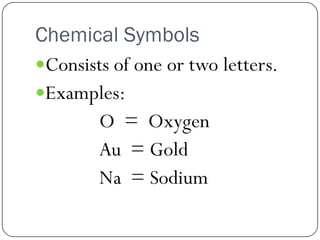
Chemical Symbols
Consists of one or two letters.
Examples:
O = Oxygen
Au = Gold
Na = Sodium
Elements can be metals, non-
metals, or metalloids
Metals
Shiny
Malleable
Ductile
Usually solid
Good
conductors of
heat and
electricity
Non-metals
Tend to be
gases or brittle
solids
Dull
Non-malleable
and non-
ductile
Poor
conductors of
heat and
electricity
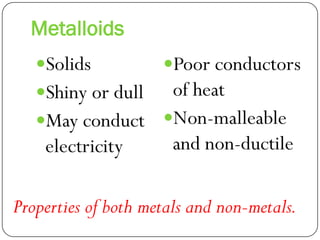
Metalloids
Solids
Shiny or dull
May conduct
electricity
Poor conductors
of heat
Non-malleable
and non-ductile
Properties of both metals and non-metals.
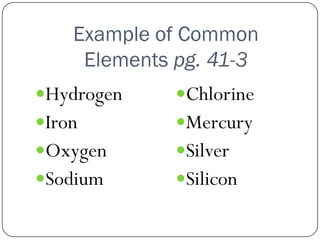
Example of Common
Elements pg. 41-3
Hydrogen
Iron
Oxygen
Sodium
Chlorine
Mercury
Silver
Silicon
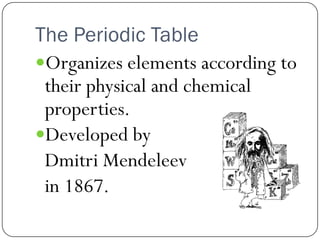
The Periodic Table
Organizes elements according to
their physical and chemical
properties.
Developed by
Dmitri Mendeleev
in 1867.
Mendeleev’s two main
contributions:
1. organizing known elements
according to properties and
characteristics
2. recognizing the need to leave
spaces for elements not yet
discovered
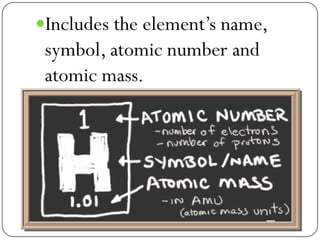
Includes the element’s name,
symbol, atomic number and
atomic mass.
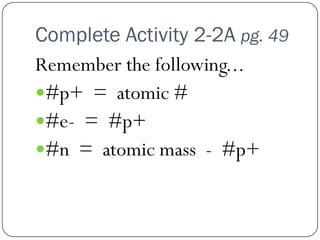
Complete Activity 2-2A pg. 49
Remember the following...
#p+ = atomic #
#e- = #p+
#n = atomic mass - #p+
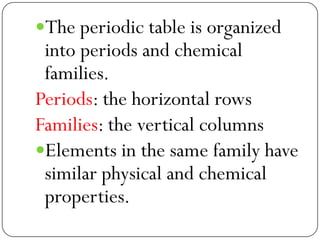
The periodic table is organized
into periods and chemical
families.
Periods: the horizontal rows
Families: the vertical columns
Elements in the same family have
similar physical and chemical
properties.
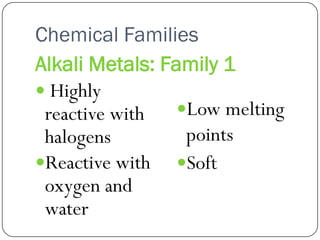
Chemical Families
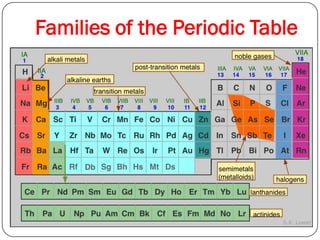
Alkali Metals: Family 1
 Highly
reactive with
halogens
Reactive with
oxygen and
water
Low melting
points
Soft
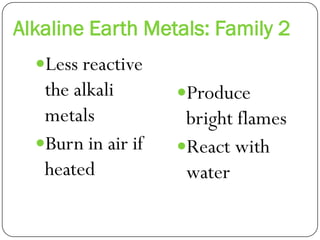
Alkaline Earth Metals: Family 2
Less reactive
the alkali
metals
Burn in air if
heated
Produce
bright flames
React with
water
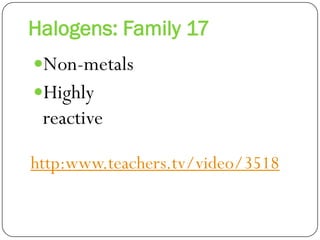
Halogens: Family 17
Non-metals
Highly
reactive
http:www.teachers.tv/video/3518
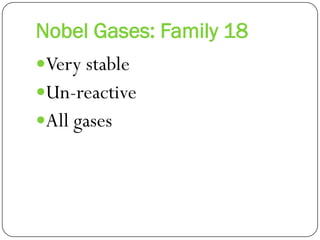
Nobel Gases: Family 18
Very stable
Un-reactive
All gases
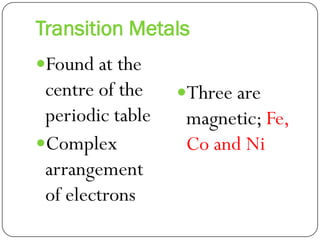
Transition Metals
Found at the
centre of the
periodic table
Complex
arrangement
of electrons
Three are
magnetic; Fe,
Co and Ni
Families of the Periodic Table
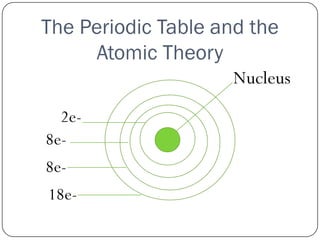
The Periodic Table and the
Atomic Theory
Nucleus
2e-
8e-
8e-
18e-
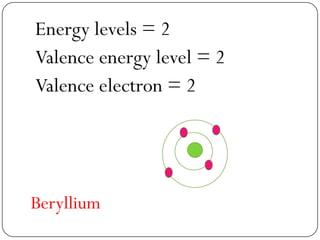
Energy levels = 2
Valence energy level = 2
Valence electron = 2
Beryllium
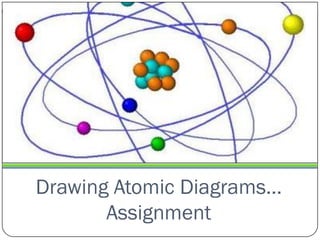
Drawing Atomic Diagrams…
Assignment
Most elements in the same
family have the same # of
valence electrons (# of electrons
in the outermost energy level).
The period # = the # of energy
levels.
The valence shell of the noble
gases is FULL; therefore stable.
Gaining or losing electrons will
allow atoms to achieve a kind of
stability. Metals will gain
electrons while non-metals will
lose them.

9 unit1ch2slideshow09