WESTERN
CLASSICAL PLAYS
AND OPERA
MAPEH
Fourth Quarter
Grade 9 – Arts Education
INTRODUCTION
Theater Arts of the Western countries produced and
performed in different periods and that have had great
influence from the Ancient Greek and Roman theater
art.
Some of the famous playwrights and composers of the
Western Theater Arts/ Opera were Sophocles, William
Shakespeare, Christopher Marlowe, Farinelli, Claudio
Giovanni Antonio Monteverdi, Pierre Beaumarchais,
Johann Wolfgang von Goethe, Victor Hugo, Georges
Bizet, Wolfgang Amadeus Mozart, Franz Schubert,
Giusseppe Verdi, and Giacomo Puccini.
Modern theatrical plays and musicals are still
influenced by their predecessors. The
development and evolution of Western
classical plays/operas are specifically
discussed in this module.
For better and effective understanding,
different activities will be performed in this
module. Viewing and listening of sample
plays or operas are encouraged to promote
appreciation of the culture and traditions of
the western countries.
HISTORY OF THE
THEATRICAL FORMS
AND THEIR EVOLUTION
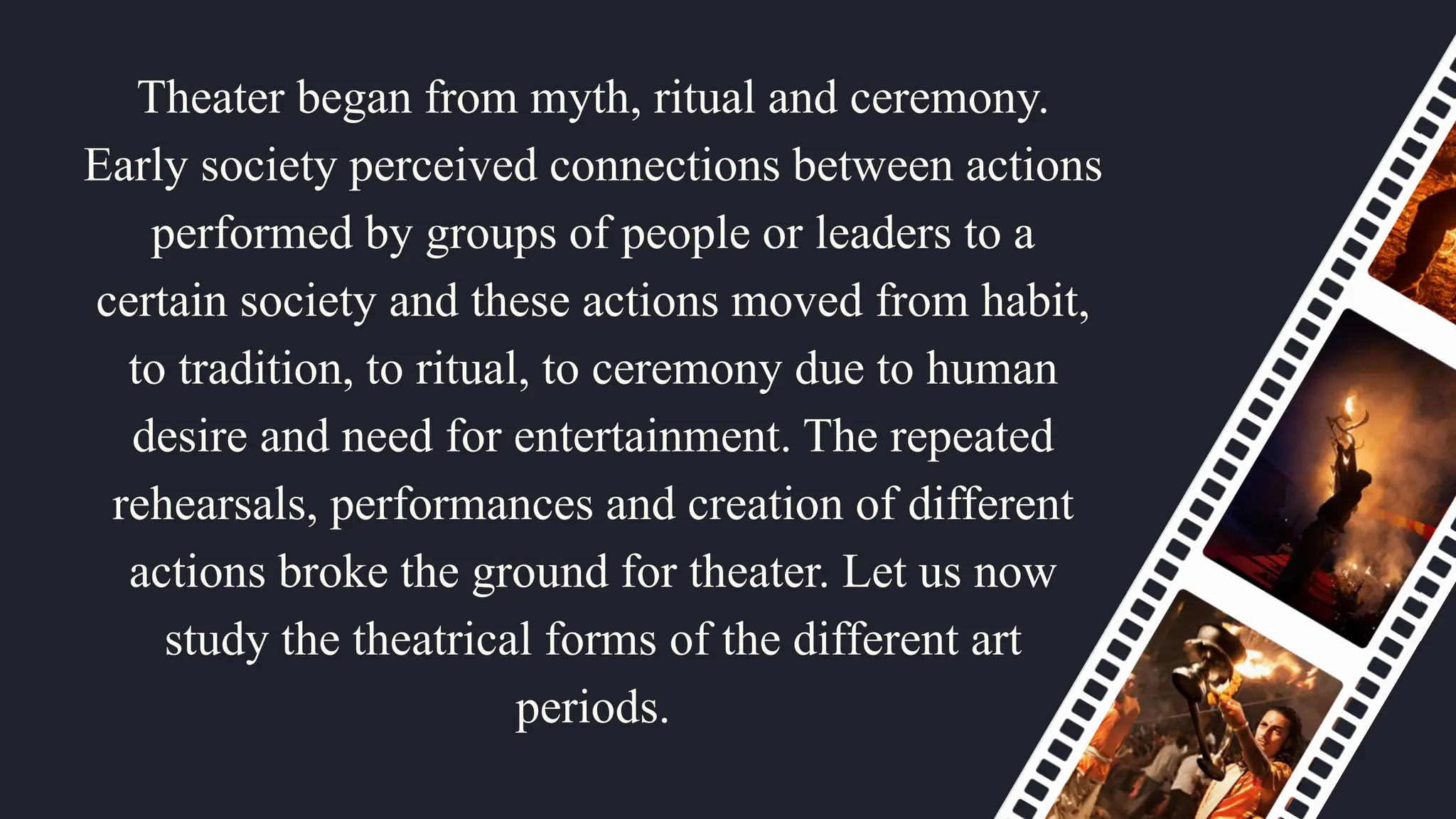
Theater began from myth, ritual and ceremony.
Early society perceived connections between actions
performed by groups of people or leaders to a
certain society and these actions moved from habit,
to tradition, to ritual, to ceremony due to human
desire and need for entertainment. The repeated
rehearsals, performances and creation of different
actions broke the ground for theater. Let us now
study the theatrical forms of the different art
periods.
Theater means "place of seeing," but it is
more than the buildings where performance
take place. To produce theater, a playwright
writes the scripts, the director rehearses the
performers, the designer and technical crew
produce props to create the scenes, and
actors and actresses perform on stage. Then
it will only be a true theater act when an
audience witnesses it.
ANCIENT THEATER
700 B.C.E.-410 C.E.
THE ANCIENT GREEK
European theater began in Ancient
Greece. It began around 700
B.C.with festivals honoring their
many gods.
Dionysus (Di-on-i-sus), the god of
wine and fertility, has a religious
festival called, "The Cult of
Dionysus,“ to honor him.
The three well-known Greek tragedy
playwrights are Sophocles, Euripides and
Aeschylus.
The theater of ancient Greece consisted
of three types of drama:
Tragedy, Comedy and the Satyr play.
In Greece, tragedy was the most
admired type of play. It dealt with
tragic events and have an unhappy
ending, especially one concerning the
downfall of the main character.
THESPIS
was the first actor and introduced the use of masks and was
called the "Father of Tragedy."
COMEDY
plays were derived from imitation; there were no
traces of their origin. Aristophanes wrote most of the
comedy plays.
LYSISTRATA
a humorous tale about a strong
woman who led a female
coalition to end war in Greece.
CYCLOPS
was an adventurous comedy by
Euripides.
SATYR PLAY
contains comic elements to lighten the overall
mood or a serious play with a happy ending.
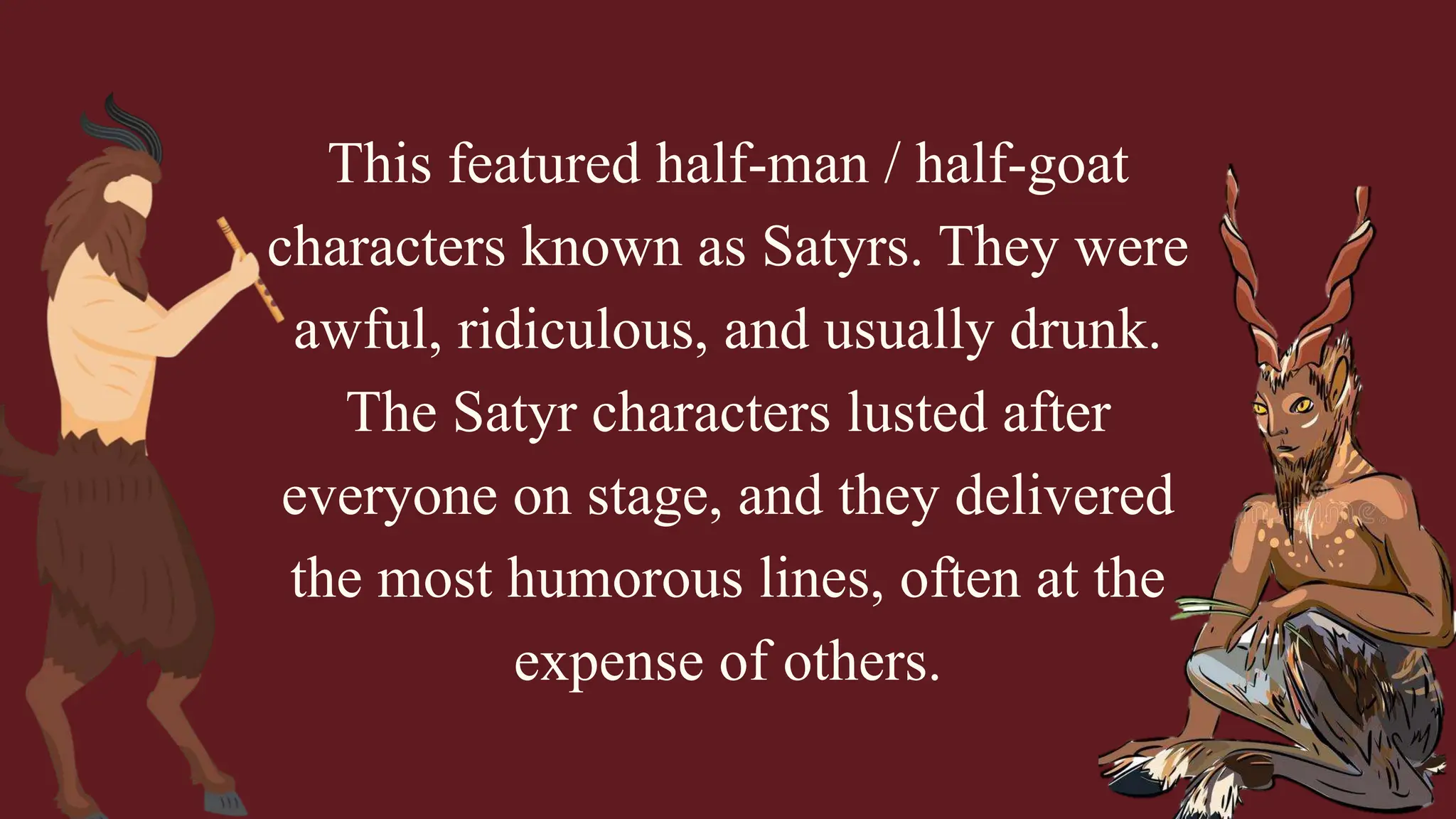
This featured half-man / half-goat
characters known as Satyrs. They were
awful, ridiculous, and usually drunk.
The Satyr characters lusted after
everyone on stage, and they delivered
the most humorous lines, often at the
expense of others.
THE GREEK THEATER
THE GREEK THEATER
(EPIDAUROS)
(EPIDAUROS)
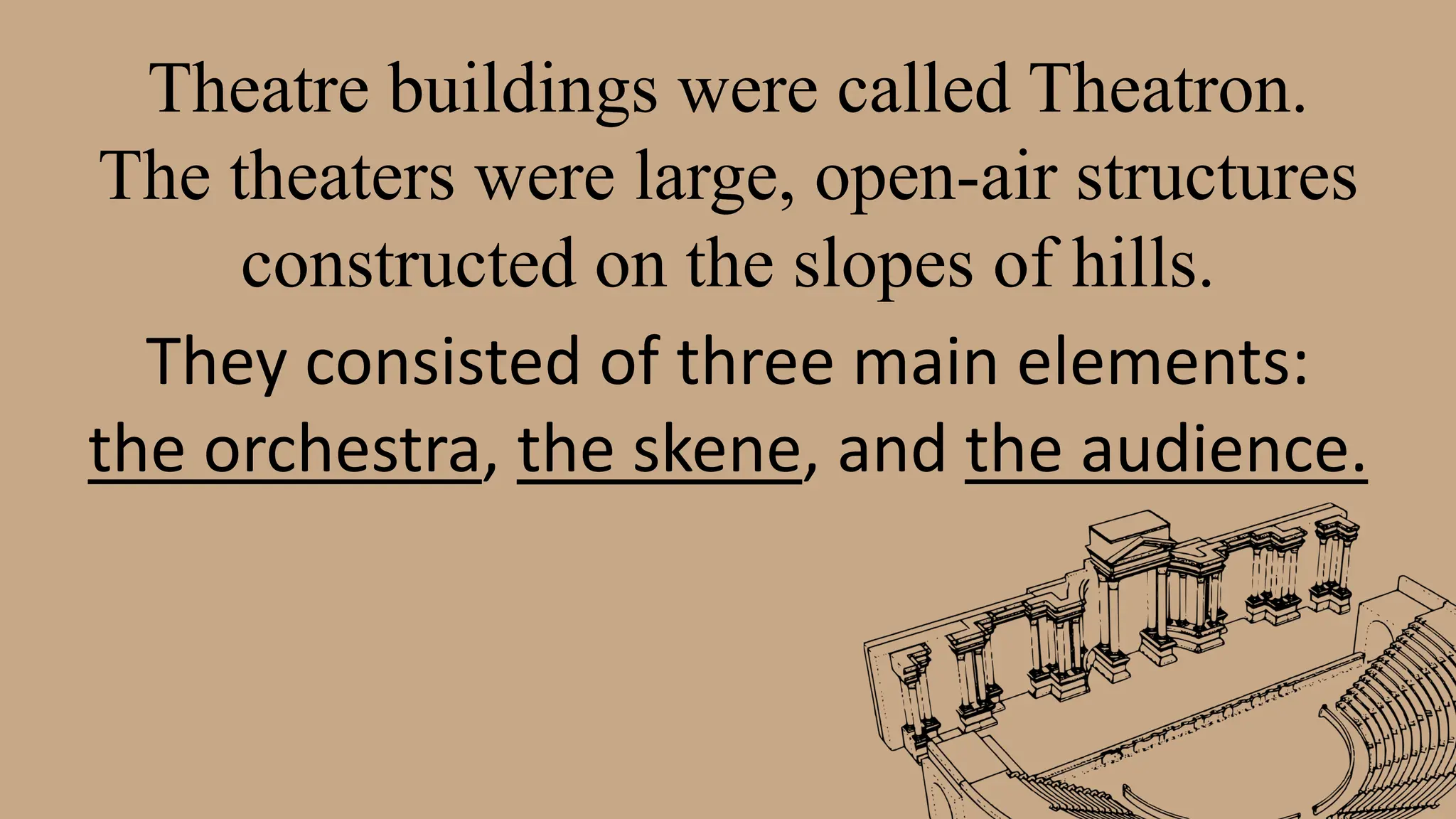
Theatre buildings were called Theatron.
The theaters were large, open-air structures
constructed on the slopes of hills.
They consisted of three main elements:
the orchestra, the skene, and the audience.
THEATRON
-viewing place on the slope
of a hill.
ORCHESTRA
-A LARGE CIRCULAR OR
RECTANGULAR AREAAT THE
CENTER PART OF THE
THEATRE, WHERE THE PLAY,
DANCE, RELIGIOUS RITES,
AND ACTING TOOK PLACE.
A SKENE
-stage.
A PARODOS
-side entrance.
ROMAN THEATER
3RD CENTURY B.C.
The theatre of ancient Rome started in the 3rd century BC.
Although Rome had a native tradition of performance, the Hellenization
(historical spread of ancient Greek culture) of Roman culture in the 3rd
century BC had an intense and energizing effect on Roman theatre and
encouraged the development of Latin literature.
Greek theatres had a great influence on the Roman’s theater, too.
The Triumvir Pompey- was one of the first permanent (non-wooden)
theatres in Rome, whose structure was somewhat similar to the theatron
of Athens.
The building was a part of a multi-use complex that included a large quadriporticus (a columned
quadrangle), directly behind the scaenae fron (an elaborately decorated background of theatre stage)
enclosed by the large columned porticos with an expansive garden complex of fountains and statues.
There were rooms also that were dedicated to the exposition of art and other works collected by Pompey
Magnus which were located along the stretch of covered arcade.
THEATER OF POMPEY
The usual themes for Roman theater plays were chariots races, gladiators, and
public executions. The Romans loved a good spectacle. They loved to watch
combat, admired blood sports and gladiator competition.
ROMAN CHARIOTS
500 C.E.-1400
MEDIEVAL
THEATER
They travelled from one town to another as
puppeteers, jugglers, story tellers, dancers, singers,
and other theatrical acts. These minstrels were
viewed as dangerous and pagan.
During the Medieval era, theater performances
were not allowed throughout Europe. To keep
the theater alive, minstrels, though denounced
by the Church, performed in markets, public
places and festivals.
Illustration of Minstrels Medieval Times
Churches in Europe started staging their own theater
performances during Easter Sundays with biblical stories
and events. Eventually, some plays were brought outside the
church due to their portrayal of the devil and hell.

9 Arts Quarter IV - part 1............pptx

  • 1.
    WESTERN CLASSICAL PLAYS AND OPERA MAPEH FourthQuarter Grade 9 – Arts Education
  • 2.
    INTRODUCTION Theater Arts ofthe Western countries produced and performed in different periods and that have had great influence from the Ancient Greek and Roman theater art. Some of the famous playwrights and composers of the Western Theater Arts/ Opera were Sophocles, William Shakespeare, Christopher Marlowe, Farinelli, Claudio Giovanni Antonio Monteverdi, Pierre Beaumarchais, Johann Wolfgang von Goethe, Victor Hugo, Georges Bizet, Wolfgang Amadeus Mozart, Franz Schubert, Giusseppe Verdi, and Giacomo Puccini.
  • 3.
    Modern theatrical playsand musicals are still influenced by their predecessors. The development and evolution of Western classical plays/operas are specifically discussed in this module. For better and effective understanding, different activities will be performed in this module. Viewing and listening of sample plays or operas are encouraged to promote appreciation of the culture and traditions of the western countries.
  • 4.
    HISTORY OF THE THEATRICALFORMS AND THEIR EVOLUTION
  • 5.
    Theater began frommyth, ritual and ceremony. Early society perceived connections between actions performed by groups of people or leaders to a certain society and these actions moved from habit, to tradition, to ritual, to ceremony due to human desire and need for entertainment. The repeated rehearsals, performances and creation of different actions broke the ground for theater. Let us now study the theatrical forms of the different art periods.
  • 6.
    Theater means "placeof seeing," but it is more than the buildings where performance take place. To produce theater, a playwright writes the scripts, the director rehearses the performers, the designer and technical crew produce props to create the scenes, and actors and actresses perform on stage. Then it will only be a true theater act when an audience witnesses it.
  • 7.
    ANCIENT THEATER 700 B.C.E.-410C.E. THE ANCIENT GREEK
  • 8.
    European theater beganin Ancient Greece. It began around 700 B.C.with festivals honoring their many gods. Dionysus (Di-on-i-sus), the god of wine and fertility, has a religious festival called, "The Cult of Dionysus,“ to honor him.
  • 9.
    The three well-knownGreek tragedy playwrights are Sophocles, Euripides and Aeschylus.
  • 10.
    The theater ofancient Greece consisted of three types of drama: Tragedy, Comedy and the Satyr play. In Greece, tragedy was the most admired type of play. It dealt with tragic events and have an unhappy ending, especially one concerning the downfall of the main character.
  • 11.
    THESPIS was the firstactor and introduced the use of masks and was called the "Father of Tragedy."
  • 12.
    COMEDY plays were derivedfrom imitation; there were no traces of their origin. Aristophanes wrote most of the comedy plays.
  • 13.
    LYSISTRATA a humorous taleabout a strong woman who led a female coalition to end war in Greece. CYCLOPS was an adventurous comedy by Euripides.
  • 14.
    SATYR PLAY contains comicelements to lighten the overall mood or a serious play with a happy ending.
  • 15.
    This featured half-man/ half-goat characters known as Satyrs. They were awful, ridiculous, and usually drunk. The Satyr characters lusted after everyone on stage, and they delivered the most humorous lines, often at the expense of others.
  • 16.
    THE GREEK THEATER THEGREEK THEATER (EPIDAUROS) (EPIDAUROS)
  • 17.
    Theatre buildings werecalled Theatron. The theaters were large, open-air structures constructed on the slopes of hills. They consisted of three main elements: the orchestra, the skene, and the audience.
  • 18.
    THEATRON -viewing place onthe slope of a hill. ORCHESTRA -A LARGE CIRCULAR OR RECTANGULAR AREAAT THE CENTER PART OF THE THEATRE, WHERE THE PLAY, DANCE, RELIGIOUS RITES, AND ACTING TOOK PLACE. A SKENE -stage. A PARODOS -side entrance.
  • 19.
  • 20.
    The theatre ofancient Rome started in the 3rd century BC. Although Rome had a native tradition of performance, the Hellenization (historical spread of ancient Greek culture) of Roman culture in the 3rd century BC had an intense and energizing effect on Roman theatre and encouraged the development of Latin literature. Greek theatres had a great influence on the Roman’s theater, too. The Triumvir Pompey- was one of the first permanent (non-wooden) theatres in Rome, whose structure was somewhat similar to the theatron of Athens.
  • 21.
    The building wasa part of a multi-use complex that included a large quadriporticus (a columned quadrangle), directly behind the scaenae fron (an elaborately decorated background of theatre stage) enclosed by the large columned porticos with an expansive garden complex of fountains and statues. There were rooms also that were dedicated to the exposition of art and other works collected by Pompey Magnus which were located along the stretch of covered arcade. THEATER OF POMPEY
  • 22.
    The usual themesfor Roman theater plays were chariots races, gladiators, and public executions. The Romans loved a good spectacle. They loved to watch combat, admired blood sports and gladiator competition. ROMAN CHARIOTS
  • 23.
  • 24.
    They travelled fromone town to another as puppeteers, jugglers, story tellers, dancers, singers, and other theatrical acts. These minstrels were viewed as dangerous and pagan. During the Medieval era, theater performances were not allowed throughout Europe. To keep the theater alive, minstrels, though denounced by the Church, performed in markets, public places and festivals.
  • 25.
    Illustration of MinstrelsMedieval Times Churches in Europe started staging their own theater performances during Easter Sundays with biblical stories and events. Eventually, some plays were brought outside the church due to their portrayal of the devil and hell.

Editor's Notes