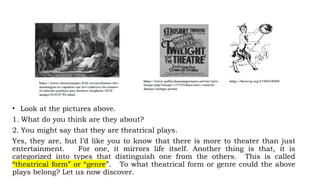
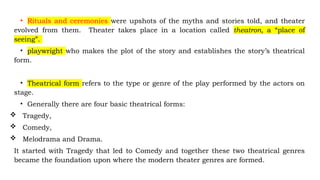
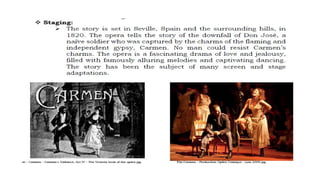
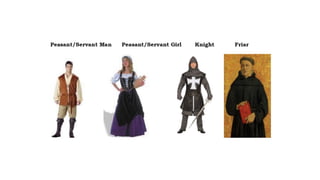
• Look atthe pictures above.
1. What do you think are they about?
2. You might say that they are theatrical plays.
Yes, they are, but I’d like you to know that there is more to theater than just
entertainment. For one, it mirrors life itself. Another thing is that, it is
categorized into types that distinguish one from the others. This is called
“theatrical form” or “genre”. To what theatrical form or genre could the above
plays belong? Let us now discover.
4.
• Rituals andceremonies were upshots of the myths and stories told, and theater
evolved from them. Theater takes place in a location called theatron, a “place of
seeing”.
• playwright who makes the plot of the story and establishes the story’s theatrical
form.
• Theatrical form refers to the type or genre of the play performed by the actors on
stage.
• Generally there are four basic theatrical forms:
Tragedy,
Comedy,
Melodrama and Drama.
It started with Tragedy that led to Comedy and together these two theatrical genres
became the foundation upon where the modern theater genres are formed.
5.
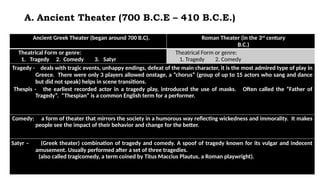
A. Ancient Theater(700 B.C.E – 410 B.C.E.)
Ancient Greek Theater (began around 700 B.C). Roman Theater (in the 3rd
century
B.C.)
Theatrical Form or genre:
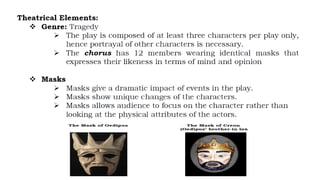
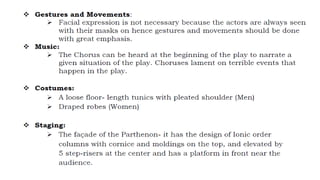
1. Tragedy 2. Comedy 3. Satyr
Theatrical Form or genre:
1. Tragedy 2. Comedy
Tragedy - deals with tragic events, unhappy endings, defeat of the main character, it is the most admired type of play in
Greece. There were only 3 players allowed onstage, a “chorus” (group of up to 15 actors who sang and dance
but did not speak) helps in scene transitions.
Thespis - the earliest recorded actor in a tragedy play, introduced the use of masks. Often called the “Father of
Tragedy”. “Thespian” is a common English term for a performer.
Comedy: a form of theater that mirrors the society in a humorous way reflecting wickedness and immorality. It makes
people see the impact of their behavior and change for the better.
Satyr – (Greek theater) combination of tragedy and comedy. A spoof of tragedy known for its vulgar and indecent
amusement. Usually performed after a set of three tragedies.
(also called tragicomedy, a term coined by Titus Maccius Plautus, a Roman playwright).
6.
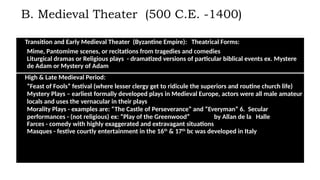
B. Medieval Theater(500 C.E. -1400)
Transition and Early Medieval Theater (Byzantine Empire): Theatrical Forms:
1. Mime, Pantomime scenes, or recitations from tragedies and comedies
2. Liturgical dramas or Religious plays - dramatized versions of particular biblical events ex. Mystere
de Adam or Mystery of Adam
High & Late Medieval Period:
3. “Feast of Fools” festival (where lesser clergy get to ridicule the superiors and routine church life)
4. Mystery Plays – earliest formally developed plays in Medieval Europe, actors were all male amateur
locals and uses the vernacular in their plays
5. Morality Plays - examples are: “The Castle of Perseverance” and “Everyman” 6. Secular
performances - (not religious) ex: “Play of the Greenwood” by Allan de la Halle
7. Farces - comedy with highly exaggerated and extravagant situations
8. Masques - festive courtly entertainment in the 16th
& 17th
bc was developed in Italy
7.
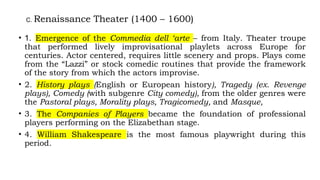
C. Renaissance Theater(1400 – 1600)
• 1. Emergence of the Commedia dell ‘arte – from Italy. Theater troupe
that performed lively improvisational playlets across Europe for
centuries. Actor centered, requires little scenery and props. Plays come
from the “Lazzi” or stock comedic routines that provide the framework
of the story from which the actors improvise.
• 2. History plays (English or European history), Tragedy (ex. Revenge
plays), Comedy (with subgenre City comedy), from the older genres were
the Pastoral plays, Morality plays, Tragicomedy, and Masque,
• 3. The Companies of Players became the foundation of professional
players performing on the Elizabethan stage.
• 4. William Shakespeare is the most famous playwright during this
period.
8.
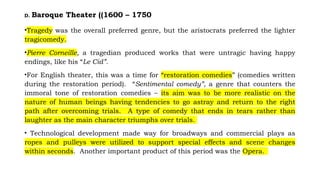
D. Baroque Theater((1600 – 1750
•Tragedy was the overall preferred genre, but the aristocrats preferred the lighter
tragicomedy.
•Pierre Corneille, a tragedian produced works that were untragic having happy
endings, like his “Le Cid”.
•For English theater, this was a time for “restoration comedies” (comedies written
during the restoration period). “Sentimental comedy”, a genre that counters the
immoral tone of restoration comedies – its aim was to be more realistic on the
nature of human beings having tendencies to go astray and return to the right
path after overcoming trials. A type of comedy that ends in tears rather than
laughter as the main character triumphs over trials.
• Technological development made way for broadways and commercial plays as
ropes and pulleys were utilized to support special effects and scene changes
within seconds. Another important product of this period was the Opera.
9.
E. Neoclassical Theater(1800 – 1900)
•Theater was dominated by Neoclassicism (art forms inspired by the classics). Emphasis was on
the exact adherence to the classical unities that has largely contributed to proper decorum
(audience etiquette) when watching a play. This period was characterized by lavish and complex
scenery, costumes, large gestures and melodrama. Politically satirical comedies outshined the
sexual farces of the Restoration.
• In Germany, historic accuracy in costumes and settings was the trend. Theater
architecture was greatly improved and German Romanticism theatrical form was introduced.
• The emergence of “Theater Movements” i.e.
• Realism (depicts life as it is naturally) and non-realism –
• Symbolism (expressing the intangible or unseen internal feelings by means of visible or
sensuous representations) and
• forerunner of Expressionism. (Express emotion and meaning rather than reality).
Naturalism (naturalistic) which was influenced by Darwin’s theory of Evolution founded on the
belief that one’s character is determined by its heredity and environment.
10.
F. Romantic Theater(1800 – 2000)
• Melodrama and Operas were the most popular theatrical
forms.
• There was an abundance of Experimental theater (also known
as avant-garde theater), a rejection of the conventional
theater styles, the experimental theater changes the theme,
language even the relationship of the actors to the audience.
Through the breaking of the “fourth wall” where the actors
address dialogues (questions) to the audience.
• Hollywood came out and endangered American theater. But
theater was not affected instead it continued to be known
and noticed worldwide
Elements of Artsas Applied to Western Classical Theaters and
Operas: Ancient Greek Theater
• Western Classical Plays and Operas
More than the birth of well- known and famous playwrights
and composers, Western classical plays and operas have had
fulfilled the human desire and need for entertainment.
Western classical plays and operas performed and produced in
different periods have greatly influenced the succeeding
generations. Prominent concepts of Western classical plays
and operas include entertainment and a moral lesson at the
end. These features are evident in films nowadays including in
the Philippines where Filipinos are mostly hooked to following
a “teleserye”, romcom(Romantic- Comedy) and even dramas in
radios.
13.
The representative playsfrom Greek Theatre, Renaissance
Theatre and Romantic Theater.
GREEK
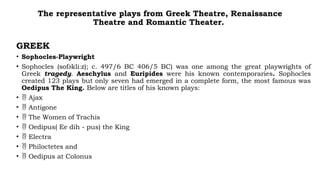
• Sophocles-Playwright
• Sophocles (sofəkliːz); c. 497/6 BC 406/5 BC) was one among the great playwrights of
Greek tragedy. Aeschylus and Euripides were his known contemporaries. Sophocles
created 123 plays but only seven had emerged in a complete form, the most famous was
Oedipus The King. Below are titles of his known plays:
• Ajax
• Antigone
• The Women of Trachis
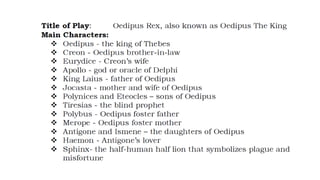
• Oedipus( Ee dih - pus) the King
• Electra
• Philoctetes and
• Oedipus at Colonus
27.
Arts
Quarter 4 –Module 3:
Influences of Renaissance Theatre on
Philippine Theatrical Performance in Terms of
Form and Content of Story
28.
• During theMiddle Ages, mystery plays formed a part of
religious festivals in England
• and other parts of Europe during the Renaissance period.
Morality plays (in which the protagonist was met by
personifications of various moral attributes who try to choose
a godly life over evil) and the university drama were formed to
recreate Athenian tragedy.
• Public theatrical performances were developed like, the
Commedia dell'arte (Italian comedy and a humorous
theatrical presentation performed by professional players
who traveled in troupes)
• and the elaborate masques (a dramatic entertainment
consisting of pantomime, dancing, dialogue, and song where
players wore masks) that were usually presented in court.
29.
Renaissance Theater:
1400-1600
• Renaissancetheatre is characterized by a return of Classical Greek and
Roman arts and culture.
• One of the most prominent supporters of the theatre was Queen
Elizabeth I.
• The companies of players (companies of actors) were organized by the
aristocrats and performed seasonally in many places. They were called
professional players and they performed on the Elizabethan stage.
• The tours of these players gradually replaced the performances of the
mystery and morality plays by local players.
• Gorboduc (whose authors were Thomas Norton and Thomas Sackville),
also known as Ferrex and Porrex, was an English play and first performed
at the Christmas celebration in 1561, and performed before Queen
Elizabeth I on 18 January 1562, by the Gentlemen of the Inner Temple.
30.
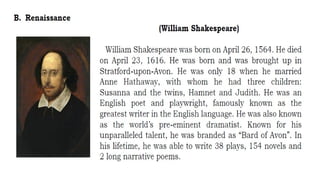
• The famousactor and poet who emerged in this period was William Shakespeare.
• He was baptized on April 26, 1564 and died on April 23, 1616.
• He was an English poet, playwright and actor and regarded as the greatest writer
and dramatist in the whole world.
•Shakespeare was often called England's national poet and the "Bard of Avon". His
works consist of about 38 plays.
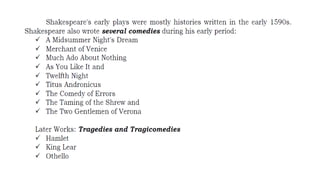
•Some of these plays include the well-loved Romeo and Juliet, Hamlet, Midsummer
Night’s Dream, Cleopatra, Julius Caesar, and Much Ado about Nothing. The four
tragedies considered to be Shakespeare's greatest works were Hamlet, Othello, King
Lear, and Macbeth.
•Other contemporary playwrights of Shakespeare were :
Christopher Marlowe (who wrote tragedies such as Dr. Faustus and The Jew of Malta),
and Thomas Kyd (who wrote The Spanish Tragedy also known as Hieronimo is Mad
• Again).
31.
•The history playsdepicted English or European history.
Shakespeare wrote about the lives of kings, such as
Richard III and Henry V, Christopher Marlowe wrote
Edward II, and George Peele penned The Famous Chronicle
of King Edward the First.
•Comedies were common, too. These dealt with life in
London after the fashion of the Roman New Comedy.
Famous comedy plays include The Shoemaker's Holiday by
Thomas Dekker and A Chaste Maid in Cheapside by
Thomas Middleton.
32.
•For the firsttime, ballet was performed in public during this period.
•Ballet is a formalized form of dance which originated from the Italian
Renaissance courts.
•It developed and flourished from Italy to France with the help of Catherine de'
Medici, (Queen of France). An early example of Catherine's development of ballet
is through Le Paradis d' Amour, a piece of work presented at her daughter,
Marguerite de Valoi's wedding, to Henry of Navarre. The wealth of the aristocrats
was responsible for the initial stages of court ballet for their entertainment. The
first formal ―court ballet ever recognized was, 'Ballet des Polonais' in 1573. A
true form of royal entertainment, 'Ballet des Polonais' was commissioned by
Catherine de' Medici to honor the Polish ambassadors who visited Paris for the
enthronement of King Henry in Poland.
33.
Innovations of theStage:
• 1. The Proscenium was developed. This is the area of a
theatre surrounding the stage opening. Arches frame
and divide the stage from the audience.
• 2. Backdrops for scenery were popularized by the art of
painting clothes.
• 3. Commedia dell’arte or ―the “Comedy of the
Profession” was developed. It was a quick-witted
performance of various characters/players
34.
Theatrical Elements:
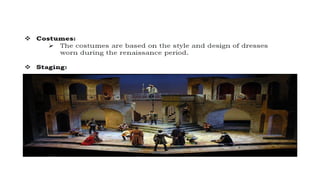
Staging forRomeo and Juliet:
• The stage itself was divided into three levels:
a main stage area with doors at the rear and a
curtained area at the back for "discovery scenes";
an upper, canopied area called "heaven", for
balcony scenes; and
an area under the stage called "hell," which could
be accessed through a trap door in the stage.
35.
•The performances duringthe Renaissance period
took place during the day, and the open plan
theater allowed for the use of natural light.
•Since there could be no dramatic lighting and
there was art direction (scenery and props),
audiences relied on the actors' lines, dialogue,
movements, and stage directions to tell the time
of day and year, same as the location, mood, and
weather.
36.
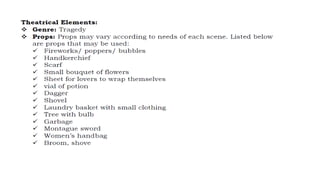
• Props inthis play may vary depend on the scene/act the learners are going to perform. Here are lists of props one
may use for the play.
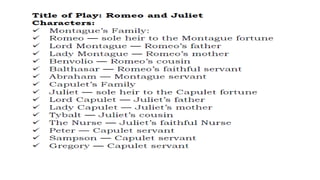
• Characters:
Montague Family:
• Romeo — sole heir to the Montague fortune
• Lord Montague — Romeo’s father
• Lady Montague — Romeo’s mother
• Benvolio — Romeo’s cousin
• Balthasar — Romeo’s faithful servant
• Abraham — Montague servant
Capulet Family
• Juliet — sole heir to the Capulet fortune
• Lord Capulet — Juliet’s father
• Lady Capulet — Juliet’s mother
• Tybalt — Juliet’s cousin
• The Nurse — Juliet’s faithful Nurse
• Peter — Capulet servant
• Sampson — Capulet servant
• Gregory — Capulet servant
37.
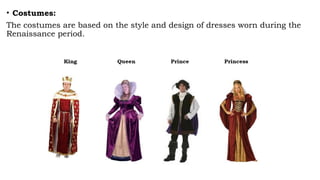
• Costumes:
The costumesare based on the style and design of dresses worn during the
Renaissance period.
39.
Philippine Theater ArtForm
• Philippine theatre art form has evolved to become an
amalgamation of the various influences such that of the
zarzuela, comedia bodabil, senakulo, moro moro and
western classics. Theatre was largely performed in
English during the time, as it became a large part of
classroom education. Meanwhile, zarzuelas such as “Ang
Kiri,” “Dalagang Bukid,” and “Paglipis ng Dilim”
became well-known beyond their regions.
40.
Famous Filipino Playwrights
•Francisco Balagtas y de la Cruz
• He is well-known for his best work Florante at
Laura. In 1835, Balagtas moved to Panacan,
where he met Maria Asuncion Rivera, who served
as the muse for his future work. She is the
reference in Florante at Laura as “Celia” and
“Mer”.
41.
• Severino Reyes
•(A playwright)
• He is known as “Father of the Tagalog Zarzuela”. A
Filipino writer, dramatist, and playwright, Reyes
was highly acclaimed as one of the giants of Tagalog
Literature.
• Severino Reyes’ masterpiece, Walang Sugat broadly
underscores the injustice of Spanish rule even as it
dances around the cruel fate of the young lovers
Tenyong and Julie with humor and song.
42.
• Dr. RicardoG. Abad
• (A Director)
• He has been involved as actor and director in over 120
productions while at the same time doing sociological work as a
teacher, researcher, and editor.
• He has also directed and acted for professional companies like
Teatro Pilipino and Tanghalang Pilipino of the Cultural Center
of the Philippines, and the Metropolitan Theater.
• Theater Guild. Many of his theater productions were classics of
western drama but in terms of a Filipino and Asian sensibility, like
Shakespeare’s Romeo and Juliet.
43.
• Salvador F.Bernal
• (Father of Theater Design in the Philippines)
• He was first to develop theater design as a profession and
elevate it to an art form. Studied at Ateneo de Manila and
at Northwestern University, Evanston, Illinois, USA,
practiced, and handled courses in the art and craft of
theater design.
44.
• Through theyears, Philippine theatre groups have
staged numerous plays in both English and
Filipino, be they written by Western or local
playwrights. Spanish culture and traditions largely
influence performing arts in the Philippines, but
the contemporary style is borrowed from the
Americans. Classic shows such as West Side Story
and The Sound of Music invariably made waves
when they took the local stage.