HISTORY OF THE
THEATRICAL FORMS AND
EVOLUTION OF ANCIENT
THEATER
Theater began from myth, ritual and ceremony.
Early society perceived connections between actions
performed by groups of people or leaders to certain
society and these actions moved from habit, to
tradition, to ritual, to ceremony due to human desire
and need for entertainment.
Theater means “Place of Seeing”, but it is more
than the buildings where performance takes place.
DIFFERENT ART
PERIODS
A. Ancients Theater 700 B.C.E –410 C.E(Greek and
Roman Theater)
◦Greek Theater
It begun around 700 B.C with festivals honoring their many Gods.-
Dionysus (Di-on-i-sus), the God of wine and fertility, has a
religious festival called “The Cult of Dionysus” to honor him.
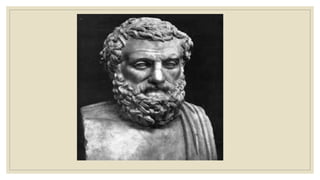
The tree well known Greek tragedy playwrights are: Sophocles,
Euripides, and Aeschylus. The Theater of ancient Greece consisted
of Three types of drama: Tragedy, Comedy and the Satyr play.
Tragedy is a compound of two Greek words, tragosor
“goat” and (ode) meaning “song” referring to goats
sacrificed to Dionysus before performances, to goat-
skin worn by the performers.
In Greece, tragedy was the most admired type of play.
It dealt with tragic events and have an unhappy ending,
especially downfall of the main character. Thespis was
the first actor and introduced the use of masks and
was called the “Father of Tragedy”.
Comedy plays where derived from imitation; there were no traces of their origin.
Aristophanes wrote of the comedy plays. Out of these 11 plays, Lysistrata, a humorous tale about a strong woman who
led a female coalition to end war in Greece survived. Cyclops was an adventurous comedy by Euripides.
Satyr Play contains comic elements to lighten the overall
mood of a serious play with a happy ending. The Satyr play
was a short, lighthearted tailpiece performed after each
trilogy of the tragedies. It is an ancient Greek form of
tragic comedy.
It featured choruses of Satyrs, based on Greek Mythology,
and with pretended drunkenness, bold similarity (including
Phallic props), tricks, and slight jokes. This featured a Half-
man/Half-Goat knowns as Satyrs.
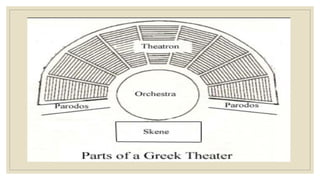
Orchestra–a large circular or rectangular area at the
center part of the theater.
Theatron–viewing place on the slope of a hill.
Skene–stage.
Parados–side entrance.
B. Roman Theater
The theater of ancient Rome started in the 3rdCentury BC. It
had interesting forms such as festival performances of street
theater, acrobatic, the staging of comedies of Plautus and the
high-verbally elaborate tragedies of Seneca.
Hellenization–historical spread of Ancient Greek Culture
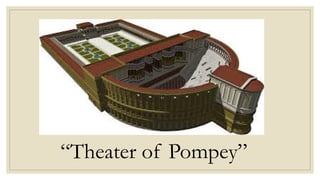
Pompey–1st
permanent (non-wooden) theater in Rome.
Scanae fron –an elaborately decorated background theater Stage.
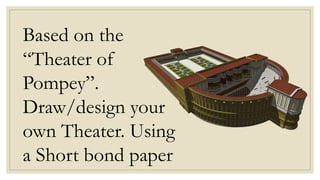
“Theater of Pompey”
C. Medieval Theater (500 C.E. -1400)
Transition and Early Medieval Theater (Byzantine
Empire): Theatrical Forms:
1. Mime, Pantomime scenes, or recitations from tragedies
and comedies.
2. Liturgical dramas or Religious plays - dramatized
versions of particular biblical events.
ex. Mystere de Adam or Mystery of Adam
High & Late Medieval Period:
3. “Feast of Fools” festival (where lesser clergy
get to ridicule the superiors and routine
church life)
4. Mystery Plays – earliest formally developed
plays in Medieval Europe, actors were all male
amateur locals and uses the vernacular in their
plays
5. Morality Plays - examples are: “The Castle of Perseverance” and “Everyman”
6. Secular performances - (not religious) ex: “Play of the Greenwood” by Allan de la Halle
7. Farces - comedy with highly exaggerated and extravagant situations.
8. Masques - festive courtly entertainment in the 16th & 17th B.C was developed in Italy
D. Renaissance Theater (1400 – 1600)
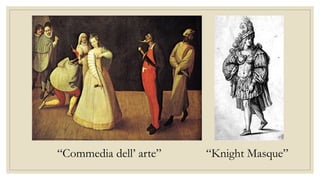
1. Emergence of the Commedia dell ‘arte – from Italy.
Theater troupe that performed lively improvisational
playsets across Europe for centuries. Actor centered,
requires little scenery and props. Plays come from the
“Lazzi” or stock comedic routines that provide the
framework of the story from which the actors
improvise.
2. History plays (English or European
history), Tragedy (ex. Revenge plays),
Comedy (with subgenre City comedy),
from the older genres were the
Pastoral plays, Morality plays,
Tragicomedy, and Masque,
3. The Companies of Players became
the foundation of professional
players performing on the
Elizabethan stage.
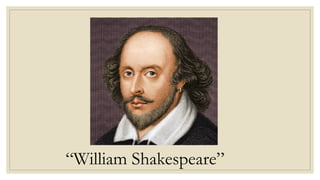
4. playwright William Shakespeare is
the most famous during this period.
“Commedia dell’ arte” “Knight Masque”
“William Shakespeare”
E. Baroque Theater (1600 – 1750)
Tragedy was the overall preferred genre, but the
aristocrats preferred the lighter tragicomedy.
Pierre Corneille, a tragedian produced works that
were untragic having happy endings, like his “Le
Cid”. For English theater, this was a time for
“restoration comedies” (comedies written during
the restoration period).
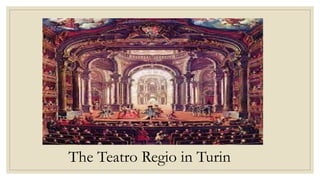
The Teatro Regio in Turin
“Sentimental comedy”, a genre that counters the immoral tone
of restoration comedies – its aim was to be more realistic on
the nature of human beings having tendencies to go astray
and return to the right path after overcoming trials. A type of
comedy that ends in tears rather than laughter as the main
character triumphs over trials.
Technological development made way for broadways and
commercial plays as ropes and pulleys were utilized to support
special effects and scene changes within seconds. Another
important product of this period was the Opera.
F. Neoclassical Theater (1800 – 1900)
Theater was dominated by Neoclassicism (art forms inspired by
the classics). Emphasis was on the exact adherence to the classical
unities that has largely contributed to proper decorum (audience
etiquette) when watching a play. This period was characterized by
lavish and complex scenery, costumes, large gestures and
melodrama. Politically satirical comedies outshined the sexual
farces of the Restoration.
In Germany, historic accuracy in costumes and settings was the
trend. Theater architecture was greatly improved and German
Romanticism theatrical form was introduced.
The emergence of “Theater Movements”. Realism (depicts
life as it is naturally) and non-realism - Symbolism (expressing
the intangible or unseen internal feelings by means of visible
or sensuous representations) and forerunner of
Expressionism. (Express emotion and meaning rather than
reality). Naturalism (naturalistic) which was influenced by
Darwin’s theory of Evolution founded on the belief that
one’s character is determined by its heredity and environment.
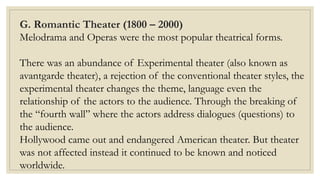
G. Romantic Theater (1800 – 2000)
Melodrama and Operas were the most popular theatrical forms.
There was an abundance of Experimental theater (also known as
avantgarde theater), a rejection of the conventional theater styles, the
experimental theater changes the theme, language even the
relationship of the actors to the audience. Through the breaking of
the “fourth wall” where the actors address dialogues (questions) to
the audience.
Hollywood came out and endangered American theater. But theater
was not affected instead it continued to be known and noticed
worldwide.
DIFFERENT WESTERN
CLASSICAL PLAYS AND
OPERA
A. GREEK
A. Greek
Sophocles (sofkliz); c. 497/6 BC 406/5 BC)
is an ancient Greek tragedian. His contemporary playwrights were Aeschylus and
Euripides. Sophocles wrote 123 plays, but only seven have survived in a complete form:
Ajax
Antigone
The Women of Trachis
Oedipus (Ee dih-pus) the King
Electra
Philoctetes
Oedipus at Colonus
For almost 50 years in the dramatic competitions of the city-state of Athens that took
place during the religious festivals of the Lenaea and the Dionysia, Sophocles was the
most famous playwright. He won first place in 24 out of 30 competitions and was never
judged lower than second place. Aeschylus won 14 competitions.
The most famous tragedies of Sophocles were Oedipus Rex and Antigone: They were known as the Theban
plays, although each play was actually a part of a different tetralogy.
Sophocles influenced the development of the drama, most importantly by adding a third actor. And he
developed his characters to a greater importance than the chorus in the presentation of the plot.
Genre: Tragedy
Number of Characters per Play: 1 to 3 characters only,
but they can portray other characters.
The Chorus: consists of twelve (12) members, all of
whom wore identical masks since they were supposed
to be of like mind and opinion
Masks: The use of masks acts to advance the
universality of the themes and the dramatic impact of
the events and to keep the audience from being
distracted by the actual, physical attributes of the
actors.
Oedipus Rex (Ee-dih-pus Rex)
(Sophocles - Playwright) Main Characters
Oedipus the king of Thebes
Creon Oedipus brother-in-law
Eurydice-Creon's wife
Apollo god or oracle of Delphi King Laius-father
of Oedipus
Jocasta mother and wife of Oedipus
Polynices and Eteocles sons of Oedipus
Tiresias the blind prophet
Polybus Oedipus foster father
Merope Oedipus foster mother Antigone
and
Ismene - the daughters of Oedipus
Haemon
Antigone's lover
Sphinx the half-human half lion that
symbolizes plague and misfortune.
B. RENAISSANCE
Romeo and Juliet
(William Shakespeare)
Genre: Tragedy William Shakespeare was born and baptized on April 26 1564 and died on April 23 1616. Shakespeare was born and
brought up in Stratford-upon-Avon. At the age of 18, he married Anne Hathaway, with whom he had three children: Susanna, and
twins Hamnet and Judith.
A main stage area with doors at the rear and a curtained area at the back for "discovery scenes;"
an upper, canopied area called "heaven," for balcony scenes;
and an area under the stage called "hell," which could be accessed through a trap door in the stage.
There is no curtain in the front of the stage, which meant
that scenes had to flow into each other, and "dead bodies"
had to be dragged off. There are dressing rooms located
behind the stage. The performances during the renaissance
period took place during the day, and the open plan theater
allowed for the use of natural light.
Since there could be no dramatic lighting and there was art
direction (scenery and props), audiences relied on the
actors' lines, dialogue, movements, and stage directions to
tell the time of day and year, same as the location, mood,
and weather.
C. ROMANTIC
PERIOD
Georges Bizet was born on October 25, 1838 in Paris,
France and died on June 3, 1875 at Bougival, France.
Bizet was the only child of Adolphe Armand Bizet (a
former hairdresser who became a singer and
composer) and Aimee Marie Louise Leopoldine
Josephine Delsarte, a pianist.
They lived on the southern slopes of Montmartre,
Paris Georges Bizet was a French composer and pianist
of the Romantic era. He is best known for his opera
Carmen.
FAMOUS FILIPINO
PLAYWRIGHTS
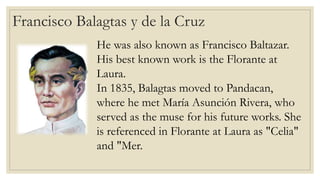
Francisco Balagtas y de la Cruz
He was also known as Francisco Baltazar.
His best known work is the Florante at
Laura.
In 1835, Balagtas moved to Pandacan,
where he met María Asunción Rivera, who
served as the muse for his future works. She
is referenced in Florante at Laura as "Celia"
and "Mer.
"Balagtas published Florante at Laura upon his
release in 1838. He moved to Balanga, Bataan in
1840 where he served as the assistant to the Justice
of Peace and later, in 1856, as Major Lieutenant. He
died on February 20, 1862 at the age of 73.On his
death bed, he asked a favor that none of his children
become a poet like him, who had suffered under his
gift. He even told them it would be better to cut
their hands off than let them be writers
Severino R. Reyes
"Father of the Tagalog Zarzuela“
In 1902, Reyes founded and directed the Grand
Compania de Zarzuela Tagala. On June 14, 1902, the
company staged his play Walang Sugat (No Wounds), a
drama set against the historical events in Bulacan during
the Philippine rev-olution. In 1923, Reyes co-founded
the Liwayway, a Tagalog literary weekly which published
a series of fairy tales titled Mga Kuwento ni Lola
Basyang, written by Reyes. The storyteller, Lola Basyang,
was based by the author on a neighbor named Gervacia
de Guzman. Severino Reyes died on September 15,
1942, when the Philippines was under the Japanese
regime.
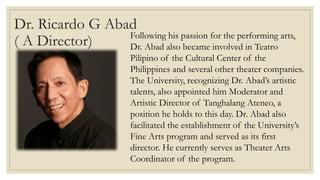
Dr. Ricardo G Abad
( A Director) Following his passion for the performing arts,
Dr. Abad also became involved in Teatro
Pilipino of the Cultural Center of the
Philippines and several other theater companies.
The University, recognizing Dr. Abad’s artistic
talents, also appointed him Moderator and
Artistic Director of Tanghalang Ateneo, a
position he holds to this day. Dr. Abad also
facilitated the establishment of the University’s
Fine Arts program and served as its first
director. He currently serves as Theater Arts
Coordinator of the program.
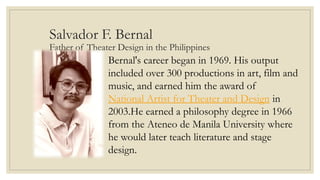
Salvador F. Bernal
Father of Theater Design in the Philippines
Bernal's career began in 1969. His output
included over 300 productions in art, film and
music, and earned him the award of
National Artist for Theater and Design in
2003.He earned a philosophy degree in 1966
from the Ateneo de Manila University where
he would later teach literature and stage
design.
SHORT ACTIVITY
In a ½ crosswise
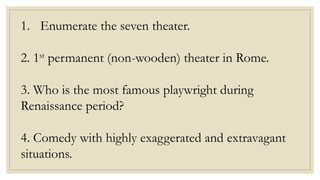
1. Enumerate the seven theater.
2. 1st
permanent (non-wooden) theater in Rome.
3. Who is the most famous playwright during
Renaissance period?
4. Comedy with highly exaggerated and extravagant
situations.
PETA
Based on the
“Theater of
Pompey”.
Draw/design your
own Theater. Using
a Short bond paper
Direction: Answer the following in your quiz notebook.
1. Earliest theater forms were rituals and festivals, all an upshot of the following:
A. gods b. myths c. music d. composers
2. When we talk about Ancient period we are actually talking about these great cities.
a. Rome & Athens b. Greece & Athens c. Athens & Israel d. Rome & Italy
3. Armand used to be joyful, but this COVID 19 had been unforgiving. The time he spent at home thinking about his future made him sad. He finally
succumbed to depression. His family misunderstood him as only having tantrums. Being misunderstood and unable to control his feelings, Armand
committed the grave mistake of killing his mother. The other members of the family were very sad not only for the death of the mother but also for
Armand who now have to spend his life living in prison. How would you classify this story’s genre?
A. morality play b. satyr c. tragedy d. mystery play
4. “There are only two sides of a coin in the same way that there are only two kinds of color either black or white which sometimes mean either you are
good or bad. During what period in history was classical theater viewed diabolical that eventually led to its closure?
a. Ancient b. Medieval c. Renaissance d. none of the above
5. In Greek theater, performers were limited to only 3 persons playing different roles, the transition between scenes and the storyline itself is taken care of by
one of the following
A. the narrator b. the guest c. the host d. the chorus
6. Tragedy goes back to ancient times where it was the most preferred sort of play. The first performer in a tragedy plays who was later
on considered the Father of tragedy was.
a. Dionysus b. Thespis c. Plautus d. Magnus
7. Medieval period began with the closure of classical theater by the church for it was seen as of the devil. What happened to the
religious plays in many countries at the end of the period?
a. It was banned b. it multiplied c. it grew more d. none of the above
8. True or False. In Commedia dell’arte the players wrote their own plays and build their own characters from scratch.
9. Satyr was often performed after three tragedies. What could be the reason for this?
a. It is the most important genre b. It contains the name of the playwright c. It provides a breather from the preceding unhappy
endings d. It is always requested
10. Which of the following is a common English term for a performer?
a. Actor b. Playwright c. Shakespearian d. Thespian
THANK YOU!
Till 'next time.

Pp-in-arts-9 (2).pptx PPT PPT PPTT PTPPPT

  • 1.
    HISTORY OF THE THEATRICALFORMS AND EVOLUTION OF ANCIENT THEATER
  • 2.
    Theater began frommyth, ritual and ceremony. Early society perceived connections between actions performed by groups of people or leaders to certain society and these actions moved from habit, to tradition, to ritual, to ceremony due to human desire and need for entertainment. Theater means “Place of Seeing”, but it is more than the buildings where performance takes place.
  • 3.
  • 4.
    A. Ancients Theater700 B.C.E –410 C.E(Greek and Roman Theater) ◦Greek Theater It begun around 700 B.C with festivals honoring their many Gods.- Dionysus (Di-on-i-sus), the God of wine and fertility, has a religious festival called “The Cult of Dionysus” to honor him. The tree well known Greek tragedy playwrights are: Sophocles, Euripides, and Aeschylus. The Theater of ancient Greece consisted of Three types of drama: Tragedy, Comedy and the Satyr play.
  • 5.
    Tragedy is acompound of two Greek words, tragosor “goat” and (ode) meaning “song” referring to goats sacrificed to Dionysus before performances, to goat- skin worn by the performers. In Greece, tragedy was the most admired type of play. It dealt with tragic events and have an unhappy ending, especially downfall of the main character. Thespis was the first actor and introduced the use of masks and was called the “Father of Tragedy”.
  • 7.
    Comedy plays wherederived from imitation; there were no traces of their origin. Aristophanes wrote of the comedy plays. Out of these 11 plays, Lysistrata, a humorous tale about a strong woman who led a female coalition to end war in Greece survived. Cyclops was an adventurous comedy by Euripides.
  • 8.
    Satyr Play containscomic elements to lighten the overall mood of a serious play with a happy ending. The Satyr play was a short, lighthearted tailpiece performed after each trilogy of the tragedies. It is an ancient Greek form of tragic comedy. It featured choruses of Satyrs, based on Greek Mythology, and with pretended drunkenness, bold similarity (including Phallic props), tricks, and slight jokes. This featured a Half- man/Half-Goat knowns as Satyrs.
  • 10.
    Orchestra–a large circularor rectangular area at the center part of the theater. Theatron–viewing place on the slope of a hill. Skene–stage. Parados–side entrance.
  • 11.
    B. Roman Theater Thetheater of ancient Rome started in the 3rdCentury BC. It had interesting forms such as festival performances of street theater, acrobatic, the staging of comedies of Plautus and the high-verbally elaborate tragedies of Seneca. Hellenization–historical spread of Ancient Greek Culture Pompey–1st permanent (non-wooden) theater in Rome. Scanae fron –an elaborately decorated background theater Stage.
  • 12.
  • 13.
    C. Medieval Theater(500 C.E. -1400) Transition and Early Medieval Theater (Byzantine Empire): Theatrical Forms: 1. Mime, Pantomime scenes, or recitations from tragedies and comedies. 2. Liturgical dramas or Religious plays - dramatized versions of particular biblical events. ex. Mystere de Adam or Mystery of Adam
  • 14.
    High & LateMedieval Period: 3. “Feast of Fools” festival (where lesser clergy get to ridicule the superiors and routine church life) 4. Mystery Plays – earliest formally developed plays in Medieval Europe, actors were all male amateur locals and uses the vernacular in their plays
  • 15.
    5. Morality Plays- examples are: “The Castle of Perseverance” and “Everyman” 6. Secular performances - (not religious) ex: “Play of the Greenwood” by Allan de la Halle 7. Farces - comedy with highly exaggerated and extravagant situations. 8. Masques - festive courtly entertainment in the 16th & 17th B.C was developed in Italy
  • 16.
    D. Renaissance Theater(1400 – 1600) 1. Emergence of the Commedia dell ‘arte – from Italy. Theater troupe that performed lively improvisational playsets across Europe for centuries. Actor centered, requires little scenery and props. Plays come from the “Lazzi” or stock comedic routines that provide the framework of the story from which the actors improvise.
  • 17.
    2. History plays(English or European history), Tragedy (ex. Revenge plays), Comedy (with subgenre City comedy), from the older genres were the Pastoral plays, Morality plays, Tragicomedy, and Masque,
  • 18.
    3. The Companiesof Players became the foundation of professional players performing on the Elizabethan stage. 4. playwright William Shakespeare is the most famous during this period.
  • 19.
    “Commedia dell’ arte”“Knight Masque”
  • 20.
  • 21.
    E. Baroque Theater(1600 – 1750) Tragedy was the overall preferred genre, but the aristocrats preferred the lighter tragicomedy. Pierre Corneille, a tragedian produced works that were untragic having happy endings, like his “Le Cid”. For English theater, this was a time for “restoration comedies” (comedies written during the restoration period).
  • 22.
  • 23.
    “Sentimental comedy”, agenre that counters the immoral tone of restoration comedies – its aim was to be more realistic on the nature of human beings having tendencies to go astray and return to the right path after overcoming trials. A type of comedy that ends in tears rather than laughter as the main character triumphs over trials. Technological development made way for broadways and commercial plays as ropes and pulleys were utilized to support special effects and scene changes within seconds. Another important product of this period was the Opera.
  • 24.
    F. Neoclassical Theater(1800 – 1900) Theater was dominated by Neoclassicism (art forms inspired by the classics). Emphasis was on the exact adherence to the classical unities that has largely contributed to proper decorum (audience etiquette) when watching a play. This period was characterized by lavish and complex scenery, costumes, large gestures and melodrama. Politically satirical comedies outshined the sexual farces of the Restoration. In Germany, historic accuracy in costumes and settings was the trend. Theater architecture was greatly improved and German Romanticism theatrical form was introduced.
  • 25.
    The emergence of“Theater Movements”. Realism (depicts life as it is naturally) and non-realism - Symbolism (expressing the intangible or unseen internal feelings by means of visible or sensuous representations) and forerunner of Expressionism. (Express emotion and meaning rather than reality). Naturalism (naturalistic) which was influenced by Darwin’s theory of Evolution founded on the belief that one’s character is determined by its heredity and environment.
  • 26.
    G. Romantic Theater(1800 – 2000) Melodrama and Operas were the most popular theatrical forms. There was an abundance of Experimental theater (also known as avantgarde theater), a rejection of the conventional theater styles, the experimental theater changes the theme, language even the relationship of the actors to the audience. Through the breaking of the “fourth wall” where the actors address dialogues (questions) to the audience. Hollywood came out and endangered American theater. But theater was not affected instead it continued to be known and noticed worldwide.
  • 27.
  • 28.
  • 29.
    A. Greek Sophocles (sofkliz);c. 497/6 BC 406/5 BC) is an ancient Greek tragedian. His contemporary playwrights were Aeschylus and Euripides. Sophocles wrote 123 plays, but only seven have survived in a complete form:
  • 30.
    Ajax Antigone The Women ofTrachis Oedipus (Ee dih-pus) the King Electra Philoctetes Oedipus at Colonus
  • 31.
    For almost 50years in the dramatic competitions of the city-state of Athens that took place during the religious festivals of the Lenaea and the Dionysia, Sophocles was the most famous playwright. He won first place in 24 out of 30 competitions and was never judged lower than second place. Aeschylus won 14 competitions.
  • 32.
    The most famoustragedies of Sophocles were Oedipus Rex and Antigone: They were known as the Theban plays, although each play was actually a part of a different tetralogy. Sophocles influenced the development of the drama, most importantly by adding a third actor. And he developed his characters to a greater importance than the chorus in the presentation of the plot.
  • 33.
    Genre: Tragedy Number ofCharacters per Play: 1 to 3 characters only, but they can portray other characters. The Chorus: consists of twelve (12) members, all of whom wore identical masks since they were supposed to be of like mind and opinion Masks: The use of masks acts to advance the universality of the themes and the dramatic impact of the events and to keep the audience from being distracted by the actual, physical attributes of the actors.
  • 34.
    Oedipus Rex (Ee-dih-pusRex) (Sophocles - Playwright) Main Characters Oedipus the king of Thebes Creon Oedipus brother-in-law Eurydice-Creon's wife Apollo god or oracle of Delphi King Laius-father of Oedipus Jocasta mother and wife of Oedipus Polynices and Eteocles sons of Oedipus Tiresias the blind prophet
  • 35.
    Polybus Oedipus fosterfather Merope Oedipus foster mother Antigone and Ismene - the daughters of Oedipus Haemon Antigone's lover Sphinx the half-human half lion that symbolizes plague and misfortune.
  • 36.
  • 37.
    Romeo and Juliet (WilliamShakespeare) Genre: Tragedy William Shakespeare was born and baptized on April 26 1564 and died on April 23 1616. Shakespeare was born and brought up in Stratford-upon-Avon. At the age of 18, he married Anne Hathaway, with whom he had three children: Susanna, and twins Hamnet and Judith.
  • 38.
    A main stagearea with doors at the rear and a curtained area at the back for "discovery scenes;" an upper, canopied area called "heaven," for balcony scenes; and an area under the stage called "hell," which could be accessed through a trap door in the stage.
  • 39.
    There is nocurtain in the front of the stage, which meant that scenes had to flow into each other, and "dead bodies" had to be dragged off. There are dressing rooms located behind the stage. The performances during the renaissance period took place during the day, and the open plan theater allowed for the use of natural light. Since there could be no dramatic lighting and there was art direction (scenery and props), audiences relied on the actors' lines, dialogue, movements, and stage directions to tell the time of day and year, same as the location, mood, and weather.
  • 40.
  • 41.
    Georges Bizet wasborn on October 25, 1838 in Paris, France and died on June 3, 1875 at Bougival, France. Bizet was the only child of Adolphe Armand Bizet (a former hairdresser who became a singer and composer) and Aimee Marie Louise Leopoldine Josephine Delsarte, a pianist. They lived on the southern slopes of Montmartre, Paris Georges Bizet was a French composer and pianist of the Romantic era. He is best known for his opera Carmen.
  • 42.
  • 43.
    Francisco Balagtas yde la Cruz He was also known as Francisco Baltazar. His best known work is the Florante at Laura. In 1835, Balagtas moved to Pandacan, where he met María Asunción Rivera, who served as the muse for his future works. She is referenced in Florante at Laura as "Celia" and "Mer.
  • 44.
    "Balagtas published Floranteat Laura upon his release in 1838. He moved to Balanga, Bataan in 1840 where he served as the assistant to the Justice of Peace and later, in 1856, as Major Lieutenant. He died on February 20, 1862 at the age of 73.On his death bed, he asked a favor that none of his children become a poet like him, who had suffered under his gift. He even told them it would be better to cut their hands off than let them be writers
  • 45.
    Severino R. Reyes "Fatherof the Tagalog Zarzuela“ In 1902, Reyes founded and directed the Grand Compania de Zarzuela Tagala. On June 14, 1902, the company staged his play Walang Sugat (No Wounds), a drama set against the historical events in Bulacan during the Philippine rev-olution. In 1923, Reyes co-founded the Liwayway, a Tagalog literary weekly which published a series of fairy tales titled Mga Kuwento ni Lola Basyang, written by Reyes. The storyteller, Lola Basyang, was based by the author on a neighbor named Gervacia de Guzman. Severino Reyes died on September 15, 1942, when the Philippines was under the Japanese regime.
  • 46.
    Dr. Ricardo GAbad ( A Director) Following his passion for the performing arts, Dr. Abad also became involved in Teatro Pilipino of the Cultural Center of the Philippines and several other theater companies. The University, recognizing Dr. Abad’s artistic talents, also appointed him Moderator and Artistic Director of Tanghalang Ateneo, a position he holds to this day. Dr. Abad also facilitated the establishment of the University’s Fine Arts program and served as its first director. He currently serves as Theater Arts Coordinator of the program.
  • 47.
    Salvador F. Bernal Fatherof Theater Design in the Philippines Bernal's career began in 1969. His output included over 300 productions in art, film and music, and earned him the award of National Artist for Theater and Design in 2003.He earned a philosophy degree in 1966 from the Ateneo de Manila University where he would later teach literature and stage design.
  • 48.
    SHORT ACTIVITY In a½ crosswise
  • 49.
    1. Enumerate theseven theater. 2. 1st permanent (non-wooden) theater in Rome. 3. Who is the most famous playwright during Renaissance period? 4. Comedy with highly exaggerated and extravagant situations.
  • 50.
  • 51.
    Based on the “Theaterof Pompey”. Draw/design your own Theater. Using a Short bond paper
  • 52.
    Direction: Answer thefollowing in your quiz notebook. 1. Earliest theater forms were rituals and festivals, all an upshot of the following: A. gods b. myths c. music d. composers 2. When we talk about Ancient period we are actually talking about these great cities. a. Rome & Athens b. Greece & Athens c. Athens & Israel d. Rome & Italy 3. Armand used to be joyful, but this COVID 19 had been unforgiving. The time he spent at home thinking about his future made him sad. He finally succumbed to depression. His family misunderstood him as only having tantrums. Being misunderstood and unable to control his feelings, Armand committed the grave mistake of killing his mother. The other members of the family were very sad not only for the death of the mother but also for Armand who now have to spend his life living in prison. How would you classify this story’s genre? A. morality play b. satyr c. tragedy d. mystery play 4. “There are only two sides of a coin in the same way that there are only two kinds of color either black or white which sometimes mean either you are good or bad. During what period in history was classical theater viewed diabolical that eventually led to its closure? a. Ancient b. Medieval c. Renaissance d. none of the above 5. In Greek theater, performers were limited to only 3 persons playing different roles, the transition between scenes and the storyline itself is taken care of by one of the following A. the narrator b. the guest c. the host d. the chorus
  • 53.
    6. Tragedy goesback to ancient times where it was the most preferred sort of play. The first performer in a tragedy plays who was later on considered the Father of tragedy was. a. Dionysus b. Thespis c. Plautus d. Magnus 7. Medieval period began with the closure of classical theater by the church for it was seen as of the devil. What happened to the religious plays in many countries at the end of the period? a. It was banned b. it multiplied c. it grew more d. none of the above 8. True or False. In Commedia dell’arte the players wrote their own plays and build their own characters from scratch. 9. Satyr was often performed after three tragedies. What could be the reason for this? a. It is the most important genre b. It contains the name of the playwright c. It provides a breather from the preceding unhappy endings d. It is always requested 10. Which of the following is a common English term for a performer? a. Actor b. Playwright c. Shakespearian d. Thespian
  • 54.