Personal
Development
Quarter 1 – Module 8
EMOTIONAL
INTELLIGENCE
OBJECTIVE/S:
1. EXPLORE ONE’S POSITIVE AND NEGATIVE
EMOTIONS AND HOW ONE EXPRESSES OR
HIDES THEM
2. DEMONSTRATE AND CREATE WAYS TO MANAGE
VARIOUS EMOTION.
1.It involves self-awareness, social awareness, self – management and the ability to
get along with others and make friends.
A. Artificial Intelligence C. Emotional Intelligence
B. Behavioral Intelligence D. Intelligence Quotient
2. This means simply noticing them as you feel them and being able to notice and
accurately label in your mind those feelings.( ex, “ I feet great”, “I feel frustrated )
A. Being aware of the emotions
B. Choosing your mood
C. Managing Emotional Reactions
D. Understanding How others feel and Why
3. Means knowing when, where, and how to express yourself.
A. Being aware of the emotions
B. Choosing your mood
C. Managing Emotional Reactions
D. Understanding How others feel and Why
4. You have the power to decide what mood is good for a situation and get into that
mood.
A. Being aware of the emotions
B. Choosing your mood
C. Managing Emotional Reactions
D. Understanding How others feel and Why
5. Are naturally instinctive or intuitive feelings associated with a person’s response
to a particular person, thing, or situation whenever he interacts with the
environment.
A. Emotions B. Stimulus C. Stress D. Values
6. This means being honest with what you feel. It also means knowing how, when,
and where to express it.
A. Entails skills and flexibility
B. Managing emotional reactions
C. Understanding how others feel
D. Being aware of your connections
7. This means simply noticing them as you feel them and being able to
notice and accurately label in your mind those feelings ( ex, “ I feet
great”, “I feel frustrated ) everyday.
A. Entails skills and flexibility
B. Managing emotional reactions
C. Understanding how others feel
D. Being aware of your connections
8. Means knowing when, where, and how to express yourself.
A. Entails skills and flexibility
B. Managing emotional reactions
C. Understanding how others feel
D. Being aware of your connections
9. Being able to imagine what emotions a person is likely to be
feeling even when you don’t actually know.
A. Care
B. Concern
C. Discern
D. Empathy
10. The most crucial element for a student’s success in school is
____.
A. the awareness of other’s fault
B. the discontentment of one’s grade
C. the understanding of how to learn
D. the promotion of gender discrimination
What’s In
Let us find out how you deal with your negative emotions. Go over the list of
negative emotions or events below and provide the activities that you often
engage in to handle the said emotions or events. You are going to write your
answers in a sentence on a separate sheet of paper or on your notebook.
1. You are bored at home due to this pandemic
______________________________
2. You are frustrated because you have a failing grade
_______________________
3. You are angry because your project was destroyed by your pets
_________________
4. You are impatient to your younger brother who always ask for your help in
his/her subject ______________________________
5. You disobeyed you parents because you listen to the advice of your
classmate__________________________________________________________
What’s New
Activity 1: MY EMOTION, MY REACTION
Please read the questions below and write your reactions in a sentence to a
separate sheet of paper or to your notebook.
1. Your partner in project raised his voice at you because you did not
understand his instructions and you ruined the project .____________________
2. You overheard someone from other section criticize your class president as
Ineffective leader._________________________________________________
3. You and your parents have misunderstanding. _________________________
4. You are attending a party and accidentally the server spilled the wine to
your dress. _______________________________________________
5. You were telling to your best friend an exciting news about your passing the
UP College Admission Test however, he/she is not listening to
you.___________.
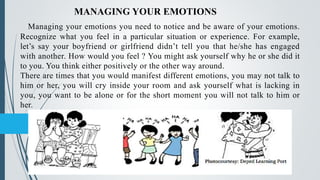
MANAGING YOUR EMOTIONS
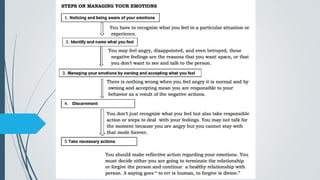
Managing your emotions you need to notice and be aware of your emotions.
Recognize what you feel in a particular situation or experience. For example,
let’s say your boyfriend or girlfriend didn’t tell you that he/she has engaged
with another. How would you feel ? You might ask yourself why he or she did it
to you. You think either positively or the other way around.
There are times that you would manifest different emotions, you may not talk to
him or her, you will cry inside your room and ask yourself what is lacking in
you, you want to be alone or for the short moment you will not talk to him or
her.
Emotional Intelligence
All adolescent must begin to master the emotional skills necessary to
manage stress and be sensitive and effective in relating to other people.
These skills have been called “emotional intelligence” ( Goleman, 1994 as
cited from APA 2002 ). It involves self-awareness, social awareness, self –
management and the ability to get along with others and make friends.
Emotionally intelligent person is competent in identifying how various
emotions affect him or her. You need to know how to identify, understand.
OTHER FACTORS ON MANAGING EMOTIONS
1. Entails skills and flexibility . This means being honest with what you
feel. It also means knowing how, when, and where to express it.
Emotionally intelligent person knows that he or she has to stay calm first
he might utter hateful words that might be regretted later.
2. It involves developing various strategies. Means not only one
way to respond the situations but you have always a choice. Being
careful with your thoughts may lead you to be more emotionally
intelligent. Ex. You have your best friend coming to you and you
smiled at her, but she didn’t respond. So it might be that your first
interpretation you will get angry at her for not responding you, but it
you are emotionally intelligent you will not fell bad about it,
probably she didn’t notice you smile.
3. Taking time to understand why you feel the way you do before
acting upon your emotions. Thinking and studying your options
allows you to make an informed and wise decisions. Physical
activities such as exercise and playing games, release tensions, clear
your minds and give you more time to
4. Learn from experiences when looking for something
positive about the situation. ex. feeling sad when you received
a low grade, that feeling of sadness is telling something is
wrong in your study habits so you have to change how you do
the things.
5. Knowing how to manage your emotions and that all
emotions have positive intent and may be used at your
advantage. ex. you have to be honest with your feelings, write
or talk about it, bear in mind that you need to express your
emotions in appropriate manner in a right place and a right time.
Talk to God about your problems, “there is no problem too big,
God cannot solve it.”
Emotional Intelligence is a combination of several
different skills
1. Being aware of your emotions
This means simply noticing them as you feel them and being able to
notice and accurately label in your mind those feelings ( ex, “ I feet
great”, “I feel frustrated ) everyday. This also helps us to understand
how other people feel. Make it a habit to be aware of your emotions.
2. Understanding How others feel and Why
Part of EQ is being able to imagine how other people might feel
certain situations. It is about understanding why they feel the way they

do. We develop the idea of empathy – being able to imagine what
emotions a person is likely to be feeling even when you don’t actually
know.
3. Managing Emotional Reactions
Means knowing when, where, and how to express yourself. When you understand
your emotions and know how to manage them, you can use self-control to hold a
reaction if now is not the right time or place to express it.
4. Choosing your mood
Moods are emotional state that a last a bit. You have the power to decide what
mood is good for a situation and get into that mood. Choosing your mood can help
someone get motivated, concentrate on a task or try again. You can control emotions
by knowing which mood is best for a particular situation and get into that mood.
5. Emotional Quotient : Under Construction
Emotional Intelligence / Quotient ( EQ ) is something that develops as you grow
older. Some skills develop earlier, may be easier. Example: knowing emotions seems
easy one, but skill of managing emotional reactions and choosing a mood might seem
to hard to master that’s because part of brain responsible for self-management.
Continues to mature beyond our teen years. We can all work to build stronger
emotional intelligence.
Emotional Intelligence and School
According to Johnson ( 2009 ), the most crucial element for a
student’s success in school is an understanding of how to
learn. Some key factors for this understanding are self -
confidence, self-control, capacity to communicate, and
ability to cooperate. These traits are all aspects of
emotional intelligence. Adolescents with high emotional
intelligence will also have a good relationship with teachers
and parents which also helps them to perform well in
examinations. It is also easy for students with good EQ to
relate well with peers and are not likely to use drugs or
alcohol.
Activity 2: EMOTIONS ARE MINE
In your notebook or in a separate sheet of paper I want you to share
some present experiences about those unforgettable moments where
your emotions were revealed, it can be positive or negative emotions.
You make a One Week Diary. In each day from Monday to Sunday you
are going to write in a sentence or paragraph the events unforgettable on
that day. For positive ones you can add sentences on how you can
sustain it, while on negative happenings you make a resolution or action
in a sentence on how you can manage next time these bad emotions
happen.
Emotion Sun. Mon. Tues. Wed. Thur. Fri. Sat.
Positive
Negative
What I Have Learned
After doing the activities above and reading the discussion too.
May I ask you to do simple recall by enumerating or discussing
what have you learned in this lesson by writing in a separate sheet
of paper or in your notebook.
Activity 3: KWL CHART
K What I know
about the topic?
W What I wonder
about the topic?
L What I learned
about the topic?
What I Can Do
Activity 4: COLLAGE MAKING “CELEBRATING MEMORIES
OF EMOTIONS”
Create your story of celebrating emotions. Using the
materials below you will create a collage that will depict on
“ Celebrating Memories of Emotions”. You make label or
add caption on it by cutting letters from old magazines or
newspapers or any materials you want to use that is
available in the house.
What I Can Do
Instructions:
1. Use a clean sheet of papers/cartolina/illustration board or any
materials that is available.
2. Cut old pictures from magazines brochures, any colored materials
available.
3. Coloring materials, colored papers/ art papers / tissue paper.
4. Paste or glue, pair of scissors.
5. Other materials that is available in the house to add beauty to the
collage.
Criteria:
A. Variety of pictures used to develop main ideas - 5pts.
B. Ideas ( originality and interest ) - 5pts.
C. Relevance of material ( connected to main idea ) - 5pts.
D. Visual Impact ( effectiveness of overall presentation ) – 5pts.
Total 20 pts.
ASSESSMENT
1. It involves self-awareness, social awareness, self – management and
the ability to get along with others and make friends.
A. Artificial Intelligence C. Emotional Intelligence
B. Behavioral Intelligence D. Intelligence Quotient
2. This means simply noticing them as you feel them and being able to
notice and accurately label in your mind those feelings ( ex, “ I feet
great”, “I feel frustrated )
A.Being aware of the emotions
B. Choosing your mood
C.Managing Emotional Reactions
D.Understanding How others feel and Why
3. Means knowing when, where, and how to express yourself.
A. Being aware of the emotions
B. Choosing your mood
C. Managing Emotional Reactions
D. Understanding How others feel and Why
4. You have the power to decide what mood is good for a situation and
get into that mood.
A. Being aware of the emotions
B. Choosing your mood
C. Managing Emotional Reactions
D. Understanding How others feel and Why
5. Are naturally instinctive or intuitive feelings associated with a person’s response
to a person, thing, or situation whenever he interacts with the environment.
A. Emotions B. Stimulus C. Stress D. Values
6. This means being honest with what you feel. It also means knowing how,
when, and where to express it.
A. Entails skills and flexibility
B. Knowing how to manage your emotions
C. It involves developing various strategies
D. Taking time to understand why you feel the way you do.
7. This means not only one way to respond the situations, but you have always a
choice.
A. Entails skills and flexibility
B. Knowing how to manage your emotions
C. It involves developing various strategies
D. Taking time to understand why you feel the way you do
8. You don’t just recognize what you feel but also take responsible action
or steps to deal with your feelings.
A. Benevolent C. Encouragement
B. Discernment D. Upliftment
9. May help to become more motivated in doing the tasks and may
develop creativity or establish harmonious relationship with others and
associated with good physical and psychological conditions.
A. Negative emotions C. Passive emotions
B. Nonviolent emotions D. Positive emotions
10. May reduce person’s efficiency and even motivation to perform
certain tasks.
A. Negative emotions C. Passive emotions
B. Nonviolent emotions D. Positive emotions
11. This means being honest with what you feel. It also means knowing how,
when, and where to express it.
A. Entails skills and flexibility
B. Understanding how others feel
C. Managing emotional reactions
D. Being aware of your connections
12. This means simply noticing them as you feel them and being able to
notice and accurately label in your mind those feelings ( ex, “ I fegreat”, “I feel
frustrated ) everyday.
A. Entails skills and flexibility
B. Understanding how others feel
C. Managing emotional reactions
D. Being aware of your connections
13. Means knowing when, where, and how to express yourself.
A. Entails skills and flexibility
B. Understanding how others feel
C. Managing emotional reactions
D.Being aware of your connections
14. Being able to imagine what emotions a person is likely to be
feeling even when you don’t actually know.
A. Care B. Concern C. Discern D. Empathy
15. The most crucial element for a student’s success in school is ____.
A. the awareness of other’s fault
B. the discontentment of one’s grade
C. the understanding of how to learn
D.the promotion of gender discrimination
Additional Activity
Activity 4: REACTION PAPER
Read the questions below and write your answers in sentence form. You
may write it on your notebook or any separate sheet of paper
1. Am I able to calm someone down when needed or do I get easily
upset when others are in distress ? _____________________________
2. When it comes to managing and controlling one’s emotions,
what strategies can I suggest ?________________________________
3. When I am deeply upset or in distress what do I expect from a
friend or relative who is willing to sit with me and listen ? ________
8_Q1-PerDev.pptx

8_Q1-PerDev.pptx

  • 1.
    Personal Development Quarter 1 –Module 8 EMOTIONAL INTELLIGENCE
  • 2.
    OBJECTIVE/S: 1. EXPLORE ONE’SPOSITIVE AND NEGATIVE EMOTIONS AND HOW ONE EXPRESSES OR HIDES THEM 2. DEMONSTRATE AND CREATE WAYS TO MANAGE VARIOUS EMOTION.
  • 3.
    1.It involves self-awareness,social awareness, self – management and the ability to get along with others and make friends. A. Artificial Intelligence C. Emotional Intelligence B. Behavioral Intelligence D. Intelligence Quotient 2. This means simply noticing them as you feel them and being able to notice and accurately label in your mind those feelings.( ex, “ I feet great”, “I feel frustrated ) A. Being aware of the emotions B. Choosing your mood C. Managing Emotional Reactions D. Understanding How others feel and Why 3. Means knowing when, where, and how to express yourself. A. Being aware of the emotions B. Choosing your mood C. Managing Emotional Reactions D. Understanding How others feel and Why
  • 4.
    4. You havethe power to decide what mood is good for a situation and get into that mood. A. Being aware of the emotions B. Choosing your mood C. Managing Emotional Reactions D. Understanding How others feel and Why 5. Are naturally instinctive or intuitive feelings associated with a person’s response to a particular person, thing, or situation whenever he interacts with the environment. A. Emotions B. Stimulus C. Stress D. Values 6. This means being honest with what you feel. It also means knowing how, when, and where to express it. A. Entails skills and flexibility B. Managing emotional reactions C. Understanding how others feel D. Being aware of your connections
  • 5.
    7. This meanssimply noticing them as you feel them and being able to notice and accurately label in your mind those feelings ( ex, “ I feet great”, “I feel frustrated ) everyday. A. Entails skills and flexibility B. Managing emotional reactions C. Understanding how others feel D. Being aware of your connections 8. Means knowing when, where, and how to express yourself. A. Entails skills and flexibility B. Managing emotional reactions C. Understanding how others feel D. Being aware of your connections
  • 6.
    9. Being ableto imagine what emotions a person is likely to be feeling even when you don’t actually know. A. Care B. Concern C. Discern D. Empathy 10. The most crucial element for a student’s success in school is ____. A. the awareness of other’s fault B. the discontentment of one’s grade C. the understanding of how to learn D. the promotion of gender discrimination
  • 7.
    What’s In Let usfind out how you deal with your negative emotions. Go over the list of negative emotions or events below and provide the activities that you often engage in to handle the said emotions or events. You are going to write your answers in a sentence on a separate sheet of paper or on your notebook. 1. You are bored at home due to this pandemic ______________________________ 2. You are frustrated because you have a failing grade _______________________ 3. You are angry because your project was destroyed by your pets _________________ 4. You are impatient to your younger brother who always ask for your help in his/her subject ______________________________ 5. You disobeyed you parents because you listen to the advice of your classmate__________________________________________________________
  • 8.
    What’s New Activity 1:MY EMOTION, MY REACTION Please read the questions below and write your reactions in a sentence to a separate sheet of paper or to your notebook. 1. Your partner in project raised his voice at you because you did not understand his instructions and you ruined the project .____________________ 2. You overheard someone from other section criticize your class president as Ineffective leader._________________________________________________ 3. You and your parents have misunderstanding. _________________________ 4. You are attending a party and accidentally the server spilled the wine to your dress. _______________________________________________ 5. You were telling to your best friend an exciting news about your passing the UP College Admission Test however, he/she is not listening to you.___________.
  • 9.
    MANAGING YOUR EMOTIONS Managingyour emotions you need to notice and be aware of your emotions. Recognize what you feel in a particular situation or experience. For example, let’s say your boyfriend or girlfriend didn’t tell you that he/she has engaged with another. How would you feel ? You might ask yourself why he or she did it to you. You think either positively or the other way around. There are times that you would manifest different emotions, you may not talk to him or her, you will cry inside your room and ask yourself what is lacking in you, you want to be alone or for the short moment you will not talk to him or her.
  • 11.
    Emotional Intelligence All adolescentmust begin to master the emotional skills necessary to manage stress and be sensitive and effective in relating to other people. These skills have been called “emotional intelligence” ( Goleman, 1994 as cited from APA 2002 ). It involves self-awareness, social awareness, self – management and the ability to get along with others and make friends. Emotionally intelligent person is competent in identifying how various emotions affect him or her. You need to know how to identify, understand. OTHER FACTORS ON MANAGING EMOTIONS 1. Entails skills and flexibility . This means being honest with what you feel. It also means knowing how, when, and where to express it. Emotionally intelligent person knows that he or she has to stay calm first he might utter hateful words that might be regretted later.
  • 12.
    2. It involvesdeveloping various strategies. Means not only one way to respond the situations but you have always a choice. Being careful with your thoughts may lead you to be more emotionally intelligent. Ex. You have your best friend coming to you and you smiled at her, but she didn’t respond. So it might be that your first interpretation you will get angry at her for not responding you, but it you are emotionally intelligent you will not fell bad about it, probably she didn’t notice you smile. 3. Taking time to understand why you feel the way you do before acting upon your emotions. Thinking and studying your options allows you to make an informed and wise decisions. Physical activities such as exercise and playing games, release tensions, clear your minds and give you more time to
  • 13.
    4. Learn fromexperiences when looking for something positive about the situation. ex. feeling sad when you received a low grade, that feeling of sadness is telling something is wrong in your study habits so you have to change how you do the things. 5. Knowing how to manage your emotions and that all emotions have positive intent and may be used at your advantage. ex. you have to be honest with your feelings, write or talk about it, bear in mind that you need to express your emotions in appropriate manner in a right place and a right time. Talk to God about your problems, “there is no problem too big, God cannot solve it.”
  • 14.
    Emotional Intelligence isa combination of several different skills 1. Being aware of your emotions This means simply noticing them as you feel them and being able to notice and accurately label in your mind those feelings ( ex, “ I feet great”, “I feel frustrated ) everyday. This also helps us to understand how other people feel. Make it a habit to be aware of your emotions. 2. Understanding How others feel and Why Part of EQ is being able to imagine how other people might feel certain situations. It is about understanding why they feel the way they do. We develop the idea of empathy – being able to imagine what emotions a person is likely to be feeling even when you don’t actually know.
  • 15.
    3. Managing EmotionalReactions Means knowing when, where, and how to express yourself. When you understand your emotions and know how to manage them, you can use self-control to hold a reaction if now is not the right time or place to express it. 4. Choosing your mood Moods are emotional state that a last a bit. You have the power to decide what mood is good for a situation and get into that mood. Choosing your mood can help someone get motivated, concentrate on a task or try again. You can control emotions by knowing which mood is best for a particular situation and get into that mood. 5. Emotional Quotient : Under Construction Emotional Intelligence / Quotient ( EQ ) is something that develops as you grow older. Some skills develop earlier, may be easier. Example: knowing emotions seems easy one, but skill of managing emotional reactions and choosing a mood might seem to hard to master that’s because part of brain responsible for self-management. Continues to mature beyond our teen years. We can all work to build stronger emotional intelligence.
  • 16.
    Emotional Intelligence andSchool According to Johnson ( 2009 ), the most crucial element for a student’s success in school is an understanding of how to learn. Some key factors for this understanding are self - confidence, self-control, capacity to communicate, and ability to cooperate. These traits are all aspects of emotional intelligence. Adolescents with high emotional intelligence will also have a good relationship with teachers and parents which also helps them to perform well in examinations. It is also easy for students with good EQ to relate well with peers and are not likely to use drugs or alcohol.
  • 17.
    Activity 2: EMOTIONSARE MINE In your notebook or in a separate sheet of paper I want you to share some present experiences about those unforgettable moments where your emotions were revealed, it can be positive or negative emotions. You make a One Week Diary. In each day from Monday to Sunday you are going to write in a sentence or paragraph the events unforgettable on that day. For positive ones you can add sentences on how you can sustain it, while on negative happenings you make a resolution or action in a sentence on how you can manage next time these bad emotions happen. Emotion Sun. Mon. Tues. Wed. Thur. Fri. Sat. Positive Negative
  • 18.
    What I HaveLearned After doing the activities above and reading the discussion too. May I ask you to do simple recall by enumerating or discussing what have you learned in this lesson by writing in a separate sheet of paper or in your notebook. Activity 3: KWL CHART K What I know about the topic? W What I wonder about the topic? L What I learned about the topic?
  • 19.
    What I CanDo Activity 4: COLLAGE MAKING “CELEBRATING MEMORIES OF EMOTIONS” Create your story of celebrating emotions. Using the materials below you will create a collage that will depict on “ Celebrating Memories of Emotions”. You make label or add caption on it by cutting letters from old magazines or newspapers or any materials you want to use that is available in the house.
  • 20.
    What I CanDo Instructions: 1. Use a clean sheet of papers/cartolina/illustration board or any materials that is available. 2. Cut old pictures from magazines brochures, any colored materials available. 3. Coloring materials, colored papers/ art papers / tissue paper. 4. Paste or glue, pair of scissors. 5. Other materials that is available in the house to add beauty to the collage. Criteria: A. Variety of pictures used to develop main ideas - 5pts. B. Ideas ( originality and interest ) - 5pts. C. Relevance of material ( connected to main idea ) - 5pts. D. Visual Impact ( effectiveness of overall presentation ) – 5pts. Total 20 pts.
  • 21.
    ASSESSMENT 1. It involvesself-awareness, social awareness, self – management and the ability to get along with others and make friends. A. Artificial Intelligence C. Emotional Intelligence B. Behavioral Intelligence D. Intelligence Quotient 2. This means simply noticing them as you feel them and being able to notice and accurately label in your mind those feelings ( ex, “ I feet great”, “I feel frustrated ) A.Being aware of the emotions B. Choosing your mood C.Managing Emotional Reactions D.Understanding How others feel and Why
  • 22.
    3. Means knowingwhen, where, and how to express yourself. A. Being aware of the emotions B. Choosing your mood C. Managing Emotional Reactions D. Understanding How others feel and Why 4. You have the power to decide what mood is good for a situation and get into that mood. A. Being aware of the emotions B. Choosing your mood C. Managing Emotional Reactions D. Understanding How others feel and Why
  • 23.
    5. Are naturallyinstinctive or intuitive feelings associated with a person’s response to a person, thing, or situation whenever he interacts with the environment. A. Emotions B. Stimulus C. Stress D. Values 6. This means being honest with what you feel. It also means knowing how, when, and where to express it. A. Entails skills and flexibility B. Knowing how to manage your emotions C. It involves developing various strategies D. Taking time to understand why you feel the way you do. 7. This means not only one way to respond the situations, but you have always a choice. A. Entails skills and flexibility B. Knowing how to manage your emotions C. It involves developing various strategies D. Taking time to understand why you feel the way you do
  • 24.
    8. You don’tjust recognize what you feel but also take responsible action or steps to deal with your feelings. A. Benevolent C. Encouragement B. Discernment D. Upliftment 9. May help to become more motivated in doing the tasks and may develop creativity or establish harmonious relationship with others and associated with good physical and psychological conditions. A. Negative emotions C. Passive emotions B. Nonviolent emotions D. Positive emotions 10. May reduce person’s efficiency and even motivation to perform certain tasks. A. Negative emotions C. Passive emotions B. Nonviolent emotions D. Positive emotions
  • 25.
    11. This meansbeing honest with what you feel. It also means knowing how, when, and where to express it. A. Entails skills and flexibility B. Understanding how others feel C. Managing emotional reactions D. Being aware of your connections 12. This means simply noticing them as you feel them and being able to notice and accurately label in your mind those feelings ( ex, “ I fegreat”, “I feel frustrated ) everyday. A. Entails skills and flexibility B. Understanding how others feel C. Managing emotional reactions D. Being aware of your connections
  • 26.
    13. Means knowingwhen, where, and how to express yourself. A. Entails skills and flexibility B. Understanding how others feel C. Managing emotional reactions D.Being aware of your connections 14. Being able to imagine what emotions a person is likely to be feeling even when you don’t actually know. A. Care B. Concern C. Discern D. Empathy 15. The most crucial element for a student’s success in school is ____. A. the awareness of other’s fault B. the discontentment of one’s grade C. the understanding of how to learn D.the promotion of gender discrimination
  • 27.
    Additional Activity Activity 4:REACTION PAPER Read the questions below and write your answers in sentence form. You may write it on your notebook or any separate sheet of paper 1. Am I able to calm someone down when needed or do I get easily upset when others are in distress ? _____________________________ 2. When it comes to managing and controlling one’s emotions, what strategies can I suggest ?________________________________ 3. When I am deeply upset or in distress what do I expect from a friend or relative who is willing to sit with me and listen ? ________