






GAMIFICATION IN SCIENCE
LESSON PLAN
GROUP 8
SAHIN IDIN – SCIENCE TEACHER
ISMAIL DONMEZ - SCIENCE TEACHER
NURAY AKBULUT – BIOLOGY TEACHER
JANINA KRIPIENE – MATH TEACHER
BORYANA KUYUMDZHIEVA - MATH TEACHER
LESSON
SCIENCE LESSON IN 8TH
DEGREE
SECONDARY LESSON 10TH
DEGREE
SUBJECT
PHOTOSYNTHESIS
AIM
Technological devices to improve
careless s pupils motivation and
attitude and enjoying and
providing them the process
PROCESS
WHATS GAMIFICATION
• The use of game design principles
and mechanics in non-game
contexts
• Making technology more inviting
by encouraging users to engage in
desired behaviors
Who Wants To BeWho Wants To Be
A Millionaire?A Millionaire?
Photosynthesis
Question 1
Sepals which colour it have
A red
B blue
C green
D yellow
Sepals which colour it have
A red
B blue
C green
D yellow
£100
Question 2
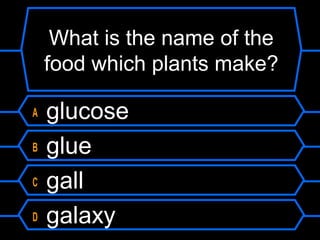
What is the name of the
food which plants make?
A glucose
B glue
C gall
D galaxy
What is the name of the
food which plants make?
A glucose
B glue
C gall
D galaxy
£200
Question 3
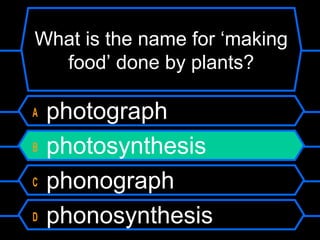
What is the name for ‘making
food’ done by plants?
A photograph
B photosynthesis
C phonograph
D phonosynthesis
What is the name for ‘making
food’ done by plants?
A photograph
B photosynthesis
C phonograph
D phonosynthesis
£300
Question 4
Which gas is taken in by
plants to make food?
A hydrogen
B oxygen
C carbon dioxide
D nitrogen
Which gas is taken in by
plants to make food?
A hydrogen
B oxygen
C carbon dioxide
D nitrogen
£500
Question 5
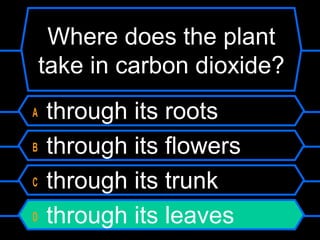
Where does the plant
take in carbon dioxide?
A through its roots
B through its flowers
C through its trunk
D through its leaves
Where does the plant
take in carbon dioxide?
A through its roots
B through its flowers
C through its trunk
D through its leaves
£1,000
Question 6
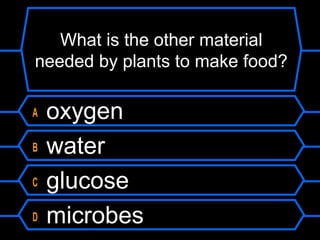
What is the other material
needed by plants to make food?
A oxygen
B water
C glucose
D microbes
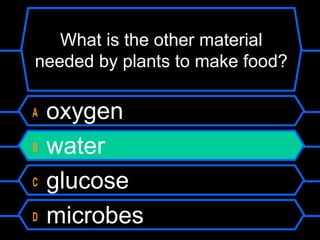
What is the other material
needed by plants to make food?
A oxygen
B water
C glucose
D microbes
£2,000
Question 7
Which type of energy is used by
the plant when making food?
A sound
B electrical
C heat
D light
Which type of energy is used by
the plant when making food?
A sound
B electrical
C heat
D light
£4,000
Question 8
Where does this energy
come from?
A Sun
B Moon
C Stars
D Earth
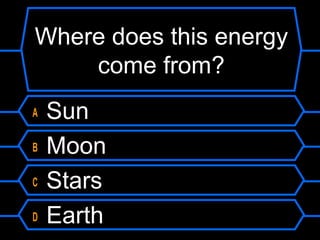
Where does this energy
come from?
A Sun
B Moon
C Stars
D Earth
£8,000
Question 9
What is the name of the waste
gas given out in photosynthesis?
A hydrogen
B oxygen
C carbon dioxide
D nitrogen
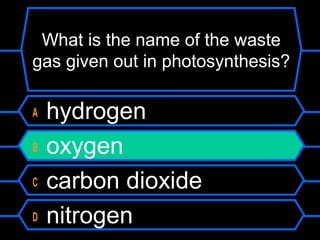
What is the name of the waste
gas given out in photosynthesis?
A hydrogen
B oxygen
C carbon dioxide
D nitrogen
£16,000
Question 10
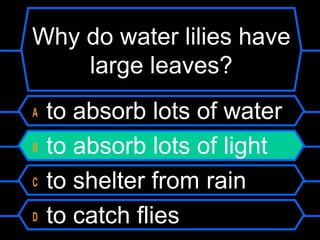
Why do water lilies have
large leaves?
A to absorb lots of water
B to absorb lots of light
C to shelter from rain
D to catch flies
Why do water lilies have
large leaves?
A to absorb lots of water
B to absorb lots of light
C to shelter from rain
D to catch flies
£32,000
Question 11
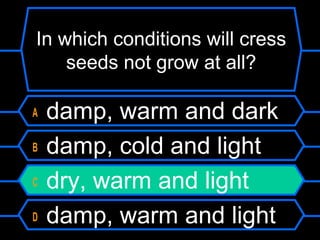
In which conditions will cress
seeds not grow at all?
A damp, warm and dark
B damp, cold and light
C dry, warm and light
D damp, warm and light
In which conditions will cress
seeds not grow at all?
A damp, warm and dark
B damp, cold and light
C dry, warm and light
D damp, warm and light
£64,000
Question 12
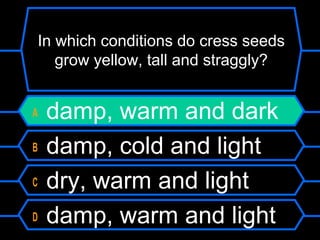
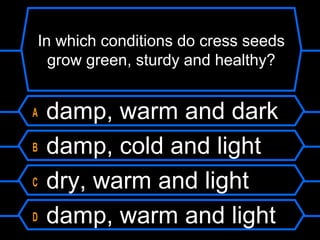
In which conditions do cress seeds
grow yellow, tall and straggly?
A damp, warm and dark
B damp, cold and light
C dry, warm and light
D damp, warm and light
In which conditions do cress seeds
grow yellow, tall and straggly?
A damp, warm and dark
B damp, cold and light
C dry, warm and light
D damp, warm and light
£125,000
Question 13
In which conditions do cress seeds
grow green, sturdy and healthy?
A damp, warm and dark
B damp, cold and light
C dry, warm and light
D damp, warm and light
In which conditions do cress seeds
grow green, sturdy and healthy?
A damp, warm and dark
B damp, cold and light
C dry, warm and light
D damp, warm and light
£250,000
Question 14
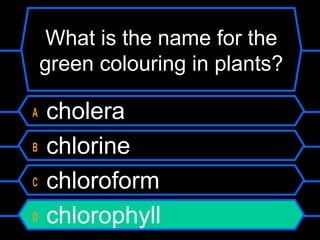
What is the name for the
green colouring in plants?
A cholera
B chlorine
C chloroform
D chlorophyll
What is the name for the
green colouring in plants?
A cholera
B chlorine
C chloroform
D chlorophyll
£500,000
Question 15
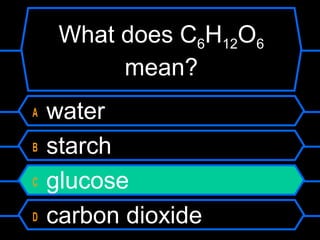
What does C6H12O6
mean?
A water
B starch
C glucose
D carbon dioxide
What does C6H12O6
mean?
A water
B starch
C glucose
D carbon dioxide
£1,000,000

Scientix 7th SPWatFCL Brussels 19-21 June 2015: Gamification in Science

  • 1.
    GAMIFICATION IN SCIENCE LESSONPLAN GROUP 8 SAHIN IDIN – SCIENCE TEACHER ISMAIL DONMEZ - SCIENCE TEACHER NURAY AKBULUT – BIOLOGY TEACHER JANINA KRIPIENE – MATH TEACHER BORYANA KUYUMDZHIEVA - MATH TEACHER
  • 2.
    LESSON SCIENCE LESSON IN8TH DEGREE SECONDARY LESSON 10TH DEGREE SUBJECT PHOTOSYNTHESIS
  • 3.
    AIM Technological devices toimprove careless s pupils motivation and attitude and enjoying and providing them the process
  • 4.
    PROCESS WHATS GAMIFICATION • Theuse of game design principles and mechanics in non-game contexts • Making technology more inviting by encouraging users to engage in desired behaviors
  • 5.
    Who Wants ToBeWho Wants To Be A Millionaire?A Millionaire? Photosynthesis
  • 6.
  • 7.
    Sepals which colourit have A red B blue C green D yellow
  • 8.
    Sepals which colourit have A red B blue C green D yellow
  • 9.
  • 10.
  • 11.
    What is thename of the food which plants make? A glucose B glue C gall D galaxy
  • 12.
    What is thename of the food which plants make? A glucose B glue C gall D galaxy
  • 13.
  • 14.
  • 15.
    What is thename for ‘making food’ done by plants? A photograph B photosynthesis C phonograph D phonosynthesis
  • 16.
    What is thename for ‘making food’ done by plants? A photograph B photosynthesis C phonograph D phonosynthesis
  • 17.
  • 18.
  • 19.
    Which gas istaken in by plants to make food? A hydrogen B oxygen C carbon dioxide D nitrogen
  • 20.
    Which gas istaken in by plants to make food? A hydrogen B oxygen C carbon dioxide D nitrogen
  • 21.
  • 22.
  • 23.
    Where does theplant take in carbon dioxide? A through its roots B through its flowers C through its trunk D through its leaves
  • 24.
    Where does theplant take in carbon dioxide? A through its roots B through its flowers C through its trunk D through its leaves
  • 25.
  • 26.
  • 27.
    What is theother material needed by plants to make food? A oxygen B water C glucose D microbes
  • 28.
    What is theother material needed by plants to make food? A oxygen B water C glucose D microbes
  • 29.
  • 30.
  • 31.
    Which type ofenergy is used by the plant when making food? A sound B electrical C heat D light
  • 32.
    Which type ofenergy is used by the plant when making food? A sound B electrical C heat D light
  • 33.
  • 34.
  • 35.
    Where does thisenergy come from? A Sun B Moon C Stars D Earth
  • 36.
    Where does thisenergy come from? A Sun B Moon C Stars D Earth
  • 37.
  • 38.
  • 39.
    What is thename of the waste gas given out in photosynthesis? A hydrogen B oxygen C carbon dioxide D nitrogen
  • 40.
    What is thename of the waste gas given out in photosynthesis? A hydrogen B oxygen C carbon dioxide D nitrogen
  • 41.
  • 42.
  • 43.
    Why do waterlilies have large leaves? A to absorb lots of water B to absorb lots of light C to shelter from rain D to catch flies
  • 44.
    Why do waterlilies have large leaves? A to absorb lots of water B to absorb lots of light C to shelter from rain D to catch flies
  • 45.
  • 46.
  • 47.
    In which conditionswill cress seeds not grow at all? A damp, warm and dark B damp, cold and light C dry, warm and light D damp, warm and light
  • 48.
    In which conditionswill cress seeds not grow at all? A damp, warm and dark B damp, cold and light C dry, warm and light D damp, warm and light
  • 49.
  • 50.
  • 51.
    In which conditionsdo cress seeds grow yellow, tall and straggly? A damp, warm and dark B damp, cold and light C dry, warm and light D damp, warm and light
  • 52.
    In which conditionsdo cress seeds grow yellow, tall and straggly? A damp, warm and dark B damp, cold and light C dry, warm and light D damp, warm and light
  • 53.
  • 54.
  • 55.
    In which conditionsdo cress seeds grow green, sturdy and healthy? A damp, warm and dark B damp, cold and light C dry, warm and light D damp, warm and light
  • 56.
    In which conditionsdo cress seeds grow green, sturdy and healthy? A damp, warm and dark B damp, cold and light C dry, warm and light D damp, warm and light
  • 57.
  • 58.
  • 59.
    What is thename for the green colouring in plants? A cholera B chlorine C chloroform D chlorophyll
  • 60.
    What is thename for the green colouring in plants? A cholera B chlorine C chloroform D chlorophyll
  • 61.
  • 62.
  • 63.
    What does C6H12O6 mean? Awater B starch C glucose D carbon dioxide
  • 64.
    What does C6H12O6 mean? Awater B starch C glucose D carbon dioxide
  • 65.