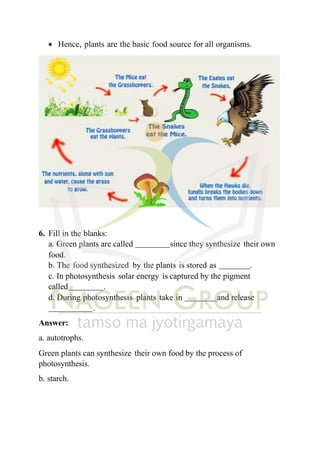
NCERT
Solutions
Solutions
Solutions
BIOLOGY
For Revised Syllabus Session 2024-25
Artham
Resource Material
7
Powered by
Class
Chapter 1 Nutrition in Plants
Chapter – 1
Nutrition in Plants
Exercise
1. Why do organisms need to take food?
Answer:
All the organisms need to take food which provides us with the
energy to perform daily activities like walking, breathing, etc. and for
the growth and the maintenance of the body.
The various components present in our food such as carbohydrates,
proteins, fats, vitamins, and minerals provide energy to our body.
Thus, food intake by the organism is necessary for the survival of the
organism in the surroundings.
2. Distinguish between a parasite and a saprotroph.
Answer:
Differences between a parasite and a saprotroph are:
Parasite Saprotrop
Parasites live on or in other
organisms (host) and obtain their
food from them.
Saprophytes obtain their food
from dead and decaying
organisms. They do not require
any host.
They harm the body of host. They are cleaning agent.
Leech is an example of parasite. Fungi is an example of
saprotroph.
3. How would you test the presence of starch in leaves?
Answer:
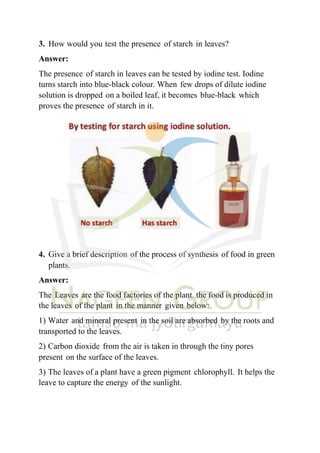
The presence of starch in leaves can be tested by iodine test. Iodine
turns starch into blue-black colour. When few drops of dilute iodine
solution is dropped on a boiled leaf, it becomes blue-black which
proves the presence of starch in it.
4. Give a brief description of the process of synthesis of food in green
plants.
Answer:
The Leaves are the food factories of the plant. the food is produced in
the leaves of the plant in the manner given below:
1) Water and mineral present in the soil are absorbed by the roots and
transported to the leaves.
2) Carbon dioxide from the air is taken in through the tiny pores
present on the surface of the leaves.
3) The leaves of a plant have a green pigment chlorophyll. It helps the
leave to capture the energy of the sunlight.
4) This energy is used to synthesise food from carbon dioxide and
water. This process of synthesis of food in the presence of sunlight is
called photosynthesis.
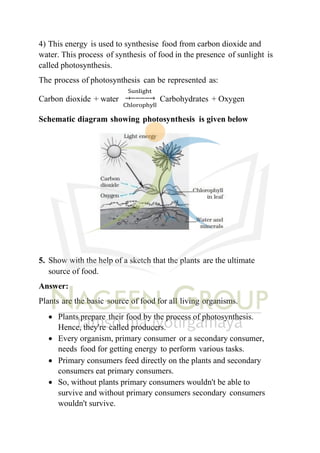
The process of photosynthesis can be represented as:
Sunlight
Carbon dioxide + water →−−−−→
Chlorophyll
Carbohydrates + Oxygen
Schematic diagram showing photosynthesis is given below
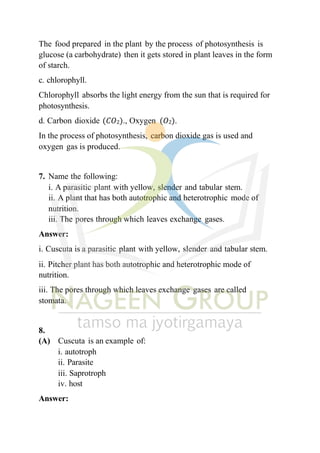
5. Show with the help of a sketch that the plants are the ultimate
source of food.
Answer:
Plants are the basic source of food for all living organisms.
• Plants prepare their food by the process of photosynthesis.
Hence, they're called producers.
• Every organism, primary consumer or a secondary consumer,
needs food for getting energy to perform various tasks.
• Primary consumers feed directly on the plants and secondary
consumers eat primary consumers.
• So, without plants primary consumers wouldn't be able to
survive and without primary consumers secondary consumers
wouldn't survive.
• Hence, plants are the basic food source for all organisms.
6. Fill in the blanks:
a. Green plants are called since they synthesize their own
food.
b. The food synthesized by the plants is stored as .
c. In photosynthesis solar energy is captured by the pigment
called .
d. During photosynthesis plants take in and release
.
Answer:
a. autotrophs.
Green plants can synthesize their own food by the process of
photosynthesis.
b. starch.
The food prepared in the plant by the process of photosynthesis is
glucose (a carbohydrate) then it gets stored in plant leaves in the form
of starch.
c. chlorophyll.
Chlorophyll absorbs the light energy from the sun that is required for
photosynthesis.
d. Carbon dioxide (𝐶𝑂2)., Oxygen (𝑂2).
In the process of photosynthesis, carbon dioxide gas is used and
oxygen gas is produced.
7. Name the following:
i. A parasitic plant with yellow, slender and tabular stem.
ii. A plant that has both autotrophic and heterotrophic mode of
nutrition.
iii. The pores through which leaves exchange gases.
Answer:
i. Cuscuta is a parasitic plant with yellow, slender and tabular stem.
ii. Pitcher plant has both autotrophic and heterotrophic mode of
nutrition.
iii. The pores through which leaves exchange gases are called
stomata.
8.
(A) Cuscuta is an example of:
i. autotroph
ii. Parasite
iii. Saprotroph
iv. host
Answer:
Amarbel (Cuscuta) is an example of parasite.
It does not have chlorophyll. It gets readymade food from the plant on
which it is climbing.
(B) The plant which traps and feeds on insects is:
i. Cuscuta
ii. China rose
iii. pitcher plant
iv. Rose
Answer:
The plant which traps and feeds on insects is pitcher plant. Such
insect-eating plants are called insectivorous plants.
9. Match the items given in Column I with those in Column II:
Column I Column II
Chlorophyll Bacteria
Nitrogen Heterotrophs
Amarbel Pitcher plant
Animal Leaf
Insects Parasite
Answer:
Chlorophyll: Leaf
The chlorophyll is found in the chloroplasts present in the plant
cells in the leaves.
Nitrogen: Bacteria
The nitrogen fixing bacteria transform the atmospheric nitrogen
into fixed nitrogen
Amarbel: Parasite
Amarbel is an example of parasite. It grows over host plants and is
a leafless and rootless parasite.
Animals: Heterotrophs
Heterotrophs are those which cannot make their own food. They
consume *autotrophs or other heterotrophs.*Autotrophs are those
which make their own food.
Insects: pitcher plant
10. Mark ‘T’ if the statement is true and ‘F’ if it is false.
i. Carbon dioxide is released during photosynthesis. (T/F)
ii. Plants which synthesize their food themselves are called
saprotrophs. (T/F)
iii. The product of photosynthesis is not a protein. (T/F)
iv. Solar energy is converted into chemical energy during
photosynthesis. (T/F)
Answer:
i. False.
In the process of photosynthesis, carbon dioxide gas is used and
oxygen is released.
ii. False.
plants which synthesize their food themselves are called autotrophs.
iii. True.
In the process of photosynthesis, carbohydrate is produced.
iv. True.
During the process of photosynthesis, solar energy absorbed by the
chlorophyll converted into chemical energy.
11. Choose the correct option from the following:
Which part of the plant gets carbon dioxide from the air for
photosynthesis?
i. root hair
ii. Stomata
iii. Leaf veins
iv. Sepals.
Answer:
Plants need carbon dioxide for the process of photosynthesis. They
take carbon dioxide from the air. Carbon dioxide enters the leaves
through tiny pores present on the leaves’ surface called stomata.
12. Choose the correct option from the following:
Plants take carbon dioxide from the atmosphere mainly through their:
(i) root
(ii) stem
(iii) flowers
(iv) Leaves
Answer:
(iv) Leaves
Plants need carbon dioxide for the process of photosynthesis. They
take carbon dioxide from the air. Carbon dioxide enters the leaves
through tiny pores present on the leaves’ surface called stomata.
Q. 13 Why do farmers grow many fruits and vegetable crops inside
large green houses? What are the advantages to the farmers?
Answer :
Fruits and vegetable crops are grown in large greenhouses
because it protects crops from external climatic condition and to
provide suitable temperature for the growth of crops. It protects
crops from diseases and adverse climatic conditions.
CLICK TO DOWNLOAD NCERT SOLUTIONS
CLASS 7 (ALL SUBJECTS)
Dear Teachers and Students,
Join School of Educators' exclusive WhatsApp, Telegram, and Signal groups for FREE access
to a vast range of educational resources designed to help you achieve 100/100 in exams!
Separate groups for teachers and students are available, packed with valuable content to
boost your performance.
Additionally, benefit from expert tips, practical advice, and study hacks designed to enhance
performance in both CBSE exams and competitive entrance tests.
Don’t miss out—join today and take the first step toward academic excellence!
Join the Teachers and Students
Group by Clicking the Link Below
JOIN OUR
WHATSAPP
GROUPS
FOR FREE EDUCATIONAL
RESOURCES
JOIN SCHOOL OF EDUCATORS WHATSAPP GROUPS
FOR FREE EDUCATIONAL RESOURCES
BENEFITS OF SOE WHATSAPP GROUPS
We are thrilled to introduce the School of Educators WhatsApp Group, a
platform designed exclusively for educators to enhance your teaching & Learning
experience and learning outcomes. Here are some of the key benefits you can
expect from joining our group:
Abundance of Content: Members gain access to an extensive repository of
educational materials tailored to their class level. This includes various formats such
as PDFs, Word files, PowerPoint presentations, lesson plans, worksheets, practical
tips, viva questions, reference books, smart content, curriculum details, syllabus,
marking schemes, exam patterns, and blueprints. This rich assortment of resources
enhances teaching and learning experiences.
Immediate Doubt Resolution: The group facilitates quick clarification of doubts.
Members can seek assistance by sending messages, and experts promptly respond
to queries. This real-time interaction fosters a supportive learning environment
where educators and students can exchange knowledge and address concerns
effectively.
Access to Previous Years' Question Papers and Topper Answers: The group
provides access to previous years' question papers (PYQ) and exemplary answer
scripts of toppers. This resource is invaluable for exam preparation, allowing
individuals to familiarize themselves with the exam format, gain insights into scoring
techniques, and enhance their performance in assessments.
Free and Unlimited Resources: Members enjoy the benefit of accessing an array of
educational resources without any cost restrictions. Whether its study materials,
teaching aids, or assessment tools, the group offers an abundance of resources
tailored to individual needs. This accessibility ensures that educators and students
have ample support in their academic endeavors without financial constraints.
Instant Access to Educational Content: SOE WhatsApp groups are a platform where
teachers can access a wide range of educational content instantly. This includes study
materials, notes, sample papers, reference materials, and relevant links shared by
group members and moderators.
Timely Updates and Reminders: SOE WhatsApp groups serve as a source of timely
updates and reminders about important dates, exam schedules, syllabus changes, and
academic events. Teachers can stay informed and well-prepared for upcoming
assessments and activities.
Interactive Learning Environment: Teachers can engage in discussions, ask questions,
and seek clarifications within the group, creating an interactive learning environment.
This fosters collaboration, peer learning, and knowledge sharing among group
members, enhancing understanding and retention of concepts.
Access to Expert Guidance: SOE WhatsApp groups are moderated by subject matter
experts, teachers, or experienced educators can benefit from their guidance,
expertise, and insights on various academic topics, exam strategies, and study
techniques.
Join the School of Educators WhatsApp Group today and unlock a world of resources,
support, and collaboration to take your teaching to new heights. To join, simply click
on the group links provided below or send a message to +91-95208-77777 expressing
your interest.
Together, let's empower ourselves & Our Students and
inspire the next generation of learners.
Best Regards,
Team
School of Educators
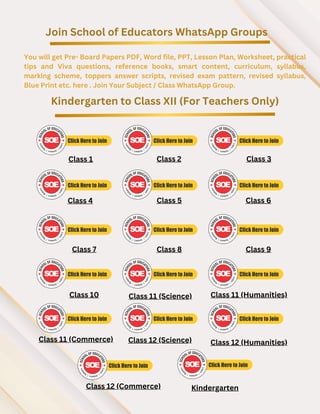
Join School of Educators WhatsApp Groups
You will get Pre- Board Papers PDF, Word file, PPT, Lesson Plan, Worksheet, practical
tips and Viva questions, reference books, smart content, curriculum, syllabus,
marking scheme, toppers answer scripts, revised exam pattern, revised syllabus,
Blue Print etc. here . Join Your Subject / Class WhatsApp Group.
Kindergarten to Class XII (For Teachers Only)
Class 1 Class 2 Class 3
Class 4 Class 5 Class 6
Class 7 Class 8 Class 9
Class 10 Class 11 (Science) Class 11 (Humanities)
Class 11 (Commerce)
Class 12 (Commerce)
Class 12 (Science) Class 12 (Humanities)
Kindergarten
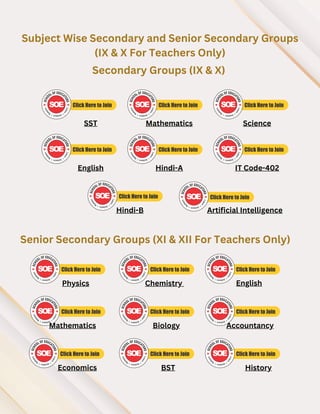
Subject Wise Secondary and Senior Secondary Groups
(IX & X For Teachers Only)
Secondary Groups (IX & X)
Senior Secondary Groups (XI & XII For Teachers Only)
SST Mathematics Science
English Hindi-A IT Code-402
Physics Chemistry English
Mathematics
Economics
Biology
BST
Accountancy
History
Hindi-B Artificial Intelligence
Hindi Core Home Science Sanskrit
Psychology Political Science Painting
Vocal Music Comp. Science IP
Physical Education APP. Mathematics Legal Studies
Entrepreneurship French
Teachers Jobs
Principal’s Group IIT/NEET
Other Important Groups (For Teachers & Principal’s)
IT
Sociology Hindi Elective
Geography
Artificial Intelligence
Join School of Educators WhatsApp Groups
You will get Pre- Board Papers PDF, Word file, PPT, Lesson Plan, Worksheet, practical
tips and Viva questions, reference books, smart content, curriculum, syllabus,
marking scheme, toppers answer scripts, revised exam pattern, revised syllabus,
Blue Print etc. here . Join Your Subject / Class WhatsApp Group.
Kindergarten to Class XII (For Students Only)
Class 1 Class 2 Class 3
Class 4 Class 5 Class 6
Class 7 Class 8 Class 9
Class 10 Class 11 (Science) Class 11 (Humanities)
Class 11 (Commerce)
Class 12 (Commerce)
Class 12 (Science) Class 12 (Humanities)
Artificial Intelligence
(VI TO VIII)
Subject Wise Secondary and Senior Secondary Groups
(IX & X For Students Only)
Secondary Groups (IX & X)
Senior Secondary Groups (XI & XII For Students Only)
SST Mathematics Science
English Hindi IT Code
Physics Chemistry English
Mathematics
Economics
Biology
BST
Accountancy
History
Artificial Intelligence
Hindi Core Home Science Sanskrit
Psychology Political Science Painting
Music Comp. Science IP
Physical Education APP. Mathematics Legal Studies
Entrepreneurship French IT
Sociology Hindi Elective
Geography
IIT/NEET
AI CUET
To maximize the benefits of these WhatsApp groups, follow these guidelines:
1. Share your valuable resources with the group.
2. Help your fellow educators by answering their queries.
3. Watch and engage with shared videos in the group.
4. Distribute WhatsApp group resources among your students.
5. Encourage your colleagues to join these groups.
Additional notes:
1. Avoid posting messages between 9 PM and 7 AM.
2. After sharing resources with students, consider deleting outdated data if necessary.
3. It's a NO Nuisance groups, single nuisance and you will be removed.
No introductions.
No greetings or wish messages.
No personal chats or messages.
No spam. Or voice calls
Share and seek learning resources only.
Groups Rules & Regulations:
Please only share and request learning resources. For assistance,
contact the helpline via WhatsApp: +91-95208-77777.
Join Premium WhatsApp Groups
Ultimate Educational Resources!!
Join our premium groups and just Rs. 1000 and gain access to all our exclusive
materials for the entire academic year. Whether you're a student in Class IX, X, XI, or
XII, or a teacher for these grades, Artham Resources provides the ultimate tools to
enhance learning. Pay now to delve into a world of premium educational content!
Class 9 Class 10 Class 11
Click here for more details
📣 Don't Miss Out! Elevate your academic journey with top-notch study materials and secure
your path to top scores! Revolutionize your study routine and reach your academic goals with
our comprehensive resources. Join now and set yourself up for success! 📚🌟
Best Wishes,
Team
School of Educators & Artham Resources
Class 12
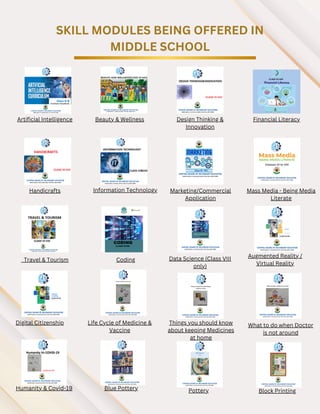
SKILL MODULES BEING OFFERED IN
MIDDLE SCHOOL
Artificial Intelligence Beauty & Wellness Design Thinking &
Innovation
Financial Literacy
Handicrafts Information Technology Marketing/Commercial
Application
Mass Media - Being Media
Literate
Travel & Tourism Coding Data Science (Class VIII
only)
Augmented Reality /
Virtual Reality
Digital Citizenship Life Cycle of Medicine &
Vaccine
Things you should know
about keeping Medicines
at home
What to do when Doctor
is not around
Humanity & Covid-19 Blue Pottery Pottery Block Printing
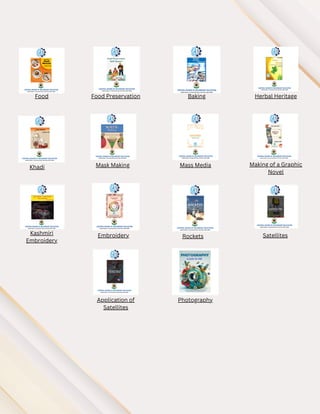
Food Food Preservation Baking Herbal Heritage
Khadi Mask Making Mass Media Making of a Graphic
Novel
Kashmiri
Embroidery
Embroidery Rockets Satellites
Application of
Satellites
Photography
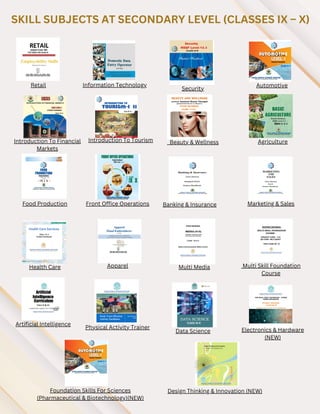
SKILL SUBJECTS AT SECONDARY LEVEL (CLASSES IX – X)
Retail Information Technology
Security
Automotive
Introduction To Financial
Markets
Introduction To Tourism Beauty & Wellness Agriculture
Food Production Front Office Operations Banking & Insurance Marketing & Sales
Health Care Apparel Multi Media Multi Skill Foundation
Course
Artificial Intelligence
Physical Activity Trainer
Data Science Electronics & Hardware
(NEW)
Design Thinking & Innovation (NEW)
Foundation Skills For Sciences
(Pharmaceutical & Biotechnology)(NEW)
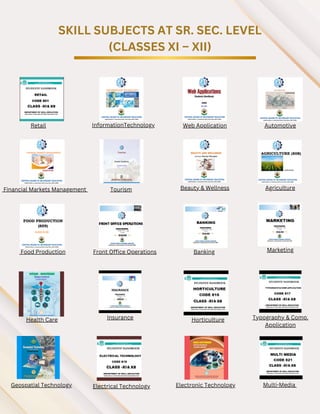
SKILL SUBJECTS AT SR. SEC. LEVEL
(CLASSES XI – XII)
Retail InformationTechnology Web Application Automotive
Financial Markets Management Tourism Beauty & Wellness Agriculture
Food Production Front Office Operations Banking Marketing
Health Care Insurance Horticulture Typography & Comp.
Application
Geospatial Technology Electrical Technology Electronic Technology Multi-Media
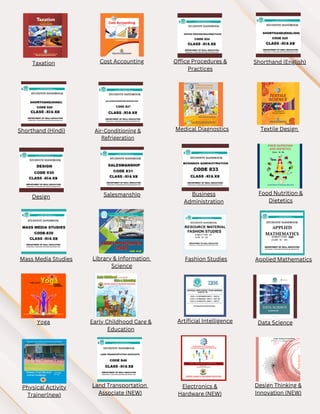
Taxation Cost Accounting Office Procedures &
Practices
Shorthand (English)
Shorthand (Hindi) Air-Conditioning &
Refrigeration
Medical Diagnostics Textile Design
Design Salesmanship Business
Administration
Food Nutrition &
Dietetics
Mass Media Studies Library & Information
Science
Fashion Studies Applied Mathematics
Yoga Early Childhood Care &
Education
Artificial Intelligence Data Science
Physical Activity
Trainer(new)
Land Transportation
Associate (NEW)
Electronics &
Hardware (NEW)
Design Thinking &
Innovation (NEW)
Join School of Educators Signal Groups
You will get Pre- Board Papers PDF, Word file, PPT, Lesson Plan, Worksheet, practical
tips and Viva questions, reference books, smart content, curriculum, syllabus,
marking scheme, toppers answer scripts, revised exam pattern, revised syllabus,
Blue Print etc. here . Join Your Subject / Class signal Group.
Kindergarten to Class XII
Class 2 Class 3
Class 4
Class 5 Class 6
Class 7 Class 8 Class 9
Class 10
Class 1
Class 11 (Humanities)
Class 11 (Science)
Class 11 (Commerce) Class 12 (Science) Class 12 (Humanities)
Class 12 (Commerce) Kindergarten Artifical intelligence
Subject Wise Secondary and Senior Secondary
Groups IX & X
Secondary Groups (IX & X)
SST Mathematics Science
English Hindi-A
IT Code-402
Hindi-B
Senior Secondary Groups XI & XII
Physics Chemistry English
Mathematics Biology Accountancy
Economics
BST History
IT Artifical intelligence
Geography Sociology Hindi Elective
Hindi Core Home Science Sanskrit
Psychology Political Science Painting
Vocal Music Comp. Science
IP
Physical Education APP. Mathematics Legal Studies
Entrepreneurship French
Artifical intelligence CUET
IIT/NEET
Join School of Educators CBSE Telegram Groups
Kindergarten
All classes Class 1 Class 2
Class 3 Class 4 Class 5
Class 6 Class 7 Class 8
Class 9 Class 10 Class 11 (Sci)
Class 11 (Com) Class 11 (Hum) Class 12 (Sci)
Class 12 (Com) Class 12 (Hum) JEE/NEET
CUET NDA, OLYMPIAD, NTSE Principal Professional Group
Teachers Professional Group Project File Group
Join School of Educators ICSE Telegram Groups
Kindergarten Class 1 Class 2
Class 3 Class 4 Class 5
Class 6 Class 7 Class 8
Class 9 Class 10 Class 11 (Sci)
Class 11 (Com) Class 11 (Hum) Class 12 (Sci)
Class 12 (Com) Class 12 (Hum)

Class 7 Science NCERT Solution Chapter 1 Nutrition in Plants

  • 1.
    NCERT Solutions Solutions Solutions BIOLOGY For Revised SyllabusSession 2024-25 Artham Resource Material 7 Powered by Class Chapter 1 Nutrition in Plants
  • 2.
    Chapter – 1 Nutritionin Plants Exercise 1. Why do organisms need to take food? Answer: All the organisms need to take food which provides us with the energy to perform daily activities like walking, breathing, etc. and for the growth and the maintenance of the body. The various components present in our food such as carbohydrates, proteins, fats, vitamins, and minerals provide energy to our body. Thus, food intake by the organism is necessary for the survival of the organism in the surroundings. 2. Distinguish between a parasite and a saprotroph. Answer: Differences between a parasite and a saprotroph are: Parasite Saprotrop Parasites live on or in other organisms (host) and obtain their food from them. Saprophytes obtain their food from dead and decaying organisms. They do not require any host. They harm the body of host. They are cleaning agent. Leech is an example of parasite. Fungi is an example of saprotroph.
  • 3.
    3. How wouldyou test the presence of starch in leaves? Answer: The presence of starch in leaves can be tested by iodine test. Iodine turns starch into blue-black colour. When few drops of dilute iodine solution is dropped on a boiled leaf, it becomes blue-black which proves the presence of starch in it. 4. Give a brief description of the process of synthesis of food in green plants. Answer: The Leaves are the food factories of the plant. the food is produced in the leaves of the plant in the manner given below: 1) Water and mineral present in the soil are absorbed by the roots and transported to the leaves. 2) Carbon dioxide from the air is taken in through the tiny pores present on the surface of the leaves. 3) The leaves of a plant have a green pigment chlorophyll. It helps the leave to capture the energy of the sunlight.
  • 4.
    4) This energyis used to synthesise food from carbon dioxide and water. This process of synthesis of food in the presence of sunlight is called photosynthesis. The process of photosynthesis can be represented as: Sunlight Carbon dioxide + water →−−−−→ Chlorophyll Carbohydrates + Oxygen Schematic diagram showing photosynthesis is given below 5. Show with the help of a sketch that the plants are the ultimate source of food. Answer: Plants are the basic source of food for all living organisms. • Plants prepare their food by the process of photosynthesis. Hence, they're called producers. • Every organism, primary consumer or a secondary consumer, needs food for getting energy to perform various tasks. • Primary consumers feed directly on the plants and secondary consumers eat primary consumers. • So, without plants primary consumers wouldn't be able to survive and without primary consumers secondary consumers wouldn't survive.
  • 5.
    • Hence, plantsare the basic food source for all organisms. 6. Fill in the blanks: a. Green plants are called since they synthesize their own food. b. The food synthesized by the plants is stored as . c. In photosynthesis solar energy is captured by the pigment called . d. During photosynthesis plants take in and release . Answer: a. autotrophs. Green plants can synthesize their own food by the process of photosynthesis. b. starch.
  • 6.
    The food preparedin the plant by the process of photosynthesis is glucose (a carbohydrate) then it gets stored in plant leaves in the form of starch. c. chlorophyll. Chlorophyll absorbs the light energy from the sun that is required for photosynthesis. d. Carbon dioxide (𝐶𝑂2)., Oxygen (𝑂2). In the process of photosynthesis, carbon dioxide gas is used and oxygen gas is produced. 7. Name the following: i. A parasitic plant with yellow, slender and tabular stem. ii. A plant that has both autotrophic and heterotrophic mode of nutrition. iii. The pores through which leaves exchange gases. Answer: i. Cuscuta is a parasitic plant with yellow, slender and tabular stem. ii. Pitcher plant has both autotrophic and heterotrophic mode of nutrition. iii. The pores through which leaves exchange gases are called stomata. 8. (A) Cuscuta is an example of: i. autotroph ii. Parasite iii. Saprotroph iv. host Answer:
  • 7.
    Amarbel (Cuscuta) isan example of parasite. It does not have chlorophyll. It gets readymade food from the plant on which it is climbing. (B) The plant which traps and feeds on insects is: i. Cuscuta ii. China rose iii. pitcher plant iv. Rose Answer: The plant which traps and feeds on insects is pitcher plant. Such insect-eating plants are called insectivorous plants. 9. Match the items given in Column I with those in Column II: Column I Column II Chlorophyll Bacteria Nitrogen Heterotrophs Amarbel Pitcher plant Animal Leaf Insects Parasite Answer: Chlorophyll: Leaf The chlorophyll is found in the chloroplasts present in the plant cells in the leaves. Nitrogen: Bacteria The nitrogen fixing bacteria transform the atmospheric nitrogen into fixed nitrogen Amarbel: Parasite Amarbel is an example of parasite. It grows over host plants and is a leafless and rootless parasite. Animals: Heterotrophs
  • 8.
    Heterotrophs are thosewhich cannot make their own food. They consume *autotrophs or other heterotrophs.*Autotrophs are those which make their own food. Insects: pitcher plant 10. Mark ‘T’ if the statement is true and ‘F’ if it is false. i. Carbon dioxide is released during photosynthesis. (T/F) ii. Plants which synthesize their food themselves are called saprotrophs. (T/F) iii. The product of photosynthesis is not a protein. (T/F) iv. Solar energy is converted into chemical energy during photosynthesis. (T/F) Answer: i. False. In the process of photosynthesis, carbon dioxide gas is used and oxygen is released. ii. False. plants which synthesize their food themselves are called autotrophs. iii. True. In the process of photosynthesis, carbohydrate is produced. iv. True. During the process of photosynthesis, solar energy absorbed by the chlorophyll converted into chemical energy. 11. Choose the correct option from the following: Which part of the plant gets carbon dioxide from the air for photosynthesis? i. root hair
  • 9.
    ii. Stomata iii. Leafveins iv. Sepals. Answer: Plants need carbon dioxide for the process of photosynthesis. They take carbon dioxide from the air. Carbon dioxide enters the leaves through tiny pores present on the leaves’ surface called stomata. 12. Choose the correct option from the following: Plants take carbon dioxide from the atmosphere mainly through their: (i) root (ii) stem (iii) flowers (iv) Leaves Answer: (iv) Leaves Plants need carbon dioxide for the process of photosynthesis. They take carbon dioxide from the air. Carbon dioxide enters the leaves through tiny pores present on the leaves’ surface called stomata. Q. 13 Why do farmers grow many fruits and vegetable crops inside large green houses? What are the advantages to the farmers? Answer : Fruits and vegetable crops are grown in large greenhouses because it protects crops from external climatic condition and to provide suitable temperature for the growth of crops. It protects crops from diseases and adverse climatic conditions.
  • 10.
    CLICK TO DOWNLOADNCERT SOLUTIONS CLASS 7 (ALL SUBJECTS)
  • 11.
    Dear Teachers andStudents, Join School of Educators' exclusive WhatsApp, Telegram, and Signal groups for FREE access to a vast range of educational resources designed to help you achieve 100/100 in exams! Separate groups for teachers and students are available, packed with valuable content to boost your performance. Additionally, benefit from expert tips, practical advice, and study hacks designed to enhance performance in both CBSE exams and competitive entrance tests. Don’t miss out—join today and take the first step toward academic excellence! Join the Teachers and Students Group by Clicking the Link Below
  • 12.
    JOIN OUR WHATSAPP GROUPS FOR FREEEDUCATIONAL RESOURCES
  • 13.
    JOIN SCHOOL OFEDUCATORS WHATSAPP GROUPS FOR FREE EDUCATIONAL RESOURCES BENEFITS OF SOE WHATSAPP GROUPS We are thrilled to introduce the School of Educators WhatsApp Group, a platform designed exclusively for educators to enhance your teaching & Learning experience and learning outcomes. Here are some of the key benefits you can expect from joining our group: Abundance of Content: Members gain access to an extensive repository of educational materials tailored to their class level. This includes various formats such as PDFs, Word files, PowerPoint presentations, lesson plans, worksheets, practical tips, viva questions, reference books, smart content, curriculum details, syllabus, marking schemes, exam patterns, and blueprints. This rich assortment of resources enhances teaching and learning experiences. Immediate Doubt Resolution: The group facilitates quick clarification of doubts. Members can seek assistance by sending messages, and experts promptly respond to queries. This real-time interaction fosters a supportive learning environment where educators and students can exchange knowledge and address concerns effectively. Access to Previous Years' Question Papers and Topper Answers: The group provides access to previous years' question papers (PYQ) and exemplary answer scripts of toppers. This resource is invaluable for exam preparation, allowing individuals to familiarize themselves with the exam format, gain insights into scoring techniques, and enhance their performance in assessments.
  • 14.
    Free and UnlimitedResources: Members enjoy the benefit of accessing an array of educational resources without any cost restrictions. Whether its study materials, teaching aids, or assessment tools, the group offers an abundance of resources tailored to individual needs. This accessibility ensures that educators and students have ample support in their academic endeavors without financial constraints. Instant Access to Educational Content: SOE WhatsApp groups are a platform where teachers can access a wide range of educational content instantly. This includes study materials, notes, sample papers, reference materials, and relevant links shared by group members and moderators. Timely Updates and Reminders: SOE WhatsApp groups serve as a source of timely updates and reminders about important dates, exam schedules, syllabus changes, and academic events. Teachers can stay informed and well-prepared for upcoming assessments and activities. Interactive Learning Environment: Teachers can engage in discussions, ask questions, and seek clarifications within the group, creating an interactive learning environment. This fosters collaboration, peer learning, and knowledge sharing among group members, enhancing understanding and retention of concepts. Access to Expert Guidance: SOE WhatsApp groups are moderated by subject matter experts, teachers, or experienced educators can benefit from their guidance, expertise, and insights on various academic topics, exam strategies, and study techniques. Join the School of Educators WhatsApp Group today and unlock a world of resources, support, and collaboration to take your teaching to new heights. To join, simply click on the group links provided below or send a message to +91-95208-77777 expressing your interest. Together, let's empower ourselves & Our Students and inspire the next generation of learners. Best Regards, Team School of Educators
  • 15.
    Join School ofEducators WhatsApp Groups You will get Pre- Board Papers PDF, Word file, PPT, Lesson Plan, Worksheet, practical tips and Viva questions, reference books, smart content, curriculum, syllabus, marking scheme, toppers answer scripts, revised exam pattern, revised syllabus, Blue Print etc. here . Join Your Subject / Class WhatsApp Group. Kindergarten to Class XII (For Teachers Only) Class 1 Class 2 Class 3 Class 4 Class 5 Class 6 Class 7 Class 8 Class 9 Class 10 Class 11 (Science) Class 11 (Humanities) Class 11 (Commerce) Class 12 (Commerce) Class 12 (Science) Class 12 (Humanities) Kindergarten
  • 16.
    Subject Wise Secondaryand Senior Secondary Groups (IX & X For Teachers Only) Secondary Groups (IX & X) Senior Secondary Groups (XI & XII For Teachers Only) SST Mathematics Science English Hindi-A IT Code-402 Physics Chemistry English Mathematics Economics Biology BST Accountancy History Hindi-B Artificial Intelligence
  • 17.
    Hindi Core HomeScience Sanskrit Psychology Political Science Painting Vocal Music Comp. Science IP Physical Education APP. Mathematics Legal Studies Entrepreneurship French Teachers Jobs Principal’s Group IIT/NEET Other Important Groups (For Teachers & Principal’s) IT Sociology Hindi Elective Geography Artificial Intelligence
  • 18.
    Join School ofEducators WhatsApp Groups You will get Pre- Board Papers PDF, Word file, PPT, Lesson Plan, Worksheet, practical tips and Viva questions, reference books, smart content, curriculum, syllabus, marking scheme, toppers answer scripts, revised exam pattern, revised syllabus, Blue Print etc. here . Join Your Subject / Class WhatsApp Group. Kindergarten to Class XII (For Students Only) Class 1 Class 2 Class 3 Class 4 Class 5 Class 6 Class 7 Class 8 Class 9 Class 10 Class 11 (Science) Class 11 (Humanities) Class 11 (Commerce) Class 12 (Commerce) Class 12 (Science) Class 12 (Humanities) Artificial Intelligence (VI TO VIII)
  • 19.
    Subject Wise Secondaryand Senior Secondary Groups (IX & X For Students Only) Secondary Groups (IX & X) Senior Secondary Groups (XI & XII For Students Only) SST Mathematics Science English Hindi IT Code Physics Chemistry English Mathematics Economics Biology BST Accountancy History Artificial Intelligence
  • 20.
    Hindi Core HomeScience Sanskrit Psychology Political Science Painting Music Comp. Science IP Physical Education APP. Mathematics Legal Studies Entrepreneurship French IT Sociology Hindi Elective Geography IIT/NEET AI CUET
  • 21.
    To maximize thebenefits of these WhatsApp groups, follow these guidelines: 1. Share your valuable resources with the group. 2. Help your fellow educators by answering their queries. 3. Watch and engage with shared videos in the group. 4. Distribute WhatsApp group resources among your students. 5. Encourage your colleagues to join these groups. Additional notes: 1. Avoid posting messages between 9 PM and 7 AM. 2. After sharing resources with students, consider deleting outdated data if necessary. 3. It's a NO Nuisance groups, single nuisance and you will be removed. No introductions. No greetings or wish messages. No personal chats or messages. No spam. Or voice calls Share and seek learning resources only. Groups Rules & Regulations: Please only share and request learning resources. For assistance, contact the helpline via WhatsApp: +91-95208-77777.
  • 22.
    Join Premium WhatsAppGroups Ultimate Educational Resources!! Join our premium groups and just Rs. 1000 and gain access to all our exclusive materials for the entire academic year. Whether you're a student in Class IX, X, XI, or XII, or a teacher for these grades, Artham Resources provides the ultimate tools to enhance learning. Pay now to delve into a world of premium educational content! Class 9 Class 10 Class 11 Click here for more details 📣 Don't Miss Out! Elevate your academic journey with top-notch study materials and secure your path to top scores! Revolutionize your study routine and reach your academic goals with our comprehensive resources. Join now and set yourself up for success! 📚🌟 Best Wishes, Team School of Educators & Artham Resources Class 12
  • 23.
    SKILL MODULES BEINGOFFERED IN MIDDLE SCHOOL Artificial Intelligence Beauty & Wellness Design Thinking & Innovation Financial Literacy Handicrafts Information Technology Marketing/Commercial Application Mass Media - Being Media Literate Travel & Tourism Coding Data Science (Class VIII only) Augmented Reality / Virtual Reality Digital Citizenship Life Cycle of Medicine & Vaccine Things you should know about keeping Medicines at home What to do when Doctor is not around Humanity & Covid-19 Blue Pottery Pottery Block Printing
  • 24.
    Food Food PreservationBaking Herbal Heritage Khadi Mask Making Mass Media Making of a Graphic Novel Kashmiri Embroidery Embroidery Rockets Satellites Application of Satellites Photography
  • 25.
    SKILL SUBJECTS ATSECONDARY LEVEL (CLASSES IX – X) Retail Information Technology Security Automotive Introduction To Financial Markets Introduction To Tourism Beauty & Wellness Agriculture Food Production Front Office Operations Banking & Insurance Marketing & Sales Health Care Apparel Multi Media Multi Skill Foundation Course Artificial Intelligence Physical Activity Trainer Data Science Electronics & Hardware (NEW) Design Thinking & Innovation (NEW) Foundation Skills For Sciences (Pharmaceutical & Biotechnology)(NEW)
  • 26.
    SKILL SUBJECTS ATSR. SEC. LEVEL (CLASSES XI – XII) Retail InformationTechnology Web Application Automotive Financial Markets Management Tourism Beauty & Wellness Agriculture Food Production Front Office Operations Banking Marketing Health Care Insurance Horticulture Typography & Comp. Application Geospatial Technology Electrical Technology Electronic Technology Multi-Media
  • 27.
    Taxation Cost AccountingOffice Procedures & Practices Shorthand (English) Shorthand (Hindi) Air-Conditioning & Refrigeration Medical Diagnostics Textile Design Design Salesmanship Business Administration Food Nutrition & Dietetics Mass Media Studies Library & Information Science Fashion Studies Applied Mathematics Yoga Early Childhood Care & Education Artificial Intelligence Data Science Physical Activity Trainer(new) Land Transportation Associate (NEW) Electronics & Hardware (NEW) Design Thinking & Innovation (NEW)
  • 28.
    Join School ofEducators Signal Groups You will get Pre- Board Papers PDF, Word file, PPT, Lesson Plan, Worksheet, practical tips and Viva questions, reference books, smart content, curriculum, syllabus, marking scheme, toppers answer scripts, revised exam pattern, revised syllabus, Blue Print etc. here . Join Your Subject / Class signal Group. Kindergarten to Class XII Class 2 Class 3 Class 4 Class 5 Class 6 Class 7 Class 8 Class 9 Class 10 Class 1 Class 11 (Humanities) Class 11 (Science) Class 11 (Commerce) Class 12 (Science) Class 12 (Humanities) Class 12 (Commerce) Kindergarten Artifical intelligence
  • 29.
    Subject Wise Secondaryand Senior Secondary Groups IX & X Secondary Groups (IX & X) SST Mathematics Science English Hindi-A IT Code-402 Hindi-B Senior Secondary Groups XI & XII Physics Chemistry English Mathematics Biology Accountancy Economics BST History IT Artifical intelligence
  • 30.
    Geography Sociology HindiElective Hindi Core Home Science Sanskrit Psychology Political Science Painting Vocal Music Comp. Science IP Physical Education APP. Mathematics Legal Studies Entrepreneurship French Artifical intelligence CUET IIT/NEET
  • 31.
    Join School ofEducators CBSE Telegram Groups Kindergarten All classes Class 1 Class 2 Class 3 Class 4 Class 5 Class 6 Class 7 Class 8 Class 9 Class 10 Class 11 (Sci) Class 11 (Com) Class 11 (Hum) Class 12 (Sci) Class 12 (Com) Class 12 (Hum) JEE/NEET CUET NDA, OLYMPIAD, NTSE Principal Professional Group Teachers Professional Group Project File Group
  • 32.
    Join School ofEducators ICSE Telegram Groups Kindergarten Class 1 Class 2 Class 3 Class 4 Class 5 Class 6 Class 7 Class 8 Class 9 Class 10 Class 11 (Sci) Class 11 (Com) Class 11 (Hum) Class 12 (Sci) Class 12 (Com) Class 12 (Hum)