1. WHAT IS THE SOLAR SYSTEM MADE UP
OF?
a) Of the Sun
b) Of the planets
c) Of the satellites
d) Of the Sun and the planets
2. HOW MANY PLANETS ARE THERE IN
THE SOLAR SYSTEM?
a) Six
b) Two
c) Eight
d) Five
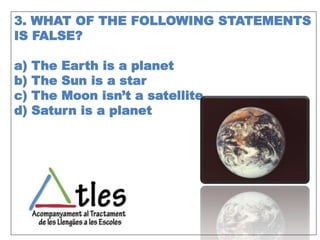
3. WHAT OF THE FOLLOWING STATEMENTS
IS FALSE?
a) The Earth is a planet
b) The Sun is a star
c) The Moon isn’t a satellite
d) Saturn is a planet
4. WHAT ARE THE COMETS MADE UP OF?
a) Of water and ice
b) Of ice and dust
c) Of air and ice
d) Of dust and water
5. WHAT ARE THE INNER PLANETS?
a) They are far from the Earth
b) They are close to the Sun
c) They have a tail
d) They are satellites
6. THE EARTH HAS ONE SATELLITE,WHICH
IS …
a) The Moon
b) Mars
c) Uranus
d) Jupiter
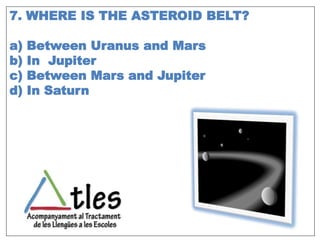
7. WHERE IS THE ASTEROID BELT?
a) Between Uranus and Mars
b) In Jupiter
c) Between Mars and Jupiter
d) In Saturn
8. CHOOSE THE TRUE STATEMENT
a) Asteroids aren´t made of rock
b) Comets are made of ice
c) Satellites don´t move around planets
d) The planets move around the Sun
9. WHAT ARE METEOROIDS?
a) Satellites
b) Planets
c) Small asteroids
d) Comets
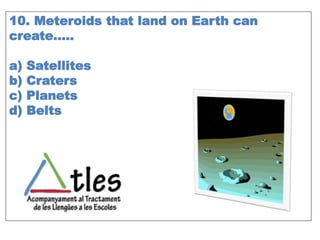
10. Meteroids that land on Earth can
create…..
a) Satellites
b) Craters
c) Planets
d) Belts
11. THE LINES OF LATITUDE GO …….
a) Around the Earth
b) From pole to pole
c) Around the Sun
d) From the Sun to the Earth
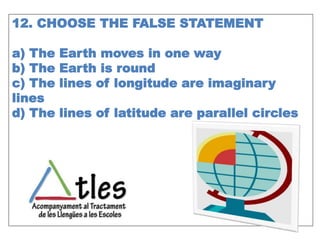
12. CHOOSE THE FALSE STATEMENT
a) The Earth moves in one way
b) The Earth is round
c) The lines of longitude are imaginary
lines
d) The lines of latitude are parallel circles
13. HOW LONG IS A YEAR?
a) 6 hours
b) 24 hours
c) One week
d) 365 days
14. WHAT CAUSES THE DIFFERENT
SEASONS?
a)The latitude
b) The Sun
c) The rotation on its axis
d) The Moon
15. THE EARTH ….THE SUN
a) Orbits
b) Moves
c) Goes
d) Turns
16. WHAT CAUSES DAY AND NIGHT?
a) The Sun
b) The Moon
c) The Earth´s rotation
d) The heat
17. CHOOSE THE FALSE STATEMENT
a) In winter the days are longer in the
northern hemisphere
b) In summer the days are longer in the
northern hemisphere
c) In winter the days are shorter in the
northern hemisphere
d) In summer it´s hot
18. THE MOON TAKES …. TO COMPLETE
ONE ORBIT OF THE EARTH
a) 28 days
b) One week
c) One year
d) One day
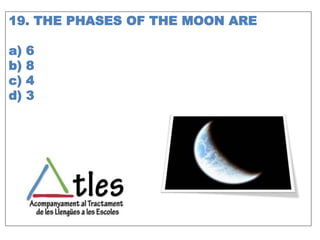
19. THE PHASES OF THE MOON ARE
a) 6
b) 8
c) 4
d) 3
20. IN THE FULL MOON….
a)The Moon isn´t illuminated
b)The Moon is partially illuminated
c)The Moon isn´t partially illuminated
d)The Moon is totally illuminated
21. WHAT IS AIR?
a)It is a mixture of gases
b)It is a mixture of ice
c)It is a mixture of water
d)It is a mixture of rocks
22. WHAT ARE THE TWO MAIN GASES IN
AIR?
a)Nitrogen and oxygen
b) Water and vapour
c) Breeze and nitrogen
d) Carbon dioxide and nitrogen
23. CHOOSE THE TRUE STATEMENT
a) Air hasn´t weight
b) Air has taste
c) Air has colour
d) Air occupies space
24. THE ATMOSPHERE CAUSES …
a) Day and night
b) The different seasons
c) The poles
d) Weather conditions
25. THE ATMOSPHERE IS A LAYER OF
…SURROUNDING THE EARTH
a) Water
b) Ice
c) Air
d) Rock
26. WHAT IS WIND?
a)It is moving land
b)It is moving water
c)It is moving ice
d)It is moving air
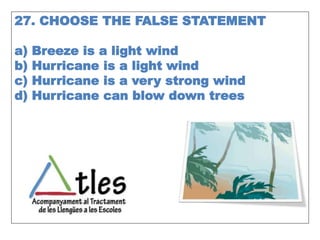
27. CHOOSE THE FALSE STATEMENT
a) Breeze is a light wind
b) Hurricane is a light wind
c) Hurricane is a very strong wind
d) Hurricane can blow down trees
28. WHICH GAS DO WE TAKE FROM THE
AIR WHEN WE BREATHE?
a) Water vapour
b) Nitrogen
c) Carbon dioxide
d) Oxygen
29. PLANTS RELEASE….
a)Nitrogen
b)Water vapour
c) Carbon dioxide
d) Oxygen
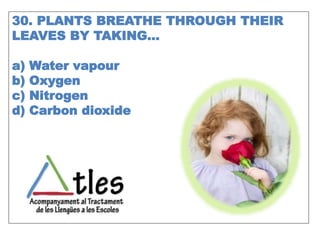
30. PLANTS BREATHE THROUGH THEIR
LEAVES BY TAKING…
a) Water vapour
b) Oxygen
c) Nitrogen
d) Carbon dioxide
31.PLANTS MAKE THEIR OWN FOOD IN A
PROCESS CALLED….
a)Breeze
b) Photosynthesis
c) Hurricane
d) Nitrogen
32. WHAT DO HUMANS NEED TO LIVE?
a) Air
b) Land
c) Snow
d) Fire
33. FISH NEED…. TO BREATHE
a) Nitrogen
b) Oxygen
c) Water
d) Land
34. HUMANS MUST CARRY SPECIAL
EQUIPMENT IN ORDER TO BREATHE
a) Under water
b) Out in the space
c) A and b
d) In town
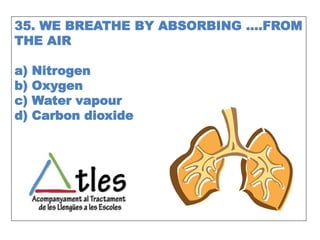
35. WE BREATHE BY ABSORBING ….FROM
THE AIR
a) Nitrogen
b) Oxygen
c) Water vapour
d) Carbon dioxide
36. PLANTS MAKE THEIR OWN FOOD BY
PRODUCING…
a) Nitrogen
b) Water vapour
c) Oxygen
d) Carbon dioxide
37. AIR HAS … PROPERTIES
a) Two
b) Five
c) Six
d) Three
38. AIR DOESN´T HAVE ANY TASTE OR….
a) Colour
b) Place
c) Weight
d) Height
39. AIR MAKES UP THE…
a) Moon
b) Earth
c) Atmosphere
d) Nitrosphere
40. OUR BODY HAS THE ENERGY TO LIVE
WITH
a) Food and air
b) Water vapour and food
c) Nitrogen and wine
d) Air and carbon dioxide
41. ALL THE WEATHER ON THE EARTH
HAPPENS IN THE
a)Moon
b) Land
c) Atmosphere
d) Nitrosphere
42. PEOPLE WHO STUDY THE WEATHER
ARE CALLED
a) Teachers
b) Carpenters
c) Doctors
d) Meteorologists
43. WHAT IS THE LAYER OF AIR THAT
SURROUNDS THE EARTH?
a) Atmosphere
b) Nitrosphere
c) Water vapour
d) Carbon dioxide
44. THE MAIN FEATURES OF THE
WEATHER ARE
a) Two
b) Five
c) Six
d) Eight
45. TEMPERATURE INDICATES..
a) How cold or hot the air is
b) How light the air is
c) How heavy the air is
d) How clean the air is
46. HUMIDITY INDICATES THE AMOUNT
OF……
a) Carbon dioxide in the air
b) Water vapour in the air
c) Oxygen in the air
d) Nitrogen in the air
47. WIND IS….
a) Hot air
b) Cold air
c) Moving air
d) Fresh air
48. ATMOSPHERIC PRESSURE IS….
a) The weight of the Atmosphere´s air
b) The colour
c) The shape
d) The smell
49. CHANGES IN THE ATMOSPHERE
CAUSE DIFFERENT TYPES OF…
a) Humidity
b) Pressure
c) Precipitation
d) Weather
50. WHAT ARE CLOUDS MADE UP OF?
a) Ice
b) Water vapour
c) Frozen water
d) Hot water
51. HOW MANY TYPES OF CLOUDS ARE
THERE?
a) Five
b) Six
c) Four
d) Two
52. PRECIPITATIONS CAN BE…
a) Water
b) Wind
c) Rain, snow or hail
d) Pressure
53. DRIZZLE HAS…
a) Very small light drops
b) Very big heavy drops
c) Enormous drops
d) Snowflakes
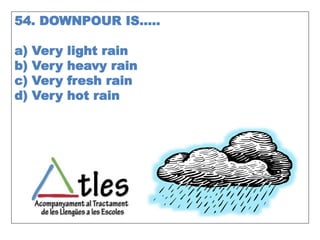
54. DOWNPOUR IS…..
a) Very light rain
b) Very heavy rain
c) Very fresh rain
d) Very hot rain
55. THE THREE TYPES OF RAIN ARE
a) Snow,hail,rain
b) Hail,drizzle,snow
c) Drizzle, rain, downpour
d) Drizzle, air , ice
56. HAIL CONSISTS OF…
a) Small balls of air
b) Small balls of water
c) Small balls of wind
d) Small balls of ice
57. A THERMOMETER MESURES….
a) The air humidity
b) The air pressure
c) The air temperature
d) The air weight
58. AN ANEMOMETER MEASURES…
a) Rain speed
b) Snow speed
c) Wind speed
d) Water speed
59. PEOPLE WHO STUDY WEATHER
CONDITIONS ARE…
a) Teachers
b) Meteorologists
c) Doctors
d) Carpenters
60. NIMBUS, CUMULUS AND STRATUS
ARE TYPES OF…
a) Rain
b) Clouds
c) Snow
d) Wind
61. LANDSCAPES THAT HUMANS HAVE
NOT CHANGED ARE….
a) Natural landscapes
b) Fresh landscapes
c) Old landscapes
d) New landscapes
62. EROSION CONSISTS OF
a) Water and wind move soil from high
areas to low areas
b) Rain and snow
c) Wind and trees
d) Clouds and snow
63. RELIEF IN A LANDSCAPE CAN BE
a) Mountainous or flat
b) Small or big
c) Wide or narrow
d) Dry or wet
64. THERE IS WATER IN A LANDSCAPE
MAINLY IN…
a) A glass
b) A bottle
c) Rivers, lakes and seas
d) A shoe
65. WHAT IS FAUNA?
a) All of the animals that live in a
landscape
b) All of the humans beings
c) All of the alive beings
d) All of the plants
66. AGRICULTURAL LANDSCAPES ARE…
a) Natural landscapes that humans have
changed
b) Old landscapes
c) New landscapes
d) Little landscapes
67. THE MAIN FEATURES OF
AGRICULTURAL LANDSCAPE ARE…
a) Seas and lakes
b) Houses and trees
c) Fields, villages and roads
d) Plants and animals
68. INDUSTRIAL LANDSCAPES ARE…
a) New landscapes
b) Landscapes with industrial activities
c) Old landscapes
d) Little landscapes
69. THE FEATURES OF INDUSTRIAL
LANDSCAPES ARE…
a) Factories and means of transport
b) Fields and trees
c) Houses and villages
d) Roads and sea
70. WHAT ARE THE MAIN TYPES OF
CROPS?
a) Little and big crops
b) Fields and seas
c) Lakes and trees
d) Irrigated crops and dry crops
71. CHOOSE TWO EXAMPLES OF
IRRIGATED CROPS
a) Tomato and wheat
b) Pepper and barley
c) Onion and corn
d) Lettuce and spinach
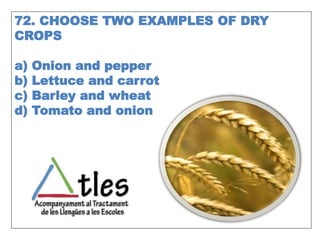
72. CHOOSE TWO EXAMPLES OF DRY
CROPS
a) Onion and pepper
b) Lettuce and carrot
c) Barley and wheat
d) Tomato and onion
73. URBAN LANDSCAPES ARE
a)Factories and houses
b) Lakes and seas
c) Trees and plants
d) Towns and cities
74. URBAN LANDSCAPES HAVE
DIFFERENT
a) Shape and weight
b) Climates and locations
c) Height and temperature
d) Pressure and Wind
75. PEOPLE IN CITIES WORK AND LIVE
IN
a) Farms
b) Villages
c) Buildings
d) Roads
76. CHOOSE TWO EXAMPLES OF
HISTORIC BUILDINGS
a) Street and avenue
b) Square and park
c) Village and road
d) Church and palace
77. NEIGHBOURHOOD IS THE SAME AS …
a) Village
b) Road
c) Area
d) Church
78. WHAT IS VEGETATION?
a) All the animals that live in a natural
landscape
b) All the alive beings
c) All the human beings
d) All the plants
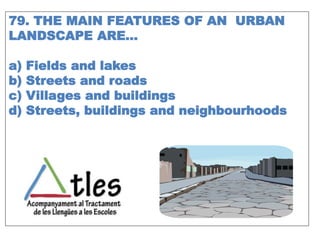
79. THE MAIN FEATURES OF AN URBAN
LANDSCAPE ARE…
a) Fields and lakes
b) Streets and roads
c) Villages and buildings
d) Streets, buildings and neighbourhoods
80. CHOOSE THE FALSE ANSWER
a) Street is an urban feature
b) Factory is an industrial feature
c) Road is an industrial feature
d) Building is an urban feature
81. WHAT IS A HABITAT?
a) The place where a living thing lives
b) Where a rock lives
c) Where a lake lives
d) Where a wind lives
82. SAY TWO LIVING THINGS IN A HABITAT
a) Rock and tree
b) Fish and air
c) Bush and lake
d) Bird and tree
83. CHOOSE TWO NON –LIVING
THINGS IN A HABITAT
a) Lake and plant
b) Cat and sea
c) Wind and lake
d) Dog and fish
84. PHYSICAL ENVIRONMENT INCLUDES
a) Non-living and living things
b) Only living things
c) Only non-living things
d) All are false
85. THE LIVING THINGS NEED …………TO
GROW AND LIVE
a) Water
b) Air
c) Temperature
d) All are true
86. WHAT DO ALL LIVING THINGS NEED?
a) Water
b) Shoes
c) Cars
d) Rock
87. WHAT DO LIVING THINGS GET FROM
THE AIR?
a) Nitrogen
b) Water vapour
c) Oxygen
d) All are true
88. WHAT DO PLANTS GET FROM SOIL?
a) Light
b) Water
c) Mineral salts
d) B and c are correct
89. WHY DO LIVING THINGS NEED LIGHT?
BECAUSE…
a) Plants need sunlight to make their food
b) Most animals have eyes and need light
to see
c) A and b are true
d) A and b are false
90. THE BIOLOGICAL ENVIRONMENT
CONSISTS OF…
a) All the living things in a habitat
b) All the non-living things in a habitat
c) A and b are false
d) A and b are true
91. WHAT DOES A FOOD CHAIN SHOW US?
a) What the animals in a place eat
b) What the plants in a place eat
c) A and b are true
d) A and b are false
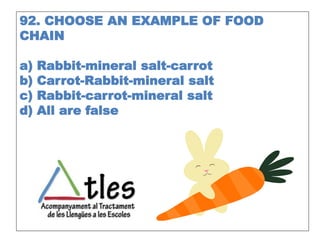
92. CHOOSE AN EXAMPLE OF FOOD
CHAIN
a) Rabbit-mineral salt-carrot
b) Carrot-Rabbit-mineral salt
c) Rabbit-carrot-mineral salt
d) All are false
93. WHAT DO PLANTS COMPETE FOR?
a) Light
b) Water
c) Light , water and mineral salts
d) All are false
94. WHY DO LIVING THINGS COOPERATE?
BECAUSE
a) They work together
b) To find food
c) To defend themselves against their
enemies
d) All are true
95. ITS FEET ARE ADAPTED TO LIVE IN
WATER
a) Duck
b) Polar bear
c) Dog
d) Camel
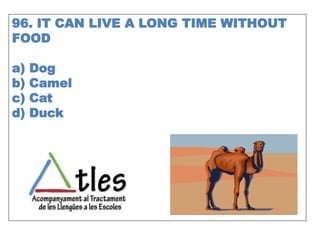
96. IT CAN LIVE A LONG TIME WITHOUT
FOOD
a) Dog
b) Camel
c) Cat
d) Duck
97. WHAT IS A BIOLOGICAL COMMUNITY?
a) Living things that live and interact in a
particular place
b) Living and non-living things that live and
interact ina particular place
c) All are true
d) All are false
98. WHAT IS AN ECOSYSTEM?
a) Is a physical environment
b) Is a biological community
c) A and b are true
d) A and b are false
99. WHICH HUMAN ACTIVITIES AFFECT
ECOSYSTEMS DIRECTLY?
a) Hunting
b) Fishing
c) Cutting down trees
d) All are true
100. NAME THREE TYPES OF POLLUTION
a) Air pollution
b) Water pollution
c) Soil pollution
d) All are true

Let's learn nature i

  • 2.
    1. WHAT ISTHE SOLAR SYSTEM MADE UP OF? a) Of the Sun b) Of the planets c) Of the satellites d) Of the Sun and the planets
  • 3.
    2. HOW MANYPLANETS ARE THERE IN THE SOLAR SYSTEM? a) Six b) Two c) Eight d) Five
  • 4.
    3. WHAT OFTHE FOLLOWING STATEMENTS IS FALSE? a) The Earth is a planet b) The Sun is a star c) The Moon isn’t a satellite d) Saturn is a planet
  • 5.
    4. WHAT ARETHE COMETS MADE UP OF? a) Of water and ice b) Of ice and dust c) Of air and ice d) Of dust and water
  • 6.
    5. WHAT ARETHE INNER PLANETS? a) They are far from the Earth b) They are close to the Sun c) They have a tail d) They are satellites
  • 7.
    6. THE EARTHHAS ONE SATELLITE,WHICH IS … a) The Moon b) Mars c) Uranus d) Jupiter
  • 8.
    7. WHERE ISTHE ASTEROID BELT? a) Between Uranus and Mars b) In Jupiter c) Between Mars and Jupiter d) In Saturn
  • 9.
    8. CHOOSE THETRUE STATEMENT a) Asteroids aren´t made of rock b) Comets are made of ice c) Satellites don´t move around planets d) The planets move around the Sun
  • 10.
    9. WHAT AREMETEOROIDS? a) Satellites b) Planets c) Small asteroids d) Comets
  • 11.
    10. Meteroids thatland on Earth can create….. a) Satellites b) Craters c) Planets d) Belts
  • 12.
    11. THE LINESOF LATITUDE GO ……. a) Around the Earth b) From pole to pole c) Around the Sun d) From the Sun to the Earth
  • 13.
    12. CHOOSE THEFALSE STATEMENT a) The Earth moves in one way b) The Earth is round c) The lines of longitude are imaginary lines d) The lines of latitude are parallel circles
  • 14.
    13. HOW LONGIS A YEAR? a) 6 hours b) 24 hours c) One week d) 365 days
  • 15.
    14. WHAT CAUSESTHE DIFFERENT SEASONS? a)The latitude b) The Sun c) The rotation on its axis d) The Moon
  • 16.
    15. THE EARTH….THE SUN a) Orbits b) Moves c) Goes d) Turns
  • 17.
    16. WHAT CAUSESDAY AND NIGHT? a) The Sun b) The Moon c) The Earth´s rotation d) The heat
  • 18.
    17. CHOOSE THEFALSE STATEMENT a) In winter the days are longer in the northern hemisphere b) In summer the days are longer in the northern hemisphere c) In winter the days are shorter in the northern hemisphere d) In summer it´s hot
  • 19.
    18. THE MOONTAKES …. TO COMPLETE ONE ORBIT OF THE EARTH a) 28 days b) One week c) One year d) One day
  • 20.
    19. THE PHASESOF THE MOON ARE a) 6 b) 8 c) 4 d) 3
  • 21.
    20. IN THEFULL MOON…. a)The Moon isn´t illuminated b)The Moon is partially illuminated c)The Moon isn´t partially illuminated d)The Moon is totally illuminated
  • 22.
    21. WHAT ISAIR? a)It is a mixture of gases b)It is a mixture of ice c)It is a mixture of water d)It is a mixture of rocks
  • 23.
    22. WHAT ARETHE TWO MAIN GASES IN AIR? a)Nitrogen and oxygen b) Water and vapour c) Breeze and nitrogen d) Carbon dioxide and nitrogen
  • 24.
    23. CHOOSE THETRUE STATEMENT a) Air hasn´t weight b) Air has taste c) Air has colour d) Air occupies space
  • 25.
    24. THE ATMOSPHERECAUSES … a) Day and night b) The different seasons c) The poles d) Weather conditions
  • 26.
    25. THE ATMOSPHEREIS A LAYER OF …SURROUNDING THE EARTH a) Water b) Ice c) Air d) Rock
  • 27.
    26. WHAT ISWIND? a)It is moving land b)It is moving water c)It is moving ice d)It is moving air
  • 28.
    27. CHOOSE THEFALSE STATEMENT a) Breeze is a light wind b) Hurricane is a light wind c) Hurricane is a very strong wind d) Hurricane can blow down trees
  • 29.
    28. WHICH GASDO WE TAKE FROM THE AIR WHEN WE BREATHE? a) Water vapour b) Nitrogen c) Carbon dioxide d) Oxygen
  • 30.
    29. PLANTS RELEASE…. a)Nitrogen b)Watervapour c) Carbon dioxide d) Oxygen
  • 31.
    30. PLANTS BREATHETHROUGH THEIR LEAVES BY TAKING… a) Water vapour b) Oxygen c) Nitrogen d) Carbon dioxide
  • 32.
    31.PLANTS MAKE THEIROWN FOOD IN A PROCESS CALLED…. a)Breeze b) Photosynthesis c) Hurricane d) Nitrogen
  • 33.
    32. WHAT DOHUMANS NEED TO LIVE? a) Air b) Land c) Snow d) Fire
  • 34.
    33. FISH NEED….TO BREATHE a) Nitrogen b) Oxygen c) Water d) Land
  • 35.
    34. HUMANS MUSTCARRY SPECIAL EQUIPMENT IN ORDER TO BREATHE a) Under water b) Out in the space c) A and b d) In town
  • 36.
    35. WE BREATHEBY ABSORBING ….FROM THE AIR a) Nitrogen b) Oxygen c) Water vapour d) Carbon dioxide
  • 37.
    36. PLANTS MAKETHEIR OWN FOOD BY PRODUCING… a) Nitrogen b) Water vapour c) Oxygen d) Carbon dioxide
  • 38.
    37. AIR HAS… PROPERTIES a) Two b) Five c) Six d) Three
  • 39.
    38. AIR DOESN´THAVE ANY TASTE OR…. a) Colour b) Place c) Weight d) Height
  • 40.
    39. AIR MAKESUP THE… a) Moon b) Earth c) Atmosphere d) Nitrosphere
  • 41.
    40. OUR BODYHAS THE ENERGY TO LIVE WITH a) Food and air b) Water vapour and food c) Nitrogen and wine d) Air and carbon dioxide
  • 42.
    41. ALL THEWEATHER ON THE EARTH HAPPENS IN THE a)Moon b) Land c) Atmosphere d) Nitrosphere
  • 43.
    42. PEOPLE WHOSTUDY THE WEATHER ARE CALLED a) Teachers b) Carpenters c) Doctors d) Meteorologists
  • 44.
    43. WHAT ISTHE LAYER OF AIR THAT SURROUNDS THE EARTH? a) Atmosphere b) Nitrosphere c) Water vapour d) Carbon dioxide
  • 45.
    44. THE MAINFEATURES OF THE WEATHER ARE a) Two b) Five c) Six d) Eight
  • 46.
    45. TEMPERATURE INDICATES.. a)How cold or hot the air is b) How light the air is c) How heavy the air is d) How clean the air is
  • 47.
    46. HUMIDITY INDICATESTHE AMOUNT OF…… a) Carbon dioxide in the air b) Water vapour in the air c) Oxygen in the air d) Nitrogen in the air
  • 48.
    47. WIND IS…. a)Hot air b) Cold air c) Moving air d) Fresh air
  • 49.
    48. ATMOSPHERIC PRESSUREIS…. a) The weight of the Atmosphere´s air b) The colour c) The shape d) The smell
  • 50.
    49. CHANGES INTHE ATMOSPHERE CAUSE DIFFERENT TYPES OF… a) Humidity b) Pressure c) Precipitation d) Weather
  • 51.
    50. WHAT ARECLOUDS MADE UP OF? a) Ice b) Water vapour c) Frozen water d) Hot water
  • 52.
    51. HOW MANYTYPES OF CLOUDS ARE THERE? a) Five b) Six c) Four d) Two
  • 53.
    52. PRECIPITATIONS CANBE… a) Water b) Wind c) Rain, snow or hail d) Pressure
  • 54.
    53. DRIZZLE HAS… a)Very small light drops b) Very big heavy drops c) Enormous drops d) Snowflakes
  • 55.
    54. DOWNPOUR IS….. a)Very light rain b) Very heavy rain c) Very fresh rain d) Very hot rain
  • 56.
    55. THE THREETYPES OF RAIN ARE a) Snow,hail,rain b) Hail,drizzle,snow c) Drizzle, rain, downpour d) Drizzle, air , ice
  • 57.
    56. HAIL CONSISTSOF… a) Small balls of air b) Small balls of water c) Small balls of wind d) Small balls of ice
  • 58.
    57. A THERMOMETERMESURES…. a) The air humidity b) The air pressure c) The air temperature d) The air weight
  • 59.
    58. AN ANEMOMETERMEASURES… a) Rain speed b) Snow speed c) Wind speed d) Water speed
  • 60.
    59. PEOPLE WHOSTUDY WEATHER CONDITIONS ARE… a) Teachers b) Meteorologists c) Doctors d) Carpenters
  • 61.
    60. NIMBUS, CUMULUSAND STRATUS ARE TYPES OF… a) Rain b) Clouds c) Snow d) Wind
  • 62.
    61. LANDSCAPES THATHUMANS HAVE NOT CHANGED ARE…. a) Natural landscapes b) Fresh landscapes c) Old landscapes d) New landscapes
  • 63.
    62. EROSION CONSISTSOF a) Water and wind move soil from high areas to low areas b) Rain and snow c) Wind and trees d) Clouds and snow
  • 64.
    63. RELIEF INA LANDSCAPE CAN BE a) Mountainous or flat b) Small or big c) Wide or narrow d) Dry or wet
  • 65.
    64. THERE ISWATER IN A LANDSCAPE MAINLY IN… a) A glass b) A bottle c) Rivers, lakes and seas d) A shoe
  • 66.
    65. WHAT ISFAUNA? a) All of the animals that live in a landscape b) All of the humans beings c) All of the alive beings d) All of the plants
  • 67.
    66. AGRICULTURAL LANDSCAPESARE… a) Natural landscapes that humans have changed b) Old landscapes c) New landscapes d) Little landscapes
  • 68.
    67. THE MAINFEATURES OF AGRICULTURAL LANDSCAPE ARE… a) Seas and lakes b) Houses and trees c) Fields, villages and roads d) Plants and animals
  • 69.
    68. INDUSTRIAL LANDSCAPESARE… a) New landscapes b) Landscapes with industrial activities c) Old landscapes d) Little landscapes
  • 70.
    69. THE FEATURESOF INDUSTRIAL LANDSCAPES ARE… a) Factories and means of transport b) Fields and trees c) Houses and villages d) Roads and sea
  • 71.
    70. WHAT ARETHE MAIN TYPES OF CROPS? a) Little and big crops b) Fields and seas c) Lakes and trees d) Irrigated crops and dry crops
  • 72.
    71. CHOOSE TWOEXAMPLES OF IRRIGATED CROPS a) Tomato and wheat b) Pepper and barley c) Onion and corn d) Lettuce and spinach
  • 73.
    72. CHOOSE TWOEXAMPLES OF DRY CROPS a) Onion and pepper b) Lettuce and carrot c) Barley and wheat d) Tomato and onion
  • 74.
    73. URBAN LANDSCAPESARE a)Factories and houses b) Lakes and seas c) Trees and plants d) Towns and cities
  • 75.
    74. URBAN LANDSCAPESHAVE DIFFERENT a) Shape and weight b) Climates and locations c) Height and temperature d) Pressure and Wind
  • 76.
    75. PEOPLE INCITIES WORK AND LIVE IN a) Farms b) Villages c) Buildings d) Roads
  • 77.
    76. CHOOSE TWOEXAMPLES OF HISTORIC BUILDINGS a) Street and avenue b) Square and park c) Village and road d) Church and palace
  • 78.
    77. NEIGHBOURHOOD ISTHE SAME AS … a) Village b) Road c) Area d) Church
  • 79.
    78. WHAT ISVEGETATION? a) All the animals that live in a natural landscape b) All the alive beings c) All the human beings d) All the plants
  • 80.
    79. THE MAINFEATURES OF AN URBAN LANDSCAPE ARE… a) Fields and lakes b) Streets and roads c) Villages and buildings d) Streets, buildings and neighbourhoods
  • 81.
    80. CHOOSE THEFALSE ANSWER a) Street is an urban feature b) Factory is an industrial feature c) Road is an industrial feature d) Building is an urban feature
  • 82.
    81. WHAT ISA HABITAT? a) The place where a living thing lives b) Where a rock lives c) Where a lake lives d) Where a wind lives
  • 83.
    82. SAY TWOLIVING THINGS IN A HABITAT a) Rock and tree b) Fish and air c) Bush and lake d) Bird and tree
  • 84.
    83. CHOOSE TWONON –LIVING THINGS IN A HABITAT a) Lake and plant b) Cat and sea c) Wind and lake d) Dog and fish
  • 85.
    84. PHYSICAL ENVIRONMENTINCLUDES a) Non-living and living things b) Only living things c) Only non-living things d) All are false
  • 86.
    85. THE LIVINGTHINGS NEED …………TO GROW AND LIVE a) Water b) Air c) Temperature d) All are true
  • 87.
    86. WHAT DOALL LIVING THINGS NEED? a) Water b) Shoes c) Cars d) Rock
  • 88.
    87. WHAT DOLIVING THINGS GET FROM THE AIR? a) Nitrogen b) Water vapour c) Oxygen d) All are true
  • 89.
    88. WHAT DOPLANTS GET FROM SOIL? a) Light b) Water c) Mineral salts d) B and c are correct
  • 90.
    89. WHY DOLIVING THINGS NEED LIGHT? BECAUSE… a) Plants need sunlight to make their food b) Most animals have eyes and need light to see c) A and b are true d) A and b are false
  • 91.
    90. THE BIOLOGICALENVIRONMENT CONSISTS OF… a) All the living things in a habitat b) All the non-living things in a habitat c) A and b are false d) A and b are true
  • 92.
    91. WHAT DOESA FOOD CHAIN SHOW US? a) What the animals in a place eat b) What the plants in a place eat c) A and b are true d) A and b are false
  • 93.
    92. CHOOSE ANEXAMPLE OF FOOD CHAIN a) Rabbit-mineral salt-carrot b) Carrot-Rabbit-mineral salt c) Rabbit-carrot-mineral salt d) All are false
  • 94.
    93. WHAT DOPLANTS COMPETE FOR? a) Light b) Water c) Light , water and mineral salts d) All are false
  • 95.
    94. WHY DOLIVING THINGS COOPERATE? BECAUSE a) They work together b) To find food c) To defend themselves against their enemies d) All are true
  • 96.
    95. ITS FEETARE ADAPTED TO LIVE IN WATER a) Duck b) Polar bear c) Dog d) Camel
  • 97.
    96. IT CANLIVE A LONG TIME WITHOUT FOOD a) Dog b) Camel c) Cat d) Duck
  • 98.
    97. WHAT ISA BIOLOGICAL COMMUNITY? a) Living things that live and interact in a particular place b) Living and non-living things that live and interact ina particular place c) All are true d) All are false
  • 99.
    98. WHAT ISAN ECOSYSTEM? a) Is a physical environment b) Is a biological community c) A and b are true d) A and b are false
  • 100.
    99. WHICH HUMANACTIVITIES AFFECT ECOSYSTEMS DIRECTLY? a) Hunting b) Fishing c) Cutting down trees d) All are true
  • 101.
    100. NAME THREETYPES OF POLLUTION a) Air pollution b) Water pollution c) Soil pollution d) All are true