NVAC Approved Adult Immunizations Recommendations – June 2, 2009
Homework Help
https://www.homeworkping.com/
Research Paper help
https://www.homeworkping.com/
Online Tutoring
https://www.homeworkping.com/
National Vaccine Advisory Committee Recommendations for Federal Adult Immunization
Programs regarding Immunization Delivery, Assessment, Research, and Safety Monitoring
Approved by the National Vaccine Advisory Committee – June 2, 2009
Introduction
The draft recommendations were developed by the National Vaccine Advisory Committee
(NVAC) Adult Immunization Working Group. They were subsequently reviewed and
approved by the NVAC. The NVAC serves in an advisory role to the Assistant Secretary
for Health, within the United States Department of Health and Human Services. Thus, the
recommendations listed below have been formally transmitted to the Assistant Secretary
for Health for his consideration, which may include communication with various
components of the Department and other interested parties.
Overview
The use of vaccines in infectious disease prevention has primarily focused on vaccination
of children. Detailed pediatric immunization recommendations, routine “well child” visits
oriented to prevention, and school-entry laws have helped establish and maintain high
immunization rates and reduce childhood morbidity and mortality caused by once-common
infections. While vaccines for adults have similar recommendations, medical care for adults
often focuses on treatment of acute or chronic conditions, other than infectious diseases, and
there are few immunization mandates, leading to lower uptake of these vaccines, and
consequently, higher morbidity and mortality.
The National Vaccine Advisory Committee (NVAC) has previously looked at the issue of
adult immunization, with recommendations from the Subcommittee on Adult Immunization
(1990)1
, a report on Adult Immunization with a new series of recommendations (1994)2
, and a
series of recommendations regarding adult immunization in non-traditional settings (2000)3
.
While some of the recommendations previously made have been implemented, there are still
large numbers of adults who have not received recommended vaccines.
To address this issue, the NVAC convened an Adult Immunization Working Group
(AIWG) in 2008. The first task of this working group has been to assess public health adult
immunization activities in HHS and other federal programs, identify gaps, and recommend
1
NVAC Approved Adult Immunizations Recommendations – June 2, 2009
improvements, particularly in program implementation, coordination, evaluation and
collaboration across agencies, that will lead to improved vaccination uptake in adults. HHS
programs encompasses a wide range of individuals, including those receiving benefits through
Medicare or Medicaid, which can occur in both public or private health-care venues, and those
receiving health care through other public health care settings. The AIWG has also addressed
programs in Veteran’s Administration hospitals, in Department of Defense health-care facilities
for active-duty service members and their families, as well as in public health department clinics
and federally qualified health centers and rural health centers that serve underserved populations.
The second part of this review will include the financing of adult immunization by both
public and private payers. This review will include members of the NVAC Financing Working
Group which has recently completed and published recommendations for improving the
financing of vaccines provided to children. Only two funding issues have been addressed in this
report related to collecting data from the Medicaid program, and inclusion of all preventive
vaccines in Medicare part B.
The NVAC recognizes it is also necessary to address non-Federally funded venues for
delivery of adult vaccines as well. However, addressing the depth and breadth of the federally
funded aspects of adult immunization, and the financing of adult vaccines are formidable tasks.
Once these tasks are completed, the AIWG plans to address adult immunization delivery in the
realm of private health care.
Adult Immunization Recommendations
Two vaccines are most commonly thought of in the area of adult immunization –
vaccines to protect against influenza and pneumococcal disease. These are also the two vaccines
for which the most data have been collected, and to which the most attention is paid. However,
the Advisory Committee on Immunization Practices (ACIP) has recommended that adults be
vaccinated against up to 14 infectious diseases, using a complex schedule that includes some
vaccines that are routinely recommended and some that are recommended for use based on other
risk factors4
.
Adult Immunization Targets
Healthy People 2010 established goals for vaccination against pneumococcal disease and
for annual vaccination against influenza5.
For non-institutionalized adults aged 65 and older, the
2010 targets for having been vaccinated against pneumococcal disease at least once, and for
annual influenza vaccination are 90%. Additionally, for non-institutionalized high-risk adults
aged 18-64, the 2010 target for both of these immunization programs is 60%. In addition to
setting goals for vaccination, other goals corresponding to reduction of vaccine-preventable
diseases have been established. These include the elimination of diphtheria and tetanus in
persons less than 35 years of age, the elimination of measles, mumps, rubella and polio in all
persons, as well as a reduction of the morbidity related to hepatitis B in all persons aged 19 and
over, and the reduction of invasive pneumococcal disease in persons aged 65 and older.
Current Adult Immunization Levels
Levels of immunization against influenza and pneumococcal disease for adults aged 65
and older have increased since the late 1980s, but are still short of the Healthy People 2010
goals.
Influenza
2
NVAC Approved Adult Immunizations Recommendations – June 2, 2009
For influenza vaccination, annual coverage levels have more than doubled between 1989
and 2007, according to self-reported data collected through the National Health Interview Survey
(NHIS) (30.4% in 1989 versus 66.4% in 2007)6
. The 2007 NHIS estimate of 66.4% compares
favorably to estimates from the 2007 National Immunization Survey – Adult (NIS-Adult)7
and
the 2007 Behavioral Risk Factor Surveillance Survey (BRFSS)8
. Adults younger than 65, even
those identified as being in a high-risk group, have much lower influenza vaccination rates than
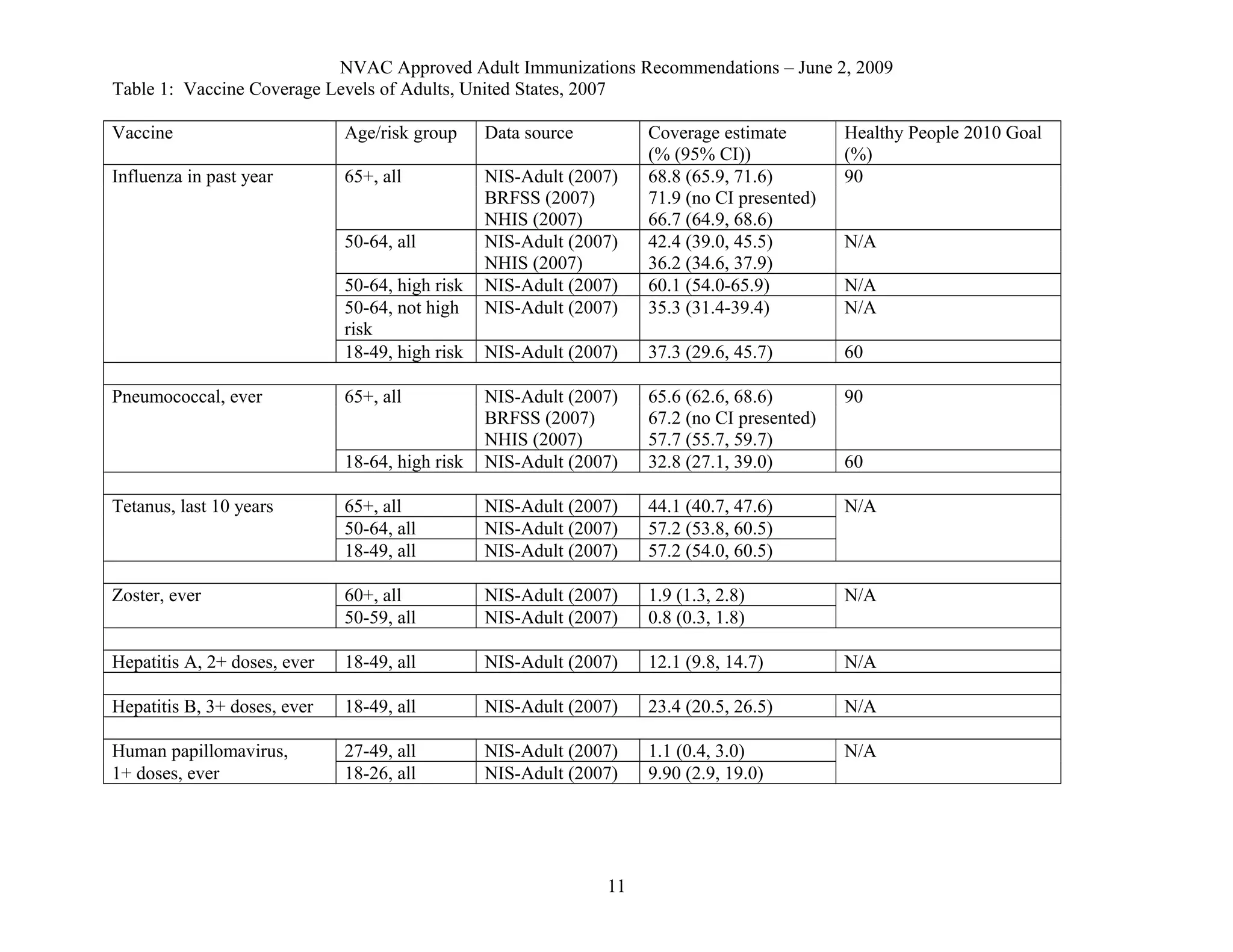
adults 65 years and older. (Table 1)
A racial disparity is apparent in the 2007 NIS-Adult data, with an estimated 69.4% of
non-Hispanic whites, 67.2% of Hispanics, and 54.6% of non-Hispanic blacks receiving influenza
vaccine in the past influenza season7
.
Pneumococcal disease
As with influenza, rates of immunization of adults 65 and older against pneumococcal
disease have increased dramatically between 1989 and 2007, from 14.1% to 57.7%9
. Again,
comparable values are seen between NHIS9
, NIS-Adult7
, and BRFSS10
estimates for
pneumococcal vaccination in this age group, though these rates still have not reached the
threshold established for Healthy People 2010. (Table 1). While blacks and Hispanics have
similar rates of pneumococcal vaccination (52.5% and 51.3%, respectively), their rates that are
much lower than those for whites (67.8%)7
.
Less than a third of younger adults in high-risk groups report having ever received
pneumococcal vaccination in 2007 (Table 1).
Other diseases
Adult vaccination rates for other diseases are typically much lower than those estimated
for influenza and pneumococcal disease. While tetanus vaccination rates are comparable at
approximately 57% of adults aged 18-64, there is a steep drop, to 44%, in adults aged 65 and
older. Tdap, a combined tetanus, diphtheria and acellular pertussis vaccine formulated for
adults, was licensed in 2005 to boost immunity to pertussis, as well as to tetanus and diphtheria.
The recent timing of this licensure may be responsible for the low Tdap vaccination rate among
18 to 64 year olds of only two percent7
. (Table 1)
Zoster vaccine was licensed in 2006. While this vaccine is recommended for all adults
over 60, uptake to date is low, with only approximately two percent of these adults reporting
having received this vaccine7
. (Table 1)
Approximately 12% of adults 18-49 have received at least two doses of hepatitis A
vaccine, and about twice as many have received at least three doses of hepatitis B vaccine7
.
(Table 1)
Uptake of the most recently recommended adult vaccine, the quadrivalent human
papillomavirus (HPV) vaccine, has been low, with approximately 10% of women aged 18-26
having received at least one HPV vaccination7
. (Table 1) This stands in contrast with the
estimated 25% of adolescents who have received at least one dose of the HPV vaccine11
.
Burden of Vaccine-Preventable Disease in Adults
Determining the morbidity and mortality related to vaccine-preventable diseases in adults
is difficult because some of these diseases are not reportable conditions (e.g. influenza, zoster,
3
NVAC Approved Adult Immunizations Recommendations – June 2, 2009
some pneumococcal infections). However, attempts have been made to summarize the burden of
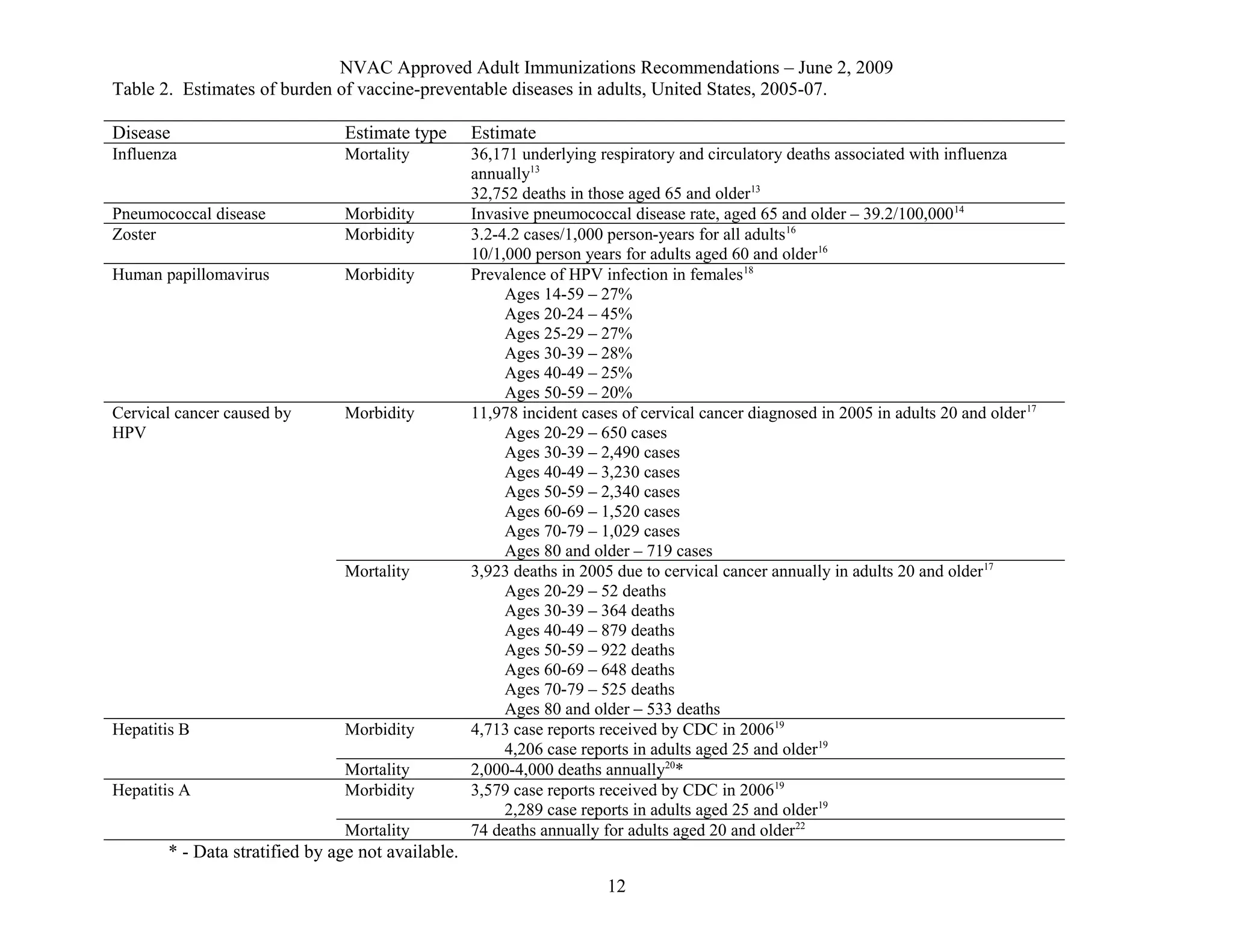
these diseases in adults. The results of these summaries are presented below and in Table 2.
Estimating the incidence and mortality of influenza is complicated because diagnostic
testing is rarely performed in adults, when identified influenza in adults is not a reportable
disease, and cause of death information may not always specify influenza. Two recent attempts
have been made to estimate mortality due to influenza, both of which gave very similar results.
In 2003, a report estimated that annually in the US, during the 1990-91 to 1998-99 influenza
seasons, there were 36,155 deaths associated with influenza, of which 32,651 were in individuals
65 and older, and 2,623 were individuals aged 50-6412
. Using the same methodology with a
more recent decade (1993-94 influenza season to 2002-2003 influenza season), there were an
estimated 36,171 deaths associated with influenza, of which 32,752 were in individuals 65 and
older13
.
For pneumococcal disease, CDC monitors invasive pneumococcal disease through its
Active Bacterial Core surveillance system in ten locations14
. In 2007, invasive pneumococcal
disease in persons >65 years was estimated at 39.2/100,000, below the Healthy People 2010
objective of 42/100,000. This decrease since 2000 from a rate of 57.6/100,000 has been
attributed primarily to widespread vaccination of children with pneumococcal conjugate vaccine
and consequent decreases in carriage of the pneumococci serotypes represented in that vaccine15
.
Similarly for zoster, there have not been large population-based morbidity studies done.
However, the 2008 ACIP recommendation does summarize data from a number of studies,
generating an estimate of 3.2-4.2 cases/1000 person-years for all adults, and 10/1000 person-
years for adults aged 60 and older16
.
Human papillomavirus infection is the leading cause of cervical cancer, and has been
implicated in a number of other ano-genital cancers. In 2005, there were 11,999 new cases of
cervical cancer reported in the United States, with 3,924 deaths attributed to cervical cancer. Of
these, 11,978 new cases and 3,923 deaths occurred in adults aged 20 and older17
. Recent
population based estimates for HPV infections have been generated. For US females aged 14-
59, it is estimated that approximately 27% have cervico-vaginal HPV infections, with the highest
prevalence in the 20-24 year age group (45%). Of the four HPV types in the currently licensed
vaccine, prevalence estimates are 1.5% (HPV-16), 0.8% (HPV-18), 1.3% (HPV-6), and 0.1%
(HPV-11). While these prevalence estimates are low, HPV types 16 and 18 are responsible for
approximately 70% of cervical cancer cases, and HPV types 6 and 11 are responsible for
approximately 90% of genital warts cases18
.
In 2006, the CDC received 3,579 case reports of hepatitis A virus (HAV) infection, of
which 2,289 (64.0%) were in individuals aged 25 and older, with an additional 561 (15.7%) aged
15-24. Also in 2006, 4,713 case reports of hepatitis B virus (HBV) infection received, of which
4,206 (89.2%) were in individuals aged 25 and older, with an additional 381 (8.0%) in
individuals aged 15-24. Further stratification of the late adolescent/young adult age group (15-
24) was not provided19
. Underreporting of hepatitis A and B infections is thought to be very
high, with an estimated 32,000 HAV and 46,000 HBV infections, across all age groups, taking
into account the lack of reporting of asymptomatic cases20
. In 2006, five deaths attributed to
acute HAV infection and 23 deaths attributed to acute HBV infection21
. Annual mortality due to
chronic liver disease associated with Hepatitis B has been estimated to be between 2,000 and
4,000 deaths, though no age-stratified estimates are available18
. Before the recommendation for
Hepatitis A vaccination in high-risk groups in 1996, there was an annual average of 91 deaths
due to HAV (1990-1995) in individuals aged 20 and older, with 59% of these occurring in
4
NVAC Approved Adult Immunizations Recommendations – June 2, 2009
individuals at least 60 years old; following expansion of the recommendations for Hepatitis A
vaccination between 1996 and 1999, the average annual adult HAV mortality dropped to 74
deaths per year (2000-2004), of which 53% were in individuals aged 60 and older22
.
Role of Funding in Adult Immunization
Funding of immunization programs for children and adolescents received a major boost
in 1994 when the Vaccines for Children (VFC) program became operational. This program
provides vaccines, free of cost, to children who are uninsured, receiving Medicaid benefits,
children who are American Indian or Alaskan Native, or who are underinsured and receive their
vaccinations at federally qualified health centers or rural health clinics. The VFC program has
helped to increase immunization rates among children and adolescents. However, there is no
such entitlement program for adults who cannot afford immunization services. While funding
for vaccination of adults is a key component of the adult immunization program, these initial
recommendations only address factors that can be improved within federal agencies that provide
or administer adult immunization services. As discussed above, financing related issues will be
addressed in detail in a later report by the combined NVAC Adult Immunization and Financing
Working Groups.
RECOMMENDATIONS
1-Assess Adult Immunization Coverage
 Assess coverage of U.S. adults:
o NVAC recommends increased resources be made available by HHS for national
and state-based adult immunization data collection and dissemination, which
include adequate sample sizes in relevant surveys, and permitting analyses by
region, demographic, and behavioral characteristics of a variety of populations.
This effort should target more complete collection of data, and more timely
analysis and dissemination of data.
 Assess coverage of U.S. adults served with federal-funding:
o NVAC recommends CMS regularly assess immunization uptake for adults in the
Medicare and Medicaid programs through claims and survey data, as supplements
to CDC surveys.
o NVAC recommends appropriate HHS agencies (e.g., AHRQ, CDC, HRSA) and
the Departments of Defense and Veterans Affairs review how best they can
collect data regularly about vaccination rates and practices for adults cared for
within their public health care settings to meet or exceed the Healthy People 2010
(and later Healthy People 2020) adult immunization objectives:
 HRSA could use existing and planned program surveys to collect data
about adult immunization rates, starting with the pending Health Center
Patient Survey, which is likely to include data on influenza and
pneumococcal vaccinations. Using Healthy People 2010, and later 2020,
targets, this information will help HRSA to assess how well programs are
providing adult immunizations.
 These agencies and Departments could develop and disseminate standard
evaluation clinical assessment tools to clinics funded in whole or in part by
them, to evaluate adult immunization programs. CDC’s Comprehensive
5
NVAC Approved Adult Immunizations Recommendations – June 2, 2009
Clinic Assessment Software Application (CoCASA) provides a readily
available assessment tool for this purpose.
2-Support Health Services Research to answer key adult immunization related questions:
• NVAC recommends HHS agencies review how they can conduct health services research
with the goal of increasing adult immunization rates. Such research should include
evaluation of barriers to immunization, particularly for racial and ethnic minority groups and
health care personnel. It would also include an assessment of 1) why evidence-based
strategies to raise adult immunization coverage have not been more widely adopted, and 2)
the appropriate role of policy initiatives, including mandatory vaccination for health care
personnel. Agencies should examine settings under their purview: e.g. CDC – state and local
health departments, HRSA – community health centers. Information should be solicited
using innovative techniques, such as new social media and the internet.
3-Include Adult Immunization in State and selected City Public Health Grantees and other
Federal Clinic Sites
 NVAC recommends CDC and HRSA
o revise their funding guidance for states, territories, select cities, and community
health centers to require adult immunization activities.
o require all funded entities (e.g., CDC immunization grantees, HRSA Federally
qualified health centers) they oversee to adopt and implement the ACIP
recommendations for routine adult immunization.
o devote resources for inclusion of immunization records for adults into
Immunization Information Systems (IIS), and in electronic health records.
o work with the Office of the National Coordinator for Health Information
Technology to establish electronic medical record systems’ certification include
interfaces with IIS.
o support a full time adult immunization coordinator at each CDC immunization
grantee site.
 NVAC recommends the Department of Veterans Affairs Health Care System (VA)
enhance its electronic medical records system to provide easy access to a comprehensive IIS
functionality for all vaccines delivered to patients in the VA system. This effort would include
compatibility and sharing of information with relevant state IIS.
4-Update Federal Guidance on Adult Immunization
• NVAC recommends NVPO revise the guidance from 2000 on use of alternative vaccination
sites. New areas of emphasis will include use of IIS for recordkeeping. Travel medicine
clinics will be included as alternative sites for routine adult immunization.
5-Support Quality Assessment and Quality Improvement of Adult and Health Care
Worker Immunization Service Delivery
• NVAC recommends HHS agencies and the VA Health Care System review approaches to
implement:
6
NVAC Approved Adult Immunizations Recommendations – June 2, 2009
o Embarking on system-wide quality improvement initiatives to meet or exceed the
Healthy People 2010 (and later Healthy People 2020) goals for adult immunizations
in all of their funded agencies and sites. These initiatives should include
• promulgating clinical guidance for all ACIP-recommended vaccines
for adults as a standard of practice in all appropriate settings, and using
the pending Healthy People 2020 targets and/or the National Vaccine
Plan targets as program goals;
• recommending uniform and routine use of evidence-based strategies to
raise vaccination rates such as standing orders, reminder-recall,
expanding access, assessment-feedback, pay for performance, and
combination strategies including education of providers and patients.
6-Identify Meaningful Incentives
 NVAC recommends CMS require institutions receiving Medicare payments to follow the
Joint Commission on Accreditation of Healthcare Organizations performance standards which
include offering annual influenza vaccination to all health care personnel, reporting annual
vaccination rates, and conducting vigorous promotional campaigns to increase vaccine
acceptance. The annual vaccination rates should be posted at the Nursing Home Compare
Medicare website.
 NVAC recommends CMS work with groups that develop performance measures to
enhance its Physician Quality Reporting Improvement measures, such as adding measures for
o pneumococcal and hepatitis B vaccination for end state renal disease patients,
o Zoster vaccination for all Medicare-eligible persons 60 years and older, without
contraindications to vaccination,
o Tetanus-diphtheria toxoids at ten year intervals for all Medicare patients,
including administration of a single Tdap for those <65 years, and Td for those
>65 years.
7-Secure Adequate Federal Funding of Adult Immunization
 NVAC recommends CMS survey Medicaid programs to
o Assess if all ACIP-recommended vaccines for adults are included in each state
Medicaid Program’s formulary of covered vaccines;
o Inform future work of the NVAC Financing Working Group regarding
reimbursement for vaccine and vaccine administration.
 NVAC recommends that all ACIP routinely recommended preventive vaccines be
included in Medicare part B.
8-Outreach to Promote Adult Immunization
• NVAC recommends all HHS agencies, particularly CDC, CMS, and FDA, implement
appropriate and regular evaluation of their provider and public outreach campaigns and tools.
• NVAC recommends appropriate offices and agencies in the Department develop a
comprehensive website for adult immunization, including disease burden information,
vaccination coverage data, evidence-based strategies to improve adult vaccination rates in a
7
NVAC Approved Adult Immunizations Recommendations – June 2, 2009
variety of settings, promotional materials, all of which could be packaged as a “toolkit” to
assist providers in improving adult vaccination rates.
9- Improve Vaccine Safety Monitoring for Adults
• NVAC recommends CDC and FDA review and implement approaches to improving health
care providers’ awareness of, and reporting to, the Vaccine Adverse Event Reporting System
(VAERS), including health care providers who primarily see adult patients.
• NVAC recommends HRSA review and implement approaches for improving the awareness
of, and information to, health care providers who primarily see adult patients about the
National Vaccine Injury Compensation Program.
8
NVAC Approved Adult Immunizations Recommendations – June 2, 2009
References
1. National Vaccine Advisory Committee. Report of the Subcommittee on Adult
Immunization. 1990 [cited 8 Apr 2009]. Available from
http://www.hhs.gov/nvpo/nvac/Adult%20Immunization%202-90.pdf.
2. National Vaccine Advisory Committee. Adult Immunization: A report by the National
Vaccine Advisory Committee. 1994 [cited 8 Apr 2009]. Available from
http://www.hhs.gov/nvpo/nvac/AdultImmunization194.pdf.
3. Centers for Disease Control and Prevention. Adult immunization programs in
nontraditional settings: quality standards and guidance for program evaluation – a report
of the National Vaccine Advisory Committee and Use of standing orders programs to
increase adult vaccination rates: recommendations of the Advisory Committee on
Immunization Practices. MMWR 2000;49(RR-1):1-13.
4. Advisory Committee on Immunization Practices. Recommended adult immunization
schedule: United States, 2009. Ann Intern Med. 2009;150:40-4.
5. Department of Health and Human Services. Healthy People 2010: 14: Immunization and
Infectious Diseases. 2000 [cited 8 Apr 2009]. Available from
http://healthypeople.gov/document/pdf/Volume1/14Immunization.pdf.
6. Centers for Disease Control and Prevention. Self-reported influenza vaccination
coverage trends 1989-2007 among adults by age group, risk group, race/ethnicity, health-
care worker status, and pregnancy status, United States, National Health Interview
Survey (NHIS). 2008 [cited 8 Apr 2009]. Available from
http://www.cdc.gov/flu/professionals/vaccination/pdf/NHIS89_07fluvaxtrendtab.pdf.
7. Centers for Disease Control and Prevention. Vaccination coverage among US adults –
National Immunization Survey-Adult, 2007. 2008 [cited 8 Apr 2009]. Available from
http://www.cdc.gov/vaccines/stats-surv/nis/downloads/nis-adult-summer-2007.pdf.
8. Centers for Disease Control and Prevention. Behavioral Risk Factor Surveillance System
Prevalence and Trends Data – Adults aged 65+ who have had a flu shot within the past
year. 2008 [cited 8 Apr 2009]. Available from
http://apps.nccd.cdc.gov/brfss/display.asp?cat=IM&yr=2007&qkey=4407&state=US.
9. Centers for Disease Control and Prevention. Self-reported pneumococcal vaccination
coverage trends 1989-2007 among adults by age group, risk group, race/ethnicity, health-
care worker status, and pregnancy status, United States, National Health Interview
Survey (NHIS). 2008 [cited 8 Apr 2009]. Available from
http://www.cdc.gov/flu/professionals/vaccination/pdf/NHIS89_07ppvvaxtrendtab.pdf.
10. Centers for Disease Control and Prevention. Behavioral Risk Factor Surveillance System
Prevalence and Trends Data – Adults aged 65+ who have ever had a pneumonia
vaccination. 2008 [cited 8 Apr 2009]. Available from
http://apps.nccd.cdc.gov/brfss/display.asp?cat=IM&yr=2007&qkey=4408&state=US.
11. Centers for Disease Control and Prevention. Vaccination coverage among adolescents
aged 13-17 years – United States, 2007. MMWR 2008;57(40):1100-3.
12. Thompson WW, Shay DK, Weintraub E, et al. Mortality associated with influenza and
respiratory syncytial virus in the United States. JAMA 2004;289(2):179-86.
9
NVAC Approved Adult Immunizations Recommendations – June 2, 2009
13. Thompson WW, Weintraub E, Dhankhar P, et al. Estimates of US influenza-associated
deaths made using four different methods. Influenza Other Respir Viruses. 2009;3:37-
49.
14. Centers for Disease Control and Prevention. Active Bacterial Core Surveillance (ABCs)
Report, Emerging Infections Network, Streptococcus pneumoniae 2007. available at
http://www.cdc.gov/ncidod/dbmd/abcs/survreports/spneu07.pdf, accessed April 12, 2007
15. Lexau CA, Lynfield R, Danila R, Pilishvili T, Facklam R, Farley MM, Harrison LH, Schaffner
W, Reingold A, Bennett NM, Hadler J, Cieslak PR, Whitney CG, for the ABCs Team. Changing
epidemiology of invasive pneumococcal disease among older adults in the era of pediatric
pneumococcal conjugate vaccine. JAMA 2005;294(16):2043-2051.
16. Centers for Disease Control and Prevention. Prevention of Herpes Zoster:
recommendations from the Advisory Committee on Immunization Practices (ACIP).
MMWR Recomm Rep 2008;57(RR-5):1-30.
17. U.S. Cancer Statistics Working Group. United States Cancer Statistics: 1999-2005
Incidence and Mortality Web-Based Report. Atlanta: U.S. Department of Health and
Human Services, Centers for Disease Control and Prevention and National Cancer
Institute. 2009 [cited 23 Apr 2009]. Available from http://www.cdc.gov/uscs.
18. Dunne EF, Unger ER, Sternberg M, et al. Prevalence of HPV infection among females in
the United States. JAMA 2007;297(8):813-9.
19. Centers for Disease Control and Prevention. Summary of Notifiable Diseases – United
State, 2006. MMWR 2008;55(53):1-100.
20. Centers for Disease Control and Prevention. Disease burden from Hepatitis A, B, and C
in the United States. 2008 [cited 8 Apr 2009]. Available from
http://www.cdc.gov/hepatitis/Statistics.htm#section3.
21. Centers for Disease Control and Prevention. Surveillance for acute viral hepatitis –
United States, 2006. Surveillance Summaries, March 21, 2008. MMWR 2008;57(No.
SS-2):
22. Vogt TM, Wise ME, Bell BP, et al. Declining hepatitis A mortality in the United States
during the era of hepatitis A vaccination. J Infect Dis 2008;197(9):1282-8.
10
NVAC Approved Adult Immunizations Recommendations – June 2, 2009
Table 1: Vaccine Coverage Levels of Adults, United States, 2007
Vaccine Age/risk group Data source Coverage estimate
(% (95% CI))
Healthy People 2010 Goal
(%)
Influenza in past year 65+, all NIS-Adult (2007) 68.8 (65.9, 71.6) 90
BRFSS (2007) 71.9 (no CI presented)
NHIS (2007) 66.7 (64.9, 68.6)
50-64, all NIS-Adult (2007) 42.4 (39.0, 45.5) N/A
NHIS (2007) 36.2 (34.6, 37.9)
50-64, high risk NIS-Adult (2007) 60.1 (54.0-65.9) N/A
50-64, not high
risk
NIS-Adult (2007) 35.3 (31.4-39.4) N/A
18-49, high risk NIS-Adult (2007) 37.3 (29.6, 45.7) 60
Pneumococcal, ever 65+, all NIS-Adult (2007) 65.6 (62.6, 68.6) 90
BRFSS (2007) 67.2 (no CI presented)
NHIS (2007) 57.7 (55.7, 59.7)
18-64, high risk NIS-Adult (2007) 32.8 (27.1, 39.0) 60
Tetanus, last 10 years 65+, all NIS-Adult (2007) 44.1 (40.7, 47.6) N/A
50-64, all NIS-Adult (2007) 57.2 (53.8, 60.5)
18-49, all NIS-Adult (2007) 57.2 (54.0, 60.5)
Zoster, ever 60+, all NIS-Adult (2007) 1.9 (1.3, 2.8) N/A
50-59, all NIS-Adult (2007) 0.8 (0.3, 1.8)
Hepatitis A, 2+ doses, ever 18-49, all NIS-Adult (2007) 12.1 (9.8, 14.7) N/A
Hepatitis B, 3+ doses, ever 18-49, all NIS-Adult (2007) 23.4 (20.5, 26.5) N/A
Human papillomavirus, 27-49, all NIS-Adult (2007) 1.1 (0.4, 3.0) N/A
1+ doses, ever 18-26, all NIS-Adult (2007) 9.90 (2.9, 19.0)
11
NVAC Approved Adult Immunizations Recommendations – June 2, 2009
Table 2. Estimates of burden of vaccine-preventable diseases in adults, United States, 2005-07.
Disease Estimate type Estimate
Influenza Mortality 36,171 underlying respiratory and circulatory deaths associated with influenza
annually13
32,752 deaths in those aged 65 and older13
Pneumococcal disease Morbidity Invasive pneumococcal disease rate, aged 65 and older – 39.2/100,00014
Zoster Morbidity 3.2-4.2 cases/1,000 person-years for all adults16
10/1,000 person years for adults aged 60 and older16
Human papillomavirus Morbidity Prevalence of HPV infection in females18
Ages 14-59 – 27%
Ages 20-24 – 45%
Ages 25-29 – 27%
Ages 30-39 – 28%
Ages 40-49 – 25%
Ages 50-59 – 20%
Cervical cancer caused by
HPV
Morbidity 11,978 incident cases of cervical cancer diagnosed in 2005 in adults 20 and older17
Ages 20-29 – 650 cases
Ages 30-39 – 2,490 cases
Ages 40-49 – 3,230 cases
Ages 50-59 – 2,340 cases
Ages 60-69 – 1,520 cases
Ages 70-79 – 1,029 cases
Ages 80 and older – 719 cases
Mortality 3,923 deaths in 2005 due to cervical cancer annually in adults 20 and older17
Ages 20-29 – 52 deaths
Ages 30-39 – 364 deaths
Ages 40-49 – 879 deaths
Ages 50-59 – 922 deaths
Ages 60-69 – 648 deaths
Ages 70-79 – 525 deaths
Ages 80 and older – 533 deaths
Hepatitis B Morbidity 4,713 case reports received by CDC in 200619
4,206 case reports in adults aged 25 and older19
Mortality 2,000-4,000 deaths annually20
*
Hepatitis A Morbidity 3,579 case reports received by CDC in 200619
2,289 case reports in adults aged 25 and older19
Mortality 74 deaths annually for adults aged 20 and older22
* - Data stratified by age not available.
12
NVAC Approved Adult Immunizations Recommendations – June 2, 2009
Homework Help
https://www.homeworkping.com/
Math homework help
https://www.homeworkping.com/
Research Paper help
https://www.homeworkping.com/
Algebra Help
https://www.homeworkping.com/
Calculus Help
https://www.homeworkping.com/
Accounting help
https://www.homeworkping.com/
Paper Help
https://www.homeworkping.com/
Writing Help
https://www.homeworkping.com/
Online Tutor
https://www.homeworkping.com/
Online Tutoring
https://www.homeworkping.com/
13

88881295 program

  • 1.
    NVAC Approved AdultImmunizations Recommendations – June 2, 2009 Homework Help https://www.homeworkping.com/ Research Paper help https://www.homeworkping.com/ Online Tutoring https://www.homeworkping.com/ National Vaccine Advisory Committee Recommendations for Federal Adult Immunization Programs regarding Immunization Delivery, Assessment, Research, and Safety Monitoring Approved by the National Vaccine Advisory Committee – June 2, 2009 Introduction The draft recommendations were developed by the National Vaccine Advisory Committee (NVAC) Adult Immunization Working Group. They were subsequently reviewed and approved by the NVAC. The NVAC serves in an advisory role to the Assistant Secretary for Health, within the United States Department of Health and Human Services. Thus, the recommendations listed below have been formally transmitted to the Assistant Secretary for Health for his consideration, which may include communication with various components of the Department and other interested parties. Overview The use of vaccines in infectious disease prevention has primarily focused on vaccination of children. Detailed pediatric immunization recommendations, routine “well child” visits oriented to prevention, and school-entry laws have helped establish and maintain high immunization rates and reduce childhood morbidity and mortality caused by once-common infections. While vaccines for adults have similar recommendations, medical care for adults often focuses on treatment of acute or chronic conditions, other than infectious diseases, and there are few immunization mandates, leading to lower uptake of these vaccines, and consequently, higher morbidity and mortality. The National Vaccine Advisory Committee (NVAC) has previously looked at the issue of adult immunization, with recommendations from the Subcommittee on Adult Immunization (1990)1 , a report on Adult Immunization with a new series of recommendations (1994)2 , and a series of recommendations regarding adult immunization in non-traditional settings (2000)3 . While some of the recommendations previously made have been implemented, there are still large numbers of adults who have not received recommended vaccines. To address this issue, the NVAC convened an Adult Immunization Working Group (AIWG) in 2008. The first task of this working group has been to assess public health adult immunization activities in HHS and other federal programs, identify gaps, and recommend 1
  • 2.
    NVAC Approved AdultImmunizations Recommendations – June 2, 2009 improvements, particularly in program implementation, coordination, evaluation and collaboration across agencies, that will lead to improved vaccination uptake in adults. HHS programs encompasses a wide range of individuals, including those receiving benefits through Medicare or Medicaid, which can occur in both public or private health-care venues, and those receiving health care through other public health care settings. The AIWG has also addressed programs in Veteran’s Administration hospitals, in Department of Defense health-care facilities for active-duty service members and their families, as well as in public health department clinics and federally qualified health centers and rural health centers that serve underserved populations. The second part of this review will include the financing of adult immunization by both public and private payers. This review will include members of the NVAC Financing Working Group which has recently completed and published recommendations for improving the financing of vaccines provided to children. Only two funding issues have been addressed in this report related to collecting data from the Medicaid program, and inclusion of all preventive vaccines in Medicare part B. The NVAC recognizes it is also necessary to address non-Federally funded venues for delivery of adult vaccines as well. However, addressing the depth and breadth of the federally funded aspects of adult immunization, and the financing of adult vaccines are formidable tasks. Once these tasks are completed, the AIWG plans to address adult immunization delivery in the realm of private health care. Adult Immunization Recommendations Two vaccines are most commonly thought of in the area of adult immunization – vaccines to protect against influenza and pneumococcal disease. These are also the two vaccines for which the most data have been collected, and to which the most attention is paid. However, the Advisory Committee on Immunization Practices (ACIP) has recommended that adults be vaccinated against up to 14 infectious diseases, using a complex schedule that includes some vaccines that are routinely recommended and some that are recommended for use based on other risk factors4 . Adult Immunization Targets Healthy People 2010 established goals for vaccination against pneumococcal disease and for annual vaccination against influenza5. For non-institutionalized adults aged 65 and older, the 2010 targets for having been vaccinated against pneumococcal disease at least once, and for annual influenza vaccination are 90%. Additionally, for non-institutionalized high-risk adults aged 18-64, the 2010 target for both of these immunization programs is 60%. In addition to setting goals for vaccination, other goals corresponding to reduction of vaccine-preventable diseases have been established. These include the elimination of diphtheria and tetanus in persons less than 35 years of age, the elimination of measles, mumps, rubella and polio in all persons, as well as a reduction of the morbidity related to hepatitis B in all persons aged 19 and over, and the reduction of invasive pneumococcal disease in persons aged 65 and older. Current Adult Immunization Levels Levels of immunization against influenza and pneumococcal disease for adults aged 65 and older have increased since the late 1980s, but are still short of the Healthy People 2010 goals. Influenza 2
  • 3.
    NVAC Approved AdultImmunizations Recommendations – June 2, 2009 For influenza vaccination, annual coverage levels have more than doubled between 1989 and 2007, according to self-reported data collected through the National Health Interview Survey (NHIS) (30.4% in 1989 versus 66.4% in 2007)6 . The 2007 NHIS estimate of 66.4% compares favorably to estimates from the 2007 National Immunization Survey – Adult (NIS-Adult)7 and the 2007 Behavioral Risk Factor Surveillance Survey (BRFSS)8 . Adults younger than 65, even those identified as being in a high-risk group, have much lower influenza vaccination rates than adults 65 years and older. (Table 1) A racial disparity is apparent in the 2007 NIS-Adult data, with an estimated 69.4% of non-Hispanic whites, 67.2% of Hispanics, and 54.6% of non-Hispanic blacks receiving influenza vaccine in the past influenza season7 . Pneumococcal disease As with influenza, rates of immunization of adults 65 and older against pneumococcal disease have increased dramatically between 1989 and 2007, from 14.1% to 57.7%9 . Again, comparable values are seen between NHIS9 , NIS-Adult7 , and BRFSS10 estimates for pneumococcal vaccination in this age group, though these rates still have not reached the threshold established for Healthy People 2010. (Table 1). While blacks and Hispanics have similar rates of pneumococcal vaccination (52.5% and 51.3%, respectively), their rates that are much lower than those for whites (67.8%)7 . Less than a third of younger adults in high-risk groups report having ever received pneumococcal vaccination in 2007 (Table 1). Other diseases Adult vaccination rates for other diseases are typically much lower than those estimated for influenza and pneumococcal disease. While tetanus vaccination rates are comparable at approximately 57% of adults aged 18-64, there is a steep drop, to 44%, in adults aged 65 and older. Tdap, a combined tetanus, diphtheria and acellular pertussis vaccine formulated for adults, was licensed in 2005 to boost immunity to pertussis, as well as to tetanus and diphtheria. The recent timing of this licensure may be responsible for the low Tdap vaccination rate among 18 to 64 year olds of only two percent7 . (Table 1) Zoster vaccine was licensed in 2006. While this vaccine is recommended for all adults over 60, uptake to date is low, with only approximately two percent of these adults reporting having received this vaccine7 . (Table 1) Approximately 12% of adults 18-49 have received at least two doses of hepatitis A vaccine, and about twice as many have received at least three doses of hepatitis B vaccine7 . (Table 1) Uptake of the most recently recommended adult vaccine, the quadrivalent human papillomavirus (HPV) vaccine, has been low, with approximately 10% of women aged 18-26 having received at least one HPV vaccination7 . (Table 1) This stands in contrast with the estimated 25% of adolescents who have received at least one dose of the HPV vaccine11 . Burden of Vaccine-Preventable Disease in Adults Determining the morbidity and mortality related to vaccine-preventable diseases in adults is difficult because some of these diseases are not reportable conditions (e.g. influenza, zoster, 3
  • 4.
    NVAC Approved AdultImmunizations Recommendations – June 2, 2009 some pneumococcal infections). However, attempts have been made to summarize the burden of these diseases in adults. The results of these summaries are presented below and in Table 2. Estimating the incidence and mortality of influenza is complicated because diagnostic testing is rarely performed in adults, when identified influenza in adults is not a reportable disease, and cause of death information may not always specify influenza. Two recent attempts have been made to estimate mortality due to influenza, both of which gave very similar results. In 2003, a report estimated that annually in the US, during the 1990-91 to 1998-99 influenza seasons, there were 36,155 deaths associated with influenza, of which 32,651 were in individuals 65 and older, and 2,623 were individuals aged 50-6412 . Using the same methodology with a more recent decade (1993-94 influenza season to 2002-2003 influenza season), there were an estimated 36,171 deaths associated with influenza, of which 32,752 were in individuals 65 and older13 . For pneumococcal disease, CDC monitors invasive pneumococcal disease through its Active Bacterial Core surveillance system in ten locations14 . In 2007, invasive pneumococcal disease in persons >65 years was estimated at 39.2/100,000, below the Healthy People 2010 objective of 42/100,000. This decrease since 2000 from a rate of 57.6/100,000 has been attributed primarily to widespread vaccination of children with pneumococcal conjugate vaccine and consequent decreases in carriage of the pneumococci serotypes represented in that vaccine15 . Similarly for zoster, there have not been large population-based morbidity studies done. However, the 2008 ACIP recommendation does summarize data from a number of studies, generating an estimate of 3.2-4.2 cases/1000 person-years for all adults, and 10/1000 person- years for adults aged 60 and older16 . Human papillomavirus infection is the leading cause of cervical cancer, and has been implicated in a number of other ano-genital cancers. In 2005, there were 11,999 new cases of cervical cancer reported in the United States, with 3,924 deaths attributed to cervical cancer. Of these, 11,978 new cases and 3,923 deaths occurred in adults aged 20 and older17 . Recent population based estimates for HPV infections have been generated. For US females aged 14- 59, it is estimated that approximately 27% have cervico-vaginal HPV infections, with the highest prevalence in the 20-24 year age group (45%). Of the four HPV types in the currently licensed vaccine, prevalence estimates are 1.5% (HPV-16), 0.8% (HPV-18), 1.3% (HPV-6), and 0.1% (HPV-11). While these prevalence estimates are low, HPV types 16 and 18 are responsible for approximately 70% of cervical cancer cases, and HPV types 6 and 11 are responsible for approximately 90% of genital warts cases18 . In 2006, the CDC received 3,579 case reports of hepatitis A virus (HAV) infection, of which 2,289 (64.0%) were in individuals aged 25 and older, with an additional 561 (15.7%) aged 15-24. Also in 2006, 4,713 case reports of hepatitis B virus (HBV) infection received, of which 4,206 (89.2%) were in individuals aged 25 and older, with an additional 381 (8.0%) in individuals aged 15-24. Further stratification of the late adolescent/young adult age group (15- 24) was not provided19 . Underreporting of hepatitis A and B infections is thought to be very high, with an estimated 32,000 HAV and 46,000 HBV infections, across all age groups, taking into account the lack of reporting of asymptomatic cases20 . In 2006, five deaths attributed to acute HAV infection and 23 deaths attributed to acute HBV infection21 . Annual mortality due to chronic liver disease associated with Hepatitis B has been estimated to be between 2,000 and 4,000 deaths, though no age-stratified estimates are available18 . Before the recommendation for Hepatitis A vaccination in high-risk groups in 1996, there was an annual average of 91 deaths due to HAV (1990-1995) in individuals aged 20 and older, with 59% of these occurring in 4
  • 5.
    NVAC Approved AdultImmunizations Recommendations – June 2, 2009 individuals at least 60 years old; following expansion of the recommendations for Hepatitis A vaccination between 1996 and 1999, the average annual adult HAV mortality dropped to 74 deaths per year (2000-2004), of which 53% were in individuals aged 60 and older22 . Role of Funding in Adult Immunization Funding of immunization programs for children and adolescents received a major boost in 1994 when the Vaccines for Children (VFC) program became operational. This program provides vaccines, free of cost, to children who are uninsured, receiving Medicaid benefits, children who are American Indian or Alaskan Native, or who are underinsured and receive their vaccinations at federally qualified health centers or rural health clinics. The VFC program has helped to increase immunization rates among children and adolescents. However, there is no such entitlement program for adults who cannot afford immunization services. While funding for vaccination of adults is a key component of the adult immunization program, these initial recommendations only address factors that can be improved within federal agencies that provide or administer adult immunization services. As discussed above, financing related issues will be addressed in detail in a later report by the combined NVAC Adult Immunization and Financing Working Groups. RECOMMENDATIONS 1-Assess Adult Immunization Coverage  Assess coverage of U.S. adults: o NVAC recommends increased resources be made available by HHS for national and state-based adult immunization data collection and dissemination, which include adequate sample sizes in relevant surveys, and permitting analyses by region, demographic, and behavioral characteristics of a variety of populations. This effort should target more complete collection of data, and more timely analysis and dissemination of data.  Assess coverage of U.S. adults served with federal-funding: o NVAC recommends CMS regularly assess immunization uptake for adults in the Medicare and Medicaid programs through claims and survey data, as supplements to CDC surveys. o NVAC recommends appropriate HHS agencies (e.g., AHRQ, CDC, HRSA) and the Departments of Defense and Veterans Affairs review how best they can collect data regularly about vaccination rates and practices for adults cared for within their public health care settings to meet or exceed the Healthy People 2010 (and later Healthy People 2020) adult immunization objectives:  HRSA could use existing and planned program surveys to collect data about adult immunization rates, starting with the pending Health Center Patient Survey, which is likely to include data on influenza and pneumococcal vaccinations. Using Healthy People 2010, and later 2020, targets, this information will help HRSA to assess how well programs are providing adult immunizations.  These agencies and Departments could develop and disseminate standard evaluation clinical assessment tools to clinics funded in whole or in part by them, to evaluate adult immunization programs. CDC’s Comprehensive 5
  • 6.
    NVAC Approved AdultImmunizations Recommendations – June 2, 2009 Clinic Assessment Software Application (CoCASA) provides a readily available assessment tool for this purpose. 2-Support Health Services Research to answer key adult immunization related questions: • NVAC recommends HHS agencies review how they can conduct health services research with the goal of increasing adult immunization rates. Such research should include evaluation of barriers to immunization, particularly for racial and ethnic minority groups and health care personnel. It would also include an assessment of 1) why evidence-based strategies to raise adult immunization coverage have not been more widely adopted, and 2) the appropriate role of policy initiatives, including mandatory vaccination for health care personnel. Agencies should examine settings under their purview: e.g. CDC – state and local health departments, HRSA – community health centers. Information should be solicited using innovative techniques, such as new social media and the internet. 3-Include Adult Immunization in State and selected City Public Health Grantees and other Federal Clinic Sites  NVAC recommends CDC and HRSA o revise their funding guidance for states, territories, select cities, and community health centers to require adult immunization activities. o require all funded entities (e.g., CDC immunization grantees, HRSA Federally qualified health centers) they oversee to adopt and implement the ACIP recommendations for routine adult immunization. o devote resources for inclusion of immunization records for adults into Immunization Information Systems (IIS), and in electronic health records. o work with the Office of the National Coordinator for Health Information Technology to establish electronic medical record systems’ certification include interfaces with IIS. o support a full time adult immunization coordinator at each CDC immunization grantee site.  NVAC recommends the Department of Veterans Affairs Health Care System (VA) enhance its electronic medical records system to provide easy access to a comprehensive IIS functionality for all vaccines delivered to patients in the VA system. This effort would include compatibility and sharing of information with relevant state IIS. 4-Update Federal Guidance on Adult Immunization • NVAC recommends NVPO revise the guidance from 2000 on use of alternative vaccination sites. New areas of emphasis will include use of IIS for recordkeeping. Travel medicine clinics will be included as alternative sites for routine adult immunization. 5-Support Quality Assessment and Quality Improvement of Adult and Health Care Worker Immunization Service Delivery • NVAC recommends HHS agencies and the VA Health Care System review approaches to implement: 6
  • 7.
    NVAC Approved AdultImmunizations Recommendations – June 2, 2009 o Embarking on system-wide quality improvement initiatives to meet or exceed the Healthy People 2010 (and later Healthy People 2020) goals for adult immunizations in all of their funded agencies and sites. These initiatives should include • promulgating clinical guidance for all ACIP-recommended vaccines for adults as a standard of practice in all appropriate settings, and using the pending Healthy People 2020 targets and/or the National Vaccine Plan targets as program goals; • recommending uniform and routine use of evidence-based strategies to raise vaccination rates such as standing orders, reminder-recall, expanding access, assessment-feedback, pay for performance, and combination strategies including education of providers and patients. 6-Identify Meaningful Incentives  NVAC recommends CMS require institutions receiving Medicare payments to follow the Joint Commission on Accreditation of Healthcare Organizations performance standards which include offering annual influenza vaccination to all health care personnel, reporting annual vaccination rates, and conducting vigorous promotional campaigns to increase vaccine acceptance. The annual vaccination rates should be posted at the Nursing Home Compare Medicare website.  NVAC recommends CMS work with groups that develop performance measures to enhance its Physician Quality Reporting Improvement measures, such as adding measures for o pneumococcal and hepatitis B vaccination for end state renal disease patients, o Zoster vaccination for all Medicare-eligible persons 60 years and older, without contraindications to vaccination, o Tetanus-diphtheria toxoids at ten year intervals for all Medicare patients, including administration of a single Tdap for those <65 years, and Td for those >65 years. 7-Secure Adequate Federal Funding of Adult Immunization  NVAC recommends CMS survey Medicaid programs to o Assess if all ACIP-recommended vaccines for adults are included in each state Medicaid Program’s formulary of covered vaccines; o Inform future work of the NVAC Financing Working Group regarding reimbursement for vaccine and vaccine administration.  NVAC recommends that all ACIP routinely recommended preventive vaccines be included in Medicare part B. 8-Outreach to Promote Adult Immunization • NVAC recommends all HHS agencies, particularly CDC, CMS, and FDA, implement appropriate and regular evaluation of their provider and public outreach campaigns and tools. • NVAC recommends appropriate offices and agencies in the Department develop a comprehensive website for adult immunization, including disease burden information, vaccination coverage data, evidence-based strategies to improve adult vaccination rates in a 7
  • 8.
    NVAC Approved AdultImmunizations Recommendations – June 2, 2009 variety of settings, promotional materials, all of which could be packaged as a “toolkit” to assist providers in improving adult vaccination rates. 9- Improve Vaccine Safety Monitoring for Adults • NVAC recommends CDC and FDA review and implement approaches to improving health care providers’ awareness of, and reporting to, the Vaccine Adverse Event Reporting System (VAERS), including health care providers who primarily see adult patients. • NVAC recommends HRSA review and implement approaches for improving the awareness of, and information to, health care providers who primarily see adult patients about the National Vaccine Injury Compensation Program. 8
  • 9.
    NVAC Approved AdultImmunizations Recommendations – June 2, 2009 References 1. National Vaccine Advisory Committee. Report of the Subcommittee on Adult Immunization. 1990 [cited 8 Apr 2009]. Available from http://www.hhs.gov/nvpo/nvac/Adult%20Immunization%202-90.pdf. 2. National Vaccine Advisory Committee. Adult Immunization: A report by the National Vaccine Advisory Committee. 1994 [cited 8 Apr 2009]. Available from http://www.hhs.gov/nvpo/nvac/AdultImmunization194.pdf. 3. Centers for Disease Control and Prevention. Adult immunization programs in nontraditional settings: quality standards and guidance for program evaluation – a report of the National Vaccine Advisory Committee and Use of standing orders programs to increase adult vaccination rates: recommendations of the Advisory Committee on Immunization Practices. MMWR 2000;49(RR-1):1-13. 4. Advisory Committee on Immunization Practices. Recommended adult immunization schedule: United States, 2009. Ann Intern Med. 2009;150:40-4. 5. Department of Health and Human Services. Healthy People 2010: 14: Immunization and Infectious Diseases. 2000 [cited 8 Apr 2009]. Available from http://healthypeople.gov/document/pdf/Volume1/14Immunization.pdf. 6. Centers for Disease Control and Prevention. Self-reported influenza vaccination coverage trends 1989-2007 among adults by age group, risk group, race/ethnicity, health- care worker status, and pregnancy status, United States, National Health Interview Survey (NHIS). 2008 [cited 8 Apr 2009]. Available from http://www.cdc.gov/flu/professionals/vaccination/pdf/NHIS89_07fluvaxtrendtab.pdf. 7. Centers for Disease Control and Prevention. Vaccination coverage among US adults – National Immunization Survey-Adult, 2007. 2008 [cited 8 Apr 2009]. Available from http://www.cdc.gov/vaccines/stats-surv/nis/downloads/nis-adult-summer-2007.pdf. 8. Centers for Disease Control and Prevention. Behavioral Risk Factor Surveillance System Prevalence and Trends Data – Adults aged 65+ who have had a flu shot within the past year. 2008 [cited 8 Apr 2009]. Available from http://apps.nccd.cdc.gov/brfss/display.asp?cat=IM&yr=2007&qkey=4407&state=US. 9. Centers for Disease Control and Prevention. Self-reported pneumococcal vaccination coverage trends 1989-2007 among adults by age group, risk group, race/ethnicity, health- care worker status, and pregnancy status, United States, National Health Interview Survey (NHIS). 2008 [cited 8 Apr 2009]. Available from http://www.cdc.gov/flu/professionals/vaccination/pdf/NHIS89_07ppvvaxtrendtab.pdf. 10. Centers for Disease Control and Prevention. Behavioral Risk Factor Surveillance System Prevalence and Trends Data – Adults aged 65+ who have ever had a pneumonia vaccination. 2008 [cited 8 Apr 2009]. Available from http://apps.nccd.cdc.gov/brfss/display.asp?cat=IM&yr=2007&qkey=4408&state=US. 11. Centers for Disease Control and Prevention. Vaccination coverage among adolescents aged 13-17 years – United States, 2007. MMWR 2008;57(40):1100-3. 12. Thompson WW, Shay DK, Weintraub E, et al. Mortality associated with influenza and respiratory syncytial virus in the United States. JAMA 2004;289(2):179-86. 9
  • 10.
    NVAC Approved AdultImmunizations Recommendations – June 2, 2009 13. Thompson WW, Weintraub E, Dhankhar P, et al. Estimates of US influenza-associated deaths made using four different methods. Influenza Other Respir Viruses. 2009;3:37- 49. 14. Centers for Disease Control and Prevention. Active Bacterial Core Surveillance (ABCs) Report, Emerging Infections Network, Streptococcus pneumoniae 2007. available at http://www.cdc.gov/ncidod/dbmd/abcs/survreports/spneu07.pdf, accessed April 12, 2007 15. Lexau CA, Lynfield R, Danila R, Pilishvili T, Facklam R, Farley MM, Harrison LH, Schaffner W, Reingold A, Bennett NM, Hadler J, Cieslak PR, Whitney CG, for the ABCs Team. Changing epidemiology of invasive pneumococcal disease among older adults in the era of pediatric pneumococcal conjugate vaccine. JAMA 2005;294(16):2043-2051. 16. Centers for Disease Control and Prevention. Prevention of Herpes Zoster: recommendations from the Advisory Committee on Immunization Practices (ACIP). MMWR Recomm Rep 2008;57(RR-5):1-30. 17. U.S. Cancer Statistics Working Group. United States Cancer Statistics: 1999-2005 Incidence and Mortality Web-Based Report. Atlanta: U.S. Department of Health and Human Services, Centers for Disease Control and Prevention and National Cancer Institute. 2009 [cited 23 Apr 2009]. Available from http://www.cdc.gov/uscs. 18. Dunne EF, Unger ER, Sternberg M, et al. Prevalence of HPV infection among females in the United States. JAMA 2007;297(8):813-9. 19. Centers for Disease Control and Prevention. Summary of Notifiable Diseases – United State, 2006. MMWR 2008;55(53):1-100. 20. Centers for Disease Control and Prevention. Disease burden from Hepatitis A, B, and C in the United States. 2008 [cited 8 Apr 2009]. Available from http://www.cdc.gov/hepatitis/Statistics.htm#section3. 21. Centers for Disease Control and Prevention. Surveillance for acute viral hepatitis – United States, 2006. Surveillance Summaries, March 21, 2008. MMWR 2008;57(No. SS-2): 22. Vogt TM, Wise ME, Bell BP, et al. Declining hepatitis A mortality in the United States during the era of hepatitis A vaccination. J Infect Dis 2008;197(9):1282-8. 10
  • 11.
    NVAC Approved AdultImmunizations Recommendations – June 2, 2009 Table 1: Vaccine Coverage Levels of Adults, United States, 2007 Vaccine Age/risk group Data source Coverage estimate (% (95% CI)) Healthy People 2010 Goal (%) Influenza in past year 65+, all NIS-Adult (2007) 68.8 (65.9, 71.6) 90 BRFSS (2007) 71.9 (no CI presented) NHIS (2007) 66.7 (64.9, 68.6) 50-64, all NIS-Adult (2007) 42.4 (39.0, 45.5) N/A NHIS (2007) 36.2 (34.6, 37.9) 50-64, high risk NIS-Adult (2007) 60.1 (54.0-65.9) N/A 50-64, not high risk NIS-Adult (2007) 35.3 (31.4-39.4) N/A 18-49, high risk NIS-Adult (2007) 37.3 (29.6, 45.7) 60 Pneumococcal, ever 65+, all NIS-Adult (2007) 65.6 (62.6, 68.6) 90 BRFSS (2007) 67.2 (no CI presented) NHIS (2007) 57.7 (55.7, 59.7) 18-64, high risk NIS-Adult (2007) 32.8 (27.1, 39.0) 60 Tetanus, last 10 years 65+, all NIS-Adult (2007) 44.1 (40.7, 47.6) N/A 50-64, all NIS-Adult (2007) 57.2 (53.8, 60.5) 18-49, all NIS-Adult (2007) 57.2 (54.0, 60.5) Zoster, ever 60+, all NIS-Adult (2007) 1.9 (1.3, 2.8) N/A 50-59, all NIS-Adult (2007) 0.8 (0.3, 1.8) Hepatitis A, 2+ doses, ever 18-49, all NIS-Adult (2007) 12.1 (9.8, 14.7) N/A Hepatitis B, 3+ doses, ever 18-49, all NIS-Adult (2007) 23.4 (20.5, 26.5) N/A Human papillomavirus, 27-49, all NIS-Adult (2007) 1.1 (0.4, 3.0) N/A 1+ doses, ever 18-26, all NIS-Adult (2007) 9.90 (2.9, 19.0) 11
  • 12.
    NVAC Approved AdultImmunizations Recommendations – June 2, 2009 Table 2. Estimates of burden of vaccine-preventable diseases in adults, United States, 2005-07. Disease Estimate type Estimate Influenza Mortality 36,171 underlying respiratory and circulatory deaths associated with influenza annually13 32,752 deaths in those aged 65 and older13 Pneumococcal disease Morbidity Invasive pneumococcal disease rate, aged 65 and older – 39.2/100,00014 Zoster Morbidity 3.2-4.2 cases/1,000 person-years for all adults16 10/1,000 person years for adults aged 60 and older16 Human papillomavirus Morbidity Prevalence of HPV infection in females18 Ages 14-59 – 27% Ages 20-24 – 45% Ages 25-29 – 27% Ages 30-39 – 28% Ages 40-49 – 25% Ages 50-59 – 20% Cervical cancer caused by HPV Morbidity 11,978 incident cases of cervical cancer diagnosed in 2005 in adults 20 and older17 Ages 20-29 – 650 cases Ages 30-39 – 2,490 cases Ages 40-49 – 3,230 cases Ages 50-59 – 2,340 cases Ages 60-69 – 1,520 cases Ages 70-79 – 1,029 cases Ages 80 and older – 719 cases Mortality 3,923 deaths in 2005 due to cervical cancer annually in adults 20 and older17 Ages 20-29 – 52 deaths Ages 30-39 – 364 deaths Ages 40-49 – 879 deaths Ages 50-59 – 922 deaths Ages 60-69 – 648 deaths Ages 70-79 – 525 deaths Ages 80 and older – 533 deaths Hepatitis B Morbidity 4,713 case reports received by CDC in 200619 4,206 case reports in adults aged 25 and older19 Mortality 2,000-4,000 deaths annually20 * Hepatitis A Morbidity 3,579 case reports received by CDC in 200619 2,289 case reports in adults aged 25 and older19 Mortality 74 deaths annually for adults aged 20 and older22 * - Data stratified by age not available. 12
  • 13.
    NVAC Approved AdultImmunizations Recommendations – June 2, 2009 Homework Help https://www.homeworkping.com/ Math homework help https://www.homeworkping.com/ Research Paper help https://www.homeworkping.com/ Algebra Help https://www.homeworkping.com/ Calculus Help https://www.homeworkping.com/ Accounting help https://www.homeworkping.com/ Paper Help https://www.homeworkping.com/ Writing Help https://www.homeworkping.com/ Online Tutor https://www.homeworkping.com/ Online Tutoring https://www.homeworkping.com/ 13