Communities of Practice & Knowledge
UNIT – 9
By
Lieutenant Colonel
Muhammad Afaq Durrez, TI(M)
PhD Scholar EPM, AIOU
Quote of the Day
Definition
“A group of people who gather online and engage
in the acquisition and exchange
of knowledge around a particular topic, either
with explicit goals of building new knowledge, or
less formally through shared interests and
practice”
What is meant by Community?
• Community is a social structure comprising a group of
people:
• Living in the same locale OR
• Belonging to same religion/sect OR
• Sharing same sociopolitical interests OR
• Having same academic/ professional field
• The social construction of identity shapes each person's
view and interpretation of the world.
• Homogenous or Heterogenous
• Small or Large
Some Examples of Types….
• Local or Global
• Face to Face OR Online
• Closely defined or Far reaching
• Native or Setteled
Community of Practice
• Lave and Wenger (1991) introduced the concept of
community of practice which describes a learning theory
with a strong relationship to the social construction of
knowledge.
• A community of practice is not simply a club of friends or
an association of connections between people. It has an
identity defined by a shared DOMAIN OF INTEREST.
Community of Practice (Cont…)
• In pursuing their interest in their domain, members
engage in joint activities and discussions, help each
other, and share information. BOND OF COMMUNITY
• A community of practice is not merely a community of
interest–people who like certain kinds of movies, for
instance. Members of a community of practice are
practitioners. They develop a shared repertoire of
resources: experiences, stories, tools, ways of addressing
recurring problems—in short a SHARED PRACTICE.
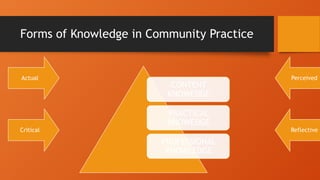
Forms of Knowledge in Community Practice
CONTENT
KNOWEDGE
PRACTICAL
KNOWEDGE
PROFESSIONAL
KNOWLEDGE
Actual Perceived
Critical Reflective
Perceived Knowledge of Perception
• When information passes through our knowledge filter, one of
three things happens:
• We decide that the information is not meaningful to us and the perception
stops there,
• We do not immediately recognize the information, but believe it may be
meaningful to us so we have some incentive to gain more information
• The information is meaningful to us and therefore passes through the next
filter, the valuing filter.
• If a person always feels well informed, he or she may engage in
early closure, not seek out additional information, and perhaps
reach a faulty conclusion.
Problems in Perceived Knowledge
• Highly subjective: based on one's culture, education, experience,
gender, age, etc.
• Unique
• Subject to constant change (new information, new experiences =
new perceptions)
• Frequently inaccurate
Critical and Reflective Knowledge
• Critical knowledge answers how and why exists in the current form
and what is yet missing or not included
• Reflective knowledge requires justification as to taking one’s
sources to be reliable. Reflective knowledge turns out to be a
meta-competence (Multiple)
• Disposition to aptly evaluate the circumstances. If one is to have
reflective knowledge, one must have “an understanding of its
place in a wider whole that include one’s beliefs and knowledge of
it and how these come about” (Sosa, 2007).
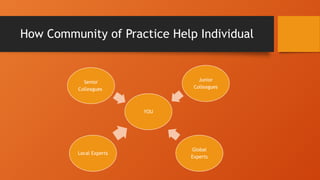
How Community of Practice Help Individual
YOU
Junior
Colleagues
Global
Experts
Local Experts
Senior
Colleagues
Community of Knowledge
• The community of knowledge is a group of people who gather
online and engage in the acquisition and exchange
of knowledge around a particular topic, either with explicit goals
of building new knowledge, or less formally through shared
interests and practice.
• In the current century we can easily go beyond the geographical
limits
• Most of these groups network and share knowledge in conferences,
seminars, webinars, and social media networks etc. and then
continue to share knowledge and knowledge creation practices
Community of Knowledge
• "A group of individuals informally bound to one another through
exposure to a common class of problems, common pursuit of
solutions, and thereby themselves embodying a store of
knowledge" (Stewart 2001 in Botha et al 2008).
• “Group of people who share a concern, a set of problems, or a
passion about a topic, and who deepen their knowledge and
expertise in this area by interacting on an ongoing basis”. (Wenger,
McDermott & Snyder, 2002)
Dimensions of Communities of Knowledge
• The perspective of communities of knowledge and practice affects
educational practices along three dimensions
• Internally: How to organize educational experiences that ground
learning in practice through participation in communities around
subject matters?
• Externally: How to connect the experience of students to actual
practice through peripheral forms of participation in broader
communities beyond the walls of the educational institution?
• Over the lifetime of students: How to serve the lifelong learning
needs of students by organizing communities of practice focused on
topics of continuing interest to students throughout their life?
Functioning of Communities of Knowledge
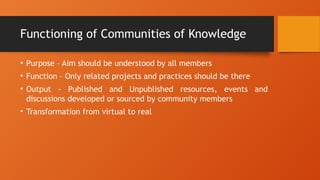
• Purpose – Aim should be understood by all members
• Function – Only related projects and practices should be there
• Output - Published and Unpublished resources, events and
discussions developed or sourced by community members
• Transformation from virtual to real
Stages of Community Development
• Purpose – Aim should be understood by all members
• Function – Only related projects and practices should be there
• Output - Published and Unpublished resources, events and
discussions developed or sourced by community members
• Transformation from virtual to real
Principles of Communities of Knowledge
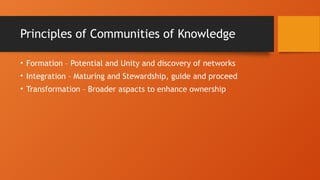
• Formation – Potential and Unity and discovery of networks
• Integration – Maturing and Stewardship, guide and proceed
• Transformation – Broader aspacts to enhance ownership
Sharing Knowledge Base
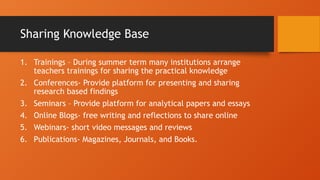
1. Trainings – During summer term many institutions arrange
teachers trainings for sharing the practical knowledge
2. Conferences- Provide platform for presenting and sharing
research based findings
3. Seminars – Provide platform for analytical papers and essays
4. Online Blogs- free writing and reflections to share online
5. Webinars- short video messages and reviews
6. Publications- Magazines, Journals, and Books.
Thank You Very Much
Tutor and Resource Person
Lieutenant Colonel
Muhammad Afaq Durrez, TI(M)
PhD Scholar EPM, AIOU
afaqdurrez@hotmail.com
0333-5141866

8611 Unit 9 Revised.pptx. Critical thinking and reflections

  • 1.
    Communities of Practice& Knowledge UNIT – 9 By Lieutenant Colonel Muhammad Afaq Durrez, TI(M) PhD Scholar EPM, AIOU
  • 2.
  • 3.
    Definition “A group ofpeople who gather online and engage in the acquisition and exchange of knowledge around a particular topic, either with explicit goals of building new knowledge, or less formally through shared interests and practice”
  • 4.
    What is meantby Community? • Community is a social structure comprising a group of people: • Living in the same locale OR • Belonging to same religion/sect OR • Sharing same sociopolitical interests OR • Having same academic/ professional field • The social construction of identity shapes each person's view and interpretation of the world. • Homogenous or Heterogenous • Small or Large
  • 5.
    Some Examples ofTypes…. • Local or Global • Face to Face OR Online • Closely defined or Far reaching • Native or Setteled
  • 6.
    Community of Practice •Lave and Wenger (1991) introduced the concept of community of practice which describes a learning theory with a strong relationship to the social construction of knowledge. • A community of practice is not simply a club of friends or an association of connections between people. It has an identity defined by a shared DOMAIN OF INTEREST.
  • 7.
    Community of Practice(Cont…) • In pursuing their interest in their domain, members engage in joint activities and discussions, help each other, and share information. BOND OF COMMUNITY • A community of practice is not merely a community of interest–people who like certain kinds of movies, for instance. Members of a community of practice are practitioners. They develop a shared repertoire of resources: experiences, stories, tools, ways of addressing recurring problems—in short a SHARED PRACTICE.
  • 8.
    Forms of Knowledgein Community Practice CONTENT KNOWEDGE PRACTICAL KNOWEDGE PROFESSIONAL KNOWLEDGE Actual Perceived Critical Reflective
  • 9.
    Perceived Knowledge ofPerception • When information passes through our knowledge filter, one of three things happens: • We decide that the information is not meaningful to us and the perception stops there, • We do not immediately recognize the information, but believe it may be meaningful to us so we have some incentive to gain more information • The information is meaningful to us and therefore passes through the next filter, the valuing filter. • If a person always feels well informed, he or she may engage in early closure, not seek out additional information, and perhaps reach a faulty conclusion.
  • 10.
    Problems in PerceivedKnowledge • Highly subjective: based on one's culture, education, experience, gender, age, etc. • Unique • Subject to constant change (new information, new experiences = new perceptions) • Frequently inaccurate
  • 11.
    Critical and ReflectiveKnowledge • Critical knowledge answers how and why exists in the current form and what is yet missing or not included • Reflective knowledge requires justification as to taking one’s sources to be reliable. Reflective knowledge turns out to be a meta-competence (Multiple) • Disposition to aptly evaluate the circumstances. If one is to have reflective knowledge, one must have “an understanding of its place in a wider whole that include one’s beliefs and knowledge of it and how these come about” (Sosa, 2007).
  • 12.
    How Community ofPractice Help Individual YOU Junior Colleagues Global Experts Local Experts Senior Colleagues
  • 13.
    Community of Knowledge •The community of knowledge is a group of people who gather online and engage in the acquisition and exchange of knowledge around a particular topic, either with explicit goals of building new knowledge, or less formally through shared interests and practice. • In the current century we can easily go beyond the geographical limits • Most of these groups network and share knowledge in conferences, seminars, webinars, and social media networks etc. and then continue to share knowledge and knowledge creation practices
  • 14.
    Community of Knowledge •"A group of individuals informally bound to one another through exposure to a common class of problems, common pursuit of solutions, and thereby themselves embodying a store of knowledge" (Stewart 2001 in Botha et al 2008). • “Group of people who share a concern, a set of problems, or a passion about a topic, and who deepen their knowledge and expertise in this area by interacting on an ongoing basis”. (Wenger, McDermott & Snyder, 2002)
  • 15.
    Dimensions of Communitiesof Knowledge • The perspective of communities of knowledge and practice affects educational practices along three dimensions • Internally: How to organize educational experiences that ground learning in practice through participation in communities around subject matters? • Externally: How to connect the experience of students to actual practice through peripheral forms of participation in broader communities beyond the walls of the educational institution? • Over the lifetime of students: How to serve the lifelong learning needs of students by organizing communities of practice focused on topics of continuing interest to students throughout their life?
  • 16.
    Functioning of Communitiesof Knowledge • Purpose – Aim should be understood by all members • Function – Only related projects and practices should be there • Output - Published and Unpublished resources, events and discussions developed or sourced by community members • Transformation from virtual to real
  • 17.
    Stages of CommunityDevelopment • Purpose – Aim should be understood by all members • Function – Only related projects and practices should be there • Output - Published and Unpublished resources, events and discussions developed or sourced by community members • Transformation from virtual to real
  • 18.
    Principles of Communitiesof Knowledge • Formation – Potential and Unity and discovery of networks • Integration – Maturing and Stewardship, guide and proceed • Transformation – Broader aspacts to enhance ownership
  • 19.
    Sharing Knowledge Base 1.Trainings – During summer term many institutions arrange teachers trainings for sharing the practical knowledge 2. Conferences- Provide platform for presenting and sharing research based findings 3. Seminars – Provide platform for analytical papers and essays 4. Online Blogs- free writing and reflections to share online 5. Webinars- short video messages and reviews 6. Publications- Magazines, Journals, and Books.
  • 20.
    Thank You VeryMuch Tutor and Resource Person Lieutenant Colonel Muhammad Afaq Durrez, TI(M) PhD Scholar EPM, AIOU afaqdurrez@hotmail.com 0333-5141866