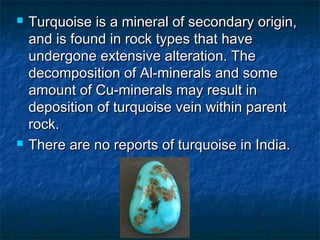
TURQUOISETURQUOISE
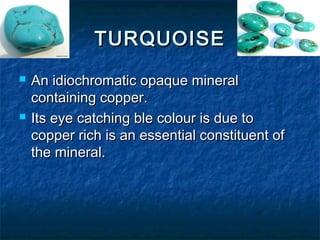
 An idiochromatic opaque mineralAn idiochromatic opaque mineral
containing copper.containing copper.
 Its eye catching ble colour is due toIts eye catching ble colour is due to
copper rich is an essential constituent ofcopper rich is an essential constituent of
the mineral.the mineral.
 Chemical composition- HydratedChemical composition- Hydrated
Phosphate of Copper and AluminiumPhosphate of Copper and Aluminium
CuAl6(OH)8(PO4)4 4H2OCuAl6(OH)8(PO4)4 4H2O
 Crystal system—triclinic.Crystal system—triclinic.
 The name turquoise is derived fromThe name turquoise is derived from
‘Turkey’, although they were not found‘Turkey’, although they were not found
there, but only traded the stones mined inthere, but only traded the stones mined in
Iran for centuries.Iran for centuries.
 Hardness=5-6Hardness=5-6
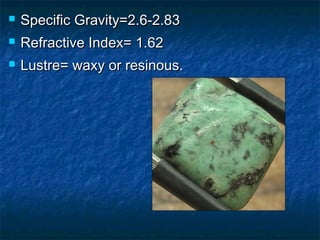
 Specific Gravity=2.6-2.83Specific Gravity=2.6-2.83
 Refractive Index= 1.62Refractive Index= 1.62
 Lustre= waxy or resinous.Lustre= waxy or resinous.
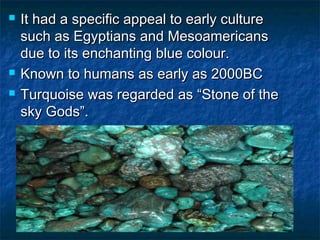
 It had a specific appeal to early cultureIt had a specific appeal to early culture
such as Egyptians and Mesoamericanssuch as Egyptians and Mesoamericans
due to its enchanting blue colour.due to its enchanting blue colour.
 Known to humans as early as 2000BCKnown to humans as early as 2000BC
 Turquoise was regarded as “Stone of theTurquoise was regarded as “Stone of the
sky Gods”.sky Gods”.
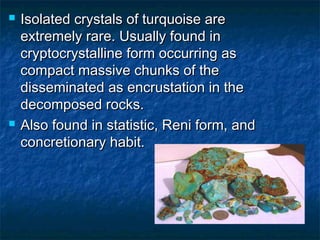
 Isolated crystals of turquoise areIsolated crystals of turquoise are
extremely rare. Usually found inextremely rare. Usually found in
cryptocrystalline form occurring ascryptocrystalline form occurring as
compact massive chunks of thecompact massive chunks of the
disseminated as encrustation in thedisseminated as encrustation in the
decomposed rocks.decomposed rocks.
 Also found in statistic, Reni form, andAlso found in statistic, Reni form, and
concretionary habit.concretionary habit.
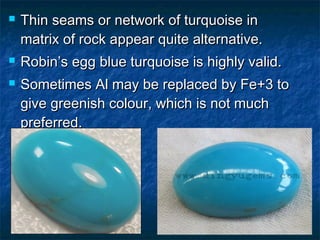
 Thin seams or network of turquoise inThin seams or network of turquoise in
matrix of rock appear quite alternative.matrix of rock appear quite alternative.
 Robin’s egg blue turquoise is highly valid.Robin’s egg blue turquoise is highly valid.
 Sometimes Al may be replaced by Fe+3 toSometimes Al may be replaced by Fe+3 to
give greenish colour, which is not muchgive greenish colour, which is not much
preferred.preferred.
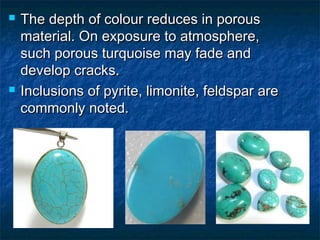
 The depth of colour reduces in porousThe depth of colour reduces in porous
material. On exposure to atmosphere,material. On exposure to atmosphere,
such porous turquoise may fade andsuch porous turquoise may fade and
develop cracks.develop cracks.
 Inclusions of pyrite, limonite, feldspar areInclusions of pyrite, limonite, feldspar are
commonly noted.commonly noted.
 Stones of turquoise with a network of darkStones of turquoise with a network of dark
veins are described as “spider webveins are described as “spider web
turquoise”. Some consider perfect blueturquoise”. Some consider perfect blue
stones as “male” and Greenish asstones as “male” and Greenish as
“female”.“female”.
 Turquoise never occurs in transparentTurquoise never occurs in transparent
form.form.
 The amount of crystallinity varies fromThe amount of crystallinity varies from
specimen to specimen.specimen to specimen.
 The colour of porous turquoise is palesThe colour of porous turquoise is pales
and are impregnated with colourand are impregnated with colour
wax/paraffin/plastic to improve colour. Butwax/paraffin/plastic to improve colour. But
it is considered unethical.it is considered unethical.
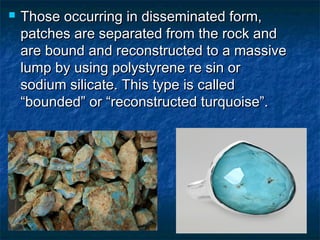
 Those occurring in disseminated form,Those occurring in disseminated form,
patches are separated from the rock andpatches are separated from the rock and
are bound and reconstructed to a massiveare bound and reconstructed to a massive
lump by using polystyrene re sin orlump by using polystyrene re sin or
sodium silicate. This type is calledsodium silicate. This type is called
“bounded” or “reconstructed turquoise”.“bounded” or “reconstructed turquoise”.
 Test recommended to see porosity degree---Test recommended to see porosity degree---
place a drop of hot water on the stone andplace a drop of hot water on the stone and
observe absorbance.observe absorbance.
 There are numerousThere are numerous simulantssimulants for turquoises. Asfor turquoises. As
it is opaque stone, whose main asset is, itsit is opaque stone, whose main asset is, its
colour, it is easier to create glass, enamel,colour, it is easier to create glass, enamel,
porcelain and highly compressed variousporcelain and highly compressed various
powders including plaster of Paris.powders including plaster of Paris.
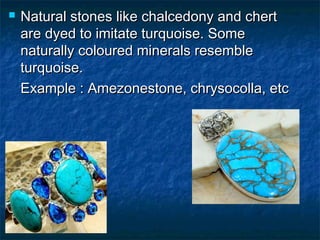
 Natural stones like chalcedony and chertNatural stones like chalcedony and chert
are dyed to imitate turquoise. Someare dyed to imitate turquoise. Some
naturally coloured minerals resemblenaturally coloured minerals resemble
turquoise.turquoise.
Example : Amezonestone, chrysocolla, etcExample : Amezonestone, chrysocolla, etc
 Turquoise is a mineral of secondary origin,Turquoise is a mineral of secondary origin,
and is found in rock types that haveand is found in rock types that have
undergone extensive alteration. Theundergone extensive alteration. The
decomposition of Al-minerals and somedecomposition of Al-minerals and some
amount of Cu-minerals may result inamount of Cu-minerals may result in
deposition of turquoise vein within parentdeposition of turquoise vein within parent
rock.rock.
 There are no reports of turquoise in India.There are no reports of turquoise in India.

8 turquoise

  • 1.
    TURQUOISETURQUOISE  An idiochromaticopaque mineralAn idiochromatic opaque mineral containing copper.containing copper.  Its eye catching ble colour is due toIts eye catching ble colour is due to copper rich is an essential constituent ofcopper rich is an essential constituent of the mineral.the mineral.
  • 2.
     Chemical composition-HydratedChemical composition- Hydrated Phosphate of Copper and AluminiumPhosphate of Copper and Aluminium CuAl6(OH)8(PO4)4 4H2OCuAl6(OH)8(PO4)4 4H2O  Crystal system—triclinic.Crystal system—triclinic.
  • 3.
     The nameturquoise is derived fromThe name turquoise is derived from ‘Turkey’, although they were not found‘Turkey’, although they were not found there, but only traded the stones mined inthere, but only traded the stones mined in Iran for centuries.Iran for centuries.  Hardness=5-6Hardness=5-6
  • 4.
     Specific Gravity=2.6-2.83SpecificGravity=2.6-2.83  Refractive Index= 1.62Refractive Index= 1.62  Lustre= waxy or resinous.Lustre= waxy or resinous.
  • 5.
     It hada specific appeal to early cultureIt had a specific appeal to early culture such as Egyptians and Mesoamericanssuch as Egyptians and Mesoamericans due to its enchanting blue colour.due to its enchanting blue colour.  Known to humans as early as 2000BCKnown to humans as early as 2000BC  Turquoise was regarded as “Stone of theTurquoise was regarded as “Stone of the sky Gods”.sky Gods”.
  • 6.
     Isolated crystalsof turquoise areIsolated crystals of turquoise are extremely rare. Usually found inextremely rare. Usually found in cryptocrystalline form occurring ascryptocrystalline form occurring as compact massive chunks of thecompact massive chunks of the disseminated as encrustation in thedisseminated as encrustation in the decomposed rocks.decomposed rocks.  Also found in statistic, Reni form, andAlso found in statistic, Reni form, and concretionary habit.concretionary habit.
  • 7.
     Thin seamsor network of turquoise inThin seams or network of turquoise in matrix of rock appear quite alternative.matrix of rock appear quite alternative.  Robin’s egg blue turquoise is highly valid.Robin’s egg blue turquoise is highly valid.  Sometimes Al may be replaced by Fe+3 toSometimes Al may be replaced by Fe+3 to give greenish colour, which is not muchgive greenish colour, which is not much preferred.preferred.
  • 8.
     The depthof colour reduces in porousThe depth of colour reduces in porous material. On exposure to atmosphere,material. On exposure to atmosphere, such porous turquoise may fade andsuch porous turquoise may fade and develop cracks.develop cracks.  Inclusions of pyrite, limonite, feldspar areInclusions of pyrite, limonite, feldspar are commonly noted.commonly noted.
  • 9.
     Stones ofturquoise with a network of darkStones of turquoise with a network of dark veins are described as “spider webveins are described as “spider web turquoise”. Some consider perfect blueturquoise”. Some consider perfect blue stones as “male” and Greenish asstones as “male” and Greenish as “female”.“female”.  Turquoise never occurs in transparentTurquoise never occurs in transparent form.form.
  • 10.
     The amountof crystallinity varies fromThe amount of crystallinity varies from specimen to specimen.specimen to specimen.  The colour of porous turquoise is palesThe colour of porous turquoise is pales and are impregnated with colourand are impregnated with colour wax/paraffin/plastic to improve colour. Butwax/paraffin/plastic to improve colour. But it is considered unethical.it is considered unethical.
  • 11.
     Those occurringin disseminated form,Those occurring in disseminated form, patches are separated from the rock andpatches are separated from the rock and are bound and reconstructed to a massiveare bound and reconstructed to a massive lump by using polystyrene re sin orlump by using polystyrene re sin or sodium silicate. This type is calledsodium silicate. This type is called “bounded” or “reconstructed turquoise”.“bounded” or “reconstructed turquoise”.
  • 12.
     Test recommendedto see porosity degree---Test recommended to see porosity degree--- place a drop of hot water on the stone andplace a drop of hot water on the stone and observe absorbance.observe absorbance.  There are numerousThere are numerous simulantssimulants for turquoises. Asfor turquoises. As it is opaque stone, whose main asset is, itsit is opaque stone, whose main asset is, its colour, it is easier to create glass, enamel,colour, it is easier to create glass, enamel, porcelain and highly compressed variousporcelain and highly compressed various powders including plaster of Paris.powders including plaster of Paris.
  • 13.
     Natural stoneslike chalcedony and chertNatural stones like chalcedony and chert are dyed to imitate turquoise. Someare dyed to imitate turquoise. Some naturally coloured minerals resemblenaturally coloured minerals resemble turquoise.turquoise. Example : Amezonestone, chrysocolla, etcExample : Amezonestone, chrysocolla, etc
  • 14.
     Turquoise isa mineral of secondary origin,Turquoise is a mineral of secondary origin, and is found in rock types that haveand is found in rock types that have undergone extensive alteration. Theundergone extensive alteration. The decomposition of Al-minerals and somedecomposition of Al-minerals and some amount of Cu-minerals may result inamount of Cu-minerals may result in deposition of turquoise vein within parentdeposition of turquoise vein within parent rock.rock.  There are no reports of turquoise in India.There are no reports of turquoise in India.