ALEXANDRITE
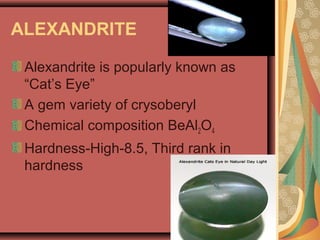
Alexandrite is popularly known as
“Cat’s Eye”
A gem variety of crysoberyl
Chemical composition BeAl2O4
Hardness-High-8.5, Third rank in
hardness
Crystal system orthorhombic
Occurs as tabular crystals, which are
often twinned.
Iron impurity is usually present in
traces, resulting in shades of yellow,
brown and green.
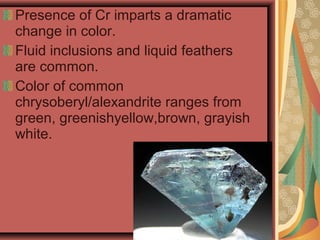
Presence of Cr imparts a dramatic
change in color.
Fluid inclusions and liquid feathers
are common.
Color of common
chrysoberyl/alexandrite ranges from
green, greenishyellow,brown, grayish
white.
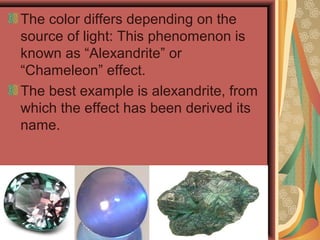
The color differs depending on the
source of light: This phenomenon is
known as “Alexandrite” or
“Chameleon” effect.
The best example is alexandrite, from
which the effect has been derived its
name.
Alexandrite that changes color when
its position of sight is changed, or a
ware like color effect on color tone
effect is seen, which is known as
“Cat’s Eye”.
All Alexandrites do not show
spectacular color change.
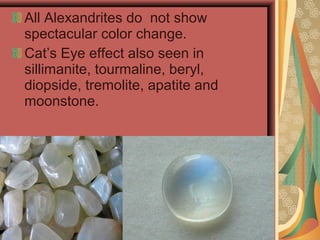
Cat’s Eye effect also seen in
sillimanite, tourmaline, beryl,
diopside, tremolite, apatite and
moonstone.
According to Gemologists, the term “Cat’s
Eye” is exclusively reserved for alexandrite,
a gem variety of crysoberyl(BeAl2O4).
Suitable presence of chromium in
alexandrite shows a significant color
change. However presence of Fe reduces
the quality of color change. However there
is no particular scale to determine the so
called percentage of color change.
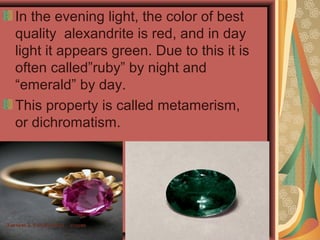
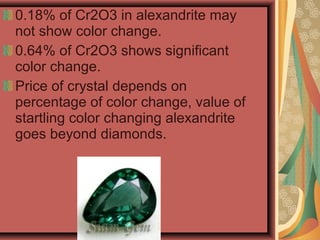
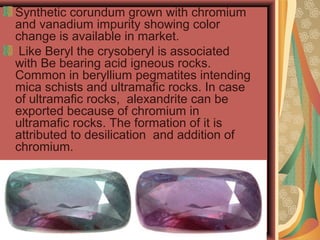
In the evening light, the color of best
quality alexandrite is red, and in day
light it appears green. Due to this it is
often called”ruby” by night and
“emerald” by day.
This property is called metamerism,
or dichromatism.
0.18% of Cr2O3 in alexandrite may
not show color change.
0.64% of Cr2O3 shows significant
color change.
Price of crystal depends on
percentage of color change, value of
startling color changing alexandrite
goes beyond diamonds.
Synthetic corundum grown with chromium
and vanadium impurity showing color
change is available in market.
Like Beryl the crysoberyl is associated
with Be bearing acid igneous rocks.
Common in beryllium pegmatites intending
mica schists and ultramafic rocks. In case
of ultramafic rocks, alexandrite can be
exported because of chromium in
ultramafic rocks. The formation of it is
attributed to desilication and addition of
chromium.
Distribution:
Alexandrite has been reported from
Western Ghats south of Kaveri River.
Kumaun and Garwal of Himalayas
Coimbatore-salem region of Tamil
Nadu Shevrai hills of Tamil Nadu
Manikkal of Kerala state.

alexandrite

  • 1.
    ALEXANDRITE Alexandrite is popularlyknown as “Cat’s Eye” A gem variety of crysoberyl Chemical composition BeAl2O4 Hardness-High-8.5, Third rank in hardness
  • 2.
    Crystal system orthorhombic Occursas tabular crystals, which are often twinned. Iron impurity is usually present in traces, resulting in shades of yellow, brown and green.
  • 3.
    Presence of Crimparts a dramatic change in color. Fluid inclusions and liquid feathers are common. Color of common chrysoberyl/alexandrite ranges from green, greenishyellow,brown, grayish white.
  • 4.
    The color differsdepending on the source of light: This phenomenon is known as “Alexandrite” or “Chameleon” effect. The best example is alexandrite, from which the effect has been derived its name.
  • 5.
    Alexandrite that changescolor when its position of sight is changed, or a ware like color effect on color tone effect is seen, which is known as “Cat’s Eye”.
  • 6.
    All Alexandrites donot show spectacular color change. Cat’s Eye effect also seen in sillimanite, tourmaline, beryl, diopside, tremolite, apatite and moonstone.
  • 7.
    According to Gemologists,the term “Cat’s Eye” is exclusively reserved for alexandrite, a gem variety of crysoberyl(BeAl2O4). Suitable presence of chromium in alexandrite shows a significant color change. However presence of Fe reduces the quality of color change. However there is no particular scale to determine the so called percentage of color change.
  • 8.
    In the eveninglight, the color of best quality alexandrite is red, and in day light it appears green. Due to this it is often called”ruby” by night and “emerald” by day. This property is called metamerism, or dichromatism.
  • 9.
    0.18% of Cr2O3in alexandrite may not show color change. 0.64% of Cr2O3 shows significant color change. Price of crystal depends on percentage of color change, value of startling color changing alexandrite goes beyond diamonds.
  • 10.
    Synthetic corundum grownwith chromium and vanadium impurity showing color change is available in market. Like Beryl the crysoberyl is associated with Be bearing acid igneous rocks. Common in beryllium pegmatites intending mica schists and ultramafic rocks. In case of ultramafic rocks, alexandrite can be exported because of chromium in ultramafic rocks. The formation of it is attributed to desilication and addition of chromium.
  • 11.
    Distribution: Alexandrite has beenreported from Western Ghats south of Kaveri River. Kumaun and Garwal of Himalayas Coimbatore-salem region of Tamil Nadu Shevrai hills of Tamil Nadu Manikkal of Kerala state.