
Bella Starling and Suzanne Parsons on behalf of Work Package 3 of EUPATI
Nowgen, University of Manchester
Patient involvement in medicines
development – the views of
patients and key stakeholders
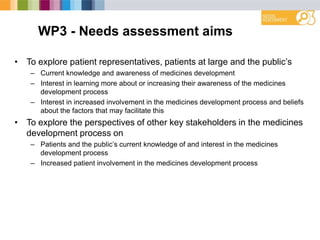
WP3 - Needs assessment aims
• To explore patient representatives, patients at large and the public‟s
– Current knowledge and awareness of medicines development
– Interest in learning more about or increasing their awareness of the medicines
development process
– Interest in increased involvement in the medicines development process and beliefs
about the factors that may facilitate this
• To explore the perspectives of other key stakeholders in the medicines
development process on
– Patients and the public‟s current knowledge of and interest in the medicines
development process
– Increased patient involvement in the medicines development process
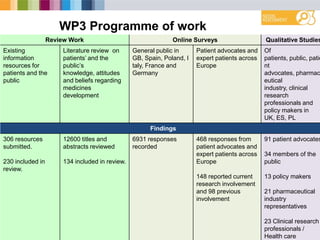
Review Work Online Surveys Qualitative Studies
Existing
information
resources for
patients and the
public
Literature review on
patients‟ and the
public‟s
knowledge, attitudes
and beliefs regarding
medicines
development
General public in
GB, Spain, Poland, I
taly, France and
Germany
Patient advocates and
expert patients across
Europe
Of
patients, public, patie
nt
advocates, pharmac
eutical
industry, clinical
research
professionals and
policy makers in
UK, ES, PL
Findings
306 resources
submitted.
230 included in
review.
12600 titles and
abstracts reviewed
134 included in review.
6931 responses
recorded
468 responses from
patient advocates and
expert patients across
Europe
148 reported current
research involvement
and 98 previous
involvement
91 patient advocates
34 members of the
public
13 policy makers
21 pharmaceutical
industry
representatives
23 Clinical research
professionals /
Health care
WP3 Programme of work
Findings
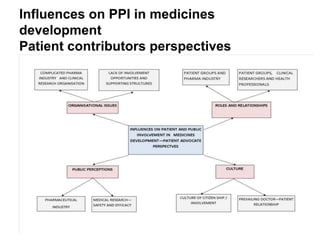
Influences on PPI in medicines
development
Patient contributors perspectives
Patient contributors involvement in
research
 Roles
• Research involvement one part of a multi – faceted role
• Part of role in supporting patients not necessarily well established or externally
recognised
• Perceived lack of clear roles for patients in the medicines development process –
(From both patient representatives and key stakeholders perspectives)
 Relationships
• Good relationships between patient groups, industry and clinical researchers
essential
• Patient contributors spoke at length about the challenges and facilitators of
establishing successful relationships with industry and clinical researchers
• Facilitators
– Existing examples of good practice to build upon
– Increasing importance of patient involvement in medicines development to the
pharmaceutical industry
• Challenges
– Conflicting agendas and ways of working
– Difficulties in establishing trust in one another
Patient contributors involvement in
research
 Perceptions of industry and clinical research
• Negative perceptions of industry and clinical research led to
– Fears amongst some patient groups that involvement in medicines
development might taint their reputation
– Decreased receptivity of some patient groups to the material developed by
EUPATI
 Organisational issues
• Structures and organisations involved in medicines development relatively
complex and difficult to navigate
• Perceived lack of involvement opportunities within medicines development and
structures to support involvement
• Need for beacon projects for industry and patients to work together on from
which lessons can be learnt and shared
Patient contributors involvement in
medicines development – Culture
 Perceptions of whether patient contributors would be likely to have a
voice in the medicines development process varied across the
countries studied
• E.G. in the UK stronger culture of involvement whereas in Poland a wide level of
distrust in healthcare, concerns about corruption seemed to act as a disincentive to
involvement.
 Related to this, the nature of the doctor patient relationship within each
of the countries seemed to influence willingness to get involved
• E.G. in both Spain and Poland, more traditional models of the Dr-Patient
relationship appeared to still prevail meaning that patients felt that they could be
less questioning and challenging to healthcare professionals about their healthcare
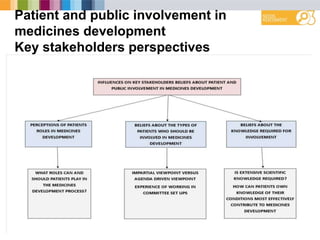
Patient and public involvement in
medicines development
Key stakeholders perspectives
Roles
 Beliefs about patients‟ roles in the medicines development process
varied
 Some raised the question whether patients had a role
 Others believed that patients could have a role but felt that roles were
currently unclear and needed to be worked out
 Those with experience of involving patients had more concrete ideas
 Those in countries where patient involvement was not widespread had
greater difficulty in outlining roles
Key stakeholders perspectives
Characteristics of patient contributors
 Participants talked at length about the characteristics of „good‟ patient
representatives. Ideas included
• Those with experience of committee work
• Those with a well developed knowledge base in this area
• Those who were able to act as impartially as possible and put personal agendas
aside
• Contrasts with patient contributors perceptions that they often became involved due
to their beliefs that there was a particular “battle to be won” with regard to their
condition,
 Those with some experience of involvement talked about some
potential downsides of the „good‟ patient representative
• Lack of diversity in the population involved
• Potential for patient representatives to become over professionalised – leading to
grassroots patients‟ views no longer being represented
• Contrasts with patient contributors perceptions that
Key stakeholders and patients
perspectives – Knowledge
 How much knowledge is enough? Key question for both patient
representatives and key stakeholders
 Widespread belief amongst key stakeholders that patient and the
public knowledge levels were low - sometimes amongst patient
groups
 Importance of giving value to patients existing knowledge –(Patients)
 Importance of ensuring that patients‟ do not lose their original and
unique contribution by increasing their knowledge of the more
technical aspects of medicines development too much (Key
stakeholders)
Discussion
 Considerable involvement experience amongst the patient contributors
surveyed - useful to build on the existing experience to develop
patient involvement in medicines development
 Need for key stakeholders in medicines development to think more
strategically about patient involvement, e.g. roles and systems to
support involvement
 Importance of analysing and sharing examples of good practice in
patient involvement in medicines development
 Importance of raising key stakeholders understanding and awareness
of the benefits and value of patient involvement in medicines
development
 Importance of developing training and advice not just for patients but
also for those who will be involving patients in the medicines
development process
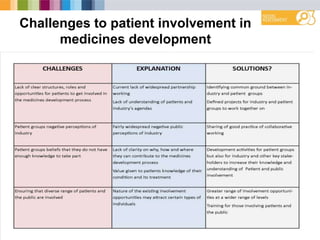
Challenges to patient involvement in
medicines development
Final points and thank you
 Other aspect of this work addresses increasing public awareness of
these issues
 Findings presented pending publication
 Many of the findings will be addressed within the EUPATI programme
of work although some findings and recommendations are likely to
require more wide scale activities beyond the scope of EUPATI
Contact details
bella.starling@cmft.nhs.uk
suzanne.parsons@cmft.nhs.uk
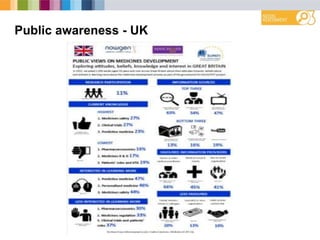
Public awareness - UK
Work Package 3 team
 University of Manchester
 Bella Starling – WP3 lead
 Suzanne Parsons – WP3 Project Manager
 Su-Gwan Tham – WP3 Project Assistant
 GlaxoSmithKline
 Kay Warner – WP3 co-lead
 Novo Nordisk
 Christine Mullan-Jensen – WP3 Deputy Co-lead
 EGAN / GAUK
 Kim Wever
 Celine Lewis
 Amgen, Genzyme, Roche, AstraZeneca, VFA
18

Patient involvement in medicines development – the views of patients and key stakeholders (Starling/Parsons, EUPATI / Nowgen)

  • 1.
    Bella Starling andSuzanne Parsons on behalf of Work Package 3 of EUPATI Nowgen, University of Manchester Patient involvement in medicines development – the views of patients and key stakeholders
  • 2.
    WP3 - Needsassessment aims • To explore patient representatives, patients at large and the public‟s – Current knowledge and awareness of medicines development – Interest in learning more about or increasing their awareness of the medicines development process – Interest in increased involvement in the medicines development process and beliefs about the factors that may facilitate this • To explore the perspectives of other key stakeholders in the medicines development process on – Patients and the public‟s current knowledge of and interest in the medicines development process – Increased patient involvement in the medicines development process
  • 3.
    Review Work OnlineSurveys Qualitative Studies Existing information resources for patients and the public Literature review on patients‟ and the public‟s knowledge, attitudes and beliefs regarding medicines development General public in GB, Spain, Poland, I taly, France and Germany Patient advocates and expert patients across Europe Of patients, public, patie nt advocates, pharmac eutical industry, clinical research professionals and policy makers in UK, ES, PL Findings 306 resources submitted. 230 included in review. 12600 titles and abstracts reviewed 134 included in review. 6931 responses recorded 468 responses from patient advocates and expert patients across Europe 148 reported current research involvement and 98 previous involvement 91 patient advocates 34 members of the public 13 policy makers 21 pharmaceutical industry representatives 23 Clinical research professionals / Health care WP3 Programme of work
  • 4.
  • 6.
    Influences on PPIin medicines development Patient contributors perspectives
  • 7.
    Patient contributors involvementin research  Roles • Research involvement one part of a multi – faceted role • Part of role in supporting patients not necessarily well established or externally recognised • Perceived lack of clear roles for patients in the medicines development process – (From both patient representatives and key stakeholders perspectives)  Relationships • Good relationships between patient groups, industry and clinical researchers essential • Patient contributors spoke at length about the challenges and facilitators of establishing successful relationships with industry and clinical researchers • Facilitators – Existing examples of good practice to build upon – Increasing importance of patient involvement in medicines development to the pharmaceutical industry • Challenges – Conflicting agendas and ways of working – Difficulties in establishing trust in one another
  • 8.
    Patient contributors involvementin research  Perceptions of industry and clinical research • Negative perceptions of industry and clinical research led to – Fears amongst some patient groups that involvement in medicines development might taint their reputation – Decreased receptivity of some patient groups to the material developed by EUPATI  Organisational issues • Structures and organisations involved in medicines development relatively complex and difficult to navigate • Perceived lack of involvement opportunities within medicines development and structures to support involvement • Need for beacon projects for industry and patients to work together on from which lessons can be learnt and shared
  • 9.
    Patient contributors involvementin medicines development – Culture  Perceptions of whether patient contributors would be likely to have a voice in the medicines development process varied across the countries studied • E.G. in the UK stronger culture of involvement whereas in Poland a wide level of distrust in healthcare, concerns about corruption seemed to act as a disincentive to involvement.  Related to this, the nature of the doctor patient relationship within each of the countries seemed to influence willingness to get involved • E.G. in both Spain and Poland, more traditional models of the Dr-Patient relationship appeared to still prevail meaning that patients felt that they could be less questioning and challenging to healthcare professionals about their healthcare
  • 10.
    Patient and publicinvolvement in medicines development Key stakeholders perspectives
  • 11.
    Key stakeholders perspectives Roles Beliefs about patients‟ roles in the medicines development process varied  Some raised the question whether patients had a role  Others believed that patients could have a role but felt that roles were currently unclear and needed to be worked out  Those with experience of involving patients had more concrete ideas  Those in countries where patient involvement was not widespread had greater difficulty in outlining roles
  • 12.
    Key stakeholders perspectives Characteristicsof patient contributors  Participants talked at length about the characteristics of „good‟ patient representatives. Ideas included • Those with experience of committee work • Those with a well developed knowledge base in this area • Those who were able to act as impartially as possible and put personal agendas aside • Contrasts with patient contributors perceptions that they often became involved due to their beliefs that there was a particular “battle to be won” with regard to their condition,  Those with some experience of involvement talked about some potential downsides of the „good‟ patient representative • Lack of diversity in the population involved • Potential for patient representatives to become over professionalised – leading to grassroots patients‟ views no longer being represented • Contrasts with patient contributors perceptions that
  • 13.
    Key stakeholders andpatients perspectives – Knowledge  How much knowledge is enough? Key question for both patient representatives and key stakeholders  Widespread belief amongst key stakeholders that patient and the public knowledge levels were low - sometimes amongst patient groups  Importance of giving value to patients existing knowledge –(Patients)  Importance of ensuring that patients‟ do not lose their original and unique contribution by increasing their knowledge of the more technical aspects of medicines development too much (Key stakeholders)
  • 14.
    Discussion  Considerable involvementexperience amongst the patient contributors surveyed - useful to build on the existing experience to develop patient involvement in medicines development  Need for key stakeholders in medicines development to think more strategically about patient involvement, e.g. roles and systems to support involvement  Importance of analysing and sharing examples of good practice in patient involvement in medicines development  Importance of raising key stakeholders understanding and awareness of the benefits and value of patient involvement in medicines development  Importance of developing training and advice not just for patients but also for those who will be involving patients in the medicines development process
  • 15.
    Challenges to patientinvolvement in medicines development
  • 16.
    Final points andthank you  Other aspect of this work addresses increasing public awareness of these issues  Findings presented pending publication  Many of the findings will be addressed within the EUPATI programme of work although some findings and recommendations are likely to require more wide scale activities beyond the scope of EUPATI Contact details bella.starling@cmft.nhs.uk suzanne.parsons@cmft.nhs.uk
  • 17.
  • 18.
    Work Package 3team  University of Manchester  Bella Starling – WP3 lead  Suzanne Parsons – WP3 Project Manager  Su-Gwan Tham – WP3 Project Assistant  GlaxoSmithKline  Kay Warner – WP3 co-lead  Novo Nordisk  Christine Mullan-Jensen – WP3 Deputy Co-lead  EGAN / GAUK  Kim Wever  Celine Lewis  Amgen, Genzyme, Roche, AstraZeneca, VFA 18

Editor's Notes

  • #2 A key workstream within the EUPATI project has explored patients and the public’s knowledge and interest in learning more about the medicines development process and their attitudes and beliefs regarding increased patient involvement in the medicines development process and key stakeholders perspectives on these issues.This work has taken a mixed methods social research approach – online questionnaire surveys and qualitative studies and reviews of both information resources and empirical research literature in this area
  • #3 As you can see from these aims, we did not just focus on patient involvement, we also focused on increasing public awareness of medicines development. However, for the purposes of today’s presentation we just have the opportunity to describe our findings regarding patient involvement in the medicines development process By other key stakeholders we mean healthcare policymakers, pharmaceutical industry representatives and clinical research professionals
  • #4 So as you can see the needs assessment could be split into three phasesReview work Review of existing information sources on the medicines development processReview of the existing literature on patients and the public’s knowledge, attitudes and beliefs regarding medicines developmentOnline surveys of the general public in six european countriesOnline survey of patients advocates and patients experts across europeQualitative studies in the UK, Spain and Poland exploring patients and the public’s attitudes towards and information needs regarding the medicines development process and their beliefs about increasing patient involvement and awareness Qualitative studies in the UK, Spain and Poland and on a pan-European basis exploring key stakeholders (healthcare policymakers, pharmaceutical industry and clinical research professionals and academics beliefs about these issues This presentation will primarily focus on our findings regarding patient involvement in the medicines development process The following pieces of research work have informed this presentationOnline survey of patient advocates across EuropePan-European focus groups with patient advocates undertaken at EUPATI eventsFocus groups and interviews with patient advocates undertaken in the UK, Spain and PolandInterviews and focus groups with key stakeholders in the UK, Spain and Poland
  • #6 The survey was sent out to approximately 1000 patient organisations on the databases of Eurordis and EPF and it was also disseminated on twitter, facebook and via the EUPATI newsletter Therefore we cannot be exactly certain of the denominator of the survey As one might expect the majority of those replying to the survey reported that they had been a research participant, however there was also a considerable amount of active involvement reported from commenting on and developing patient information leaflets (27%) to getting involved in research design 16% and committee membership HTA, ethics committees Therefore the findings suggest that there is a considerable amount of capacity and experience in terms of patient involvement in medical research which EUPATI could usefully build upon As part of the survey we also asked participants to describe collaborations between patient groups, industry and academia, and approximatey 60 were inputted which will be followed up at a later date
  • #7 Interviews were conducted in the UK, Spain and Poland and on a pan-European basis at EUPATI events which meant that we were able to explore the views of patient contributors from a range of EU countries. The diagram is drawn from themes across these three datasetsImportant to note that we were asking participants about the pharmaceutical medicines development process and working with the pharmaceutical industry on the medicines development process and not specifically about NHS research or Health Service research in their , respective countries. Therefore, the key feature of this involvement was about collaboration with industry We recognise that there are a number of good examples of collaborative working in the UK between patient groups and industry and that in many respects that the field of patient involvement is further advanced in the UK, than in other countries. However the themes presented here were issues in some ways for all of the countries were we undertook work. UK based interviewees described both positive and negative experiences of collaborating with industry For participants key influences on their willingness and opportunity to get involved in the medicines development process were Public perceptions – Across the countries where we undertook the qualitative work, public perceptions of the pharmaceutical industry and the safety of medical research varied. The negative perceptions sometimes impacted on patient contributors and patients organisation representatives willingness to become more actively involved in the medicines development process. This was a particular issue in Poland even if they were representing a group of patients. The extent of healthcare corruption within Poland appeared appeared to be strongly influencing people’s willingness to get involved Culture –We undertook this research in three countries and the perceptions of whether patient contributors would be likely to have a voice and to be heard varied quite widely. For example in the UK, the culture of involvement in healthcare issues and in general appeared to be strongest whereas in Poland, the wide level of distrust in healthcare, concerns about corruption and feeling that you would not be contributing to a fair and just process appeared to act as a huge disincentive to involvement. Related to this, the nature of the doctor patient relationship within each of the countries that we studied also appeared to have an influence on willingness to become involved in the medicines development process, for example in both Spain and Poland, more traditional models of the Dr-Patient relationship appeared to still prevail meaning that patients felt that they could be less questioning and challenging to healthcare professionals and about their healthcare in general which is likely to impact on the extent to which they feel that they can become more actively involved in something like medicines development
  • #11 Finally, we also explored key stakeholders perspectives on patient involvement in the medicines development process, the current state of play and the issues they felt existed in terms of increasing patient involvement and making it increasingly well-established within the medicines development process The key themes within this area from key stakeholders perspectives were Their beliefs about patients roles in the medicines development process – number of questions raised about whether patients have a role, and if so the difficulties in identifying roles and agreeing roles for them in the medicines development process – nod to those who we interviewed not having a great deal of experience in patient involvementFinally they also discussed their beliefs about the level of knowledge required for involvement
  • #16 So from the previous slide it may be possible to identify several challenges to patient involvement in the medicines development process. From our qualitative data we also identfied potential explanations for these challenges and the solutions that were proposed by our participants (both patients and industry)Roles and structures to support involvement Managing negative perceptions of industry Helping patient groups to recognise and value the knowledge that they bring to the medicines development process Diversity and representativeness of those who are involved The explanations and the solutions were both highlighted by interview participants