PATIENTS – SCIENCE – INDUSTRY
UCD Rare Disease Module, March 28th, 2017
Derick Mitchell, PhD
Overview
• Context
• Environment IPPOSI exists in / was created to address
• IPPOSI – aims/objectives
• Rare diseases in Ireland & Europe
• Centres of Expertise – European Reference Networks
• Orphan drugs & technologies
• Your feedback
May you live in changing times….
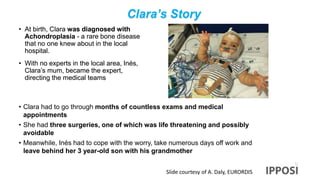
Clara’s Story
• At birth, Clara was diagnosed with
Achondroplasia - a rare bone disease
that no one knew about in the local
hospital.
• With no experts in the local area, Inés,
Clara’s mum, became the expert,
directing the medical teams
• Clara had to go through months of countless exams and medical
appointments
• She had three surgeries, one of which was life threatening and possibly
avoidable
• Meanwhile, Inés had to cope with the worry, take numerous days off work and
leave behind her 3 year-old son with his grandmother
Slide courtesy of A. Daly, EURORDIS
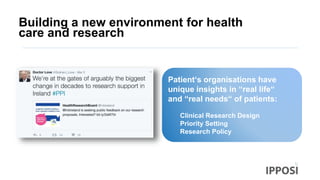
Patient‘s organisations have
unique insights in “real life“
and “real needs“ of patients:
Clinical Research Design
Priority Setting
Research Policy
Building a new environment for health
care and research
5
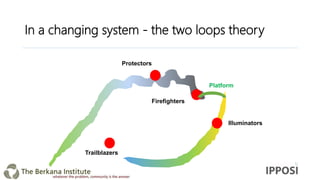
In a changing system - the two loops theory
Trailblazers
Protectors
Firefighters
Illuminators
Platform
• https://vimeo.com/194851031
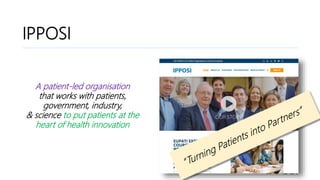
IPPOSI? Who?IPPOSI
A patient-led organisation
that works with patients,
government, industry,
& science to put patients at the
heart of health innovation
IPPOSI Members (examples)
100+ Patient Organisations
100+ Scientific/Regulatory/Agencies
(200+ individuals)
20 Industry members
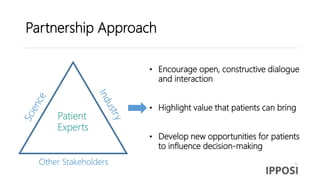
Partnership Approach
Other Stakeholders
Patient
Experts
• Encourage open, constructive dialogue
and interaction
• Highlight value that patients can bring
• Develop new opportunities for patients
to influence decision-making
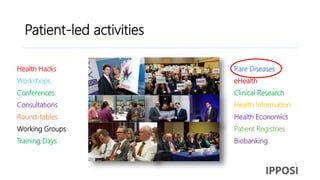
Patient-led activities
Health Hacks
Workshops
Conferences
Consultations
Round-tables
Working Groups
Training Days
Rare Diseases
eHealth
Clinical Research
Health Information
Health Economics
Patient Registries
Biobanking
Rare Diseases in Europe
• Rare diseases in EU = 5 in 10,000
• 6-7,000 rare diseases found (Orphanet)
• Up to 6% - 8% of EU population affected at one point in life = 30
million people in the EU are affected or will be affected by a Rare
Disease
• Republic of Ireland = 157,000 have a Rare Disease
• 200,000 in the population yet to be diagnosed
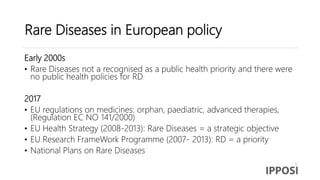
Rare Diseases in European policy
Early 2000s
• Rare Diseases not a recognised as a public health priority and there were
no public health policies for RD
2017
• EU regulations on medicines: orphan, paediatric, advanced therapies,
(Regulation EC NO 141/2000)
• EU Health Strategy (2008-2013): Rare Diseases = a strategic objective
• EU Research FrameWork Programme (2007- 2013): RD = a priority
• National Plans on Rare Diseases
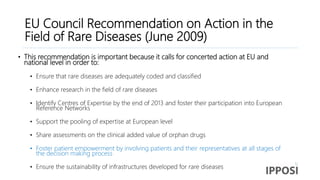
EU Council Recommendation on Action in the
Field of Rare Diseases (June 2009)
• This recommendation is important because it calls for concerted action at EU and
national level in order to:
• Ensure that rare diseases are adequately coded and classified
• Enhance research in the field of rare diseases
• Identify Centres of Expertise by the end of 2013 and foster their participation into European
Reference Networks
• Support the pooling of expertise at European level
• Share assessments on the clinical added value of orphan drugs
• Foster patient empowerment by involving patients and their representatives at all stages of
the decision making process
• Ensure the sustainability of infrastructures developed for rare diseases
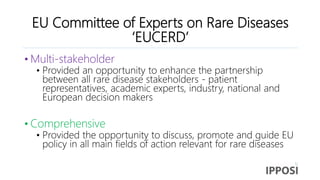
EU Committee of Experts on Rare Diseases
‘EUCERD’
• Multi-stakeholder
• Provided an opportunity to enhance the partnership
between all rare disease stakeholders - patient
representatives, academic experts, industry, national and
European decision makers
• Comprehensive
• Provided the opportunity to discuss, promote and guide EU
policy in all main fields of action relevant for rare diseases
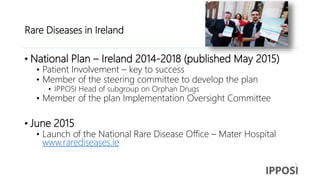
Rare Diseases in Ireland
• National Plan – Ireland 2014-2018 (published May 2015)
• Patient Involvement – key to success
• Member of the steering committee to develop the plan
• IPPOSI Head of subgroup on Orphan Drugs
• Member of the plan Implementation Oversight Committee
• June 2015
• Launch of the National Rare Disease Office – Mater Hospital
www.rarediseases.ie
Centres of Expertise
EUROPEAN REFERENCE NETWORKS
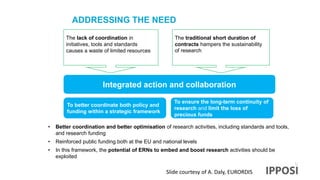
ADDRESSING THE NEED
Integrated action and collaboration
The traditional short duration of
contracts hampers the sustainability
of research
• Better coordination and better optimisation of research activities, including standards and tools,
and research funding
• Reinforced public funding both at the EU and national levels
• In this framework, the potential of ERNs to embed and boost research activities should be
exploited
The lack of coordination in
initiatives, tools and standards
causes a waste of limited resources
To better coordinate both policy and
funding within a strategic framework
To ensure the long-term continuity of
research and limit the loss of
precious funds
Slide courtesy of A. Daly, EURORDIS
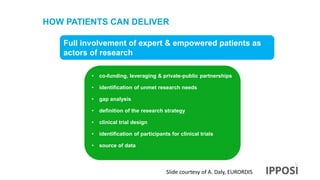
HOW PATIENTS CAN DELIVER
Full involvement of expert & empowered patients as
actors of research
• co-funding, leveraging & private-public partnerships
• identification of unmet research needs
• gap analysis
• definition of the research strategy
• clinical trial design
• identification of participants for clinical trials
• source of data
Slide courtesy of A. Daly, EURORDIS
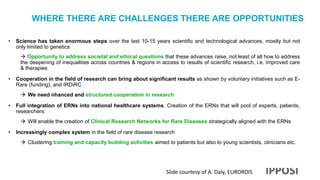
WHERE THERE ARE CHALLENGES THERE ARE OPPORTUNITIES
• Science has taken enormous steps over the last 10-15 years scientific and technological advances, mostly but not
only limited to genetics
 Opportunity to address societal and ethical questions that these advances raise, not least of all how to address
the deepening of inequalities across countries & regions in access to results of scientific research, i.e. improved care
& therapies
• Cooperation in the field of research can bring about significant results as shown by voluntary initiatives such as E-
Rare (funding), and IRDiRC
 We need nhanced and structured cooperation in research
• Full integration of ERNs into national healthcare systems. Creation of the ERNs that will pool of experts, patients,
researchers:
 Will enable the creation of Clinical Research Networks for Rare Diseases strategically aligned with the ERNs
• Increasingly complex system in the field of rare disease research
 Clustering training and capacity building activities aimed to patients but also to young scientists, clinicians etc.
Slide courtesy of A. Daly, EURORDIS
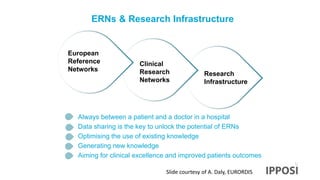
ERNs & Research Infrastructure
21
Always between a patient and a doctor in a hospital
Data sharing is the key to unlock the potential of ERNs
Optimising the use of existing knowledge
Generating new knowledge
Aiming for clinical excellence and improved patients outcomes
Research
Infrastructure
Clinical
Research
Networks
European
Reference
Networks
Slide courtesy of A. Daly, EURORDIS
Orphan Drugs
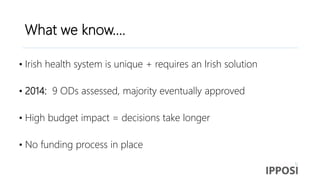
What we know….
• Irish health system is unique + requires an Irish solution
• 2014: 9 ODs assessed, majority eventually approved
• High budget impact = decisions take longer
• No funding process in place
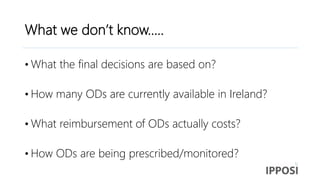
What we don’t know…..
• What the final decisions are based on?
• How many ODs are currently available in Ireland?
• What reimbursement of ODs actually costs?
• How ODs are being prescribed/monitored?
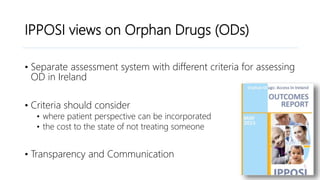
IPPOSI views on Orphan Drugs (ODs)
• Separate assessment system with different criteria for assessing
OD in Ireland
• Criteria should consider
• where patient perspective can be incorporated
• the cost to the state of not treating someone
• Transparency and Communication
Health Technology Assessment
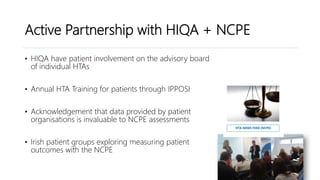
Active Partnership with HIQA + NCPE
• HIQA have patient involvement on the advisory board
of individual HTAs
• Annual HTA Training for patients through IPPOSI
• Acknowledgement that data provided by patient
organisations is invaluable to NCPE assessments
• Irish patient groups exploring measuring patient
outcomes with the NCPE
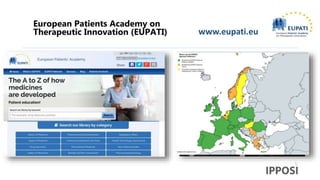
European Patients Academy on
Therapeutic Innovation (EUPATI) www.eupati.eu
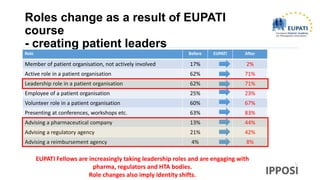
Roles change as a result of EUPATI
course
- creating patient leaders
Role Before EUPATI After
Member of patient organisation, not actively involved 17% 2%
Active role in a patient organisation 62% 71%
Leadership role in a patient organisation 62% 71%
Employee of a patient organisation 25% 23%
Volunteer role in a patient organisation 60% 67%
Presenting at conferences, workshops etc. 63% 83%
Advising a pharmaceutical company 13% 44%
Advising a regulatory agency 21% 42%
Advising a reimbursement agency 4% 8%
EUPATI Fellows are increasingly taking leadership roles and are engaging with
pharma, regulators and HTA bodies.
Role changes also imply identity shifts.
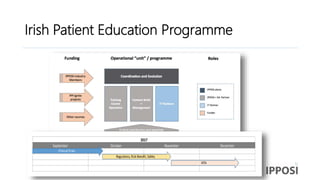
Irish Patient Education Programme
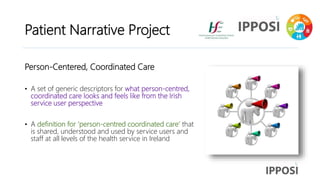
Patient Narrative Project
Person-Centered, Coordinated Care
• A set of generic descriptors for what person-centred,
coordinated care looks and feels like from the Irish
service user perspective
• A definition for ‘person-centred coordinated care’ that
is shared, understood and used by service users and
staff at all levels of the health service in Ireland

UCD Rare Disease Module 2017 - Dr Derick Mitchell - March 28th 2017

  • 1.
    PATIENTS – SCIENCE– INDUSTRY UCD Rare Disease Module, March 28th, 2017 Derick Mitchell, PhD
  • 2.
    Overview • Context • EnvironmentIPPOSI exists in / was created to address • IPPOSI – aims/objectives • Rare diseases in Ireland & Europe • Centres of Expertise – European Reference Networks • Orphan drugs & technologies • Your feedback
  • 3.
    May you livein changing times….
  • 4.
    Clara’s Story • Atbirth, Clara was diagnosed with Achondroplasia - a rare bone disease that no one knew about in the local hospital. • With no experts in the local area, Inés, Clara’s mum, became the expert, directing the medical teams • Clara had to go through months of countless exams and medical appointments • She had three surgeries, one of which was life threatening and possibly avoidable • Meanwhile, Inés had to cope with the worry, take numerous days off work and leave behind her 3 year-old son with his grandmother Slide courtesy of A. Daly, EURORDIS
  • 5.
    Patient‘s organisations have uniqueinsights in “real life“ and “real needs“ of patients: Clinical Research Design Priority Setting Research Policy Building a new environment for health care and research 5
  • 6.
    In a changingsystem - the two loops theory Trailblazers Protectors Firefighters Illuminators Platform
  • 7.
  • 8.
    IPPOSI? Who?IPPOSI A patient-ledorganisation that works with patients, government, industry, & science to put patients at the heart of health innovation
  • 9.
    IPPOSI Members (examples) 100+Patient Organisations 100+ Scientific/Regulatory/Agencies (200+ individuals) 20 Industry members
  • 10.
    Partnership Approach Other Stakeholders Patient Experts •Encourage open, constructive dialogue and interaction • Highlight value that patients can bring • Develop new opportunities for patients to influence decision-making
  • 11.
    Patient-led activities Health Hacks Workshops Conferences Consultations Round-tables WorkingGroups Training Days Rare Diseases eHealth Clinical Research Health Information Health Economics Patient Registries Biobanking
  • 12.
    Rare Diseases inEurope • Rare diseases in EU = 5 in 10,000 • 6-7,000 rare diseases found (Orphanet) • Up to 6% - 8% of EU population affected at one point in life = 30 million people in the EU are affected or will be affected by a Rare Disease • Republic of Ireland = 157,000 have a Rare Disease • 200,000 in the population yet to be diagnosed
  • 13.
    Rare Diseases inEuropean policy Early 2000s • Rare Diseases not a recognised as a public health priority and there were no public health policies for RD 2017 • EU regulations on medicines: orphan, paediatric, advanced therapies, (Regulation EC NO 141/2000) • EU Health Strategy (2008-2013): Rare Diseases = a strategic objective • EU Research FrameWork Programme (2007- 2013): RD = a priority • National Plans on Rare Diseases
  • 14.
    EU Council Recommendationon Action in the Field of Rare Diseases (June 2009) • This recommendation is important because it calls for concerted action at EU and national level in order to: • Ensure that rare diseases are adequately coded and classified • Enhance research in the field of rare diseases • Identify Centres of Expertise by the end of 2013 and foster their participation into European Reference Networks • Support the pooling of expertise at European level • Share assessments on the clinical added value of orphan drugs • Foster patient empowerment by involving patients and their representatives at all stages of the decision making process • Ensure the sustainability of infrastructures developed for rare diseases
  • 15.
    EU Committee ofExperts on Rare Diseases ‘EUCERD’ • Multi-stakeholder • Provided an opportunity to enhance the partnership between all rare disease stakeholders - patient representatives, academic experts, industry, national and European decision makers • Comprehensive • Provided the opportunity to discuss, promote and guide EU policy in all main fields of action relevant for rare diseases
  • 16.
    Rare Diseases inIreland • National Plan – Ireland 2014-2018 (published May 2015) • Patient Involvement – key to success • Member of the steering committee to develop the plan • IPPOSI Head of subgroup on Orphan Drugs • Member of the plan Implementation Oversight Committee • June 2015 • Launch of the National Rare Disease Office – Mater Hospital www.rarediseases.ie
  • 17.
  • 18.
    ADDRESSING THE NEED Integratedaction and collaboration The traditional short duration of contracts hampers the sustainability of research • Better coordination and better optimisation of research activities, including standards and tools, and research funding • Reinforced public funding both at the EU and national levels • In this framework, the potential of ERNs to embed and boost research activities should be exploited The lack of coordination in initiatives, tools and standards causes a waste of limited resources To better coordinate both policy and funding within a strategic framework To ensure the long-term continuity of research and limit the loss of precious funds Slide courtesy of A. Daly, EURORDIS
  • 19.
    HOW PATIENTS CANDELIVER Full involvement of expert & empowered patients as actors of research • co-funding, leveraging & private-public partnerships • identification of unmet research needs • gap analysis • definition of the research strategy • clinical trial design • identification of participants for clinical trials • source of data Slide courtesy of A. Daly, EURORDIS
  • 20.
    WHERE THERE ARECHALLENGES THERE ARE OPPORTUNITIES • Science has taken enormous steps over the last 10-15 years scientific and technological advances, mostly but not only limited to genetics  Opportunity to address societal and ethical questions that these advances raise, not least of all how to address the deepening of inequalities across countries & regions in access to results of scientific research, i.e. improved care & therapies • Cooperation in the field of research can bring about significant results as shown by voluntary initiatives such as E- Rare (funding), and IRDiRC  We need nhanced and structured cooperation in research • Full integration of ERNs into national healthcare systems. Creation of the ERNs that will pool of experts, patients, researchers:  Will enable the creation of Clinical Research Networks for Rare Diseases strategically aligned with the ERNs • Increasingly complex system in the field of rare disease research  Clustering training and capacity building activities aimed to patients but also to young scientists, clinicians etc. Slide courtesy of A. Daly, EURORDIS
  • 21.
    ERNs & ResearchInfrastructure 21 Always between a patient and a doctor in a hospital Data sharing is the key to unlock the potential of ERNs Optimising the use of existing knowledge Generating new knowledge Aiming for clinical excellence and improved patients outcomes Research Infrastructure Clinical Research Networks European Reference Networks Slide courtesy of A. Daly, EURORDIS
  • 22.
  • 23.
    What we know…. •Irish health system is unique + requires an Irish solution • 2014: 9 ODs assessed, majority eventually approved • High budget impact = decisions take longer • No funding process in place
  • 24.
    What we don’tknow….. • What the final decisions are based on? • How many ODs are currently available in Ireland? • What reimbursement of ODs actually costs? • How ODs are being prescribed/monitored?
  • 25.
    IPPOSI views onOrphan Drugs (ODs) • Separate assessment system with different criteria for assessing OD in Ireland • Criteria should consider • where patient perspective can be incorporated • the cost to the state of not treating someone • Transparency and Communication
  • 26.
  • 27.
    Active Partnership withHIQA + NCPE • HIQA have patient involvement on the advisory board of individual HTAs • Annual HTA Training for patients through IPPOSI • Acknowledgement that data provided by patient organisations is invaluable to NCPE assessments • Irish patient groups exploring measuring patient outcomes with the NCPE
  • 28.
    European Patients Academyon Therapeutic Innovation (EUPATI) www.eupati.eu
  • 29.
    Roles change asa result of EUPATI course - creating patient leaders Role Before EUPATI After Member of patient organisation, not actively involved 17% 2% Active role in a patient organisation 62% 71% Leadership role in a patient organisation 62% 71% Employee of a patient organisation 25% 23% Volunteer role in a patient organisation 60% 67% Presenting at conferences, workshops etc. 63% 83% Advising a pharmaceutical company 13% 44% Advising a regulatory agency 21% 42% Advising a reimbursement agency 4% 8% EUPATI Fellows are increasingly taking leadership roles and are engaging with pharma, regulators and HTA bodies. Role changes also imply identity shifts.
  • 30.
  • 31.
    Patient Narrative Project Person-Centered,Coordinated Care • A set of generic descriptors for what person-centred, coordinated care looks and feels like from the Irish service user perspective • A definition for ‘person-centred coordinated care’ that is shared, understood and used by service users and staff at all levels of the health service in Ireland

Editor's Notes

  • #6 Training required to get the expertise required to contribute to research & development projects
  • #9 A patient-led platform that provides a structured way of facilitating interaction between patients, government, industry, science and academia to put patients at the heart of policy and medicines development. In pursuit of this we hold workshops, discussion groups, training days and conferences on policy, legislation and regulation around the development of new medicines, products, devices and diagnostics for unmet medical needs.
  • #24 Ireland behind in facilitating access
  • #25 Across all hospital settings HSE guidelines for prescribing? How are they being monitored to ensure patient safety and quality healthcare?
  • #27 Health Information and Quality Authority (HIQA) official HTA agency HIQA conduct HTA’s on surgical/diagnostic/therapeutic interventions The National Centre for Pharmacoeconomics (NCPE) is tasked by HIQA and the Health Service Executive to perform assessments on Pharmaceutical Products
  • #28 HIQA have patient involvement on the advisory board of the particular HTA that they’re doing. And that’s a good example of patient involvement right the way through. And one of the outcomes from that is, it’s great to talk to us. You know, when you’re at that point where the HTA is nearly complete and a decision has to be made on access by the government to bring patients in. That’s very positive. List of products under NCPE rapid review available on IPPOSI website A lot of people see payers and the regulatory system were barriers. That’s historically been the case where patients not being engaged, or communicted to have gone on joe Duffy. So therefore, the expert patient – the one living with the condition – is really important to get into the process. We think it’s important for them to understand what health technology is about. We think it’s important for them to gather evidence to back up their views. You’ve really got to understand the process and follow it most carefully. We believe that the more opportunities patients get to engage, the more understanding that they have about being part of a very difficult and complex process. And one with which patients should engage in. And the more they engaged in it, the more they understand why the processes and agencies were there and the challenges that they faced themselves.