PATIENTS – SCIENCE – INDUSTRY
March 7th, 2017
Derick Mitchell, PhD
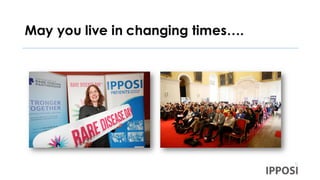
May you live in changing times….
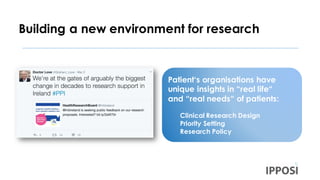
Patient‘s organisations have
unique insights in “real life“
and “real needs“ of patients:
Clinical Research Design
Priority Setting
Research Policy
Building a new environment for research
3
In a changing system - the two loops theory
Trailblazers
Protectors
Firefighters
Illuminators
Platform
IPPOSI? Who?IPPOSI
A patient-led organisation
that works with patients,
government, industry,
& science to put patients at
the heart of health innovation
Priorities
20
Actively advocate for improved + equitable
patient access to Health Innovation
Promote meaningful patient involvement in
Health Research and Policy
Patient-led activities
Health Hacks
Workshops
Conferences
Consultations
Round-tables
Working Groups
Training Days
Rare Diseases
eHealth
Clinical Research
Health Information
Health Economics
Patient Registries
Biobanking
Top 10 things we can do…
1. Stimulate research
2. Engage with patients and families
3. Focus on what matters rather than what can be counted
4. Need for partnership between patients, academics, across
stakeholders
5. Need appropriate protections and supports for patients and
families
Top 10 things we can do…
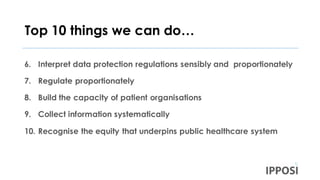
6. Interpret data protection regulations sensibly and proportionately
7. Regulate proportionately
8. Build the capacity of patient organisations
9. Collect information systematically
10. Recognise the equity that underpins public healthcare system
Practical “Roadmap” on patient involvement in R&D
Research design
and Planning
Design of Protocol
Informed Consent Study reporting
Post-study
communication
Patient Info
Leaflet
Trial steering committee
Investigators Meeting
Level	
  ofexpertise in	
  thedisease area required:
mediumhigh	
  	
  
Data Monitoring CommitteePractical
considerations
Health Technology
Assessment
Protocol
Synopsis
Research
priorities
Setting
research
priorities:
Information to
trial participants
Research conduct and
operations
Regulatory affairs
Dissemination,
communication,
post-approval
Source:	
  Geissler,	
  Ryll,	
  Leto,	
  Uhlenhopp
EPALCO/EUPATI	
  (2015,	
  unpublished)
Fundraising
for research
Ethics Review
Roles change as a result of EUPATI course
- creating patient leaders
Role Before EUPATI After
Member	
  of	
  patient	
  organisation,	
  not	
  actively	
  involved 17% 2%
Active	
  role	
  in	
  a	
  patient	
  organisation 62% 71%
Leadership	
  role in	
  a	
  patient	
  organisation 62% 71%
Employee	
  of	
  a patient	
  organisation 25% 23%
Volunteer role	
  in	
  a	
  patient	
  organisation 60% 67%
Presenting at	
  conferences,	
  workshops	
  etc. 63% 83%
Advising	
  a	
  pharmaceutical company 13% 44%
Advising	
  a	
  regulatory agency 21% 42%
Advising	
  a	
  reimbursement agency 4% 8%
EUPATI	
  Fellows	
  are	
  increasingly	
  taking	
  leadership	
  roles	
  and	
  are	
  engaging	
  with	
  
pharma,	
  regulators	
  and	
  HTA	
  bodies.	
  
Role	
  changes	
  also	
  imply	
  identity	
  shifts.
Everyone is different!
Patient Narrative Project
Person-Centered, Coordinated Care
• A set of generic descriptors for what person-
centred, coordinated care looks and feels like
from the Irish service user perspective
• A definition for ‘person-centred coordinated care’
that is shared, understood and used by service
users and staff at all levels of the health service in
Ireland
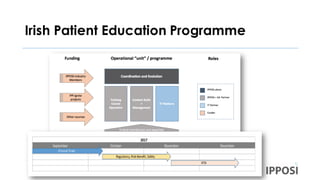
Irish Patient Education Programme
Researchers need support too
• Why?
• Understand PPI and where it can be most effective in their work
• Participation vs Engagement vs Involvement?
• How?
• Bring together PPI info + resources relevant to your research in one place
• Guidance on methodologies / practices
• How to ensure it is meaningful? - Planning + Preparing
• Who?
• Access people affected to be involved in your research
Take Home Messages
Patient involvement can improve research quality
Education + Training of both patients & researchers is key
Support patient networks, communities & spread the word!
@IPPOSI www.ipposi.ie

Irish Brain Council

  • 1.
    PATIENTS – SCIENCE– INDUSTRY March 7th, 2017 Derick Mitchell, PhD
  • 2.
    May you livein changing times….
  • 3.
    Patient‘s organisations have uniqueinsights in “real life“ and “real needs“ of patients: Clinical Research Design Priority Setting Research Policy Building a new environment for research 3
  • 4.
    In a changingsystem - the two loops theory Trailblazers Protectors Firefighters Illuminators Platform
  • 5.
    IPPOSI? Who?IPPOSI A patient-ledorganisation that works with patients, government, industry, & science to put patients at the heart of health innovation
  • 6.
    Priorities 20 Actively advocate forimproved + equitable patient access to Health Innovation Promote meaningful patient involvement in Health Research and Policy
  • 7.
    Patient-led activities Health Hacks Workshops Conferences Consultations Round-tables WorkingGroups Training Days Rare Diseases eHealth Clinical Research Health Information Health Economics Patient Registries Biobanking
  • 8.
    Top 10 thingswe can do… 1. Stimulate research 2. Engage with patients and families 3. Focus on what matters rather than what can be counted 4. Need for partnership between patients, academics, across stakeholders 5. Need appropriate protections and supports for patients and families
  • 9.
    Top 10 thingswe can do… 6. Interpret data protection regulations sensibly and proportionately 7. Regulate proportionately 8. Build the capacity of patient organisations 9. Collect information systematically 10. Recognise the equity that underpins public healthcare system
  • 10.
    Practical “Roadmap” onpatient involvement in R&D Research design and Planning Design of Protocol Informed Consent Study reporting Post-study communication Patient Info Leaflet Trial steering committee Investigators Meeting Level  ofexpertise in  thedisease area required: mediumhigh     Data Monitoring CommitteePractical considerations Health Technology Assessment Protocol Synopsis Research priorities Setting research priorities: Information to trial participants Research conduct and operations Regulatory affairs Dissemination, communication, post-approval Source:  Geissler,  Ryll,  Leto,  Uhlenhopp EPALCO/EUPATI  (2015,  unpublished) Fundraising for research Ethics Review
  • 11.
    Roles change asa result of EUPATI course - creating patient leaders Role Before EUPATI After Member  of  patient  organisation,  not  actively  involved 17% 2% Active  role  in  a  patient  organisation 62% 71% Leadership  role in  a  patient  organisation 62% 71% Employee  of  a patient  organisation 25% 23% Volunteer role  in  a  patient  organisation 60% 67% Presenting at  conferences,  workshops  etc. 63% 83% Advising  a  pharmaceutical company 13% 44% Advising  a  regulatory agency 21% 42% Advising  a  reimbursement agency 4% 8% EUPATI  Fellows  are  increasingly  taking  leadership  roles  and  are  engaging  with   pharma,  regulators  and  HTA  bodies.   Role  changes  also  imply  identity  shifts.
  • 12.
  • 13.
    Patient Narrative Project Person-Centered,Coordinated Care • A set of generic descriptors for what person- centred, coordinated care looks and feels like from the Irish service user perspective • A definition for ‘person-centred coordinated care’ that is shared, understood and used by service users and staff at all levels of the health service in Ireland
  • 14.
  • 15.
    Researchers need supporttoo • Why? • Understand PPI and where it can be most effective in their work • Participation vs Engagement vs Involvement? • How? • Bring together PPI info + resources relevant to your research in one place • Guidance on methodologies / practices • How to ensure it is meaningful? - Planning + Preparing • Who? • Access people affected to be involved in your research
  • 16.
    Take Home Messages Patientinvolvement can improve research quality Education + Training of both patients & researchers is key Support patient networks, communities & spread the word! @IPPOSI www.ipposi.ie