The project is receiving support from the Innovative Medicines Initiative Joint Undertaking under grant agreement n° 115334, resources of which are composed
of financial contribution from the European Union's Seventh Framework Programme (FP7/2007-2013) and EFPIA companies.
EUPATI 2014 Workshop, 2 April 2014, Warsaw
What do people think about medicines
research and development?
Bella Starling, Nowgen, United Kingdom
on behalf of Work Package Three of EUPATI
EUPATI needs assessment & gap analysis
• To identify and review existing information resources on
medicines R&D in selected European countries;
• To use quantitative and qualitative methods to find out
knowledge and attitudes towards medicines R&D amongst
health professionals, policy-makers, patients and the public;
• To provide a detailed analysis of the information needs of
professionals, patients and the public regarding medicines R&D,
including preferences for format and style of delivery.
Today: Focus on public audience findings
• To explore public
– Knowledge and awareness of medicines R&D
– Interest in learning more in medicines R&D
– Preferences for information formats and providers
• To explore key stakeholders’ perspectives on public
– Knowledge and awareness of medicines R&D
– Future interest in learning more about medicines R&D
What did we do?
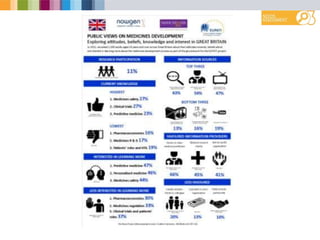
• Online survey of the general public
– Six European countries (UK, Spain, Poland, Italy, Germany and France)
– 6731 participants
– Largest ever survey of public attitudes to medicines R&D!
• Qualitative work
– Focus groups and interviews
– With patients and the public in the UK, Spain and Poland
– With key stakeholders (pharmaceutical industry, healthcare policy makers,
clinical research professionals, patient advocates) in the UK, Spain and
Poland and on a pan-European basis
– 210 participants in total
Current knowledge of medicines R&D
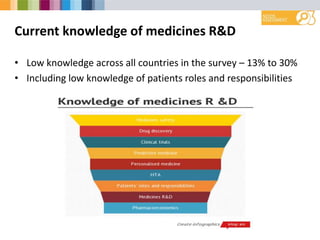
• Low knowledge across all countries in the survey – 13% to 30%
• Including low knowledge of patients roles and responsibilities
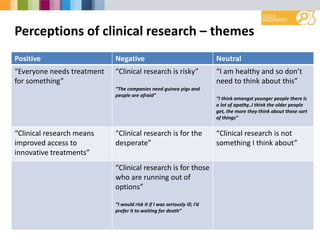
Perceptions of clinical research – themes
Positive Negative Neutral
“Everyone needs treatment
for something”
“Clinical research is risky”
“The companies need guinea pigs and
people are afraid”
“I am healthy and so don’t
need to think about this”
“I think amongst younger people there is
a lot of apathy..I think the older people
get, the more they think about these sort
of things”
“Clinical research means
improved access to
innovative treatments”
“Clinical research is for the
desperate”
“Clinical research is not
something I think about”
“Clinical research is for those
who are running out of
options”
“I would risk it if I was seriously ill; I’d
prefer it to waiting for death”
Public interest in medicines R&D
 Public interest levels regarding aspects of medicines R&D
were at most 50%
 Levels of trust in medicines R&D stakeholders vary – in
some countries, a ‘crisis of trust’ (cf. HoL Science &
Technology Committee 2000)
 Currently, people only likely to be interested if personal or
family experience of illness and/or medicines R&D
 Key roles for the doctor and/or healthcare practitioner
 Heavy influence of media
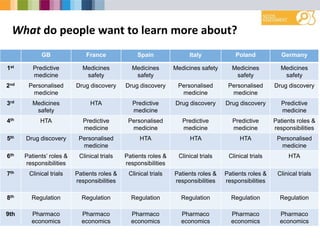
What do people want to learn more about?
GB France Spain Italy Poland Germany
1st Predictive
medicine
Medicines
safety
Medicines
safety
Medicines safety Medicines
safety
Medicines
safety
2nd Personalised
medicine
Drug discovery Drug discovery Personalised
medicine
Personalised
medicine
Drug discovery
3rd Medicines
safety
HTA Predictive
medicine
Drug discovery Drug discovery Predictive
medicine
4th HTA Predictive
medicine
Personalised
medicine
Predictive
medicine
Predictive
medicine
Patients roles &
responsibilities
5th Drug discovery Personalised
medicine
HTA HTA HTA Personalised
medicine
6th Patients’ roles &
responsibilities
Clinical trials Patients roles &
responsibilities
Clinical trials Clinical trials HTA
7th Clinical trials Patients roles &
responsibilities
Clinical trials Patients roles &
responsibilities
Patients roles &
responsibilities
Clinical trials
8th Regulation Regulation Regulation Regulation Regulation Regulation
9th Pharmaco
economics
Pharmaco
economics
Pharmaco
economics
Pharmaco
economics
Pharmaco
economics
Pharmaco
economics
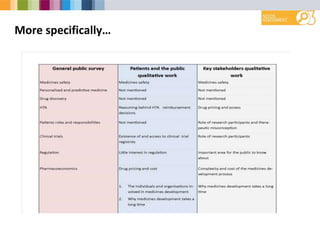
More specifically…
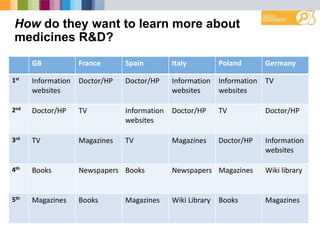
How do they want to learn more about
medicines R&D?
GB France Spain Italy Poland Germany
1st
Information
websites
Doctor/HP Doctor/HP Information
websites
Information
websites
TV
2nd
Doctor/HP TV Information
websites
Doctor/HP TV Doctor/HP
3rd
TV Magazines TV Magazines Doctor/HP Information
websites
4th
Books Newspapers Books Newspapers Magazines Wiki library
5th
Magazines Books Magazines Wiki Library Books Magazines
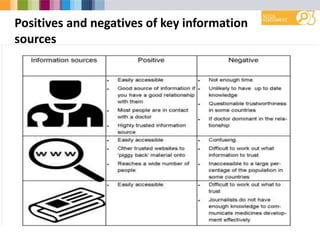
Positives and negatives of key information
sources
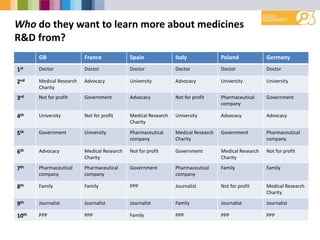
Who do they want to learn more about medicines
R&D from?
GB France Spain Italy Poland Germany
1st Doctor Doctor Doctor Doctor Doctor Doctor
2nd Medical Research
Charity
Advocacy University Advocacy University University
3rd Not for profit Government Advocacy Not for profit Pharmaceutical
company
Government
4th University Not for profit Medical Research
Charity
University Advocacy Advocacy
5th Government University Pharmaceutical
company
Medical Research
Charity
Government Pharmaceutical
company
6th Advocacy Medical Research
Charity
Not for profit Government Medical Research
Charity
Not for profit
7th Pharmaceutical
company
Pharmaceutical
company
Government Pharmaceutical
company
Family Family
8th Family Family PPP Journalist Not for profit Medical Research
Charity
9th Journalist Journalist Journalist Family Journalist Journalist
10th PPP PPP Family PPP PPP PPP
Next steps
How can EUPATI engage people with medicines R&D to enable
them to make informed choices about clinical research?
• Development of high-quality, impartial, honest and trusted
information in a variety of formats
• Via relevant and trusted ‘touch points’ for public audiences
• Thoughtful engagement to ‘drive’ or ‘tempt’ those who might be
less interested – including through National Liaison Teams
• Information tailored by country and health literacy levels
• Not public relations, rather starting a conversation to enable
informed choices & decision-making
What might public engagement with
medicines R&D focus on?
Suggestions from our research:
• What role does medicines R&D play in developing treatments?
• How long it takes to develop a new medicine and why?
• Who are the players involved in medicines development and
how do they work together?
• What are regulations? How do they monitor medicines R&D to
achieve greater medicines safety?
• How are medicines priced and how is access determined?
• That people (including patients) can play different roles in
medicines R&D (and aren’t just “guinea pigs” in research).
• Social and ethical considerations can effectively engage
audiences.
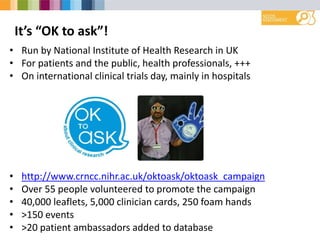
It’s “OK to ask”!
• Run by National Institute of Health Research in UK
• For patients and the public, health professionals, +++
• On international clinical trials day, mainly in hospitals
• http://www.crncc.nihr.ac.uk/oktoask/oktoask_campaign
• Over 55 people volunteered to promote the campaign
• 40,000 leaflets, 5,000 clinician cards, 250 foam hands
• >150 events
• >20 patient ambassadors added to database
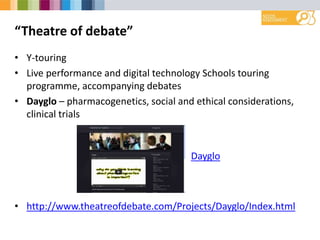
“Theatre of debate”
• Y-touring
• Live performance and digital technology Schools touring
programme, accompanying debates
• Dayglo – pharmacogenetics, social and ethical considerations,
clinical trials
• http://www.theatreofdebate.com/Projects/Dayglo/Index.html
Dayglo
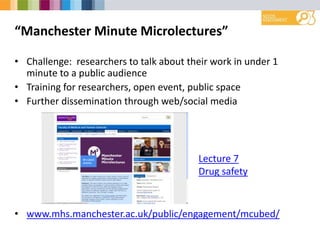
“Manchester Minute Microlectures”
• Challenge: researchers to talk about their work in under 1
minute to a public audience
• Training for researchers, open event, public space
• Further dissemination through web/social media
• www.mhs.manchester.ac.uk/public/engagement/mcubed/
Lecture 7
Drug safety
Work Package 3 team
• University of Manchester
• Bella Starling (WP3 lead), Suzanne Parsons (WP3 Project Manager), Su-Gwan
Tham (WP3 Project Assistant)
• GlaxoSmithKline
• Kay Warner (WP3 co-lead)
• Novo Nordisk
• Christine Mullan-Jensen (WP3 Deputy Co-lead)
• EGAN / GAUK
• Kim Wever, Celine Lewis
• Amgen, Genzyme, Roche, AstraZeneca, VFA
• Subcontractors:
• Poland: CEM Market and Public Opinion Research Institute, Krakow
• Spain: GFK Ad Hoc Emer Research, Madrid
19
Thank you!
• bella.starling@cmft.nhs.uk
• www.nowgen.org.uk
• www.mhs.manchester.ac.uk/public/cei/
@bellastarling

What do people think about medicines research and development? (Starling, EUPATI / Nowgen)

  • 1.
    The project isreceiving support from the Innovative Medicines Initiative Joint Undertaking under grant agreement n° 115334, resources of which are composed of financial contribution from the European Union's Seventh Framework Programme (FP7/2007-2013) and EFPIA companies. EUPATI 2014 Workshop, 2 April 2014, Warsaw What do people think about medicines research and development? Bella Starling, Nowgen, United Kingdom on behalf of Work Package Three of EUPATI
  • 2.
    EUPATI needs assessment& gap analysis • To identify and review existing information resources on medicines R&D in selected European countries; • To use quantitative and qualitative methods to find out knowledge and attitudes towards medicines R&D amongst health professionals, policy-makers, patients and the public; • To provide a detailed analysis of the information needs of professionals, patients and the public regarding medicines R&D, including preferences for format and style of delivery.
  • 3.
    Today: Focus onpublic audience findings • To explore public – Knowledge and awareness of medicines R&D – Interest in learning more in medicines R&D – Preferences for information formats and providers • To explore key stakeholders’ perspectives on public – Knowledge and awareness of medicines R&D – Future interest in learning more about medicines R&D
  • 4.
    What did wedo? • Online survey of the general public – Six European countries (UK, Spain, Poland, Italy, Germany and France) – 6731 participants – Largest ever survey of public attitudes to medicines R&D! • Qualitative work – Focus groups and interviews – With patients and the public in the UK, Spain and Poland – With key stakeholders (pharmaceutical industry, healthcare policy makers, clinical research professionals, patient advocates) in the UK, Spain and Poland and on a pan-European basis – 210 participants in total
  • 5.
    Current knowledge ofmedicines R&D • Low knowledge across all countries in the survey – 13% to 30% • Including low knowledge of patients roles and responsibilities
  • 6.
    Perceptions of clinicalresearch – themes Positive Negative Neutral “Everyone needs treatment for something” “Clinical research is risky” “The companies need guinea pigs and people are afraid” “I am healthy and so don’t need to think about this” “I think amongst younger people there is a lot of apathy..I think the older people get, the more they think about these sort of things” “Clinical research means improved access to innovative treatments” “Clinical research is for the desperate” “Clinical research is not something I think about” “Clinical research is for those who are running out of options” “I would risk it if I was seriously ill; I’d prefer it to waiting for death”
  • 7.
    Public interest inmedicines R&D  Public interest levels regarding aspects of medicines R&D were at most 50%  Levels of trust in medicines R&D stakeholders vary – in some countries, a ‘crisis of trust’ (cf. HoL Science & Technology Committee 2000)  Currently, people only likely to be interested if personal or family experience of illness and/or medicines R&D  Key roles for the doctor and/or healthcare practitioner  Heavy influence of media
  • 8.
    What do peoplewant to learn more about? GB France Spain Italy Poland Germany 1st Predictive medicine Medicines safety Medicines safety Medicines safety Medicines safety Medicines safety 2nd Personalised medicine Drug discovery Drug discovery Personalised medicine Personalised medicine Drug discovery 3rd Medicines safety HTA Predictive medicine Drug discovery Drug discovery Predictive medicine 4th HTA Predictive medicine Personalised medicine Predictive medicine Predictive medicine Patients roles & responsibilities 5th Drug discovery Personalised medicine HTA HTA HTA Personalised medicine 6th Patients’ roles & responsibilities Clinical trials Patients roles & responsibilities Clinical trials Clinical trials HTA 7th Clinical trials Patients roles & responsibilities Clinical trials Patients roles & responsibilities Patients roles & responsibilities Clinical trials 8th Regulation Regulation Regulation Regulation Regulation Regulation 9th Pharmaco economics Pharmaco economics Pharmaco economics Pharmaco economics Pharmaco economics Pharmaco economics
  • 9.
  • 10.
    How do theywant to learn more about medicines R&D? GB France Spain Italy Poland Germany 1st Information websites Doctor/HP Doctor/HP Information websites Information websites TV 2nd Doctor/HP TV Information websites Doctor/HP TV Doctor/HP 3rd TV Magazines TV Magazines Doctor/HP Information websites 4th Books Newspapers Books Newspapers Magazines Wiki library 5th Magazines Books Magazines Wiki Library Books Magazines
  • 11.
    Positives and negativesof key information sources
  • 12.
    Who do theywant to learn more about medicines R&D from? GB France Spain Italy Poland Germany 1st Doctor Doctor Doctor Doctor Doctor Doctor 2nd Medical Research Charity Advocacy University Advocacy University University 3rd Not for profit Government Advocacy Not for profit Pharmaceutical company Government 4th University Not for profit Medical Research Charity University Advocacy Advocacy 5th Government University Pharmaceutical company Medical Research Charity Government Pharmaceutical company 6th Advocacy Medical Research Charity Not for profit Government Medical Research Charity Not for profit 7th Pharmaceutical company Pharmaceutical company Government Pharmaceutical company Family Family 8th Family Family PPP Journalist Not for profit Medical Research Charity 9th Journalist Journalist Journalist Family Journalist Journalist 10th PPP PPP Family PPP PPP PPP
  • 14.
    Next steps How canEUPATI engage people with medicines R&D to enable them to make informed choices about clinical research? • Development of high-quality, impartial, honest and trusted information in a variety of formats • Via relevant and trusted ‘touch points’ for public audiences • Thoughtful engagement to ‘drive’ or ‘tempt’ those who might be less interested – including through National Liaison Teams • Information tailored by country and health literacy levels • Not public relations, rather starting a conversation to enable informed choices & decision-making
  • 15.
    What might publicengagement with medicines R&D focus on? Suggestions from our research: • What role does medicines R&D play in developing treatments? • How long it takes to develop a new medicine and why? • Who are the players involved in medicines development and how do they work together? • What are regulations? How do they monitor medicines R&D to achieve greater medicines safety? • How are medicines priced and how is access determined? • That people (including patients) can play different roles in medicines R&D (and aren’t just “guinea pigs” in research). • Social and ethical considerations can effectively engage audiences.
  • 16.
    It’s “OK toask”! • Run by National Institute of Health Research in UK • For patients and the public, health professionals, +++ • On international clinical trials day, mainly in hospitals • http://www.crncc.nihr.ac.uk/oktoask/oktoask_campaign • Over 55 people volunteered to promote the campaign • 40,000 leaflets, 5,000 clinician cards, 250 foam hands • >150 events • >20 patient ambassadors added to database
  • 17.
    “Theatre of debate” •Y-touring • Live performance and digital technology Schools touring programme, accompanying debates • Dayglo – pharmacogenetics, social and ethical considerations, clinical trials • http://www.theatreofdebate.com/Projects/Dayglo/Index.html Dayglo
  • 18.
    “Manchester Minute Microlectures” •Challenge: researchers to talk about their work in under 1 minute to a public audience • Training for researchers, open event, public space • Further dissemination through web/social media • www.mhs.manchester.ac.uk/public/engagement/mcubed/ Lecture 7 Drug safety
  • 19.
    Work Package 3team • University of Manchester • Bella Starling (WP3 lead), Suzanne Parsons (WP3 Project Manager), Su-Gwan Tham (WP3 Project Assistant) • GlaxoSmithKline • Kay Warner (WP3 co-lead) • Novo Nordisk • Christine Mullan-Jensen (WP3 Deputy Co-lead) • EGAN / GAUK • Kim Wever, Celine Lewis • Amgen, Genzyme, Roche, AstraZeneca, VFA • Subcontractors: • Poland: CEM Market and Public Opinion Research Institute, Krakow • Spain: GFK Ad Hoc Emer Research, Madrid 19
  • 20.
    Thank you! • bella.starling@cmft.nhs.uk •www.nowgen.org.uk • www.mhs.manchester.ac.uk/public/cei/ @bellastarling