Objective:
After going through this
lesson, students should be
able to explore one’s positive
and negative emotions and
how one expresses or hides
them.
Feelings and
Emotions
Worksheet
List different types or kinds of emotions you
have felt. Now, try to fill out the worksheet.
Categorize the emotions you just thought as
positive or negative. If you think a certain
emotion belongs to both, write it in both
columns.
Feelings and
Emotions
Worksheet
Experiencing both positive and
negative emotions is a natural part
of being human. The word
“negative” in the phrase “negative
emotions” may imply that these
emotions are unwanted, but this
does not necessarily mean that
those emotions are bad for us or
that we should not have them.
POSITIVE
EMOTIONS
Normal Natural Important
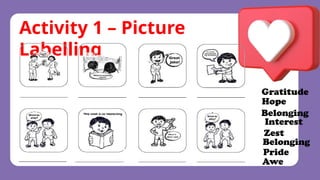
Activity 1 – Picture
Labelling
Gratitude
Hope
Zest
Awe
Belonging
Interest
Pride
Belonging
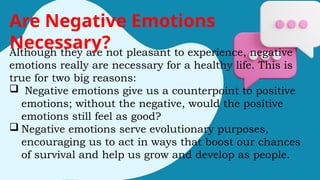
Although they are not pleasant to experience, negative
emotions really are necessary for a healthy life. This is
true for two big reasons:
 Negative emotions give us a counterpoint to positive
emotions; without the negative, would the positive
emotions still feel as good?
 Negative emotions serve evolutionary purposes,
encouraging us to act in ways that boost our chances
of survival and help us grow and develop as people.
Are Negative Emotions
Necessary?
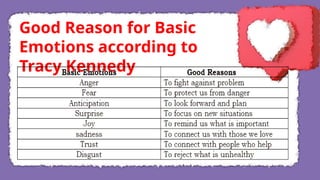
Good Reason for Basic
Emotions according to
Tracy Kennedy
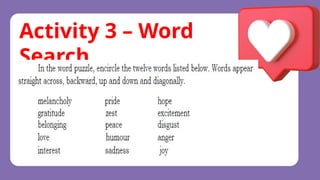
Activity 3 – Word
Search
Positive vs.
Negative Emotions:
A Look at the
Differences
Given the impact of positive and negative
emotions on our thoughts and behaviors,
it is easy to see why helpful thinking keeps
a close eye on negative emotions in
addition to the positive. As vital as it is for
us to learn how to boost our positive
emotions and take advantage of the
opportunities they bring, it is just as vital
to learn how to adapt from negative
emotions and cope with them effectively.
How Do They Affect the
Brain?
• They can increase our performance on a
knowledgeable task by lifting our spirits
without disrupting us like negative
emotions do (Iordan & Dolcos, 2017).
• Positive emotions may help us increase our
horizons and widen our brain’s scope of
focus (Fredrickson, 2001).
 Positive Emotions
How Do They Affect the
Brain?
• Facilitating emotional conflict processing,
helping us to make sense of conflicting
emotional information. In other words,
negative emotions can help us figure hard
emotional problems (Zinchenko et al.,
2015).
 Negative Emotions
How Do They Affect the
Brain?
• Facilitating cognitive conflict processing,
aiding us in comprehending dissimilar or
conflicting cognitive information. In other
words, negative emotions can also help us
make sense when we receive confusing
signals (Kanske & Kotz, 2010; 2011).
 Negative Emotions
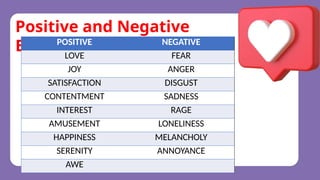
Positive and Negative
Emotions
POSITIVE NEGATIVE
LOVE FEAR
JOY ANGER
SATISFACTION DISGUST
CONTENTMENT SADNESS
INTEREST RAGE
AMUSEMENT LONELINESS
HAPPINESS MELANCHOLY
SERENITY ANNOYANCE
AWE
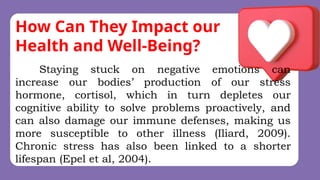
How Can They Impact our
Health and Well-Being?
Staying stuck on negative emotions can
increase our bodies’ production of our stress
hormone, cortisol, which in turn depletes our
cognitive ability to solve problems proactively, and
can also damage our immune defenses, making us
more susceptible to other illness (Iliard, 2009).
Chronic stress has also been linked to a shorter
lifespan (Epel et al, 2004).
Emotions play a big role in our life.
They are twenty- four hours active and alive
every day. It tells us what to do with our self,
family, job, career, and how we love others.
That is where we experience most differently
the positive and the negative emotions. If we
are unable to control the course that our
emotions run, we might as well be heading
down the road towards destruction that is
the reason why we need to manage and
control our emotions.
M
D
L

8.1-Positive-and-Negative-Emotions.personal development

  • 2.
    Objective: After going throughthis lesson, students should be able to explore one’s positive and negative emotions and how one expresses or hides them.
  • 3.
    Feelings and Emotions Worksheet List differenttypes or kinds of emotions you have felt. Now, try to fill out the worksheet. Categorize the emotions you just thought as positive or negative. If you think a certain emotion belongs to both, write it in both columns.
  • 4.
  • 5.
    Experiencing both positiveand negative emotions is a natural part of being human. The word “negative” in the phrase “negative emotions” may imply that these emotions are unwanted, but this does not necessarily mean that those emotions are bad for us or that we should not have them.
  • 6.
  • 7.
    Activity 1 –Picture Labelling Gratitude Hope Zest Awe Belonging Interest Pride Belonging
  • 8.
    Although they arenot pleasant to experience, negative emotions really are necessary for a healthy life. This is true for two big reasons:  Negative emotions give us a counterpoint to positive emotions; without the negative, would the positive emotions still feel as good?  Negative emotions serve evolutionary purposes, encouraging us to act in ways that boost our chances of survival and help us grow and develop as people. Are Negative Emotions Necessary?
  • 9.
    Good Reason forBasic Emotions according to Tracy Kennedy
  • 10.
    Activity 3 –Word Search
  • 12.
    Positive vs. Negative Emotions: ALook at the Differences
  • 13.
    Given the impactof positive and negative emotions on our thoughts and behaviors, it is easy to see why helpful thinking keeps a close eye on negative emotions in addition to the positive. As vital as it is for us to learn how to boost our positive emotions and take advantage of the opportunities they bring, it is just as vital to learn how to adapt from negative emotions and cope with them effectively.
  • 14.
    How Do TheyAffect the Brain? • They can increase our performance on a knowledgeable task by lifting our spirits without disrupting us like negative emotions do (Iordan & Dolcos, 2017). • Positive emotions may help us increase our horizons and widen our brain’s scope of focus (Fredrickson, 2001).  Positive Emotions
  • 15.
    How Do TheyAffect the Brain? • Facilitating emotional conflict processing, helping us to make sense of conflicting emotional information. In other words, negative emotions can help us figure hard emotional problems (Zinchenko et al., 2015).  Negative Emotions
  • 16.
    How Do TheyAffect the Brain? • Facilitating cognitive conflict processing, aiding us in comprehending dissimilar or conflicting cognitive information. In other words, negative emotions can also help us make sense when we receive confusing signals (Kanske & Kotz, 2010; 2011).  Negative Emotions
  • 17.
    Positive and Negative Emotions POSITIVENEGATIVE LOVE FEAR JOY ANGER SATISFACTION DISGUST CONTENTMENT SADNESS INTEREST RAGE AMUSEMENT LONELINESS HAPPINESS MELANCHOLY SERENITY ANNOYANCE AWE
  • 18.
    How Can TheyImpact our Health and Well-Being? Staying stuck on negative emotions can increase our bodies’ production of our stress hormone, cortisol, which in turn depletes our cognitive ability to solve problems proactively, and can also damage our immune defenses, making us more susceptible to other illness (Iliard, 2009). Chronic stress has also been linked to a shorter lifespan (Epel et al, 2004).
  • 19.
    Emotions play abig role in our life. They are twenty- four hours active and alive every day. It tells us what to do with our self, family, job, career, and how we love others. That is where we experience most differently the positive and the negative emotions. If we are unable to control the course that our emotions run, we might as well be heading down the road towards destruction that is the reason why we need to manage and control our emotions.
  • 20.

Editor's Notes

  • #5 most people would rather choose a positive emotion over a negative one. It is likely you would prefer to feel happy than to feel sad or be confident than be insecure. But always experiencing favorable emotions over less favorable ones is not what matters. It is still important to have balance in both
  • #6 Having plenty of positive emotions everyday can help our well – being in dealing in our everyday situation. Scientists have discovered that we should have at least 3 positive emotions to balance 1 negative emotion.
  • #13 When we accept, embrace, and act both our positive and our negative emotions, we give ourselves the best chance to live a balanced, meaningful life.
  • #18 It’s not the negative emotions that directly impact our health and well-being, but it is on how we react and process them.