* GB780193 (A)
Description: GB780193 (A) ? 1957-07-31
Phenthiazine derivatives and processes for the preparation
Description of GB780193 (A)
A high quality text as facsimile in your desired language may be available
amongst the following family members:
BE535922 (A) CH338457 (A) DE1037461 (B) FR1167627 (A)
NL89749 (C) US2902485 (A) BE537689 (A) CH338460 (A)
CH338461 (A) CH339205 (A) CH339206 (A)
BE535922 (A) CH338457 (A) DE1037461 (B) FR1167627 (A)
NL89749 (C) US2902485 (A) BE537689 (A) CH338460 (A)
CH338461 (A) CH339205 (A) CH339206 (A) less
Translate this text into Tooltip
[98][(1)__Select language]
Translate this text into
The EPO does not accept any responsibility for the accuracy of data
and information originating from other authorities than the EPO; in
particular, the EPO does not guarantee that they are complete,
up-to-date or fit for specific purposes.
PATENT SPECIFICA LION
Inventor: RAYMOND JACQUES HORCLOIS 780,193
Date of filing Complete Specification (under Section 3 (3) of the
Patents
Act, 1949): Jan. 21, 1955.
Application Date: April 27, 1954.
Application Date: July I, 1954.
No. 12225/54.
No. 19366/54.
 -;..%/ Complete Specification Published: July 31, 1957.
idex at acceptance: -Class 2(3), B4(Al: E: H: K: L: M), Cl(AX: B6),
C1E3K(4: 8), ClE6K(4:
8), C1G5B, C1G6B(3:4:5:6), C2B37C(1:2), C3A7(A4:C:El:K2),
C3AlOE(3Dl:5E), C3A13A3(A4:BI:L), C3A13C(lC:2C:3C:4C: 6C:
1OF: lOH), C3A14A(3D: 8A).
aternational Classification:-C07d.
COMPLETE SPECIFICATION
Phenthiazine Derivatives and processes for their preparation ERRATA
SPECIFICATION NO. 780,193
Page 3, line 65, for "d =" read nd =11 Page 3, line 79, after
"chloroethyl)" insertPage 14, lines 66 and 81, for "2560C" read "265
C', Page 14, line 88, for "process" read "processes" Page 15, line 60,
for "these" read "those" Page 15, line 62, after "chloro" insert "-"
Page 15, line 114, for "phenyhthiazinylethyl" read
"phenthiazinylethyl" Page 16, line 13, for "carbonzyloxy" read
"carbobenzyloxy" Page 16, line 92, after "(2'" insert "-" Page 17,
line 6, after "(3'" insert "-N"I Page 17, line 13, for "13.5" read
"3:5" THE PATENT OFFICE, 27th October, 1960 prciauiy,l -...........
pcsition, the phenthiazine ring may contain substituents additional to
Y and Y, and one or more of the carbon atoms of the piperazine ring
may carry a substituent in the form of a mrthyl group. It should be
understood that the term "lower alkyl" when used in this specification
and in the appended claims means an alkyl _ _., DS 81597/1(27)/8482
200 10/60 DL piperazine ring may carry a substituent in the formi of a
methyl group and the phenthiazine ring may contain substituents
additional to Y and/or Y1. Where either or both of the said starting
materials contain one or more "convertible" groups as hereinafter
defined, the process includes the step or steps of transr PATENT
SPECIFICA rION Inventor: RAYMOND JACQUES HORCLOIS 780,193 Date of
filing Complete Specification (under Section 3 (3) of the Patents
Act, 1949): Jan. 21, 1955.
Application Date: April 27, 1954.
Application Date: July 1, 1954.
No. 12225/54.
No. 19366/54.
Complete Specification Published: July 31, 1957.
Index at acceptance: -Class 2(3), B4(A1: E: H: K: L: M), C1 (AX: B6),
C1E3K(4: 8), C1E6K(4:
8), C1G5B, C1G6B(3:4:5:6), C2B37C(1:2), C3A7(A4:C:El:K2),
C3AlOE(3D1:5E), C3A13A3(A4: BI: L), C3A13C(lC:2C:3C:4C: 6C:
1OF: 1OH), C3A14A(3D: 8A).
International Classification:-C07d.
COMPLETE SPECIFICATION
Phenthiazine Derivatives and processes for then- pre,:. -ration We,
SOCIETE DES USINES CHIMIQUES RHONE-POULENC, a French Body Corporate,
of 21 rue Jean-Goujon, Paris, France, do hereby declare the invention
for which we pray that a patent may be granted to us, and the method
by which it is to be performed, to be particularly described in and by
the following statement: -
This invention relates to new phenthiazine derivatives of value as
therapeutic agents and/ - or as intermediates for the production of
such agents. It also concerns processes for the preparation of said
derivatives.
The new compounds of the present inven-.
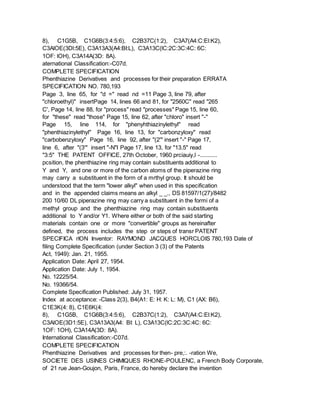
tion are these containing the structure:
S A -NN_- R_ and include not only the bases conforming to this formula
but also the corresponding acid addition and quaternary ammonium salts
and addition compounds (such for example as those formed between the
bases: and 8-chlorotheophylline). In, the foregoing formula, A
represents a divalent saturated aliphatic hydrocarbon radical with a
straight or branched chain containing from: 2 to 6 carbon atoms, R1
represents a hydrogen atom or a lower alkyl or an aryl or araliphatic
group, Y and Y, are respectively a hydrogen or halogen atom or a lower
alkyl, alkoxy or aryl or aryloxy group, preferably (in the case of Y)
in the 1- or 3position, the phenthiazine ring may contain substituents
additional to Y and Y1 and one or more of the carbon, atoms of the
piperazine ring may carry a substituent in the form of a me<thyl
group. It should be understood that the term "lower alkyl" when. used
in this specification and in the appended claims means an alkyl group
containing not more than 6 and preferably not more than 4 carbon
atoms.
These new compounds may be prepared in a variety of different ways, of
which the more important can be expressed generically as comprising
the interaction of a' phenthiazine compound having a structure
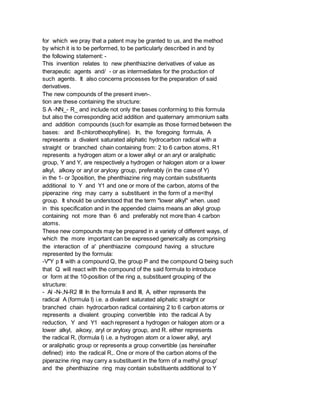
represented by the formula:
-V"Y p II with a compound Q, the group P and the compound Q being such
that Q will react with the compound of the said formula to introduce
or form at the 10-position of the ring a, substituent grouping of the
structure:
- Al -N-,N-R2 III In the formula II and III, A, either represents the
radical A (formula I) i.e. a divalent saturated aliphatic straight or
branched chain hydrocarbon radical containing 2 to 6 carbon atoms or
represents a divalent grouping convertible into the radical A by
reduction, Y and Y1 each represent a hydrogen or halogen atom or a
lower alkyl, aikoxy, aryl or aryloxy group, and R. either represents
the radical R, (formula I) i.e. a hydrogen atom or a lower alkyl, aryl
or araliphatic group or represents a group convertible (as hereinafter
defined) into the radical R,. One or more of the carbon atoms of the
piperazine ring may carry a substituent in the form of a methyl group'
and the phenthiazine ring may contain substituents additional to Y
and/or Y1. Where either or both of the said starting materials contain
one or more "convertible" groups as hereinafter defined, the process
includes the step, or steps of transforming the convertible group or
groups into the desired final atom and/or group.
Spzcific embodiments of the generic process defined in the last
preceding paragraph are as follows: (I- interaction of a phenthiazine
of the general formula:
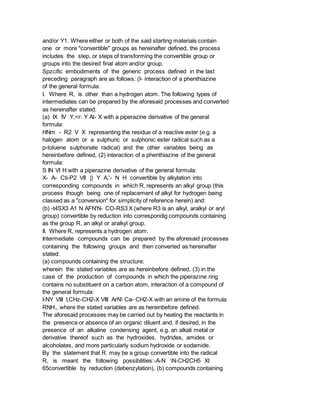
I. Where R, is other than a hydrogen atom. The following types of
intermediates can be prepared by the aforesaid processes and converted
as hereinafter stated:
(a) IX IV Y,<r: Y Al- X with a piperazine derivative of the general
formula:
HNm - R2 V X representing the residue of a reactive ester (e.g. a
halogen atom or a sulphuric or sulphonic ester radical such as a
p-toluene sulphonate radical) and the other variables being as
hereinbefore defined, (2) interaction of a phenthiazine of the general
formula:
S IN VI H with a piperazine derivative of the general formula:
X- A- Cti-P2 VII |) Y A,'- N H convertible by alkylation into
corresponding compounds in which R, represents an alkyl group (this
process though being one of replacement of alkyl for hydrogen being
classed as a "conversion" for simplicity of reference herein) and:
(b) -t4SX3 A1 N AFN'N- CO-RS3 X (where R3 is an alkyl, aralkyl or aryl
group) convertible by reduction into correspondig compounds containing
as the group R, an alkyl or aralkyl group.
II. Where R, represents a hydrogen atom.
Intermediate compounds can be prepared by the aforesaid processes
containing the following groups and then converted as hereinafter
stated:
(a) compounds containing the structure:
wherein the stated variables are as hereinbefore defined, (3) in the
case of the production of compounds in which the piperazine ring
contains no substituent on a carbon atom, interaction of a compound of
the general formula:
I-NY VIII I,CHz-CH2-X VIII ArN Ca- CH2-X with an amine of the formula
RNH., where the stated variables are as hereinbefore defined.
The aforesaid processes may be carried out by heating the reactants in
the presence or absence of an organic diluent and, if desired, in the
presence of an alkaline condensing agent, e.g. an alkali metal or
derivative thereof such as the hydroxides, hydrides, amides or
alcoholates, and more particularly sodium hydroxide or sodamide.
By the statement that R. may be a group convertible into the radical
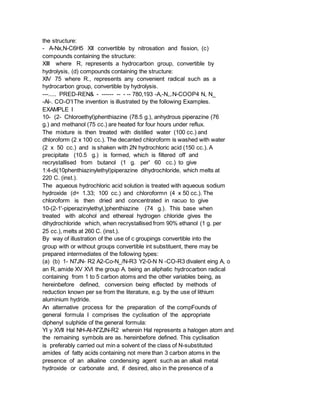
R, is meant the following possibilities:-A-N N-CH2CH5 XI
65convertible by reduction (debenzylation), (b) compounds containing
the structure:
- A-Nx,N-C6H5 XII convertible by nitrosation and fission, (c)
compounds containing the structure:
XIII where R, represents a hydrocarbon group, convertible by
hydrolysis, (d) compounds containing the structure:
XIV 75 where R., represents any convenient radical such as a
hydrocarbon group, convertible by hydrolysis.
---..... PRED-REN& - ------ -- - -- 780,193 -A,-N,,.N-COOP4 N, N_
-Al-. CO-O'IThe invention is illustrated by the following Examples.
EXAMPLE I
10- (2- Chloroethyl)phenthiazine (78.5 g.), anhydrous piperazine (76
g.) and methanol (75 cc.) are heated for four hours under reflux.
The mixture is then treated with distilled water (100 cc.) and
dhloroform (2 x 100 cc.). The decanted chloroform is washed with water
(2 x 50 cc.) and is shaken with 2N hydrochloric acid (150 cc.). A
precipitate (10.5 g.) is formed, which is filtered off and
recrystallised from butanol (1 g. per' 60 cc.) to give
1:4-di(10phenthiazinylethyl)piperazine dihydrochloride, which melts at
220 C. (inst.).
The aqueous hydrochloric acid solution is treated with aqueous sodium
hydroxide (d= 1.33; 100 cc.) and chloroformn (4 x 50 cc.). The
chloroform is then dried and concentrated in racuo to give
10-(2-1'-piperazinylethyl,)phenthiazine (74 g.). This base when
treated with alcohol and ethereal hydrogen chloride gives the
dihydrochloride which, when recrystallised from 90% ethanol (1 g. per
25 cc.), melts at 260 C. (inst.).
By way of illustration of the use of c groupings convertible into the
group with or without groups convertible int substituent, there may be
prepared intermediates of the following types:
(a) (b) 1- N7JN- R2 A2-Co-N_/N-R3 Y2-0-N N -CO-R3 divalent eing A, o
an R, amide XV XVI the group A. being an aliphatic hydrocarbon radical
containing from 1 to 5 carbon atoms and the other variables being, as
hereinbefore defined, conversion being effected by methods of
reduction known per se from the literature, e.g. by the use of lithium
aluminium hydride.
An alternative process for the preparation of the compFounds of
general formula I comprises the cyclisation of the appropriate
diphenyl sulphide of the general formula:
YI y XVII Hal NH-At-N"ZJN-R2 wherein Hal represents a halogen atom and
the remaining symbols are as. hereinbefore defined. This cyclisation
is preferably carried out min a solvent of the class of N-substituted
amides of fatty acids containing not mere than 3 carbon atoms in the
presence of an alkaline condensing agent such as an alkali metal
hydroxide or carbonate and, if desired, also in the presence of a
dehydrohalogenation catalyst such as copper powder. When either or
both of' A and R, represents a "convertible" group, the process
includes the subsequent step or steps of conversion to A and/or R,
respectively.
The new compounds of the present invention containing a structure
conforming to formula I possess interesting pharmacodynamic
properties; in particular, they have been found to be, very active
anti-epileptics and anti-emetics. In consequence they have application
in human or veterinary medicine.
Especially outstanding utility as anti-emetic agents is possessed by
those of the said comnpounds in which Y represents a hydrogen or
chlorine atom m the 3-position, Y1 represents a hydrogen atom, A
represents -(CH),-, R, represents a hydrogen atom or a methyl or ethyl
group, and the piperazine ring is either unsubstituted or is
substituted by a methyl group.
C0 EXAMPLE II
Phenthiazine (10 g.) is converted to the 75 sodium derivative by
treatment with sodamide (2.25 g.) in xylene (75 cc.) and the product
is condensed with a solution in xylene of 1-(2chloroethyl) 4 -
benzyloxycarbonylpiperazine obtained from the corresponding
hydrochloride 80 (16 g.).
By treatment of the solution with water (100 cc.), extraction with 2N
hydrochloric acid (2 x 50 cc.), treatment with aqueous sodium
hydroxide, extraction with chloroform and 85 preparation of the
hydrochloride, there is obtained directly thez same dihydrochloride of
- (2 - 11 - piperazinylethyl)-phenthiazine as described in Example I.
1 - (2 - Chloroathyl) - 4-benzyloxycarbonylpiperazine hydrochloride,
m.p. 130-132 C.
(inst.), is obtained by the action of' thionyl chloride upon
1-(2-hydroxyethyl)-4-benzyloxycarbonylpiperazine hydrochloride in
benzene.
1 - (2 - Hydroxyethyl) - 4-benzyloxycarbonylpiperazine, b.p. 286-288
G./1 mm.Hg., is obtained by condensing ethylene oxide with
1-benzyloxycarbonylpiperazine in methanol.
EXAMPLE II1
10-(2-Chloroethyl)phenthi'azine (10.5 g.) is 100 heated for 4 to 5
hours at 1800 C. with 1ethylpiperazine (22.8 g.). After cooling, water
(25 cc.) is added and the m!ixture is extracted with ether (2 x 25
cc.). The ethereal solution is shaken with a nmormlal solution of
hydrochloric acid (60 cc.), the acidic layer is decanted and treated
with concentrated sodium hydroxide solution (15 cc.). The base is
extracted with ether (2 x 20 cc.) and the extract dried over sodium
sulphate. Concentration in vacuo yields
10-(2-41-ethyl-llpiperazinylethyl)phenthiazine (11.4 g-), m.p.
780,193 (inst.) 72' C. The picrate of this base melts at 260 C.
(inst.).
10- (2-4'-Ethyl-1'-piperazinylethyl)phenthiazine (2 g.) is heated for
two hours under reflux with methyl iodide (10 cc.). The excess methyl
iodide is distilled off and the residual resin is dissolved in water
(10 cc.). The solution is treated with charcoal, filtered and
evaporated in vacuo at 205 C. The residue is recrystallised from 90-:
ethanol (50 cc.) to give
10-(2-4-ethyl-l'-piperazinylethyl)phenthiazine dimethiedide (2.8 g.)
which melts at 240= C. (inst.).
EXAMPLE IV
Proceeding as in Example III but commencing with
10-(2-chloroethyl)-phenthiazine (5.25 g.) and 1-methylpiperazine (10
g.), 10(2 - 4'-methyl-l'-piperazinylethyl)phenthiazine (5.6g.) is
obtained in the form of a viscous:
resin. The picrate of this base melts at 2650 C.
(inst.).
EXAMPLE V
Commencing with 10-(2-chloroethyl)phenthiazine (5.25 g.) and
1-benzylpiperazine (15.5 g.) there is obtained
10-(24-benzyl-l-piperazinylethyl)phenthiazine (8 g.), which is then
treated with ethanol and ethereal hydrogen chloride to give the
dihydrochloride which, on recrystallisation from water (1 g. per 7
cc.), melts at 2300 C. (inst.).
EXAMPLE VI
Commencing with 10-(2-chloroethyl)phenthiazine (5.25 g.) and
1-phenylpiperazine (16.2 g.) a monohydrochloride (6.5 g.) is obtained
which is then recrystallised from a mixture of dimethylformamide and
water (1 g. per 20 cc.
of dimnethylformamide and 10 cc. cf wa er).
The 10-(2-4'-phenyl-1l-piperazinylethyl)phenthiazinz monohydrochloride
thus obtined melts at 2450 C. (inst.).
EXAMPLE VII
Proceeding as in Example III but commencing with
10-(2-chloroethyl)-phenthiazine (5.25 g.) and 2:3:4:5:
6-pentamethy'liperazine (15.6 g.), there is obtained 10-(2-2':31:
41: 51:6 - pentamethyl - 1' - ip erazinylethyl) phenthiazine (5.2 g.)
as a viscous resin. The picrate of this base melts at 2280 C. (inst.).
EXAMPLE VIII
Proceeding as in Example III but commencing with
10-(3-chloropropyl)-phenthiazine (11 g.) and 1-ethylpiperazine (22.8
g.), 10-(3-4'ethyl-l'-piperazinylpropyl)phenthiazine is obtained, m.p.
(inst.) 520 C. The picrate of this base melts at 2580 C. (inst.).
EXAMPLE IX
Proceeding as in Example III but commncing with
10-(3-chlorcprcpyl)-phenthiazine (5.5 g.) and 4-ethyl-2: 3: 5:
6-tetramethylpip erazine (5.1 g.), there is obtained
10-(3-41-ethyl-21:
31: 51: 6 - tetramethyl - 1 - piperazinylpropyl)phenthiazine (3 g.) as
a viscous resin. The picrate of this base melts at 158 C. (inst.).
EXAMPLE X
Proceeding as in Example I but commencing with
10-(2-chloropropyl)-phenthiazine (11 g.) and 1-ethylpiperazine (21
g.), 10-(2-4-ethyll'-piperazinylpropyl)phenthiazine (7.5 g.) is
obtained, m.p. (inst.) 68 C. The picrate of this base melts at 250 C.
(inst.).
EXAMPLE XI
10-(2-Chloropropyl)phenthiazine (5.5 g.) is heated for 5 hours at 200
C. with 1-phenylpiperazine (16.2 g.). The mixture is treated with
water (50 cc.) and with ether (50 cc.
followed by 20 cc.). The ethereal solutions are agitated with 7%(
hydrochloric acid (50 cc.) and a feebly soluble hydrochloride (4.5 g.)
is obtained which is recrystallised from a 70% aqueous solution of
dimethylformamide (50 cc.). 10- (2 - 4' - Phenyl-l'-piperazinylpropyl)
phenthiazine mcnohydrochloride (3.5 g.) is obtained, m.p. 2450 C.
(inst.).
EXAMPLE XII
3-Chlorophenthiazine (9.3 g.) is converted to the sodium derivative
with sodamide (2 g.) in xylene (75 cc.). The product is condensed with
1-(2-chloroethyl)-4-rmethylpiperazine (8 g.) in solution (45 cc.) in
xylene by boiling for five hours.
3-Chloro-10-(24x'-methyl-1'piperazinylethyl)phenthiazine
dihydrochlioride (14.5 g.) is then obtained by the usual treatment,
and may be recrystallised from absolute ethanol (1 g. per 10 cc.). The
dihydrochloride melts at 253-255: C. (inst.).
1 - (2 - Chloroethyl) - 4-methylpiperazine dihydrochloride, m.p. 265
C. (inst.), is obtained by the action of thionyl chloride upon
1-(2hydrexyethyl)-4-methylpiperazine in chloroform.
EXAMPLE XIII
3 - Chloro-10-(3-chloropropyl)phenthiazine (27 g.) is heated for 5
hours under reflux on the water-bath with anhydrous piperazine (22.4
g.) and methanol (25 cc.). The mixture 105 is then treated with water
(100 cc.) and chloroform (100 cc.), the chloroform solution is shaken
with N hydrochloric acid (100 cc.) and the acid solution is made
alkaline with sodium hydroxide (d-= 1.33, 50 cc.). On 110 extraction
with chloroform (2 x 50 cc.), the base (15.2 g.) is obtained and is
treated with mraleic acid (10 g.) and ethyl acetate (200 cc.).
The maleate is recrystallised from ethanol (750 cc.) and
3-chloro-10-(3-1'-piperazinylpropyl)phenthiazine di-acid maleate (18
g.) is obtained, m.p. 186 C. (inst.).
EXAMPLE XIV
3-(3-Chloro-10-phenthiazinyl)propyl p-toluenesulphonate (20 g.) is
heated under reflux 120 for 5 hours with anhydrous piperazine (11.6
g.) and m:thanol (35 cc.). The mixture is treated with water (35 cc.)
and chloroform (70 cc.) and the chloroform., solution is agitated with
10 ' hydrochloric acid (50 cc.). The acid solution is made alkaline
with sodium hydroxide (d = 1.33, 50 cc.) and the base is extracted
with chloroform (50 cc.). The base (6.5 g.) is treated with maleic
acid (5 g.) and ethyl acetate (100 cc.). 3 - Chloro - 10 - (3-I -
piperazinylpropyl) 130 780,193 melts at 265 C. (inst.).
The base when treated with ethanol and ethereal hydrogen chloride
gives the dihydrochloride which is recrystallised from absolute
ethanol (1 g. per 25 cc.). The dihydrochloride 70 melts at 220 C.
(inst.).
3 - Chloro - 10 - (3-4'-ethyl-l'-piperazinylpropyl)phenthiazine (1.2
g.) is heated with ethyl iodide (10 cc.) for two hours under reflux.
The mixture is concentrated on the 75 water-bath and the resin
obtained is dissolved in water (10 cc.). On cooling, a crystalline
product (1.5 g.) is obtained, which is, then recrystallised from 80%
ethanol (25 cc.) to give 3 - chloro - 10 -
(3-4-ethyl-l'-piperazinylpropyl)phenthiazine diethiodide (0.8 g.),
m.p.
260 C. (inst.).
By treating 3-chloro-10-(3-4'-ethyl-ll-piperazinylpropyl)phenthiazine
(3.4 g.) with theophylline acetic acid (4 g.) and ethanol (15 cc.), 85
3 - chloro-10-(3-4-,ethyl-l-pip-razinylpropyl) phenthiazine
di-theophylline acetate (7.4 g.) is obtained which is water-soluble
and melts at 100 C. (inst.) (not sharp).
3 - Chloro - 10 - (34-ethyl-l'-piperazinylpropyl)phentbiazine (2 g.)
is heated for 2 hours under reflux with 8-chlerotheophylline (1.6 g.)
in mlethylethylketone (9 cc.) and water (1 cc.).
The solution is concentrated and then treated with ethanol (10 cc.).
The solutiorn crystallises 95 slowly and
3-chloro-10-(3-41-ethyl-ll-piperazinylpropyl)phenthiazine di - 8 -
chlorotheophyllinate (2.3 g.) is obtained, m.p. 1850 C.
(inst.):
3 - Chioro - 10 - (3-4'-ethyl-l'-piperazinylpropyl)phenthiazine (2 g.)
is heated for 1 hours tander reflux with methyl iodide (3 g.) and
acetone (10 cc.). The mixture is coneentrated,-dissolved in water,
filtered and dried in vacua at 200 C. and the product is
recrystallised from methanol (10 cc.).
3-Chloro-10-(34'-ethyl-l'-piperazinylpropyl)phenthiazine dimnethiodide
(0.6 g.) is obtained, m.p. 260265 C.<tinst.).
EXAMPLE XVIII 110 Proceeding as in Example III but commencing with
3-chloro-10-(2-chloropropyl)phenthiazine (12.4 g.) and
1-ethylpiperazine (22.8 g.), 3 -
chloro-10-(2-4'-ethyl-ll-piperazinylpropyl) phenthiazine (8.3 g.) is
obtained in the form 115 of a viscous resin. The picrate of this base
melts at 254 C. (inst.).
EXAMPLE XIX
Proceeding as in Example XI but commencing with
3-.chlcro-10-(2-chloropropyl) 120 phenthiazine (6.2 g.),
3-chloro-10-(2-4-phenyl1' - piperazinylpropyl) - phenthiazine
monohydrochloride (3.4 g.) is obtained, mn.p. 225 C.
phenthiazine dimaleate (8 g.) is obtained which, on recrystallisation
from ethanol, melts at 186 C.
3-(3-Chloro-10-phenthiazinyl)propyl.p-toluenesulphonate (20 g.) is
prepared by treating 3 - (3 - chloro-10-phenthiazinyl)propanol (14.6
g.) in anhydrous pyridine (73 g.) with ptoluenesulphonylbloride (10.5
g.) added over 1 hour at a temperature in the neighbourhood of 50 C.
The mixture is left at 0 C. for 48 hours and is then washed in the
presence of ether with iced water, dilute hydro.chloric acid and a 5%
aqueous solution of sodium bicarbonate. It is then concentrated at 20
C.
EXAMPLE XV
Proceeding as in Example III but commencing with
3-chloro-10-(3-chloropropyl)phenthiazine (19 g.) and
1-methylpiperazine (15 g.), there is obtained
3-chloro-10-(3-41-methylll-piperazinylpropyl)phenthiazine (15.8 g.),
the dihydrochloride of which melts at 195 C.
(inst.). The picrate of the base melts at 250 C.
(inst.).
3 - Ghloro - 10-(3-4A-methyl-ll-piperazinylpropyl)phenthiazine (2 g.)
is heated for 1 hour under reflux with methyl iodide (10 cc.). The
mixture is concentrated, dissolved in water, filtered and dried in
vacuo and, on recrystallisation from methanol 3-chloro-10-(3-4'methyl-
l1-piperazinYipropyl)phenthiazine dimethiodide (2 g.), m.p. 266 C.
(inst.), is obtained.
3 - Chloro' - 10-(34'-methyl-ll-piperazinylpropyl)phenthiazine (1.6
g.), 8-chlorotheophylline (0.8 g.) and methanol (2.5 cc.) are heated
for one hour under reflux. Methanol (5 cc.) - and water (1 cc.) are
then added and the mixture is boiled for half an hour and then
filtered hot to remove insoluble matter.
The alcoholic solution crystallises on cooling and the crystals are
filtered off, washed with ethanol and dried in vacuoa to give
3-chloro-10(3 - 4' - methyl-ll-piperazinylpropyl)phenthiazine
8-chlorotheophyllinate which melts at 175 C. (inst.).
EXAMPLE XVI
By treating 3-(3-chloro-10-phenthiazinyl) propyl p-toluenesulrhonate
(20 g.) with 1methylpiperazine (13.5 g.) in a manner similar to that
described in Example XIV, 3-chloro-
(3-41-methyl-l-piperazinylpropyl)phenthiazine dimnaleate (16 g.) m.p.
228 C. is obtained.
Proceeding as in Example XV but using ethyl iodide instead of methyl
iodide, 3-chloro10- (3-4'-methyl-ll-p-iperazinylpropyl)phenthiazine
diethiodide is obtained, m.p. 268 C.
(inst.).
EXAMPLE XVII
Proceeding as in Example II but commencing with
3-chloro-10-(3-chloropropyl)phenthiazine (11.7 g.) and
lbethylpiperazine (20 g.), 3 -
chloro-10-(3-4'-ethyl-l'-piperazinylpropyl) phenthiazine (10.6 g.) is
obtained in the form of a viscous resin. The picrate of this base
EXAMPLE XX
A mixture of phenthiazinz- (6.65 g.), 85% sodamide (2 g.) andvxylene
(40 cc.) is heated for 1 hour under reflux. With continued reflux, 1 -
(2 - phenylallyl) - 4-(3-chloropropyl)piperazine (11 -g.) is added and
heating is continued 780,193 for 4 hours. The mixture is treated with
water (80 cc.) and the xylene is decanted. The xylene layer is treated
with N hydrochloric acid (90 cc.) and
10-[34-(2-phenylallyl)-1'-piperazinylpropyl]phenthiazine hydrochloride
precipitates as an oil. It is converted to the base by adding sodium
hydroxide (d= 1.33, 10 cc.) and ethanol (25 cc.) and the base is
extracted with ether (2 x 80 cc.). The ethereal extract is dried over
sodium sulphate and the ether is removed on the water-bath.
10-[3-4-(2-phenylallyl)-1'piperazinylpropyl]-phenthiazine (14 g.) is
thus obtained and is purified by conversion to the oxalate in acetone.
The hydrochloride of the pure base melts at 200--202 C.
The 1 - (2 - phenylallyl)-4-(3-chloropropyl) piperazine which serves
as starting material is prepared by the action of
1-chloro-3-bromopropane upon 1-21-phenylallylpiperazina in ether.
EXAMPLE XXI
A mixture of phenthiazine (7.6 g.), 85% sodamide (4.5 g.) and
anhydrous xylene (150 cc.) is heated for 2 hours under reflux. The
mixture is cooled to 30 C., 1-(4-bromobutyl)4-ethylpiperazine
monohydrobromide (15 g.) is added, the mixture is reheated gradually
until reflux commences and refluxing is continued for 8 hours. The
excess sodamide is decomposed, after cooling, with water (20 cc.) and
the xylene layer is extracted with N hydrochloric acid (2 x 50 cc.).
The hydrochloric acid extracts are made alkaline with caustic soda (d=
1.33, 15 cc.), and the oily base which separates is extracted with
ether (3 x 100 cc.).
After drying over sodium sulphate, the ether is removed under normal
pressure and the residue is distilled in vacuo.
10-(44-ethyl-llpiperazinylbutyl)phenthiazine (5.5 g.), b.p.
210-215 C./0.4 mm.Hg., is thus obtained.
Its dihydrochloride mnelts at 218-220 C.
The 1 - (4- bromobutyl) - 4-ethylpiFerazine monohydrobromide which
serves as starting material in the preceding preparation is obtained
by the bromination with thionyl bromide in chloroform of
1-(4-hydroxybutyl)4ethylpiperazine, b.p. 110-115 C./10.3 mm.
Hg., itself prepared by heating I mole of 4chlorobutanol with 2 moles
of ethylpiperazine by heating for 10 hours at 100 C.
EXAMPLE XXII
Proceeding as in Example XII but commencing with 3-chlorophenthiazine
and 1-(2chloroethyl)-4-ethylpiperazine, there is obtained
3-chlero-10-(2-4'-ethyl-l-piperazinylethyl)phenthiazine
dihydrochloride, which melts at 228-230 C. (inst.).
3 - Chloro - 10- (24'-ethyl-l'-piperazinylethyl)phenthiazine (1.7 g.)
and methyl iodide (10 cc.) are heated for four hours under reflux.
The excess methyl iodide is distilled off and the resin so obtained is
dissolved in water (20 cc.). The solution is treated with charcoal,
filtered and concentrated in vacuo at 20 C., and the product is
recrystallised from 80 ' ethanol (12 cc.) to give
3-chloro-10-(24'ethyl-l'-piperazinylethyl)phenthiazine dimethiodide,
which melts at 262 C. (inst.).
EXAMPLE XXIII
3-Chlorophenthiazine (7 g.) is converted to 7C the sodium derivative
with sodamide (1.4 g.) in xylne (50 cc.).
1-(2-Chloroethyl)-4-butylpiperazine (7 g.) in xylene (30 cc.) is then
added over 10 minutes and the mixture is heated for 2 hours under
reflux. The usual 75 treatment yields
3-chloro-10-(2-4'-butyl-1lpiperazinylethyl)phenthiazine
dihydrochloride (11.9 g.), m.p. 208C C. (inst.).
1 - (2 - Chloroethyl) - 4 - butylpiperazine dihydrochloride, m.p. 2450
C. (inst.), is obtained 80 by the action of thionyl chloride upon the
hydroxy compound in chloroform,.
1-(2-Hydroxyethyl)-4-butylpiperazine, b.p.
98-100 C./lmm.Hg., is obtained by heating 1-(2-hydroxyethyl)piperazine
with n-butyl ptoluenesulphonate for 2 hours on a water-bath, treating
the mixture with aqueous sodium hydroxide and chloroform and then
distilling.
EXAMPLE XXIV
Sodamide (8.2 g.) is added to a solution of 90 3-chlorophenthiazine
(44 g.) in toluene (250 cc.) maintained at about 120 C. and
1-(3chloropropyl - 4 - mnethylpiperazine (37 g.) is then added
gradually over 40 minutes. After being heated for a further 40 minutes
under 95 reflux, the mixture is cooled, treated with water (200 cc.)
and acidified with hydrochloric acid(d= 1.19, 40 cc.). The organic
layer is separated and the aqueous layer is washed with ether (200
cc.), made alkaline with aqueous 100 sodium hydroxide (d= 1.33, 50
cc.) and extracted with ether (300 cc.). The ethereal extract is dried
over sodium sulphate, the ether is evaporated and the residue is
distilled yielding 3 - chloro - 10-
(34-methyl-l-piperazinylpropyl)phenthiazine (57 g.), b.p. 260275 C./2
mm.Hg., the hkdrochloride of which melts at 200--210 C.
3 - Chloro - 10-3-4'-methyl-ll-piperazinylpropyl)phenthiazine (6.9 g.)
is heated under 110 reflux with theobromine acetic acid (8.75 g.) and
ethanol (20 cc.). The alcohol is distilled off in vacua and the
residue is dried in vacuo in the presence of sulphuric acid.
3-Chloro-10(3 - 4' - methyl-l'-piperazinylpropyl)phenthiazine
di-theobromine acetate (15.5 g.) is obtained which is soluble in water
and melts at about 130 C. (inst.).
1-(3-Chloropropyl)-4-methylpiperazine, b.p.
82-83' C./3 mm.Hg., may be prepared by 120 the action of
1-chloro-3-bromopropane on 1methylpiperazine.
EXAMPLE XXV
Sodamide (12.9 g.) is added to a solution of 3-chlorophenthiazine
(23.4 g.) in toluene (300 125 cc.) maintained at 80 C. The mixture is
heated in the neighbourhood of its boiling point (1100 C.) and
1-(3-chloropropyl)-4methylpiperazine dihydrochloride (27.5 g.) is
added gradually (over 1 hour). After addition 130 780,193 in 55%
yield. Its dihydrochloride melts at 200-202 C.
EXAMPLE XXIX
Proceeding as in Example XXVI but commencing with
1-chlorophenthiazine, 1-chloro- (3 -
4'-butyl-1l-pip'erazinylpropyl)phenthiazine (b.p. 236-245 C./0.4
mm.Hg.) is obtained in a 71% yield. Its dihydrochloride melts at
255-256 C.
EXAMPLE XXX
Proceeding as in Example XXI but commencing with 1-chlorophenthiazine,
1-chloro- (4 - 4'-ethyl-1l'-piperazinylbutyl)phenthiazine (b.p,.
180-210 C./0.3 mm.Hg.) is obtained in a 40% yield. Its dihydrochloride
melts at 225-230 C.
EXAMPLE XXXI
Proceeding as in Example XXVI but commencing with
3-mrethylpLhenthiazine (27 g.), sodamide (5.4 g.),
1-(3-chloropropyl)-4-methyl piperazine (24.5 g.) and xylene (270 cc.),
3methyl- 10-(3-4'-methyl-l'-piperazinylpropyl) phenthiazine (40 g.),
b.p. 230-245 C./0.9 mm.Hg., is obtained, the dihydrochioride of which
malts at about 200 C.
EXAMPLE XXXII
3-Methylphenthiazin'e (21.3 g.) is converted to the sodium derivative
with sodamide (4.5 g.) in boiling xylene (180 cc.) and the product is'
condensed with 1-(3-chloropropyl)-4-ethylpiperazine (22.9 g.) by
heating under reflux for 3 hours. The mixture is treated with water,
the xylene layer is extracted with 2N hydrochloric acid and the
aqueous layer is made alkaline and extracted with ether. The ethereal
extract is dried, the ether is evaporated and the residue is distilled
to, yield 3-methyl-10(3 - 4-ethyl-1l-piperazinylpropyl)phenthiazine
(30 g.), b.p. 233-235 C./0.2 mm.Hg., the dihydrochloride of which
melts at 242-244 C.
1 - (3-Chloropropyl)-4-ethylpiperazine, b.p.
83-84 C./1 mm.Hg., may be prepared by the action of
1-chloro-3-bromopropane on 1ethylpiperazine.
EXAMPLE XXXIII Proceeding as in Example XXVI but commencing with
3-miethoxyphenthiazine (23.4 g.) sodamide (4.4 g.)
1-(3-chloropropyl)-4-methylpiperazine (20 g.) and xylene (230 cc.),
3methoxy - 10 - (3-4 - methyl - 1'-piperazinylpropyl)phenthiazine (28
g.), b.p. 245-255 C./1 mm.Hg., is obtained, the dihydrochioride of
which melts at about 225 C.
EXAMPLE XXXIV
Proceeding as, in Example XXVI but commencing with
3-methoxyphenthiazine (12 g.) and 1-(3-cloropropyl)-4-ethylpiperazine
(11.5 g.), 3 - methoxy -
10-(3-41-ethyl-1l-piperazinylpropyl)phenthiazine (12.5 g.) bh.p.
238-243 C./0.7 mm.Hg., is obtained, the dihydrochloride of which melts
at 229 C.
EXAMPLE XXXV
Proceeding- as in Example XXVI but comr mencing with
3-metoxyphenthiazine, 3-methis completed, heating is continued for 3
hours.
After cooling, the mixture is treated with water (250 cc.) and is made
acid to Congo Red with hydrochloric acid (d= 1.19, 30 cc.). The
toluene layer? is separated and the aqueous; layer is washed with
ether (250 cc.) and is then made alkaline to phenolphthalein with
sodium hydroxide (d=1.33, 35 cc.). The base which separates is
extracted with ether. The ether is evaporated and the residue is
distilled. 3Chloro - 10-(3-4-rnethyl-ll-piperazinylpropyl)
phenthiazine (27.3 g.) is thus obtained, the dihydrochloride of which
melts at about 195 C.
By treating 3 - chloro - 10 -
(3-41-methyl-1lpiperazinylpropyl)-phenthiazine (5 g.) with
theophylline acetic acid (6.3 g.) and ethanol (20 cc.) as described in
Example XXIV, 3chloro- O10-(3-41-methyl-ll-piperazinylpropyl)
phenthiazine ditheophylline acetate. (11.2 g.) is obtained which is
water-soluble and melts at 100 C. (inst.) (not sharp).
EXAMPLE XXVI
3- Chlrophenthiazine (8 g.), anhydrous xylene (35 cc.) and 95%
sodamide (1.52 g.) are heated under reflux for hour. A solution of
1-(3-chloropropyl)-4-butylpiperazine (9 g.) in anhydrous xylene (18
cc.) is run gradually over 15 minautes into the boiling suspension of
the sodium derivative of 3-chlorophenthiazine thus obtained and
heating under reflux is continued for 22 hours.
- The excess sodarmide is decomposed with water (30 cc.), the aqueous
layer is decanted and the xylene layer is extracted with approximately
normal hydrochloric acid (2 x 50 cc.).
- The hydrochloric acid extracts are made alkaline with sodium
hydroxide (d = 1.33, 15 cc.) and the oily base which separates is;
extracted with ether (3 x 80 cc.). After drying over sodium sulphate
the ether is removed under normal pressure and the residue is
distilled.
3 - Chloro-10-(3-4-butyl-1l-piperazinylpropyl) phenthiazine (9.45 g.),
b.p. 237-246 C./0.6 -mnn.Hg., is thus obtained, the dihydrochloride of
which melts at 232-234 C. (inst.).
The 1 - (3 chloropropyl)-4-butylpiperazine which serves as starting
material in the preceding preparation is obtained by the action of
1-chloro-3-bromopropane on 1-butylpiperazine in ether under reflux. It
boils at 85-87 C./0.8 mm.Hg. EXAMPLE XXVII
Proceeding as in Example XII but commencing with 1-chlorophenthiazine
and 1-(2chloroethyl)-4-ethylpiperazine, there is obtained
1-chloro-10-(2-4%ethyl-1P-piperazinylethyl)phenthiazine
dihydrochloride, which melts at 238-240 C. (inst.).
EXAMPLE XXVIII Proceeding as in Example XXVI but commencing with
1-chlorophenthiazine and 1-(3chloropropyl)-4-ethylpiperazine,
1-chloro-10(3 - 4'-ethyl- l-piperazinylpropyl)phenthiazine, b.p.
213-230 C./0.25 mm.Hg., is obtained 780,193 oxy-
10-(34'-butyl-l'-piperazinylpropyl)phenthiazine, b.p. 230---243
C./0.35 mm.Hg., is obtained in 56% yield. Its hydrochloride melts at
252-254 C.
EXAMPLE XXXVI
Proceeding as in Example XXVI but commencing with 3-phenylphenthiazine
(20 g.), xylene (200 cc.), sodamide (3.1 g.) and
1-(3chloropropyl)-4-methylpiperazine (14 g.), 3phenyl -
10-(3-4-methyl-Pll-piperazinylpropyl)phenthiazine (25 g.), b.p.
275-285 C./0.9 mm.Hg., is obtained, the dihydrochloride of which melts
at about 220 C.
EXAMPLE XXXVII Sodamide (0.9 g.) is added to a solution of
1-phenylphenthiazine (5.5 g.) in xylene (55 cc.) heated to 100 C. The
mixture is then heated in the neighbourhood of its boiling point
(120-130 C.) and a solution of 1-(3-chloropropyl)-4-methylpiperazine
(3.9 g.) in xylene (8 cc.) is added slowly. After the addition is
completed, heating is continued for 1 hours.
After cooling, the mixture is treated with water (55 cc.) and then it
is made acid to Congo Red with hydrochloric acid (d= 1.19, 6 cc.). The
organic layer is separated and the aqueous solution is washed with
ether (50 cc.) and then made alkaline to phenolphthalein with sodium
hydroxid: (d = 1.33, 6.5 cc.).
Thz base which separates is extracted with ether (3 x 150 cc.), the
ether is evaporated and the residue is distilled in vacuo.
1-Phenyl-10(3 - 41 - methyl - 1l-piperazinylpropyl)phenthiazine (5.2
g.), b.p. 275-285 C./1 mm.Hg., is thus obtained the dihydrochloride of
which melts. at about 210 C.
EXAMPLE XXXVIII Proceeding as in Example XXVI but commencing with 2:
3-dimethylphenthiazine (22.7 g.) 85% scdamide (5 g.) xylene (210 cc.)
and 1 - (3 - chloropropyl)-4-methylpiperazine (19.4 g.) in xylene (50
cc.), 2:3-dimethyl-10-(3-4methyl - 11 - piperazinylpropyl)phenthiazine
(24.75 g.), b.p. 215-225 C./0.2 mm.Hg., is obtained, the
dihydrochloride of which melts at 238 C.
The 2:3-dimethylphenthiazine (m.p. 204 C.) which serves as starting
material is prepared by the action cf sulphur upon
3:4dimethyldiphenylamine in the presence of iodine.
EXAMPLE XXXIX
10-(2-11-Piperazinylethyl)phenthiazine (9.3 g.) is heated with
agitation under reflux with n-propyl p-toluenesulphonate (9.6 g.),
anhydrous sodium carbonate (2.4 g.) and absolute ethanol (15 cc.).
After 6 hours heating, the alcohol is distilled off and the residue is
treated with N sodium hydroxide (45 cc.) and ether (100 cc.). The
ethereal layer is decanted, the aqueous layer is washed with ether (60
cc.) and the combined ethereal solutions are treated with N
hydrochloric acid (50 cc.). The acid solution is shaken with sodium
hydroxide (d = 1.33, 20 cc.) and then with ether (2 x 50 cc.).
On drying and concentrating, the base (6 g.) is obtained. The
hydrochloride is prepared in alcohol-ether and
10-(2-4-propyl-l'-piperazinylethyl)phenthiazine dihydrochloride (7.7
g.) is obtained which melts at 240 C. (inst.) after crystallisation
from ethanol (5 parts).
EXAMPLE XL
10-(2-11-piperazinylethyl)phenthiazine (6.2 g.),
n-butyl.p-toluenesulphonate (6.9 g.), anhydrous sodium carbonate (1.6
g.) and ethanol (10 cc.) are heated for five hours under reflux.
The mixture is treated with N sodium hydroxide (30 cc.) and ether (2 x
50 cc.), and the ethereal solution is extracted with N hydrochloric
acid (2 x 20 cc.). The acid layer is then treated with aqueous sodium
hydroxide (d= 1.33, 10 cc.) and is extracted with ether (2 x cc.).
After concentration, the base is treated with alcohol and ethereal
hydrogen chloride 85 to give
10-(2-4'-butyl-ll-piperazinylethyl)phenthiazine dihydrochloride (4.5
g.), which melts at 226 C. (inst.).
EXAMPLE XLI
3 - Chloro-10-(3-11-piperazinylpropyl)phenthiazine (0.4 g.) is
hydrogenated for 1 hour at normal pressure and at 20 C. with 30%
formaldehyde (0.3 g.) and acetic acid (10 cc.) in the presence of
pre-reduced Adams' platinum catalyst (0.2 g.). 95 The mixture is
filtered and, after washing the solid with water (4 x 10 cc.), is made
alkaline with sodium hydroxide (d= 1.33) and extracted successively
with ether (3 x 25 cc.) and chloroform (3 x 25 cc.). After drying, the
100 solvents are distilled off and, on treatment with ethereal
hydrogen chloride 3-chloro-10-(3-4'methyl -
l1-piperazinylpropyl)phenthiazine dihydrochloride is obtained, m.p.
195-200 C.
(inst.). 105 EXAMPLE XLII
A solution of 10-(24-propionyl-ll-piperazinylethyl)phenthiazine (1.5
g.) in tetrahydrofuran (8 cc.) is added over 15 minutes to a 2%
ethereal solution of lithium aluminium 110 hydride (10 cc.).
The mixture is heated with agitation under reflux for 6 hours and,
after standing overnight, is treated successively with water (0.25
cc.), 15% sodium hydroxide (0.25 cc.), water 115 (7 cc.) and
chloroform (20 cc.). The precipitate is filtered off and washed with
chloroform (5 x cc.). The liquors are dried over sodium sulphate and
concentrated, and on the addition of ethereal hydrogen chloride give
10-(24propyl - 11 - piperazinylethyl)-phenthiazine dihydrochloride
(1.5 g.) melting at 240 C.
(inst.) as in Example XXXIX.
- (2 - 4' - Propionyl-ll-piperazinylethyl) phenthiazine hydrochloride,
m.p. 165 C. 125 (inst.), is obtained by the action of propionyl
chloride on 10-(2-1'-piperazinylethyl)phenthiazine in the presence of
pyridine.
780,193 ethyl)phenthiazine (1 g.) is heated for 24 hours under reflux
with alcoholic potassium hydroxide (250 g. per litre; 15 cc.). The
solution is concentrated and treated with water (5 cc.) and ether (4 x
10 cc.). The addition of ethereal 70 hydrogen chloride yields
10-(2-11-piperazinylethyl)phenthiazine dihydrochloride (0.7 g.) which,
after recrystallisation from ethanol, mnelts at 260 C. (inst.).
- (2 -4' - Ethoxycarbonyl-ll-piperazinylethyl)phenthiazine may be
obtained by heating 10-(2-chloroethyl)phemniazine (10.5 g.) with
1-ethoxycarbonylpiperazine (31.6 g.) for 4 hours at 195 C. and then,
treating the mixture with water (30 cc.) and ether (2 x 20 80 cc.).
The ethereal solution is shaken with 10% hydrochloric acid (35 cc.),
and treatment with scdium hydroxide and ether yields
10-(2-41ethoxycarbonyl - 11 - piperazminylethyl)phenthiazine (16.5
g.), m.p. 95 C. (inst.). 85 EXAMPLE XLVIII - (2 -
41-Diethylcarbamyl-ll-piperazinylethyl)phenithiazine hydrochloride
(0.3 g.) is heated for 30 hours under reflux with hydrochloric acid
(d= 1.19, 7 cc.). Water (20 cc.) 90 is then added, a small quantity of
insoluble matter is filtered off and the aqueous solution is treated
with sodium hydroxide solution (d= 1.33, 8 cc.). Extraction with
chloroform (2 x 20 cc.), drying over sodium sulphate, concentration
and tratmen with ethereal hydro:
gen chloride yields 10-(2-11-piperazinylethyl) phenthiazine
dihydrochloride (0.15 g.) which, after recrystallisation from ethanol,
melts at 260 C. (inst.). 100 - (2 -
4'-Diethylcarbamyl-lL-piperazinylethyl)phenthiazine may be obtained by
heating 10-(2-chloroethyl)phenthiazine (5.2 g.) with
1diethylearbamylpiperazine (18.5 g.) for 5 hours at 2000 C.
10-(241-diethylcarbamyl-l'-piperazinylethyl)plhenthiazine
hydrochloride (6 g.) m.p. 182-184 C. (inst.) is, thus obtained.
The following derivatives may also be treated in a similar manner:
- (2-4'-dimethylcarblamyl-ll-piperazinylethyl)phenthiazine
hydrochloride, m.p. 215 C. (inst.).
- (2 - 4 - phenylcarbamnyl-1-piperazinylethyl)phenthiazine, m.p. 160
C. (inst.).
- (2 - 4 - carbamyl - 1 piperazinylethyl) 115 phenthiazine
hydrochloride, m.p. 180 C.
(inst.).
EXAMPLE IL
3 - Chloro - 10-(2-chloroethyl)phenthiazine (29.6 g.) is heated for 6
hours under reflux 120 with anhydrous piperazine (26 g.) and methanol
(30 cc.). The mixture is then treated with chloroform (100 cc.) and
water (100 cc.) and filtered and the chloroform layer is agitated with
10% hydrochloric acid (100 cc.). The 125 aqueous layer is treated with
aqueous sodium hydroxide (d= 1.33, 40 cc.) and the base is extracted
with chloroform (2 x 50 cc.). After the chloroform has been evaporated
the crude base (27.7 g.) is, obtained, to which is added 130 EXAMPLE
XLIII
A solution of 3-chMloro-10-(34-acetyl-1'piperazinylpropyl)pherthiazine
(0.6 g.) in tetrahydrofuran (8 cc.) is added over 2 hour S to a 2%
ethereal solution of lithium aluminium hydride (10 cc.) and the
mixture is heated for 7 hours under reflux withi agitation. 3-chlora-
(3 - 4'-ethyl-ll-piperazinylpropyl)phenthiazine dihydrochloride, m.p.
220-225 C.
(inst.) is thus obtained.
3 - Chloro - 10 - (3-4'-acetyl-l'-piperazinylpropyl)phenthilazine
hydrochloride, m.p,. 215 C. (inst.), is obtained by the action of
acetyl chloride and pyridine upon
3-chloro-10-(3-1Ppiperazinylpropyl)phenthiazine.
EXAMPLE XLIV
3 - Chloro-10-[3-(di-N-2-chloroethyl)aminopropyl]phenthiazine
hydrochloride (1.8 g.) is heated in a sealed tube for 4 hours at 140
C.
with a 290 g./1. aqueous solution (9 cc.) of monomethylamine. The
contents of the tube are treated with chloroformi (40 cc.). The
aqueous layer is decanted and the chloroform layer is shaken with N
hydrochloric acid (15 cc. followed by 2 cc.). The aqueous solution is
treated with sodium; hydroxide (d=1.33, cc.) and chloroform (20 cc.).
After evaporation of the solvent, the base (1.5 g.) is obtained.
A solution of maleic acid (1 g.) in ethanol (5 cc.) is added and after
recrystallisation from water,
3-chloro-10-(3-41-mwethyl-lL-piperazinylpropyl)phenthiazine dimaleate
is obtained, m.p. 228 C. (inst.).
EXAMPLE XLV
10 - (2 - 4'-Benzyl-llpiperazinylethyl)phenthiazine dihydrochloride
(0.4 g.) is hydrogenated in acetic acid (7 cc.) with palladised
charcoal (0.5 g., 10% palladium) at 20 C.
and at atmospheric pressure. The hydrogenation is complete after 2
hours. After filtering and washing with water made alkaline with
concentrated aqueous sodium hydroxide, the 1base so obtained is
extracted with ether (4 x 10 cc.). Treatment of the base with ethereal
hydrogen chloride yields 10-(2-1'-piperazinylethyl)phenthiazine
dihydrcchloride (0.2 g.) which, after recrystallisation from absolute
ethanol, melts at 2600 C. (inst.).
EXAMPLE XLVI
10 - (2 - 41-Phenyl-ll-piperazinylethyl)phenthiazine hydrochloride
(1.15 g.) agitated with dimethylformarnide (20 cc.) and hydrochloric
acid (d= 1.19, 2 cc.), is treated with a solution of sodium nitrite
(0.2 g.) in water (2 cc.) the temperature being kept below 0 C. After
1 hour, sodium bisulphite (d=1.33, 3 cc.) is added, and after standing
overnight, the mixture is treated with sodium hydroxide (d-' 1.33, 6
cc.) and water (20 cc.). It is then shaken with chloroformi (2 x 25
cc.) and, on the addition of ethereal hydrogen chloride,
10-(2-1piperazinylethyl)phenthiazine dihydrochloride (0.9 g.) is
obtained, mi.p. 2600 C. (inst.).
EXAMPLE XLVII
10 - (2 - 41 - Ethoxycarbonyl-llpiper:azinyl780,193 ethyl acetate (200
cc.) add a warm solution of maleic acid (20.8 g.) in ethyl acetate
(600 cc.). A maleate is obtained which is recrystallised from ethanol
(1,200 cc.) to give 3-chloro:
10 - (2 - l1-piperazinylethyl)phenthiazine dimaleate (34.8 g.), rnm.p.
1955 C.
EXAMPLE L
3-Ethylphenthiazine (5.7 g.) is heated for 1 hour under reflux with
scdamide (3.6 g.) in xylene (150 cc.). 1-Methyl-4-(3-chloropropyl)
piperazine dihydrechloride (7.5 g.), is added over 4 hour and heating
under reflux is continued for 6 hours. Water (100 cc.) is then added
and the xylene layer is agitated with 7%. hydrochloric acid (50 cc.
followed by 25 cc.). The aqueous layer is treated with aqueous sodium
hydroxide (d = 1.33, 25 cc.) and the has: is extracted with ether (2 x
25 cc.). On evaporating cff the ether the crude base (9 g.) Is
obtained which is triturated with a warm solution cf maleic acid (5.8
g.) in ethyl acetate (150 cc.) to give
3-ethyl-10-(3-4-miethyl-l'piperazinylpropyl)phenthiazine dirraleate
(12 g.) m.p. 200 C. which may be recrystallised fromn water.
EXAMPLE LI
2:5-Dimethylpiperazine (6.9 g.) is heated for 7 hours under reflux
with 3-chloro-10-(3hydroxypropyl)phenthiazine p-toluencesulphonate
(8.9 g.) and methanol (10 cc.). The mixture is treated with chloroform
(100 cc.) and water (100 cc.) and the chloroform layer is agitated
with 10% hydrochloric acid (25 cc.). The aqueous layer is filtered and
aqueous sodium hydrcxide (d= 1.33, 10 cc.) is added. The base is
extracted with chloroform (3 x 25 cc.) and on evaporation of the
chloroform the crude base (4 g.) is obtained, which is treated with
ethereal hydrogen chloride to give 3-chloro10 - (3-21: 51 - dim
-thyl-ll-piperazinylpropyl)phenthiazine dihydrochloride (2.7 g.), m.p.
195 C.
EXAMPLE LII
A mixture of 10-(2-chloropropyl)phenthiazine (13.8 g.) and anhydrous
piperazine (13 g.) is fused by heating in an oil-bath for 7 hours at
160 C. The mixture is then treated with water (40 cc.) and chloroform
(60 cc.), the chloroform layer is agitated with 10%' hydrochloric acid
(40 cc.) and the aqueous layer is then filtered and treated with
aqueous sodium hydroxide (d= 1.33, 30 cc.). The base is extracted with
chloroform (2 x 20 cc.) and cn evaporation of the chloroform, the
crude base (5.9 g.) is isolated and is treated with traleic acid (4.2
g.) in ethyl acetate (50 cc.) to give 10 - (2 -
l1-piperazinylprcpyl)phenthiazine dimaleate (8.1 g.), m.p. 160 C.,
which may be recrystallised from ethanol.
EXAMPLE LIII
10-(3-Chloropropyl)phenthiazine (7.5 g.) is heated for 5 hours under
reflux with anhydrcus piperazine (7 g.) anrd methanol (10 cc.).
Water (30 cc.) and chloroform (2 x 20 cc.) are then added and the
chloroform layer is agitated with 9 hydrochloric acid (20 cc.). The
aqueous acid layer is made alkaline with sodium hydroxide (d= 1.33, 10
cc.) and the base is extracted with chloroform (2 x 20 cc.).
After concentration, the base (6.7 g.) is isolated and is treated with
maleic acid (6 g.) and ethyl acetate (150 cc.) to give
10-(3-11piperazinylpropyl)phenthiazine dimaleate (7.7 g.), m.p. 185=
C.
EXAMPLE LIV
Phenthiazine (8 g.) is heated for one hour under reflux with sodamide
(1.8 g.) and xylene (1C00 c.) and a solution of
1-(3-chloropropyl)4-rr-ethylpiperazine (8.5 g.) in xylene (20 cc.) is
then added dropwise over 2 hours. The mixture is heated under reflux
for 5 hours and is then treated with water (100 cc.) and with ether
(100 cc.). The ether-xylene layer is agitated with 7".' hydrochloric
acid (60 cc.
Tollowed by 2 x 20 cc.), the aqueous acid layer is made alkaline with
sodium hydroxide (d= 1.33, 40 cc.) and the base is extracted with
ether (3 x 50 cc.).
After concentration, the base (13 g.) is isolated and is treated with
maleic acid (9 g.) and ethyl acetate (230 cc.). The crude maleate is
recrystallised from boiling water (750 cc.) and 10 - (3 -
4-mrr.ethyl-1'-piperazinylpropyl) phenthiazine dimaleate (15 g.) is
obtained, m.p. 2100 C.
EXAMPLE LV
* 2 - Bromo - 2' -
(3-4'-mrrethyl-1l-piperazinylpropylamino)4-chlerodiphenyl sulphide
(10.5 g.) is dissolved in dimethylformamide (80 cc.).
Potassium carbonate (5 g.) and copper powder 100 (0.4 g.) are added to
this solution and the mixture is heated under reflux for 48 hours.
After cooling, insoluble matter is filtered off and washed with
dimethylformamide (20 cc.).
The filtrates are treated with distilled water 105 (200 cc.) and the
base formed is extracted with ether (3 x 50 cc.) and dried over sodium
sulphate. The ethev is removed on the water-bath and the residue is
distilled to give 3-chloro-10(3 - 4' - methyl - 1' -
piperazinylpropyl)phenthiazine, (5.05 g.), b.p. 224-234 C./0.5 mrm.Hg.
The mraleate is prepared by the action cf maleic acid uron the base
dissolved in ethyl acetate and melts at about 220 C. The dirrethiodide
melts at 266 C. and the 8-chlorotheonhyllinate at 175 C.
The
2-bromo-2'-(3-4'-methyl-ll-piperazinylpropylamino)-4'-chlcrodiphenyl
sulphide (b.p.
234-245 C./0.5 mm.Hg., m.p. 75-77 C.) which is used as starting
material is obtained 120 by the action. of
1-(3-chloropropyl)-4-methylpiperazine upon
2-bromo-2-amino-4'-chlorodiphenyl sulphide in xvlene solution in the
presence of sodamide.
It should be noted that in the foregoing 125 specification and in the
appended claims the system of numbering of substituents in the
phenthiazine ring is that of Bellstein.
In our Specification No. 632,277 we have claimed a process for the
production of phen780,193 780,193 11 thiazine derivativeb which
comprises reacting a thiazine derivative which comprises reacting a
compound of the general formula:
X (cR, R2)D- - D where X is halogen, R, and R1 are the same or
different in their various occurrences and are hydrogen atoms.:or
alkyl groups, n is a small positive integer greater than 1 and D is
the residue of a heterocyclic nucleus of which the N atom is one
hetero atom and in which there may be another hetero atom, with
phenthiazine itself or phenthiazine which is benzene-ring-subhstituted
by alkyl or alkoxy groups, the said reaction being effected in the
presence of an acceptor for hydrogen halide.
We have further claimed the products when - obtained by the said
process.
Further in Specification No. 641,452 we have clainmed a process for
the production of compounds of the general formula:
I R 0aN(:
( Ri22),- 1 p which comprises reacting a compound of the general
formula R.X, where R5 is! an alkyl or aralkyl group and X is an acid
residue, with a compound of the general formula:
25S0 3 (1-R3 (C,I 'R wherein R1 and R. are the same or different and
are hydrogen atoms or methyl groups, n is 2 or 3, the CRR. groups may
be the same or different and the total number of carbon atoms in the
(GRR2)a grouping does not exceed three, R, and R.4 are the same and
are methyl or ethyl groups or together represent a divalent saturated
unsubstituted alkylene chain which may include a hetero atom, or with
a corresponding compound in which the phenthiazine nucleus contains a
methoxy substituent in the 3-position. We have further claimed the
products when obtained by the said process.
Again, in Specification No. 716,206 we have claimed phenthiazine
compounds of the general formula:
N/R' A- N R2 wherein:
R is in the 6- or 8-position and represents a hydrogen, chlorine or
bromine atom or a methyl or me.thoxy group, X is in the 1- or
3-position and represents either a chlorine or a bromine atom, A
represents a divalent, straight, or branched aliphatic chain
containing from 2 to 5 carbon atoms, and R, and R. represent either
individual methyl or ethyl groups or divalent groups which together
with the adjacent nitrogen atom form a mono-nuclear heterocyclic ring,
with the exclusion of those cotmpounds in which simultaneously R
represents a hydrogen atom, X represents a chlorine atom, A represents
n-propyIene and R, and R. each represent methyl and of those compounds
in which simultaneously R represents a hydrogen atom and R1 and R.
together represent the residue of a pyrrolidyl or piperidyl ring. We
haye further claimed processes for the production of such compounds.
* Sitemap
* Accessibility
* Legal notice
* Terms of use
* Last updated: 08.04.2015
* Worldwide Database
* 5.8.23.4; 93p

780193

  • 1.
    * GB780193 (A) Description:GB780193 (A) ? 1957-07-31 Phenthiazine derivatives and processes for the preparation Description of GB780193 (A) A high quality text as facsimile in your desired language may be available amongst the following family members: BE535922 (A) CH338457 (A) DE1037461 (B) FR1167627 (A) NL89749 (C) US2902485 (A) BE537689 (A) CH338460 (A) CH338461 (A) CH339205 (A) CH339206 (A) BE535922 (A) CH338457 (A) DE1037461 (B) FR1167627 (A) NL89749 (C) US2902485 (A) BE537689 (A) CH338460 (A) CH338461 (A) CH339205 (A) CH339206 (A) less Translate this text into Tooltip [98][(1)__Select language] Translate this text into The EPO does not accept any responsibility for the accuracy of data and information originating from other authorities than the EPO; in particular, the EPO does not guarantee that they are complete, up-to-date or fit for specific purposes. PATENT SPECIFICA LION Inventor: RAYMOND JACQUES HORCLOIS 780,193 Date of filing Complete Specification (under Section 3 (3) of the Patents Act, 1949): Jan. 21, 1955. Application Date: April 27, 1954. Application Date: July I, 1954. No. 12225/54. No. 19366/54. -;..%/ Complete Specification Published: July 31, 1957. idex at acceptance: -Class 2(3), B4(Al: E: H: K: L: M), Cl(AX: B6), C1E3K(4: 8), ClE6K(4:
  • 2.
    8), C1G5B, C1G6B(3:4:5:6),C2B37C(1:2), C3A7(A4:C:El:K2), C3AlOE(3Dl:5E), C3A13A3(A4:BI:L), C3A13C(lC:2C:3C:4C: 6C: 1OF: lOH), C3A14A(3D: 8A). aternational Classification:-C07d. COMPLETE SPECIFICATION Phenthiazine Derivatives and processes for their preparation ERRATA SPECIFICATION NO. 780,193 Page 3, line 65, for "d =" read nd =11 Page 3, line 79, after "chloroethyl)" insertPage 14, lines 66 and 81, for "2560C" read "265 C', Page 14, line 88, for "process" read "processes" Page 15, line 60, for "these" read "those" Page 15, line 62, after "chloro" insert "-" Page 15, line 114, for "phenyhthiazinylethyl" read "phenthiazinylethyl" Page 16, line 13, for "carbonzyloxy" read "carbobenzyloxy" Page 16, line 92, after "(2'" insert "-" Page 17, line 6, after "(3'" insert "-N"I Page 17, line 13, for "13.5" read "3:5" THE PATENT OFFICE, 27th October, 1960 prciauiy,l -........... pcsition, the phenthiazine ring may contain substituents additional to Y and Y, and one or more of the carbon atoms of the piperazine ring may carry a substituent in the form of a mrthyl group. It should be understood that the term "lower alkyl" when used in this specification and in the appended claims means an alkyl _ _., DS 81597/1(27)/8482 200 10/60 DL piperazine ring may carry a substituent in the formi of a methyl group and the phenthiazine ring may contain substituents additional to Y and/or Y1. Where either or both of the said starting materials contain one or more "convertible" groups as hereinafter defined, the process includes the step or steps of transr PATENT SPECIFICA rION Inventor: RAYMOND JACQUES HORCLOIS 780,193 Date of filing Complete Specification (under Section 3 (3) of the Patents Act, 1949): Jan. 21, 1955. Application Date: April 27, 1954. Application Date: July 1, 1954. No. 12225/54. No. 19366/54. Complete Specification Published: July 31, 1957. Index at acceptance: -Class 2(3), B4(A1: E: H: K: L: M), C1 (AX: B6), C1E3K(4: 8), C1E6K(4: 8), C1G5B, C1G6B(3:4:5:6), C2B37C(1:2), C3A7(A4:C:El:K2), C3AlOE(3D1:5E), C3A13A3(A4: BI: L), C3A13C(lC:2C:3C:4C: 6C: 1OF: 1OH), C3A14A(3D: 8A). International Classification:-C07d. COMPLETE SPECIFICATION Phenthiazine Derivatives and processes for then- pre,:. -ration We, SOCIETE DES USINES CHIMIQUES RHONE-POULENC, a French Body Corporate, of 21 rue Jean-Goujon, Paris, France, do hereby declare the invention
  • 3.
    for which wepray that a patent may be granted to us, and the method by which it is to be performed, to be particularly described in and by the following statement: - This invention relates to new phenthiazine derivatives of value as therapeutic agents and/ - or as intermediates for the production of such agents. It also concerns processes for the preparation of said derivatives. The new compounds of the present inven-. tion are these containing the structure: S A -NN_- R_ and include not only the bases conforming to this formula but also the corresponding acid addition and quaternary ammonium salts and addition compounds (such for example as those formed between the bases: and 8-chlorotheophylline). In, the foregoing formula, A represents a divalent saturated aliphatic hydrocarbon radical with a straight or branched chain containing from: 2 to 6 carbon atoms, R1 represents a hydrogen atom or a lower alkyl or an aryl or araliphatic group, Y and Y, are respectively a hydrogen or halogen atom or a lower alkyl, alkoxy or aryl or aryloxy group, preferably (in the case of Y) in the 1- or 3position, the phenthiazine ring may contain substituents additional to Y and Y1 and one or more of the carbon, atoms of the piperazine ring may carry a substituent in the form of a me<thyl group. It should be understood that the term "lower alkyl" when. used in this specification and in the appended claims means an alkyl group containing not more than 6 and preferably not more than 4 carbon atoms. These new compounds may be prepared in a variety of different ways, of which the more important can be expressed generically as comprising the interaction of a' phenthiazine compound having a structure represented by the formula: -V"Y p II with a compound Q, the group P and the compound Q being such that Q will react with the compound of the said formula to introduce or form at the 10-position of the ring a, substituent grouping of the structure: - Al -N-,N-R2 III In the formula II and III, A, either represents the radical A (formula I) i.e. a divalent saturated aliphatic straight or branched chain hydrocarbon radical containing 2 to 6 carbon atoms or represents a divalent grouping convertible into the radical A by reduction, Y and Y1 each represent a hydrogen or halogen atom or a lower alkyl, aikoxy, aryl or aryloxy group, and R. either represents the radical R, (formula I) i.e. a hydrogen atom or a lower alkyl, aryl or araliphatic group or represents a group convertible (as hereinafter defined) into the radical R,. One or more of the carbon atoms of the piperazine ring may carry a substituent in the form of a methyl group' and the phenthiazine ring may contain substituents additional to Y
  • 4.
    and/or Y1. Whereeither or both of the said starting materials contain one or more "convertible" groups as hereinafter defined, the process includes the step, or steps of transforming the convertible group or groups into the desired final atom and/or group. Spzcific embodiments of the generic process defined in the last preceding paragraph are as follows: (I- interaction of a phenthiazine of the general formula: I. Where R, is other than a hydrogen atom. The following types of intermediates can be prepared by the aforesaid processes and converted as hereinafter stated: (a) IX IV Y,<r: Y Al- X with a piperazine derivative of the general formula: HNm - R2 V X representing the residue of a reactive ester (e.g. a halogen atom or a sulphuric or sulphonic ester radical such as a p-toluene sulphonate radical) and the other variables being as hereinbefore defined, (2) interaction of a phenthiazine of the general formula: S IN VI H with a piperazine derivative of the general formula: X- A- Cti-P2 VII |) Y A,'- N H convertible by alkylation into corresponding compounds in which R, represents an alkyl group (this process though being one of replacement of alkyl for hydrogen being classed as a "conversion" for simplicity of reference herein) and: (b) -t4SX3 A1 N AFN'N- CO-RS3 X (where R3 is an alkyl, aralkyl or aryl group) convertible by reduction into correspondig compounds containing as the group R, an alkyl or aralkyl group. II. Where R, represents a hydrogen atom. Intermediate compounds can be prepared by the aforesaid processes containing the following groups and then converted as hereinafter stated: (a) compounds containing the structure: wherein the stated variables are as hereinbefore defined, (3) in the case of the production of compounds in which the piperazine ring contains no substituent on a carbon atom, interaction of a compound of the general formula: I-NY VIII I,CHz-CH2-X VIII ArN Ca- CH2-X with an amine of the formula RNH., where the stated variables are as hereinbefore defined. The aforesaid processes may be carried out by heating the reactants in the presence or absence of an organic diluent and, if desired, in the presence of an alkaline condensing agent, e.g. an alkali metal or derivative thereof such as the hydroxides, hydrides, amides or alcoholates, and more particularly sodium hydroxide or sodamide. By the statement that R. may be a group convertible into the radical R, is meant the following possibilities:-A-N N-CH2CH5 XI 65convertible by reduction (debenzylation), (b) compounds containing
  • 5.
    the structure: - A-Nx,N-C6H5XII convertible by nitrosation and fission, (c) compounds containing the structure: XIII where R, represents a hydrocarbon group, convertible by hydrolysis, (d) compounds containing the structure: XIV 75 where R., represents any convenient radical such as a hydrocarbon group, convertible by hydrolysis. ---..... PRED-REN& - ------ -- - -- 780,193 -A,-N,,.N-COOP4 N, N_ -Al-. CO-O'IThe invention is illustrated by the following Examples. EXAMPLE I 10- (2- Chloroethyl)phenthiazine (78.5 g.), anhydrous piperazine (76 g.) and methanol (75 cc.) are heated for four hours under reflux. The mixture is then treated with distilled water (100 cc.) and dhloroform (2 x 100 cc.). The decanted chloroform is washed with water (2 x 50 cc.) and is shaken with 2N hydrochloric acid (150 cc.). A precipitate (10.5 g.) is formed, which is filtered off and recrystallised from butanol (1 g. per' 60 cc.) to give 1:4-di(10phenthiazinylethyl)piperazine dihydrochloride, which melts at 220 C. (inst.). The aqueous hydrochloric acid solution is treated with aqueous sodium hydroxide (d= 1.33; 100 cc.) and chloroformn (4 x 50 cc.). The chloroform is then dried and concentrated in racuo to give 10-(2-1'-piperazinylethyl,)phenthiazine (74 g.). This base when treated with alcohol and ethereal hydrogen chloride gives the dihydrochloride which, when recrystallised from 90% ethanol (1 g. per 25 cc.), melts at 260 C. (inst.). By way of illustration of the use of c groupings convertible into the group with or without groups convertible int substituent, there may be prepared intermediates of the following types: (a) (b) 1- N7JN- R2 A2-Co-N_/N-R3 Y2-0-N N -CO-R3 divalent eing A, o an R, amide XV XVI the group A. being an aliphatic hydrocarbon radical containing from 1 to 5 carbon atoms and the other variables being, as hereinbefore defined, conversion being effected by methods of reduction known per se from the literature, e.g. by the use of lithium aluminium hydride. An alternative process for the preparation of the compFounds of general formula I comprises the cyclisation of the appropriate diphenyl sulphide of the general formula: YI y XVII Hal NH-At-N"ZJN-R2 wherein Hal represents a halogen atom and the remaining symbols are as. hereinbefore defined. This cyclisation is preferably carried out min a solvent of the class of N-substituted amides of fatty acids containing not mere than 3 carbon atoms in the presence of an alkaline condensing agent such as an alkali metal hydroxide or carbonate and, if desired, also in the presence of a
  • 6.
    dehydrohalogenation catalyst suchas copper powder. When either or both of' A and R, represents a "convertible" group, the process includes the subsequent step or steps of conversion to A and/or R, respectively. The new compounds of the present invention containing a structure conforming to formula I possess interesting pharmacodynamic properties; in particular, they have been found to be, very active anti-epileptics and anti-emetics. In consequence they have application in human or veterinary medicine. Especially outstanding utility as anti-emetic agents is possessed by those of the said comnpounds in which Y represents a hydrogen or chlorine atom m the 3-position, Y1 represents a hydrogen atom, A represents -(CH),-, R, represents a hydrogen atom or a methyl or ethyl group, and the piperazine ring is either unsubstituted or is substituted by a methyl group. C0 EXAMPLE II Phenthiazine (10 g.) is converted to the 75 sodium derivative by treatment with sodamide (2.25 g.) in xylene (75 cc.) and the product is condensed with a solution in xylene of 1-(2chloroethyl) 4 - benzyloxycarbonylpiperazine obtained from the corresponding hydrochloride 80 (16 g.). By treatment of the solution with water (100 cc.), extraction with 2N hydrochloric acid (2 x 50 cc.), treatment with aqueous sodium hydroxide, extraction with chloroform and 85 preparation of the hydrochloride, there is obtained directly thez same dihydrochloride of - (2 - 11 - piperazinylethyl)-phenthiazine as described in Example I. 1 - (2 - Chloroathyl) - 4-benzyloxycarbonylpiperazine hydrochloride, m.p. 130-132 C. (inst.), is obtained by the action of' thionyl chloride upon 1-(2-hydroxyethyl)-4-benzyloxycarbonylpiperazine hydrochloride in benzene. 1 - (2 - Hydroxyethyl) - 4-benzyloxycarbonylpiperazine, b.p. 286-288 G./1 mm.Hg., is obtained by condensing ethylene oxide with 1-benzyloxycarbonylpiperazine in methanol. EXAMPLE II1 10-(2-Chloroethyl)phenthi'azine (10.5 g.) is 100 heated for 4 to 5 hours at 1800 C. with 1ethylpiperazine (22.8 g.). After cooling, water (25 cc.) is added and the m!ixture is extracted with ether (2 x 25 cc.). The ethereal solution is shaken with a nmormlal solution of hydrochloric acid (60 cc.), the acidic layer is decanted and treated with concentrated sodium hydroxide solution (15 cc.). The base is extracted with ether (2 x 20 cc.) and the extract dried over sodium sulphate. Concentration in vacuo yields 10-(2-41-ethyl-llpiperazinylethyl)phenthiazine (11.4 g-), m.p.
  • 7.
    780,193 (inst.) 72'C. The picrate of this base melts at 260 C. (inst.). 10- (2-4'-Ethyl-1'-piperazinylethyl)phenthiazine (2 g.) is heated for two hours under reflux with methyl iodide (10 cc.). The excess methyl iodide is distilled off and the residual resin is dissolved in water (10 cc.). The solution is treated with charcoal, filtered and evaporated in vacuo at 205 C. The residue is recrystallised from 90-: ethanol (50 cc.) to give 10-(2-4-ethyl-l'-piperazinylethyl)phenthiazine dimethiedide (2.8 g.) which melts at 240= C. (inst.). EXAMPLE IV Proceeding as in Example III but commencing with 10-(2-chloroethyl)-phenthiazine (5.25 g.) and 1-methylpiperazine (10 g.), 10(2 - 4'-methyl-l'-piperazinylethyl)phenthiazine (5.6g.) is obtained in the form of a viscous: resin. The picrate of this base melts at 2650 C. (inst.). EXAMPLE V Commencing with 10-(2-chloroethyl)phenthiazine (5.25 g.) and 1-benzylpiperazine (15.5 g.) there is obtained 10-(24-benzyl-l-piperazinylethyl)phenthiazine (8 g.), which is then treated with ethanol and ethereal hydrogen chloride to give the dihydrochloride which, on recrystallisation from water (1 g. per 7 cc.), melts at 2300 C. (inst.). EXAMPLE VI Commencing with 10-(2-chloroethyl)phenthiazine (5.25 g.) and 1-phenylpiperazine (16.2 g.) a monohydrochloride (6.5 g.) is obtained which is then recrystallised from a mixture of dimethylformamide and water (1 g. per 20 cc. of dimnethylformamide and 10 cc. cf wa er). The 10-(2-4'-phenyl-1l-piperazinylethyl)phenthiazinz monohydrochloride thus obtined melts at 2450 C. (inst.). EXAMPLE VII Proceeding as in Example III but commencing with 10-(2-chloroethyl)-phenthiazine (5.25 g.) and 2:3:4:5: 6-pentamethy'liperazine (15.6 g.), there is obtained 10-(2-2':31: 41: 51:6 - pentamethyl - 1' - ip erazinylethyl) phenthiazine (5.2 g.) as a viscous resin. The picrate of this base melts at 2280 C. (inst.). EXAMPLE VIII Proceeding as in Example III but commencing with 10-(3-chloropropyl)-phenthiazine (11 g.) and 1-ethylpiperazine (22.8 g.), 10-(3-4'ethyl-l'-piperazinylpropyl)phenthiazine is obtained, m.p. (inst.) 520 C. The picrate of this base melts at 2580 C. (inst.). EXAMPLE IX
  • 8.
    Proceeding as inExample III but commncing with 10-(3-chlorcprcpyl)-phenthiazine (5.5 g.) and 4-ethyl-2: 3: 5: 6-tetramethylpip erazine (5.1 g.), there is obtained 10-(3-41-ethyl-21: 31: 51: 6 - tetramethyl - 1 - piperazinylpropyl)phenthiazine (3 g.) as a viscous resin. The picrate of this base melts at 158 C. (inst.). EXAMPLE X Proceeding as in Example I but commencing with 10-(2-chloropropyl)-phenthiazine (11 g.) and 1-ethylpiperazine (21 g.), 10-(2-4-ethyll'-piperazinylpropyl)phenthiazine (7.5 g.) is obtained, m.p. (inst.) 68 C. The picrate of this base melts at 250 C. (inst.). EXAMPLE XI 10-(2-Chloropropyl)phenthiazine (5.5 g.) is heated for 5 hours at 200 C. with 1-phenylpiperazine (16.2 g.). The mixture is treated with water (50 cc.) and with ether (50 cc. followed by 20 cc.). The ethereal solutions are agitated with 7%( hydrochloric acid (50 cc.) and a feebly soluble hydrochloride (4.5 g.) is obtained which is recrystallised from a 70% aqueous solution of dimethylformamide (50 cc.). 10- (2 - 4' - Phenyl-l'-piperazinylpropyl) phenthiazine mcnohydrochloride (3.5 g.) is obtained, m.p. 2450 C. (inst.). EXAMPLE XII 3-Chlorophenthiazine (9.3 g.) is converted to the sodium derivative with sodamide (2 g.) in xylene (75 cc.). The product is condensed with 1-(2-chloroethyl)-4-rmethylpiperazine (8 g.) in solution (45 cc.) in xylene by boiling for five hours. 3-Chloro-10-(24x'-methyl-1'piperazinylethyl)phenthiazine dihydrochlioride (14.5 g.) is then obtained by the usual treatment, and may be recrystallised from absolute ethanol (1 g. per 10 cc.). The dihydrochloride melts at 253-255: C. (inst.). 1 - (2 - Chloroethyl) - 4-methylpiperazine dihydrochloride, m.p. 265 C. (inst.), is obtained by the action of thionyl chloride upon 1-(2hydrexyethyl)-4-methylpiperazine in chloroform. EXAMPLE XIII 3 - Chloro-10-(3-chloropropyl)phenthiazine (27 g.) is heated for 5 hours under reflux on the water-bath with anhydrous piperazine (22.4 g.) and methanol (25 cc.). The mixture 105 is then treated with water (100 cc.) and chloroform (100 cc.), the chloroform solution is shaken with N hydrochloric acid (100 cc.) and the acid solution is made alkaline with sodium hydroxide (d-= 1.33, 50 cc.). On 110 extraction with chloroform (2 x 50 cc.), the base (15.2 g.) is obtained and is treated with mraleic acid (10 g.) and ethyl acetate (200 cc.). The maleate is recrystallised from ethanol (750 cc.) and
  • 9.
    3-chloro-10-(3-1'-piperazinylpropyl)phenthiazine di-acid maleate(18 g.) is obtained, m.p. 186 C. (inst.). EXAMPLE XIV 3-(3-Chloro-10-phenthiazinyl)propyl p-toluenesulphonate (20 g.) is heated under reflux 120 for 5 hours with anhydrous piperazine (11.6 g.) and m:thanol (35 cc.). The mixture is treated with water (35 cc.) and chloroform (70 cc.) and the chloroform., solution is agitated with 10 ' hydrochloric acid (50 cc.). The acid solution is made alkaline with sodium hydroxide (d = 1.33, 50 cc.) and the base is extracted with chloroform (50 cc.). The base (6.5 g.) is treated with maleic acid (5 g.) and ethyl acetate (100 cc.). 3 - Chloro - 10 - (3-I - piperazinylpropyl) 130 780,193 melts at 265 C. (inst.). The base when treated with ethanol and ethereal hydrogen chloride gives the dihydrochloride which is recrystallised from absolute ethanol (1 g. per 25 cc.). The dihydrochloride 70 melts at 220 C. (inst.). 3 - Chloro - 10 - (3-4'-ethyl-l'-piperazinylpropyl)phenthiazine (1.2 g.) is heated with ethyl iodide (10 cc.) for two hours under reflux. The mixture is concentrated on the 75 water-bath and the resin obtained is dissolved in water (10 cc.). On cooling, a crystalline product (1.5 g.) is obtained, which is, then recrystallised from 80% ethanol (25 cc.) to give 3 - chloro - 10 - (3-4-ethyl-l'-piperazinylpropyl)phenthiazine diethiodide (0.8 g.), m.p. 260 C. (inst.). By treating 3-chloro-10-(3-4'-ethyl-ll-piperazinylpropyl)phenthiazine (3.4 g.) with theophylline acetic acid (4 g.) and ethanol (15 cc.), 85 3 - chloro-10-(3-4-,ethyl-l-pip-razinylpropyl) phenthiazine di-theophylline acetate (7.4 g.) is obtained which is water-soluble and melts at 100 C. (inst.) (not sharp). 3 - Chloro - 10 - (34-ethyl-l'-piperazinylpropyl)phentbiazine (2 g.) is heated for 2 hours under reflux with 8-chlerotheophylline (1.6 g.) in mlethylethylketone (9 cc.) and water (1 cc.). The solution is concentrated and then treated with ethanol (10 cc.). The solutiorn crystallises 95 slowly and 3-chloro-10-(3-41-ethyl-ll-piperazinylpropyl)phenthiazine di - 8 - chlorotheophyllinate (2.3 g.) is obtained, m.p. 1850 C. (inst.): 3 - Chioro - 10 - (3-4'-ethyl-l'-piperazinylpropyl)phenthiazine (2 g.) is heated for 1 hours tander reflux with methyl iodide (3 g.) and acetone (10 cc.). The mixture is coneentrated,-dissolved in water, filtered and dried in vacua at 200 C. and the product is recrystallised from methanol (10 cc.). 3-Chloro-10-(34'-ethyl-l'-piperazinylpropyl)phenthiazine dimnethiodide
  • 10.
    (0.6 g.) isobtained, m.p. 260265 C.<tinst.). EXAMPLE XVIII 110 Proceeding as in Example III but commencing with 3-chloro-10-(2-chloropropyl)phenthiazine (12.4 g.) and 1-ethylpiperazine (22.8 g.), 3 - chloro-10-(2-4'-ethyl-ll-piperazinylpropyl) phenthiazine (8.3 g.) is obtained in the form 115 of a viscous resin. The picrate of this base melts at 254 C. (inst.). EXAMPLE XIX Proceeding as in Example XI but commencing with 3-.chlcro-10-(2-chloropropyl) 120 phenthiazine (6.2 g.), 3-chloro-10-(2-4-phenyl1' - piperazinylpropyl) - phenthiazine monohydrochloride (3.4 g.) is obtained, mn.p. 225 C. phenthiazine dimaleate (8 g.) is obtained which, on recrystallisation from ethanol, melts at 186 C. 3-(3-Chloro-10-phenthiazinyl)propyl.p-toluenesulphonate (20 g.) is prepared by treating 3 - (3 - chloro-10-phenthiazinyl)propanol (14.6 g.) in anhydrous pyridine (73 g.) with ptoluenesulphonylbloride (10.5 g.) added over 1 hour at a temperature in the neighbourhood of 50 C. The mixture is left at 0 C. for 48 hours and is then washed in the presence of ether with iced water, dilute hydro.chloric acid and a 5% aqueous solution of sodium bicarbonate. It is then concentrated at 20 C. EXAMPLE XV Proceeding as in Example III but commencing with 3-chloro-10-(3-chloropropyl)phenthiazine (19 g.) and 1-methylpiperazine (15 g.), there is obtained 3-chloro-10-(3-41-methylll-piperazinylpropyl)phenthiazine (15.8 g.), the dihydrochloride of which melts at 195 C. (inst.). The picrate of the base melts at 250 C. (inst.). 3 - Ghloro - 10-(3-4A-methyl-ll-piperazinylpropyl)phenthiazine (2 g.) is heated for 1 hour under reflux with methyl iodide (10 cc.). The mixture is concentrated, dissolved in water, filtered and dried in vacuo and, on recrystallisation from methanol 3-chloro-10-(3-4'methyl- l1-piperazinYipropyl)phenthiazine dimethiodide (2 g.), m.p. 266 C. (inst.), is obtained. 3 - Chloro' - 10-(34'-methyl-ll-piperazinylpropyl)phenthiazine (1.6 g.), 8-chlorotheophylline (0.8 g.) and methanol (2.5 cc.) are heated for one hour under reflux. Methanol (5 cc.) - and water (1 cc.) are then added and the mixture is boiled for half an hour and then filtered hot to remove insoluble matter. The alcoholic solution crystallises on cooling and the crystals are filtered off, washed with ethanol and dried in vacuoa to give 3-chloro-10(3 - 4' - methyl-ll-piperazinylpropyl)phenthiazine
  • 11.
    8-chlorotheophyllinate which meltsat 175 C. (inst.). EXAMPLE XVI By treating 3-(3-chloro-10-phenthiazinyl) propyl p-toluenesulrhonate (20 g.) with 1methylpiperazine (13.5 g.) in a manner similar to that described in Example XIV, 3-chloro- (3-41-methyl-l-piperazinylpropyl)phenthiazine dimnaleate (16 g.) m.p. 228 C. is obtained. Proceeding as in Example XV but using ethyl iodide instead of methyl iodide, 3-chloro10- (3-4'-methyl-ll-p-iperazinylpropyl)phenthiazine diethiodide is obtained, m.p. 268 C. (inst.). EXAMPLE XVII Proceeding as in Example II but commencing with 3-chloro-10-(3-chloropropyl)phenthiazine (11.7 g.) and lbethylpiperazine (20 g.), 3 - chloro-10-(3-4'-ethyl-l'-piperazinylpropyl) phenthiazine (10.6 g.) is obtained in the form of a viscous resin. The picrate of this base EXAMPLE XX A mixture of phenthiazinz- (6.65 g.), 85% sodamide (2 g.) andvxylene (40 cc.) is heated for 1 hour under reflux. With continued reflux, 1 - (2 - phenylallyl) - 4-(3-chloropropyl)piperazine (11 -g.) is added and heating is continued 780,193 for 4 hours. The mixture is treated with water (80 cc.) and the xylene is decanted. The xylene layer is treated with N hydrochloric acid (90 cc.) and 10-[34-(2-phenylallyl)-1'-piperazinylpropyl]phenthiazine hydrochloride precipitates as an oil. It is converted to the base by adding sodium hydroxide (d= 1.33, 10 cc.) and ethanol (25 cc.) and the base is extracted with ether (2 x 80 cc.). The ethereal extract is dried over sodium sulphate and the ether is removed on the water-bath. 10-[3-4-(2-phenylallyl)-1'piperazinylpropyl]-phenthiazine (14 g.) is thus obtained and is purified by conversion to the oxalate in acetone. The hydrochloride of the pure base melts at 200--202 C. The 1 - (2 - phenylallyl)-4-(3-chloropropyl) piperazine which serves as starting material is prepared by the action of 1-chloro-3-bromopropane upon 1-21-phenylallylpiperazina in ether. EXAMPLE XXI A mixture of phenthiazine (7.6 g.), 85% sodamide (4.5 g.) and anhydrous xylene (150 cc.) is heated for 2 hours under reflux. The mixture is cooled to 30 C., 1-(4-bromobutyl)4-ethylpiperazine monohydrobromide (15 g.) is added, the mixture is reheated gradually until reflux commences and refluxing is continued for 8 hours. The excess sodamide is decomposed, after cooling, with water (20 cc.) and the xylene layer is extracted with N hydrochloric acid (2 x 50 cc.). The hydrochloric acid extracts are made alkaline with caustic soda (d=
  • 12.
    1.33, 15 cc.),and the oily base which separates is extracted with ether (3 x 100 cc.). After drying over sodium sulphate, the ether is removed under normal pressure and the residue is distilled in vacuo. 10-(44-ethyl-llpiperazinylbutyl)phenthiazine (5.5 g.), b.p. 210-215 C./0.4 mm.Hg., is thus obtained. Its dihydrochloride mnelts at 218-220 C. The 1 - (4- bromobutyl) - 4-ethylpiFerazine monohydrobromide which serves as starting material in the preceding preparation is obtained by the bromination with thionyl bromide in chloroform of 1-(4-hydroxybutyl)4ethylpiperazine, b.p. 110-115 C./10.3 mm. Hg., itself prepared by heating I mole of 4chlorobutanol with 2 moles of ethylpiperazine by heating for 10 hours at 100 C. EXAMPLE XXII Proceeding as in Example XII but commencing with 3-chlorophenthiazine and 1-(2chloroethyl)-4-ethylpiperazine, there is obtained 3-chlero-10-(2-4'-ethyl-l-piperazinylethyl)phenthiazine dihydrochloride, which melts at 228-230 C. (inst.). 3 - Chloro - 10- (24'-ethyl-l'-piperazinylethyl)phenthiazine (1.7 g.) and methyl iodide (10 cc.) are heated for four hours under reflux. The excess methyl iodide is distilled off and the resin so obtained is dissolved in water (20 cc.). The solution is treated with charcoal, filtered and concentrated in vacuo at 20 C., and the product is recrystallised from 80 ' ethanol (12 cc.) to give 3-chloro-10-(24'ethyl-l'-piperazinylethyl)phenthiazine dimethiodide, which melts at 262 C. (inst.). EXAMPLE XXIII 3-Chlorophenthiazine (7 g.) is converted to 7C the sodium derivative with sodamide (1.4 g.) in xylne (50 cc.). 1-(2-Chloroethyl)-4-butylpiperazine (7 g.) in xylene (30 cc.) is then added over 10 minutes and the mixture is heated for 2 hours under reflux. The usual 75 treatment yields 3-chloro-10-(2-4'-butyl-1lpiperazinylethyl)phenthiazine dihydrochloride (11.9 g.), m.p. 208C C. (inst.). 1 - (2 - Chloroethyl) - 4 - butylpiperazine dihydrochloride, m.p. 2450 C. (inst.), is obtained 80 by the action of thionyl chloride upon the hydroxy compound in chloroform,. 1-(2-Hydroxyethyl)-4-butylpiperazine, b.p. 98-100 C./lmm.Hg., is obtained by heating 1-(2-hydroxyethyl)piperazine with n-butyl ptoluenesulphonate for 2 hours on a water-bath, treating the mixture with aqueous sodium hydroxide and chloroform and then distilling. EXAMPLE XXIV Sodamide (8.2 g.) is added to a solution of 90 3-chlorophenthiazine
  • 13.
    (44 g.) intoluene (250 cc.) maintained at about 120 C. and 1-(3chloropropyl - 4 - mnethylpiperazine (37 g.) is then added gradually over 40 minutes. After being heated for a further 40 minutes under 95 reflux, the mixture is cooled, treated with water (200 cc.) and acidified with hydrochloric acid(d= 1.19, 40 cc.). The organic layer is separated and the aqueous layer is washed with ether (200 cc.), made alkaline with aqueous 100 sodium hydroxide (d= 1.33, 50 cc.) and extracted with ether (300 cc.). The ethereal extract is dried over sodium sulphate, the ether is evaporated and the residue is distilled yielding 3 - chloro - 10- (34-methyl-l-piperazinylpropyl)phenthiazine (57 g.), b.p. 260275 C./2 mm.Hg., the hkdrochloride of which melts at 200--210 C. 3 - Chloro - 10-3-4'-methyl-ll-piperazinylpropyl)phenthiazine (6.9 g.) is heated under 110 reflux with theobromine acetic acid (8.75 g.) and ethanol (20 cc.). The alcohol is distilled off in vacua and the residue is dried in vacuo in the presence of sulphuric acid. 3-Chloro-10(3 - 4' - methyl-l'-piperazinylpropyl)phenthiazine di-theobromine acetate (15.5 g.) is obtained which is soluble in water and melts at about 130 C. (inst.). 1-(3-Chloropropyl)-4-methylpiperazine, b.p. 82-83' C./3 mm.Hg., may be prepared by 120 the action of 1-chloro-3-bromopropane on 1methylpiperazine. EXAMPLE XXV Sodamide (12.9 g.) is added to a solution of 3-chlorophenthiazine (23.4 g.) in toluene (300 125 cc.) maintained at 80 C. The mixture is heated in the neighbourhood of its boiling point (1100 C.) and 1-(3-chloropropyl)-4methylpiperazine dihydrochloride (27.5 g.) is added gradually (over 1 hour). After addition 130 780,193 in 55% yield. Its dihydrochloride melts at 200-202 C. EXAMPLE XXIX Proceeding as in Example XXVI but commencing with 1-chlorophenthiazine, 1-chloro- (3 - 4'-butyl-1l-pip'erazinylpropyl)phenthiazine (b.p. 236-245 C./0.4 mm.Hg.) is obtained in a 71% yield. Its dihydrochloride melts at 255-256 C. EXAMPLE XXX Proceeding as in Example XXI but commencing with 1-chlorophenthiazine, 1-chloro- (4 - 4'-ethyl-1l'-piperazinylbutyl)phenthiazine (b.p,. 180-210 C./0.3 mm.Hg.) is obtained in a 40% yield. Its dihydrochloride melts at 225-230 C. EXAMPLE XXXI Proceeding as in Example XXVI but commencing with 3-mrethylpLhenthiazine (27 g.), sodamide (5.4 g.), 1-(3-chloropropyl)-4-methyl piperazine (24.5 g.) and xylene (270 cc.),
  • 14.
    3methyl- 10-(3-4'-methyl-l'-piperazinylpropyl) phenthiazine(40 g.), b.p. 230-245 C./0.9 mm.Hg., is obtained, the dihydrochioride of which malts at about 200 C. EXAMPLE XXXII 3-Methylphenthiazin'e (21.3 g.) is converted to the sodium derivative with sodamide (4.5 g.) in boiling xylene (180 cc.) and the product is' condensed with 1-(3-chloropropyl)-4-ethylpiperazine (22.9 g.) by heating under reflux for 3 hours. The mixture is treated with water, the xylene layer is extracted with 2N hydrochloric acid and the aqueous layer is made alkaline and extracted with ether. The ethereal extract is dried, the ether is evaporated and the residue is distilled to, yield 3-methyl-10(3 - 4-ethyl-1l-piperazinylpropyl)phenthiazine (30 g.), b.p. 233-235 C./0.2 mm.Hg., the dihydrochloride of which melts at 242-244 C. 1 - (3-Chloropropyl)-4-ethylpiperazine, b.p. 83-84 C./1 mm.Hg., may be prepared by the action of 1-chloro-3-bromopropane on 1ethylpiperazine. EXAMPLE XXXIII Proceeding as in Example XXVI but commencing with 3-miethoxyphenthiazine (23.4 g.) sodamide (4.4 g.) 1-(3-chloropropyl)-4-methylpiperazine (20 g.) and xylene (230 cc.), 3methoxy - 10 - (3-4 - methyl - 1'-piperazinylpropyl)phenthiazine (28 g.), b.p. 245-255 C./1 mm.Hg., is obtained, the dihydrochioride of which melts at about 225 C. EXAMPLE XXXIV Proceeding as, in Example XXVI but commencing with 3-methoxyphenthiazine (12 g.) and 1-(3-cloropropyl)-4-ethylpiperazine (11.5 g.), 3 - methoxy - 10-(3-41-ethyl-1l-piperazinylpropyl)phenthiazine (12.5 g.) bh.p. 238-243 C./0.7 mm.Hg., is obtained, the dihydrochloride of which melts at 229 C. EXAMPLE XXXV Proceeding- as in Example XXVI but comr mencing with 3-metoxyphenthiazine, 3-methis completed, heating is continued for 3 hours. After cooling, the mixture is treated with water (250 cc.) and is made acid to Congo Red with hydrochloric acid (d= 1.19, 30 cc.). The toluene layer? is separated and the aqueous; layer is washed with ether (250 cc.) and is then made alkaline to phenolphthalein with sodium hydroxide (d=1.33, 35 cc.). The base which separates is extracted with ether. The ether is evaporated and the residue is distilled. 3Chloro - 10-(3-4-rnethyl-ll-piperazinylpropyl) phenthiazine (27.3 g.) is thus obtained, the dihydrochloride of which melts at about 195 C. By treating 3 - chloro - 10 -
  • 15.
    (3-41-methyl-1lpiperazinylpropyl)-phenthiazine (5 g.)with theophylline acetic acid (6.3 g.) and ethanol (20 cc.) as described in Example XXIV, 3chloro- O10-(3-41-methyl-ll-piperazinylpropyl) phenthiazine ditheophylline acetate. (11.2 g.) is obtained which is water-soluble and melts at 100 C. (inst.) (not sharp). EXAMPLE XXVI 3- Chlrophenthiazine (8 g.), anhydrous xylene (35 cc.) and 95% sodamide (1.52 g.) are heated under reflux for hour. A solution of 1-(3-chloropropyl)-4-butylpiperazine (9 g.) in anhydrous xylene (18 cc.) is run gradually over 15 minautes into the boiling suspension of the sodium derivative of 3-chlorophenthiazine thus obtained and heating under reflux is continued for 22 hours. - The excess sodarmide is decomposed with water (30 cc.), the aqueous layer is decanted and the xylene layer is extracted with approximately normal hydrochloric acid (2 x 50 cc.). - The hydrochloric acid extracts are made alkaline with sodium hydroxide (d = 1.33, 15 cc.) and the oily base which separates is; extracted with ether (3 x 80 cc.). After drying over sodium sulphate the ether is removed under normal pressure and the residue is distilled. 3 - Chloro-10-(3-4-butyl-1l-piperazinylpropyl) phenthiazine (9.45 g.), b.p. 237-246 C./0.6 -mnn.Hg., is thus obtained, the dihydrochloride of which melts at 232-234 C. (inst.). The 1 - (3 chloropropyl)-4-butylpiperazine which serves as starting material in the preceding preparation is obtained by the action of 1-chloro-3-bromopropane on 1-butylpiperazine in ether under reflux. It boils at 85-87 C./0.8 mm.Hg. EXAMPLE XXVII Proceeding as in Example XII but commencing with 1-chlorophenthiazine and 1-(2chloroethyl)-4-ethylpiperazine, there is obtained 1-chloro-10-(2-4%ethyl-1P-piperazinylethyl)phenthiazine dihydrochloride, which melts at 238-240 C. (inst.). EXAMPLE XXVIII Proceeding as in Example XXVI but commencing with 1-chlorophenthiazine and 1-(3chloropropyl)-4-ethylpiperazine, 1-chloro-10(3 - 4'-ethyl- l-piperazinylpropyl)phenthiazine, b.p. 213-230 C./0.25 mm.Hg., is obtained 780,193 oxy- 10-(34'-butyl-l'-piperazinylpropyl)phenthiazine, b.p. 230---243 C./0.35 mm.Hg., is obtained in 56% yield. Its hydrochloride melts at 252-254 C. EXAMPLE XXXVI Proceeding as in Example XXVI but commencing with 3-phenylphenthiazine (20 g.), xylene (200 cc.), sodamide (3.1 g.) and 1-(3chloropropyl)-4-methylpiperazine (14 g.), 3phenyl - 10-(3-4-methyl-Pll-piperazinylpropyl)phenthiazine (25 g.), b.p. 275-285 C./0.9 mm.Hg., is obtained, the dihydrochloride of which melts
  • 16.
    at about 220C. EXAMPLE XXXVII Sodamide (0.9 g.) is added to a solution of 1-phenylphenthiazine (5.5 g.) in xylene (55 cc.) heated to 100 C. The mixture is then heated in the neighbourhood of its boiling point (120-130 C.) and a solution of 1-(3-chloropropyl)-4-methylpiperazine (3.9 g.) in xylene (8 cc.) is added slowly. After the addition is completed, heating is continued for 1 hours. After cooling, the mixture is treated with water (55 cc.) and then it is made acid to Congo Red with hydrochloric acid (d= 1.19, 6 cc.). The organic layer is separated and the aqueous solution is washed with ether (50 cc.) and then made alkaline to phenolphthalein with sodium hydroxid: (d = 1.33, 6.5 cc.). Thz base which separates is extracted with ether (3 x 150 cc.), the ether is evaporated and the residue is distilled in vacuo. 1-Phenyl-10(3 - 41 - methyl - 1l-piperazinylpropyl)phenthiazine (5.2 g.), b.p. 275-285 C./1 mm.Hg., is thus obtained the dihydrochloride of which melts. at about 210 C. EXAMPLE XXXVIII Proceeding as in Example XXVI but commencing with 2: 3-dimethylphenthiazine (22.7 g.) 85% scdamide (5 g.) xylene (210 cc.) and 1 - (3 - chloropropyl)-4-methylpiperazine (19.4 g.) in xylene (50 cc.), 2:3-dimethyl-10-(3-4methyl - 11 - piperazinylpropyl)phenthiazine (24.75 g.), b.p. 215-225 C./0.2 mm.Hg., is obtained, the dihydrochloride of which melts at 238 C. The 2:3-dimethylphenthiazine (m.p. 204 C.) which serves as starting material is prepared by the action cf sulphur upon 3:4dimethyldiphenylamine in the presence of iodine. EXAMPLE XXXIX 10-(2-11-Piperazinylethyl)phenthiazine (9.3 g.) is heated with agitation under reflux with n-propyl p-toluenesulphonate (9.6 g.), anhydrous sodium carbonate (2.4 g.) and absolute ethanol (15 cc.). After 6 hours heating, the alcohol is distilled off and the residue is treated with N sodium hydroxide (45 cc.) and ether (100 cc.). The ethereal layer is decanted, the aqueous layer is washed with ether (60 cc.) and the combined ethereal solutions are treated with N hydrochloric acid (50 cc.). The acid solution is shaken with sodium hydroxide (d = 1.33, 20 cc.) and then with ether (2 x 50 cc.). On drying and concentrating, the base (6 g.) is obtained. The hydrochloride is prepared in alcohol-ether and 10-(2-4-propyl-l'-piperazinylethyl)phenthiazine dihydrochloride (7.7 g.) is obtained which melts at 240 C. (inst.) after crystallisation from ethanol (5 parts). EXAMPLE XL 10-(2-11-piperazinylethyl)phenthiazine (6.2 g.), n-butyl.p-toluenesulphonate (6.9 g.), anhydrous sodium carbonate (1.6
  • 17.
    g.) and ethanol(10 cc.) are heated for five hours under reflux. The mixture is treated with N sodium hydroxide (30 cc.) and ether (2 x 50 cc.), and the ethereal solution is extracted with N hydrochloric acid (2 x 20 cc.). The acid layer is then treated with aqueous sodium hydroxide (d= 1.33, 10 cc.) and is extracted with ether (2 x cc.). After concentration, the base is treated with alcohol and ethereal hydrogen chloride 85 to give 10-(2-4'-butyl-ll-piperazinylethyl)phenthiazine dihydrochloride (4.5 g.), which melts at 226 C. (inst.). EXAMPLE XLI 3 - Chloro-10-(3-11-piperazinylpropyl)phenthiazine (0.4 g.) is hydrogenated for 1 hour at normal pressure and at 20 C. with 30% formaldehyde (0.3 g.) and acetic acid (10 cc.) in the presence of pre-reduced Adams' platinum catalyst (0.2 g.). 95 The mixture is filtered and, after washing the solid with water (4 x 10 cc.), is made alkaline with sodium hydroxide (d= 1.33) and extracted successively with ether (3 x 25 cc.) and chloroform (3 x 25 cc.). After drying, the 100 solvents are distilled off and, on treatment with ethereal hydrogen chloride 3-chloro-10-(3-4'methyl - l1-piperazinylpropyl)phenthiazine dihydrochloride is obtained, m.p. 195-200 C. (inst.). 105 EXAMPLE XLII A solution of 10-(24-propionyl-ll-piperazinylethyl)phenthiazine (1.5 g.) in tetrahydrofuran (8 cc.) is added over 15 minutes to a 2% ethereal solution of lithium aluminium 110 hydride (10 cc.). The mixture is heated with agitation under reflux for 6 hours and, after standing overnight, is treated successively with water (0.25 cc.), 15% sodium hydroxide (0.25 cc.), water 115 (7 cc.) and chloroform (20 cc.). The precipitate is filtered off and washed with chloroform (5 x cc.). The liquors are dried over sodium sulphate and concentrated, and on the addition of ethereal hydrogen chloride give 10-(24propyl - 11 - piperazinylethyl)-phenthiazine dihydrochloride (1.5 g.) melting at 240 C. (inst.) as in Example XXXIX. - (2 - 4' - Propionyl-ll-piperazinylethyl) phenthiazine hydrochloride, m.p. 165 C. 125 (inst.), is obtained by the action of propionyl chloride on 10-(2-1'-piperazinylethyl)phenthiazine in the presence of pyridine. 780,193 ethyl)phenthiazine (1 g.) is heated for 24 hours under reflux with alcoholic potassium hydroxide (250 g. per litre; 15 cc.). The solution is concentrated and treated with water (5 cc.) and ether (4 x 10 cc.). The addition of ethereal 70 hydrogen chloride yields 10-(2-11-piperazinylethyl)phenthiazine dihydrochloride (0.7 g.) which, after recrystallisation from ethanol, mnelts at 260 C. (inst.).
  • 18.
    - (2 -4'- Ethoxycarbonyl-ll-piperazinylethyl)phenthiazine may be obtained by heating 10-(2-chloroethyl)phemniazine (10.5 g.) with 1-ethoxycarbonylpiperazine (31.6 g.) for 4 hours at 195 C. and then, treating the mixture with water (30 cc.) and ether (2 x 20 80 cc.). The ethereal solution is shaken with 10% hydrochloric acid (35 cc.), and treatment with scdium hydroxide and ether yields 10-(2-41ethoxycarbonyl - 11 - piperazminylethyl)phenthiazine (16.5 g.), m.p. 95 C. (inst.). 85 EXAMPLE XLVIII - (2 - 41-Diethylcarbamyl-ll-piperazinylethyl)phenithiazine hydrochloride (0.3 g.) is heated for 30 hours under reflux with hydrochloric acid (d= 1.19, 7 cc.). Water (20 cc.) 90 is then added, a small quantity of insoluble matter is filtered off and the aqueous solution is treated with sodium hydroxide solution (d= 1.33, 8 cc.). Extraction with chloroform (2 x 20 cc.), drying over sodium sulphate, concentration and tratmen with ethereal hydro: gen chloride yields 10-(2-11-piperazinylethyl) phenthiazine dihydrochloride (0.15 g.) which, after recrystallisation from ethanol, melts at 260 C. (inst.). 100 - (2 - 4'-Diethylcarbamyl-lL-piperazinylethyl)phenthiazine may be obtained by heating 10-(2-chloroethyl)phenthiazine (5.2 g.) with 1diethylearbamylpiperazine (18.5 g.) for 5 hours at 2000 C. 10-(241-diethylcarbamyl-l'-piperazinylethyl)plhenthiazine hydrochloride (6 g.) m.p. 182-184 C. (inst.) is, thus obtained. The following derivatives may also be treated in a similar manner: - (2-4'-dimethylcarblamyl-ll-piperazinylethyl)phenthiazine hydrochloride, m.p. 215 C. (inst.). - (2 - 4 - phenylcarbamnyl-1-piperazinylethyl)phenthiazine, m.p. 160 C. (inst.). - (2 - 4 - carbamyl - 1 piperazinylethyl) 115 phenthiazine hydrochloride, m.p. 180 C. (inst.). EXAMPLE IL 3 - Chloro - 10-(2-chloroethyl)phenthiazine (29.6 g.) is heated for 6 hours under reflux 120 with anhydrous piperazine (26 g.) and methanol (30 cc.). The mixture is then treated with chloroform (100 cc.) and water (100 cc.) and filtered and the chloroform layer is agitated with 10% hydrochloric acid (100 cc.). The 125 aqueous layer is treated with aqueous sodium hydroxide (d= 1.33, 40 cc.) and the base is extracted with chloroform (2 x 50 cc.). After the chloroform has been evaporated the crude base (27.7 g.) is, obtained, to which is added 130 EXAMPLE XLIII A solution of 3-chMloro-10-(34-acetyl-1'piperazinylpropyl)pherthiazine (0.6 g.) in tetrahydrofuran (8 cc.) is added over 2 hour S to a 2% ethereal solution of lithium aluminium hydride (10 cc.) and the
  • 19.
    mixture is heatedfor 7 hours under reflux withi agitation. 3-chlora- (3 - 4'-ethyl-ll-piperazinylpropyl)phenthiazine dihydrochloride, m.p. 220-225 C. (inst.) is thus obtained. 3 - Chloro - 10 - (3-4'-acetyl-l'-piperazinylpropyl)phenthilazine hydrochloride, m.p,. 215 C. (inst.), is obtained by the action of acetyl chloride and pyridine upon 3-chloro-10-(3-1Ppiperazinylpropyl)phenthiazine. EXAMPLE XLIV 3 - Chloro-10-[3-(di-N-2-chloroethyl)aminopropyl]phenthiazine hydrochloride (1.8 g.) is heated in a sealed tube for 4 hours at 140 C. with a 290 g./1. aqueous solution (9 cc.) of monomethylamine. The contents of the tube are treated with chloroformi (40 cc.). The aqueous layer is decanted and the chloroform layer is shaken with N hydrochloric acid (15 cc. followed by 2 cc.). The aqueous solution is treated with sodium; hydroxide (d=1.33, cc.) and chloroform (20 cc.). After evaporation of the solvent, the base (1.5 g.) is obtained. A solution of maleic acid (1 g.) in ethanol (5 cc.) is added and after recrystallisation from water, 3-chloro-10-(3-41-mwethyl-lL-piperazinylpropyl)phenthiazine dimaleate is obtained, m.p. 228 C. (inst.). EXAMPLE XLV 10 - (2 - 4'-Benzyl-llpiperazinylethyl)phenthiazine dihydrochloride (0.4 g.) is hydrogenated in acetic acid (7 cc.) with palladised charcoal (0.5 g., 10% palladium) at 20 C. and at atmospheric pressure. The hydrogenation is complete after 2 hours. After filtering and washing with water made alkaline with concentrated aqueous sodium hydroxide, the 1base so obtained is extracted with ether (4 x 10 cc.). Treatment of the base with ethereal hydrogen chloride yields 10-(2-1'-piperazinylethyl)phenthiazine dihydrcchloride (0.2 g.) which, after recrystallisation from absolute ethanol, melts at 2600 C. (inst.). EXAMPLE XLVI 10 - (2 - 41-Phenyl-ll-piperazinylethyl)phenthiazine hydrochloride (1.15 g.) agitated with dimethylformarnide (20 cc.) and hydrochloric acid (d= 1.19, 2 cc.), is treated with a solution of sodium nitrite (0.2 g.) in water (2 cc.) the temperature being kept below 0 C. After 1 hour, sodium bisulphite (d=1.33, 3 cc.) is added, and after standing overnight, the mixture is treated with sodium hydroxide (d-' 1.33, 6 cc.) and water (20 cc.). It is then shaken with chloroformi (2 x 25 cc.) and, on the addition of ethereal hydrogen chloride, 10-(2-1piperazinylethyl)phenthiazine dihydrochloride (0.9 g.) is obtained, mi.p. 2600 C. (inst.).
  • 20.
    EXAMPLE XLVII 10 -(2 - 41 - Ethoxycarbonyl-llpiper:azinyl780,193 ethyl acetate (200 cc.) add a warm solution of maleic acid (20.8 g.) in ethyl acetate (600 cc.). A maleate is obtained which is recrystallised from ethanol (1,200 cc.) to give 3-chloro: 10 - (2 - l1-piperazinylethyl)phenthiazine dimaleate (34.8 g.), rnm.p. 1955 C. EXAMPLE L 3-Ethylphenthiazine (5.7 g.) is heated for 1 hour under reflux with scdamide (3.6 g.) in xylene (150 cc.). 1-Methyl-4-(3-chloropropyl) piperazine dihydrechloride (7.5 g.), is added over 4 hour and heating under reflux is continued for 6 hours. Water (100 cc.) is then added and the xylene layer is agitated with 7%. hydrochloric acid (50 cc. followed by 25 cc.). The aqueous layer is treated with aqueous sodium hydroxide (d = 1.33, 25 cc.) and the has: is extracted with ether (2 x 25 cc.). On evaporating cff the ether the crude base (9 g.) Is obtained which is triturated with a warm solution cf maleic acid (5.8 g.) in ethyl acetate (150 cc.) to give 3-ethyl-10-(3-4-miethyl-l'piperazinylpropyl)phenthiazine dirraleate (12 g.) m.p. 200 C. which may be recrystallised fromn water. EXAMPLE LI 2:5-Dimethylpiperazine (6.9 g.) is heated for 7 hours under reflux with 3-chloro-10-(3hydroxypropyl)phenthiazine p-toluencesulphonate (8.9 g.) and methanol (10 cc.). The mixture is treated with chloroform (100 cc.) and water (100 cc.) and the chloroform layer is agitated with 10% hydrochloric acid (25 cc.). The aqueous layer is filtered and aqueous sodium hydrcxide (d= 1.33, 10 cc.) is added. The base is extracted with chloroform (3 x 25 cc.) and on evaporation of the chloroform the crude base (4 g.) is obtained, which is treated with ethereal hydrogen chloride to give 3-chloro10 - (3-21: 51 - dim -thyl-ll-piperazinylpropyl)phenthiazine dihydrochloride (2.7 g.), m.p. 195 C. EXAMPLE LII A mixture of 10-(2-chloropropyl)phenthiazine (13.8 g.) and anhydrous piperazine (13 g.) is fused by heating in an oil-bath for 7 hours at 160 C. The mixture is then treated with water (40 cc.) and chloroform (60 cc.), the chloroform layer is agitated with 10%' hydrochloric acid (40 cc.) and the aqueous layer is then filtered and treated with aqueous sodium hydroxide (d= 1.33, 30 cc.). The base is extracted with chloroform (2 x 20 cc.) and cn evaporation of the chloroform, the crude base (5.9 g.) is isolated and is treated with traleic acid (4.2 g.) in ethyl acetate (50 cc.) to give 10 - (2 - l1-piperazinylprcpyl)phenthiazine dimaleate (8.1 g.), m.p. 160 C., which may be recrystallised from ethanol.
  • 21.
    EXAMPLE LIII 10-(3-Chloropropyl)phenthiazine (7.5g.) is heated for 5 hours under reflux with anhydrcus piperazine (7 g.) anrd methanol (10 cc.). Water (30 cc.) and chloroform (2 x 20 cc.) are then added and the chloroform layer is agitated with 9 hydrochloric acid (20 cc.). The aqueous acid layer is made alkaline with sodium hydroxide (d= 1.33, 10 cc.) and the base is extracted with chloroform (2 x 20 cc.). After concentration, the base (6.7 g.) is isolated and is treated with maleic acid (6 g.) and ethyl acetate (150 cc.) to give 10-(3-11piperazinylpropyl)phenthiazine dimaleate (7.7 g.), m.p. 185= C. EXAMPLE LIV Phenthiazine (8 g.) is heated for one hour under reflux with sodamide (1.8 g.) and xylene (1C00 c.) and a solution of 1-(3-chloropropyl)4-rr-ethylpiperazine (8.5 g.) in xylene (20 cc.) is then added dropwise over 2 hours. The mixture is heated under reflux for 5 hours and is then treated with water (100 cc.) and with ether (100 cc.). The ether-xylene layer is agitated with 7".' hydrochloric acid (60 cc. Tollowed by 2 x 20 cc.), the aqueous acid layer is made alkaline with sodium hydroxide (d= 1.33, 40 cc.) and the base is extracted with ether (3 x 50 cc.). After concentration, the base (13 g.) is isolated and is treated with maleic acid (9 g.) and ethyl acetate (230 cc.). The crude maleate is recrystallised from boiling water (750 cc.) and 10 - (3 - 4-mrr.ethyl-1'-piperazinylpropyl) phenthiazine dimaleate (15 g.) is obtained, m.p. 2100 C. EXAMPLE LV * 2 - Bromo - 2' - (3-4'-mrrethyl-1l-piperazinylpropylamino)4-chlerodiphenyl sulphide (10.5 g.) is dissolved in dimethylformamide (80 cc.). Potassium carbonate (5 g.) and copper powder 100 (0.4 g.) are added to this solution and the mixture is heated under reflux for 48 hours. After cooling, insoluble matter is filtered off and washed with dimethylformamide (20 cc.). The filtrates are treated with distilled water 105 (200 cc.) and the base formed is extracted with ether (3 x 50 cc.) and dried over sodium sulphate. The ethev is removed on the water-bath and the residue is distilled to give 3-chloro-10(3 - 4' - methyl - 1' - piperazinylpropyl)phenthiazine, (5.05 g.), b.p. 224-234 C./0.5 mrm.Hg. The mraleate is prepared by the action cf maleic acid uron the base dissolved in ethyl acetate and melts at about 220 C. The dirrethiodide melts at 266 C. and the 8-chlorotheonhyllinate at 175 C. The
  • 22.
    2-bromo-2'-(3-4'-methyl-ll-piperazinylpropylamino)-4'-chlcrodiphenyl sulphide (b.p. 234-245 C./0.5mm.Hg., m.p. 75-77 C.) which is used as starting material is obtained 120 by the action. of 1-(3-chloropropyl)-4-methylpiperazine upon 2-bromo-2-amino-4'-chlorodiphenyl sulphide in xvlene solution in the presence of sodamide. It should be noted that in the foregoing 125 specification and in the appended claims the system of numbering of substituents in the phenthiazine ring is that of Bellstein. In our Specification No. 632,277 we have claimed a process for the production of phen780,193 780,193 11 thiazine derivativeb which comprises reacting a thiazine derivative which comprises reacting a compound of the general formula: X (cR, R2)D- - D where X is halogen, R, and R1 are the same or different in their various occurrences and are hydrogen atoms.:or alkyl groups, n is a small positive integer greater than 1 and D is the residue of a heterocyclic nucleus of which the N atom is one hetero atom and in which there may be another hetero atom, with phenthiazine itself or phenthiazine which is benzene-ring-subhstituted by alkyl or alkoxy groups, the said reaction being effected in the presence of an acceptor for hydrogen halide. We have further claimed the products when - obtained by the said process. Further in Specification No. 641,452 we have clainmed a process for the production of compounds of the general formula: I R 0aN(: ( Ri22),- 1 p which comprises reacting a compound of the general formula R.X, where R5 is! an alkyl or aralkyl group and X is an acid residue, with a compound of the general formula: 25S0 3 (1-R3 (C,I 'R wherein R1 and R. are the same or different and are hydrogen atoms or methyl groups, n is 2 or 3, the CRR. groups may be the same or different and the total number of carbon atoms in the (GRR2)a grouping does not exceed three, R, and R.4 are the same and are methyl or ethyl groups or together represent a divalent saturated unsubstituted alkylene chain which may include a hetero atom, or with a corresponding compound in which the phenthiazine nucleus contains a methoxy substituent in the 3-position. We have further claimed the products when obtained by the said process. Again, in Specification No. 716,206 we have claimed phenthiazine compounds of the general formula: N/R' A- N R2 wherein: R is in the 6- or 8-position and represents a hydrogen, chlorine or bromine atom or a methyl or me.thoxy group, X is in the 1- or
  • 23.
    3-position and representseither a chlorine or a bromine atom, A represents a divalent, straight, or branched aliphatic chain containing from 2 to 5 carbon atoms, and R, and R. represent either individual methyl or ethyl groups or divalent groups which together with the adjacent nitrogen atom form a mono-nuclear heterocyclic ring, with the exclusion of those cotmpounds in which simultaneously R represents a hydrogen atom, X represents a chlorine atom, A represents n-propyIene and R, and R. each represent methyl and of those compounds in which simultaneously R represents a hydrogen atom and R1 and R. together represent the residue of a pyrrolidyl or piperidyl ring. We haye further claimed processes for the production of such compounds. * Sitemap * Accessibility * Legal notice * Terms of use * Last updated: 08.04.2015 * Worldwide Database * 5.8.23.4; 93p