This document discusses the origins and development of the English language. It begins by examining the linguistic geography of Europe prior to the origins of English, noting that western Europe was broadly divided into Celtic-speaking south and Germanic-speaking north, overlaid by the spread of Latin from Rome. It then focuses on the specific linguistic situation in Britain, where Celtic languages were spoken until the 5th century arrival of Anglo-Saxon Germanic tribes. These early dialects eventually developed into the four main dialects of Old English: Northumbrian, Mercian, West Saxon, and Kentish, which correlated largely with the political kingdoms and boundaries at the time.
![Early English 23
Northumbria is still reflected in the name of the Mersey ('boundary river').
In the south, Wessex stretched from the Tamar in the west to the bound-
aries of Kent in the east.
2.3 Early English
Any detailed knowledge we have of early English necessarily comes from
the first written records. In other words we have to make inferences about
the spoken language from the written language. This is made difficult by
the different patterns of contact. Whereas spoken English was interacting
with Celtic in the context of the emerging kingdoms, written English was
interacting with Latin as the international language of Christendom.
Early English dialects
There was no such thing at this time as a Standard English language in our
modern sense. Not only did the original settlers come from many different
tribes, they also arrived over a long period of time, so that there must have
been considerable dialect variety in the early kingdoms. As groups
achieved some local dominance, their speech was accorded prestige, and
the prestigious forms spread over the territory that they dominated. In some
cases the immigrants took control of existing Celtic kingdoms, for example
Northumbria subsumed the old kingdoms of Bernicia and Deira (Higham,
1986). Here there would already be a communications infrastructure which
would enable the prestigious forms to spread. Within their borders, there
would thus be a general tendency towards homogeneity in speech. The
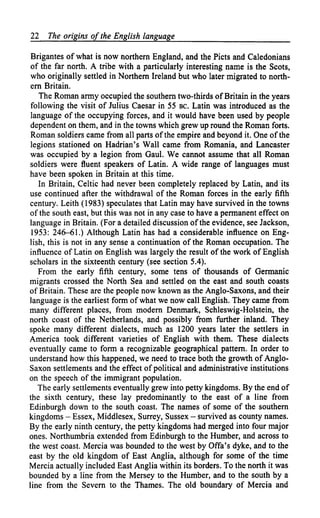
evidence of the earliest written records suggests a rough correlation
between dialects and kingdoms, and the dialects of Anglo-Saxon are con-
ventionally classified by kingdom: Northumbrian, Mercian, West Saxon
and Kentish (see map 1). The northern dialects, Northumbrian and Mer-
cian, are usually grouped together under the name Anglian. The pattern of
change which was established at this period survived until the introduction
of mass education in the nineteenth century.
Subsequent development of English dialects can in some cases be traced to
shifts in political boundaries. The new Scottish border (see section 3.1), for
example, cut the people of the Lowlands off from the rest of Northumbria,
with the result that the dialects on either side of the border began to change in
different directions. The political boundary between Mercia and Northum-
bria, for instance, disappeared over 1000 years ago, and yet there are still
marked differences in speech north and south of the Mersey. In south-east
Lancashire, a consonantal [r] can still be heard in local speech in words such
as learn, square, but this is not heard a few miles away in Cheshire.](https://image.slidesharecdn.com/texto-theoriginsoftheenglishlanguage-111124200150-phpapp01/85/Text-The-origins-of-the-English-language-6-320.jpg)
![Early English 25
Traces of the old dialect of Kent survive in modern Standard English.
There are indications that Kent was settled by some homogeneous tribal
group, possibly Jutes or Frisians, and so Kentish may have had marked
differences from the earliest times. A distinctive feature of Kentish con-
cerned the pronunciation of the vowel sound written <y>' in early English
spelling, which elsewhere must have been similar to the French vowel of tu
[ty] ('you'), or German ktihl [ky:l] ('cool'). In Kent the corresponding
vowel was often written <e>. For example, a word meaning 'give' was
syllan in Wessex and sellan in Kent; it is of course from the Kentish form
that we get the modern form sell. After the Norman conquest the [y] sound
was spelt <u>, and this is retained in the modern spelling of the word bury;
the pronunciation of this word, however, has the vowel sound [e], and was
originally a Kentish form.
When England finally became a single kingdom, innovations would
spread across the whole of the country, and begin to cross old borders.
Eventually this created a situation in which some features of language are
general and others localized. The general features are interesting because
they form the nucleus of the later standard language. This point is worth
emphasizing, because there is a common misconception that dialects arise
as a result of the corruption or fragmentation of an earlier standard lan-
guage. Such a standard language had never existed. The standard language
arose out of the dialects of the old kingdoms.
The beginnings of written English
From about the second century the Germanic tribes had made use of an
alphabet of characters called runes, which were mainly designed in straight
lines and were thus suitable for incising with a chisel. Runes were used for
short inscriptions on jewellery and other valuable artifacts, commemora-
tive texts on wood, rocks and stones, and for magical purposes. As Chris-
tianity was introduced to the Anglo-Saxon kingdoms, a new literacy culture
was introduced with it. The new culture made use of connected texts, and
its language was Latin. There are some interesting overlaps between the
two cultures, for example the Ruthwell Cross is a late runic monument
from the middle of the eighth century, and is incised with runes represent-
ing extracts from the Christian poem The dream of the rood. One runic
panel even represents a phrase of Latin (Sweet, 1978: 103).
The earliest use of English in manuscripts as opposed to inscriptions is
found in glosses, which provided an English equivalent for some of the
words of the Latin text. To make the earliest glosses, the writer had to find
a way of using Latin letters to represent the sounds of English. Some
letters, including <c, d, m, p>, had identifiable English counterparts, and
I . The angle brackets are used to enclose spellings.](https://image.slidesharecdn.com/texto-theoriginsoftheenglishlanguage-111124200150-phpapp01/85/Text-The-origins-of-the-English-language-8-320.jpg)
![26 The origins of the English language
so the use of these letters was straightforward. English also had vowel and
consonant sounds which did not exist in Latin, and a means had to be found
to represent them. For the sounds now spelt <th>, the runic character <}>>
was used interchangeably with a new character <d>, and another rune wynn
was used to represent the sound [w]. Another solution for non-Latin sounds
was the use of digraphs. Vowel letters were combined in different ways to
represent the complex vowel sounds of English, for example the digraph
<se> ('ash') was used for the English vowel intermediate between Latin
<a> and <e>. In <ecg> ('edge') the digraph <cg> was used for the con-
sonant [ds]. (The pronunciation of this word has not changed: the conven-
tion <cg> was later replaced by <dge>.)
The same spellings would be used time and time again, and eventually a
convention would develop. The existence of a convention tends to con-
servatism in spelling, for old conventions can be retained even when
pronunciation has changed, or they can be used for another dialect for
which they do not quite fit. For example, the English words <fisc> and
<scip> originally had phonetic spellings and were pronounced [fisk] and
[skip] respectively. The sequence [sk] was replaced in pronunciation by the
single sound [J], so that the words were later pronounced [fij, Jip]. In this
way the spelling <sc> became an arbitrary spelling convention. Spelling
conventions can thus reflect archaic pronunciations, and any close connec-
tion between spoken and written is quickly lost. We still write knee with an
initial <k> not because we pronounce [k] ourselves, but because it was
pronounced in that way when the modern conventions were established
many generations ago in the fifteenth century.
There has always been variation in the pronunciation of English words,
and so the question must be raised as to whose pronunciation was repre-
sented by the spelling. In the first instance, it was more likely that of the
person in charge of a scriptorium than of the individual who prepared the
manuscript. When new spellings were adopted, they would represent the
pronunciation of powerful people: for example, new spellings in the eighth
century presumably represented the English spoken at the Mercian court. It
follows that although we can usually guess what kind of pronunciation is
represented by English spellings, it is far from clear whose pronunciation
this is, and it may not be the pronunciation of any individual person. Second,
while it is possible by examining orthographic variants to work out roughly
where a text comes from, it does not follow that these variants represent the
contemporary speech of the local community. Official languages, in parti-
cular spellings, are not necessarily close to any spoken form, and are
relatively unaffected by subsequent change in the spoken language. The
language of early texts was already far removed from the speech of the
ordinary people of Tamworth or Winchester, much as it is today.
There is a similar problem with respect to grammar. Some later glosses,
for example the Lindisfarne gospels of the mid to late tenth century, take
the form of an interlinear translation of groups of words or a whole text.](https://image.slidesharecdn.com/texto-theoriginsoftheenglishlanguage-111124200150-phpapp01/85/Text-The-origins-of-the-English-language-9-320.jpg)


![Great Britain[1]](https://cdn.slidesharecdn.com/ss_thumbnails/greatbritain1-1221657389073244-9-thumbnail.jpg?width=640&height=640&fit=bounds)


