COLLEGE WORK
PERSON
YOU
LOVE
PERSON
THAT
LOVES
YOU
How do you make
decisions?
What are things you need to
consider in making
decisions?
DECISION-MAKING
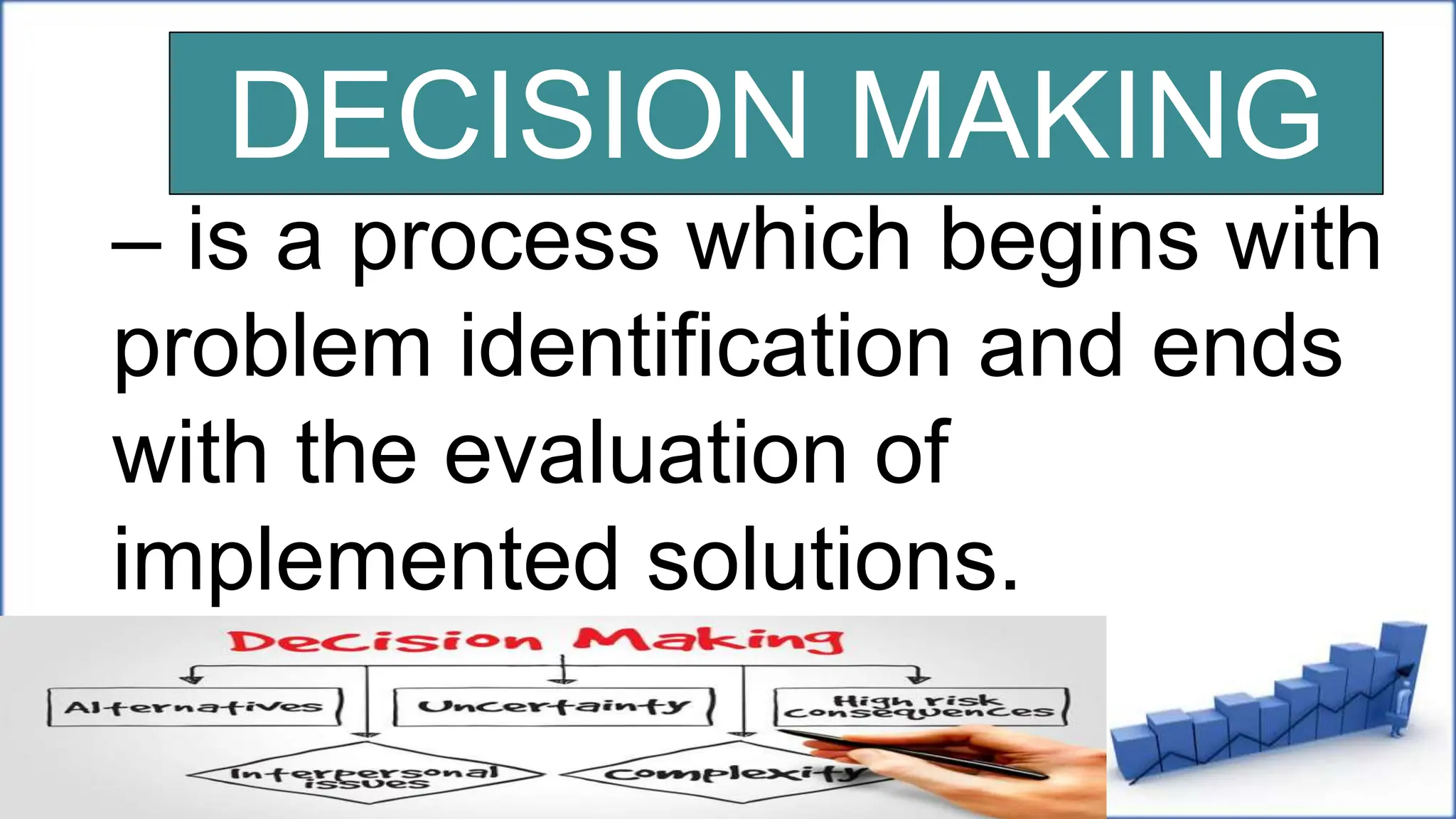
DECISION MAKING
– is a process which begins with
problem identification and ends
with the evaluation of
implemented solutions.
TYPES OF DECISIONS
1. Structured or programmed
decision
-a decision that is repetitive
and can be handled using a
routine approach.
1. Structured or programmed
decision
For example, a restaurant
customer complains about the dirty
utensils the waiter has given him.
This is not an unusual situation, and,
therefore, standardized solutions to
such a problem may be readily
available.
TYPES OF DECISIONS
2. Unstructured or
nonprogrammed decisions
-applied to the resolution of
problems that are new or
unusual, and for which
information is incomplete.
2. Unstructured or
nonprogrammed decisions
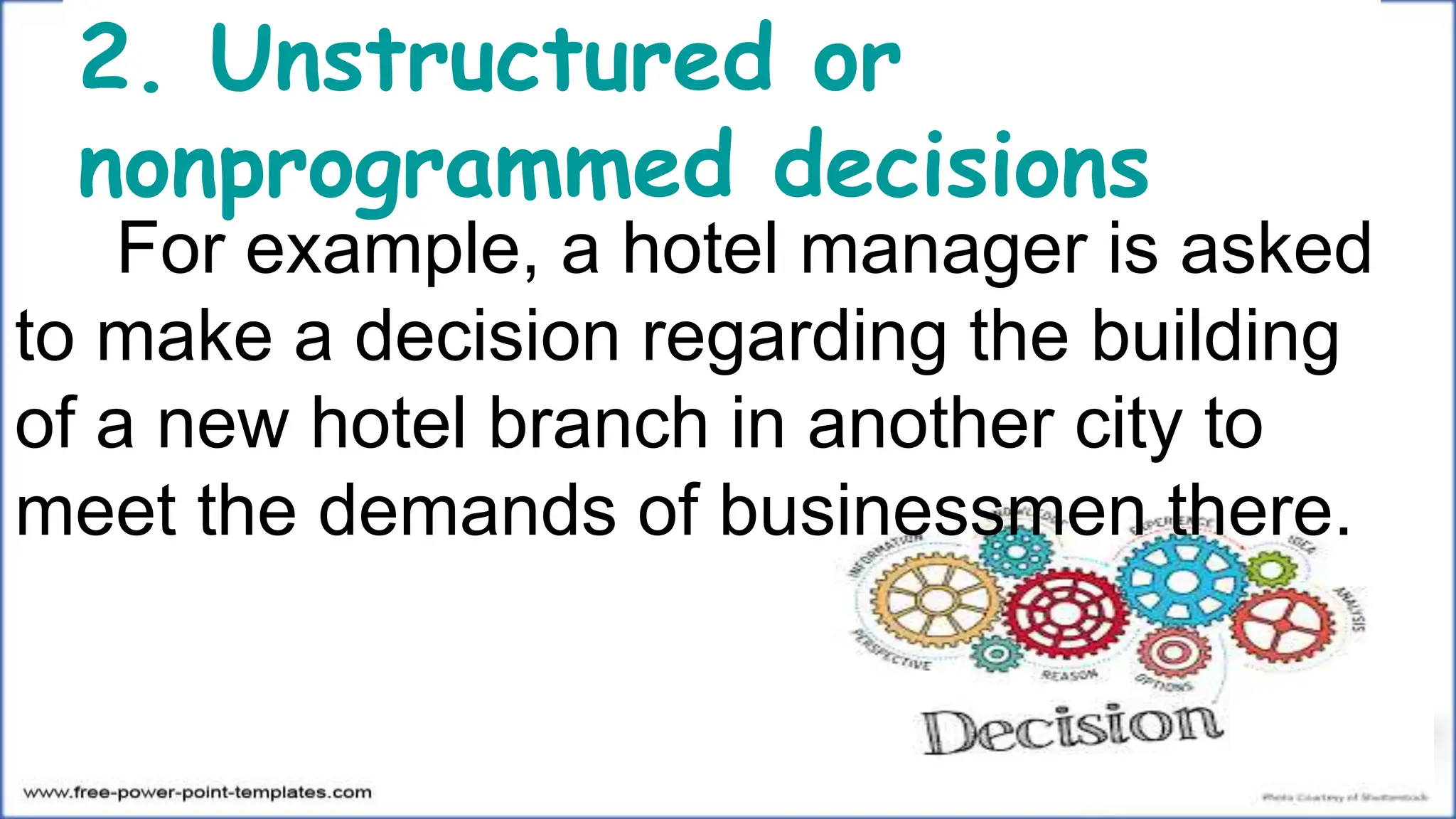
For example, a hotel manager is asked
to make a decision regarding the building
of a new hotel branch in another city to
meet the demands of businessmen there.
TYPES OF DECISION-
MAKING CONDITIONS
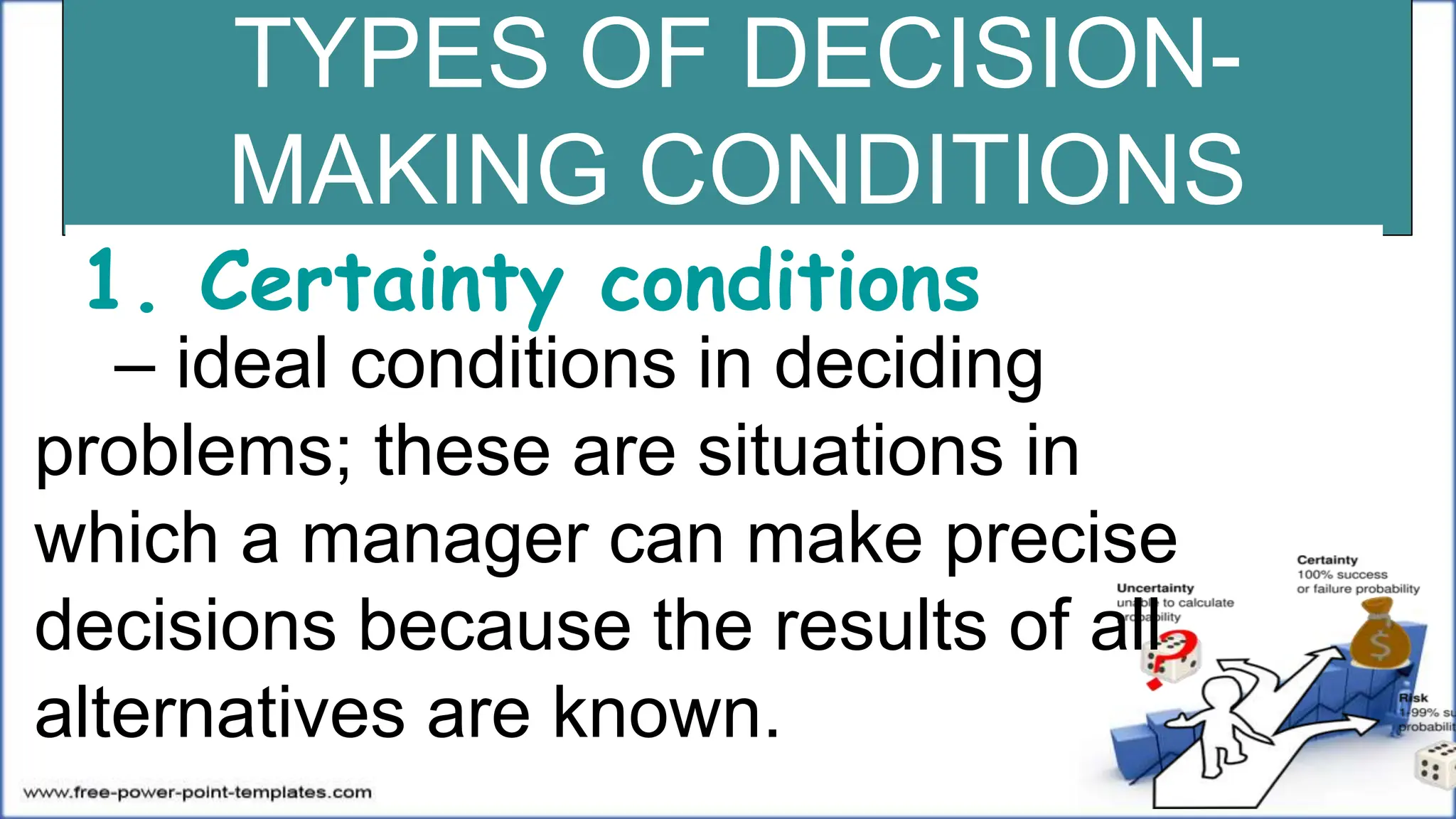
1. Certainty conditions
– ideal conditions in deciding
problems; these are situations in
which a manager can make precise
decisions because the results of all
alternatives are known.
1. Certainty conditions
For example, bank interests
are made known to clients so it is
easier for business managers to
decide on the problem of where
to deposit their company’s funds.
TYPES OF DECISION-
MAKING CONDITIONS
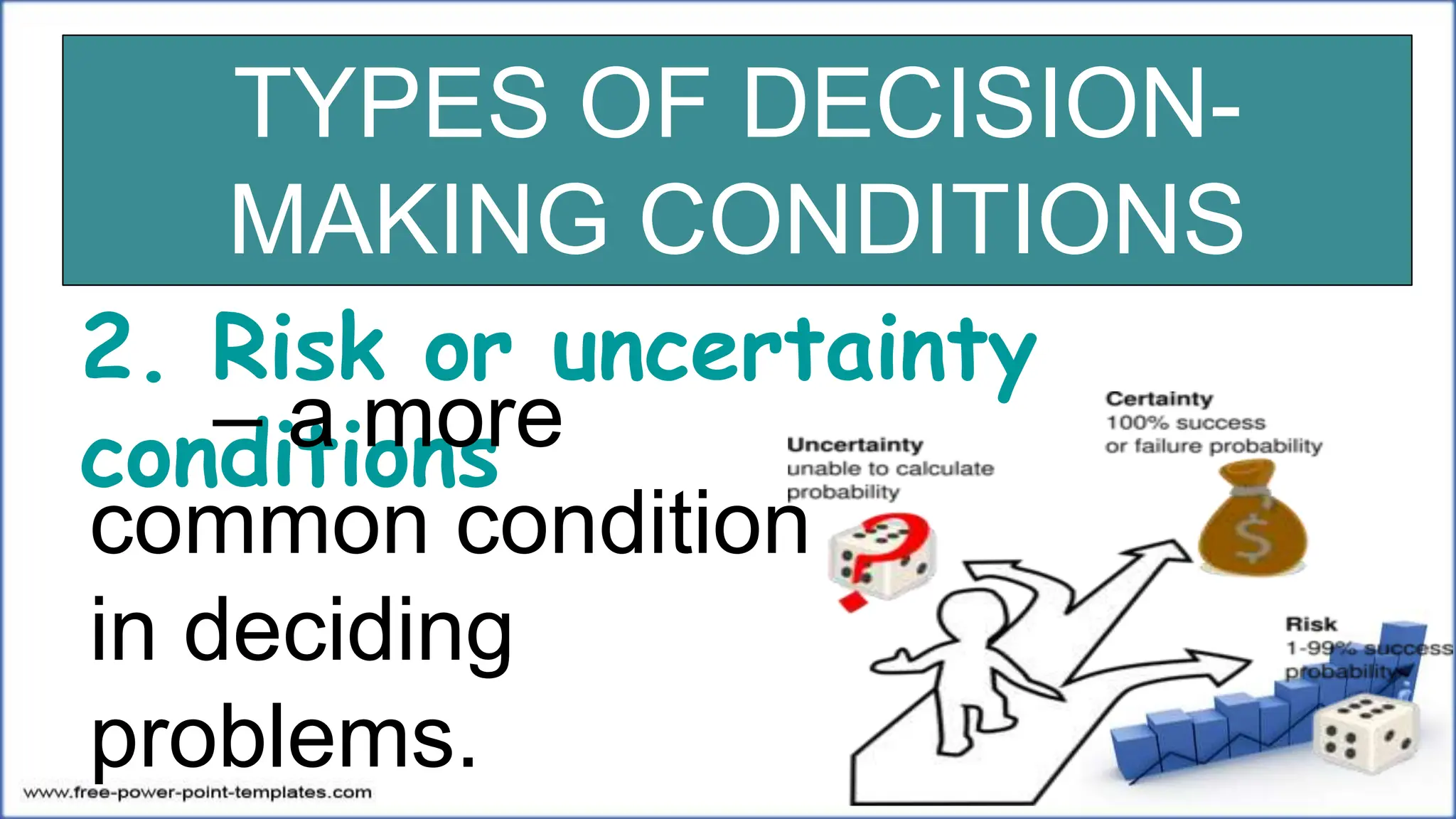
2. Risk or uncertainty
conditions
– a more
common condition
in deciding
problems.
2. Risk or uncertainty
conditions
For example, a manager is asked to
invest some of their company funds in
the money market offered by a financial
institution. Risk factors must be
considered, because of the uncertainty
conditions involved, before making a
decision—whether to invest or not in the
said money market.
STEPS IN DECISION-MAKING
PROCESS
1. Define the Problem
2. Identifying Decision Criteria
3. Allocating Weights to the
Criteria
4. Developing Alternatives
STEPS IN DECISION-MAKING
PROCESS
5. Analyzing Alternatives
6. Selecting an Alternatives
7. Implementing the Alternative
8. Evaluating decision
effectiveness
Think of a difficult problem you
encountered before. Explain the
scenario and how did you solve
it?
GROUP ACTIVITY
Group 1 – Play a scenario that shows
decision – making.
Group 2 – Think of a one minute song
that indicates decision-making.
Group 3 – Show decision-making by
means of drawing.
Group 4 – Dance a song that describes
decision-making.
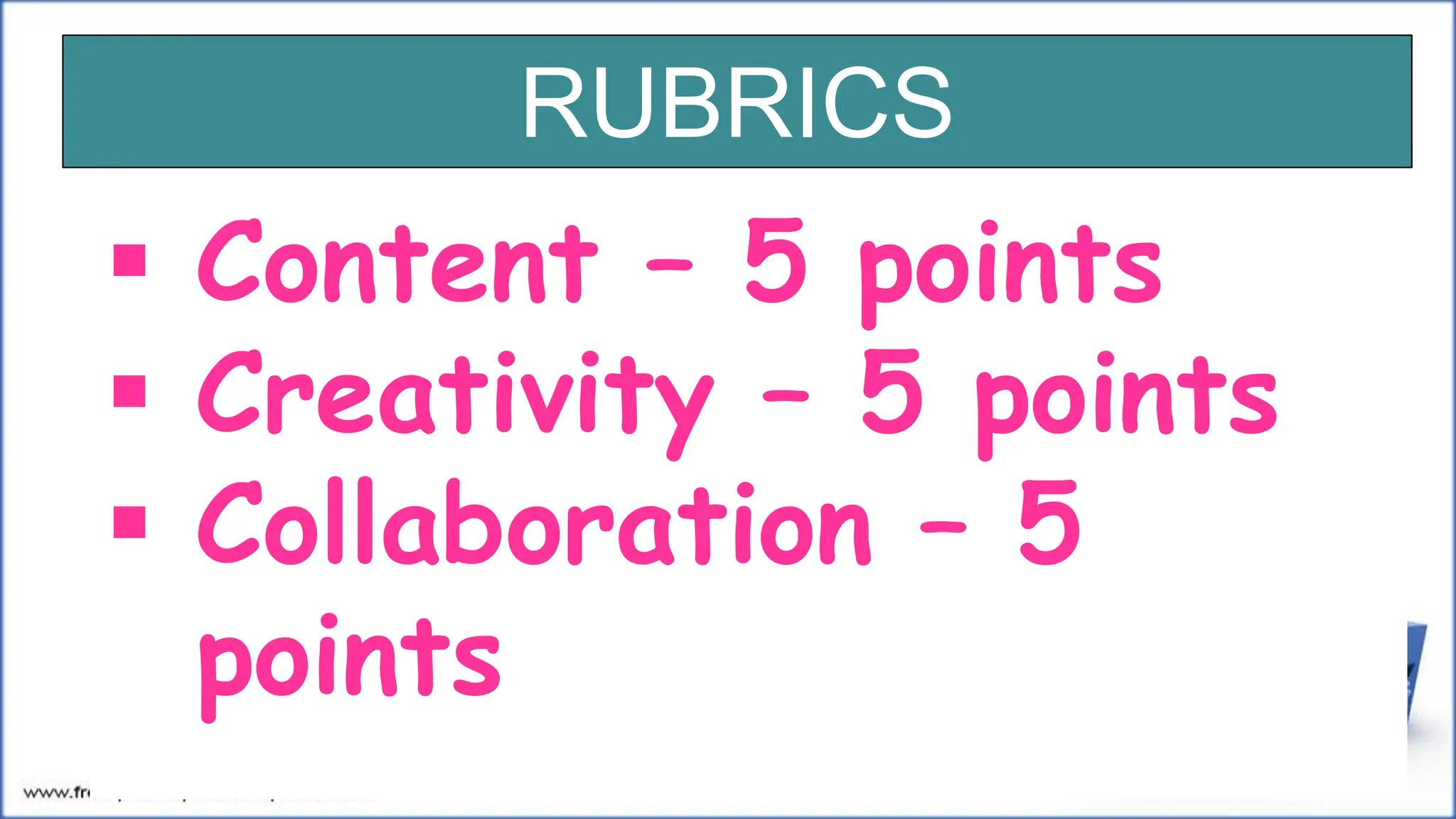
RUBRICS
 Content – 5 points
 Creativity – 5 points
 Collaboration – 5
points

6.-DECISION-MAKING organization and management.ppt

  • 1.
  • 2.
  • 3.
    How do youmake decisions?
  • 4.
    What are thingsyou need to consider in making decisions?
  • 5.
  • 6.
    DECISION MAKING – isa process which begins with problem identification and ends with the evaluation of implemented solutions.
  • 7.
    TYPES OF DECISIONS 1.Structured or programmed decision -a decision that is repetitive and can be handled using a routine approach.
  • 8.
    1. Structured orprogrammed decision For example, a restaurant customer complains about the dirty utensils the waiter has given him. This is not an unusual situation, and, therefore, standardized solutions to such a problem may be readily available.
  • 9.
    TYPES OF DECISIONS 2.Unstructured or nonprogrammed decisions -applied to the resolution of problems that are new or unusual, and for which information is incomplete.
  • 10.
    2. Unstructured or nonprogrammeddecisions For example, a hotel manager is asked to make a decision regarding the building of a new hotel branch in another city to meet the demands of businessmen there.
  • 11.
    TYPES OF DECISION- MAKINGCONDITIONS 1. Certainty conditions – ideal conditions in deciding problems; these are situations in which a manager can make precise decisions because the results of all alternatives are known.
  • 12.
    1. Certainty conditions Forexample, bank interests are made known to clients so it is easier for business managers to decide on the problem of where to deposit their company’s funds.
  • 13.
    TYPES OF DECISION- MAKINGCONDITIONS 2. Risk or uncertainty conditions – a more common condition in deciding problems.
  • 14.
    2. Risk oruncertainty conditions For example, a manager is asked to invest some of their company funds in the money market offered by a financial institution. Risk factors must be considered, because of the uncertainty conditions involved, before making a decision—whether to invest or not in the said money market.
  • 15.
    STEPS IN DECISION-MAKING PROCESS 1.Define the Problem 2. Identifying Decision Criteria 3. Allocating Weights to the Criteria 4. Developing Alternatives
  • 16.
    STEPS IN DECISION-MAKING PROCESS 5.Analyzing Alternatives 6. Selecting an Alternatives 7. Implementing the Alternative 8. Evaluating decision effectiveness
  • 17.
    Think of adifficult problem you encountered before. Explain the scenario and how did you solve it?
  • 18.
    GROUP ACTIVITY Group 1– Play a scenario that shows decision – making. Group 2 – Think of a one minute song that indicates decision-making. Group 3 – Show decision-making by means of drawing. Group 4 – Dance a song that describes decision-making.
  • 19.
    RUBRICS  Content –5 points  Creativity – 5 points  Collaboration – 5 points