Copyright © 2011 Pearson Education
Part Two
Comparative Environmental Frameworks
International Business
Environments and Operations,
13/e
Global Edition
5-1
Copyright © 2011 Pearson Education
5-2
Chapter Five
Globalization
and Society
Copyright © 2011 Pearson Education
5-3
Chapter Objectives
• To identify problems in evaluating the activities
of multinational enterprises (MNEs)
• To evaluate the major economic effects of MNEs
on home and host countries
• To understand the foundations of responsible
corporate behavior in the international sphere
• To discuss some key issues in the social
activities and consequences of globalized
business
• To examine corporate responses to globalization
Copyright © 2011 Pearson Education
5-4
Evaluating the Impact of FDI
• FDI is Foreign Direct Investment
• The large size of some MNEs causes
concern for some countries
• MNEs and countries need to understand
the impact of FDI in home and host
countries
Copyright © 2011 Pearson Education
5-5
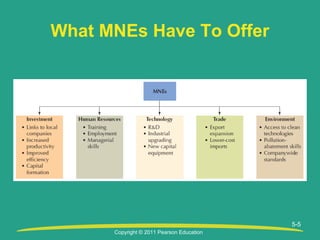
What MNEs Have To Offer
Copyright © 2011 Pearson Education
5-6
Considering the Logic of FDI
• Need to consider relationship between
those who make foreign investments
(MNEs) and possible effects on receiving
countries
• Areas to consider:
 Stakeholder trade-offs
 Cause-and-effect relationships
 Individual and aggregate effects
Copyright © 2011 Pearson Education
5-7
The Economic Impact of the MNE
• Balance-of-Payments effects:
 Net import effect
 Net capital flow
• Growth and Employment effects:
 Home-country losses
 Host-country gains
 Host-country losses
Copyright © 2011 Pearson Education
5-8
Why Companies Care About Ethical
Behavior
• Instrumental in achieving two objectives:
 To develop competitive advantage
 To avoid being perceived as irresponsible
Copyright © 2011 Pearson Education
5-9
The Cultural Foundations of Ethical
Behavior
• Relativism vs. Normativism: do truths
depend on the values of the groups or are
there universal standards
• Negotiating between evils
Copyright © 2011 Pearson Education
5-10
The Legal Foundations of Ethical
Behavior
• Legal justification for ethical behavior may
not be sufficient because not everything
that is unethical is illegal.
• The law is a good basis because it
embodies local cultural values.
• As countries tackle similar ethical issues,
laws will become more similar.
Copyright © 2011 Pearson Education
5-11
Ethics and Bribery
• Bribes are payments or promises to pay cash or
anything of value
• Bribes are used to get government contracts or
to get officials to do what they should be doing
anyway
• Problems with bribery:
 Affects performance of company & country
 Erodes government authority
 Damages reputations when disclosed
 Increases cost of doing business
Copyright © 2011 Pearson Education
5-12
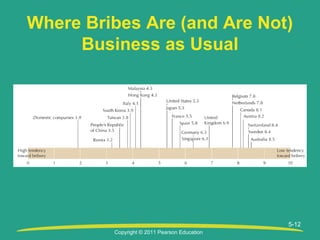
Where Bribes Are (and Are Not)
Business as Usual
Copyright © 2011 Pearson Education
5-13
What’s Being Done About
Corruption?
• Cross-National Accords: The OECD, the
ICC, and the UN
• The U.S. Foreign Corrupt Properties Act
• Industry Initiatives
• Relativism, the Rule of Law, and
Responsibility
Copyright © 2011 Pearson Education
5-14
Ethics and the Environment
• Sustainability
• Global Warming and The Kyoto Protocol
 National and Regional Initiatives
 Company-Specific Initiatives
Copyright © 2011 Pearson Education
5-15
Future: How to See the Trees in
the Rain Forest
• The Amazon rain forest accounts for 1/3
of the world’s remaining tropical forest
• Kyoto Protocol proposes reforestation to
reduce greenhouse emissions
• Major Challenge: protect global
environment while preserving Brazil’s
sovereignty over resources
Copyright © 2011 Pearson Education
5-16
Ethical Dilemmas and the
Pharmaceutical Industry
• Tiered pricing and other price-related
issues
• WTO Agreement on Trade-Related
Aspects of Intellectual Property Rights
(TRIPS)
• R&D and the Bottom Line
Copyright © 2011 Pearson Education
5-17
Ethical Dimensions of Labor
Conditions
• Ethical Trading Initiative
• The Problem of Child Labor
• What MNEs Can and Can’t Do
Copyright © 2011 Pearson Education
5-18
Sources of Worker-Related Pressures in
the Global Supply Chain
Copyright © 2011 Pearson Education
5-19
Corporate Codes of Ethics
• Motivations for Corporate Responsibility
• Developing a Good Code of Conduct
Copyright © 2011 Pearson Education
5-20
All rights reserved. No part of this publication may be
reproduced, stored in a retrieval system, or
transmitted, in any form or by any means, electronic,
mechanical, photocopying, recording, or otherwise,
without the prior written permission of the publisher.
Printed in the United States of America.

12296365 bznt enviro

  • 1.
    Copyright © 2011Pearson Education Part Two Comparative Environmental Frameworks International Business Environments and Operations, 13/e Global Edition 5-1
  • 2.
    Copyright © 2011Pearson Education 5-2 Chapter Five Globalization and Society
  • 3.
    Copyright © 2011Pearson Education 5-3 Chapter Objectives • To identify problems in evaluating the activities of multinational enterprises (MNEs) • To evaluate the major economic effects of MNEs on home and host countries • To understand the foundations of responsible corporate behavior in the international sphere • To discuss some key issues in the social activities and consequences of globalized business • To examine corporate responses to globalization
  • 4.
    Copyright © 2011Pearson Education 5-4 Evaluating the Impact of FDI • FDI is Foreign Direct Investment • The large size of some MNEs causes concern for some countries • MNEs and countries need to understand the impact of FDI in home and host countries
  • 5.
    Copyright © 2011Pearson Education 5-5 What MNEs Have To Offer
  • 6.
    Copyright © 2011Pearson Education 5-6 Considering the Logic of FDI • Need to consider relationship between those who make foreign investments (MNEs) and possible effects on receiving countries • Areas to consider:  Stakeholder trade-offs  Cause-and-effect relationships  Individual and aggregate effects
  • 7.
    Copyright © 2011Pearson Education 5-7 The Economic Impact of the MNE • Balance-of-Payments effects:  Net import effect  Net capital flow • Growth and Employment effects:  Home-country losses  Host-country gains  Host-country losses
  • 8.
    Copyright © 2011Pearson Education 5-8 Why Companies Care About Ethical Behavior • Instrumental in achieving two objectives:  To develop competitive advantage  To avoid being perceived as irresponsible
  • 9.
    Copyright © 2011Pearson Education 5-9 The Cultural Foundations of Ethical Behavior • Relativism vs. Normativism: do truths depend on the values of the groups or are there universal standards • Negotiating between evils
  • 10.
    Copyright © 2011Pearson Education 5-10 The Legal Foundations of Ethical Behavior • Legal justification for ethical behavior may not be sufficient because not everything that is unethical is illegal. • The law is a good basis because it embodies local cultural values. • As countries tackle similar ethical issues, laws will become more similar.
  • 11.
    Copyright © 2011Pearson Education 5-11 Ethics and Bribery • Bribes are payments or promises to pay cash or anything of value • Bribes are used to get government contracts or to get officials to do what they should be doing anyway • Problems with bribery:  Affects performance of company & country  Erodes government authority  Damages reputations when disclosed  Increases cost of doing business
  • 12.
    Copyright © 2011Pearson Education 5-12 Where Bribes Are (and Are Not) Business as Usual
  • 13.
    Copyright © 2011Pearson Education 5-13 What’s Being Done About Corruption? • Cross-National Accords: The OECD, the ICC, and the UN • The U.S. Foreign Corrupt Properties Act • Industry Initiatives • Relativism, the Rule of Law, and Responsibility
  • 14.
    Copyright © 2011Pearson Education 5-14 Ethics and the Environment • Sustainability • Global Warming and The Kyoto Protocol  National and Regional Initiatives  Company-Specific Initiatives
  • 15.
    Copyright © 2011Pearson Education 5-15 Future: How to See the Trees in the Rain Forest • The Amazon rain forest accounts for 1/3 of the world’s remaining tropical forest • Kyoto Protocol proposes reforestation to reduce greenhouse emissions • Major Challenge: protect global environment while preserving Brazil’s sovereignty over resources
  • 16.
    Copyright © 2011Pearson Education 5-16 Ethical Dilemmas and the Pharmaceutical Industry • Tiered pricing and other price-related issues • WTO Agreement on Trade-Related Aspects of Intellectual Property Rights (TRIPS) • R&D and the Bottom Line
  • 17.
    Copyright © 2011Pearson Education 5-17 Ethical Dimensions of Labor Conditions • Ethical Trading Initiative • The Problem of Child Labor • What MNEs Can and Can’t Do
  • 18.
    Copyright © 2011Pearson Education 5-18 Sources of Worker-Related Pressures in the Global Supply Chain
  • 19.
    Copyright © 2011Pearson Education 5-19 Corporate Codes of Ethics • Motivations for Corporate Responsibility • Developing a Good Code of Conduct
  • 20.
    Copyright © 2011Pearson Education 5-20 All rights reserved. No part of this publication may be reproduced, stored in a retrieval system, or transmitted, in any form or by any means, electronic, mechanical, photocopying, recording, or otherwise, without the prior written permission of the publisher. Printed in the United States of America.