CRP7 - Climate Change, Agriculture and Food SecurityTheme 4.1,  Linking Knowledge with ActionMT meeting, Bonn, June 2011
Theme 4.1 Linking Knowledge with Action Strategy‘Efforts to mobilize science and technology for sustainability are more likely to be effective when they manage boundaries between knowledge and action in ways that simultaneously enhance the salience, credibility and legitimacy of the information they produce’ (Cash et al. 1990)
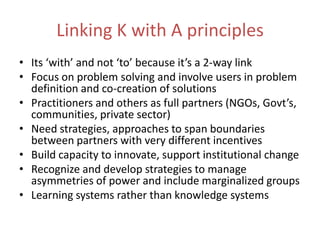
Linking K with A principlesIts ‘with’ and not ‘to’ because it’s a 2-way linkFocus on problem solving and involve users in problem definition and co-creation of solutionsPractitioners and others as full partners (NGOs, Govt’s, communities, private sector)Need strategies, approaches to span boundaries between partners with very different incentivesBuild capacity to innovate, support institutional changeRecognize and develop strategies to manage asymmetries of power and include marginalized groupsLearning systems rather than knowledge systems
Linking K with A StrategiesEngagement – CCAFS as a trusted partnerCommunication – more effective use of ICT’s, how best to communicate CC-Ag-FS issues at different levels and influence decision makersCapacity Building – CCAFS as an ‘incubator’Gender – targeted efforts and investments neededSo, in a sentence:Theme 4.1’s strategy is to continue to test tools and approaches and learn and apply lessons in each of these areas, and to develop new joint action research with partners where there are gaps (e.g. communicating CC with smallholders).
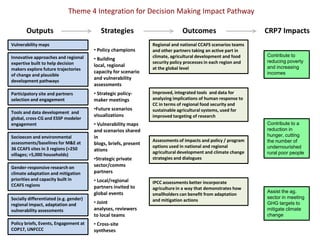
Theme 4 Integration for Decision Making Impact PathwayCRP7 ImpactsOutcomesOutputsStrategies Policy champions
 Building local, regional capacity for scenario and vulnerability  assessments
 Strategic policy-maker meetings
Future scenarios visualizations

CCAFS Theme 4.1 strategy: Linking Knowledge with Action

  • 1.
    CRP7 - ClimateChange, Agriculture and Food SecurityTheme 4.1, Linking Knowledge with ActionMT meeting, Bonn, June 2011
  • 2.
    Theme 4.1 LinkingKnowledge with Action Strategy‘Efforts to mobilize science and technology for sustainability are more likely to be effective when they manage boundaries between knowledge and action in ways that simultaneously enhance the salience, credibility and legitimacy of the information they produce’ (Cash et al. 1990)
  • 3.
    Linking K withA principlesIts ‘with’ and not ‘to’ because it’s a 2-way linkFocus on problem solving and involve users in problem definition and co-creation of solutionsPractitioners and others as full partners (NGOs, Govt’s, communities, private sector)Need strategies, approaches to span boundaries between partners with very different incentivesBuild capacity to innovate, support institutional changeRecognize and develop strategies to manage asymmetries of power and include marginalized groupsLearning systems rather than knowledge systems
  • 4.
    Linking K withA StrategiesEngagement – CCAFS as a trusted partnerCommunication – more effective use of ICT’s, how best to communicate CC-Ag-FS issues at different levels and influence decision makersCapacity Building – CCAFS as an ‘incubator’Gender – targeted efforts and investments neededSo, in a sentence:Theme 4.1’s strategy is to continue to test tools and approaches and learn and apply lessons in each of these areas, and to develop new joint action research with partners where there are gaps (e.g. communicating CC with smallholders).
  • 5.
    Theme 4 Integrationfor Decision Making Impact PathwayCRP7 ImpactsOutcomesOutputsStrategies Policy champions
  • 6.
    Building local,regional capacity for scenario and vulnerability assessments
  • 7.
  • 8.