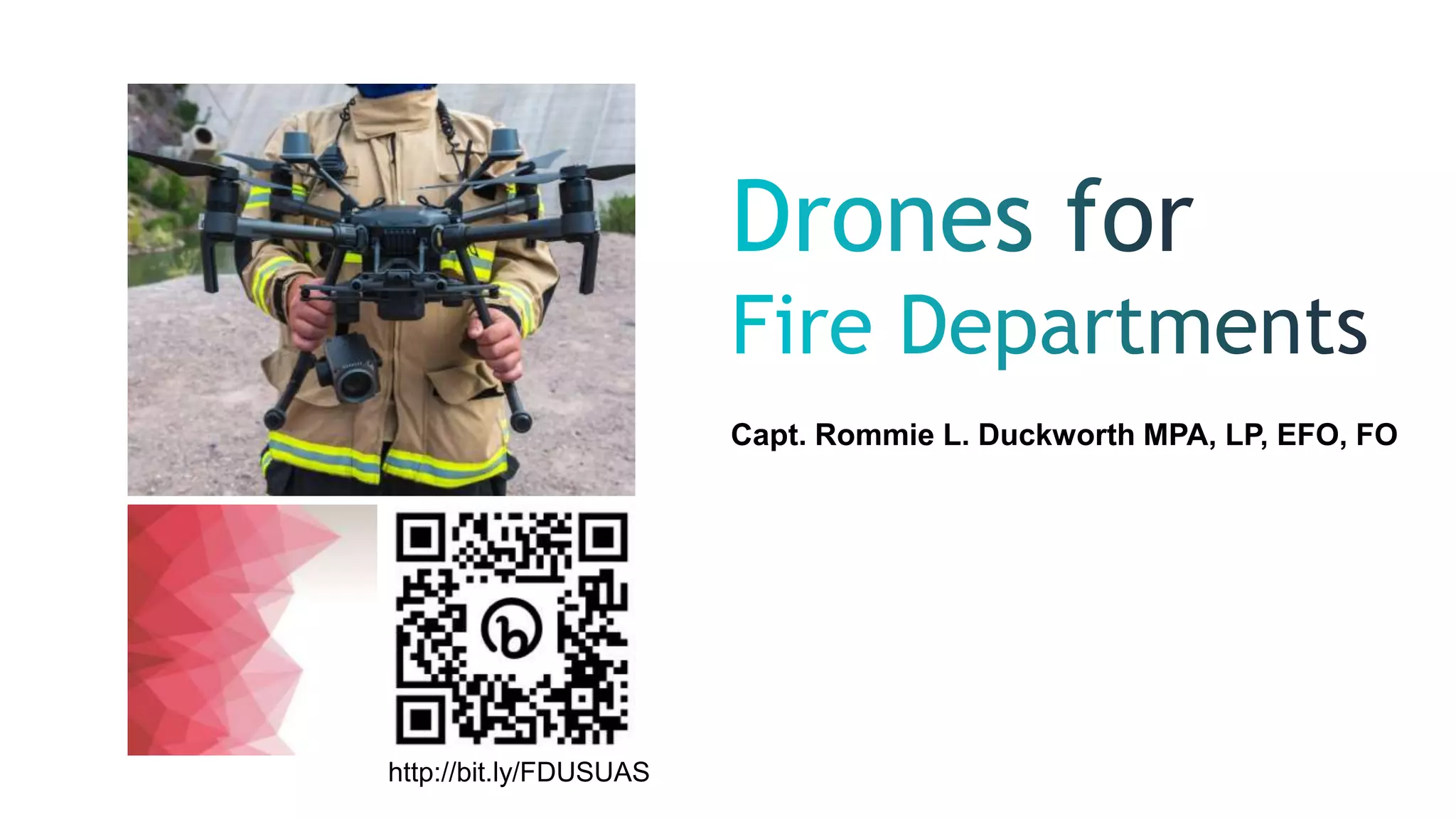

Capt. Rommie L. Duckworth MPA, LP, EFO, FO
http://bit.ly/FDUSUAS
 Peer-reviewed published research
 Government and private entity reports
 Fire service trade magazine
 Website articles
 Resources from national and international
public safety organizations
https://www.droneresponders.org
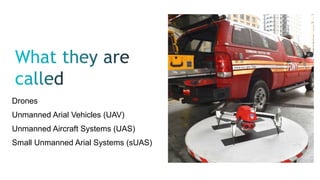
Drones
Unmanned Arial Vehicles (UAV)
Unmanned Aircraft Systems (UAS)
Small Unmanned Arial Systems (sUAS)
Modern sUAS are typically associated with military uses, from
observation of enemy positions and movements to delivery of weapon
payloads (Dormehl, 2018).
While the military has used forms of sUAS from the 19th century to the
21st, the first civilian use ready-to-fly quadcopter was introduced at the
2010 Consumer Electronics Show CESS) (Dormehl, 2018).
By 2022, even relatively low-cost sUAS can be purchased by civilians
with various features, including hi-resolution photography, thermal
imaging, and even the ability to deliver small payloads, all
characteristics that make modern sUAS appealing to the fire service
(Fisher, 2022).
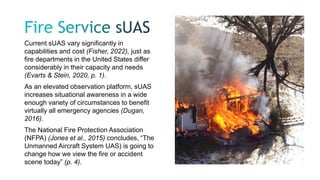
Current sUAS vary significantly in
capabilities and cost (Fisher, 2022), just as
fire departments in the United States differ
considerably in their capacity and needs
(Evarts & Stein, 2020, p. 1).
As an elevated observation platform, sUAS
increases situational awareness in a wide
enough variety of circumstances to benefit
virtually all emergency agencies (Dugan,
2016).
The National Fire Protection Association
(NFPA) (Jones et al., 2015) concludes, “The
Unmanned Aircraft System UAS) is going to
change how we view the fire or accident
scene today” (p. 4).
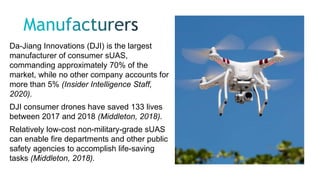
Da-Jiang Innovations (DJI) is the largest
manufacturer of consumer sUAS,
commanding approximately 70% of the
market, while no other company accounts for
more than 5% (Insider Intelligence Staff,
2020).
DJI consumer drones have saved 133 lives
between 2017 and 2018 (Middleton, 2018).
Relatively low-cost non-military-grade sUAS
can enable fire departments and other public
safety agencies to accomplish life-saving
tasks (Middleton, 2018).
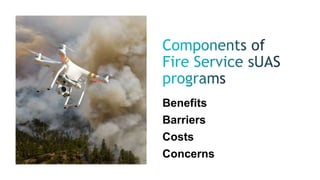
Benefits
Barriers
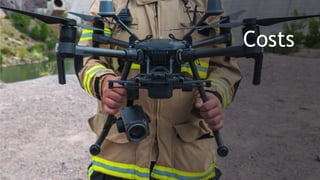
Costs
Concerns
Benefits
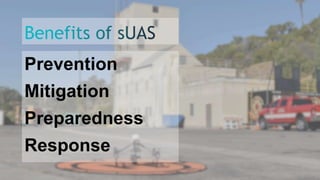
Prevention
Mitigation
Preparedness
Response
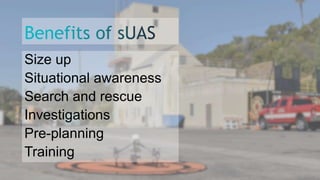
Size up
Situational awareness
Search and rescue
Investigations
Pre-planning
Training
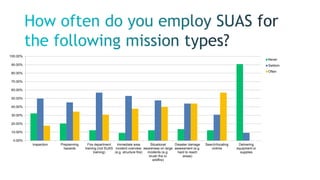
Inspection Preplanning
hazards
Fire department
training (not SUAS
training)
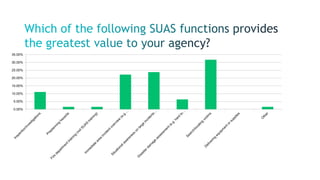
Immediate area
incident overview
(e.g. structure fire)
Situational
awareness on large
incidents (e.g.
brush fire or
wildfire)
Disaster damage
assessment (e.g.
hard to reach
areas)
Search/locating
victims
Delivering
equipment or
supplies
0.00%
10.00%
20.00%
30.00%
40.00%
50.00%
60.00%
70.00%
80.00%
90.00%
100.00%
Never
Seldom
Often
0.00%
5.00%
10.00%
15.00%
20.00%
25.00%
30.00%
35.00%
National Public Safety
Telecommunications
Council (NPSTC)
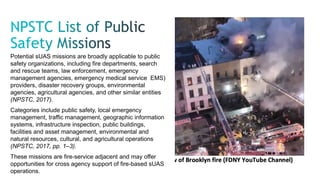
Potential sUAS missions are broadly applicable to public
safety organizations, including fire departments, search
and rescue teams, law enforcement, emergency
management agencies, emergency medical service EMS)
providers, disaster recovery groups, environmental
agencies, agricultural agencies, and other similar entities
(NPSTC, 2017).
Categories include public safety, local emergency
management, traffic management, geographic information
systems, infrastructure inspection, public buildings,
facilities and asset management, environmental and
natural resources, cultural, and agricultural operations
(NPSTC, 2017, pp. 1–3).
These missions are fire-service adjacent and may offer
opportunities for cross agency support of fire-based sUAS
operations.
International
Association of
Fire Chiefs
(IAFC)
The International Association of Fire Chiefs (IAFC) (2018a) has
developed a toolkit that includes a fire-service-specific section on
sUAS operational abilities. These include structural firefighting,
wildland fire fighting, rescue, hazardous materials, EMS, disaster
response, and other operations (IAFC, 2018b).
Other operational uses and benefits of sUAS in fire agencies include
scene size up, structure fire overview, hazardous materials response,
air monitoring, wide area search, technical rescue, pre-incident
planning, and special event planning as only scratching the surface of
ways fire department may be able to use sUAS to enhance their
operations (Hatt, 2021).
www.bit.ly/IAFCSUAS
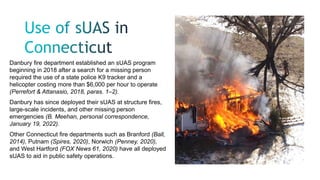
Danbury fire department established an sUAS program
beginning in 2018 after a search for a missing person
required the use of a state police K9 tracker and a
helicopter costing more than $6,000 per hour to operate
(Perrefort & Attanasio, 2018, paras. 1–2).
Danbury has since deployed their sUAS at structure fires,
large-scale incidents, and other missing person
emergencies (B. Meehan, personal correspondence,
January 19, 2022).
Other Connecticut fire departments such as Branford (Ball,
2014), Putnam (Spires, 2020), Norwich (Penney, 2020),
and West Hartford (FOX News 61, 2020) have all deployed
sUAS to aid in public safety operations.
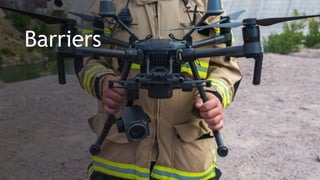
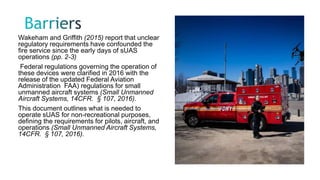
Barriers
Wakeham and Griffith (2015) report that unclear
regulatory requirements have confounded the
fire service since the early days of sUAS
operations (pp. 2-3)
Federal regulations governing the operation of
these devices were clarified in 2016 with the
release of the updated Federal Aviation
Administration FAA) regulations for small
unmanned aircraft systems (Small Unmanned
Aircraft Systems, 14CFR. § 107, 2016).
This document outlines what is needed to
operate sUAS for non-recreational purposes,
defining the requirements for pilots, aircraft, and
operations (Small Unmanned Aircraft Systems,
14CFR. § 107, 2016).
http://bit.ly/FAACFR107 http://bit.ly/FAA10GUIDE
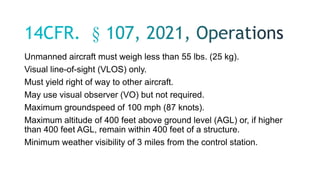
Unmanned aircraft must weigh less than 55 lbs. (25 kg).
Visual line-of-sight (VLOS) only.
Must yield right of way to other aircraft.
May use visual observer (VO) but not required.
Maximum groundspeed of 100 mph (87 knots).
Maximum altitude of 400 feet above ground level (AGL) or, if higher
than 400 feet AGL, remain within 400 feet of a structure.
Minimum weather visibility of 3 miles from the control station.
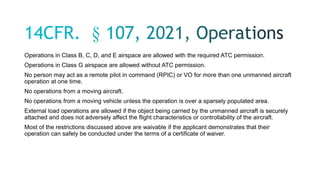
Operations in Class B, C, D, and E airspace are allowed with the required ATC permission.
Operations in Class G airspace are allowed without ATC permission.
No person may act as a remote pilot in command (RPIC) or VO for more than one unmanned aircraft
operation at one time.
No operations from a moving aircraft.
No operations from a moving vehicle unless the operation is over a sparsely populated area.
External load operations are allowed if the object being carried by the unmanned aircraft is securely
attached and does not adversely affect the flight characteristics or controllability of the aircraft.
Most of the restrictions discussed above are waivable if the applicant demonstrates that their
operation can safely be conducted under the terms of a certificate of waiver.
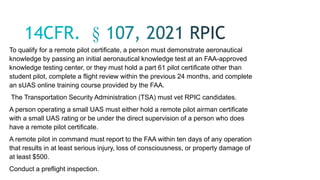
To qualify for a remote pilot certificate, a person must demonstrate aeronautical
knowledge by passing an initial aeronautical knowledge test at an FAA-approved
knowledge testing center, or they must hold a part 61 pilot certificate other than
student pilot, complete a flight review within the previous 24 months, and complete
an sUAS online training course provided by the FAA.
The Transportation Security Administration (TSA) must vet RPIC candidates.
A person operating a small UAS must either hold a remote pilot airman certificate
with a small UAS rating or be under the direct supervision of a person who does
have a remote pilot certificate.
A remote pilot in command must report to the FAA within ten days of any operation
that results in at least serious injury, loss of consciousness, or property damage of
at least $500.
Conduct a preflight inspection.
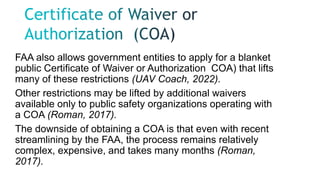
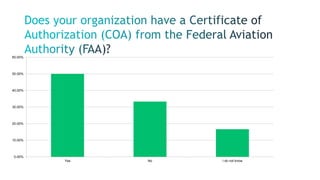
FAA also allows government entities to apply for a blanket
public Certificate of Waiver or Authorization COA) that lifts
many of these restrictions (UAV Coach, 2022).
Other restrictions may be lifted by additional waivers
available only to public safety organizations operating with
a COA (Roman, 2017).
The downside of obtaining a COA is that even with recent
streamlining by the FAA, the process remains relatively
complex, expensive, and takes many months (Roman,
2017).
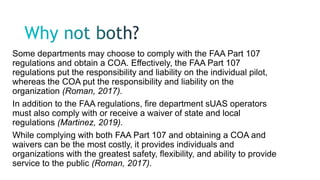
Some departments may choose to comply with the FAA Part 107
regulations and obtain a COA. Effectively, the FAA Part 107
regulations put the responsibility and liability on the individual pilot,
whereas the COA put the responsibility and liability on the
organization (Roman, 2017).
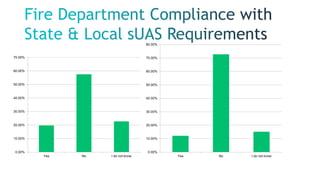
In addition to the FAA regulations, fire department sUAS operators
must also comply with or receive a waiver of state and local
regulations (Martinez, 2019).
While complying with both FAA Part 107 and obtaining a COA and
waivers can be the most costly, it provides individuals and
organizations with the greatest safety, flexibility, and ability to provide
service to the public (Roman, 2017).
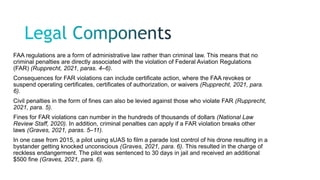
FAA regulations are a form of administrative law rather than criminal law. This means that no
criminal penalties are directly associated with the violation of Federal Aviation Regulations
(FAR) (Rupprecht, 2021, paras. 4–6).
Consequences for FAR violations can include certificate action, where the FAA revokes or
suspend operating certificates, certificates of authorization, or waivers (Rupprecht, 2021, para.
6).
Civil penalties in the form of fines can also be levied against those who violate FAR (Rupprecht,
2021, para. 5).
Fines for FAR violations can number in the hundreds of thousands of dollars (National Law
Review Staff, 2020). In addition, criminal penalties can apply if a FAR violation breaks other
laws (Graves, 2021, paras. 5–11).
In one case from 2015, a pilot using sUAS to film a parade lost control of his drone resulting in a
bystander getting knocked unconscious (Graves, 2021, para. 6). This resulted in the charge of
reckless endangerment. The pilot was sentenced to 30 days in jail and received an additional
$500 fine (Graves, 2021, para. 6).
Pilot/operator Observer Officer Liaison Maintenance/repair Logistics Other (please specify)
0.00%
10.00%
20.00%
30.00%
40.00%
50.00%
60.00%
70.00%
80.00%
90.00%
100.00%
Yes No I do not know
0.00%
10.00%
20.00%
30.00%
40.00%
50.00%
60.00%
70.00%
80.00%
90.00%
Yes No I do not know
0.00%
10.00%
20.00%
30.00%
40.00%
50.00%
60.00%
Yes No I do not know
0.00%
10.00%
20.00%
30.00%
40.00%
50.00%
60.00%
70.00%
80.00%
Yes No I do not know
0.00%
10.00%
20.00%
30.00%
40.00%
50.00%
60.00%
70.00%
Costs
A report by the European Emergency Number Association (EENA) and
DJI outlined essential costs facing agencies seeking to integrate sUAS
into their regular emergency and safety operations (O’Brien et al.,
2016, pp. 7–8).
These include the hardware platform, including the aircraft, initial and
ongoing training, staffing for operational deployment, maintenance,
and liability (O’Brien et al., 2016, pp. 7–8).
These costs apply to virtually all properly constructed public safety
sUAS programs (O’Brien et al., 2016).
One of the primary costs of integrating sUAS into firefighting operations is, of
course, the sUAS platform itself (Jones et al., 2015, p. 14).
These platforms typically consist of a radio-controlled, battery-operated multi-rotor
or quadcopter device with a camera (International Association of Fire Chiefs,
2018c). Basic commercial sUAS platforms can cost anywhere from $500 to
$10,000 and up (Fisher, 2022; PropelRCC Staff, 2021).
Prices then vary based on improvements in battery capacity (effectively flight time
and range), camera quality and features including infrared capabilities, GPS
features, build quality and robustness, weight and size, speed of deployment,
speed of slight, stability, and control features (PropelRCC Staff, 2021).
An appropriate training program is recommended for all pilots who operate the
department's sUAS platform (Jonkey, 2016, p. 66).
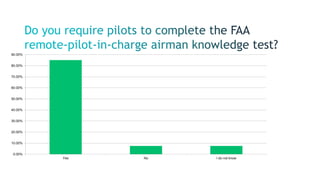
Although pilots operating under an FAA COA do not necessarily need to pass an
FAA written exam, pilots operating under the FAA Small Unmanned Aircraft
Systems regulations do (Small Unmanned Aircraft Systems, 2016).
The FAA provides free training to prepare department personnel to pass the written
FAA sUAS pilot exam. The application fee for the exam is $150 (Federal Aviation
Administration, 2021). However, this training only covers initial qualifications for
pilots. Continuing education and skills maintenance are necessary considerations
for any public safety sUAS program (Jonkey, 2016, p. 48).
In 2021 the National Aeronautics and Space Administration (NASA) and ESRI
entered into a joint venture to form DRONERESPONDERS, a global public safety
sUAS directory and resource center (Werner, 2021).
At the same time, the Airborne International Response Team (AIRT), a nonprofit,
non-governmental organization that hosts DRONERESPONDERS, established a
Global Emergency Remote Pilot Directory to coordinate and share pilot emergency
pilot resources around the world (Werner, 2021).
These resources are free and open to emergency services worldwide and are
intended to lower the cost and ease the path for agencies to obtain and train sUAS
pilots (Werner, 2021).
Integrating an sUAS into fire department operations requires more staffing
considerations than simply training one or more existing firefighters to fly the
machine (NPSTC, 2017, pp. 3–4).
Not only will the ability of the department to operate their sUAS depend on the
availability of a qualified pilot, depending on the mission, but appropriate staffing
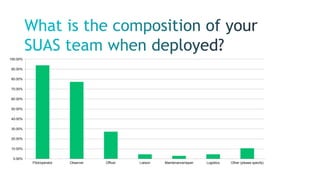
might also include a pilot, observer, and an officer or liaison to manage
communication and coordination (NPSTC, 2017, pp. 3–4).
Furthermore, a department with an in-house sUAS program must consider
including a mechanic who qualifies to maintain and repair the sUAS (NPSTC, 2017,
pp. 3–4). Because of the complexities of appropriate staffing for sUAS missions,
smaller departments may consider a program where the platform is shared
between departments or subcontract it out to a commercial operator (NPSTC
2017, pp. 4–5).
sUAS maintenance needs and costs are likely to vary
significantly from program to program (Jones et al., 2015, p.
14).
Costs should be projected based on estimated use and
manufacturers’ recommendations (Werner, 2016).
Maintenance records, along with training records, flight
plans, and other records related to sUAS operations, should
be carefully documented with other department records
(Werner, 2016).
System failures, malfunctions, and operator errors are an
inevitable part of any sUAS program. While preventative
maintenance will minimize many of these issues, and FAA
regulations and restrictions may mitigate the impact of falling
drones, these do not eliminate danger, cost, and liability
(IAFC, 2018a). In addition, consideration must be given to
intentional and malicious interference with fire department
sUAS operations (Werner, 2018).
The Volunteer Firemen’s Insurance Service (VFIS) has published
recommendations to minimize liability, along with liability insurance
costs, for public safety organizations operating sUAS platforms
(Volunteer Firemen’s Insurance Service, 2021).
These recommendations include compliance with FAA regulations and
restrictions, establishing standard operating procedures, maintaining a
training program, using proper flight planning and logging procedures,
and performing and documenting maintenance as recommended
(VFIS, 2021). VFIS emphasizes establishing the appropriate
framework for an effective sUAS program before the first flight takes
place (VFIS, 2021).
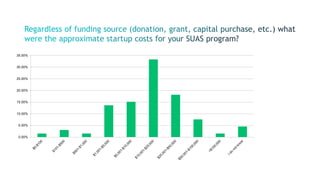
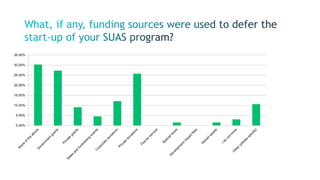
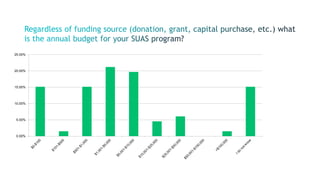
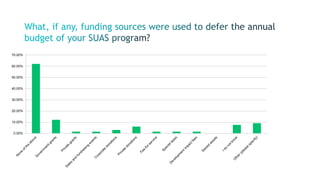
Funding alternatives exist to mitigate the cost of sUAS programs (United States
Fire Administration [USFA], 2012). Options include government grants, private
grants, sales and fundraising events, corporate donations, private donations, fee
for service, special taxes, development impact fees, and seized assets, among
others (USFA, 2012).
Minimizing the financial burden of a new program on the local tax base may
facilitate government approval of an sUAS program (USFA, 2012). Ridgefield Fire
Department has a history of successfully acquiring grants and donations (Himes,
2012).
Fire departments in Connecticut have received donations to support sUAS
programs, including Danbury (Perrefort & Attanasio, 2018), Branford (Ball, 2014),
Putnam (Spires, 2020), Norwich (Penney, 2020), and West Hartford (FOX News
61, 2020).
0.00%
5.00%
10.00%
15.00%
20.00%
25.00%
30.00%
35.00%
0.00%
5.00%
10.00%
15.00%
20.00%
25.00%
30.00%
35.00%
0.00%
5.00%
10.00%
15.00%
20.00%
25.00%
0.00%
10.00%
20.00%
30.00%
40.00%
50.00%
60.00%
70.00%
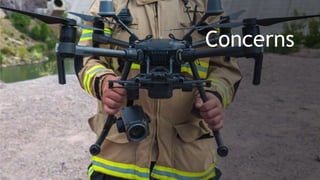
Concerns
The literature review quickly revealed that the most significant public concern
outside of program cost and safety regulations is personal privacy.
In 2015 President Obama charged the US. Department of Commerce’s National
Telecommunications Information Administration (NTIA) to gather stakeholders to
develop and publish best practices for privacy, transparency, and accountability,
promoting the use of sUAS in a way that did not diminish the rights and freedoms
of US citizens (National Telecommunications Information Administration, 2016).
The NTIA report recommends informing others of use of sUAS were practical and
reasonable, being responsible when collecting and storing data gathered by sUAS,
limiting the benefit in sharing of this data, securing the data, and monitoring apply
with evolving federal, state, and local laws governing the operation of sUAS (NTIA,
2016, pp. 5–6).
DRONERESPONDERS (2020) guide outlined the Five C’s of
community engagement and transparency, civil liberties and privacy
protection, common operating procedures, clear oversight and
accountability, and cybersecurity (p. 1).
These five principles are based on guidance from the Police Executive
Research Forum (PERF), the International Association of Chiefs of
Police (IACP), the National Institute of Justice (NIJ), and the US
Department of Justice DOJ) (DroneResponders, 2020, p. 1).
These recommendations were developed primarily with law-
enforcement sUAS programs in mind but are explicitly applicable to
sUAS programs of all branches of public safety (DroneResponders,
2020, p. 1).
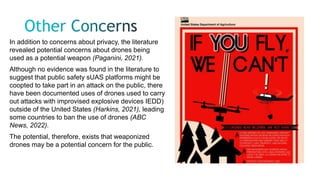
In addition to concerns about privacy, the literature
revealed potential concerns about drones being
used as a potential weapon (Paganini, 2021).
Although no evidence was found in the literature to
suggest that public safety sUAS platforms might be
coopted to take part in an attack on the public, there
have been documented uses of drones used to carry
out attacks with improvised explosive devices IEDD)
outside of the United States (Harkins, 2021), leading
some countries to ban the use of drones (ABC
News, 2022).
The potential, therefore, exists that weaponized
drones may be a potential concern for the public.
www.bit.ly/NFPA2400
National Fire Protection Association (NFPA) 2400 (2019) is the fire service
standard for small unmanned aircraft systems used for public safety operations.
This standard builds on much of the work of other individuals, national groups, and
committees mentioned in the literature review addressing the benefits, barriers,
costs, and concerns related to fire service deployment of sUAS.
As with many other aspects of fire department operations, the tremendous variety
in size, structure, and mission priorities in the various fire departments across the
United States means that NFPA 2400 make an excellent reference along with
resources from the FAA, NTIA, NPSTC, IAFC, and other organizations, but should
not be considered a comprehensive and universally accepted document that
outlines the single way that sUAS programs must be structured.
The literature search makes it clear that there is a need for individual departments
to collect and interpret data specific to their department’s resources, needs, and
mission priorities.
Benefits
Barriers
Costs
Concerns
Drones for Fire Departments UAVs.pptx

Drones for Fire Departments UAVs.pptx

  • 1.
    Capt. Rommie L.Duckworth MPA, LP, EFO, FO http://bit.ly/FDUSUAS
  • 2.
     Peer-reviewed publishedresearch  Government and private entity reports  Fire service trade magazine  Website articles  Resources from national and international public safety organizations
  • 4.
  • 5.
    Drones Unmanned Arial Vehicles(UAV) Unmanned Aircraft Systems (UAS) Small Unmanned Arial Systems (sUAS)
  • 6.
    Modern sUAS aretypically associated with military uses, from observation of enemy positions and movements to delivery of weapon payloads (Dormehl, 2018). While the military has used forms of sUAS from the 19th century to the 21st, the first civilian use ready-to-fly quadcopter was introduced at the 2010 Consumer Electronics Show CESS) (Dormehl, 2018). By 2022, even relatively low-cost sUAS can be purchased by civilians with various features, including hi-resolution photography, thermal imaging, and even the ability to deliver small payloads, all characteristics that make modern sUAS appealing to the fire service (Fisher, 2022).
  • 7.
    Current sUAS varysignificantly in capabilities and cost (Fisher, 2022), just as fire departments in the United States differ considerably in their capacity and needs (Evarts & Stein, 2020, p. 1). As an elevated observation platform, sUAS increases situational awareness in a wide enough variety of circumstances to benefit virtually all emergency agencies (Dugan, 2016). The National Fire Protection Association (NFPA) (Jones et al., 2015) concludes, “The Unmanned Aircraft System UAS) is going to change how we view the fire or accident scene today” (p. 4).
  • 8.
    Da-Jiang Innovations (DJI)is the largest manufacturer of consumer sUAS, commanding approximately 70% of the market, while no other company accounts for more than 5% (Insider Intelligence Staff, 2020). DJI consumer drones have saved 133 lives between 2017 and 2018 (Middleton, 2018). Relatively low-cost non-military-grade sUAS can enable fire departments and other public safety agencies to accomplish life-saving tasks (Middleton, 2018).
  • 9.
  • 10.
  • 11.
  • 12.
    Size up Situational awareness Searchand rescue Investigations Pre-planning Training
  • 13.
    Inspection Preplanning hazards Fire department training(not SUAS training) Immediate area incident overview (e.g. structure fire) Situational awareness on large incidents (e.g. brush fire or wildfire) Disaster damage assessment (e.g. hard to reach areas) Search/locating victims Delivering equipment or supplies 0.00% 10.00% 20.00% 30.00% 40.00% 50.00% 60.00% 70.00% 80.00% 90.00% 100.00% Never Seldom Often
  • 14.
  • 15.
  • 16.
    Potential sUAS missionsare broadly applicable to public safety organizations, including fire departments, search and rescue teams, law enforcement, emergency management agencies, emergency medical service EMS) providers, disaster recovery groups, environmental agencies, agricultural agencies, and other similar entities (NPSTC, 2017). Categories include public safety, local emergency management, traffic management, geographic information systems, infrastructure inspection, public buildings, facilities and asset management, environmental and natural resources, cultural, and agricultural operations (NPSTC, 2017, pp. 1–3). These missions are fire-service adjacent and may offer opportunities for cross agency support of fire-based sUAS operations.
  • 17.
  • 18.
    The International Associationof Fire Chiefs (IAFC) (2018a) has developed a toolkit that includes a fire-service-specific section on sUAS operational abilities. These include structural firefighting, wildland fire fighting, rescue, hazardous materials, EMS, disaster response, and other operations (IAFC, 2018b). Other operational uses and benefits of sUAS in fire agencies include scene size up, structure fire overview, hazardous materials response, air monitoring, wide area search, technical rescue, pre-incident planning, and special event planning as only scratching the surface of ways fire department may be able to use sUAS to enhance their operations (Hatt, 2021).
  • 19.
  • 20.
    Danbury fire departmentestablished an sUAS program beginning in 2018 after a search for a missing person required the use of a state police K9 tracker and a helicopter costing more than $6,000 per hour to operate (Perrefort & Attanasio, 2018, paras. 1–2). Danbury has since deployed their sUAS at structure fires, large-scale incidents, and other missing person emergencies (B. Meehan, personal correspondence, January 19, 2022). Other Connecticut fire departments such as Branford (Ball, 2014), Putnam (Spires, 2020), Norwich (Penney, 2020), and West Hartford (FOX News 61, 2020) have all deployed sUAS to aid in public safety operations.
  • 21.
  • 22.
    Wakeham and Griffith(2015) report that unclear regulatory requirements have confounded the fire service since the early days of sUAS operations (pp. 2-3) Federal regulations governing the operation of these devices were clarified in 2016 with the release of the updated Federal Aviation Administration FAA) regulations for small unmanned aircraft systems (Small Unmanned Aircraft Systems, 14CFR. § 107, 2016). This document outlines what is needed to operate sUAS for non-recreational purposes, defining the requirements for pilots, aircraft, and operations (Small Unmanned Aircraft Systems, 14CFR. § 107, 2016).
  • 23.
  • 24.
    Unmanned aircraft mustweigh less than 55 lbs. (25 kg). Visual line-of-sight (VLOS) only. Must yield right of way to other aircraft. May use visual observer (VO) but not required. Maximum groundspeed of 100 mph (87 knots). Maximum altitude of 400 feet above ground level (AGL) or, if higher than 400 feet AGL, remain within 400 feet of a structure. Minimum weather visibility of 3 miles from the control station.
  • 25.
    Operations in ClassB, C, D, and E airspace are allowed with the required ATC permission. Operations in Class G airspace are allowed without ATC permission. No person may act as a remote pilot in command (RPIC) or VO for more than one unmanned aircraft operation at one time. No operations from a moving aircraft. No operations from a moving vehicle unless the operation is over a sparsely populated area. External load operations are allowed if the object being carried by the unmanned aircraft is securely attached and does not adversely affect the flight characteristics or controllability of the aircraft. Most of the restrictions discussed above are waivable if the applicant demonstrates that their operation can safely be conducted under the terms of a certificate of waiver.
  • 26.
    To qualify fora remote pilot certificate, a person must demonstrate aeronautical knowledge by passing an initial aeronautical knowledge test at an FAA-approved knowledge testing center, or they must hold a part 61 pilot certificate other than student pilot, complete a flight review within the previous 24 months, and complete an sUAS online training course provided by the FAA. The Transportation Security Administration (TSA) must vet RPIC candidates. A person operating a small UAS must either hold a remote pilot airman certificate with a small UAS rating or be under the direct supervision of a person who does have a remote pilot certificate. A remote pilot in command must report to the FAA within ten days of any operation that results in at least serious injury, loss of consciousness, or property damage of at least $500. Conduct a preflight inspection.
  • 27.
    FAA also allowsgovernment entities to apply for a blanket public Certificate of Waiver or Authorization COA) that lifts many of these restrictions (UAV Coach, 2022). Other restrictions may be lifted by additional waivers available only to public safety organizations operating with a COA (Roman, 2017). The downside of obtaining a COA is that even with recent streamlining by the FAA, the process remains relatively complex, expensive, and takes many months (Roman, 2017).
  • 28.
    Some departments maychoose to comply with the FAA Part 107 regulations and obtain a COA. Effectively, the FAA Part 107 regulations put the responsibility and liability on the individual pilot, whereas the COA put the responsibility and liability on the organization (Roman, 2017). In addition to the FAA regulations, fire department sUAS operators must also comply with or receive a waiver of state and local regulations (Martinez, 2019). While complying with both FAA Part 107 and obtaining a COA and waivers can be the most costly, it provides individuals and organizations with the greatest safety, flexibility, and ability to provide service to the public (Roman, 2017).
  • 29.
    FAA regulations area form of administrative law rather than criminal law. This means that no criminal penalties are directly associated with the violation of Federal Aviation Regulations (FAR) (Rupprecht, 2021, paras. 4–6). Consequences for FAR violations can include certificate action, where the FAA revokes or suspend operating certificates, certificates of authorization, or waivers (Rupprecht, 2021, para. 6). Civil penalties in the form of fines can also be levied against those who violate FAR (Rupprecht, 2021, para. 5). Fines for FAR violations can number in the hundreds of thousands of dollars (National Law Review Staff, 2020). In addition, criminal penalties can apply if a FAR violation breaks other laws (Graves, 2021, paras. 5–11). In one case from 2015, a pilot using sUAS to film a parade lost control of his drone resulting in a bystander getting knocked unconscious (Graves, 2021, para. 6). This resulted in the charge of reckless endangerment. The pilot was sentenced to 30 days in jail and received an additional $500 fine (Graves, 2021, para. 6).
  • 30.
    Pilot/operator Observer OfficerLiaison Maintenance/repair Logistics Other (please specify) 0.00% 10.00% 20.00% 30.00% 40.00% 50.00% 60.00% 70.00% 80.00% 90.00% 100.00%
  • 31.
    Yes No Ido not know 0.00% 10.00% 20.00% 30.00% 40.00% 50.00% 60.00% 70.00% 80.00% 90.00%
  • 32.
    Yes No Ido not know 0.00% 10.00% 20.00% 30.00% 40.00% 50.00% 60.00%
  • 33.
    Yes No Ido not know 0.00% 10.00% 20.00% 30.00% 40.00% 50.00% 60.00% 70.00% 80.00% Yes No I do not know 0.00% 10.00% 20.00% 30.00% 40.00% 50.00% 60.00% 70.00%
  • 34.
  • 35.
    A report bythe European Emergency Number Association (EENA) and DJI outlined essential costs facing agencies seeking to integrate sUAS into their regular emergency and safety operations (O’Brien et al., 2016, pp. 7–8). These include the hardware platform, including the aircraft, initial and ongoing training, staffing for operational deployment, maintenance, and liability (O’Brien et al., 2016, pp. 7–8). These costs apply to virtually all properly constructed public safety sUAS programs (O’Brien et al., 2016).
  • 36.
    One of theprimary costs of integrating sUAS into firefighting operations is, of course, the sUAS platform itself (Jones et al., 2015, p. 14). These platforms typically consist of a radio-controlled, battery-operated multi-rotor or quadcopter device with a camera (International Association of Fire Chiefs, 2018c). Basic commercial sUAS platforms can cost anywhere from $500 to $10,000 and up (Fisher, 2022; PropelRCC Staff, 2021). Prices then vary based on improvements in battery capacity (effectively flight time and range), camera quality and features including infrared capabilities, GPS features, build quality and robustness, weight and size, speed of deployment, speed of slight, stability, and control features (PropelRCC Staff, 2021).
  • 37.
    An appropriate trainingprogram is recommended for all pilots who operate the department's sUAS platform (Jonkey, 2016, p. 66). Although pilots operating under an FAA COA do not necessarily need to pass an FAA written exam, pilots operating under the FAA Small Unmanned Aircraft Systems regulations do (Small Unmanned Aircraft Systems, 2016). The FAA provides free training to prepare department personnel to pass the written FAA sUAS pilot exam. The application fee for the exam is $150 (Federal Aviation Administration, 2021). However, this training only covers initial qualifications for pilots. Continuing education and skills maintenance are necessary considerations for any public safety sUAS program (Jonkey, 2016, p. 48).
  • 38.
    In 2021 theNational Aeronautics and Space Administration (NASA) and ESRI entered into a joint venture to form DRONERESPONDERS, a global public safety sUAS directory and resource center (Werner, 2021). At the same time, the Airborne International Response Team (AIRT), a nonprofit, non-governmental organization that hosts DRONERESPONDERS, established a Global Emergency Remote Pilot Directory to coordinate and share pilot emergency pilot resources around the world (Werner, 2021). These resources are free and open to emergency services worldwide and are intended to lower the cost and ease the path for agencies to obtain and train sUAS pilots (Werner, 2021).
  • 39.
    Integrating an sUASinto fire department operations requires more staffing considerations than simply training one or more existing firefighters to fly the machine (NPSTC, 2017, pp. 3–4). Not only will the ability of the department to operate their sUAS depend on the availability of a qualified pilot, depending on the mission, but appropriate staffing might also include a pilot, observer, and an officer or liaison to manage communication and coordination (NPSTC, 2017, pp. 3–4). Furthermore, a department with an in-house sUAS program must consider including a mechanic who qualifies to maintain and repair the sUAS (NPSTC, 2017, pp. 3–4). Because of the complexities of appropriate staffing for sUAS missions, smaller departments may consider a program where the platform is shared between departments or subcontract it out to a commercial operator (NPSTC 2017, pp. 4–5).
  • 40.
    sUAS maintenance needsand costs are likely to vary significantly from program to program (Jones et al., 2015, p. 14). Costs should be projected based on estimated use and manufacturers’ recommendations (Werner, 2016). Maintenance records, along with training records, flight plans, and other records related to sUAS operations, should be carefully documented with other department records (Werner, 2016).
  • 41.
    System failures, malfunctions,and operator errors are an inevitable part of any sUAS program. While preventative maintenance will minimize many of these issues, and FAA regulations and restrictions may mitigate the impact of falling drones, these do not eliminate danger, cost, and liability (IAFC, 2018a). In addition, consideration must be given to intentional and malicious interference with fire department sUAS operations (Werner, 2018).
  • 42.
    The Volunteer Firemen’sInsurance Service (VFIS) has published recommendations to minimize liability, along with liability insurance costs, for public safety organizations operating sUAS platforms (Volunteer Firemen’s Insurance Service, 2021). These recommendations include compliance with FAA regulations and restrictions, establishing standard operating procedures, maintaining a training program, using proper flight planning and logging procedures, and performing and documenting maintenance as recommended (VFIS, 2021). VFIS emphasizes establishing the appropriate framework for an effective sUAS program before the first flight takes place (VFIS, 2021).
  • 43.
    Funding alternatives existto mitigate the cost of sUAS programs (United States Fire Administration [USFA], 2012). Options include government grants, private grants, sales and fundraising events, corporate donations, private donations, fee for service, special taxes, development impact fees, and seized assets, among others (USFA, 2012). Minimizing the financial burden of a new program on the local tax base may facilitate government approval of an sUAS program (USFA, 2012). Ridgefield Fire Department has a history of successfully acquiring grants and donations (Himes, 2012). Fire departments in Connecticut have received donations to support sUAS programs, including Danbury (Perrefort & Attanasio, 2018), Branford (Ball, 2014), Putnam (Spires, 2020), Norwich (Penney, 2020), and West Hartford (FOX News 61, 2020).
  • 44.
  • 45.
  • 46.
  • 47.
  • 48.
  • 49.
    The literature reviewquickly revealed that the most significant public concern outside of program cost and safety regulations is personal privacy. In 2015 President Obama charged the US. Department of Commerce’s National Telecommunications Information Administration (NTIA) to gather stakeholders to develop and publish best practices for privacy, transparency, and accountability, promoting the use of sUAS in a way that did not diminish the rights and freedoms of US citizens (National Telecommunications Information Administration, 2016). The NTIA report recommends informing others of use of sUAS were practical and reasonable, being responsible when collecting and storing data gathered by sUAS, limiting the benefit in sharing of this data, securing the data, and monitoring apply with evolving federal, state, and local laws governing the operation of sUAS (NTIA, 2016, pp. 5–6).
  • 50.
    DRONERESPONDERS (2020) guideoutlined the Five C’s of community engagement and transparency, civil liberties and privacy protection, common operating procedures, clear oversight and accountability, and cybersecurity (p. 1). These five principles are based on guidance from the Police Executive Research Forum (PERF), the International Association of Chiefs of Police (IACP), the National Institute of Justice (NIJ), and the US Department of Justice DOJ) (DroneResponders, 2020, p. 1). These recommendations were developed primarily with law- enforcement sUAS programs in mind but are explicitly applicable to sUAS programs of all branches of public safety (DroneResponders, 2020, p. 1).
  • 51.
    In addition toconcerns about privacy, the literature revealed potential concerns about drones being used as a potential weapon (Paganini, 2021). Although no evidence was found in the literature to suggest that public safety sUAS platforms might be coopted to take part in an attack on the public, there have been documented uses of drones used to carry out attacks with improvised explosive devices IEDD) outside of the United States (Harkins, 2021), leading some countries to ban the use of drones (ABC News, 2022). The potential, therefore, exists that weaponized drones may be a potential concern for the public.
  • 52.
  • 53.
    National Fire ProtectionAssociation (NFPA) 2400 (2019) is the fire service standard for small unmanned aircraft systems used for public safety operations. This standard builds on much of the work of other individuals, national groups, and committees mentioned in the literature review addressing the benefits, barriers, costs, and concerns related to fire service deployment of sUAS. As with many other aspects of fire department operations, the tremendous variety in size, structure, and mission priorities in the various fire departments across the United States means that NFPA 2400 make an excellent reference along with resources from the FAA, NTIA, NPSTC, IAFC, and other organizations, but should not be considered a comprehensive and universally accepted document that outlines the single way that sUAS programs must be structured. The literature search makes it clear that there is a need for individual departments to collect and interpret data specific to their department’s resources, needs, and mission priorities.
  • 54.