ASTM F38
sUAS Standards Development Task Group
for
Design and Construction
Design and Production
Design for Command and Control
Maintenance and Continued Airworthiness
Quality Assurance
Aircraft Flight Manual
Batteries
Operational Risk Assessment
Operations Over People
Operations BVLOS (pending)
Paths to Operations
FMRA § 333
COA
14 CFR § 21.17(b)
Type Certificate
???
Where do standards fit in?
sUAS Standards Development Task Group
Objectives/Constraints/Approach
• Objectives
• To finalize draft standards for:
• Design, Construction, and Test
• Production
• Quality Assurance (for non-ISO Certified entities)
• Ensure the standards are developed so that
 They are acceptable to the FAA (safe and reliable), and
 Affordable and cost-effective solution for the industry and the user.
• Major Constraints / Guidelines
• FAA guidelines / recommendations
• Small UAS NPRM
• Schedule
• Overall Approach
• Identify core team to review and improve existing draft standards prior to next ballot
• Cleary define sUAS category (with a list of example models / names) – especially for newcomers
• Understand FAA requirements / guidelines
• Define scope of standards / framework
• Benchmark (Obtain and review existing standards for similar applications)
• Review current draft standards (keeping in mind the objectives)
• Maintain Traceability (requirements versus standards)
sUAS Standards Development Task Group
Core Team
• Technical Lead – Ted Wierzbanowski (AeroVironment)
• FAA Points of Contact
• Design, Construction, and Test – Ben Walsh and Jeff Bergson
• Production – Ken Fugate
• Quality Assurance – Jeff Bergson
• Other Team Members
• Paul McDuffee (Insitu)
• Joe Boyd (Mitre)
• Jonathan Lynch (Honeywell)
• Geoff Bland (NASA)
• Fred Marks (Agent for Leo Industries)
• Thorsten Hisam (Aurora)
• Doug Marshall (NMSU)
sUAS Standards Development Task Group
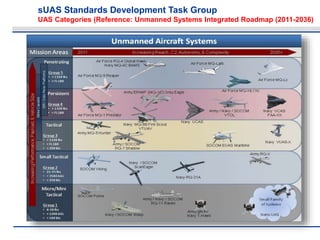
UAS Categories (Reference: Unmanned Systems Integrated Roadmap (2011-2036)
sUAS Standards Development Task Group
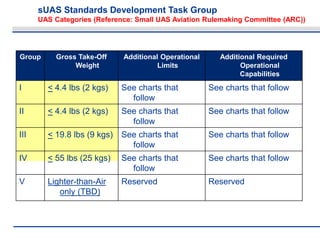
UAS Categories (Reference: Small UAS Aviation Rulemaking Committee (ARC))
Group Gross Take-Off
Weight
Additional Operational
Limits
Additional Required
Operational
Capabilities
I < 4.4 lbs (2 kgs) See charts that
follow
See charts that follow
II < 4.4 lbs (2 kgs) See charts that
follow
See charts that follow
III < 19.8 lbs (9 kgs) See charts that
follow
See charts that follow
IV < 55 lbs (25 kgs) See charts that
follow
See charts that follow
V Lighter-than-Air
only (TBD)
Reserved Reserved
sUAS Standards Development Task Group
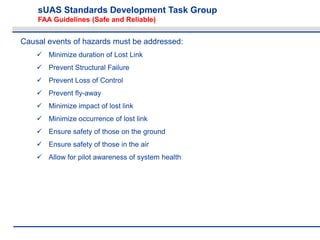
FAA Guidelines (Safe and Reliable)
Causal events of hazards must be addressed:
 Minimize duration of Lost Link
 Prevent Structural Failure
 Prevent Loss of Control
 Prevent fly-away
 Minimize impact of lost link
 Minimize occurrence of lost link
 Ensure safety of those on the ground
 Ensure safety of those in the air
 Allow for pilot awareness of system health
sUAS Standards Development Task Group
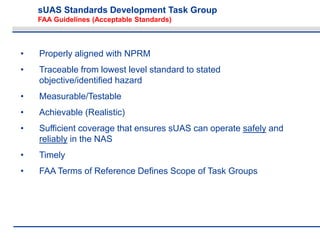
FAA Guidelines (Acceptable Standards)
• Properly aligned with NPRM
• Traceable from lowest level standard to stated
objective/identified hazard
• Measurable/Testable
• Achievable (Realistic)
• Sufficient coverage that ensures sUAS can operate safely and
reliably in the NAS
• Timely
• FAA Terms of Reference Defines Scope of Task Groups
sUAS Standards Development Task Group
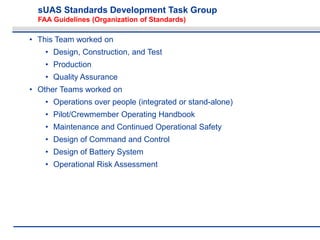
FAA Guidelines (Organization of Standards)
• This Team worked on
• Design, Construction, and Test
• Production
• Quality Assurance
• Other Teams worked on
• Operations over people (integrated or stand-alone)
• Pilot/Crewmember Operating Handbook
• Maintenance and Continued Operational Safety
• Design of Command and Control
• Design of Battery System
• Operational Risk Assessment
sUAS Standards Development Task Group
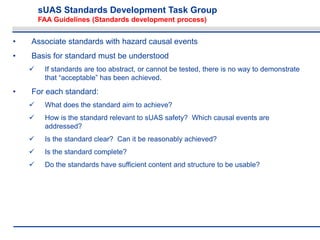
FAA Guidelines (Standards development process)
• Associate standards with hazard causal events
• Basis for standard must be understood
 If standards are too abstract, or cannot be tested, there is no way to demonstrate
that “acceptable” has been achieved.
• For each standard:
 What does the standard aim to achieve?
 How is the standard relevant to sUAS safety? Which causal events are
addressed?
 Is the standard clear? Can it be reasonably achieved?
 Is the standard complete?
 Do the standards have sufficient content and structure to be usable?
sUAS Standards Development Task Group
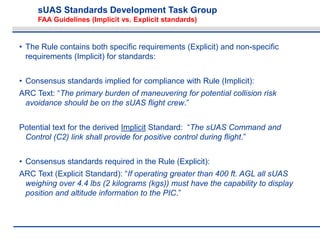
FAA Guidelines (Implicit vs. Explicit standards)
• The Rule contains both specific requirements (Explicit) and non-specific
requirements (Implicit) for standards:
• Consensus standards implied for compliance with Rule (Implicit):
ARC Text: “The primary burden of maneuvering for potential collision risk
avoidance should be on the sUAS flight crew.”
Potential text for the derived Implicit Standard: “The sUAS Command and
Control (C2) link shall provide for positive control during flight.”
• Consensus standards required in the Rule (Explicit):
ARC Text (Explicit Standard): “If operating greater than 400 ft. AGL all sUAS
weighing over 4.4 lbs (2 kilograms (kgs)) must have the capability to display
position and altitude information to the PIC.”
sUAS Standards Development Task Group
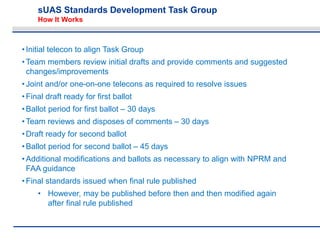
How It Works
•Initial telecon to align Task Group
•Team members review initial drafts and provide comments and suggested
changes/improvements
•Joint and/or one-on-one telecons as required to resolve issues
•Final draft ready for first ballot
•Ballot period for first ballot – 30 days
•Team reviews and disposes of comments – 30 days
•Draft ready for second ballot
•Ballot period for second ballot – 45 days
•Additional modifications and ballots as necessary to align with NPRM and
FAA guidance
•Final standards issued when final rule published
• However, may be published before then and then modified again
after final rule published
Thanks For Listening!
Doug Marshall
TrueNorth Consulting LLC
dmarshall511@gmail.com
701-740-9759

Douglas Marshall, TrueNorth Consulting

  • 2.
    ASTM F38 sUAS StandardsDevelopment Task Group for Design and Construction Design and Production Design for Command and Control Maintenance and Continued Airworthiness Quality Assurance Aircraft Flight Manual Batteries Operational Risk Assessment Operations Over People Operations BVLOS (pending)
  • 3.
    Paths to Operations FMRA§ 333 COA 14 CFR § 21.17(b) Type Certificate ??? Where do standards fit in?
  • 4.
    sUAS Standards DevelopmentTask Group Objectives/Constraints/Approach • Objectives • To finalize draft standards for: • Design, Construction, and Test • Production • Quality Assurance (for non-ISO Certified entities) • Ensure the standards are developed so that  They are acceptable to the FAA (safe and reliable), and  Affordable and cost-effective solution for the industry and the user. • Major Constraints / Guidelines • FAA guidelines / recommendations • Small UAS NPRM • Schedule • Overall Approach • Identify core team to review and improve existing draft standards prior to next ballot • Cleary define sUAS category (with a list of example models / names) – especially for newcomers • Understand FAA requirements / guidelines • Define scope of standards / framework • Benchmark (Obtain and review existing standards for similar applications) • Review current draft standards (keeping in mind the objectives) • Maintain Traceability (requirements versus standards)
  • 5.
    sUAS Standards DevelopmentTask Group Core Team • Technical Lead – Ted Wierzbanowski (AeroVironment) • FAA Points of Contact • Design, Construction, and Test – Ben Walsh and Jeff Bergson • Production – Ken Fugate • Quality Assurance – Jeff Bergson • Other Team Members • Paul McDuffee (Insitu) • Joe Boyd (Mitre) • Jonathan Lynch (Honeywell) • Geoff Bland (NASA) • Fred Marks (Agent for Leo Industries) • Thorsten Hisam (Aurora) • Doug Marshall (NMSU)
  • 6.
    sUAS Standards DevelopmentTask Group UAS Categories (Reference: Unmanned Systems Integrated Roadmap (2011-2036)
  • 7.
    sUAS Standards DevelopmentTask Group UAS Categories (Reference: Small UAS Aviation Rulemaking Committee (ARC)) Group Gross Take-Off Weight Additional Operational Limits Additional Required Operational Capabilities I < 4.4 lbs (2 kgs) See charts that follow See charts that follow II < 4.4 lbs (2 kgs) See charts that follow See charts that follow III < 19.8 lbs (9 kgs) See charts that follow See charts that follow IV < 55 lbs (25 kgs) See charts that follow See charts that follow V Lighter-than-Air only (TBD) Reserved Reserved
  • 8.
    sUAS Standards DevelopmentTask Group FAA Guidelines (Safe and Reliable) Causal events of hazards must be addressed:  Minimize duration of Lost Link  Prevent Structural Failure  Prevent Loss of Control  Prevent fly-away  Minimize impact of lost link  Minimize occurrence of lost link  Ensure safety of those on the ground  Ensure safety of those in the air  Allow for pilot awareness of system health
  • 9.
    sUAS Standards DevelopmentTask Group FAA Guidelines (Acceptable Standards) • Properly aligned with NPRM • Traceable from lowest level standard to stated objective/identified hazard • Measurable/Testable • Achievable (Realistic) • Sufficient coverage that ensures sUAS can operate safely and reliably in the NAS • Timely • FAA Terms of Reference Defines Scope of Task Groups
  • 10.
    sUAS Standards DevelopmentTask Group FAA Guidelines (Organization of Standards) • This Team worked on • Design, Construction, and Test • Production • Quality Assurance • Other Teams worked on • Operations over people (integrated or stand-alone) • Pilot/Crewmember Operating Handbook • Maintenance and Continued Operational Safety • Design of Command and Control • Design of Battery System • Operational Risk Assessment
  • 11.
    sUAS Standards DevelopmentTask Group FAA Guidelines (Standards development process) • Associate standards with hazard causal events • Basis for standard must be understood  If standards are too abstract, or cannot be tested, there is no way to demonstrate that “acceptable” has been achieved. • For each standard:  What does the standard aim to achieve?  How is the standard relevant to sUAS safety? Which causal events are addressed?  Is the standard clear? Can it be reasonably achieved?  Is the standard complete?  Do the standards have sufficient content and structure to be usable?
  • 12.
    sUAS Standards DevelopmentTask Group FAA Guidelines (Implicit vs. Explicit standards) • The Rule contains both specific requirements (Explicit) and non-specific requirements (Implicit) for standards: • Consensus standards implied for compliance with Rule (Implicit): ARC Text: “The primary burden of maneuvering for potential collision risk avoidance should be on the sUAS flight crew.” Potential text for the derived Implicit Standard: “The sUAS Command and Control (C2) link shall provide for positive control during flight.” • Consensus standards required in the Rule (Explicit): ARC Text (Explicit Standard): “If operating greater than 400 ft. AGL all sUAS weighing over 4.4 lbs (2 kilograms (kgs)) must have the capability to display position and altitude information to the PIC.”
  • 13.
    sUAS Standards DevelopmentTask Group How It Works •Initial telecon to align Task Group •Team members review initial drafts and provide comments and suggested changes/improvements •Joint and/or one-on-one telecons as required to resolve issues •Final draft ready for first ballot •Ballot period for first ballot – 30 days •Team reviews and disposes of comments – 30 days •Draft ready for second ballot •Ballot period for second ballot – 45 days •Additional modifications and ballots as necessary to align with NPRM and FAA guidance •Final standards issued when final rule published • However, may be published before then and then modified again after final rule published
  • 14.
    Thanks For Listening! DougMarshall TrueNorth Consulting LLC dmarshall511@gmail.com 701-740-9759