6 SMALL STEPS TO END
PROCRASTINATION
Dr.	Rachna	Jain
As a psychologist and business
coach, I’m always intrigued
about the place where a person’s
psychology impacts their
business.
In a way, this is happening all the
time - our individual psychology
(HOW WE THINK, FEEL,
INTERPRET, PERCEIVE)
is constantly impacting our
business.
It defines whether we feel
HOPEFUL OR PESSIMISTIC,
CONFIDENT OR FEARFUL,
whether we extend ourselves to
clients (or not) and how we think
about ourselves and the
contribution we make.
One main reason people procrastinate is…
BECAUSE THEY DON’T
FEEL THE REWARDS OF
COMPLETING THE TASK
ARE WORTH IT.
The effort required feels to be so much more than
what will be gained.
Psychological studies have
suggested that procrastination
is the
PRODUCTOF POOR SELF
REGULATION,
a gap between intention and
action.
There is also a misperception
that procrastination is not
harmful, or “hurts no-one.”
Procrastinators, in general, tend
to experience more stress and
lowered well being.
Chronic procrastinators can also
miss out on opportunities…
AND THIS IS VERY
EVIDENT IN BUSINESS.
Let’s say, for example, that you have been invited to
take part in email list building giveaway. This all sounds
great, and they’ve asked you to provide your free gift
and opt-in page by Thursday. You know you want to
create something new and special.
YOU THINK ABOUT IT.
MAKE A LIST.
DEFINE THE STEPS.
…and yet nothing gets done.
You’re aware that the days are slipping by,
one after the other, and you perceive the
stress you’re feeling as positive –
“This will really motivate me to get this done.
I work better under deadlines.”
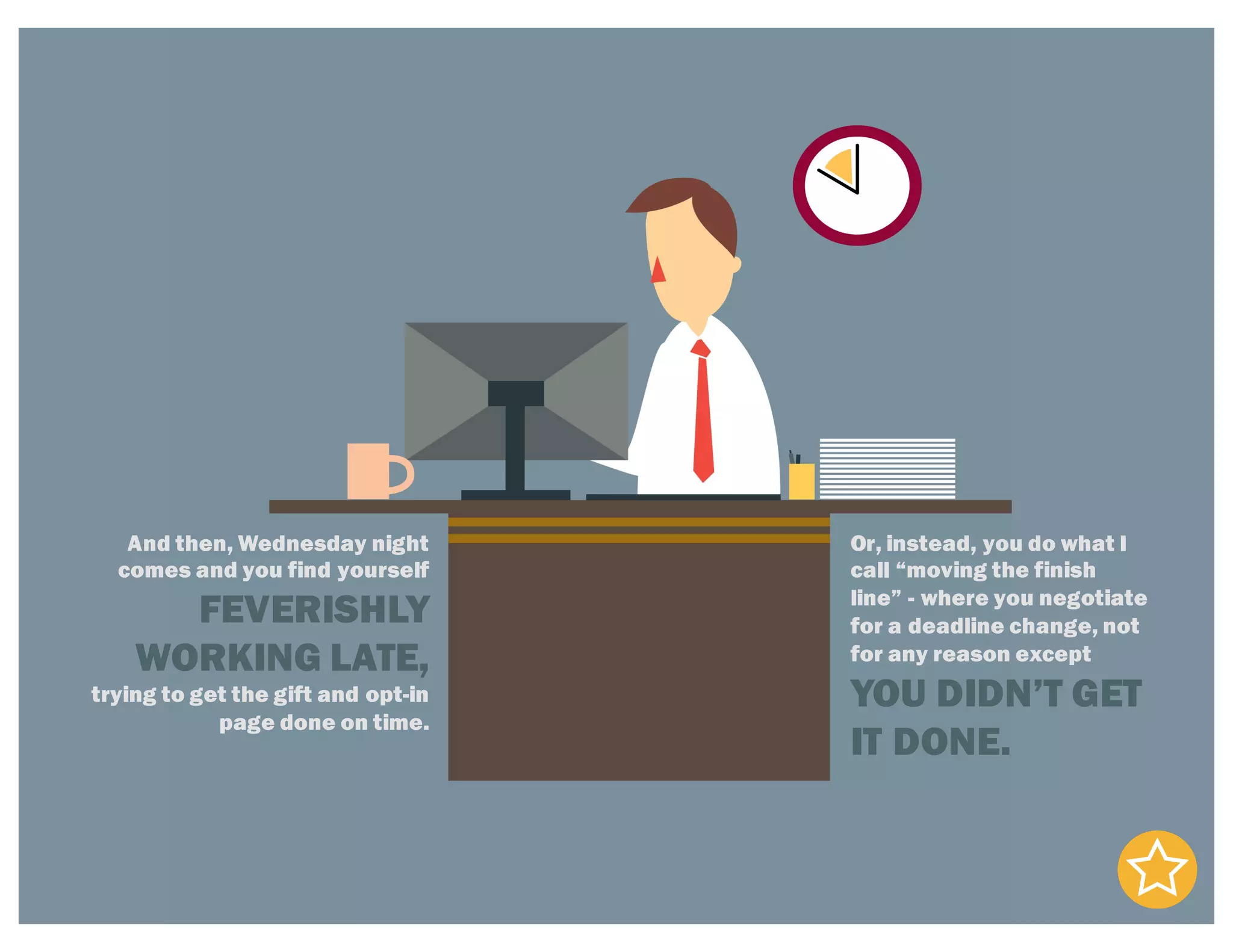
And then, Wednesday night
comes and you find yourself
FEVERISHLY
WORKING LATE,
trying to get the gift and opt-in
page done on time.
Or, instead, you do what I
call “moving the finish
line” - where you negotiate
for a deadline change, not
for any reason except
YOU DIDN’T GET
IT DONE.
In my experience,
OPPORTUNITIES COME
TO THOSE WHO ARE
READY FOR THEM
…not those who say yes and then delay and
defer.
Eventually, the opportunities will stop coming.
This isn’t to scare you or make you feel badly; just
to explain that procrastination does have some
real costs associated with it.
YOU LOSE OUT
WHEN YOU
CHRONICALLY
PROCRASTINATE.
The challenge with chronic
procrastination is that you don’t
tend to learn from experience. You
end up repeating the same cycle
over and over again.
So how do you begin to shift your
psychology and your behavior
towards greater completion and
timeliness with your tasks?
Here are some steps that will help:
BREAK THE
TASKS INTO
CHUNKS.
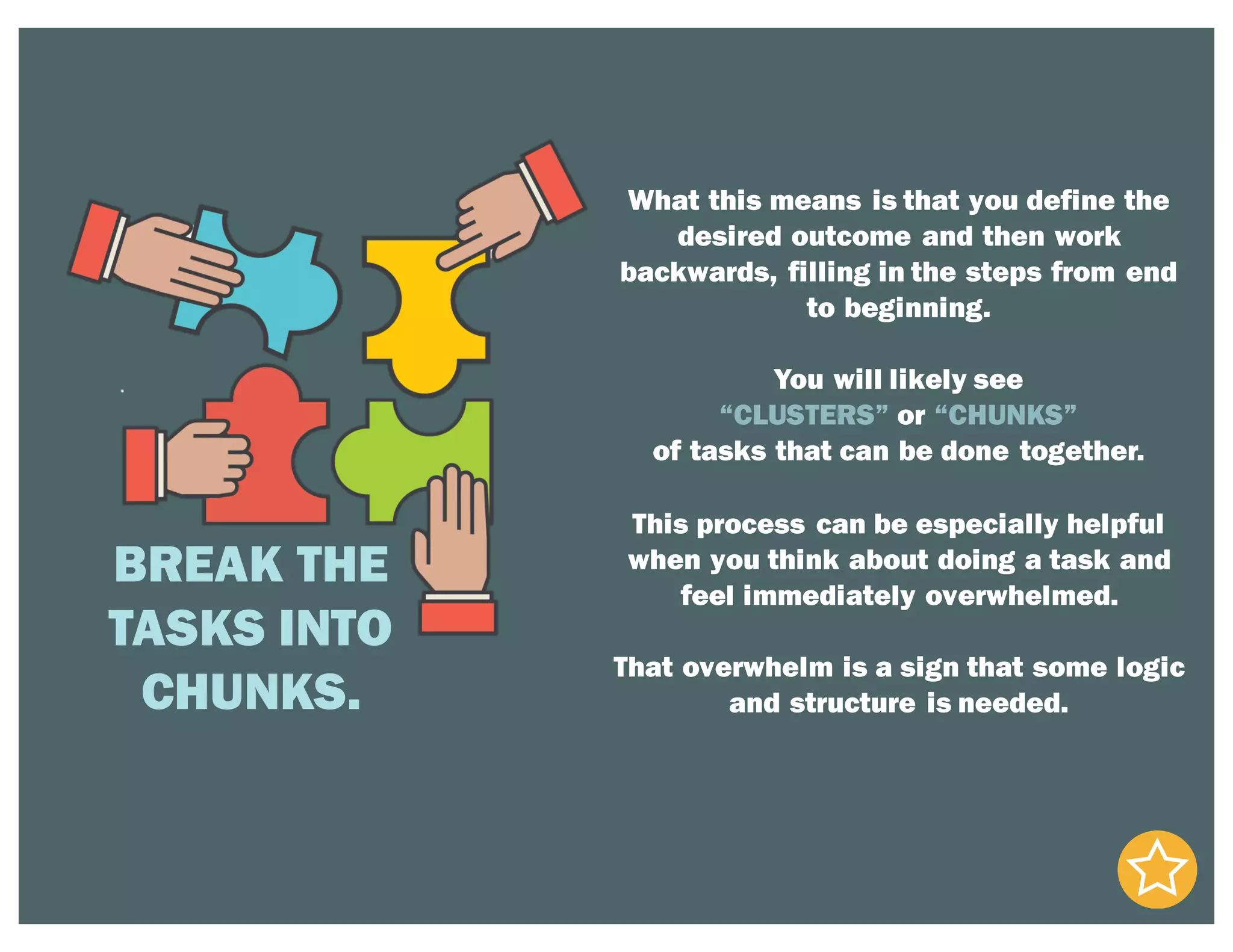
What this means is that you define the
desired outcome and then work
backwards, filling in the steps from end
to beginning.
You will likely see
“CLUSTERS” or “CHUNKS”
of tasks that can be done together.
This process can be especially helpful
when you think about doing a task and
feel immediately overwhelmed.
That overwhelm is a sign that some logic
and structure is needed.
SET UP YOUR
ENVIRONMENT
FOR SUCCESS.
I used this tip a lot when I first began
working out with my personal trainer.
Prior to that, I was never a person
who exercised consistently.
I would always have lots of excuses
for why I didn’t have time to go to the
gym. I felt overloaded with having to
get up and out early in order to be on
time.
So I started pulling out my workout
clothes the night before, and changing
into them as soon as I woke up.
Once I was changed into my gym gear, it
reduced the friction and hesitation
about going.
Of course, paying for training and
knowing my trainer was waiting for me
also helped too - I’ll talk more about
both of those next.
INVEST IN
YOUR
CHOSEN
OUTCOME.
$ I was much more motivated to go to the
gym when I knew I was paying to be
there.
The same goes for your clients - they are
likely to be more motivated and to
PROCRASTINATE LESS
when they have made a big investment
to work with you.
Most of us want to rise to whatever bar
we’ve set for ourselves - and so,
sometimes, putting money into outcome
is a way to
OVERCOME PROCRASTINATION.
GET
ACCOUNTABILITY
The other element of something like
personal training or business coaching
is the element of ACCOUNTABILITY.
• Most of us are more likely to do
something we’ve promised someone
else before we do that same thing for
ourselves.
• Committing to another person is a
way of overcoming procrastination.
• A skilled mentor can hold you
accountable to keep moving forward,
until you are able to do this for
yourself.
SET UP
CONTINGENCIES/
MAKE IT A GAME
Setting up contingencies or
gamifying the tasks can help.
Setting up contingencies is when
you make a reward contingent upon
completing something - like “I’ll go
for a walk as soon as I finish writing
this blog post.”
Gamifying might be turning the
same task into points – “I get 10
points for writing this blog post, and
10 points for replying to emails, etc,
once I hit 45 points, I’ll take the
afternoon off.”
(It’s similar to a contingency,except sometimes
gamified goals feel lighter and more fun to some
people.)
At times,
PEOPLE
PROCRASTINATE
BECAUSE THEIR TO-DO
LIST IS TOO LONG.
They know, underneath, that they will never get it done-
and so they don’t want to try. It’s difficult, I think, to live
constantly in a state of incompletion - to end each day
without any SATISFACTION
that you got the most important things done.
If you are a person who has a to-do list that keeps
getting longer and longer - and you feel like you’re
running to keep up with it; I suggest stepping back and
reviewing that list for what’s most ESSENTIAL.
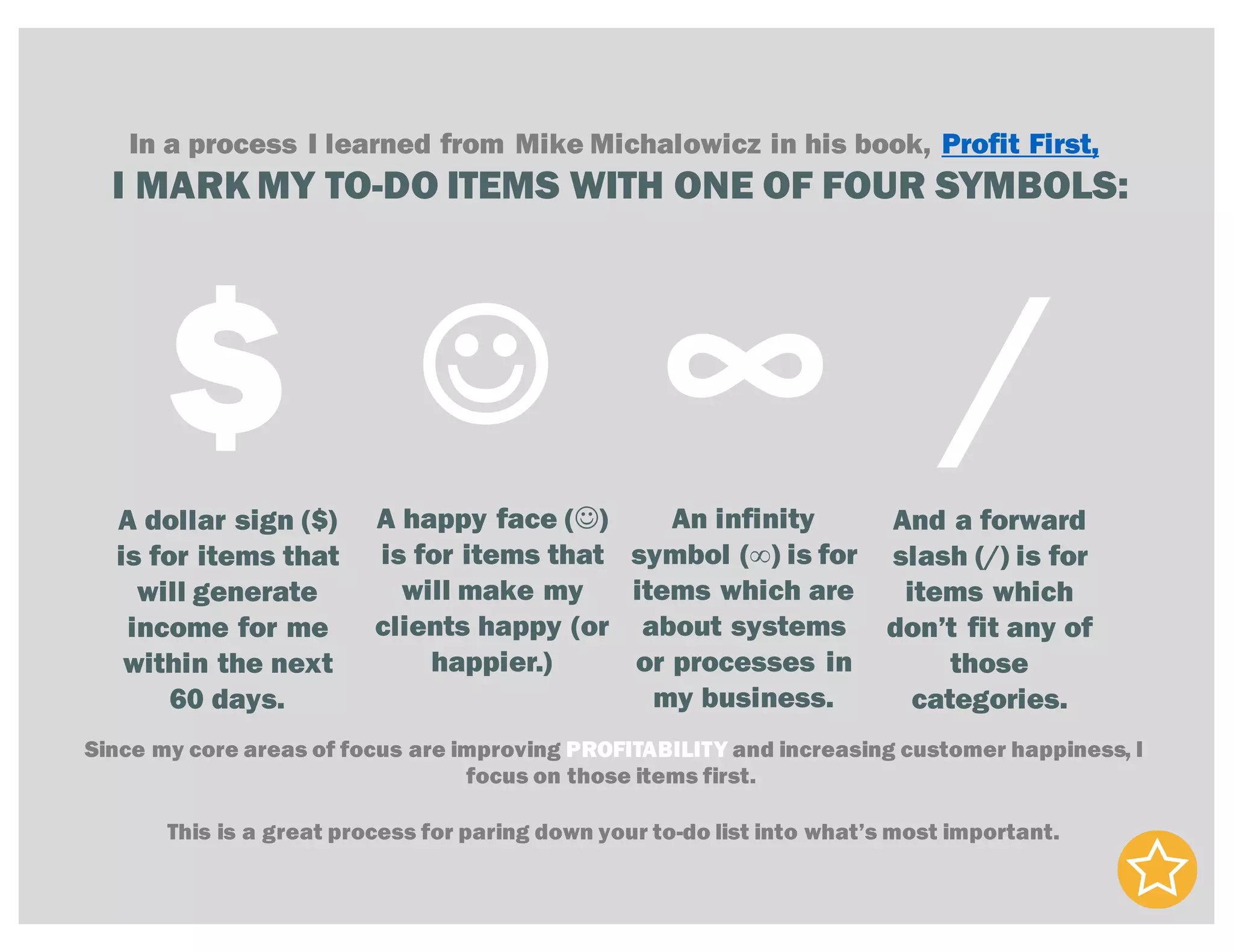
In a process I learned from Mike Michalowicz in his book, Profit First,
I MARK MY TO-DO ITEMS WITH ONE OF FOUR SYMBOLS:
$ ∞J /A dollar sign ($)
is for items that
will generate
income for me
within the next
60 days.
A happy face (J)
is for items that
will make my
clients happy (or
happier.)
An infinity
symbol (∞) is for
items which are
about systems
or processes in
my business.
And a forward
slash (/) is for
items which
don’t fit any of
those
categories.
Since my core areas of focus are improving PROFITABILITY and increasing customer happiness, I
focus on those items first.
This is a great process for paring down your to-do list into what’s most important.
I know we’re all under a lot of pressure to get more
done, and to keep up with everything all at the same
time.
UNFORTUNATELY, THAT ONLY
WORKS IN OUR MINDS –
NOT IN OUR BODIES.
We can’t do everything at once.
And, in some cases, we list things that we shouldn’t ever be doing - or won’t ever
do anyway.
Which leads me to my BONUS tip for ending
procrastination:
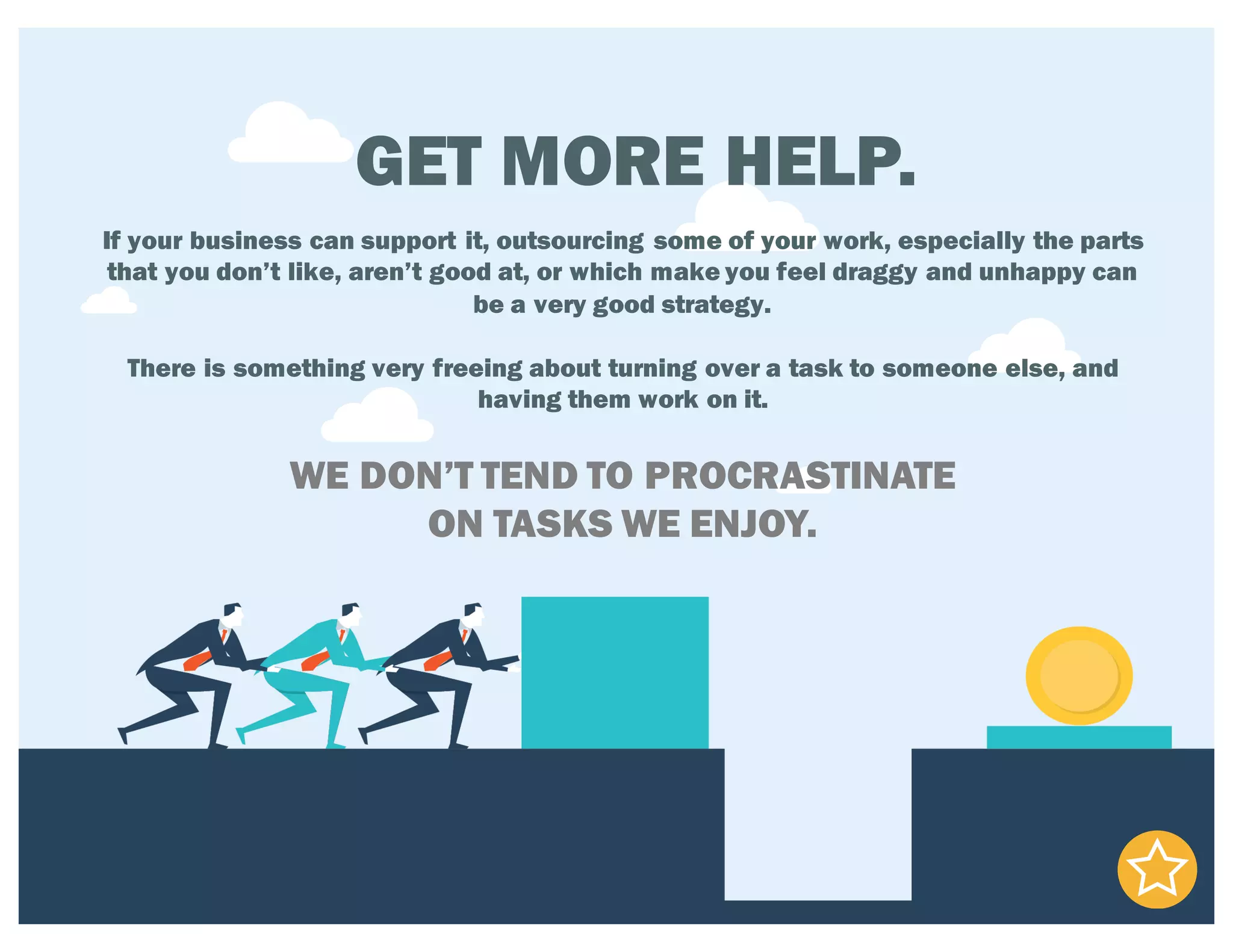
GET MORE HELP.
If your business can support it, outsourcing some of your work, especially the parts
that you don’t like, aren’t good at, or which make you feel draggy and unhappy can
be a very good strategy.
There is something very freeing about turning over a task to someone else, and
having them work on it.
WE DON’T TEND TO PROCRASTINATE
ON TASKS WE ENJOY.
PROCRASTINATION ISN’T NEW.
“Do not put your
work off ‘til
tomorrow and the
day after.”
- Greek poet Hesoid (in 800 B.C.!)
– but it seems to be more and more
of a problem as we have more
options and more opportunities.
The steps I’ve shared here are the
exact ones I use to stop
procrastination in its tracks.
LET ME KNOW HOW THEY
WORK FOR YOU!
Because You Deserve to Be Liked. And Rich.
Read the Blog at ProfitablePopularity.com

6 Small Steps to End Procrastination

  • 1.
    6 SMALL STEPSTO END PROCRASTINATION Dr. Rachna Jain
  • 2.
    As a psychologistand business coach, I’m always intrigued about the place where a person’s psychology impacts their business. In a way, this is happening all the time - our individual psychology (HOW WE THINK, FEEL, INTERPRET, PERCEIVE) is constantly impacting our business. It defines whether we feel HOPEFUL OR PESSIMISTIC, CONFIDENT OR FEARFUL, whether we extend ourselves to clients (or not) and how we think about ourselves and the contribution we make.
  • 3.
    One main reasonpeople procrastinate is… BECAUSE THEY DON’T FEEL THE REWARDS OF COMPLETING THE TASK ARE WORTH IT. The effort required feels to be so much more than what will be gained.
  • 4.
    Psychological studies have suggestedthat procrastination is the PRODUCTOF POOR SELF REGULATION, a gap between intention and action. There is also a misperception that procrastination is not harmful, or “hurts no-one.” Procrastinators, in general, tend to experience more stress and lowered well being.
  • 5.
    Chronic procrastinators canalso miss out on opportunities… AND THIS IS VERY EVIDENT IN BUSINESS.
  • 6.
    Let’s say, forexample, that you have been invited to take part in email list building giveaway. This all sounds great, and they’ve asked you to provide your free gift and opt-in page by Thursday. You know you want to create something new and special. YOU THINK ABOUT IT. MAKE A LIST. DEFINE THE STEPS. …and yet nothing gets done. You’re aware that the days are slipping by, one after the other, and you perceive the stress you’re feeling as positive – “This will really motivate me to get this done. I work better under deadlines.”
  • 7.
    And then, Wednesdaynight comes and you find yourself FEVERISHLY WORKING LATE, trying to get the gift and opt-in page done on time. Or, instead, you do what I call “moving the finish line” - where you negotiate for a deadline change, not for any reason except YOU DIDN’T GET IT DONE.
  • 8.
    In my experience, OPPORTUNITIESCOME TO THOSE WHO ARE READY FOR THEM …not those who say yes and then delay and defer. Eventually, the opportunities will stop coming. This isn’t to scare you or make you feel badly; just to explain that procrastination does have some real costs associated with it.
  • 9.
    YOU LOSE OUT WHENYOU CHRONICALLY PROCRASTINATE. The challenge with chronic procrastination is that you don’t tend to learn from experience. You end up repeating the same cycle over and over again. So how do you begin to shift your psychology and your behavior towards greater completion and timeliness with your tasks? Here are some steps that will help:
  • 10.
    BREAK THE TASKS INTO CHUNKS. Whatthis means is that you define the desired outcome and then work backwards, filling in the steps from end to beginning. You will likely see “CLUSTERS” or “CHUNKS” of tasks that can be done together. This process can be especially helpful when you think about doing a task and feel immediately overwhelmed. That overwhelm is a sign that some logic and structure is needed.
  • 11.
    SET UP YOUR ENVIRONMENT FORSUCCESS. I used this tip a lot when I first began working out with my personal trainer. Prior to that, I was never a person who exercised consistently. I would always have lots of excuses for why I didn’t have time to go to the gym. I felt overloaded with having to get up and out early in order to be on time. So I started pulling out my workout clothes the night before, and changing into them as soon as I woke up. Once I was changed into my gym gear, it reduced the friction and hesitation about going. Of course, paying for training and knowing my trainer was waiting for me also helped too - I’ll talk more about both of those next.
  • 12.
    INVEST IN YOUR CHOSEN OUTCOME. $ Iwas much more motivated to go to the gym when I knew I was paying to be there. The same goes for your clients - they are likely to be more motivated and to PROCRASTINATE LESS when they have made a big investment to work with you. Most of us want to rise to whatever bar we’ve set for ourselves - and so, sometimes, putting money into outcome is a way to OVERCOME PROCRASTINATION.
  • 13.
    GET ACCOUNTABILITY The other elementof something like personal training or business coaching is the element of ACCOUNTABILITY. • Most of us are more likely to do something we’ve promised someone else before we do that same thing for ourselves. • Committing to another person is a way of overcoming procrastination. • A skilled mentor can hold you accountable to keep moving forward, until you are able to do this for yourself.
  • 14.
    SET UP CONTINGENCIES/ MAKE ITA GAME Setting up contingencies or gamifying the tasks can help. Setting up contingencies is when you make a reward contingent upon completing something - like “I’ll go for a walk as soon as I finish writing this blog post.” Gamifying might be turning the same task into points – “I get 10 points for writing this blog post, and 10 points for replying to emails, etc, once I hit 45 points, I’ll take the afternoon off.” (It’s similar to a contingency,except sometimes gamified goals feel lighter and more fun to some people.)
  • 15.
    At times, PEOPLE PROCRASTINATE BECAUSE THEIRTO-DO LIST IS TOO LONG. They know, underneath, that they will never get it done- and so they don’t want to try. It’s difficult, I think, to live constantly in a state of incompletion - to end each day without any SATISFACTION that you got the most important things done. If you are a person who has a to-do list that keeps getting longer and longer - and you feel like you’re running to keep up with it; I suggest stepping back and reviewing that list for what’s most ESSENTIAL.
  • 16.
    In a processI learned from Mike Michalowicz in his book, Profit First, I MARK MY TO-DO ITEMS WITH ONE OF FOUR SYMBOLS: $ ∞J /A dollar sign ($) is for items that will generate income for me within the next 60 days. A happy face (J) is for items that will make my clients happy (or happier.) An infinity symbol (∞) is for items which are about systems or processes in my business. And a forward slash (/) is for items which don’t fit any of those categories. Since my core areas of focus are improving PROFITABILITY and increasing customer happiness, I focus on those items first. This is a great process for paring down your to-do list into what’s most important.
  • 17.
    I know we’reall under a lot of pressure to get more done, and to keep up with everything all at the same time. UNFORTUNATELY, THAT ONLY WORKS IN OUR MINDS – NOT IN OUR BODIES. We can’t do everything at once. And, in some cases, we list things that we shouldn’t ever be doing - or won’t ever do anyway. Which leads me to my BONUS tip for ending procrastination:
  • 18.
    GET MORE HELP. Ifyour business can support it, outsourcing some of your work, especially the parts that you don’t like, aren’t good at, or which make you feel draggy and unhappy can be a very good strategy. There is something very freeing about turning over a task to someone else, and having them work on it. WE DON’T TEND TO PROCRASTINATE ON TASKS WE ENJOY.
  • 19.
    PROCRASTINATION ISN’T NEW. “Donot put your work off ‘til tomorrow and the day after.” - Greek poet Hesoid (in 800 B.C.!) – but it seems to be more and more of a problem as we have more options and more opportunities. The steps I’ve shared here are the exact ones I use to stop procrastination in its tracks. LET ME KNOW HOW THEY WORK FOR YOU!
  • 20.
    Because You Deserveto Be Liked. And Rich. Read the Blog at ProfitablePopularity.com