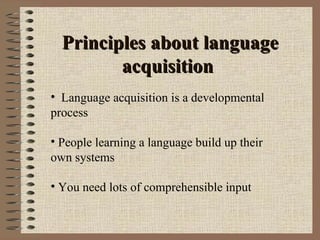
Principles about language acquisition   Language acquisition is a developmental process  People learning a language build up their own systems  You need lots of comprehensible input
You can improve your sound discrimination, memory, and grammatical sensitivity skills  You can compensate for deficiencies in some skills  The sooner you can acquire the grammatical system of a language, the sooner you can use the language creatively
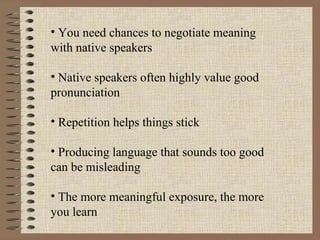
You need chances to negotiate meaning with native speakers  Native speakers often highly value good pronunciation  Repetition helps things stick Producing language that sounds too good can be misleading  The more meaningful exposure, the more you learn
You cannot rely on memorization alone  Memorized material can give a false impression of your proficiency  Your brain analyzes language whether you know it or not Knowing a language is different from knowing about a language  Knowing about a language may help you learn it
Body language, gestures, and your face communicate as much as words  Learners build up an auditory image of what the language sounds like  Language learners need to learn to understand and produce well-formed discourses  Predictable scripts aid comprehension  Language learners seem to hit plateaus
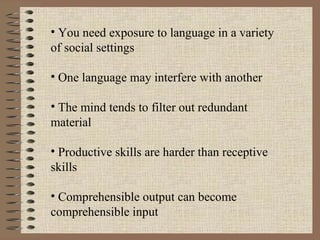
You need exposure to language in a variety of social settings  One language may interfere with another  The mind tends to filter out redundant material Productive skills are harder than receptive skills  Comprehensible output can become comprehensible input
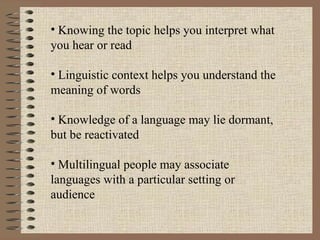
Knowing the topic helps you interpret what you hear or read  Linguistic context helps you understand the meaning of words  Knowledge of a language may lie dormant, but be reactivated  Multilingual people may associate languages with a particular setting or audience

6. Principles About Language Acquisition

  • 1.
    Principles about languageacquisition Language acquisition is a developmental process People learning a language build up their own systems You need lots of comprehensible input
  • 2.
    You can improveyour sound discrimination, memory, and grammatical sensitivity skills You can compensate for deficiencies in some skills The sooner you can acquire the grammatical system of a language, the sooner you can use the language creatively
  • 3.
    You need chancesto negotiate meaning with native speakers Native speakers often highly value good pronunciation Repetition helps things stick Producing language that sounds too good can be misleading The more meaningful exposure, the more you learn
  • 4.
    You cannot relyon memorization alone Memorized material can give a false impression of your proficiency Your brain analyzes language whether you know it or not Knowing a language is different from knowing about a language Knowing about a language may help you learn it
  • 5.
    Body language, gestures,and your face communicate as much as words Learners build up an auditory image of what the language sounds like Language learners need to learn to understand and produce well-formed discourses Predictable scripts aid comprehension Language learners seem to hit plateaus
  • 6.
    You need exposureto language in a variety of social settings One language may interfere with another The mind tends to filter out redundant material Productive skills are harder than receptive skills Comprehensible output can become comprehensible input
  • 7.
    Knowing the topichelps you interpret what you hear or read Linguistic context helps you understand the meaning of words Knowledge of a language may lie dormant, but be reactivated Multilingual people may associate languages with a particular setting or audience