Electricity 6D: Thursday 9 th  December
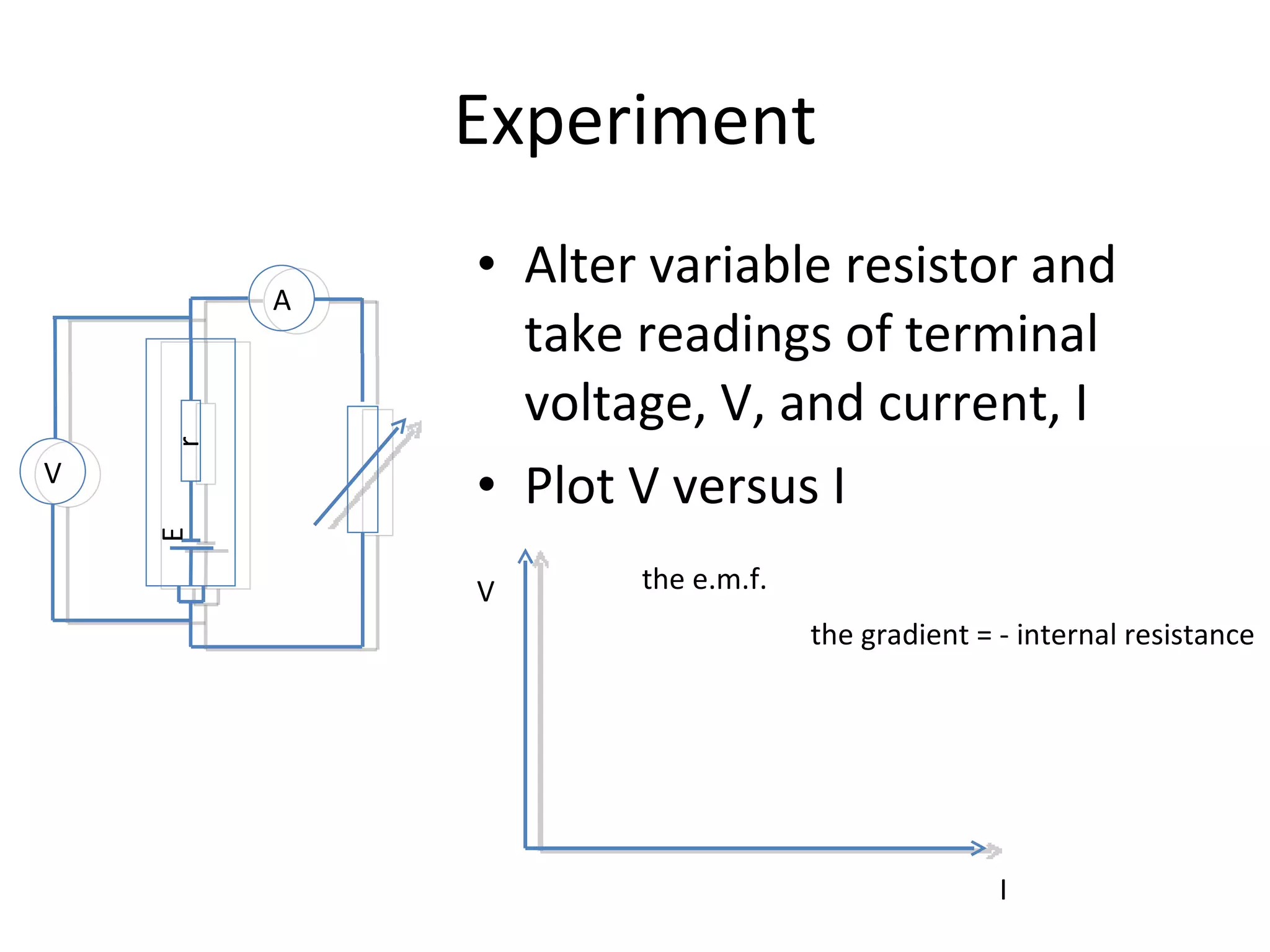
Experiment Alter variable resistor and take readings of terminal voltage, V, and current, I Plot V versus I r E V A V I the e.m.f. the gradient = - internal resistance
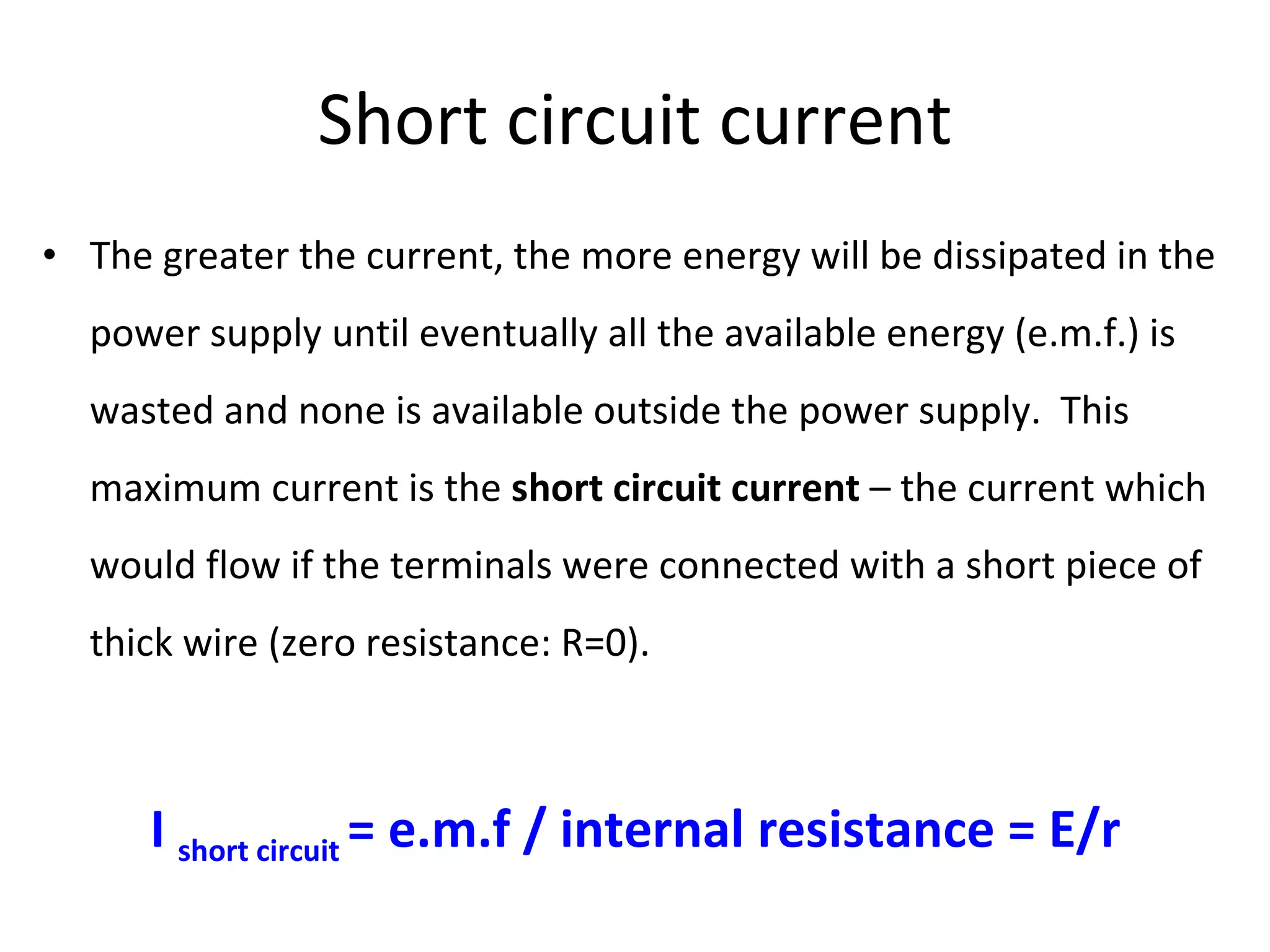
Short circuit current The greater the current, the more energy will be dissipated in the power supply until eventually all the available energy (e.m.f.) is wasted and none is available outside the power supply.  This maximum current is the  short circuit current  – the current which would flow if the terminals were connected with a short piece of thick wire (zero resistance: R=0). I  short circuit  = e.m.f / internal resistance = E/r
Purple Book, page 51 Exercise 4.5: E.M.F. and Internal Resistance, Questions 1   11
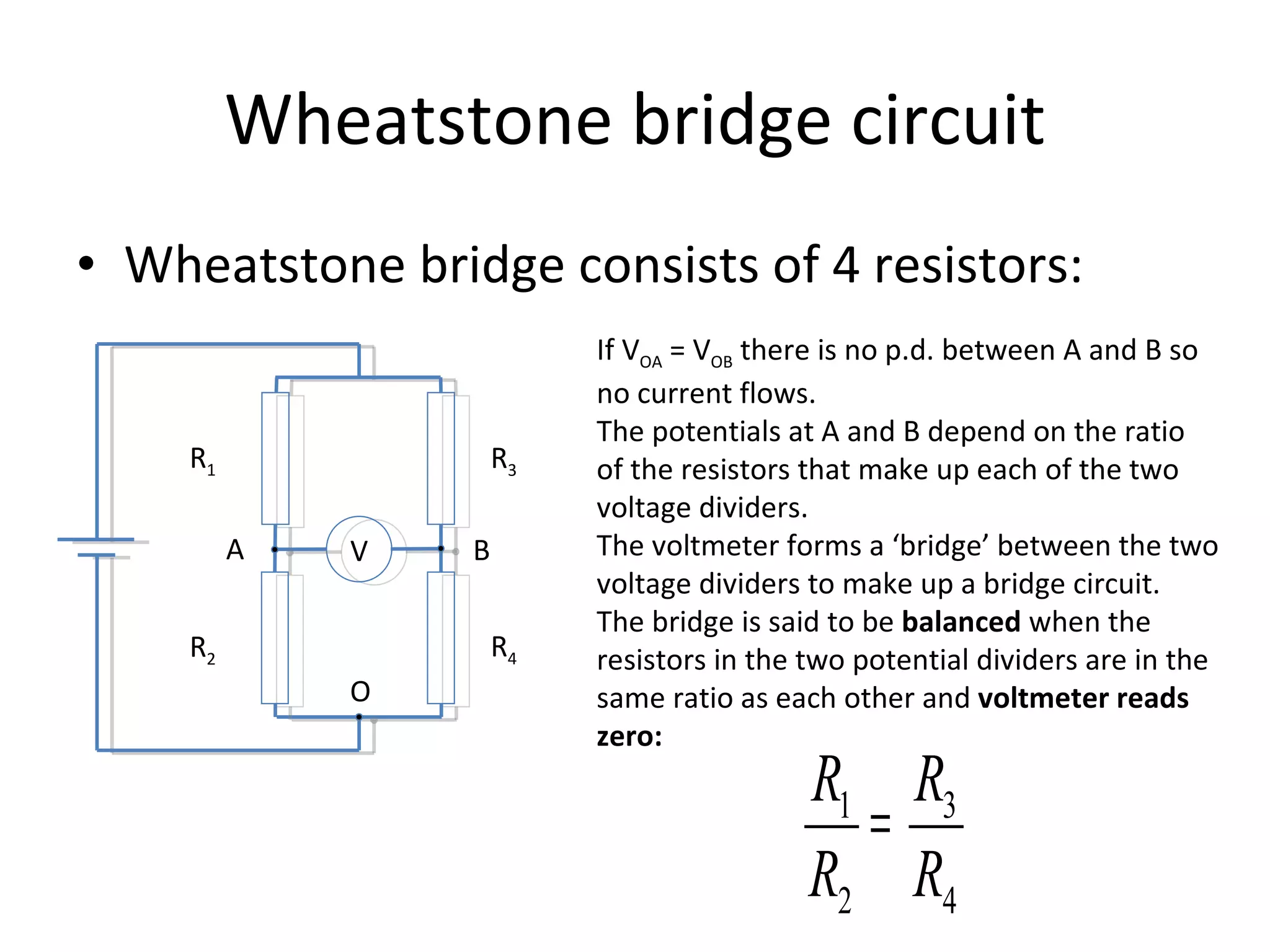
Wheatstone bridge circuit Wheatstone bridge consists of 4 resistors: V R 3 R 4 R 1 R 2 A B If V OA  = V OB  there is no p.d. between A and B so no current flows. The potentials at A and B depend on the ratio of the resistors that make up each of the two voltage dividers. The voltmeter forms a ‘bridge’ between the two voltage dividers to make up a bridge circuit. The bridge is said to be  balanced  when the resistors in the two potential dividers are in the same ratio as each other and  voltmeter reads zero: O
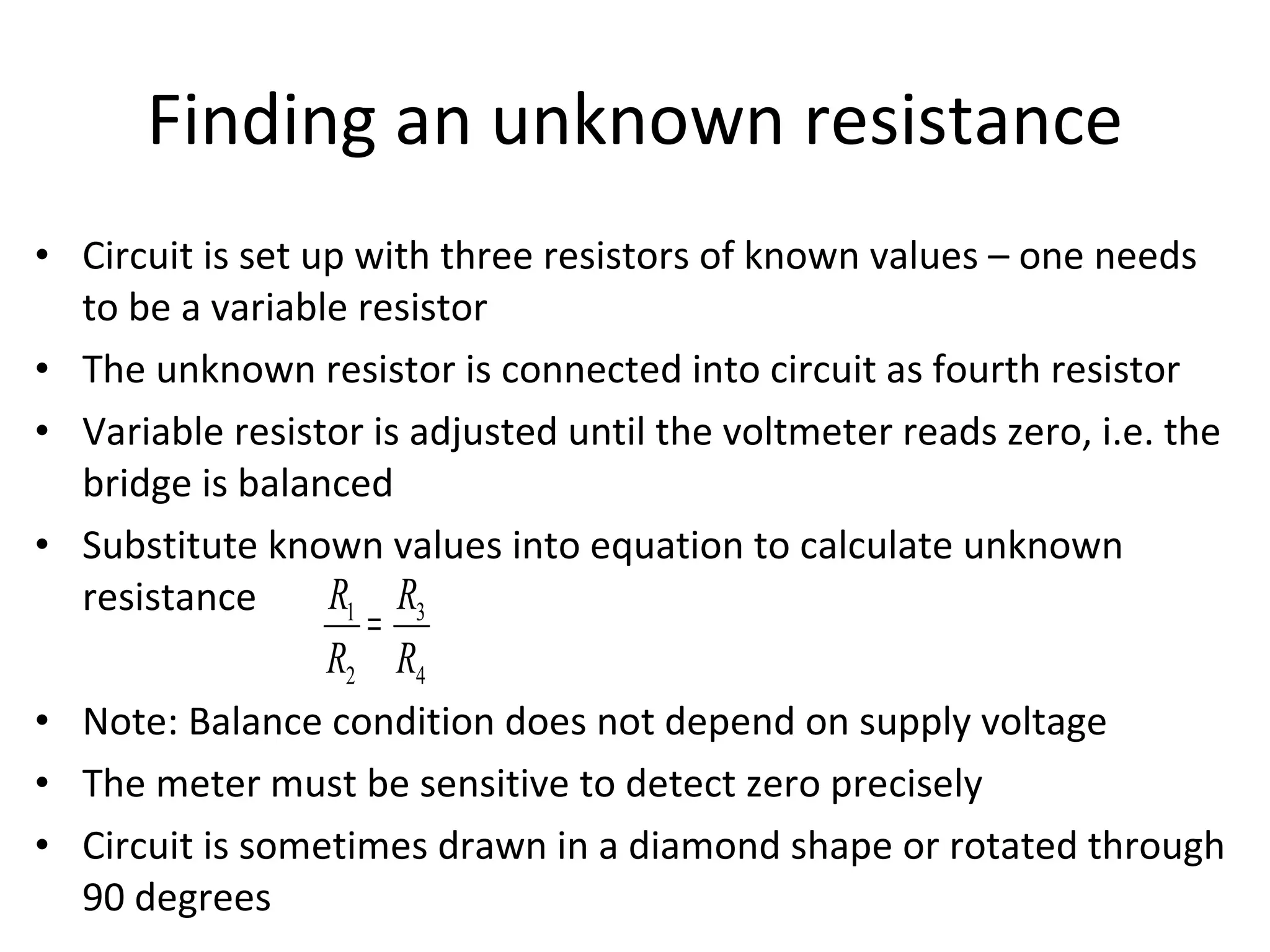
Finding an unknown resistance Circuit is set up with three resistors of known values – one needs to be a variable resistor The unknown resistor is connected into circuit as fourth resistor Variable resistor is adjusted until the voltmeter reads zero, i.e. the bridge is balanced Substitute known values into equation to calculate unknown resistance Note: Balance condition does not depend on supply voltage The meter must be sensitive to detect zero precisely Circuit is sometimes drawn in a diamond shape or rotated through 90 degrees
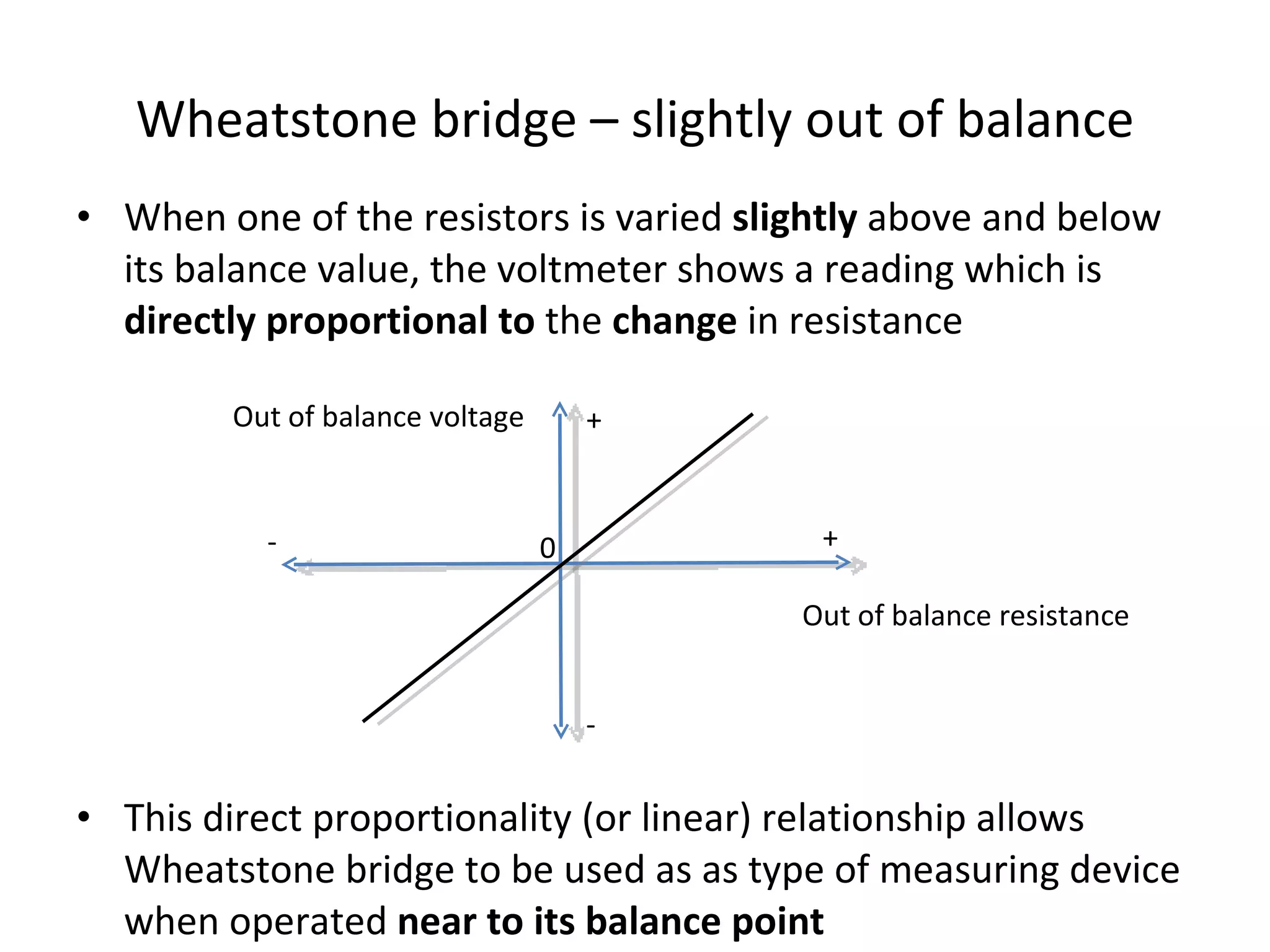
Wheatstone bridge – slightly out of balance When one of the resistors is varied  slightly  above and below its balance value, the voltmeter shows a reading which is  directly proportional to  the  change  in resistance This direct proportionality (or linear) relationship allows Wheatstone bridge to be used as as type of measuring device when operated  near to its balance point Out of balance voltage Out of balance resistance + + - - 0
Purple Book, page 53 Exercise 4.5: Wheatstone Bridges,  Questions 1    3

6 d electronics 091210

  • 1.
  • 2.
    Experiment Alter variableresistor and take readings of terminal voltage, V, and current, I Plot V versus I r E V A V I the e.m.f. the gradient = - internal resistance
  • 3.
    Short circuit currentThe greater the current, the more energy will be dissipated in the power supply until eventually all the available energy (e.m.f.) is wasted and none is available outside the power supply. This maximum current is the short circuit current – the current which would flow if the terminals were connected with a short piece of thick wire (zero resistance: R=0). I short circuit = e.m.f / internal resistance = E/r
  • 4.
    Purple Book, page51 Exercise 4.5: E.M.F. and Internal Resistance, Questions 1  11
  • 5.
    Wheatstone bridge circuitWheatstone bridge consists of 4 resistors: V R 3 R 4 R 1 R 2 A B If V OA = V OB there is no p.d. between A and B so no current flows. The potentials at A and B depend on the ratio of the resistors that make up each of the two voltage dividers. The voltmeter forms a ‘bridge’ between the two voltage dividers to make up a bridge circuit. The bridge is said to be balanced when the resistors in the two potential dividers are in the same ratio as each other and voltmeter reads zero: O
  • 6.
    Finding an unknownresistance Circuit is set up with three resistors of known values – one needs to be a variable resistor The unknown resistor is connected into circuit as fourth resistor Variable resistor is adjusted until the voltmeter reads zero, i.e. the bridge is balanced Substitute known values into equation to calculate unknown resistance Note: Balance condition does not depend on supply voltage The meter must be sensitive to detect zero precisely Circuit is sometimes drawn in a diamond shape or rotated through 90 degrees
  • 7.
    Wheatstone bridge –slightly out of balance When one of the resistors is varied slightly above and below its balance value, the voltmeter shows a reading which is directly proportional to the change in resistance This direct proportionality (or linear) relationship allows Wheatstone bridge to be used as as type of measuring device when operated near to its balance point Out of balance voltage Out of balance resistance + + - - 0
  • 8.
    Purple Book, page53 Exercise 4.5: Wheatstone Bridges, Questions 1  3

Editor's Notes

  • #6 Can also represent as a diamond format using a Galvanometer – a milliammeter