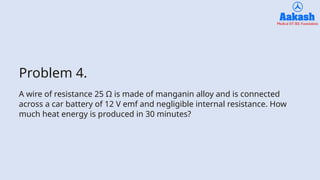
Electrical Circuits:
Powering Our
World
Welcome to the world of electrical circuits! These invisible
pathways of energy shape our modern lives. From powering
smartphones to lighting cities, circuits are the backbone of
technology.
Introduction to Electrical Circuits
1
Components
Circuits consist of power sources,
conductors, and load devices.
Each plays a crucial role in energy
flow.
2
Current Flow
Electrons move through
conductors, creating an electric
current. This flow powers our
devices.
3
Circuit Types
Circuits can be series, parallel, or
complex combinations. Each type
has unique properties.
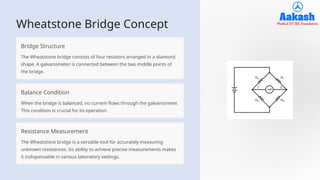
Wheatstone Bridge Concept
Bridge Structure
The Wheatstone bridge consists of four resistors arranged in a diamond
shape. A galvanometer is connected between the two middle points of
the bridge.
Balance Condition
When the bridge is balanced, no current flows through the galvanometer.
This condition is crucial for its operation.
Resistance Measurement
The Wheatstone bridge is a versatile tool for accurately measuring
unknown resistances. Its ability to achieve precise measurements makes
it indispensable in various laboratory settings.
Wheatstone Bridge
Problem
Given values: Step Calculation
R1 = 10Ω, R2 =
20Ω
1. Identify known
values
Ra = 15Ω, Rb = ?
The bridge is
balanced
2. Use the
balance equation
R1/R2 = Ra/Rb
3. Solve for Rx
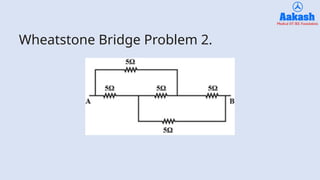
Wheatstone Bridge Problem 2.
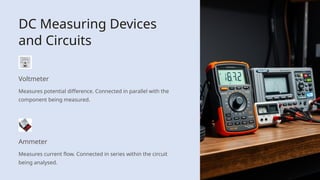
DC Measuring Devices
and Circuits
Voltmeter
Measures potential difference. Connected in parallel with the
component being measured.
Ammeter
Measures current flow. Connected in series within the circuit
being analysed.
Joule's Heating Effect: The
Fuse
1 Safety First
Fuses protect circuits from overcurrent. They're designed to
fail safely, preventing fires.
2 Melting Point
The fuse wire melts when current exceeds its rating. This
breaks the circuit.
3 Quick Response
Fuses react faster than circuit breakers. This rapid response
is crucial for sensitive electronics.
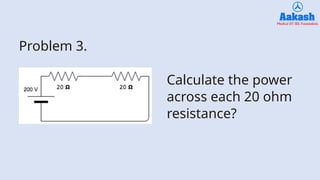
Problem 3.
Calculate the power
across each 20 ohm
resistance?
Problem 4.
A wire of resistance 25 Ω is made of manganin alloy and is connected
across a car battery of 12 V emf and negligible internal resistance. How
much heat energy is produced in 30 minutes?
Electrical-Circuits-Powering-Our-World.pptx

  • 1.
    Electrical Circuits: Powering Our World Welcometo the world of electrical circuits! These invisible pathways of energy shape our modern lives. From powering smartphones to lighting cities, circuits are the backbone of technology.
  • 2.
    Introduction to ElectricalCircuits 1 Components Circuits consist of power sources, conductors, and load devices. Each plays a crucial role in energy flow. 2 Current Flow Electrons move through conductors, creating an electric current. This flow powers our devices. 3 Circuit Types Circuits can be series, parallel, or complex combinations. Each type has unique properties.
  • 3.
    Wheatstone Bridge Concept BridgeStructure The Wheatstone bridge consists of four resistors arranged in a diamond shape. A galvanometer is connected between the two middle points of the bridge. Balance Condition When the bridge is balanced, no current flows through the galvanometer. This condition is crucial for its operation. Resistance Measurement The Wheatstone bridge is a versatile tool for accurately measuring unknown resistances. Its ability to achieve precise measurements makes it indispensable in various laboratory settings.
  • 4.
    Wheatstone Bridge Problem Given values:Step Calculation R1 = 10Ω, R2 = 20Ω 1. Identify known values Ra = 15Ω, Rb = ? The bridge is balanced 2. Use the balance equation R1/R2 = Ra/Rb 3. Solve for Rx
  • 5.
  • 6.
    DC Measuring Devices andCircuits Voltmeter Measures potential difference. Connected in parallel with the component being measured. Ammeter Measures current flow. Connected in series within the circuit being analysed.
  • 7.
    Joule's Heating Effect:The Fuse 1 Safety First Fuses protect circuits from overcurrent. They're designed to fail safely, preventing fires. 2 Melting Point The fuse wire melts when current exceeds its rating. This breaks the circuit. 3 Quick Response Fuses react faster than circuit breakers. This rapid response is crucial for sensitive electronics.
  • 8.
    Problem 3. Calculate thepower across each 20 ohm resistance?
  • 9.
    Problem 4. A wireof resistance 25 Ω is made of manganin alloy and is connected across a car battery of 12 V emf and negligible internal resistance. How much heat energy is produced in 30 minutes?