Learning Competency:
• Recognizethat some organisms
consist of a single cell
(unicellular) like in bacteria and
some consist of many cells
(multicellular) like in a human
3.
• Introduction toCellular
Organisms
• Unicellular Organisms
• Characteristics of Unicellular
Organisms
• Examples of Unicellular
Organisms
• Multicellular Organisms
• Characteristics of Multicellular
Organisms
• Examples of Multicellular
Organisms
Agenda
• Advantages of Being
Unicellular
• Advantages of Being
Multicellular
• Challenges Faced by
Unicellular Organisms
• Challenges Faced by
Multicellular Organisms
• Case Study: Bacteria
• Case Study: Humans
• Conclusion
4.
Introduction to Cellular
Organisms
Cellularorganisms are the building blocks of life. They
can be broadly classified into two categories:
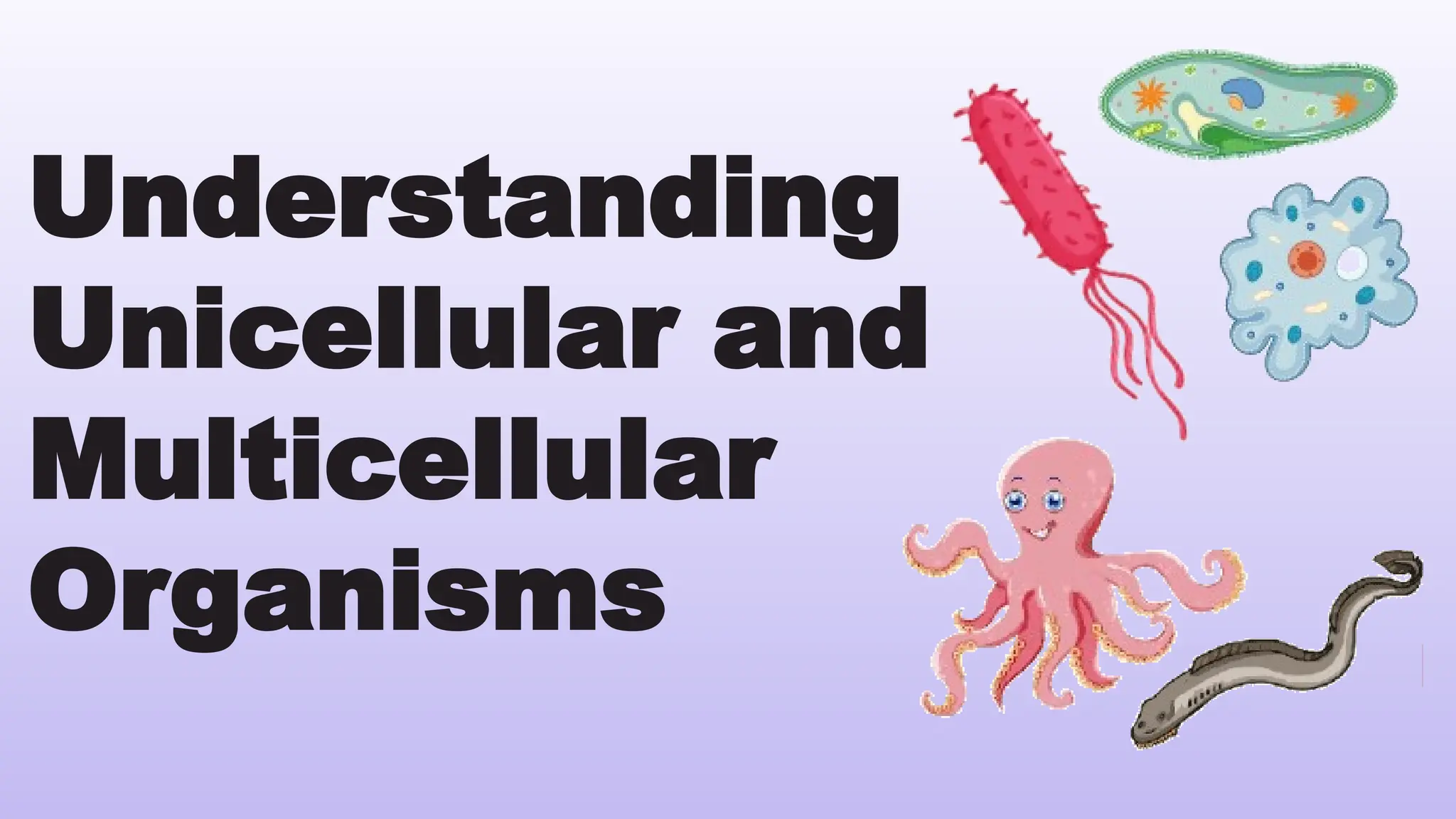
unicellular and multicellular. Unicellular organisms,
such as bacteria, consist of a single cell that performs
all life functions independently. In contrast,
multicellular organisms, like humans, are composed of
many specialized cells that work together to sustain
life. Understanding these differences is crucial for
studying biology and the complexity of life forms.
5.
Examples:
Amoeba
Unicellular
organisms consist of
asingle cell that
performs all the
functions needed for
life. They are self-
sufficient and can
carry out processes
such as metabolism,
growth, and
reproduction
independently.
Definition Examples:
Bacteria
Unicellular Organisms
Bacteria are among
the simplest and
most abundant
unicellular
organisms. They can
be found in virtually
every environment
on Earth, from soil to
water to the human
body.
Amoebas are a type
of unicellular protist
that moves using
pseudopodia. They
are often found in
freshwater
environments and
play a role in nutrient
cycling.
6.
Reproduce asexually
through processeslike
binary fission, budding,
or spore formation.
Consist of a single cell
that performs all
necessary life functions.
Characteristics of Unicellular
Organisms
Typically microscopic in
size, making them
invisible to the naked
eye.
Have simple structures
without specialized
organelles, though
some may have basic
features like flagella.
7.
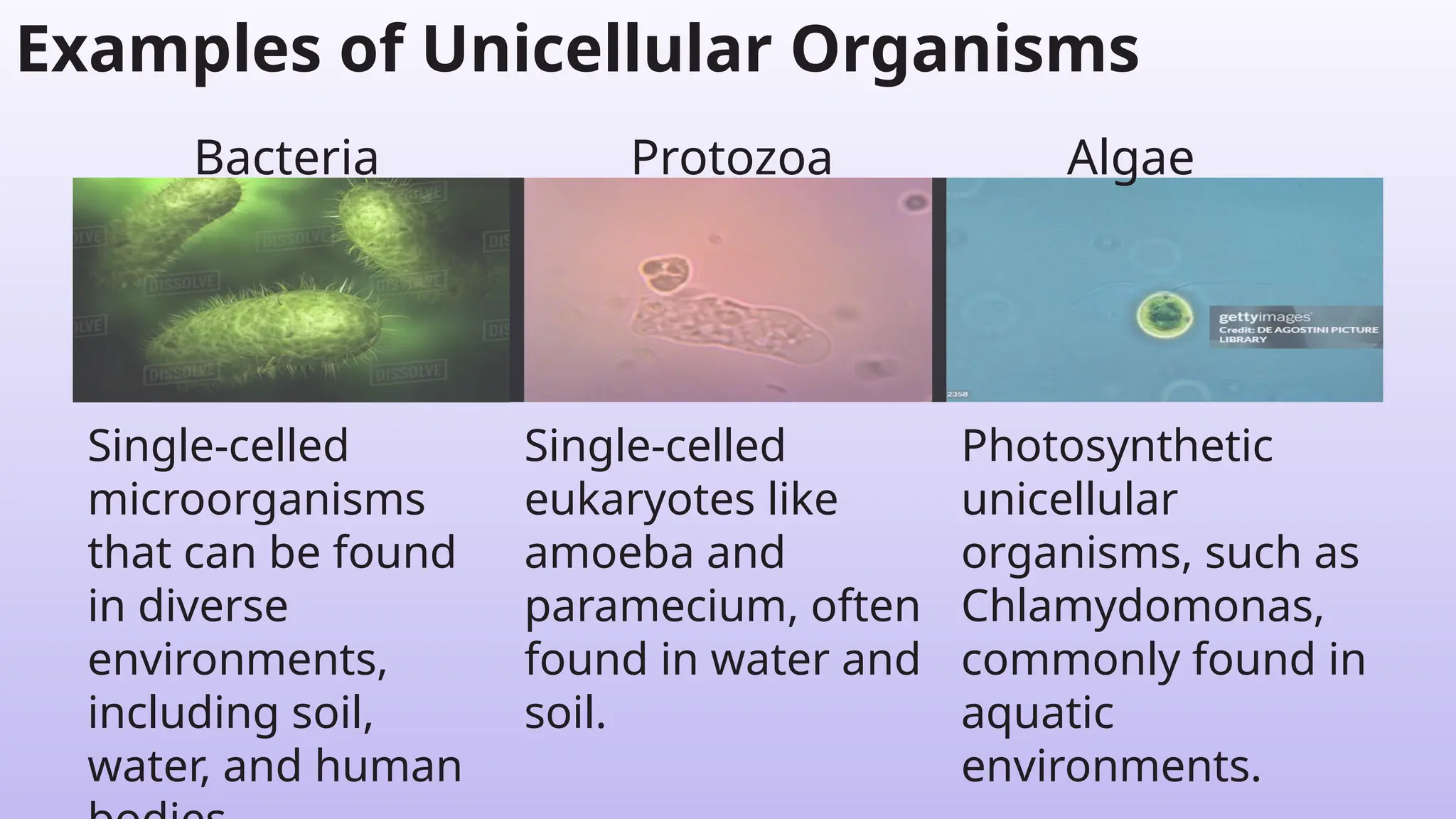
Examples of UnicellularOrganisms
Single-celled
microorganisms
that can be found
in diverse
environments,
including soil,
water, and human
Bacteria
Single-celled
eukaryotes like
amoeba and
paramecium, often
found in water and
soil.
Protozoa
Photosynthetic
unicellular
organisms, such as
Chlamydomonas,
commonly found in
aquatic
environments.
Algae
8.
Cell
Specialization
Multicellular
organisms are
composed of
morethan one
cell, with cells
differentiating to
perform
specialized
functions.
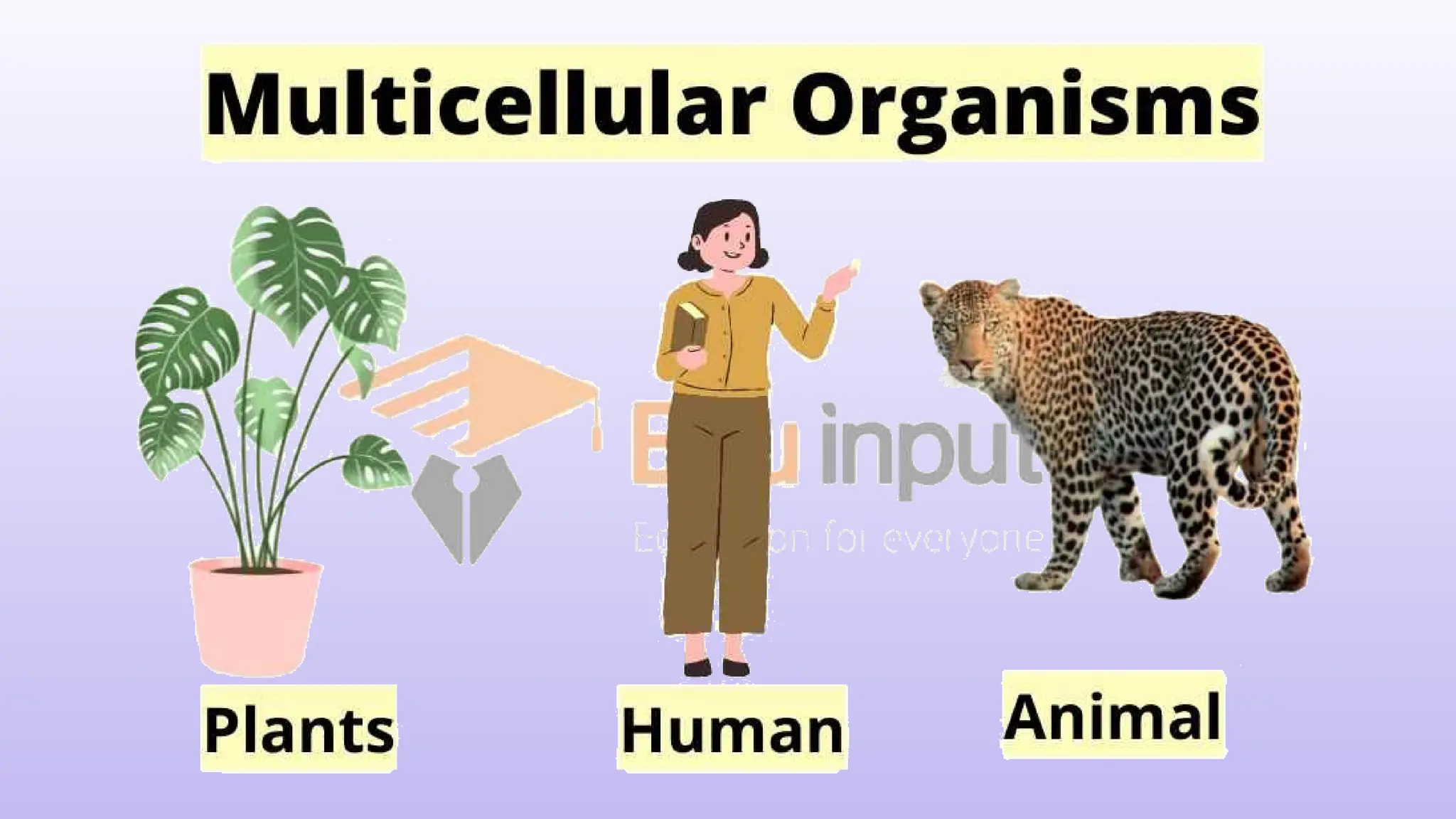
Definition Examples
Multicellular Organisms
Examples include
humans, plants,
and animals. Each
has distinct cell
types that
contribute to
their overall
function and
survival.
Cells in
multicellular
organisms
specialize in
various functions,
such as nerve
cells in animals or
leaf cells in plants,
to work together
efficiently.
10.
Characteristics of MulticellularOrganisms
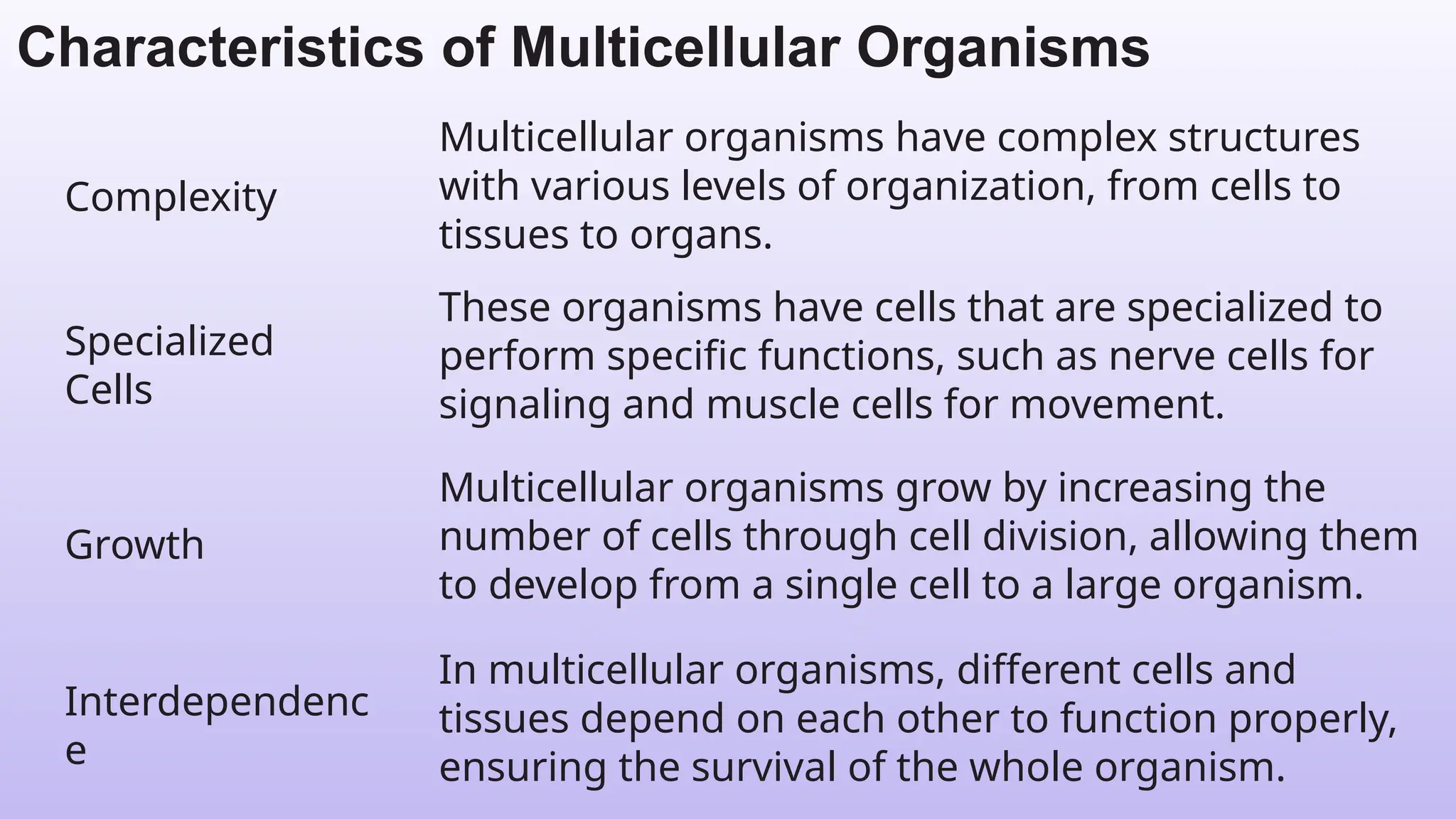
Multicellular organisms have complex structures
with various levels of organization, from cells to
tissues to organs.
These organisms have cells that are specialized to
perform specific functions, such as nerve cells for
signaling and muscle cells for movement.
Complexity
Specialized
Cells
Growth
Multicellular organisms grow by increasing the
number of cells through cell division, allowing them
to develop from a single cell to a large organism.
Interdependenc
e
In multicellular organisms, different cells and
tissues depend on each other to function properly,
ensuring the survival of the whole organism.
11.
Examples of MulticellularOrganisms
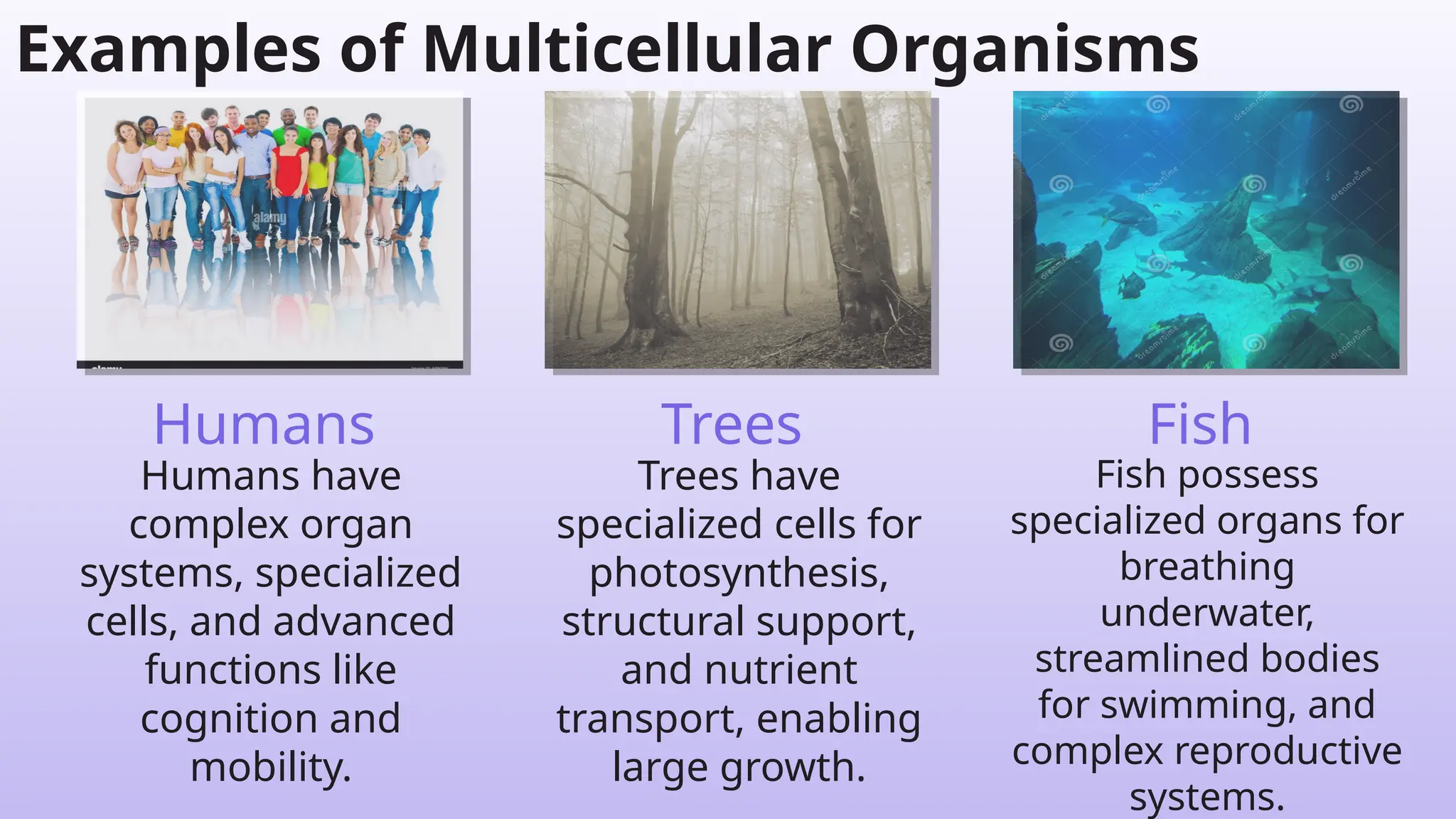
Humans have
complex organ
systems, specialized
cells, and advanced
functions like
cognition and
mobility.
Humans
Trees have
specialized cells for
photosynthesis,
structural support,
and nutrient
transport, enabling
large growth.
Trees
Fish possess
specialized organs for
breathing
underwater,
streamlined bodies
for swimming, and
complex reproductive
systems.
Fish
12.
Comparing Unicellular and
MulticellularOrganisms
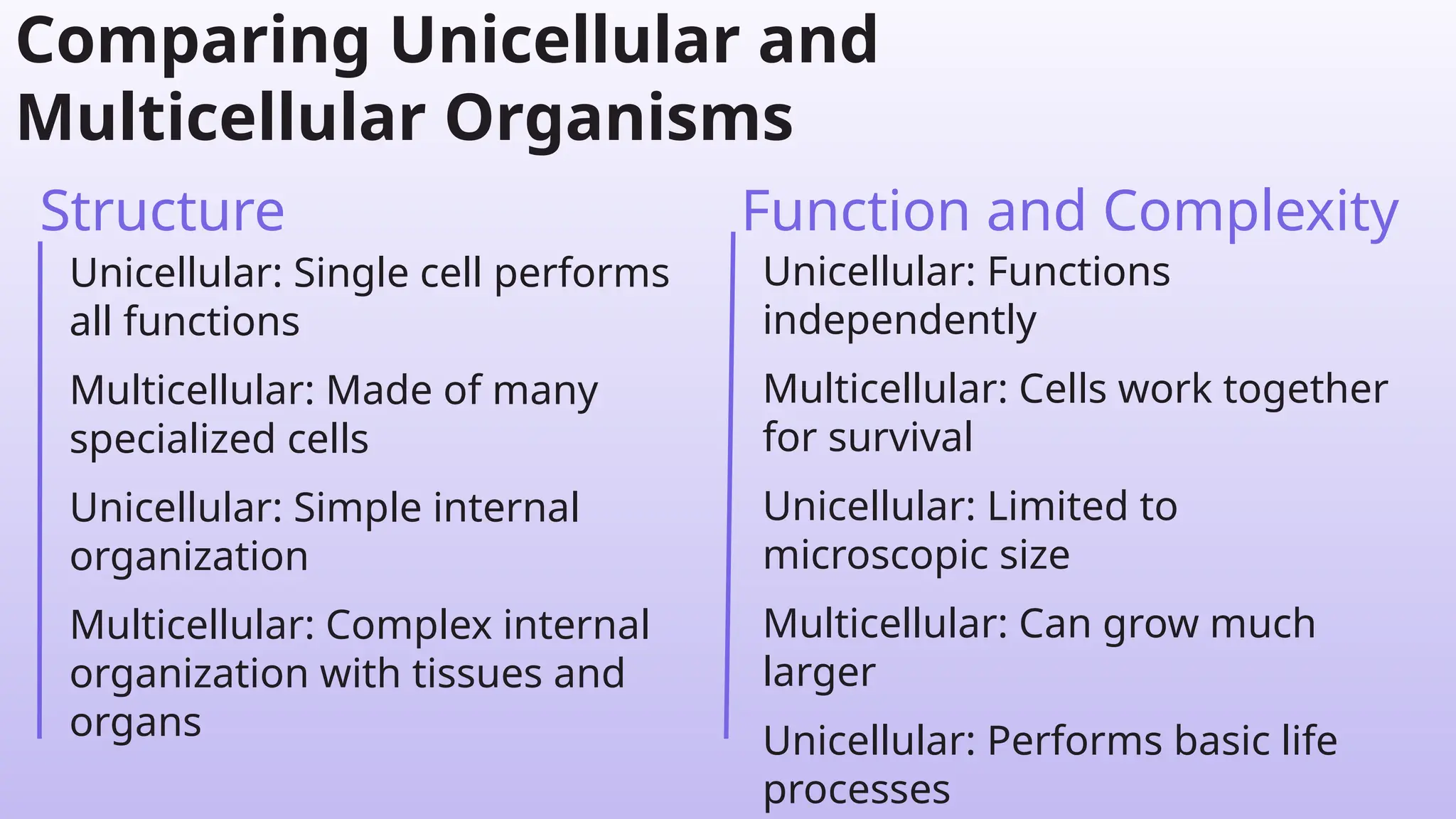
Unicellular: Single cell performs
all functions
Multicellular: Made of many
specialized cells
Unicellular: Simple internal
organization
Multicellular: Complex internal
organization with tissues and
organs
Unicellular: Functions
independently
Multicellular: Cells work together
for survival
Unicellular: Limited to
microscopic size
Multicellular: Can grow much
larger
Unicellular: Performs basic life
processes
Structure Function and Complexity
13.
They require fewerresources to survive, which
is beneficial in resource-limited environments.
Rapid reproduction allows unicellular
organisms to quickly adapt to environmental
changes.
Unicellular organisms have a simpler structure,
making them easier to reproduce and maintain.
Advantages of Being Unicellular
Unicellular organisms can occupy a variety of
niches, enhancing their chances of survival.
Resource
limitations often
restrict the
growthand
reproduction of
unicellular
organisms, as
they rely on a
single cell for all
functions.
Unicellular
organisms face
difficulty in
managing and
adapting to
complex
environments
due to their
simple structure.
Unicellular
organisms are
highly
vulnerable to
environmental
changes, which
can easily
threaten their
survival.
Challenges Faced by Unicellular
Organisms
1 2 3
16.
Risk of diseases
suchas cancer
due to errors in
cell division and
differentiation
processes.
Coordination
and
communication
between cells
are crucial to
maintain
homeostasis and
respond to
environmental
High energy
requirements to
sustain
numerous
specialized cells
and complex
bodily functions.
Challenges Faced by Multicellular
Organisms
02 03
01
17.
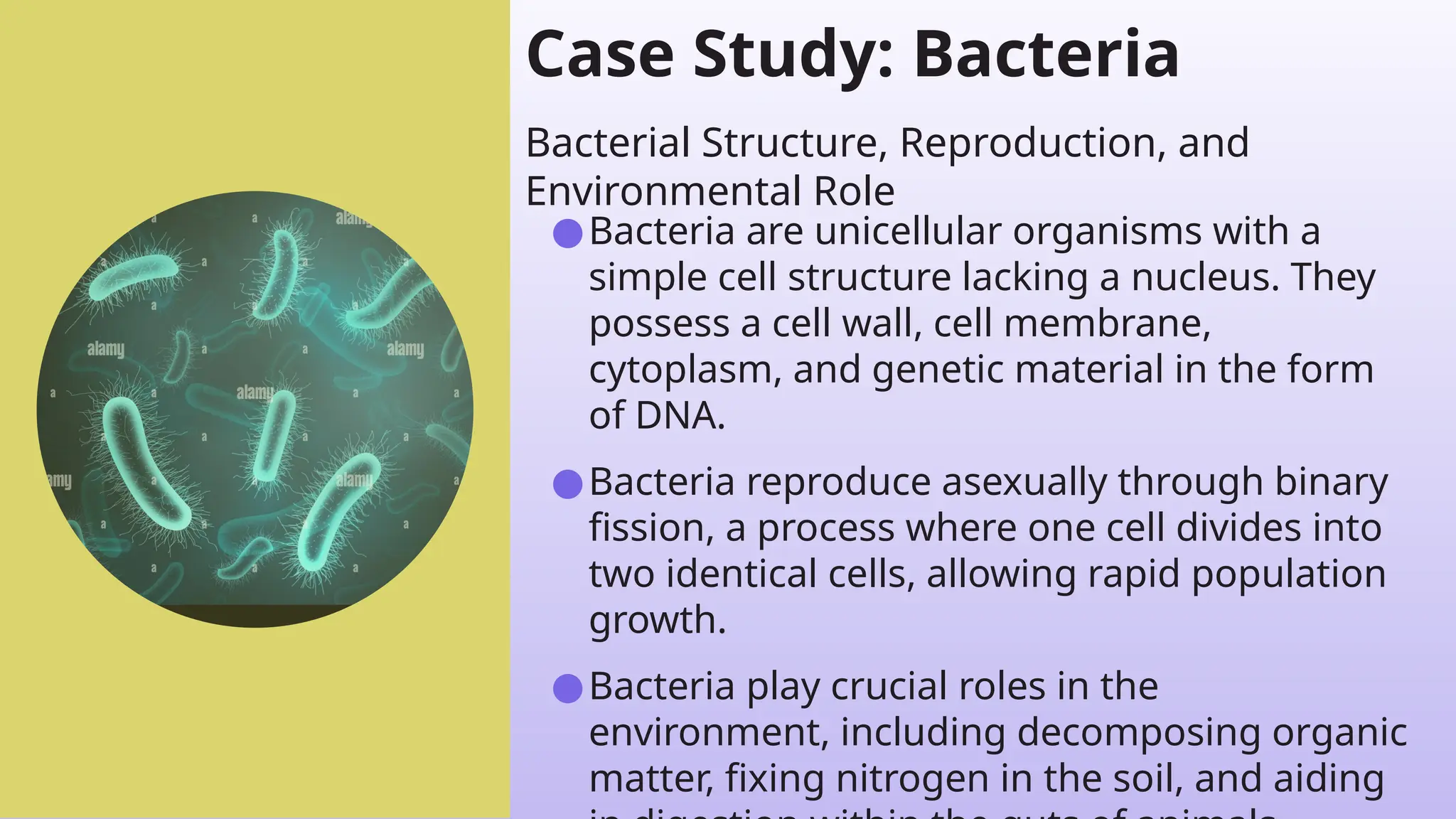
Case Study: Bacteria
●Bacteriaare unicellular organisms with a
simple cell structure lacking a nucleus. They
possess a cell wall, cell membrane,
cytoplasm, and genetic material in the form
of DNA.
●Bacteria reproduce asexually through binary
fission, a process where one cell divides into
two identical cells, allowing rapid population
growth.
●Bacteria play crucial roles in the
environment, including decomposing organic
matter, fixing nitrogen in the soil, and aiding
Bacterial Structure, Reproduction, and
Environmental Role
18.
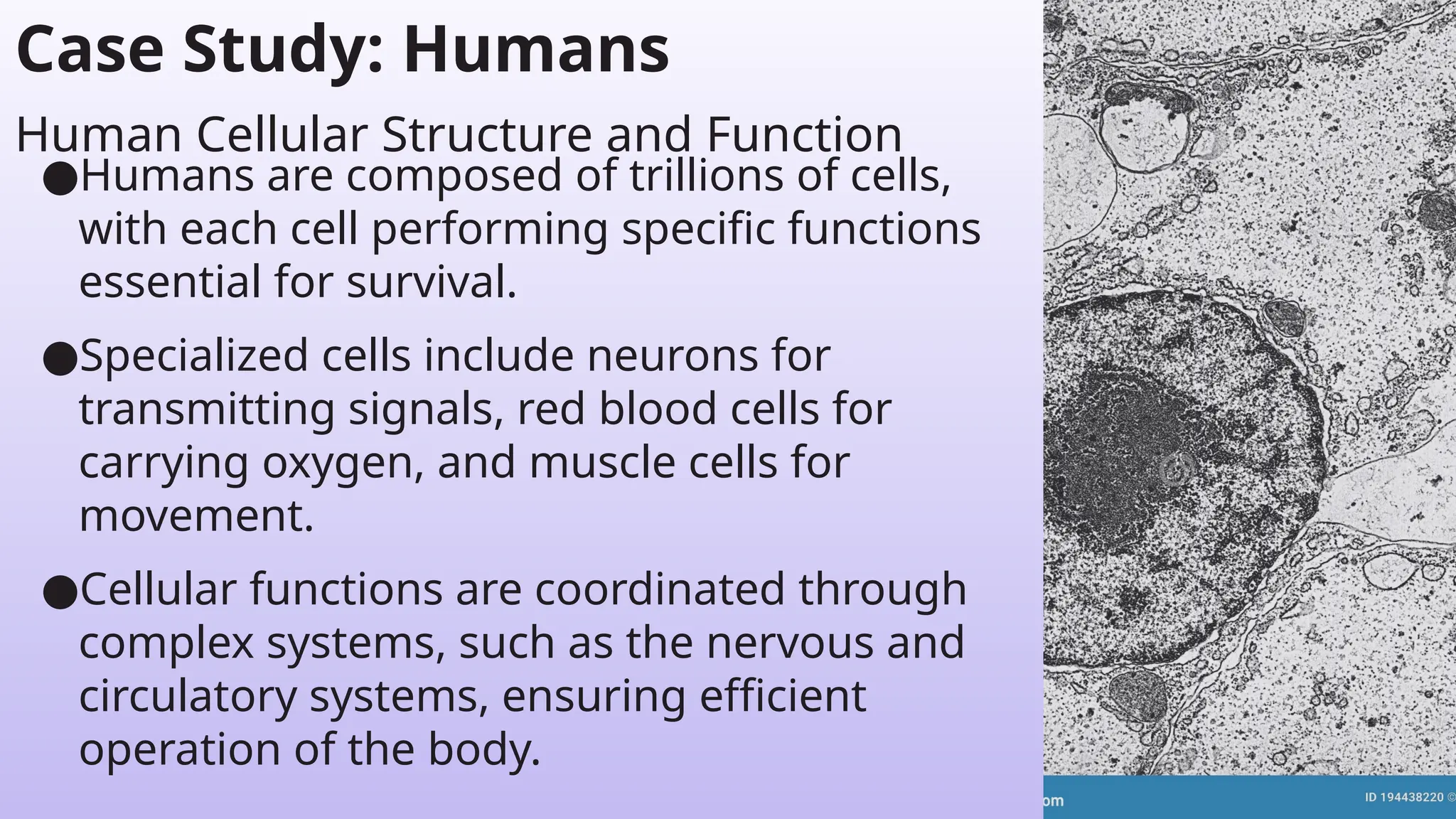
Case Study: Humans
●Humansare composed of trillions of cells,
with each cell performing specific functions
essential for survival.
●Specialized cells include neurons for
transmitting signals, red blood cells for
carrying oxygen, and muscle cells for
movement.
●Cellular functions are coordinated through
complex systems, such as the nervous and
circulatory systems, ensuring efficient
operation of the body.
Human Cellular Structure and Function
19.
Conclusion
• Throughout thispresentation, we explored the
fundamental differences between unicellular and
multicellular organisms.
• Unicellular organisms, like bacteria, consist of a
single cell that performs all life functions
independently.
20.
Conclusion
• In contrast,multicellular organisms, such as
humans, are composed of many specialized cells that
work together to sustain life.
• Understanding these differences is crucial as it
highlights the diversity of life forms and the various
strategies organisms use to survive and thrive in their
environments.