TODAYS PLAN
• Describe unicellular and multicellular
organisms.
• Identify/Describe cell, tissue, organ, organ
system, and organism.
• Distinguish between the differences among cells,
tissues, organs, organ systems, and organisms.
TODAYS DO
• We will watch a short video about and discuss
the levels of cellular organization
TISSUE C
E
L
L
ORGAN
ORGAN SYSTEM
O
R
G
A
N
I
S
M
POPULATION
ECOSYSTEM
COMMUNITY
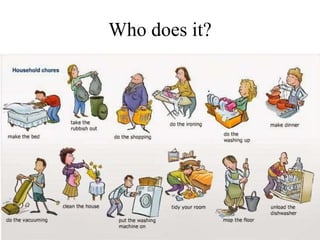
Who does it?
Division of Labor &
The First Level
Within living things, there are divisions of labor.
Division of labor means that the work (labor) of
keeping the organism alive is divided (division)
among different parts.
Each part has a job to do and as each part does its
special job, it works in harmony with all the other
parts. THE JOB OF THE SMALLEST THING
BUILDS ONT THE NEXT LEVEL!
Just like stair steps…
There are different LEVELS to
how one living thing is made, as
well as where it fits into this
world.
The arrangement of specialized parts within a living
thing is sometimes referred to as levels of organization.
We will discuss the levels from least
complex to most complex!
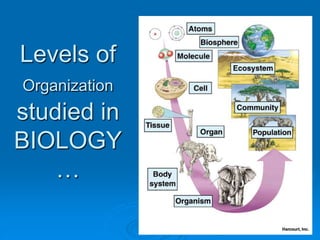
Levels of
Organization
studied in
BIOLOGY
…
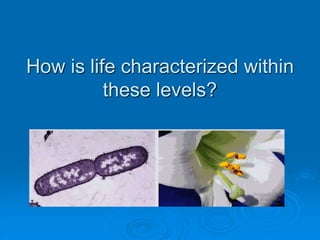
How is life characterized within
these levels?
Life is organized into different levels
based upon size (from small to large).
Organisms and Cells
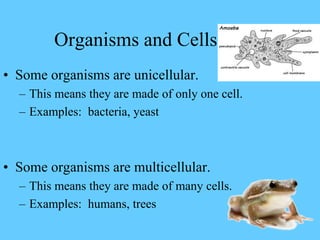
• Some organisms are unicellular.
– This means they are made of only one cell.
– Examples: bacteria, yeast
• Some organisms are multicellular.
– This means they are made of many cells.
– Examples: humans, trees
Organisms and Cells
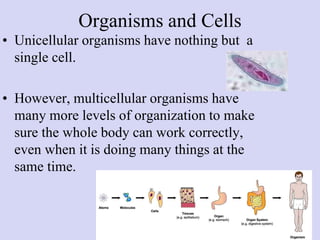
• Unicellular organisms have nothing but a
single cell.
• However, multicellular organisms have
many more levels of organization to make
sure the whole body can work correctly,
even when it is doing many things at the
same time.
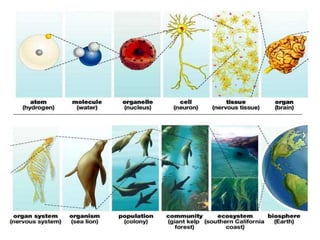
There are 9 Levels of Biological
Organization :
• 1. Cells
• 2. Tissues
• 3. Organs
• 4. Organ Systems
• 5. Organisms
• 6. Population
• 7. Community
• 8. Ecosystem
• 9. Biosphere
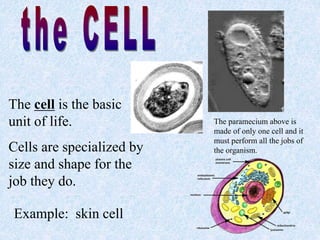
The cell is the basic
unit of life.
Cells are specialized by
size and shape for the
job they do.
The paramecium above is
made of only one cell and it
must perform all the jobs of
the organism.
Example: skin cell
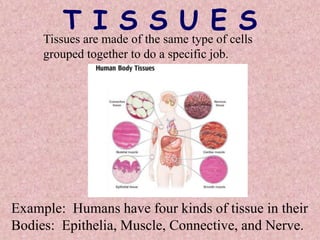
T I S S U E S
Tissues are made of the same type of cells
grouped together to do a specific job.
Example: Humans have four kinds of tissue in their
Bodies: Epithelia, Muscle, Connective, and Nerve.
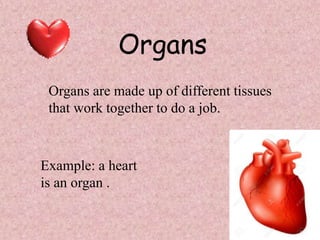
Organs
Organs are made up of different tissues
that work together to do a job.
Example: a heart
is an organ .
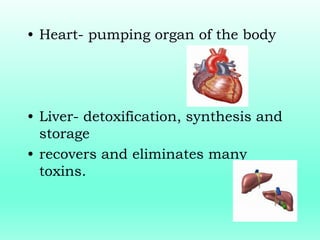
• Heart- pumping organ of the body
• Liver- detoxification, synthesis and
storage
• recovers and eliminates many
toxins.
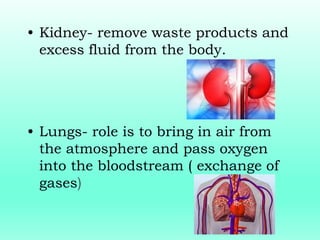
• Kidney- remove waste products and
excess fluid from the body.
• Lungs- role is to bring in air from
the atmosphere and pass oxygen
into the bloodstream ( exchange of
gases)
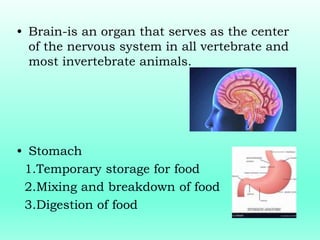
• Brain-is an organ that serves as the center
of the nervous system in all vertebrate and
most invertebrate animals.
• Stomach
1.Temporary storage for food
2.Mixing and breakdown of food
3.Digestion of food
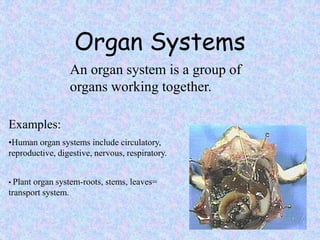
Organ Systems
An organ system is a group of
organs working together.
Examples:
•Human organ systems include circulatory,
reproductive, digestive, nervous, respiratory.
• Plant organ system-roots, stems, leaves=
transport system.
Organ System
• Cardiovascular / circulatory
transports nutrients and wastes
• Respiratory exchanges gases
• Immune protects against infection
• Digestive breaks down and absorbs
food
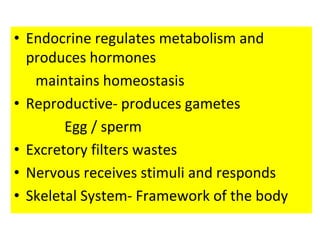
• Endocrine regulates metabolism and
produces hormones
maintains homeostasis
• Reproductive- produces gametes
Egg / sperm
• Excretory filters wastes
• Nervous receives stimuli and responds
• Skeletal System- Framework of the body
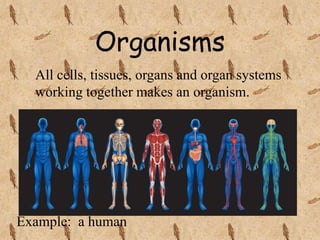
Organisms
All cells, tissues, organs and organ systems
working together makes an organism.
Example: a human
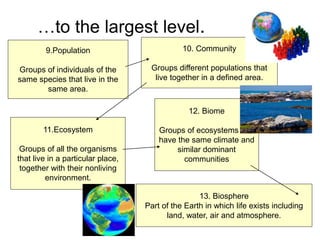
…to the largest level.
9.Population
Groups of individuals of the
same species that live in the
same area.
10. Community
Groups different populations that
live together in a defined area.
11.Ecosystem
Groups of all the organisms
that live in a particular place,
together with their nonliving
environment.
13. Biosphere
Part of the Earth in which life exists including
land, water, air and atmosphere.
12. Biome
Groups of ecosystems that
have the same climate and
similar dominant
communities

Levels-of-organization (1).ppt

  • 1.
    TODAYS PLAN • Describeunicellular and multicellular organisms. • Identify/Describe cell, tissue, organ, organ system, and organism. • Distinguish between the differences among cells, tissues, organs, organ systems, and organisms. TODAYS DO • We will watch a short video about and discuss the levels of cellular organization
  • 2.
  • 3.
  • 4.
    Division of Labor& The First Level Within living things, there are divisions of labor. Division of labor means that the work (labor) of keeping the organism alive is divided (division) among different parts. Each part has a job to do and as each part does its special job, it works in harmony with all the other parts. THE JOB OF THE SMALLEST THING BUILDS ONT THE NEXT LEVEL!
  • 6.
    Just like stairsteps… There are different LEVELS to how one living thing is made, as well as where it fits into this world. The arrangement of specialized parts within a living thing is sometimes referred to as levels of organization. We will discuss the levels from least complex to most complex!
  • 7.
  • 8.
    How is lifecharacterized within these levels?
  • 9.
    Life is organizedinto different levels based upon size (from small to large).
  • 10.
    Organisms and Cells •Some organisms are unicellular. – This means they are made of only one cell. – Examples: bacteria, yeast • Some organisms are multicellular. – This means they are made of many cells. – Examples: humans, trees
  • 11.
    Organisms and Cells •Unicellular organisms have nothing but a single cell. • However, multicellular organisms have many more levels of organization to make sure the whole body can work correctly, even when it is doing many things at the same time.
  • 12.
    There are 9Levels of Biological Organization : • 1. Cells • 2. Tissues • 3. Organs • 4. Organ Systems • 5. Organisms • 6. Population • 7. Community • 8. Ecosystem • 9. Biosphere
  • 14.
    The cell isthe basic unit of life. Cells are specialized by size and shape for the job they do. The paramecium above is made of only one cell and it must perform all the jobs of the organism. Example: skin cell
  • 15.
    T I SS U E S Tissues are made of the same type of cells grouped together to do a specific job. Example: Humans have four kinds of tissue in their Bodies: Epithelia, Muscle, Connective, and Nerve.
  • 16.
    Organs Organs are madeup of different tissues that work together to do a job. Example: a heart is an organ .
  • 17.
    • Heart- pumpingorgan of the body • Liver- detoxification, synthesis and storage • recovers and eliminates many toxins.
  • 18.
    • Kidney- removewaste products and excess fluid from the body. • Lungs- role is to bring in air from the atmosphere and pass oxygen into the bloodstream ( exchange of gases)
  • 19.
    • Brain-is anorgan that serves as the center of the nervous system in all vertebrate and most invertebrate animals. • Stomach 1.Temporary storage for food 2.Mixing and breakdown of food 3.Digestion of food
  • 20.
    Organ Systems An organsystem is a group of organs working together. Examples: •Human organ systems include circulatory, reproductive, digestive, nervous, respiratory. • Plant organ system-roots, stems, leaves= transport system.
  • 21.
    Organ System • Cardiovascular/ circulatory transports nutrients and wastes • Respiratory exchanges gases • Immune protects against infection • Digestive breaks down and absorbs food
  • 22.
    • Endocrine regulatesmetabolism and produces hormones maintains homeostasis • Reproductive- produces gametes Egg / sperm • Excretory filters wastes • Nervous receives stimuli and responds • Skeletal System- Framework of the body
  • 24.
    Organisms All cells, tissues,organs and organ systems working together makes an organism. Example: a human
  • 25.
    …to the largestlevel. 9.Population Groups of individuals of the same species that live in the same area. 10. Community Groups different populations that live together in a defined area. 11.Ecosystem Groups of all the organisms that live in a particular place, together with their nonliving environment. 13. Biosphere Part of the Earth in which life exists including land, water, air and atmosphere. 12. Biome Groups of ecosystems that have the same climate and similar dominant communities