The document discusses the application of the Gryllidae Optimization Algorithm (GOA) to solve the optimal reactive power problem in power systems, inspired by the chirping behavior of crickets. The algorithm has been tested on standard IEEE 14 and 30 bus test systems, demonstrating significant reductions in real power loss. The results indicate that the proposed GOA effectively addresses issues commonly faced by existing algorithms, such as local optima.
![International Journal of Informatics and Communication Technology (IJ-ICT)
Vol.9, No.3, December 2020, pp. 179~184
ISSN: 2252-8776, DOI: 10.11591/ijict.v9i3.pp179-184 179
Journal homepage: http://ijict.iaescore.com
Power loss reduction by gryllidae optimization algorithm
Kanagasabai Lenin
Department of EEE, Prasad V. Potluri Siddhartha Institute of Technology, India
Article Info ABSTRACT
Article history:
Received Nov 12, 2019
Revised Jan 20, 2020
Accepted Feb 19, 2020
This paper projects Gryllidae Optimization Algorithm (GOA) has been
applied to solve optimal reactive power problem. Proposed GOA approach is
based on the chirping characteristics of Gryllidae. In common, male
Gryllidae chirp, on the other hand some female Gryllidae also do as well.
Male Gryllidae draw the females by this sound which they produce.
Moreover, they caution the other Gryllidae against dangers with this sound.
The hearing organs of the Gryllidae are housed in an expansion of their
forelegs. Through this, they bias to the produced fluttering sounds. Proposed
Gryllidae Optimization Algorithm (GOA) has been tested in standard IEEE
14, 30 bus test systems and simulation results show that the projected
algorithms reduced the real power loss considerably.
Keywords:
Gryllidae optimization
algorithm,
Optimal reactive power,
Transmission loss,
This is an open access article under the CC BY-SA license.
Corresponding Author:
Kanagasabai Lenin,
Department of EEE,
Prasad V. Potluri Siddhartha Institute of Technology,
Kanuru, Vijayawada, Andhra Pradesh, 520007, India.
Email: gklenin@gmail.com
1. INTRODUCTION
Reactive power problem plays a key role in secure and economic operations of power system.
Optimal reactive power problem has been solved by variety of types of methods [1-6]. Nevertheless
numerous scientific difficulties are found while solving problem due to an assortment of constraints.
Evolutionary techniques [7-17] are applied to solve the reactive power problem, but the main problem is
many algorithms get stuck in local optimal solution & failed to balance the Exploration & Exploitation
during the search of global solution. This paper projects Gryllidae Optimization Algorithm (GOA) has been
applied to solve optimal reactive power problem. Proposed algorithm based on the chirping characteristics of
Gryllidae and formulated to solve the optimal reactive power problem. In common, male Gryllidae chirp, on
the other hand some female Gryllidae also do as well. Male Gryllidae draw the females by this sound which
they produce. Male Gryllidae create this sound by chirping the wings and known as stridulating. They attract
each other by this sound for mating and keep the others from their nests. Moreover, they caution the other
Gryllidae against dangers with this sound. The hearing organs of the Gryllidae are housed in an expansion of
their forelegs. Through this, they bias to the produced fluttering sounds. Proposed Gryllidae Optimization
Algorithm (GOA) has been tested in standard IEEE 14, 30 bus test systems and simulation results show that
the projected algorithms reduced the real power loss considerably.
2. PROBLEM FORMULATION
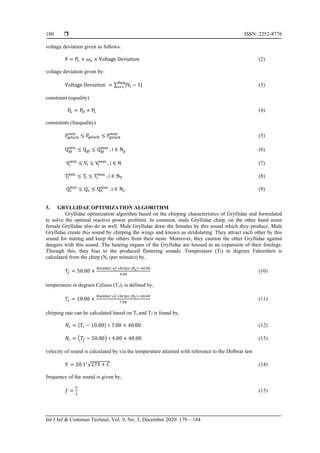
Objective of the problem is to reduce the true power loss:
F = PL = ∑ gkk∈Nbr (Vi
2
+ Vj
2
− 2ViVjcosθij) (1)](https://image.slidesharecdn.com/0420268-powerlossreduction-201020062737/85/04-20268-power-loss-reduction-1-320.jpg)
![International Journal of Informatics and Communication Technology (IJ-ICT)
Vol.9, No.3, December 2020, pp. 179~184
ISSN: 2252-8776, DOI: 10.11591/ijict.v9i3.pp179-184 179
Journal homepage: http://ijict.iaescore.com
Power loss reduction by gryllidae optimization algorithm
Kanagasabai Lenin
Department of EEE, Prasad V. Potluri Siddhartha Institute of Technology, India
Article Info ABSTRACT
Article history:
Received Nov 12, 2019
Revised Jan 20, 2020
Accepted Feb 19, 2020
This paper projects Gryllidae Optimization Algorithm (GOA) has been
applied to solve optimal reactive power problem. Proposed GOA approach is
based on the chirping characteristics of Gryllidae. In common, male
Gryllidae chirp, on the other hand some female Gryllidae also do as well.
Male Gryllidae draw the females by this sound which they produce.
Moreover, they caution the other Gryllidae against dangers with this sound.
The hearing organs of the Gryllidae are housed in an expansion of their
forelegs. Through this, they bias to the produced fluttering sounds. Proposed
Gryllidae Optimization Algorithm (GOA) has been tested in standard IEEE
14, 30 bus test systems and simulation results show that the projected
algorithms reduced the real power loss considerably.
Keywords:
Gryllidae optimization
algorithm,
Optimal reactive power,
Transmission loss,
This is an open access article under the CC BY-SA license.
Corresponding Author:
Kanagasabai Lenin,
Department of EEE,
Prasad V. Potluri Siddhartha Institute of Technology,
Kanuru, Vijayawada, Andhra Pradesh, 520007, India.
Email: gklenin@gmail.com
1. INTRODUCTION
Reactive power problem plays a key role in secure and economic operations of power system.
Optimal reactive power problem has been solved by variety of types of methods [1-6]. Nevertheless
numerous scientific difficulties are found while solving problem due to an assortment of constraints.
Evolutionary techniques [7-17] are applied to solve the reactive power problem, but the main problem is
many algorithms get stuck in local optimal solution & failed to balance the Exploration & Exploitation
during the search of global solution. This paper projects Gryllidae Optimization Algorithm (GOA) has been
applied to solve optimal reactive power problem. Proposed algorithm based on the chirping characteristics of
Gryllidae and formulated to solve the optimal reactive power problem. In common, male Gryllidae chirp, on
the other hand some female Gryllidae also do as well. Male Gryllidae draw the females by this sound which
they produce. Male Gryllidae create this sound by chirping the wings and known as stridulating. They attract
each other by this sound for mating and keep the others from their nests. Moreover, they caution the other
Gryllidae against dangers with this sound. The hearing organs of the Gryllidae are housed in an expansion of
their forelegs. Through this, they bias to the produced fluttering sounds. Proposed Gryllidae Optimization
Algorithm (GOA) has been tested in standard IEEE 14, 30 bus test systems and simulation results show that
the projected algorithms reduced the real power loss considerably.
2. PROBLEM FORMULATION
Objective of the problem is to reduce the true power loss:
F = PL = ∑ gkk∈Nbr (Vi
2
+ Vj
2
− 2ViVjcosθij) (1)](https://image.slidesharecdn.com/0420268-powerlossreduction-201020062737/75/04-20268-power-loss-reduction-1-2048.jpg)
![Int J Inf & Commun Technol ISSN: 2252-8776
Power loss reduction by gryllidae optimization algorithm (Kanagasabai Lenin)
181
intensity of the sound inversely proportional to the square of the distance,
𝐼 =
𝑊
4𝜋𝑟2 =
𝑝
𝜌𝑐
; 𝑊 = 𝐼 ∗ 4𝜋𝑟2
(16)
sound propagation level found by,
𝐿 𝑝 = 𝐿 𝑤 + 10∗
𝑙𝑜𝑔[𝑄 4𝜋𝑟2⁄ ] (17)
atmosphere sound absorption is given by,
𝐴 𝑎𝑡𝑚𝑜𝑠 = 7.4(𝑓2
𝑟/𝛷)10−8
(18)
free filed sound pressure is given by,
𝐿 𝑝
′
= 𝐿 𝑝 − 𝐴 𝑎𝑡𝑚𝑜𝑠 (19)
frequency, velocity, position value obtained by,
𝑓𝑖 = 𝑓 𝑚𝑖𝑛𝑖𝑚𝑢𝑚 + (𝑓 𝑚𝑎𝑥𝑖𝑚𝑢𝑚 − 𝑓 𝑚𝑖𝑚𝑖𝑚𝑢𝑚)𝛽 (20)
𝑣𝑖
𝑡
= 𝑣𝑖
𝑡−1
+ (𝑥𝑖 − 𝑥∗)𝑓𝑖 + 𝑉𝑖 (21)
𝑥𝑖
𝑡
= 𝑥𝑖
𝑡−1
+ 𝑣𝑖
𝑡
(22)
random walk [18] is done through,
𝑥𝑖 = 𝑥 𝑏𝑒𝑠𝑡 + 0.01 ∗ 𝑟𝑎𝑛𝑑𝑜𝑚(0,1) (23)
in the period of the modernizing procedure, Euclidian distances (r) among all of the Gryllidae in the
population were computed by,
𝐾 = 𝐾𝑜𝑒−𝛾𝑟2
(24)
𝑥𝑖 = 𝑥𝑖 + 𝐾𝑜𝑒−𝛾𝑟𝑖𝑗
2
+ 𝛼 ∈𝑖 (25)
Commence
For i=1 to n do
𝑥𝑖 ← 𝑒𝑛𝑔𝑒𝑛𝑑𝑒𝑟 𝑖𝑛𝑖𝑡𝑖𝑎𝑙 𝑠𝑜𝑙𝑢𝑡𝑖𝑜𝑛 ( )
End
𝑖 𝑚𝑖𝑛 ← 𝑎𝑟𝑔𝑚𝑖𝑛𝑖 𝑠(𝑥𝑖)
𝐹 𝑚𝑖𝑛 ← 𝑎𝑟𝑔𝑚𝑖𝑛 𝑠(𝑥𝑖)
𝑥𝑖 𝑚𝑖𝑛 ← 𝑎𝑟𝑔𝑚𝑖𝑛 𝑥𝑖 𝑠(𝑥𝑖)
For i=1 to t do
𝑤ℎ𝑖𝑙𝑒(𝐹 𝑚𝑖𝑛𝑖𝑚𝑢𝑚 > 𝑇𝑜𝑙)
For i=1 to n do
𝑁𝑖 ← 𝑒𝑛𝑔𝑒𝑛𝑑𝑒𝑟 𝑟𝑎𝑛𝑑𝑜𝑚 𝑣𝑒𝑐𝑡𝑜𝑟
𝑇𝑖 ← 𝐷𝑜𝑙𝑏𝑒𝑎𝑟 𝑙𝑎𝑤 (𝑁𝑖)
𝑐𝑖 = (5 9⁄ )𝑇𝑖 − 32
𝑉𝑖 ← 𝑉 = 20.1∗
√273 + 𝐶, 𝜆 ← 𝑥𝑖 − 𝑥 𝑏𝑒𝑠𝑡
𝐹 𝑚𝑎𝑥𝑖𝑚𝑢𝑚 ← 𝑓 =
𝑉
𝜆
, 𝑓𝑖, 𝑣𝑖
𝑡
, 𝑥𝑖
𝑡
← 𝑓𝑖 = 𝑓 𝑚𝑖𝑛𝑖𝑚𝑢𝑚 + (𝑓 𝑚𝑎𝑥𝑖𝑚𝑢𝑚 − 𝑓 𝑚𝑖𝑚𝑖𝑚𝑢𝑚)𝛽 , 𝑣𝑖
𝑡
= 𝑣𝑖
𝑡−1
+ (𝑥𝑖 − 𝑥∗)𝑓𝑖 +
𝑉𝑖, 𝑥𝑖
𝑡
= 𝑥𝑖
𝑡−1
+ 𝑣𝑖
𝑡
𝛾 ← 𝑐𝑜𝑚𝑝𝑢𝑡𝑒 𝑡ℎ𝑒 Coefficient
𝑖𝑓 𝑟𝑎𝑛𝑑𝑜𝑚[0,1] > 𝛾
For j =1 to n do
𝑖𝑓 𝑠𝑖 < 𝑠𝑗 𝑡ℎ𝑒𝑛 𝑟𝑗 ← 𝐾 = 𝐾𝑜𝑒−𝛾𝑟2
𝑃𝑠 ← 𝐼 =
𝑊
4𝜋𝑟2 =
𝑝
𝜌𝑐
; 𝑊 = 𝐼 ∗ 4𝜋𝑟2
𝐿𝑃 ← 𝐿 𝑝 = 𝐿 𝑤 + 10∗
𝑙𝑜𝑔[𝑄 4𝜋𝑟2⁄ ]
𝐴 𝑎𝑡𝑚𝑜𝑠 ← 𝐴 𝑎𝑡𝑚𝑜𝑠 = 7.4(𝑓2
𝑟/𝛷)10−8](https://image.slidesharecdn.com/0420268-powerlossreduction-201020062737/85/04-20268-power-loss-reduction-3-320.jpg)
![ ISSN: 2252-8776
Int J Inf & Commun Technol, Vol. 9, No. 3, December 2020: 179 – 184
182
𝑅𝐿 𝑝 ← 𝐿 𝑝
′
= 𝐿 𝑝 − 𝐴 𝑎𝑡𝑚𝑜𝑠
𝐾0 ← 𝑅𝐿 𝑝, 𝐾𝑖 ← 𝑥𝑖 = 𝑥𝑖 + 𝐾𝑜𝑒−𝛾𝑟𝑖𝑗
2
+ 𝛼 ∈𝑖
𝑥𝑖 ← 𝑥𝑖 = 𝑥 𝑏𝑒𝑠𝑡 + 0.01 ∗ 𝑟𝑎𝑛𝑑𝑜𝑚(0,1)
End
𝐹𝑛𝑒𝑤 ← 𝑐𝑜𝑠𝑡 𝑓𝑢𝑛𝑐𝑡𝑖𝑜𝑛(𝑥𝑖)
𝑖𝑓 (𝐹𝑛𝑒𝑤 < 𝐹 𝑚𝑖𝑛𝑖𝑚𝑢𝑚)
𝑥 𝑏𝑒𝑠𝑡 = 𝑥𝑖
𝐹 𝑚𝑖𝑛𝑖𝑚𝑢𝑚 = 𝐹𝑛𝑒𝑤
End
Find the most excellent solution
End
4. SIMULATION RESULTS
At first in standard IEEE 14 bus system the validity of the proposed Gryllidae Optimization
Algorithm (GOA) has been tested, Table 1 shows the constraints of control variables Table 2 shows the limits
of reactive power generators and comparison results are presented in Table 3.
Then the proposed Gryllidae Optimization Algorithm (GOA) simulated in IEEE 30 Bus system.
Table 4 shows the constraints of control variables, Table 5 shows the limits of reactive power generators and
comparison results are presented in Table 6.
Table 1. Constraints of control variables
System Variables Minimum (PU) Maximum (PU)
IEEE 14 Bus Generator Voltage 0.95 1.1
Transformer Tap o.9 1.1
VAR Source 0 0.20
Table 2. Constrains of reactive power generators
System Variables Q Minimum (PU) Q Maximum (PU)
IEEE 14 Bus 1 0 10
2 -40 50
3 0 40
6 -6 24
8 -6 24
Table 3. Simulation results of IEEE −14 system
Control
variables
Base case MPSO [19] PSO [19] EP [19] SARGA [19] GOA
𝑉𝐺−1 1.060 1.100 1.100 NR* NR* 1.004
𝑉𝐺−2 1.045 1.085 1.086 1.029 1.060 1.014
𝑉𝐺−3 1.010 1.055 1.056 1.016 1.036 1.009
𝑉𝐺−6 1.070 1.069 1.067 1.097 1.099 1.002
𝑉𝐺−8 1.090 1.074 1.060 1.053 1.078 1.011
𝑇𝑎𝑝 8 0.978 1.018 1.019 1.04 0.95 0.900
𝑇𝑎𝑝 9 0.969 0.975 0.988 0.94 0.95 0.911
𝑇𝑎𝑝 10 0.932 1.024 1.008 1.03 0.96 0.901
𝑄𝐶−9 0.19 14.64 0.185 0.18 0.06 0.124
𝑃𝐺 272.39 271.32 271.32 NR* NR* 271.46
𝑄𝐺 (Mvar) 82.44 75.79 76.79 NR* NR* 75.04
Reduction in
PLoss (%)
0 9.2 9.1 1.5 2.5 12.33
Total PLoss
(Mw)
13.550 12.293 12.315 13.346 13.216 11.879
NR* - Not reported.
Table 4. Constraints of control variables
System Variables Minimum (PU) Maximum (PU)
IEEE 30 Bus Generator Voltage 0.95 1.1
Transformer Tap o.9 1.1
VAR Source 0 0.20](https://image.slidesharecdn.com/0420268-powerlossreduction-201020062737/85/04-20268-power-loss-reduction-4-320.jpg)
![Int J Inf & Commun Technol ISSN: 2252-8776
Power loss reduction by gryllidae optimization algorithm (Kanagasabai Lenin)
183
Table 5. Constrains of reactive power generators
System Variables Q Minimum (PU) Q Maximum (PU)
IEEE 30 Bus 1 0 10
2 -40 50
5 -40 40
8 -10 40
11 -6 24
13 -6 24
Table 6. Simulation results of IEEE −30 system
Control
variables
Base case MPSO [19] PSO [19] EP [19] SARGA [19] GOA
𝑉𝐺−1 1.060 1.101 1.100 NR* NR* 1.010
𝑉𝐺−2 1.045 1.086 1.072 1.097 1.094 1.008
𝑉𝐺−5 1.010 1.047 1.038 1.049 1.053 1.012
𝑉𝐺−8 1.010 1.057 1.048 1.033 1.059 1.049
𝑉𝐺−12 1.082 1.048 1.058 1.092 1.099 1.032
VG-13 1.071 1.068 1.080 1.091 1.099 1.023
Tap11 0.978 0.983 0.987 1.01 0.99 0.912
Tap12 0.969 1.023 1.015 1.03 1.03 0.905
Tap15 0.932 1.020 1.020 1.07 0.98 0.914
Tap36 0.968 0.988 1.012 0.99 0.96 0.906
QC10 0.19 0.077 0.077 0.19 0.19 0.089
QC24 0.043 0.119 0.128 0.04 0.04 0.101
𝑃𝐺 (MW) 300.9 299.54 299.54 NR* NR* 298.59
𝑄𝐺 (Mvar) 133.9 130.83 130.94 NR* NR* 131.81
Reduction in
PLoss (%)
0 8.4 7.4 6.6 8.3 10.05
Total PLoss
(Mw)
17.55 16.07 16.25 16.38 16.09 15.786
NR* - Not reported.
5. Conclusion
In this paper Gryllidae Optimization Algorithm (GOA) successfully solved the optimal reactive
power problem. Application of the Gryllidae Optimization Algorithm is developed by the inspiration of a
type of insect; on the recognizable global engineering problems in the simulation-based nature which has
recently participated to the meta-heuristic algorithm approach was confirmed. Proposed Gryllidae
Optimization Algorithm (GOA) has been tested in standard IEEE 14, 30 bus test systems and simulation
results show that the projected algorithms reduced the real power loss considerably.
REFERENCES
[1] K. Y. Lee, “Fuel-cost minimisation for both real and reactive-power dispatches,” Proceedings
Generation, Transmission and Distribution Conference, vol. 131, no. 3, pp. 85-93, 1984.
[2] N. I. Deeb, “An efficient technique for reactive power dispatch using a revised linear programming
approach,” Electric Power System Research, vol. 15, no. 2, pp. 121–134, 1998.
[3] M. R. Bjelogrlic, M. S. Calovic, B. S. Babic, “Application of Newton’s optimal power flow in
voltage/reactive power control,” IEEE Trans Power System, vol. 5, no. 4, pp. 1447-1454, 1990.
[4] S. Granville, “Optimal reactive dispatch through interior point methods,” IEEE Transactions on Power
System, vol. 9, no. 1, pp. 136–146, 1994.
[5] N. Grudinin, “Reactive power optimization using successive quadratic programming method,” IEEE
Transactions on Power System, vol. 13, no. 4, pp. 1219–1225, 1998.
[6] Ng Shin Mei, R.; Sulaiman, M.H.; Mustaffa, Z.; Daniyal, H. “Optimal reactive power dispatch solution
by loss minimization using moth-flame optimization technique,” Appl. Soft Comput., vol. 59,
pp. 210–222, 2017.
[7] Chen, G., Liu, L., Zhang, Z., Huang, S. “Optimal reactive power dispatch by improved GSA-based
algorithm with the novel strategies to handle constraints,” Appl. Soft Comput., vol. 50, pp. 58–70, 2017.
[8] Naderi, E., Narimani, H., Fathi, M., Narimani, M.R, “A novel fuzzy adaptive configuration of particle
swarm optimization to solve large-scale optimal reactive power dispatch,” Appl. Soft Comput., vol. 53,
pp. 441–456, 2017.
[9] Heidari, A.A, Ali Abbaspour, R. Rezaee Jordehi, A. “Gaussian bare-bones water cycle algorithm for
optimal reactive power dispatch in electrical power systems,” Appl. Soft Comput, vol. 57,
pp. 657–671, 2017.](https://image.slidesharecdn.com/0420268-powerlossreduction-201020062737/85/04-20268-power-loss-reduction-5-320.jpg)
![ ISSN: 2252-8776
Int J Inf & Commun Technol, Vol. 9, No. 3, December 2020: 179 – 184
184
[10] Mahaletchumi Morgan, Nor Rul Hasma Abdullah, Mohd Herwan Sulaiman, Mahfuzah Mustafa,
Rosdiyana Samad, “Benchmark Studies on Optimal Reactive Power Dispatch (ORPD) Based Multi-
objective Evolutionary Programming (MOEP) Using Mutation Based on Adaptive Mutation Adapter
(AMO) and Polynomial Mutation Operator (PMO),” Journal of Electrical Systems, vol. 12, no. 1,
pp. 121-132, 2016
[11] Rebecca Ng Shin Mei, Mohd Herwan Sulaiman, Zuriani Mustaffa, “Ant Lion Optimizer for Optimal
Reactive Power Dispatch Solution,” Journal of Electrical Systems, Special Issue AMPE2015,
pp. 68-74, 2016.
[12] P. Anbarasan, T. Jayabarathi, “Optimal reactive power dispatch problem solved by symbiotic organism
search algorithm,” Innovations in Power and Advanced Computing Technologies, 2017.
[13] Gagliano A., Nocera F, “Analysis of the performances of electric energy storage in residential
applications,” International Journal of Heat and Technology, vol. 35, no. 1, pp. S41-S48, 2017.
[14] Caldera M., Ungaro P., Cammarata G., Puglisi G, “Survey-based analysis of the electrical energy
demand in Italian households,” Mathematical Modelling of Engineering Problems, Vol. 5, No. 3, pp.
217-224, 2018.
[15] M. Basu, “Quasi-oppositional differential evolution for optimal reactive power dispatch,” Electrical
Power and Energy Systems, vol. 78, pp. 29-40, 2016.
[16] Jonti Deuri, S. Siva Sathya, “A Novel Cricket Chirping Algorithm for Engineering Optimization
Problem,” Advances in Natural and Applied Sciences, vol. 9, no. 6, pp, 397-402, Special 2015.
[17] A. Kaveh, N. Farhoudi, “A new optimization method: Dolphin echolocation,” Advances in Engineering
Software, vol. 59, pp. 53–70, 2013.
[18] IEEE, “The IEEE-test systems”, http://www.ee.washington.edu/trsearch/pstca/, 1993.
[19] Ali Nasser Hussain, Ali Abdulabbas Abdullah and Omar Muhammed Neda, “Modified Particle Swarm
Optimization for Solution of Reactive Power Dispatch,” Research Journal of Applied Sciences,
Engineering and Technology, vol. 15, no. 8, pp. 316-327, 2018.](https://image.slidesharecdn.com/0420268-powerlossreduction-201020062737/85/04-20268-power-loss-reduction-6-320.jpg)


