This research paper proposes a computational model for ranking distribution products using fuzzy multiple attribute decision-making (FMADM) to improve ranking effectiveness. It utilizes various variables like household numbers, small-scale enterprises, regional income, and economic growth rates, ultimately categorizing districts into three priority levels based on their computed rankings. The study aims to assist decision-makers in enhancing the distribution efficiency of products by addressing cognitive limitations in human decision-making.
![TELKOMNIKA, Vol.16, No.1, February 2018, pp. 274~281
ISSN: 1693-6930, accredited A by DIKTI, Decree No: 58/DIKTI/Kep/2013
DOI: 10.12928/TELKOMNIKA.v16i1.6392 274
Received September 11, 2017; Revised December 28, 2017; Accepted January 10, 2018
Rank Computation Model for Distribution Product in
Fuzzy Multiple Attribute Decision Making
Syafariani R. Fenny*
1
, A. Nursikuwagus
2
, Tono Hartono
3
1,2,3
Department of Information System, Faculty of Technic and Computer Science,
Indonesia Computer University, Jl. Dipatiukur No.112-116 Bandung West Java Indonesia,
Telp 022-2504119, fax.022-2533754
*Corresponding author, e-mail: r.fenny.syafariani@email.unikom.ac.id
1
,
agusnursikuwagus@email.unikom.ac.id
2
, tono.hartono@email.unikom.ac.id
3
Abstract
Ranking of an activity is very important to support work effectiveness. Previous works, ranking for
distribution product is used by manual process or averaging value. Problem in this research, the research
should be found the effective way to rank the distribution product. This research proposes assist the
ranking with a computational model based on Fuzzy Multiple Decision Making (FMADM). Getting an
effective ranking, a variable in FMADM computing is required. Variables is used in this research such as
number of households, number of small-scale enterprises run by households, gross domestic regional
income, and economic growth rate of a region. Research completion is assisted by using self-built
research methods. Research method consists of determining value of origin, determining degree of
membership, determining weight of each variable, calculation of relation matrix, calculation of the
preference value in each village for ranking value, and last is sorting. Operationalized FMADM is gain a
result with three priorities district. Priority number one is all of district that have a rank or Vij (alternative
rank) higher than 0.4. It means only 7% or 5 villages with the highest rank. Priority number second s all of
district that have rank between Vij = 0.26 and Vij = 0.4. It means only 62% or 44 villages. Priority number
three is district that have a rank lower than Vij = 0.26, and only 31% or 22 villages. Impact in use of
FMADM, calculated in rank, is the process runs effective and dynamic with changing of weighted. User can
arrange of weighted as needed.
Keywords: rank, computation model, distribution product, fuzzy
Copyright © 2018 Universitas Ahmad Dahlan. All rights reserved.
1. Introduction
Ranking is an aspect that is often used to determine the priority of an activity. Ranking
in the priority setting or sequence of an activity, can be influenced by several things. For an
example, ranking for students, who actually get scholarship [1], is studied by utilizing variables
such as salary, value, family number, and distance [1].
Another activity is ranking of assist organizations / institutions such as priority in product
assistance in terms of distribution. Ranking of product distribution activities is necessary,
especially in assistant provided by the organization / institution. Distribution of product
assistance from organizations / institutions is often misplaced. For example, the distribution of
products, often people who need them, they have not received the assistance. It situation can
be inaccurately targeted in distribution of products and often loss of control.
Ranking in a variety of purposes often becomes an obstacle, due to the cognitive
limitations of decision making. Use of ranking variables often based on the aspects of the value
of values alone. This evidence will result in inequality of various decision-makers. For example,
distribution of products from an organization / institution, use of a receiving variable is measured
only by the willingness or unwillingness of the recipient. This case will highlight the recipient
aspect of only one variable answer is acceptance (accepted / rejected). Difficulties and
limitations of human cognitive aspects are often based on ease in an answer only. Moreover,
customer aspect should be targeted to a certain number, sometime, it often negates other
aspects. Some problems that have completed work by Fuzzy MADM Model are also used to
solve the ranking problem in terms of hybrid network [2]. At [3], Fuzzy MADM is used to assess
an institution's management portfolio. Fuzzy MADM is completed the ranking for Web services](https://image.slidesharecdn.com/346392-200820054633/85/Rank-Computation-Model-for-Distribution-Product-in-Fuzzy-Multiple-Attribute-Decision-Making-1-320.jpg)
![TELKOMNIKA, Vol.16, No.1, February 2018, pp. 274~281
ISSN: 1693-6930, accredited A by DIKTI, Decree No: 58/DIKTI/Kep/2013
DOI: 10.12928/TELKOMNIKA.v16i1.6392 274
Received September 11, 2017; Revised December 28, 2017; Accepted January 10, 2018
Rank Computation Model for Distribution Product in
Fuzzy Multiple Attribute Decision Making
Syafariani R. Fenny*
1
, A. Nursikuwagus
2
, Tono Hartono
3
1,2,3
Department of Information System, Faculty of Technic and Computer Science,
Indonesia Computer University, Jl. Dipatiukur No.112-116 Bandung West Java Indonesia,
Telp 022-2504119, fax.022-2533754
*Corresponding author, e-mail: r.fenny.syafariani@email.unikom.ac.id
1
,
agusnursikuwagus@email.unikom.ac.id
2
, tono.hartono@email.unikom.ac.id
3
Abstract
Ranking of an activity is very important to support work effectiveness. Previous works, ranking for
distribution product is used by manual process or averaging value. Problem in this research, the research
should be found the effective way to rank the distribution product. This research proposes assist the
ranking with a computational model based on Fuzzy Multiple Decision Making (FMADM). Getting an
effective ranking, a variable in FMADM computing is required. Variables is used in this research such as
number of households, number of small-scale enterprises run by households, gross domestic regional
income, and economic growth rate of a region. Research completion is assisted by using self-built
research methods. Research method consists of determining value of origin, determining degree of
membership, determining weight of each variable, calculation of relation matrix, calculation of the
preference value in each village for ranking value, and last is sorting. Operationalized FMADM is gain a
result with three priorities district. Priority number one is all of district that have a rank or Vij (alternative
rank) higher than 0.4. It means only 7% or 5 villages with the highest rank. Priority number second s all of
district that have rank between Vij = 0.26 and Vij = 0.4. It means only 62% or 44 villages. Priority number
three is district that have a rank lower than Vij = 0.26, and only 31% or 22 villages. Impact in use of
FMADM, calculated in rank, is the process runs effective and dynamic with changing of weighted. User can
arrange of weighted as needed.
Keywords: rank, computation model, distribution product, fuzzy
Copyright © 2018 Universitas Ahmad Dahlan. All rights reserved.
1. Introduction
Ranking is an aspect that is often used to determine the priority of an activity. Ranking
in the priority setting or sequence of an activity, can be influenced by several things. For an
example, ranking for students, who actually get scholarship [1], is studied by utilizing variables
such as salary, value, family number, and distance [1].
Another activity is ranking of assist organizations / institutions such as priority in product
assistance in terms of distribution. Ranking of product distribution activities is necessary,
especially in assistant provided by the organization / institution. Distribution of product
assistance from organizations / institutions is often misplaced. For example, the distribution of
products, often people who need them, they have not received the assistance. It situation can
be inaccurately targeted in distribution of products and often loss of control.
Ranking in a variety of purposes often becomes an obstacle, due to the cognitive
limitations of decision making. Use of ranking variables often based on the aspects of the value
of values alone. This evidence will result in inequality of various decision-makers. For example,
distribution of products from an organization / institution, use of a receiving variable is measured
only by the willingness or unwillingness of the recipient. This case will highlight the recipient
aspect of only one variable answer is acceptance (accepted / rejected). Difficulties and
limitations of human cognitive aspects are often based on ease in an answer only. Moreover,
customer aspect should be targeted to a certain number, sometime, it often negates other
aspects. Some problems that have completed work by Fuzzy MADM Model are also used to
solve the ranking problem in terms of hybrid network [2]. At [3], Fuzzy MADM is used to assess
an institution's management portfolio. Fuzzy MADM is completed the ranking for Web services](https://image.slidesharecdn.com/346392-200820054633/75/Rank-Computation-Model-for-Distribution-Product-in-Fuzzy-Multiple-Attribute-Decision-Making-1-2048.jpg)
![TELKOMNIKA ISSN: 1693-6930
Rank Computation Model for Distribution Product in Fuzzy Multiple… (Syafariani R. Fenny)
275
with QoS-based (Quality of Service) [4]. Various problem solving can be solved with Fuzzy
MADM computing [5-11]
Based on previous description, in this research is directed to a problem formulation,
how to make an information about rank or priority of beneficiaries of an organization / institution
by utilizing Fuzzy computational model based on Multiple Attribute Decision Making (MADM).
Purpose of this study is to provide information, a support for decision makers, and that cognitive
aspects of human beings can be assisted with computational modeling. This research also
needs boundaries. Boundaries will restrict the research and expected results do not deviate
from the desired goal. Boundaries of the problem from this study are related to data and
computational models. Data have used from result of questionnaire of 71 villages with 44961
more households in certain districts in a region. These data are associated with variables such
as the number of households, small and medium enterprises in each household, GRDP (gross
regional domestic income) and LPE (economic growth rate) of a particular region. While for
research computation model is using Simple Additive Weighting (SAW).
Fuzzy MADM is a fuzzy technique used to solve the selection problem of a limited
number of alternatives [3]. This model is widely used to solve the problems like science
management, economics, psychometrics, marketing research, applied statistics, decision theory
[3]. Some fuzzy techniques have been used MADM model. This model is applied in Simple
Additive Weighting Method (SAW), Weighted Product (WP), ELECTRE, and Technique for
Order Preference by Similarity to Ideal Solution (TOPSIS), and Analytic Hierarchy Process
(AHP) [3, 6, 8, 10].
2. Methodology
2.1. Definitions
Rank is an important sequence of events that have been processed. The sequence can
be based on the variable of an event [1]. At [3], ranking is a priority assessment on an institution
/ profit organization for an investment. Meanwhile, computational model is a model created with
the help of computer system by using a certain algorithm to complete the calculation process.
Understanding computation is often used to solve problems that require a computer to see the
process, time, and results of a model [1]. Another definition about distribution, distribution
means the process that shows the distribution of goods from producers to consumers.
Distribution is an economic activity that bridges production and consumption activities [9].
To accomplish this research, we have used several steps such as determine Fuzzy value
(include in Fuzzy MADM), Inference the fuzzy value, defuzzification. At below, we explain every
step in the research.
2.2. Fuzzy MADM (Multiple Attribute Decision Making)
Fuzzy MADM is used in various fields as described above [1, 3], [5-8], [10-15]. At [1]
Fuzzy MADM model is used to determine the order of scholarship recipients in junior high
school. At [7], the Fuzzy MADM model is used to rank a department at a university. The fuzzy
model to be used is the model of [1] and [4]. Fuzzy MADM itself requires a criterion and an
alternative choice of the issues studied. The algorithms written by [1], [4] can be seen at
Table 1. Variables C is defined as criteria that are involved such as households, UM, PDRB,
and LPE. Another variable is A. It means alternative choose from district which has selected.
Variable R means normalization matrix that structured from two indices. Row defines as
alternative, and column defines as criteria.
2.3. Membership Function
At the research [2], [10] that to facilitate the operationalization of Fuzzy variables, is
used graph conversion to transform crisp value into Fuzzy value. At Figure 1, the graph function
is applied to calculate the degree of membership of each criterion variable [11]. In the graph, we
are determined the boundary value that arrange from each variables. Example, in the variable
Households, we arranged the value between 0 and 1800. The zero value, it means that is no
activity in the households. The 1800 value, it means that is amount of households activities. We
have arranged the formula as can be seen in (4), (5), (6), and (7).](https://image.slidesharecdn.com/346392-200820054633/85/Rank-Computation-Model-for-Distribution-Product-in-Fuzzy-Multiple-Attribute-Decision-Making-2-320.jpg)
![ ISSN: 1693-6930
TELKOMNIKA Vol. 16, No. 1, February 2018 : 274 – 281
276
Table 1. Algorithm for Fuzzy MADM Process [2, 4, 6, 9, 12]
Algorithm FuzzyMADM (set of criteria (Ci), set of alternative (Ai))
a) Set Of Criteria (C1,C2,C3,…,Ci), where i<= n {n = the number of criteria}
b) Set of Alternative (A1,A2,A3,…,Aj), wherer j<= m { m = number of alternative}
c) Input (W), where W {w1,w2,w3,…,wk} and k=n, {k=series of weighting based on Ci,n=k }
d) // Making Normalization Matrix R (relation) from Criteria (Ci) and Alternative (Aj)
For i = 1 to n
For j = 1 to m
(1)
(2)
e) // Making preference from matrix R and W, using formula
∑ (3)
where Ri,j = matrix relations, and Vj = number of preference alternative
f) Return Vj, {number of preference alternative}
(a) (b)
(c) (d)
Figure 1. Memberships diagram (a) graphic “Household-HH” ,(b) graphic “UM”,
(c) Graphic “GDRP”, (d) graphic “LPE” [13-15]
The value of degree of membership is obtained by converting the crisp value into fuzzy value.
The formula used is as follows [14-15]:
( ) (4)
( ) ( ) (5)
costisjiff
attributesybeneficiarisjiff
ij
ij
i
ij
i
ij
ij
x
xMin
xMax
x
r](https://image.slidesharecdn.com/346392-200820054633/85/Rank-Computation-Model-for-Distribution-Product-in-Fuzzy-Multiple-Attribute-Decision-Making-3-320.jpg)
![TELKOMNIKA ISSN: 1693-6930
Rank Computation Model for Distribution Product in Fuzzy Multiple… (Syafariani R. Fenny)
277
( )
( )
(6)
( )
( )
(7)
In previous works [1, 4, 7], that to determine FMADM, is required variables to be
operationalized. As stated in the background, that the variables for determining rating, is
number of households, GRDP, and LPE. FMADM is possible for the variables with the weights
in the numeric value. In order to accomplish the research, it should be determined about
direction and purpose. It is necessary that the research model should be described. We have
depicted the research model to illustrate the flow of the research. At Figure 2, the block process
can divide into three blocks such as Input Block, FMADM Block Process, and Output Block.
Block number one, Input block is used for inputting the crisp value that will be entered. Block
number two, FMADM Block Process is important block, because at this block, we will convert
the crisp value into Fuzzy value. We have chosen rectangle graph to convert crisp value. Block
number three, Output block is used to present the result after the FMADM process. As a result,
we have proposed the rank of distribution in area manner.
Figure 2. Research Model, adopted from [1], [7]
At Figure 2, it is illustrating the flow of the research model. There are three parts in this
model contain of Crips Value Variable as Input Block, FMADM Process as Fuzzy MADM Block,
and Rank Set as Output Block. In FMADM Process is divided into four parts such as Determine
Memberships Function, Set Weighted for criteria, Set Normalize Matrix, Calculate Cost / Benefit
Value Using FMADM (create preferences).
3. Analysis
3.1. Crisp Value Variable
In the research that has been done, the data used is from the survey results directly in
the field. The data collected contains the number of households, gross regional domestic
income, economic growth rate, and home-based business units. At Table 2, it can be seen
examples of data that have been taken.
Table 2. Example Data, Retrieved from Survey
No District
Household
(HH)
Micro Business
(UM)
Gross Domestic Brute
(GDRB)
Growth Rate
(LPE)
1 Sebele 348 7 Rp59,501,539 Rp3,986,603
2 Lubuk Puding 905 4 Rp154,738,199 Rp10,367,459
3 Tanjung Batu Kecil 435 2 Rp74,376,924 Rp4,983,254
4 Semembang 355 45 Rp60,698,409 Rp4,066,793
5 Tanjung Kilang 451 5 Rp77,112,627 Rp5,166,546
6 Telaga Tujuh 501 21 Rp85,661,699 Rp5,739,334
7 Lubuk Semut 703 1 Rp120,199,949 Rp8,053,397
8 Parit 356 8 Rp60,869,391 Rp4,078,249
9 Selat Mendaun 270 8 Rp46,164,987 Rp3,093,054
10 Sungai Lakam Barat 1590 41 Rp271,860,482 Rp18,214,652](https://image.slidesharecdn.com/346392-200820054633/85/Rank-Computation-Model-for-Distribution-Product-in-Fuzzy-Multiple-Attribute-Decision-Making-4-320.jpg)
![ ISSN: 1693-6930
TELKOMNIKA Vol. 16, No. 1, February 2018 : 274 – 281
278
In this study, proposing fuzzy variables are Number of Households, Micro Enterprises,
Gross Domestic Income, and Economic Growth Rate. Fuzzy FMADM requires of alternative
variables and criteria variables. Research determines alternative variables such as name of the
village in one of the sub-districts, while for the criteria variable are Household Number (HH),
Micro Business (UM), Gross Domestic Product (GDRP), Economic growth rate (LPE) [1-7].
3.2. Determine Memberships Functions
Based on the proposed model of research at Figure 1, next step is determining degree
of membership of each criterion. Graphic model that used to convert Fuzzy values is triangular
graph at Figure 1. Using triangular graph is simplification process in determining conversion
result for discrete or continuous values. Calculation is using formulation of Equations (4), (5),
(6), (7). Result at Table 3, is gained by Fuzzy values for data at Table 2.
Table 3. Result from Membership Functions
Label Alternative District HH (C1) UM (C2) GDRP (C3) LPE (C3)
V1 Sebele 0.39 0.18 0.40 0.40
V2 Lubuk Puding 0.99 0.10 0.97 0.96
V3 Tanjung Batu Kecil 0.48 0.05 0.50 0.50
V4 Semembang 0.39 0.88 0.40 0.41
V5 Tanjung Kilang 0.50 0.13 0.51 0.52
V6 Telaga Tujuh 0.56 0.53 0.57 0.57
V7 Lubuk Semut 0.78 0.03 0.80 0.81
V8 Parit 0.40 0.20 0.41 0.41
V9 Selat Mendaun 0.30 0.20 0.31 0.31
V10 Sungai Lakam Barat 0.23 0.98 0.19 0.18
3.3. Set Weighted For Criteria
Based on result, determination of level important on criteria is assign a weighted of
criteria. Weighted criteria that have given to the variable is created by symbol like C1 = HH,
C2 = UM, C3 = GDRP, and C4 = LPE. At below, Fuzzy MADM is determined by weighted that
have arranged.
* + * + (8)
3.4. Set Normalized Matrix (Relation Matrix - R)
The value that has been obtained in the membership, then processed to get the matrix
normalization. An example of a normalized matrix calculation can use formulas (1) and (2) on
the FMADM algorithm. The formula can be seen in (8), (9), (10), and (11). While table 3 there is
an example of the result of normalization of fuzzy value.
( )
(9)
( )
(10)
( )
(11)
( )
(12)
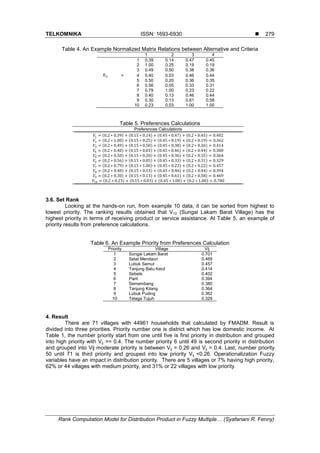
3.5. Calculate Cost/Benefit Value Using FMADM (Create preference)
The next step of the FMADM calculation is to determine the preference by using
formula (3). In this study, the alternative is the name of the existing village. The result of
preferences calculations can be seen at Table 5.
∑ ( ) ( ) ( ) ( ) (13)](https://image.slidesharecdn.com/346392-200820054633/85/Rank-Computation-Model-for-Distribution-Product-in-Fuzzy-Multiple-Attribute-Decision-Making-5-320.jpg)
![ ISSN: 1693-6930
TELKOMNIKA Vol. 16, No. 1, February 2018 : 274 – 281
280
Figure 3. The Result from FMADM with Priority
5. Conclusion
Implementation of FMADM to determine priorities in the research is effective process.
Using variables such as numbers of households, medium enterprises, GRDP, and economic
growth rates can assist to rank in distribution priority. FMADM, allowing weight changes to gain
significant results. Result obtained is 7% (5 villages) with high priority, 62% (44 villages) with
medium priority, and 31% (22 villages) for low priority. It can be easily determine, which district
to get first distribution. Impact of executing Fuzzy MADM is more effective than conventional
method. Time and needs can be considering in process. Advantage of Fuzzy MADM is that
calculating is worked by small numeric and it is influence in computing numeric value in
hardware. Conversely, conventional method is using true value. It can cause calculating run
slow and create waste the time.
References
[1] Muhammad Husaeni, A Nursikuwagus. Aplikasi Pengambilan Keputusan Beasiswa Dengan
Menggunakan Logika Fuzzy Multiple Atribute Decision Making (FMADM). Jurnal Teknik dan
Informatika. 2014; 1(2): 30-35.
[2] Faisal Kaleem, Kangk.Yen, Fumiyuki Adach Abolfazl Mehbodniya. A Fuzzy MADM Ranking
Approach For Vertical Mobility In Next Generation Hybrid Networks. International Congress On Ultra
Modern Telecommunications And Control Systems. 2012: 275-280.
[3] Vipul R Shah, Rajesh C Sanghvi, Haresh V Dedania. Portfolio Management: Stock Ranking By
Multiple Attribute Decision Making Methods. Technology And Investment. 2015; 6(1): 141-150.
[4] Shensheng Zhang, Hongxia Tong. A Fuzzy Multi-Attribute Decision Making Algorithm For Web
Services Selection Based On Qos. APSCC '06 Proceedings Of The 2006 IEEE Asia-Pacific
Conference On Services Computing. Washington DC, USA. 2006: 51-57.
[5] Yu Su, Peide Liu. Multiple Attribute Decision Making Method Based On The Trapezoid Fuzzy
Linguistic Hybrid Harmonic Averaging Operator. Informatica. 2012; 36: 83-90.
[6] V Ravi, MR Patra, R Mohanty. Application Of Fuzzy Multi Attribute Decision Making Analysis To Rank
Web Services. International Conference On Computer Information Systems And Industrial
Management Applications (CISIM). Krackow. 2010; 1: 398-403.
[7] Babak Daneshvar Rouyendegh. Selecting The High - Performing Departments Within Universities
Applying The Fuzzy MADM Methods. Scientific Research And Essays. 2011; 6(13): 2646-2654.
[8] A Ansarinejad SS, Miri-Nargesi S Nazari-Shirkouhi. Information Systems Outsourcing Decisions
Under Fuzzy Group Decision Making Approach. International Journal Of Information Technology &
Decision Making. 2011; 10(6): 989-1022.
[9] Riyanarto Sarno, Tohari Ahmad Solichul Huda. Fuzzy MADM Approach For Rating Of Process-
Based Fraud. Journal Of ICT Research And Applications. 2015; 9(2): 111-128.](https://image.slidesharecdn.com/346392-200820054633/85/Rank-Computation-Model-for-Distribution-Product-in-Fuzzy-Multiple-Attribute-Decision-Making-7-320.jpg)
![TELKOMNIKA ISSN: 1693-6930
Rank Computation Model for Distribution Product in Fuzzy Multiple… (Syafariani R. Fenny)
281
[10] NC Wadhwa, S Grover, S Goyal, V Gambhir. Applying Fuzzy Madm Approach For The Selection Of
Technical Institution. International Conference On Industrial Engineering And Engineering
Management. Hongkong. 2012: 1405-1408.
[11] Z Demsar, U Rantala, J Virrantaus, K Zhang. A Fuzzy Multiple-Attribute Decision-Making Modelling
For Vulnerability Analysis On The Basis Of Population Information For Disaster Management.
International Journal Of Geographical Information Science. 2014; 28(9): 1922-1939.
[12] Imam Riadi Shofwatul „Uyun. A Fuzzy Topsis Multiple-Attribute Decision Making For Scholarship
Selection. TELKOMNIKA Telecommunication Computing Electronics and Control. 2011; 9(1): 37-46.
[13] A Nursikuwagus, Agis Baswara. A Mamdani Fuzzy Model To Choose Eligible Student. TELKOMNIKA
Telecommunication Computing Electronics and Control. 2017; 15(1): 365-372.
[14] Erwin Susanto, Unang Sunarya, Arton Johan Lubis. Implementation Of Maximum Power Point
Tracking On Photovoltaic Using Fuzzy Logic Algorithm. TELKOMNIKA Telecommunication
Computing Electronics and Control. 2015; 13(1): 32-40.
[15] Kuspriyanto, Didin Saefudin, Edi Rakhman, Adin Mochammad Ramadlan, Noor Cholis Basjaruddin.
Overtaking Assistant System Based On Fuzzy Logic. TELKOMNIKA Telecommunication Computing
Electronics and Control. 2015; 13(1): 76-84.](https://image.slidesharecdn.com/346392-200820054633/85/Rank-Computation-Model-for-Distribution-Product-in-Fuzzy-Multiple-Attribute-Decision-Making-8-320.jpg)


![Statistics[1] Doc2](https://cdn.slidesharecdn.com/ss_thumbnails/statistics1-doc2-100327124611-phpapp01-thumbnail.jpg?width=640&height=640&fit=bounds)


