5G – Pathways to the
Next GenerationGSMA Capacity Building July 2019
Prepared by: Vusani Ramadzhia
What is 5G?
 5G will be defined in a set of standardized specifications that will be agreed by
international bodies – most notably the 3GPP and ultimately by the ITU in 2020.
(5G Spectrum, GSMA Public Policy Position, 2018)
 5G promises to deliver improved end-user experience by offering new applications
and services through gigabit speeds, and significantly improved performance and
reliability. 5G will build on the successes of 2G, 3G and 4G mobile networks, which
have transformed societies to support new services and new business models.
 5G provides an opportunity for wireless operators to move beyond providing
connectivity services, to developing rich solutions and services for consumers and
industry across a range of sectors at an affordable cost. 5G is an opportunity to
implement Wired and Wireless converged networks, in particular in terms of
integrating the management systems of networks. (ITU Discussion Paper, 2018)
Expectations in the 5G era
 5G is expected to transform societies to support new services and new
business models. (ITU Discussion Paper, 2018
 The variety of business models and services that 5G systems will support,
however, leads to numerous strategies a mobile operator has available to
introduce 5G services.
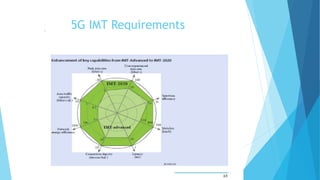
 5G will provide more advanced and enhanced capabilities compared to 4G LTE
(IMT-Advanced).
 It can be noted that 5G will aim to provide 20 times the peak data rate
(speed), 10 times lower latency (responsiveness) and 3 times more spectral
efficiency than 4G LTE. (GSMA Road to 5G Introduction and Migration, 2018)
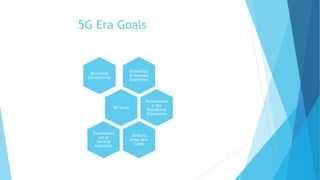
5G Era Goals
Innovation
& Network
Economics
Boundless
Connectivity
5G Goals
Revolutioniz
e the
Broadband
Experience
Assist to
Grow New
Cases
Transformat
ion of
Vertical
Industries
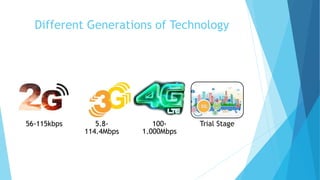
Different Generations of Technology
56-115kbps 5.8-
114.4Mbps
100-
1.000Mbps
Trial Stage
5G IMT Requirements
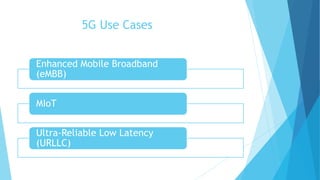
5G Use Cases
Enhanced Mobile Broadband
(eMBB)
MIoT
Ultra-Reliable Low Latency
(URLLC)
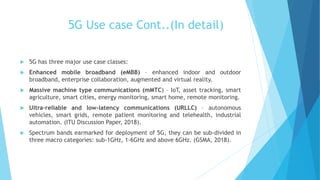
5G Use case Cont..(In detail)
 5G has three major use case classes:
 Enhanced mobile broadband (eMBB) – enhanced indoor and outdoor
broadband, enterprise collaboration, augmented and virtual reality.
 Massive machine type communications (mMTC) – IoT, asset tracking, smart
agriculture, smart cities, energy monitoring, smart home, remote monitoring.
 Ultra-reliable and low-latency communications (URLLC) – autonomous
vehicles, smart grids, remote patient monitoring and telehealth, industrial
automation. (ITU Discussion Paper, 2018).
 Spectrum bands earmarked for deployment of 5G, they can be sub-divided in
three macro categories: sub-1GHz, 1-6GHz and above 6GHz. (GSMA, 2018).
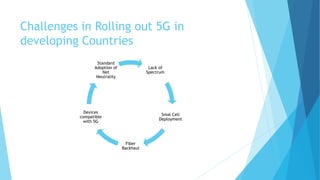
Challenges in Rolling out 5G in
developing Countries
Lack of
Spectrum
Smal Cell
Deployment
Fiber
Backhaul
Devices
compatible
with 5G
Standard
Adoption of
Net
Neutrality
Regulatory Intervention to Unlock 5G in
South Africa
 In 2018, ICASA published the Draft International Mobile Telephony (IMT)
Roadmap that seeks to ensure universal availability of broadband services as
well as a vibrant and competitive telecommunications industry and promote
investments.
 The growing demand for mobile broadband in South Africa indicates a need
for more mobile broadband bandwidth capacity in general.
 A key driver for the deployment of IMT bands is the need to ensure that
mobile broadband plays its role in meeting the objectives of ‘broadband for
all’, which is encapsulated in the targets of SA Connect (Broadband Policy),
and a key part of the document concerns the deployment of the 700 MHz and
800 MHz digital dividend bands (and potentially the 450-470 MHz Band) to
provide universal service. (ICASA Draft IMT Roadmap 2018)
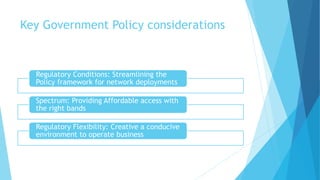
Key Government Policy considerations
Regulatory Conditions: Streamlining the
Policy framework for network deployments
Spectrum: Providing Affordable access with
the right bands
Regulatory Flexibility: Creative a conducive
environment to operate business
5G Trials by SA Telecoms Operators
 MTN South Africa has successfully launched a live 5G indoor solution at
Kyalami Grand Prix Circuit and International Convention Centre. This is the
first time that MTN SA has deployed a trial 5G network in an indoor business
environment, with standards-based commercial-grade 5G network equipment
and devices.
 Rain showcased its 5G capabilities, clocking speeds of up to 747Mbps, while
Comsol and Samsung combined to launch a 5G network in Soweto (township
in Johannesburg) that saw speeds peak at 1.75Gbps.
 A Vodacom is ready to implement 5G, and is awaiting for spectrum to be
made available.
References
 GSMA. (2018). Road to 5G Introduction and Migration (Online). Accessed on 20 July
2019 retrieved from https://www.gsma.com/futurenetworks/wp-
content/uploads/2018/04/Road-to-5G-Introduction-and-Migration_FINAL.pdf
 ITU. (2018). Setting the Scenes for 5G: Opportunities & Challenges Discussion
Paper (Online). Accessed on 20 July 2019 retrieved from
https://www.itu.int/en/ITU-D/Documents/ITU_5G_REPORT-2018.pdf
 ICASA. (2018). Draft IMT Roadmap (Online). Accessed on 20 July 2019 retrieved
from https://www.icasa.org.za/uploads/files/DRAFT-IMT-Roadmap-2018.pdf
 GSMA. (2019). 5G in Sub-Saharan Africa: Laying the Foundation (Online). Accessed
on 20 July 2019 retrieved from
https://www.gsmaintelligence.com/research/?file=7d4569ab4c1f69b82e9ad8f179b
a92ef&download
 GSMA. (2018). 5G Spectrum: GSMA Public Policy Position (Online). Accessed on 20
July 2019 retrieved from https://www.gsma.com/spectrum/wp-
content/uploads/2018/11/5G-Spectrum-Positions.pdf
References Cont..
 MTN Press Release (M&G) (10 April 2019) (Online). Accessed 20 July 2019
retrieved from
http://pressoffice.mg.co.za/mtn/PressRelease.php?StoryID=289176
 My Broadband (15 March 2019) ‘South Africa’s networks are ready and waiting
for 5G spectrum’ (Online). Accessed 20 July 2019 retrieved from
https://mybroadband.co.za/news/cellular/298892-south-africas-networks-
are-ready-and-waiting-for-5g-spectrum.html

5G Pathways to the next Generation Final Project

  • 1.
    5G – Pathwaysto the Next GenerationGSMA Capacity Building July 2019 Prepared by: Vusani Ramadzhia
  • 2.
    What is 5G? 5G will be defined in a set of standardized specifications that will be agreed by international bodies – most notably the 3GPP and ultimately by the ITU in 2020. (5G Spectrum, GSMA Public Policy Position, 2018)  5G promises to deliver improved end-user experience by offering new applications and services through gigabit speeds, and significantly improved performance and reliability. 5G will build on the successes of 2G, 3G and 4G mobile networks, which have transformed societies to support new services and new business models.  5G provides an opportunity for wireless operators to move beyond providing connectivity services, to developing rich solutions and services for consumers and industry across a range of sectors at an affordable cost. 5G is an opportunity to implement Wired and Wireless converged networks, in particular in terms of integrating the management systems of networks. (ITU Discussion Paper, 2018)
  • 3.
    Expectations in the5G era  5G is expected to transform societies to support new services and new business models. (ITU Discussion Paper, 2018  The variety of business models and services that 5G systems will support, however, leads to numerous strategies a mobile operator has available to introduce 5G services.  5G will provide more advanced and enhanced capabilities compared to 4G LTE (IMT-Advanced).  It can be noted that 5G will aim to provide 20 times the peak data rate (speed), 10 times lower latency (responsiveness) and 3 times more spectral efficiency than 4G LTE. (GSMA Road to 5G Introduction and Migration, 2018)
  • 4.
    5G Era Goals Innovation &Network Economics Boundless Connectivity 5G Goals Revolutioniz e the Broadband Experience Assist to Grow New Cases Transformat ion of Vertical Industries
  • 5.
    Different Generations ofTechnology 56-115kbps 5.8- 114.4Mbps 100- 1.000Mbps Trial Stage
  • 6.
  • 7.
    5G Use Cases EnhancedMobile Broadband (eMBB) MIoT Ultra-Reliable Low Latency (URLLC)
  • 8.
    5G Use caseCont..(In detail)  5G has three major use case classes:  Enhanced mobile broadband (eMBB) – enhanced indoor and outdoor broadband, enterprise collaboration, augmented and virtual reality.  Massive machine type communications (mMTC) – IoT, asset tracking, smart agriculture, smart cities, energy monitoring, smart home, remote monitoring.  Ultra-reliable and low-latency communications (URLLC) – autonomous vehicles, smart grids, remote patient monitoring and telehealth, industrial automation. (ITU Discussion Paper, 2018).  Spectrum bands earmarked for deployment of 5G, they can be sub-divided in three macro categories: sub-1GHz, 1-6GHz and above 6GHz. (GSMA, 2018).
  • 9.
    Challenges in Rollingout 5G in developing Countries Lack of Spectrum Smal Cell Deployment Fiber Backhaul Devices compatible with 5G Standard Adoption of Net Neutrality
  • 10.
    Regulatory Intervention toUnlock 5G in South Africa  In 2018, ICASA published the Draft International Mobile Telephony (IMT) Roadmap that seeks to ensure universal availability of broadband services as well as a vibrant and competitive telecommunications industry and promote investments.  The growing demand for mobile broadband in South Africa indicates a need for more mobile broadband bandwidth capacity in general.  A key driver for the deployment of IMT bands is the need to ensure that mobile broadband plays its role in meeting the objectives of ‘broadband for all’, which is encapsulated in the targets of SA Connect (Broadband Policy), and a key part of the document concerns the deployment of the 700 MHz and 800 MHz digital dividend bands (and potentially the 450-470 MHz Band) to provide universal service. (ICASA Draft IMT Roadmap 2018)
  • 11.
    Key Government Policyconsiderations Regulatory Conditions: Streamlining the Policy framework for network deployments Spectrum: Providing Affordable access with the right bands Regulatory Flexibility: Creative a conducive environment to operate business
  • 12.
    5G Trials bySA Telecoms Operators  MTN South Africa has successfully launched a live 5G indoor solution at Kyalami Grand Prix Circuit and International Convention Centre. This is the first time that MTN SA has deployed a trial 5G network in an indoor business environment, with standards-based commercial-grade 5G network equipment and devices.  Rain showcased its 5G capabilities, clocking speeds of up to 747Mbps, while Comsol and Samsung combined to launch a 5G network in Soweto (township in Johannesburg) that saw speeds peak at 1.75Gbps.  A Vodacom is ready to implement 5G, and is awaiting for spectrum to be made available.
  • 13.
    References  GSMA. (2018).Road to 5G Introduction and Migration (Online). Accessed on 20 July 2019 retrieved from https://www.gsma.com/futurenetworks/wp- content/uploads/2018/04/Road-to-5G-Introduction-and-Migration_FINAL.pdf  ITU. (2018). Setting the Scenes for 5G: Opportunities & Challenges Discussion Paper (Online). Accessed on 20 July 2019 retrieved from https://www.itu.int/en/ITU-D/Documents/ITU_5G_REPORT-2018.pdf  ICASA. (2018). Draft IMT Roadmap (Online). Accessed on 20 July 2019 retrieved from https://www.icasa.org.za/uploads/files/DRAFT-IMT-Roadmap-2018.pdf  GSMA. (2019). 5G in Sub-Saharan Africa: Laying the Foundation (Online). Accessed on 20 July 2019 retrieved from https://www.gsmaintelligence.com/research/?file=7d4569ab4c1f69b82e9ad8f179b a92ef&download  GSMA. (2018). 5G Spectrum: GSMA Public Policy Position (Online). Accessed on 20 July 2019 retrieved from https://www.gsma.com/spectrum/wp- content/uploads/2018/11/5G-Spectrum-Positions.pdf
  • 14.
    References Cont..  MTNPress Release (M&G) (10 April 2019) (Online). Accessed 20 July 2019 retrieved from http://pressoffice.mg.co.za/mtn/PressRelease.php?StoryID=289176  My Broadband (15 March 2019) ‘South Africa’s networks are ready and waiting for 5G spectrum’ (Online). Accessed 20 July 2019 retrieved from https://mybroadband.co.za/news/cellular/298892-south-africas-networks- are-ready-and-waiting-for-5g-spectrum.html