Competition Policy in
the Digital Age
GSMA Capacity Building April 2018
Prepared by: Vusani Ramadzhia
Competition Policy and Economic
Regulation
 Competition policy and regulation are often regarded as two most important
and inter-related areas of regulatory policy.
 These policies are designed to address weaknesses (or market failures) within
the market system.
 Competition policy and regulation can both play a vital role in improving the
quality of regulation, thus creating healthy and competitive markets.
 However if they are used inefficiently, they can distort the functioning of
market forces and results in markets that (monopoly structure) and market
barriers for new entrants.
 In addition to provisions designed to address market power in the sector
(including interconnection, facilities leasing and price regulation)
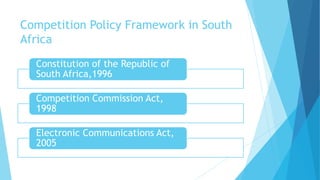
Competition Policy Framework in South
Africa
Constitution of the Republic of
South Africa,1996
Competition Commission Act,
1998
Electronic Communications Act,
2005
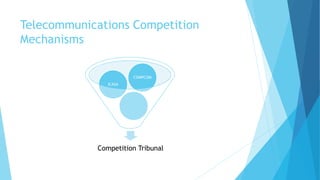
Telecommunications Competition
Mechanisms
Competition Tribunal
ICASA
COMPCOM
Competition Commission Jurisdiction in
regulating telecommunications
 The specific abuse of dominance provisions in sections 8 and 9 of the
Competition Act 89 of 1998, as amended, stipulate effects-based economic
tests.
 There are also explicit pro-competitive, efficiency and technology defences
for most of the abuse prohibitions.
 Section 8(a) prohibits a dominant firm to charge an excessive price to the
detriment of consumers.
 Exclusionary conduct is covered under sections 8(b), (c) and (d) of the
Competition Act. Section 8(b) prohibits a dominant firm from denying access
to an essential facility.
Concurrent Jurisdiction over
competition matters
 The Competition Act 89 of 1998, Section 3(1A) (b) provides for the manner in
which the concurrent jurisdiction or other public regulation is exercised and
that it must, be managed, to the extent possible’ in accordance with any
agreement between the two regulatory bodies.
 The Competition Commission and ICASA signed a memorandum of agreement
effective from 16 September 2002. (Competition Act, 1998).
 The Competition Commission holds ex-post jurisdiction whilst ICASA holds an
ex ante jurisdiction over competition matters.
 ICASA exercises its powers in terms section 67 (11) and (12) of the ECA, which
provides for concurrent jurisdiction between the Authority and Competition
Commission. In terms of ECA, Chapter 10 empowers the Authority to regulate
“competition matters” in the broadcasting industry (ECA, 2005).
Precedent-Telkom case vs Compcom
 In South Africa, one of the first cases to address the respective roles of
competition authorities and sector regulators, and jurisdiction over
anticompetitive conduct in a regulated sector, was the Telkom case
 A complaint was lodged a Telkom in respect to alleged anticompetitive
conduct.
 Commission referred various aspects of these complaints to the Competition
Tribunal for adjudication.
 Commission’s referral alleged Telkom’s refusal to provide telecommunications
facilities to VANS.
 Refusal constituted an exclusionary act in terms of section 8(c) of the
Competition Act, and/or a refusal to provide access to an essential facility in
terms of section 8(b) of the Competition Act, and/ or price discrimination in
terms of section 9 of the Competition Act.
Precedent-Telkom Case vs Compcom
 The Supreme Court of Appeal (SCA) rejected Telkom’s argument and
confirmed that the Competition Act applies to all economic activity within the
Republic, including Telkom’s conduct.
 The SCA concluded that the Commission had jurisdiction to deal with the
complaint and where its jurisdiction overlapped with that of ICASA’s, the
Commission had sufficiently co-operated with ICASA in accordance with the
Competition Act.
 The SCA found that the Telecommunications Act did not oust the jurisdiction
of the Commission to investigate competition matters in the
telecommunications industry.
Mobile interconnection rate regulation by
ICASA
 ICASA published call termination regulations in 2010 and it then conducted a
review of the pro-competitive conditions imposed in terms of those
regulations and promulgated new call termination regulations in 2014.
 Under Chapter 7 of the ECA, ICASA has the power to regulate interconnection
and it may regulate interconnection rates in terms of Section 4.
 The rate is referred to as the “mobile termination rate” and in fixed
electronic communications the rate is referred to as the “fixed termination
rate”
 Currently call termination in South Africa is at the rate of 0,19 cents
asymmetric off peak
Conclusion
 Concurrent jurisdiction over matters of competition and economic regulation
has been effective over the years.
 However in some instances the economic regulation has not yet attempted to
review the broadcasting market which dominant by the incumbent
(MultiChoice).
 In South Africa, especially in the Telecoms sector there has been market
barriers for new entrants. The market is dominated by firms such as Vodacom
and MTN while on the other hand Telkom and Cell C are still struggling to
enter the market.
 Regulation of Competion and economic regulation continues to be relavant;
but also requires improvement over time.
 Competition Commission Act, 1998 retrieved from
http://www.compcom.co.za/wp-content/uploads/2014/09/pocket-act-august-
20141.pdf [Accessed 4 May 2018]
 Electronic Communications Act, 2005 retrieved from
http://www.wipo.int/edocs/lexdocs/laws/en/za/za082en.pdf [Accessed 4 May
2018]
 The impact of regulation on competition in telecommunications and piped gas
retrieved from
http://www.nortonrosefulbright.com/knowledge/publications/128038/the-
impact-of-regulation-on-competition-in-telecommunications-and-piped-gas
[Accessed 4 May 2018]
 Review of economic regulation of the telecommunications sector retrieved from
https://static1.squarespace.com/static/52246331e4b0a46e5f1b8ce5/t/537f2e60e
4b0b4236d47a5bb/1400843872601/1400407_EDD-
UJ_RECBP_Project+Report_App10_Telecommunications+Sector+Review_Final.pdf
[Accessed 4 May 2018]

Competition Policy in the Digital Age

  • 1.
    Competition Policy in theDigital Age GSMA Capacity Building April 2018 Prepared by: Vusani Ramadzhia
  • 2.
    Competition Policy andEconomic Regulation  Competition policy and regulation are often regarded as two most important and inter-related areas of regulatory policy.  These policies are designed to address weaknesses (or market failures) within the market system.  Competition policy and regulation can both play a vital role in improving the quality of regulation, thus creating healthy and competitive markets.  However if they are used inefficiently, they can distort the functioning of market forces and results in markets that (monopoly structure) and market barriers for new entrants.  In addition to provisions designed to address market power in the sector (including interconnection, facilities leasing and price regulation)
  • 3.
    Competition Policy Frameworkin South Africa Constitution of the Republic of South Africa,1996 Competition Commission Act, 1998 Electronic Communications Act, 2005
  • 4.
  • 5.
    Competition Commission Jurisdictionin regulating telecommunications  The specific abuse of dominance provisions in sections 8 and 9 of the Competition Act 89 of 1998, as amended, stipulate effects-based economic tests.  There are also explicit pro-competitive, efficiency and technology defences for most of the abuse prohibitions.  Section 8(a) prohibits a dominant firm to charge an excessive price to the detriment of consumers.  Exclusionary conduct is covered under sections 8(b), (c) and (d) of the Competition Act. Section 8(b) prohibits a dominant firm from denying access to an essential facility.
  • 6.
    Concurrent Jurisdiction over competitionmatters  The Competition Act 89 of 1998, Section 3(1A) (b) provides for the manner in which the concurrent jurisdiction or other public regulation is exercised and that it must, be managed, to the extent possible’ in accordance with any agreement between the two regulatory bodies.  The Competition Commission and ICASA signed a memorandum of agreement effective from 16 September 2002. (Competition Act, 1998).  The Competition Commission holds ex-post jurisdiction whilst ICASA holds an ex ante jurisdiction over competition matters.  ICASA exercises its powers in terms section 67 (11) and (12) of the ECA, which provides for concurrent jurisdiction between the Authority and Competition Commission. In terms of ECA, Chapter 10 empowers the Authority to regulate “competition matters” in the broadcasting industry (ECA, 2005).
  • 7.
    Precedent-Telkom case vsCompcom  In South Africa, one of the first cases to address the respective roles of competition authorities and sector regulators, and jurisdiction over anticompetitive conduct in a regulated sector, was the Telkom case  A complaint was lodged a Telkom in respect to alleged anticompetitive conduct.  Commission referred various aspects of these complaints to the Competition Tribunal for adjudication.  Commission’s referral alleged Telkom’s refusal to provide telecommunications facilities to VANS.  Refusal constituted an exclusionary act in terms of section 8(c) of the Competition Act, and/or a refusal to provide access to an essential facility in terms of section 8(b) of the Competition Act, and/ or price discrimination in terms of section 9 of the Competition Act.
  • 8.
    Precedent-Telkom Case vsCompcom  The Supreme Court of Appeal (SCA) rejected Telkom’s argument and confirmed that the Competition Act applies to all economic activity within the Republic, including Telkom’s conduct.  The SCA concluded that the Commission had jurisdiction to deal with the complaint and where its jurisdiction overlapped with that of ICASA’s, the Commission had sufficiently co-operated with ICASA in accordance with the Competition Act.  The SCA found that the Telecommunications Act did not oust the jurisdiction of the Commission to investigate competition matters in the telecommunications industry.
  • 9.
    Mobile interconnection rateregulation by ICASA  ICASA published call termination regulations in 2010 and it then conducted a review of the pro-competitive conditions imposed in terms of those regulations and promulgated new call termination regulations in 2014.  Under Chapter 7 of the ECA, ICASA has the power to regulate interconnection and it may regulate interconnection rates in terms of Section 4.  The rate is referred to as the “mobile termination rate” and in fixed electronic communications the rate is referred to as the “fixed termination rate”  Currently call termination in South Africa is at the rate of 0,19 cents asymmetric off peak
  • 10.
    Conclusion  Concurrent jurisdictionover matters of competition and economic regulation has been effective over the years.  However in some instances the economic regulation has not yet attempted to review the broadcasting market which dominant by the incumbent (MultiChoice).  In South Africa, especially in the Telecoms sector there has been market barriers for new entrants. The market is dominated by firms such as Vodacom and MTN while on the other hand Telkom and Cell C are still struggling to enter the market.  Regulation of Competion and economic regulation continues to be relavant; but also requires improvement over time.
  • 11.
     Competition CommissionAct, 1998 retrieved from http://www.compcom.co.za/wp-content/uploads/2014/09/pocket-act-august- 20141.pdf [Accessed 4 May 2018]  Electronic Communications Act, 2005 retrieved from http://www.wipo.int/edocs/lexdocs/laws/en/za/za082en.pdf [Accessed 4 May 2018]  The impact of regulation on competition in telecommunications and piped gas retrieved from http://www.nortonrosefulbright.com/knowledge/publications/128038/the- impact-of-regulation-on-competition-in-telecommunications-and-piped-gas [Accessed 4 May 2018]  Review of economic regulation of the telecommunications sector retrieved from https://static1.squarespace.com/static/52246331e4b0a46e5f1b8ce5/t/537f2e60e 4b0b4236d47a5bb/1400843872601/1400407_EDD- UJ_RECBP_Project+Report_App10_Telecommunications+Sector+Review_Final.pdf [Accessed 4 May 2018]