4th SG13 Regional Workshop for Africa on
“Future Networks for a better Africa: IMT-2020,
Trust, Cloud Computing and Big Data”
(Accra, Ghana, 14-15 March 2016)
Paving the Way to 5G
Ali Amer
Senior Expert/Consultant
Saudi Telecom Company
Email=aliamer@stc.com.sa
Overview
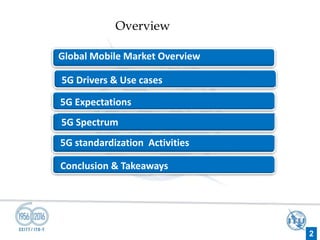
Global Mobile Market Overview
5G Drivers & Use cases
5G Spectrum
Conclusion & Takeaways
5G standardization Activities
2
5G Expectations
3
Overview
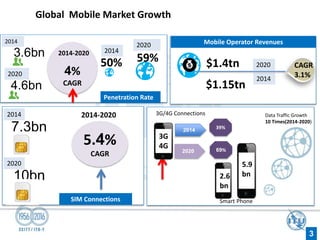
4%
CAGR
2014-2020
3.6bn
4.6bn
50%
2014
2020
59%
Penetration Rate
2014
2020
5.4%
CAGR
2014-2020
7.3bn
10bn
2014
2020
39%
2014
2020 69%
3G/4G Connections
Smart Phone
Data Traffic Growth
10 Times(2014-2020)
Overview
2014
$1.4tn
Mobile Operator Revenues
3G
4G
5.9
bn
2.6
bn
2020
$1.15tn
CAGR
3.1%
SIM Connections
Global Mobile Market Growth
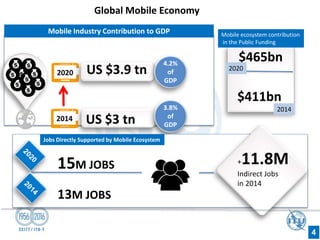
Mobile Industry Contribution to GDP
Global Mobile Economy
4
2020
2014
US $3.9 tn
4.2%
of
GDP
US $3 tn
3.8%
of
GDP
13M JOBS
15M JOBS
Jobs Directly Supported by Mobile Ecosystem
+11.8M
Indirect Jobs
in 2014
$465bn
$411bn
Mobile ecosystem contribution
in the Public Funding
2020
2014
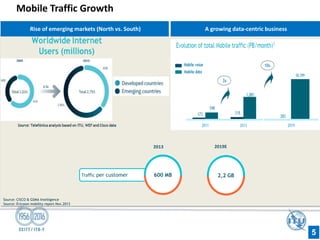
Mobile Traffic Growth
Rise of emerging markets (North vs. South)
Traffic per customer 600 MB
2013 2019E
2,2 GB
A growing data-centric business
Source: CISCO & GSMA Intelligence
Source: Ericsson mobility report Nov.2013
5
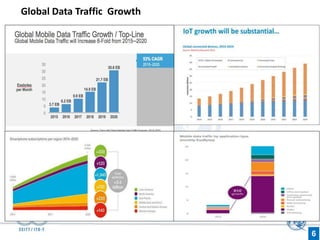
Global Data Traffic Growth
6
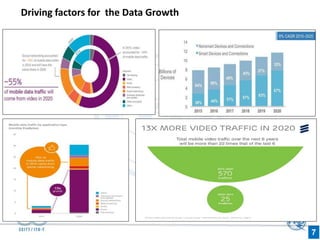
Driving factors for the Data Growth
7
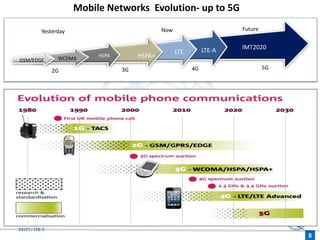
Mobile Networks Evolution- up to 5G
8
Yesterday Now Future
2G 3G 4G 5G
GSM/EDGE WCDMA
HSPA HSPA+
LTE LTE-A IMT2020
9
5G
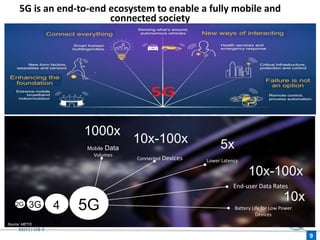
1000x
Mobile Data
Volumes
10x-100x
Connected Devices
5x
Lower Latency
10x-100x
End-user Data Rates
10x
Battery Life for Low Power
Devices
Source: METIS
4
G
3G
2G
5G is an end-to-end ecosystem to enable a fully mobile and
connected society
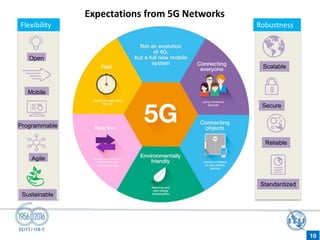
Open
Mobile
Programmable
Agile
Sustainable
Scalable
Secure
Reliable
Standardized
Flexibility Robustness
Expectations from 5G Networks
10
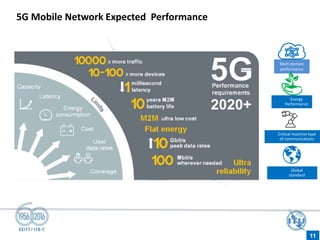
Multi domain
performance
Energy
Performance
Critical machine type
of communications
Global
standard
5G Mobile Network Expected Performance
11
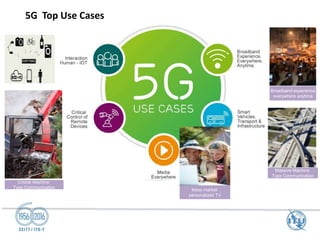
Broadband experience
everywhere anytime
Massive Machine
Type Communication
Critical Machine
Type Communication
Mass market
personalized TV
5G Top Use Cases
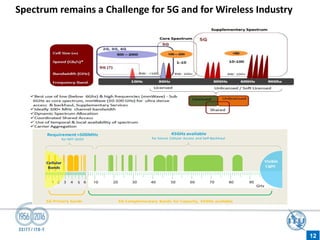
Spectrum remains a Challenge for 5G and for Wireless Industry
10 50
40
30
20 60 80
70 90
1 5
4
2 6
3
5G Complementary Bands for Capacity, 45GHz available
5G Primary bands
GHz
Visible
Light
Cellular
Bands
Requirement >500MHz
for IMT-2020
45GHz available
for future Cellular Access and Self-Backhaul
12
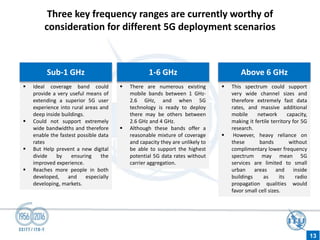
Three key frequency ranges are currently worthy of
consideration for different 5G deployment scenarios
 Ideal coverage band could
provide a very useful means of
extending a superior 5G user
experience into rural areas and
deep inside buildings.
 Could not support extremely
wide bandwidths and therefore
enable the fastest possible data
rates
 But Help prevent a new digital
divide by ensuring the
improved experience.
 Reaches more people in both
developed, and especially
developing, markets.
 There are numerous existing
mobile bands between 1 GHz-
2.6 GHz, and when 5G
technology is ready to deploy
there may be others between
2.6 GHz and 4 GHz.
 Although these bands offer a
reasonable mixture of coverage
and capacity they are unlikely to
be able to support the highest
potential 5G data rates without
carrier aggregation.
 This spectrum could support
very wide channel sizes and
therefore extremely fast data
rates, and massive additional
mobile network capacity,
making it fertile territory for 5G
research.
 However, heavy reliance on
these bands without
complimentary lower frequency
spectrum may mean 5G
services are limited to small
urban areas and inside
buildings as its radio
propagation qualities would
favor small cell sizes.
Sub-1 GHz 1-6 GHz Above 6 GHz
13
14
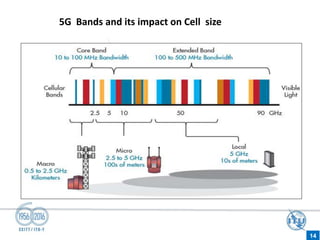
5G Bands and its impact on Cell size
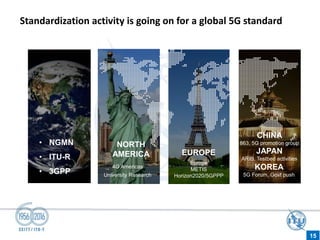
Standardization activity is going on for a global 5G standard
NORTH
AMERICA EUROPE
CHINA
4G Americas
University Research
Europe
METIS
Horizon2020/5GPPP
863, 5G promotion group
JAPAN
ARIB, Testbed activities
KOREA
5G Forum, Govt push
• NGMN
• ITU-R
• 3GPP
15
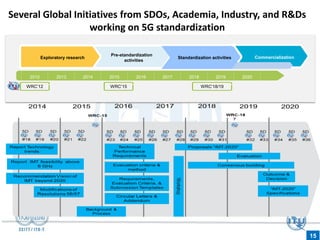
Several Global Initiatives from SDOs, Academia, Industry, and R&Ds
working on 5G standardization
2012 2013 2014 2015 2016 2017 2018 2019 2020
WRC’12 WRC’15 WRC’18/19
Exploratory research
Pre-standardization
activities
Commercialization
Standardization activities
15
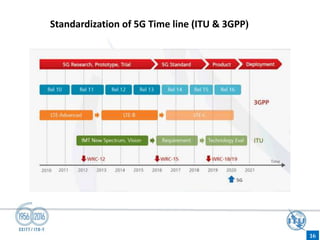
16
Standardization of 5G Time line (ITU & 3GPP)
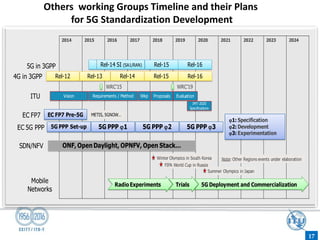
2014 2015 2016 2017 2018 2019 2020 2021 2022 2023 2024
Rel-12 Rel-13 Rel-14
Rel-14 SI (SA1/RAN)
Rel-15
Rel-15
Rel-16
Rel-16
4G in 3GPP
5G in 3GPP
5G PPP j1
WRC’15 WRC’19
Vision
ITU Requirements / Method Proposals
5G PPP j2 5G PPP j3
5G PPP Set-up
EC 5G PPP
ONF, Open Daylight, OPNFV, Open Stack…
SDN/NFV
EC FP7 Pre-5G METIS, 5GNOW…
EC FP7
j1: Specification
j2: Development
j3: Experimentation
Winter Olympics in South Korea
FIFA World Cup in Russia
Summer Olympics in Japan
5G Deployment and Commercialization
Trials
Radio Experiments
Mobile
Networks
Wkp
IMT-2020
Specifications
Evaluation
Note: Other Regions events under elaboration
Others working Groups Timeline and their Plans
for 5G Standardization Development
17
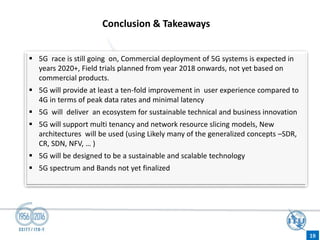
Conclusion & Takeaways
 5G race is still going on, Commercial deployment of 5G systems is expected in
years 2020+, Field trials planned from year 2018 onwards, not yet based on
commercial products.
 5G will provide at least a ten-fold improvement in user experience compared to
4G in terms of peak data rates and minimal latency
 5G will deliver an ecosystem for sustainable technical and business innovation
 5G will support multi tenancy and network resource slicing models, New
architectures will be used (using Likely many of the generalized concepts –SDR,
CR, SDN, NFV, … )
 5G will be designed to be a sustainable and scalable technology
 5G spectrum and Bands not yet finalized
18
Thank you
19

5G Technology in wireless S2P3_Ali_Amer.pptx

  • 1.
    4th SG13 RegionalWorkshop for Africa on “Future Networks for a better Africa: IMT-2020, Trust, Cloud Computing and Big Data” (Accra, Ghana, 14-15 March 2016) Paving the Way to 5G Ali Amer Senior Expert/Consultant Saudi Telecom Company Email=aliamer@stc.com.sa
  • 2.
    Overview Global Mobile MarketOverview 5G Drivers & Use cases 5G Spectrum Conclusion & Takeaways 5G standardization Activities 2 5G Expectations
  • 3.
    3 Overview 4% CAGR 2014-2020 3.6bn 4.6bn 50% 2014 2020 59% Penetration Rate 2014 2020 5.4% CAGR 2014-2020 7.3bn 10bn 2014 2020 39% 2014 2020 69% 3G/4GConnections Smart Phone Data Traffic Growth 10 Times(2014-2020) Overview 2014 $1.4tn Mobile Operator Revenues 3G 4G 5.9 bn 2.6 bn 2020 $1.15tn CAGR 3.1% SIM Connections Global Mobile Market Growth
  • 4.
    Mobile Industry Contributionto GDP Global Mobile Economy 4 2020 2014 US $3.9 tn 4.2% of GDP US $3 tn 3.8% of GDP 13M JOBS 15M JOBS Jobs Directly Supported by Mobile Ecosystem +11.8M Indirect Jobs in 2014 $465bn $411bn Mobile ecosystem contribution in the Public Funding 2020 2014
  • 5.
    Mobile Traffic Growth Riseof emerging markets (North vs. South) Traffic per customer 600 MB 2013 2019E 2,2 GB A growing data-centric business Source: CISCO & GSMA Intelligence Source: Ericsson mobility report Nov.2013 5
  • 6.
  • 7.
    Driving factors forthe Data Growth 7
  • 8.
    Mobile Networks Evolution-up to 5G 8 Yesterday Now Future 2G 3G 4G 5G GSM/EDGE WCDMA HSPA HSPA+ LTE LTE-A IMT2020
  • 9.
    9 5G 1000x Mobile Data Volumes 10x-100x Connected Devices 5x LowerLatency 10x-100x End-user Data Rates 10x Battery Life for Low Power Devices Source: METIS 4 G 3G 2G 5G is an end-to-end ecosystem to enable a fully mobile and connected society
  • 10.
  • 11.
    Multi domain performance Energy Performance Critical machinetype of communications Global standard 5G Mobile Network Expected Performance 11
  • 12.
    Broadband experience everywhere anytime MassiveMachine Type Communication Critical Machine Type Communication Mass market personalized TV 5G Top Use Cases
  • 13.
    Spectrum remains aChallenge for 5G and for Wireless Industry 10 50 40 30 20 60 80 70 90 1 5 4 2 6 3 5G Complementary Bands for Capacity, 45GHz available 5G Primary bands GHz Visible Light Cellular Bands Requirement >500MHz for IMT-2020 45GHz available for future Cellular Access and Self-Backhaul 12
  • 14.
    Three key frequencyranges are currently worthy of consideration for different 5G deployment scenarios  Ideal coverage band could provide a very useful means of extending a superior 5G user experience into rural areas and deep inside buildings.  Could not support extremely wide bandwidths and therefore enable the fastest possible data rates  But Help prevent a new digital divide by ensuring the improved experience.  Reaches more people in both developed, and especially developing, markets.  There are numerous existing mobile bands between 1 GHz- 2.6 GHz, and when 5G technology is ready to deploy there may be others between 2.6 GHz and 4 GHz.  Although these bands offer a reasonable mixture of coverage and capacity they are unlikely to be able to support the highest potential 5G data rates without carrier aggregation.  This spectrum could support very wide channel sizes and therefore extremely fast data rates, and massive additional mobile network capacity, making it fertile territory for 5G research.  However, heavy reliance on these bands without complimentary lower frequency spectrum may mean 5G services are limited to small urban areas and inside buildings as its radio propagation qualities would favor small cell sizes. Sub-1 GHz 1-6 GHz Above 6 GHz 13
  • 15.
    14 5G Bands andits impact on Cell size
  • 16.
    Standardization activity isgoing on for a global 5G standard NORTH AMERICA EUROPE CHINA 4G Americas University Research Europe METIS Horizon2020/5GPPP 863, 5G promotion group JAPAN ARIB, Testbed activities KOREA 5G Forum, Govt push • NGMN • ITU-R • 3GPP 15
  • 17.
    Several Global Initiativesfrom SDOs, Academia, Industry, and R&Ds working on 5G standardization 2012 2013 2014 2015 2016 2017 2018 2019 2020 WRC’12 WRC’15 WRC’18/19 Exploratory research Pre-standardization activities Commercialization Standardization activities 15
  • 18.
    16 Standardization of 5GTime line (ITU & 3GPP)
  • 19.
    2014 2015 20162017 2018 2019 2020 2021 2022 2023 2024 Rel-12 Rel-13 Rel-14 Rel-14 SI (SA1/RAN) Rel-15 Rel-15 Rel-16 Rel-16 4G in 3GPP 5G in 3GPP 5G PPP j1 WRC’15 WRC’19 Vision ITU Requirements / Method Proposals 5G PPP j2 5G PPP j3 5G PPP Set-up EC 5G PPP ONF, Open Daylight, OPNFV, Open Stack… SDN/NFV EC FP7 Pre-5G METIS, 5GNOW… EC FP7 j1: Specification j2: Development j3: Experimentation Winter Olympics in South Korea FIFA World Cup in Russia Summer Olympics in Japan 5G Deployment and Commercialization Trials Radio Experiments Mobile Networks Wkp IMT-2020 Specifications Evaluation Note: Other Regions events under elaboration Others working Groups Timeline and their Plans for 5G Standardization Development 17
  • 20.
    Conclusion & Takeaways 5G race is still going on, Commercial deployment of 5G systems is expected in years 2020+, Field trials planned from year 2018 onwards, not yet based on commercial products.  5G will provide at least a ten-fold improvement in user experience compared to 4G in terms of peak data rates and minimal latency  5G will deliver an ecosystem for sustainable technical and business innovation  5G will support multi tenancy and network resource slicing models, New architectures will be used (using Likely many of the generalized concepts –SDR, CR, SDN, NFV, … )  5G will be designed to be a sustainable and scalable technology  5G spectrum and Bands not yet finalized 18
  • 21.

Editor's Notes