Disaster Preparedness
Response
GSMA Capacity Building March 2018
Submission: Prepared by: Vusani Ramadzhia
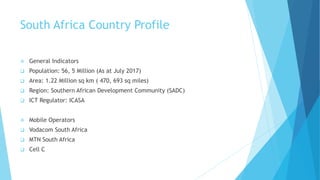
South Africa Country Profile
 General Indicators
 Population: 56, 5 Million (As at July 2017)
 Area: 1.22 Million sq km ( 470, 693 sq miles)
 Region: Southern African Development Community (SADC)
 ICT Regulator: ICASA
 Mobile Operators
 Vodacom South Africa
 MTN South Africa
 Cell C
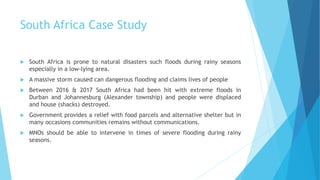
South Africa Case Study
 South Africa is prone to natural disasters such floods during rainy seasons
especially in a low-lying area.
 A massive storm caused can dangerous flooding and claims lives of people
 Between 2016 & 2017 South Africa had been hit with extreme floods in
Durban and Johannesburg (Alexander township) and people were displaced
and house (shacks) destroyed.
 Government provides a relief with food parcels and alternative shelter but in
many occasions communities remains without communications.
 MNOs should be able to intervene in times of severe flooding during rainy
seasons.
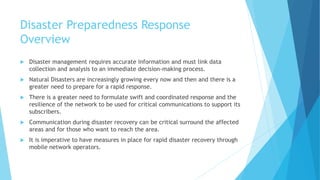
Disaster Preparedness Response
Overview
 Disaster management requires accurate information and must link data
collection and analysis to an immediate decision-making process.
 Natural Disasters are increasingly growing every now and then and there is a
greater need to prepare for a rapid response.
 There is a greater need to formulate swift and coordinated response and the
resilience of the network to be used for critical communications to support its
subscribers.
 Communication during disaster recovery can be critical surround the affected
areas and for those who want to reach the area.
 It is imperative to have measures in place for rapid disaster recovery through
mobile network operators.
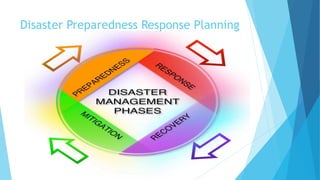
Disaster Preparedness Response Planning
 Early Warning and Remote Sensing Systems
 MNOs prediction, including the acquisition and processing of data concerning
the probability of future disaster occurrence, location and duration
(flooding).
 Disaster detection, including the detailed analysis of the topical likelihood
and severity of a disaster event
 MNOs should sent SMS to vulnerable areas to minimize the effects of disaster
or prevent the incidence.
 Broadcast emergency warning systems
 City of Johannesburg assisted by the Automated Rainfall System (ARS)should
broadcast alerting informal settlement which can be critical affected.
Disaster Preparedness Response Planning
Disaster Regulatory Response
 ICASA as the ICT Regulators should be flexible and allow MNOs to adjust to
unforeseen circumstance rather than applying stringent rules that are
applicable to non-emergency situations.
 ICASA Regulatory should relax it regulations on Tower-sitting Regulation and
provide alternative on the erection of temporary towers.
 ICASA Should also relax rules that governs mobile transmitters. Provide
operator with regulations that allows them to send free SMS during the
emergencies.
 Regulators should create an enabling environment for Mobile Operator to
cooperate and share available resources.
Long Term Recovery Strategy
 MNOs need to change their network topologies from a series type to a ring,
with the aim of increasing resilience.
 Deploy Base Stations and provision of spectrum to enable basic
communications
 In addition, two very small aperture terminals (VSATs) has to be installed for
emergency communications in strategic locations, which would be selected
based on geographic dispersion and population density.
 This measure will reduce the risk of completely losing connectivity with the
international community. National roaming and priority calling that will be
activated with the official announcement of a disaster are other initiatives
taken by the operators in .
Disaster Preparedness Response
Multistakeholder Partnership
Disaster Preparedness Response
Partnership
 It is critical that MNOs and humanitarian agencies develop a multistakeholder
partnership arrangement in advance to avoid inefficiencies.
 Successful partnerships in this space are those which at their foundation are
beneficial to both partners, leveraging the subject matter expertise and
content of the humanitarian sector and pairing it with the core
communication competency and scale that mobile operators possess.
 solid understanding of the capacity, limitations, expectations and interests of
each partner is a cornerstone of any partnership, but particularly so when the
parties may have diverse drivers and ways of working.
Long Term Solutions for Disaster
Preparedness Response
 Multi-stakeholder (Regulator, Humanitarian Agencies & Municipalities)
partnership should invest in understanding how the private sector operates
and its organizational culture, in order to support strong partnerships.
 ICASA as the Regulator should establish the regulations that governs the
Disaster recovery responses during occurrence of natural disasters.
 MNOs should always test their early warning systems in order to prepare for
unforeseen natural disasters.
 The South African Weather Service should provide information as and when
predicting heavy rainfall and likelihood of natural disaster to both the MNOs
and the Municipalities.
Conclusion
 Implementation of Disaster Preparedness requires proper planning especially
in areas where people are living in informal settlement.
 MNOs and Municipalities should develop a sound memorandum of
understanding outlining the expectations and limitations that will address and
respond to rapid disaster recovery.
 Early Warning systems should be installed in areas where it has been
identified as high risk areas.
 Regulator need to partner with MNOs to enable a swift disaster recovery by
exempting regulatory standards during the disaster recovery
References
 ITU Utilization of Telecommnications/ICTs for Disaster Preparedness,
Mitigation and Response https://www.itu.int/en/ITU-D/Emergency
Telecommunications/Pages/Publications.aspx
 South African Natural disasters retrieved from http://www.enca.com/south-
africa/four-year-old-alexandra-child-swept-away-during-floods
 Mobile Network Operators Partnership Guidelines: Building effective
partnerships between MNOs and NGOs in complex environments and crises
retrieved from https://www.gsma.com/mobilefordevelopment/wp-
content/uploads/2016/03/GSMA_Partnership_MNOs_NGOs.pdf
 GSMA Disaster Response: Business Continuity Planning Management retrieved
from https://www.gsma.com/mobilefordevelopment/wp-
content/uploads/2016/05/GSMA_Disaster-
Response_Business_Continuity_Management_Report.pdf

DPR Final Project

  • 1.
    Disaster Preparedness Response GSMA CapacityBuilding March 2018 Submission: Prepared by: Vusani Ramadzhia
  • 2.
    South Africa CountryProfile  General Indicators  Population: 56, 5 Million (As at July 2017)  Area: 1.22 Million sq km ( 470, 693 sq miles)  Region: Southern African Development Community (SADC)  ICT Regulator: ICASA  Mobile Operators  Vodacom South Africa  MTN South Africa  Cell C
  • 3.
    South Africa CaseStudy  South Africa is prone to natural disasters such floods during rainy seasons especially in a low-lying area.  A massive storm caused can dangerous flooding and claims lives of people  Between 2016 & 2017 South Africa had been hit with extreme floods in Durban and Johannesburg (Alexander township) and people were displaced and house (shacks) destroyed.  Government provides a relief with food parcels and alternative shelter but in many occasions communities remains without communications.  MNOs should be able to intervene in times of severe flooding during rainy seasons.
  • 4.
    Disaster Preparedness Response Overview Disaster management requires accurate information and must link data collection and analysis to an immediate decision-making process.  Natural Disasters are increasingly growing every now and then and there is a greater need to prepare for a rapid response.  There is a greater need to formulate swift and coordinated response and the resilience of the network to be used for critical communications to support its subscribers.  Communication during disaster recovery can be critical surround the affected areas and for those who want to reach the area.  It is imperative to have measures in place for rapid disaster recovery through mobile network operators.
  • 5.
    Disaster Preparedness ResponsePlanning  Early Warning and Remote Sensing Systems  MNOs prediction, including the acquisition and processing of data concerning the probability of future disaster occurrence, location and duration (flooding).  Disaster detection, including the detailed analysis of the topical likelihood and severity of a disaster event  MNOs should sent SMS to vulnerable areas to minimize the effects of disaster or prevent the incidence.  Broadcast emergency warning systems  City of Johannesburg assisted by the Automated Rainfall System (ARS)should broadcast alerting informal settlement which can be critical affected.
  • 6.
  • 7.
    Disaster Regulatory Response ICASA as the ICT Regulators should be flexible and allow MNOs to adjust to unforeseen circumstance rather than applying stringent rules that are applicable to non-emergency situations.  ICASA Regulatory should relax it regulations on Tower-sitting Regulation and provide alternative on the erection of temporary towers.  ICASA Should also relax rules that governs mobile transmitters. Provide operator with regulations that allows them to send free SMS during the emergencies.  Regulators should create an enabling environment for Mobile Operator to cooperate and share available resources.
  • 8.
    Long Term RecoveryStrategy  MNOs need to change their network topologies from a series type to a ring, with the aim of increasing resilience.  Deploy Base Stations and provision of spectrum to enable basic communications  In addition, two very small aperture terminals (VSATs) has to be installed for emergency communications in strategic locations, which would be selected based on geographic dispersion and population density.  This measure will reduce the risk of completely losing connectivity with the international community. National roaming and priority calling that will be activated with the official announcement of a disaster are other initiatives taken by the operators in .
  • 9.
  • 10.
    Disaster Preparedness Response Partnership It is critical that MNOs and humanitarian agencies develop a multistakeholder partnership arrangement in advance to avoid inefficiencies.  Successful partnerships in this space are those which at their foundation are beneficial to both partners, leveraging the subject matter expertise and content of the humanitarian sector and pairing it with the core communication competency and scale that mobile operators possess.  solid understanding of the capacity, limitations, expectations and interests of each partner is a cornerstone of any partnership, but particularly so when the parties may have diverse drivers and ways of working.
  • 11.
    Long Term Solutionsfor Disaster Preparedness Response  Multi-stakeholder (Regulator, Humanitarian Agencies & Municipalities) partnership should invest in understanding how the private sector operates and its organizational culture, in order to support strong partnerships.  ICASA as the Regulator should establish the regulations that governs the Disaster recovery responses during occurrence of natural disasters.  MNOs should always test their early warning systems in order to prepare for unforeseen natural disasters.  The South African Weather Service should provide information as and when predicting heavy rainfall and likelihood of natural disaster to both the MNOs and the Municipalities.
  • 12.
    Conclusion  Implementation ofDisaster Preparedness requires proper planning especially in areas where people are living in informal settlement.  MNOs and Municipalities should develop a sound memorandum of understanding outlining the expectations and limitations that will address and respond to rapid disaster recovery.  Early Warning systems should be installed in areas where it has been identified as high risk areas.  Regulator need to partner with MNOs to enable a swift disaster recovery by exempting regulatory standards during the disaster recovery
  • 13.
    References  ITU Utilizationof Telecommnications/ICTs for Disaster Preparedness, Mitigation and Response https://www.itu.int/en/ITU-D/Emergency Telecommunications/Pages/Publications.aspx  South African Natural disasters retrieved from http://www.enca.com/south- africa/four-year-old-alexandra-child-swept-away-during-floods  Mobile Network Operators Partnership Guidelines: Building effective partnerships between MNOs and NGOs in complex environments and crises retrieved from https://www.gsma.com/mobilefordevelopment/wp- content/uploads/2016/03/GSMA_Partnership_MNOs_NGOs.pdf  GSMA Disaster Response: Business Continuity Planning Management retrieved from https://www.gsma.com/mobilefordevelopment/wp- content/uploads/2016/05/GSMA_Disaster- Response_Business_Continuity_Management_Report.pdf