Radio Signal and Health
GSMA Capacity Building June 2018
Prepared by: Vusani Ramadzhia
What are Radio Signals
 GSMA defines Radio signals as part of everyday life, emitted both by natural
sources like the sun, the Earth and the ionosphere, and by artificial sources
such as:
 Mobile phone base station;
 Broadcast towers;
 Radar facilities;
 Remote controls; and
 Electrical and Electronic equipment's”.
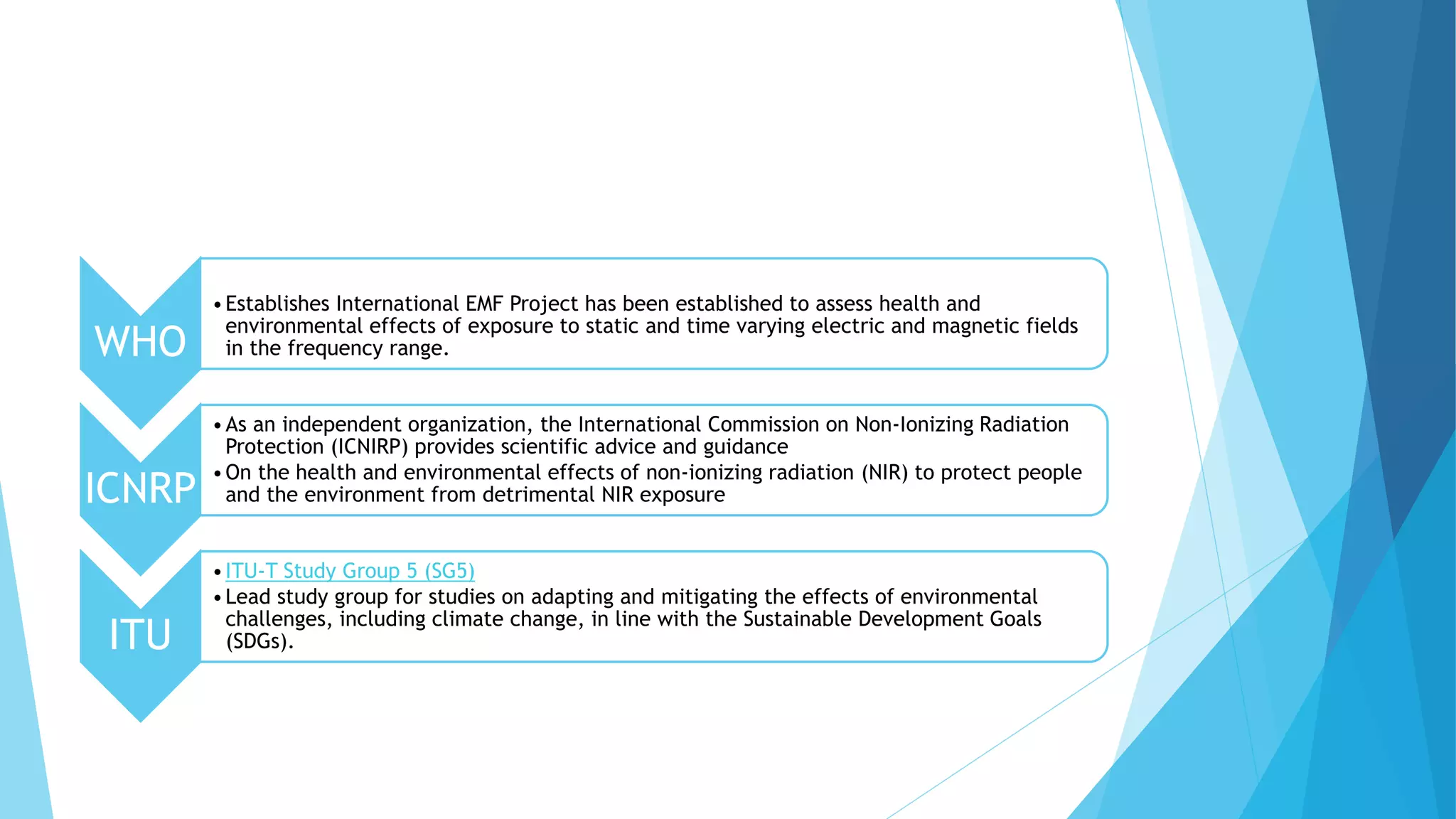
WHO
•Establishes International EMF Project has been established to assess health and
environmental effects of exposure to static and time varying electric and magnetic fields
in the frequency range.
ICNRP
•As an independent organization, the International Commission on Non-Ionizing Radiation
Protection (ICNIRP) provides scientific advice and guidance
•On the health and environmental effects of non-ionizing radiation (NIR) to protect people
and the environment from detrimental NIR exposure
ITU
•ITU-T Study Group 5 (SG5)
•Lead study group for studies on adapting and mitigating the effects of environmental
challenges, including climate change, in line with the Sustainable Development Goals
(SDGs).
Radio Signal and Health (EMF) Context
 An electromagnetic field consists of waves of electric and magnetic energy
moving together through space. Often the term "electromagnetic field" or
EMF is used to indicate the presence of electromagnetic radiation (ITU EMF
Guide, 2018).
 Wireless communications is integral to modern society and consumers are
always within arm’s reach of mobile phones, tablets and other wireless
devices.
 Base stations are being erected all the time, expanding our access to high-
quality wireless communications in both rural and urban areas.
Biological and health effects of EMF
 Biological effect is not the same as a health hazard.
 A biological effect only becomes a health hazard when it damages the health
of the individual or of his or her children.
 Experts urges that emissions from transmitters are weak and does not pose
health risk.
 However, an adverse health effect occurs when the biological effect is outside
the normal range for the body to compensate and which is detrimental to
health or well-being.
International Exposure limits
 National and International regulatory agencies or standards bodies promulgate the
EMF safety limits in line with ICNIRP limits (Appendix I)
 The standards are based on evaluations of biological effects that have been
established to have health consequences. (ITU EMF Guide)
 In general, standards for low frequency electromagnetic fields are set to avoid
adverse health effects due to induced electric currents within the body, while
standards for radiofrequency fields prevent health effects caused by localized or
whole body heating.
 Maximum exposure levels in everyday life are typically below guideline limits.
 Exposure guidelines are not intended to protect against electromagnetic
interference (EMI) with electro medical devices. New industry standards are being
developed to avoid such interference (Establishing A Dialogue on Risks From
Eletromagnetic Fields, 2002)
Compliance Management for Radio
Signals
 Wireless communication devices operating in the frequency range of 300 MHz
to 6 GHz, compliance with the ICNIRP safety limits apply the measurement
procedures.
 The following steps should be taken to achieve compliance:
 Identify appropriate compliance limits.
 Determine if EMF exposure assessment for the installation of equipment in
question is needed.
 If the EMF exposure assessment is needed, it may be performed by
calculations or measurement.
 If the EMF exposure assessment indicates that pertinent exposure limits may
be exceeded in areas where people may be present, mitigation/avoidance
measures should be applied.
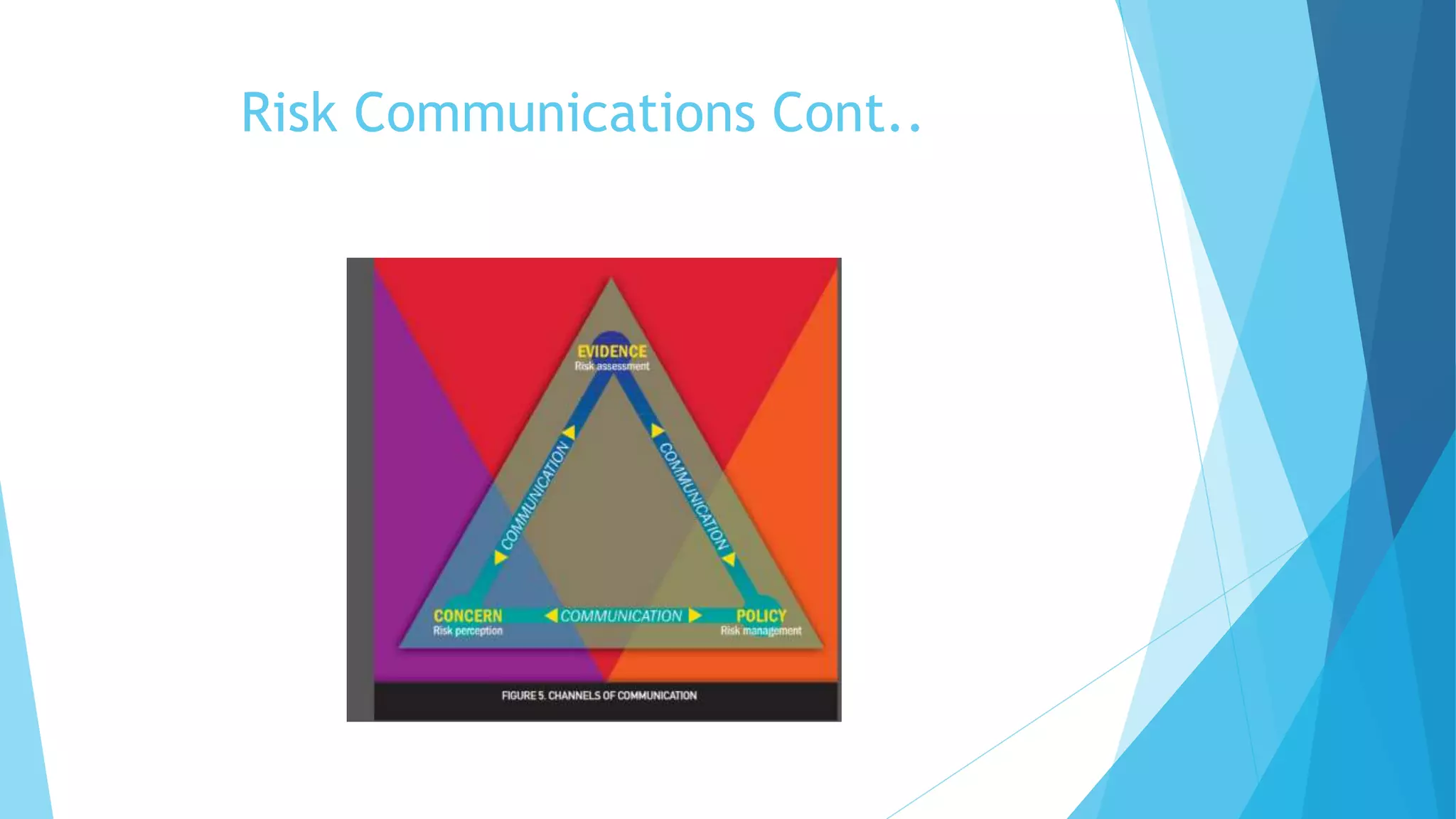
EMF Risk Communications
 Risk Communication: It is defined as interactive process of exchange of
information and opinion among individuals, groups and institutions. (GSMA
Risk Communications Guide, 2009).
 There are 6 key steps which cannot be exhausted in this exercise which are as
follows:
 Consider the Issues
 Identify your audiences
 Identify their concerns
 Develop a communications approach and methods
 Apply good practice risk communication methods
 Consider the Issues and Respond
Risk Communications Cont..
EMF SA– EMF Endocrine System in children
Adolescents Case Study
 Children are exposed to various kind of non-ionizan radiation in their daily life
involuntarily.
 In modern societies, children are being exposed to EMFs in very early ages..
 Although the international guidelines did not report definite, convincing data
about the causality.
 There are unignorable amount of studies indicating the increased risk of
cancer, hematologic effects and cognitive impairment.
 Although the results are conflicting and cannot be totally matched with
humans; there is growing evidence to distress us about the threats of EMF on
children. (EMFSA, Dec 2015)
Conclusion
 Thus far there is no scientific evidence to indicate cell phones towers
negatively affect human health.
 The World Health Organisation has categorically, with 20 years of study, there
is nothing yet that convinces experts that there are any adverse health
effects from electromagnetic frequency..
 Further investigations needs to be done to validate the uncertainty of
whether EMF poses health and biological risks.
 In South Africa, there is uncertainty as to whether the building of a signal
tower in the area could compromise residents' health.
 EMF is a topical issue to be further explored regarding the safety standards in
the telecoms sector.
References
GSMA (2009). Risk Communication Guide for Mobile Phones and Base Stations: Practical
guidance and support on good risk communications practice for the mobile industry. (2018).
Online). Accessed 29 June 2018.
ITU EMF Guide. (2017). Geneva. Accessed 22 June 2018. Retrieved from
http://emfguide.itu.int/emfguide.html
ITU. Guidance on complying with limits for human exposure to electromagnetic fields .
K.52 (12/2004) (2017). Geneva. Accessed 22 June 2018 http://emfguide.itu.int/pdfs/T-
REC-K.52-200412.pdf
WHO.(2002). Geneva. Establishing A Dialogue on Risks From Eletromagnetic Fields, 2002)
Accessed 29 June 2018.
EMFSA (2015). Cape Town. Accessed on 29 June 2018. Retrieved from
http://www.emfsa.co.za/research-and-studies/the-effects-of-electromagnetic-field-on-
the-endocrine-system-in-children-and-adolescents/
SABS (2018). Pretoria. Electronicmagnetic Interference & Compliance Certificate of
Compliance. Accessed on 29 June 2018. retrieved from
https://www.sabs.co.za/coc/docs/BrochureICASA_v6.pdf

RSH Final Project

  • 1.
    Radio Signal andHealth GSMA Capacity Building June 2018 Prepared by: Vusani Ramadzhia
  • 2.
    What are RadioSignals  GSMA defines Radio signals as part of everyday life, emitted both by natural sources like the sun, the Earth and the ionosphere, and by artificial sources such as:  Mobile phone base station;  Broadcast towers;  Radar facilities;  Remote controls; and  Electrical and Electronic equipment's”.
  • 3.
    WHO •Establishes International EMFProject has been established to assess health and environmental effects of exposure to static and time varying electric and magnetic fields in the frequency range. ICNRP •As an independent organization, the International Commission on Non-Ionizing Radiation Protection (ICNIRP) provides scientific advice and guidance •On the health and environmental effects of non-ionizing radiation (NIR) to protect people and the environment from detrimental NIR exposure ITU •ITU-T Study Group 5 (SG5) •Lead study group for studies on adapting and mitigating the effects of environmental challenges, including climate change, in line with the Sustainable Development Goals (SDGs).
  • 4.
    Radio Signal andHealth (EMF) Context  An electromagnetic field consists of waves of electric and magnetic energy moving together through space. Often the term "electromagnetic field" or EMF is used to indicate the presence of electromagnetic radiation (ITU EMF Guide, 2018).  Wireless communications is integral to modern society and consumers are always within arm’s reach of mobile phones, tablets and other wireless devices.  Base stations are being erected all the time, expanding our access to high- quality wireless communications in both rural and urban areas.
  • 5.
    Biological and healtheffects of EMF  Biological effect is not the same as a health hazard.  A biological effect only becomes a health hazard when it damages the health of the individual or of his or her children.  Experts urges that emissions from transmitters are weak and does not pose health risk.  However, an adverse health effect occurs when the biological effect is outside the normal range for the body to compensate and which is detrimental to health or well-being.
  • 6.
    International Exposure limits National and International regulatory agencies or standards bodies promulgate the EMF safety limits in line with ICNIRP limits (Appendix I)  The standards are based on evaluations of biological effects that have been established to have health consequences. (ITU EMF Guide)  In general, standards for low frequency electromagnetic fields are set to avoid adverse health effects due to induced electric currents within the body, while standards for radiofrequency fields prevent health effects caused by localized or whole body heating.  Maximum exposure levels in everyday life are typically below guideline limits.  Exposure guidelines are not intended to protect against electromagnetic interference (EMI) with electro medical devices. New industry standards are being developed to avoid such interference (Establishing A Dialogue on Risks From Eletromagnetic Fields, 2002)
  • 7.
    Compliance Management forRadio Signals  Wireless communication devices operating in the frequency range of 300 MHz to 6 GHz, compliance with the ICNIRP safety limits apply the measurement procedures.  The following steps should be taken to achieve compliance:  Identify appropriate compliance limits.  Determine if EMF exposure assessment for the installation of equipment in question is needed.  If the EMF exposure assessment is needed, it may be performed by calculations or measurement.  If the EMF exposure assessment indicates that pertinent exposure limits may be exceeded in areas where people may be present, mitigation/avoidance measures should be applied.
  • 8.
    EMF Risk Communications Risk Communication: It is defined as interactive process of exchange of information and opinion among individuals, groups and institutions. (GSMA Risk Communications Guide, 2009).  There are 6 key steps which cannot be exhausted in this exercise which are as follows:  Consider the Issues  Identify your audiences  Identify their concerns  Develop a communications approach and methods  Apply good practice risk communication methods  Consider the Issues and Respond
  • 9.
  • 10.
    EMF SA– EMFEndocrine System in children Adolescents Case Study  Children are exposed to various kind of non-ionizan radiation in their daily life involuntarily.  In modern societies, children are being exposed to EMFs in very early ages..  Although the international guidelines did not report definite, convincing data about the causality.  There are unignorable amount of studies indicating the increased risk of cancer, hematologic effects and cognitive impairment.  Although the results are conflicting and cannot be totally matched with humans; there is growing evidence to distress us about the threats of EMF on children. (EMFSA, Dec 2015)
  • 11.
    Conclusion  Thus farthere is no scientific evidence to indicate cell phones towers negatively affect human health.  The World Health Organisation has categorically, with 20 years of study, there is nothing yet that convinces experts that there are any adverse health effects from electromagnetic frequency..  Further investigations needs to be done to validate the uncertainty of whether EMF poses health and biological risks.  In South Africa, there is uncertainty as to whether the building of a signal tower in the area could compromise residents' health.  EMF is a topical issue to be further explored regarding the safety standards in the telecoms sector.
  • 12.
    References GSMA (2009). RiskCommunication Guide for Mobile Phones and Base Stations: Practical guidance and support on good risk communications practice for the mobile industry. (2018). Online). Accessed 29 June 2018. ITU EMF Guide. (2017). Geneva. Accessed 22 June 2018. Retrieved from http://emfguide.itu.int/emfguide.html ITU. Guidance on complying with limits for human exposure to electromagnetic fields . K.52 (12/2004) (2017). Geneva. Accessed 22 June 2018 http://emfguide.itu.int/pdfs/T- REC-K.52-200412.pdf WHO.(2002). Geneva. Establishing A Dialogue on Risks From Eletromagnetic Fields, 2002) Accessed 29 June 2018. EMFSA (2015). Cape Town. Accessed on 29 June 2018. Retrieved from http://www.emfsa.co.za/research-and-studies/the-effects-of-electromagnetic-field-on- the-endocrine-system-in-children-and-adolescents/ SABS (2018). Pretoria. Electronicmagnetic Interference & Compliance Certificate of Compliance. Accessed on 29 June 2018. retrieved from https://www.sabs.co.za/coc/docs/BrochureICASA_v6.pdf