Design Optimization in HelioScope
October, 2015
1
Agenda
•  Design Optimization: Integrating modeling and design
•  HelioScope Design Decisions in Practice
•  HelioScope Development Roadmap
2
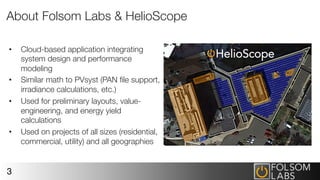
About Folsom Labs & HelioScope
3
•  Cloud-based application integrating
system design and performance
modeling
•  Similar math to PVsyst (PAN file support,
irradiance calculations, etc.)
•  Used for preliminary layouts, value-
engineering, and energy yield
calculations
•  Used on projects of all sizes (residential,
commercial, utility) and all geographies
Design Optimization:
Integrating performance modeling and system
design
4
Why Design Optimization?
5
Automatic Bill of Materials
Bankable Energy Yield
CAD Layout
Design Render Image
Automatic Engineering Calculations
Technical hurdles to optimization tools
•  Performance:
–  Single Diode Model
–  Advanced layout engine
•  Modeling
–  Incorporate Project Financials
•  Product
–  Stepwise vs. Black Box Modeling
6
Obstruction Shade Optimization
7
Heatmap of annual
shading losses for
each module
Winter solstice 10am-2pm
shading removed
Shade losses
calculated based on
hourly weather file
and shade patterns
Financial Results (Row Spacing)
8
Range of Row Spacing
Financial
metrics,
including
LCOE, NPV,
ROI, IRR
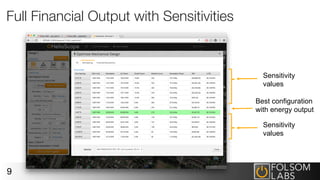
Full Financial Output with Sensitivities
9
Best configuration
with energy output
Sensitivity
values
Sensitivity
values
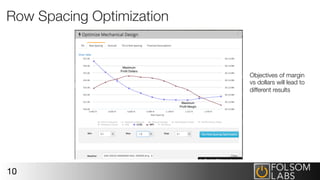
Row Spacing Optimization
10
Objectives of margin
vs dollars will lead to
different results
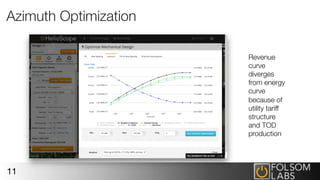
Azimuth Optimization
11
Revenue
curve
diverges
from energy
curve
because of
utility tariff
structure
and TOD
production
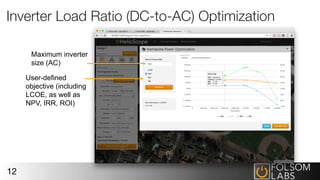
Inverter Load Ratio (DC-to-AC) Optimization
12
User-defined
objective (including
LCOE, as well as
NPV, IRR, ROI)
Maximum inverter
size (AC)
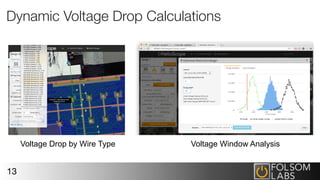
Dynamic Voltage Drop Calculations
13
Voltage Drop by Wire Type Voltage Window Analysis
Design Research Results
14
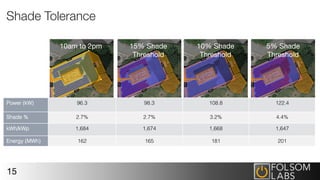
Shade Tolerance
15
10am to 2pm
 15% Shade
Threshold
10% Shade
Threshold
5% Shade
Threshold
Power (kW)! 96.3! 98.3! 108.8! 122.4!
Shade %! 2.7%! 2.7%! 3.2%! 4.4%!
kWh/kWp! 1,684! 1,674! 1,668! 1,647!
Energy (MWh)! 162! 165! 181! 201!
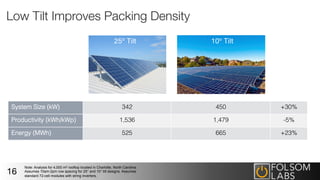
Low Tilt Improves Packing Density
16
25º Tilt
 10º Tilt
System Size (kW)! 342! 450! +30%!
Productivity (kWh/kWp)! 1,536! 1,479! -5%!
Energy (MWh)! 525! 665! +23%!
Note: Analysis for 4,000 m2 rooftop located in Charlotte, North Carolina.
Assumes 10am-2pm row spacing for 25° and 10° tilt designs. Assumes
standard 72-cell modules with string inverters.
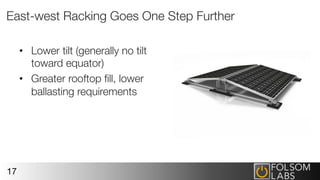
East-west Racking Goes One Step Further
•  Lower tilt (generally no tilt
toward equator)
•  Greater rooftop fill, lower
ballasting requirements
17
Drive toward Low Tilt (and Greater Density) Leads to East-West
18
25º Tilt
 10º Tilt
 Dual Tilt
Coming soon in 
Note: Analysis for 43,000 ft2 rooftop located in Charlotte, North Carolina.
Assumes 10am-2pm row spacing for 25° and 10° tilt designs, and assumes 10°
tilt for east-west design. Assumes standard 72-cell modules with string inverters.
System Size (kW)! 342! 450! 540!
Productivity!
(kWh/kWp)!
1,536! 1,479! 1,363!
Energy (MWh)! 525! 665! 736!
Azimuth Optimization
19
180º Azimuth! 198º Azimuth! Diff!
System Size! 115 kW! 123 kW! +6.5%!
Productivity! 1,251 kWh/kWp! 1,236 kWh/kWp! -1.2%!
Energy! 144 MWh! 152 MWh! +5.2%!
Note: Analysis for 21,000 ft2 rooftop located in Rochester, NY. Assumes 15°
module tilt and 3’ row spacing. Assumes standard 72-cell modules with string
inverters.
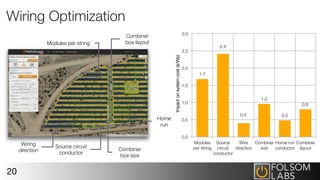
Wiring Optimization
20
Modules per string
Combiner
box size
Source circuit
conductor
Combiner
box layout
Wiring
direction
Home
run
1.7
2.4
0.4
1.0
0.5
0.8
0.0
0.5
1.0
1.5
2.0
2.5
3.0
Modules
per string
Source
circuit
conductor
Wire
direction
Combiner
size
Home run
conductor
Combiner
layout
Impactonsystemcost(¢/Wp)
Additional Resources
21
http://www.folsomlabs.com/resources
Voltage Drop Article
Shading Optimization
Article
Module Binning Cost/
Benefit
 String Inverter Energy
Yield Analysis
 Wiring Optimization
Case Study
HelioScope Update
22
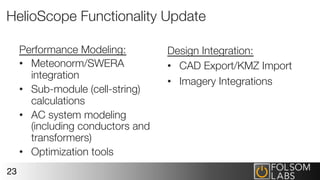
HelioScope Functionality Update
Performance Modeling:
•  Meteonorm/SWERA
integration
•  Sub-module (cell-string)
calculations
•  AC system modeling
(including conductors and
transformers)
•  Optimization tools
23
Design Integration:
•  CAD Export/KMZ Import
•  Imagery Integrations
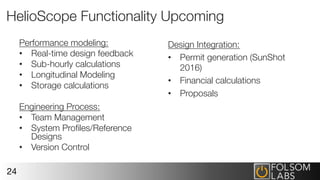
HelioScope Functionality Upcoming
Performance modeling:
•  Real-time design feedback
•  Sub-hourly calculations
•  Longitudinal Modeling
•  Storage calculations
Engineering Process:
•  Team Management
•  System Profiles/Reference
Designs
•  Version Control
24
Design Integration:
•  Permit generation (SunShot
2016)
•  Financial calculations
•  Proposals
Questions and Comments?
Contact Us:
Paul Gibbs
paul.gibbs@folsomlabs.com

Folsom Labs
San Francisco, CA

25
Hundreds of Customers, Large and Small, use HelioScope
26

54 paul gibbs_helioscope

  • 1.
    Design Optimization inHelioScope October, 2015 1
  • 2.
    Agenda •  Design Optimization:Integrating modeling and design •  HelioScope Design Decisions in Practice •  HelioScope Development Roadmap 2
  • 3.
    About Folsom Labs& HelioScope 3 •  Cloud-based application integrating system design and performance modeling •  Similar math to PVsyst (PAN file support, irradiance calculations, etc.) •  Used for preliminary layouts, value- engineering, and energy yield calculations •  Used on projects of all sizes (residential, commercial, utility) and all geographies
  • 4.
  • 5.
    Why Design Optimization? 5 AutomaticBill of Materials Bankable Energy Yield CAD Layout Design Render Image Automatic Engineering Calculations
  • 6.
    Technical hurdles tooptimization tools •  Performance: –  Single Diode Model –  Advanced layout engine •  Modeling –  Incorporate Project Financials •  Product –  Stepwise vs. Black Box Modeling 6
  • 7.
    Obstruction Shade Optimization 7 Heatmapof annual shading losses for each module Winter solstice 10am-2pm shading removed Shade losses calculated based on hourly weather file and shade patterns
  • 8.
    Financial Results (RowSpacing) 8 Range of Row Spacing Financial metrics, including LCOE, NPV, ROI, IRR
  • 9.
    Full Financial Outputwith Sensitivities 9 Best configuration with energy output Sensitivity values Sensitivity values
  • 10.
    Row Spacing Optimization 10 Objectivesof margin vs dollars will lead to different results
  • 11.
  • 12.
    Inverter Load Ratio(DC-to-AC) Optimization 12 User-defined objective (including LCOE, as well as NPV, IRR, ROI) Maximum inverter size (AC)
  • 13.
    Dynamic Voltage DropCalculations 13 Voltage Drop by Wire Type Voltage Window Analysis
  • 14.
  • 15.
    Shade Tolerance 15 10am to2pm 15% Shade Threshold 10% Shade Threshold 5% Shade Threshold Power (kW)! 96.3! 98.3! 108.8! 122.4! Shade %! 2.7%! 2.7%! 3.2%! 4.4%! kWh/kWp! 1,684! 1,674! 1,668! 1,647! Energy (MWh)! 162! 165! 181! 201!
  • 16.
    Low Tilt ImprovesPacking Density 16 25º Tilt 10º Tilt System Size (kW)! 342! 450! +30%! Productivity (kWh/kWp)! 1,536! 1,479! -5%! Energy (MWh)! 525! 665! +23%! Note: Analysis for 4,000 m2 rooftop located in Charlotte, North Carolina. Assumes 10am-2pm row spacing for 25° and 10° tilt designs. Assumes standard 72-cell modules with string inverters.
  • 17.
    East-west Racking GoesOne Step Further •  Lower tilt (generally no tilt toward equator) •  Greater rooftop fill, lower ballasting requirements 17
  • 18.
    Drive toward LowTilt (and Greater Density) Leads to East-West 18 25º Tilt 10º Tilt Dual Tilt Coming soon in Note: Analysis for 43,000 ft2 rooftop located in Charlotte, North Carolina. Assumes 10am-2pm row spacing for 25° and 10° tilt designs, and assumes 10° tilt for east-west design. Assumes standard 72-cell modules with string inverters. System Size (kW)! 342! 450! 540! Productivity! (kWh/kWp)! 1,536! 1,479! 1,363! Energy (MWh)! 525! 665! 736!
  • 19.
    Azimuth Optimization 19 180º Azimuth!198º Azimuth! Diff! System Size! 115 kW! 123 kW! +6.5%! Productivity! 1,251 kWh/kWp! 1,236 kWh/kWp! -1.2%! Energy! 144 MWh! 152 MWh! +5.2%! Note: Analysis for 21,000 ft2 rooftop located in Rochester, NY. Assumes 15° module tilt and 3’ row spacing. Assumes standard 72-cell modules with string inverters.
  • 20.
    Wiring Optimization 20 Modules perstring Combiner box size Source circuit conductor Combiner box layout Wiring direction Home run 1.7 2.4 0.4 1.0 0.5 0.8 0.0 0.5 1.0 1.5 2.0 2.5 3.0 Modules per string Source circuit conductor Wire direction Combiner size Home run conductor Combiner layout Impactonsystemcost(¢/Wp)
  • 21.
    Additional Resources 21 http://www.folsomlabs.com/resources Voltage DropArticle Shading Optimization Article Module Binning Cost/ Benefit String Inverter Energy Yield Analysis Wiring Optimization Case Study
  • 22.
  • 23.
    HelioScope Functionality Update PerformanceModeling: •  Meteonorm/SWERA integration •  Sub-module (cell-string) calculations •  AC system modeling (including conductors and transformers) •  Optimization tools 23 Design Integration: •  CAD Export/KMZ Import •  Imagery Integrations
  • 24.
    HelioScope Functionality Upcoming Performancemodeling: •  Real-time design feedback •  Sub-hourly calculations •  Longitudinal Modeling •  Storage calculations Engineering Process: •  Team Management •  System Profiles/Reference Designs •  Version Control 24 Design Integration: •  Permit generation (SunShot 2016) •  Financial calculations •  Proposals
  • 25.
    Questions and Comments? ContactUs: Paul Gibbs paul.gibbs@folsomlabs.com Folsom Labs San Francisco, CA 25
  • 26.
    Hundreds of Customers,Large and Small, use HelioScope 26